For twenty years, no one in the Herrera mansion ever used the woman’s full name.
To them, she wasn’t really seen as a person.
She was “the housekeeper.”
She arrived before sunrise in Polanco, wearing a faded gray uniform and worn shoes, her black hair threaded with gray, always tied back with the same old band. She worked in silence. Eyes lowered. No opinions. No presence.
Doña Carmen.
That’s what they called her… when they remembered.
“Move faster,” Laura Herrera, the millionaire’s youngest daughter, snapped. “The floor is still dirty.”
Carmen nodded. Always.
In that house, she learned two rules quickly:
Talking was risky.
Obedience made you unnoticed.
Don Ernesto Herrera, a real estate tycoon worth millions, barely acknowledged her. To him, Carmen was part of the household: necessary, replaceable, unimportant.
His wife, Doña Beatriz, treated her with a cold politeness that somehow felt worse than shouting.
“Have the cleaning staff make coffee,” she’d say. “And don’t let her make noise.”
The children were worse.
Laura mocked her openly.
Sebastián, the oldest son, acted as if she wasn’t there.
Mariana, the daughter-in-law, left dirty dishes on purpose to “remind her of her place.”
For twenty years, Carmen cleaned up other people’s tears. Secrets spilled in glasses. Family arguments she was never supposed to hear.
And she never said a word.
Because Carmen had something stronger than pride.
Patience.
Then one rainy dawn… Don Ernesto died.
A heart attack in his office. Contracts scattered across the desk. The news rattled the Herrera family.
But not Carmen.
She kept cleaning.
While the mansion filled with expensive flowers, lawyers, and relatives who suddenly “cared,” Carmen swept fallen petals off the marble as if nothing had changed.
“After the funeral, she’s out,” Laura whispered to her mother. “We don’t need her anymore.”
Carmen heard it.
Of course she did.
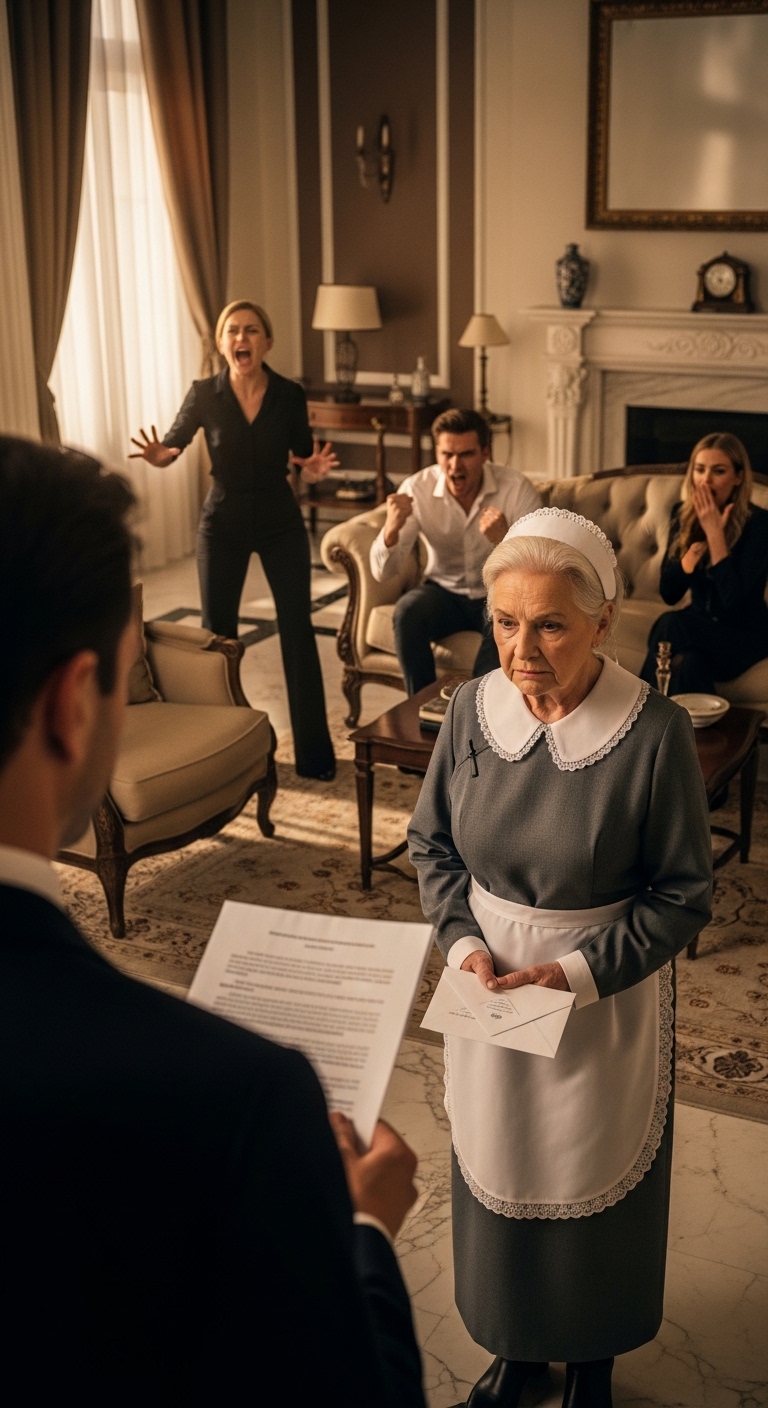
On the day the will was read, the family gathered in the main living room: leather sofas, priceless paintings, a marble table polished until it looked like glass.
Carmen was about to slip away like she always did… until the lawyer looked up.
“Mrs. Carmen López…” he read.
The silence that followed felt heavy.
“What did you say?” Laura laughed, sharp and insulting. “The housekeeper?”
“The late Mr. Ernesto Herrera specifically requested she be present,” the lawyer replied, expression neutral.
Carmen stood with her hands folded. Uniform spotless. Eyes steady.
No one offered her a seat.
The lawyer started with what everyone expected: properties, accounts, company holdings.
All going to the Herreras.
Smiles began to appear.
Then the lawyer paused.
“Now I will read a special clause.”
Laura shifted, impatient. “Finally.”
The lawyer read slowly:
“To the woman who cared for my home for twenty years…”
Laura laughed out loud. “This is ridiculous.”
“…I leave my Valle de Bravo vacation home, 30% of Herrera Group shares, and all documents stored in Safe Deposit Box Number Three.”
The room went quiet.
“WHAT?!” Laura stood up, stunned. “That can’t be right!”
Doña Beatriz went pale.
Sebastián’s hands tightened.
Mariana’s smile vanished.
Carmen didn’t react.
And then the lawyer added the part that made everyone fall silent:
“Additionally,” he said, turning the page, “Mr. Herrera included instructions that must be followed immediately, before any assets are distributed.”
Laura’s voice shook. “What instructions?”
The lawyer raised his eyes.
“Mrs. Carmen López is not only a beneficiary,” he said evenly. “She is also the person authorized to release what’s inside Box Three.”
And whatever was in that box…
Was about to reveal a truth the Herrera family had spent decades keeping hidden.
The Herrera living room feels heavier than its marble floors the moment the lawyer clears his throat. Everyone is dressed in immaculate black, seated like they own grief itself—already sorting a life into piles they believe belong to them.
You stand by the doorway with your hands folded, the way years of training taught you to take up as little space as possible. Then the lawyer looks up and says your name—fully, carefully, unmistakably—as if the house must finally admit you are real.
Laura’s laughter flickers, quick and sharp, like she’s about to brush the moment aside. You don’t flinch. In rooms like this, even a small movement can be turned against you.
“Mrs. Carmen López.”
With those two words, the mansion is forced to recognize the person it spent two decades overlooking.
Twenty Years of Being Treated Like Background Noise
You have been walking into this home since before the children became polished adults with practiced smiles. You arrived before sunrise, when the neighborhood still pretended to sleep. Your uniform was always the same muted gray—useful, unnoticed, easy to ignore.
You scrubbed banisters until your palms burned because the Herreras loved everything to shine. You kept your eyes down not from embarrassment, but because you learned early that powerful people dislike being observed too closely.
At first, patience felt like a punishment you simply endured. Later, you realized it could also become a tool—quiet, steady, and sharp when used at the right moment.
- Laura called you “the cleaning woman,” as if a name was too much respect.
- Sebastián perfected a colder cruelty: pretending you weren’t there at all.
- Mariana tested you with small humiliations, leaving messes like traps.
- Doña Beatriz spoke politely, but never warmly—like kindness performed behind glass.
- Don Ernesto looked through you the way people look at furniture they didn’t choose.
You cleaned up after their arguments, their celebrations, their careless spills—while they assumed silence meant you heard nothing.
The Man Behind the Empire
Over time, you began to understand the truth that didn’t fit their expensive image: Don Ernesto was not only wealthy—he was profoundly alone. He built a kingdom, bought land, collected status, yet his home still sounded empty at night.
Sometimes you saw him in the library long after midnight, turning a glass in his hand without drinking. Sometimes you noticed him touch his chest briefly, as if checking whether his body still wanted to keep going.
His children spoke to him with a kind of transactional affection, as though the word “Papá” meant “access.” His wife remained beside him with perfect posture, like a portrait trained to breathe.
He had everything—except the kind of peace money can’t purchase.
The Night Everything Shifted
A storm arrived one evening, and the mansion sounded different under the rain—like it was holding its breath. You finished in the kitchen and noticed a thin line of light beneath the study door, too late for anyone to be working.
You knocked. No answer. Only a sound that didn’t belong.
Inside, you found Don Ernesto slumped in his chair with scattered pills and an overturned bottle. You didn’t panic. You didn’t waste time. You called emergency services and stayed close, holding his hand and speaking to him like he was a person—not a title.
- You acted quickly instead of freezing.
- You stayed steady when others might have looked away.
- You insisted—without raising your voice—that dignity mattered.
He survived. And survival demanded the kind of honesty his family avoided.
A Private Promise, a Dangerous Envelope
Not long after, Don Ernesto called you into the study. You expected blame—because in that house, being summoned usually meant becoming the target of someone’s mood.
Instead, he asked a question that changed the air between you: why did you save him?
You told him the truth: you refused to leave anyone to face the end alone.
He said your name—Carmen—not “woman,” not “help,” not “the cleaning lady.” Just Carmen. And that simple act of recognition felt more unsettling than any insult, because it rearranged the rules.
After that, he began leaving things where only you would find them: documents, ledgers, notes. Not gifts—tests. You didn’t rush to benefit. You didn’t grab at crumbs and call it a meal.
“When I’m gone,” he warned, “they’ll try to erase you. Don’t let them.”
Before his health truly faded, he handed you a sealed envelope and told you to keep it safe. He promised the lawyer would speak your name when the time came.
His Death—and Their Immediate Calculations
The morning Don Ernesto died, the rain returned as if the sky had learned the family’s taste for drama. You found him seated peacefully at his desk, finally still.
The Herreras arrived in a rush of perfume and phone calls. Laura wept loudly but never reached for her father’s hand. Sebastián watched the desk drawers more closely than the man. Doña Beatriz stayed composed, though her attention kept drifting to the safe hidden behind a painting.
After the funeral, the mansion filled with flowers and sympathetic strangers. You kept working—partly from habit, partly because staying busy kept your thoughts from unraveling.
- You overheard plans to dismiss you once the mourning “ended.”
- You felt the cold certainty of being treated as disposable—again.
- You kept quiet, because your safety depended on timing.
The envelope in your bag felt heavier than fear.
The Will Reading: When the Room Turned Toward You
On the day the will was read, you wore your usual uniform—freshly washed, sharply ironed—because neatness was the only armor the house ever allowed you.
The lawyer began with what everyone expected: properties, accounts, shares. The family relaxed as each line confirmed their sense of entitlement.
You stood near the doorway. No one offered you a chair. Your feet ached, but the ache kept you anchored.
Then the lawyer paused and turned a page. The soft hiss of paper sounded like a warning.
His eyes found you—not as an object in the room, but as the person the document was addressing.
“Mrs. Carmen López.”
Laura gave a small laugh as if this were entertainment. Sebastián wanted the “money part.” Doña Beatriz watched with controlled impatience.
The lawyer read the clause that snapped their reality in half: a house in Valle de Bravo, thirty percent of Grupo Herrera shares, and full control of Safe Box Number Three.
Outrage, Accusations—and a Letter That Changed the Stakes
For a moment, no one spoke. Then anger poured out of Laura like smoke from a struck match. She hurled insults she’d likely practiced for years. Sebastián demanded documents. Doña Beatriz insisted her husband wasn’t thinking clearly.
The lawyer, calm and unmovable, presented notarized proof and medical confirmation that Don Ernesto had been fully competent when he made the decision.
Then he added there was more: a personal letter to be read aloud.
Don Ernesto’s words were not written to comfort them. They were written to tell the truth he had avoided for too long. He admitted he had lived behind performance—good father, good husband, good leader—until it hollowed him out.
He named you as the only person who treated him like a human being when he was at his lowest.
- Safe Box Three contained evidence of financial wrongdoing.
- It documented betrayals inside the family itself.
- It gave you the authority to decide what happened next.
The folder closed with a quiet finality, like a lock clicking into place.
When They Tried to Pressure You—and You Didn’t Move
Laura surged toward you, as if getting closer could change the law. Sebastián tried to intimidate the lawyer. Doña Beatriz’s polite mask thinned into something colder.
You felt fear—because you were still a person, not a movie character. But you also remembered every night you had listened, every detail you had written down, every precaution you had taken.
You lifted your chin. The motion felt unfamiliar, like waking a muscle long forgotten.
“I cleaned,” you said calmly. “I cleaned what you kept spilling.”
You opened your bag and pulled out an envelope—not Don Ernesto’s, but your own. You laid its contents on the marble table with careful, steady hands.
There were copies of transfers, mismatched signatures, printed emails, questionable “consulting” receipts, and a notarized statement from a former accountant who chose honesty over comfort.
You didn’t shout. You didn’t insult them back.
You simply made the boundary clear: if they tried to harm or threaten you, the evidence would go to authorities and the press.
- Laura’s tone shifted from rage to shaky sweetness.
- Sebastián tried to buy your silence with a number he believed could hypnotize anyone.
- Doña Beatriz offered to “take care of you,” a phrase that sounded more like control than kindness.
You gathered the papers back up. You didn’t come for bargains. You came for the right to decide your next step without fear.
Consequences Arrive—Quietly, Then All at Once
The fallout didn’t come as a single dramatic moment. It arrived as a series of steady collapses: investigations, nervous investors, former employees finally speaking because they realized someone might actually listen.
Headlines spread fast once the first secret slipped out.
Sebastián’s name appeared beside allegations of bribery and falsified records. Laura tried to outrun the consequences with travel plans and excuses. Doña Beatriz retreated from public view, claiming poor health.
Power doesn’t disappear because you deserve it—it disappears when silence ends.
At night, you watched the news from your small rented room with a cup of coffee, realizing Don Ernesto hadn’t only left you assets. He had left you leverage—the one thing that makes untouchable people finally pay attention.
Inside Safe Box Three: Truth in Black and White
When you finally opened Safe Box Three, cold metal and paper greeted you like a different kind of reality. Inside were neatly labeled folders, recordings, and letters that read like confessions—and warnings.
You found proof of hidden accounts and schemes designed to avoid oversight. You found documents tying Laura to money moved through fake vendors. You found evidence connecting Sebastián to decisions that harmed others—disguised as “unavoidable circumstances.”
You found Doña Beatriz’s signatures, too—confirmation that she had known far more than she ever admitted.
Among all of it was a letter addressed to you. Don Ernesto thanked you for saving him when he didn’t feel worthy of saving. He didn’t ask you to destroy the world out of anger.
He asked you to “clean” what needed cleaning—thoroughly, and without letting the stains remain.
A New Life Built With Care, Not Revenge
You sold your shares slowly and cautiously, aware that sudden money attracts people who want to take control. You hired professionals who spoke to you with respect, not surprise. You paid off debts. You bought a modest apartment—one that belonged to you, with windows facing the street.
And you chose to turn the ending into something larger than personal victory.
- You supported a shelter for women rebuilding their lives after unsafe homes.
- You helped fund scholarships for domestic workers’ children.
- You created workshops on contracts, workplace rights, and documenting exploitation.
You named your foundation “The Invisibles”—because you were done pretending unseen people don’t shape the world.
Closing the Door for Good
On your final day in the Herrera mansion, you returned alone. Not out of nostalgia, but because you believed in finishing things properly.
The rooms echoed now, furniture draped in covers, the silence revealing what the house had always been: used, not loved.
You stepped into the study and placed a small bouquet on the desk—simple flowers, honest ones. You didn’t rewrite Don Ernesto as a hero. He had benefited from a system that treated you as replaceable.
But you allowed one truth to stand: at the end, he chose to see you.
You turned off the light and closed the door gently—because gentleness can be control, not weakness.
Conclusion
This story was never about a miracle or a single document. It was about years of listening, learning, and surviving with your eyes open. The Herreras believed power made them untouchable, but their real protection was everyone else’s silence. Once silence ended, consequences had room to breathe. And the woman they ignored for twenty years didn’t need to become cruel to win—she only needed to become visible.