The takeover started at 7:00 AM while I was still eating buttered toast. There was no knock—just the sharp slam of a car door and the crunch of pricey leather shoes on my gravel driveway. My brother, Evan, stormed into my kitchen like he owned the house, wearing a navy suit that cost more than my tractor, with my mother following behind him like a buzzard waiting for a meal.
He didn’t say hi. He simply dropped a thick stack of legal papers onto my oak table. “It’s over, Daisy,” he declared in his courtroom voice—polished, smug, and completely lacking compassion. He said I was being evicted in thirty days. He called it a “mercy shutdown.” According to him, my farm was a catastrophe, an embarrassing stain on the family name, and I was a thirty-four-year-old disappointment playing in the dirt who needed a “hard reset.”
I looked down at the documents. It was a foreclosure notice based on a $750,000 debt he insisted I owed the family trust. And there, at the bottom, was my signature. A flawless fake, digitally pulled from an old employee handbook I’d signed years ago. I felt the cold, razor-sharp clarity of a trap snapping shut. They had rewritten my past, painting me as unstable and broke to justify taking my land. They stared at my dusty greenhouses and rusted shipping containers and saw nothing but failure.
They didn’t know that inside those “rusted boxes” was a sterile, cutting-edge hydroponic facility bringing in millions in annual revenue. They didn’t know I was the exclusive supplier of rare micro-greens for the most upscale hospitality group on the East Coast. I’d spent six years hiding my wins, living like I had nothing to protect my work from their greed. I let them assume I was broke because silence was my armor.
But that Friday morning, the armor came off.
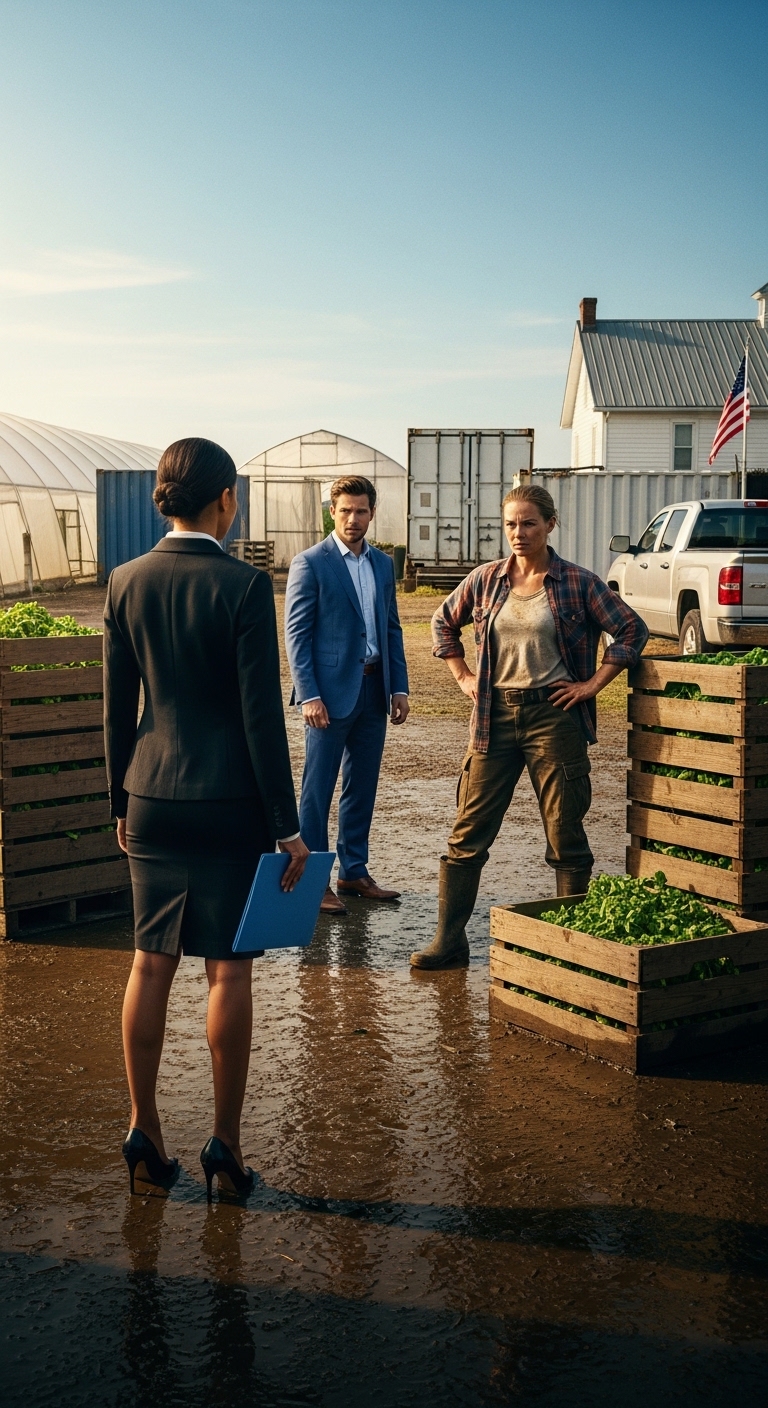
Evan brought the county assessor, a rigid official named Caleb, to price the land for the auction. Evan was parading around the yard, sneering at my “plastic tunnels” and pushing Caleb to write it all off as junk so he could sell the property fast. He was so busy boasting, so busy acting like the generous patriarch saving his pitiful sister, that he didn’t hear the low hum of a powerful engine coming closer.
A black SUV, polished to a mirror shine, turned off the main road. It skipped the visitor parking and rolled straight up to the loading ramp, blocking Evan’s path and stealing the sunlight. The engine shut off. The driver’s door opened, and a woman stepped out. She wore a tailored charcoal suit and stilettos that clicked on the metal ramp like a judge’s gavel. She didn’t look at the mud. She didn’t look at the farm. She looked straight at my brother with the eyes of a hunter who’d just spotted prey.
The county assessor went still, his face draining of color. He dropped his clipboard. He didn’t just recognize her—he was scared of her. My brother, clueless that he was standing on a landmine, puffed up his chest and demanded to know who she was. He had no idea the woman walking toward us wasn’t just my client—she was the proof that was about to ruin his entire life.
The Unexpected Visit
Driving three hours to my farm, my brother slapped a court order on my dinner table as if it were a death sentence. He declared I owed the family and would face eviction in thirty days. Standing impassively behind him was my mother, her demeanor icy as ever. However, at 9:00 AM, just as the county assessor arrived, a black SUV entered the drive. A woman stepped out, locking eyes with me, making the assessor freeze.
“Wait,” he said. “She is my client.”
My name is Daisy Martin, and I was three bites into my breakfast when the invasion commenced. Typically, my kitchen was a haven of tranquility each morning at 7:00 AM. The only sounds were the hum of our refrigerator and the gentle whistling of the wind over the valley. That morning, however, the silence shattered not with a knock but with the loud, jarring thud of a car door slamming and the crunch of polished shoes on gravel.
I did not need to peek through the window to identify the intruders; their forceful footsteps were enough of an indication. They waltzed straight through the open front door, disregarding the usual niceties of knocking. To them, this space was merely a holding cell they had generously permitted me to inhabit.
Evan, my brother, entered first, clad in a navy blue suit that likely cost more than my pickup truck. His tie was meticulously knotted, suggesting he had adhered to a strict grooming regimen in front of the mirror rather than going through his case files. Following closely was my mother, Diane, her signature expression a portrait of long-suffering martyrdom, tightly clutching a designer handbag as though afraid it might absorb any undesirable elements from my home. Like a vulture in its waiting posture, Aunt Gloria trailed behind, ready to witness the brutality unfold.
They offered no greeting. There was no inquiry about my well-being. Instead, Evan trampled right over to the heavy oak table where I sat, retrieved a substantial batch of stapled documents from his briefcase, and dropped them before me. The noise resonated like a gavel strike.
“It is over, Daisy,” Evan declared. His voice held a practiced smoothness—that courtroom cadence he wielded to intimidate defendants into favorable deals. “We are finished waiting.”
I glanced at the documents. Though the bold text on top was inverted from my viewpoint, I could decipher the legalese well enough: _Notice of Foreclosure, Seizure of Assets, Motion to Liquidate._ Taking another bite of toast, I chewed slowly before eventually chewing through the tension that hung in the air.
“Good morning to you too, Evan. Mom, Gloria, would any of you like coffee?”
“Stop playing the victim,” Evan snapped, his facade of professionalism cracking ever so slightly. He drew out a chair and sat across from me, invading my personal space. “This failing farm is slated for auction to clear the family debt. You have secluded yourself here as a farmer for the past six years, draining resources and contributing nothing. You have evaded reality long enough.”
My mother advanced, refusing to sit. She gazed out the window at the yard with disdain. “We are doing this for your sake, Daisy,” she stated, her voice devoid of maternal warmth. It sounded like a disappointed investor writing off losses. “You are thirty-four years old. You are shackled to a business that does not work. Only when you lose everything will you learn to grow up. You need a drastic change.”
“A drastic change?” I echoed, my tone flat. “Is that what we’re calling it?”
“We are calling it a mercy killing,” Evan replied, tapping a well-manicured finger on the document stack. “I have filed the motion. The court has approved a preliminary review based on the outstanding obligations you owe to the estate.”
I placed my toast down, my appetite evaporating, replaced by chilling clarity. “What obligations? I purchased this land with money my Dad gave me. The deed is in my name. I have never solicited funds from you.”
“Dad gave you a loan,” Evan corrected, narrowing his eyes. “A loan from the family trust—a loan you have never repaid. Given your lack of liquidity and the evident condition of this place, we are calling in the collateral.”
“I never signed any loan agreement,” I asserted, maintaining a steady tone, yet my heart raced with adrenaline—the realization that the trap was indeed closing in. I had anticipated this day, sensing its approach for months. “Dad provided me that seed money as a gift. He instructed me to create something of worth.”
“Dad was soft,” Evan sneered. “And he is no longer here to shield you from the harsh realities of life.” Flipping to the third page of the document, he presented it so I could see. “And as for not signing anything, it seems your memory is as unreliable as your business acumen.”
Glancing down, I noticed my name at the bottom of a document labeled _Acknowledgement of Family Debt and Collateral Agreement_. It was indeed my signature, but as I leaned closer to inspect the ink, I detected subtle artifacting along the edges of the lines. It was well-executed forgery, but I could tell—having spent years scrutinizing minor details in agriculture—this was not how I wrote my name.
“How fascinating,” I remarked, looking up at him, curiosity piqued. “Where did you come across this?”
“In the files,” Evan replied too hastily, adjusting his cuffs nervously. “You signed it five years ago during the cash injection for the irrigation repairs. Don’t insult my intelligence by claiming you forgot.”
“I understand,” I said, aware of my own prudence. I did not object, nor did I shout about the suspicious circumstances surrounding the document’s creation. I simply nodded, resigned. “So, it’s settled. You’re taking the farm.”
“The county assessor arrives on Friday,” Evan announced, sensing triumph in my silence. He reclined back, adjusting his cufflinks. “At 9:00 AM. He will assess both the land and the buildings. Once the base value is established, we shall auction it off within thirty days. Potential buyers are already lined up, ready to demolish this junk, but that is immaterial.”
“Friday,” I reiterated. “At 9:00 AM.”
“Yes,” Evan confirmed. “And don’t attempt anything foolish, Daisy. No locking gates, no hiding assets. Caleb Mercer is a serious man. He lacks patience for games, and so do I.”
“Gloria,” my mother instructed, turning to my aunt. “You heard that. She has been served.”
Aunt Gloria nodded affirmatively, clutching her purse, her eyes wide. “I heard it, Diane. Poor thing. It’s for the best, really.”
I rose, my sudden movement causing Evan to flinch. Making my way to the coffee pot, I poured the remaining contents down the sink. “Fine,” I declared, rotating toward them. “So, Friday at 9:00.”
Evan blinked, evidently dissatisfied with the absence of theatrics. He desired tears; he wanted pleas. He wished to portray himself as the benevolent patriarch, extending my stay before casting me into the cold. My acceptance ruined his climax.
“You’re handling this better than I anticipated,” he remarked, scrutinizing my expression for any sign of weakness.
“What choice do I have?” I replied, leaning against the counter, my voice calm and deliberate. “You are the attorney, Evan. You possess the paperwork. You hold the signature.”
“Exactly,” he agreed, buttoning his jacket with assurances. “At least you are demonstrating some sense. Perhaps there is hope for you after all.”
“Let’s move,” my mother derided, wrinkling her nose at the scent of fertilizer wafting through the air. “The smell is giving me a headache.”
I followed them onto the porch, the morning sun fully risen, casting an unyielding light across the farm. To untrained eyes—_their_ eyes—my land appeared desolate, a wasteland of hope. They surveyed the vast greenhouses extending to the east, the opaque abuse of high-tech polymer barely visible amongst dust. They gazed at the processing center housed within rusted shipping containers and saw nothing but waste. They looked down at soil I had nurtured meticulously for five years, and they saw only dirt.
“Witness this disgrace,” Evan laughed, gesturing at the main greenhouse as if it were the entirety of my labor. “Plastic and dirt. Six years of your life, Daisy, and this is your legacy: a shamble of wilting vegetables.”
“Pathetic,” my mother concurred, not bothering to spare a glance toward me. Her gaze was far beyond, perhaps envisioning a future filled with warehouses or subdivisions replacing my life’s work. “Your father would weep if he witnessed how you wasted his assistance.”
That comment struck a painful blow. It was a calculated jab aimed at my one Achilles heel. However, I didn’t flinch. I let it hit me, let it settle in, and allow it to stoke the fire now igniting within me.
“Do ensure this place presents well for Mr. Mercer,” Evan hollered as he strolled toward his pristine silver sedan. “Get the yard neat. I don’t want the appraisal low because you were negligent in mowing the grass.”
“Rest assured, I will take care of it,” I replied curtly.
As they climbed back into the car, Evan revved the engine, the sounds brutally incongruent against the valley’s tranquility, and kicked gravel as he maneuvered out of the driveway. I could only watch as they vanished beyond the bend, leaving a dust cloud to settle in their wake. My shoulders sagged only after they disappeared completely. The silence washed back over me, yet it was no longer the same. It had shifted from a tranquil silence of peace to a heavy silence held before a plunge.
Turning back toward the house, I locked the door behind me and headed directly to the master bedroom closet. I knelt on the floor, uprooting a loose floorboard in the corner. It felt cliché, yet effective, and retrieved a small fireproof safe bolted to the subfloor. My fingers were calm as I turned the dial: left to 24, right to 10, left to 56. The door opened with a heavy click.
Inside, I found no cash. No jewels. Just a worn manila envelope and a black USB drive. I pulled the envelope out first, the edges soft from the countless times I had held it, while the handwriting across the front was still bold and legible: _For Daisy, when you are ready._
My father had given it to me two weeks before he passed unexpectedly. He had a knowing gleam in his eye, as if he had foreseen the circumstances that would unfold. He had noticed how Evan measured my land, how my mother lamented their fading social status. He had known the day would come when the wolves would circle, and those wolves would share my bloodline. Rummaging through the contents one last time, I cataloged the letter, bank transfer records, and original notarized gift deed that Evan would not realize existed due to his preoccupation with ambulance-chaser cases.
Then, there was the USB drive. Holding it in my palm, I felt its cold weight. It contained audio files, emails, and scans of documents I had discreetly collected over the two years as I subtly observed my family’s maneuvers from the shadows.
I wasn’t the deserving victim they assumed me to be. I wasn’t a struggling farmer eking by in the dirt. They perceived only plastic and soil because that was exactly what I _wanted_ them to see. They remained oblivious to what thrived hidden inside those greenhouses. They knew nothing about the climate control systems rivaling top university laboratories. They had no idea that the dilapidated shipping containers hosted a polished, high-speed cold chain facility processing some of the priciest organic materials along the East Coast. They misjudged me from their framing. They failed to realize I was creating an empire.
I stood up, securing the safe before placing the USB and envelope on the dresser. I picked up my phone—old, its screen cracked at the corner—a part of the camouflage I wore comfortably. Dialing a number I had memorized but never stored in my contacts, the phone rang twice.
“This is Rowan.” A sharp, authoritative voice answered without hesitation.
<p“It is happening,” I stated, my tone steady. “They just departed. They filed for foreclosure.”
A brief pause echoed before the sound of typing sounded on the other end. “Timeline?”
<p“Friday. I stated 9 AM. The county assessor will arrive for the valuation.”
<p“Friday,” Rowan echoed thoughtfully. “That is tight. We have a shipment scheduled for Thursday night. Should I divert it?”
<p“No,” I replied, peering out at the greenhouses holding my true leverage. “Maintain the schedule. In fact, double the pickup volume for Thursday. I require full inventory levels.”
<p“Understood,” she affirmed. “And what about the other matter?”
<p“Bring the complete contract,” I instructed. “And gather the historicals. Evan is bringing the assessor to evaluate a failing farm. I need you to demonstrate what this place is genuinely worth.”
<p“I will be there,” Rowan confirmed, her tone hinting at dark amusement. “I have been eager to meet your brother. He seems charming.”
<p“He is a shark,” I remarked, smirking. “Yet he forgot that sharks suffocate on land.”
<p“Friday at 9. Daisy, everything needs to occur punctually. Do not let them postpone the start.”
<p“I promise,” I assured.
<p“Just be prepared to sign.”
<p“I’m always ready to sign for quality,” she replied, and the line went silent.
Lowering the receiver, I observed the empty kitchen. My toast had turned cold. The coffee had finished brewing. The shadow of eviction loomed heavily across the room, yet for the first time in six years, I felt no need to retreat. I glanced at the table where Evan had slammed down the documents earlier. He desired a conflict; he longed to strip me of my dignity and sell me off for parts. He was about to learn a costly regimen about agriculture: you truly reap what you sow.
“Friday,” I murmured to the empty room. “Let’s meet on Friday.”
Without discarding the Notice of Foreclosure, I approached the message board mounted beside the fridge. Pinning it directly in the center alongside my planting schedule altered its context entirely. It no longer served as a threat. It had morphed into motivation.
To grasp the silence enveloping my farm today, one must first comprehend the noise I had departed from six years ago. I vividly recall that Tuesday in mid-October when I exited Northbridge Strategy Group for the final time. The air conditioning at my glass-walled high-rise felt like a frigid 68 degrees while the world outside basked in a golden autumn day. After spending four years there laboring over marketing copy for products I held no passion for, optimizing click-through rates for diet pills, and predatory loans, my spirit had dwindled into a flat spreadsheet of engagement metrics.
During a Sunday dinner, when I broke the news to my family that I had resigned and purchased the aging Miller property located three hours north, their reaction was immediate and visceral. Evan burst into laughter. It was a burst of incredulity, the sort that one emits when a child announces they are flying to the moon in a cardboard box. He labeled it a “quarter-life crisis.” My mother, Diane, found no amusement. She clattered her silverware down and labeled me hysterical. According to her, I was “throwing away a pension and health insurance to play in the dirt.” To them, land represented a mere investment for tax write-offs or potential condo developments; it was not something to cultivate.
My father, Frank, was the only one who refrained from immediate comment. After listening to Evan’s rant about the statistical failure rates of small businesses and amidst my mother pouring herself a second glass of wine to cope with the humiliation of having a daughter in farming, Dad finally arrived later that evening. Standing in the doorway, he appeared older than I ever recognized. His shoulders sagged under the weight accumulated from balancing the peace between an egotistical wife and a relentless son.
He handed me a check. Although it wasn’t a fortune, it sufficed to purchase some equipment and sustain myself through the first winter. I attempted to reject it, but he pressed it back into my hand. His fingers felt toughened, reminding me that before becoming a suburban dad in a suit, he had been a man who utilized his hands to work.
“Make it real, Daisy,” he had said. No other advice accompanied it—no crop warnings, no economic concerns, just three potent words. “Do not treat it like a game. Make it real.” Then he added the part that lingered with me, a hook lodged in my side: “Allow the world to determine if you are right or wrong. Do not let your mom dictate your worth. Let the work define it.”
That check was the vehicle I used to drive north. Initially, the first eighteen months were brutally grueling. I had glamorized the romantic ideas of farming, envisioning mornings kissed by the sun and baskets brimming with perfect tomatoes. The reality was punctuated with mud, cold, and a weariness that penetrated deeper than mere exhaustion.
I started with open-field crops because that was customary amongst neighbors. I dedicated three acres to heritage corn and another acre to heirloom peppers. In forty-eight hours, a blight afflicted the corn, transforming its stalks into a gray, weeping mush. Aphids targeted the peppers, devouring them until there was little left. I expended my savings funding organic pesticides, rendering my crops shiny—just not in a quality sense.
Determined, I tried to sell bliss at the local farmers market every Saturday for six hours, only to notice countless passersby would neglect my imperfect vegetables in favor of glossy, wax-coated offerings from big distributors masquerading as local. The sales were minimal—barely enough to cover transportation costs. Old-timers in battered pickups were all too aware of my struggle, looking at me with pity and scorn, having farmed since the Truman administration. To them, I was just a city girl pretending to be a farmer, waiting to flee as the first hard freeze approached.
I came close to abandoning it all one bitter night that second winter while freezing pipes became my reality. Huddled under three blankets, the bank balance dipped into the double digits, I could hardly suppress the still, small voice whispering Evan’s judgments back in my mind.
But then my data analyst instincts kicked in. I wasn’t a conventional farmer; I recognized I was an analyst covered in dirt. I took to examining the numbers. The traditional farming model—high volume, low margins, reliant on weather—was a self-destructive practice for a solo operator managing small acreage. Competing with industrial giants in corn or soybean farming was abysmal. I resolved to quit playing their game armed with a broken bat.
As a result, I pivoted. I ceased my efforts aimed at community-based feeding, and instead I channeled my focus on a smaller scale.
Months passed with nothing but study. I devoured agronomy journals hailing from the Netherlands, read white papers addressing hydroponic nutrient density, and researched high-end hospitality supply chains. A light bulb flickered to life. I identified a market gap, an ethereal slice where demand drastically outstripped supply: ultra-specific lab-grade aromatics and garnish greens for Michelin-starred kitchens. These chefs didn’t wish for bushels of corn. They yearned for very specific strains of lemon verbena flourishing within particular humidity ranges and for perfectly harvested arugula arriving within four hours post-cut.
I altered my strategy radically. I permitted the back forty acres to turn into wild meadow, only stoking neighborhood gossip about my surrender. Instead, I concentrated on establishing an infrastructure; I utilized Dad’s remaining money to buy three pre-owned shipping containers and an abandoned greenhouse frame. Rebuilding them was an experience; I taught myself welding via YouTube videos, enduring burns and blinding flashes until I achieved a proper bead. I wired systems in place, fearful of ignition; I double-checked connections with multimeters until circuit diagrams invaded my dreams. I installed hospital-grade air filtration and purification systems.
What was once a mere farm morphed into a biological laboratory, thriving plants returning that had no business growing in this climate. I produced micro-orchids for dessert garnishing, Japanese shiso peppers retailing at eighty dollars a pound.
However, cultivating the crops was merely half of the battle. The heart of my work—what saved my venture—was construction of the cold chain. For my clientele, quality equated to consistency; a chef needed an ingredient to present the same lushness consistently from Tuesday to Saturday. Hence, I transformed one shipping container into a processing hub. Its walls were clad with food-grade PVC, featuring stainless steel tables and a blast chiller. I developed a tracking system that assigned QR codes to every seed tray. I logged planting dates, soil pH, nutrient mixes, harvest timelines, and delivery van temperatures in fifteen-minute intervals.
My commitment became obsessive; I dedicated eighteen-hour days to this pursuit. Social life faded. Friends fell away. My world contracted down to the size of a leaf. My only conversation partners were my plants and, eventually, the buyers.
And therein lay my strategy: silence. I refrained from sharing images of my spectacular produce across Instagram, nor did I invite local publications to feature me as “the woman revitalizing local agriculture.” Such publicity was unattractive. If anyone learned what I produced, they would clone it, pilfer it, or attempt to regulate it. I approached my first client—a sous chef at a resort a couple of hours away—with a cooler laden with samples and a binder full of verified data. He savored a single sorrel leaf, examined my temperature logs, and immediately issued a standing order, drowning out murmurs of something mythical spreading through back channels amongst executive chefs and procurement directors. I had resembled a ghost within the industry— a vendor whose products must be as perfect as they could be guaranteed.
My family remained blissfully unaware. They visited merely a couple of times a year, parking in the drive, glancing disdainfully at the neglected fields I had chosen not to tend, shaking their heads. The opaque plastic of my greenhouses made them assume I harbored derelict crops. The shipping containers merely reflected their perception that I was a collector hoarding junk. I never corrected them. When Evan inquired about my progress, I dismissed it with vague remarks: “It is a struggle; it keeps the lights on.”
And thus, I watched a satisfied smirk creep upon his face—he needed me to struggle. My failures nurtured his ego. If I remained the mess, then he embodied the success. If I needed rescuing, he became the benefactor. I let him thrive, and in the process, purchased my peace.
However, two years ago, my father passed away unexpectedly—a massive coronary. He was gone before he hit the ground. The funeral blurred through me like coal-black wool and insincere condolences. As I stood before his grave, I felt an isolating abyss that felt akin to physical hypoxia. Dad was the sole individual who understood. He had been the only one in the family who ever visited my farm, truly observing the life sprouting within the greenhouse. He had wept for me, wiping at his eyes with the back of his hand before he declared his pride.
Post-funeral, my mother’s and Evan’s demeanor transformed. Their grief sharpened their inclined entitlement. They began discussions about consolidating assets and trimming the fat. I realized then that Dad had acted as the dam holding back the flood of their greed. With him gone, I stood naked on the riverbank.
I returned home and started to gear up. I secured every piece of documentation Dad had ever granted me—the letter, initial check records, and any correspondence where he’d bolstered me—and locked them away, refraining from entering the main house with any paperwork. My office shifted into the rear of the processing container, away from prying eyes and beneath a substantial steel door with a biometric lock. I morphed into a phantom upon my own land. In the public’s vision, the county tax assessor’s perspective, and particularly my brother’s, Daisy Martin was merely a recluse clinging to a failing farm, barely scraping by.
Yet, behind the veil and those plastic walls, I had transformed into a fine-tuned machine. My farm appeared silent because efficiency does not create noise; there were no tractors roaring at dawn since I had automated irrigation and climate control. No hired hands shouted throughout the fields, and if anyone stood in the driveway at 4:00 AM on a Tuesday, they would see the truest reality: unmarked white vans backing toward the loading dock. They would witness uniformed, competent drivers swiftly loading insulated crates, signing digital manifests, and transporting tens of thousands of dollars in product within minutes.
My calendar was not empty; it derived shape from a Tetris block of harvest windows and delivery slots fully booked for six weeks ahead. I boasted a waiting list of restaurants eager to break into my rotation. I stood at the heart of my endeavor, encircled by the gentle hum of cooling fans and the drip of nutrient solutions, and felt I was not separate from solitude. Instead, I felt cooperative. Solitude is a shield against loneliness. The difference was striking.
I established this through my own efforts, through my perseverance—and ironically, my family believed they could seize a piece of dirt. They remained unaware of the fortress I was constructing. They envisioned a woman who had lost her way. They failed to appreciate that I was the CEO of a specter enterprise. Their blindness would entangle them in their own demise.
To the untrained observer, a farm may seem to represent nature’s whims: sun, soil, rain, and luck. But to me, along with everyone paying my invoices, it symbolized data. A controlled environment where variables are meticulously eliminated until only perfection and predictability remain. Evan and my mother gazed at my acreage and perceived nothing more than a growing hobby gone wrong; they perceived a woman muddling her way through dirt. They failed to decipher that my trade did not entail agriculture or vegetable cultivation. Rather, I was in the industry of risk mitigation and culinary precision.
My practices revolved around a singular, inflexible concept: the chain of custody. When a head of lettuce departs a traditional commercial undertaking, it enters a bin, ascends onto a truck, moves to a distribution hub, travels to a wholesaler, and finally lands upon restaurants’ plates. By that time, numerous individuals have mishandled it, exposing it to fluctuating temperatures, and obscuring its origins under generic labels. My clients could not afford such ambiguity.
Marrow and Slate Hospitality represented the anchor among my clientele. To the broader populace, they stood as a luxury brand of boutique hotels combined with high-concept restaurants scattered throughout the Eastern Seaboard. To me, they acted as a partner demanding absolute excellence, paying a premium that would have made a corn farmer weep. Our connection was not rooted in charity; it revolved around a contract thick enough to halt a bullet. I did not merely provide boxes of greens. Rather I supplied edible flowers harvested with tweezers, assuring no bruised petals ever reached my partner’s tables. Micro-cilantro had been cultivated within a hydroponic medium painstakingly balanced to enhance the essential oils, yielding flavor profiles five times more intense than field-grown brothers.
What remained was providing assurance. Each crate departing my loading dock carried an undeniability structured by a specific QR code. When chefs at a Marrow and Slate restaurant scanned the code, they found not only a packed date but a comprehensive dossier. They could observe precise harvest timings, the water quality report denoting zero contaminants, soil compositions neatly cataloged, and details about the temperature of the delivery van to verify that the cold chain had maintained integrity without faltering, not even for a moment.
This meticulousness birthed my waiting list—arising not from spirit but from capacity. Greenhouse spaces were finite. Chefs and institutional purchasing groups remained in queue for twelve to eighteen months merely to secure consultations coinciding with potential product availability. I began to reject offers designed for major grocery chains, as they sought volume while I focused on valuing my produce instead.
To the untrained observer, Evan perceived my income as erratic. I reinvested nearly 90% of revenue back into infrastructures, acquiring advanced lights, efficient pumps, and state-of-the-art sensors. Consequently, my taxable income remained modest—intentionally so. I lived pragmatically; my truck was over ten years old and my wardrobe pragmatic. I presented not as a prosperous woman running a multi-million-dollar logistics operation, but as a struggling farmer. This camouflage had been effective—until this moment.
Settled in my secure office within the processing container, I powered on my workstation—three monitors typically dedicated to metrics and supply chain logistics. Now they were designated for war. Logging into the county clerk’s online portal, I accessed public court records—a skill learned during my first business year while vetting suppliers. Typing in the case number Evan had carelessly exposed, I skittered past the Motion for Summary Judgment and directed myself toward the exhibits. In his rush, Evan had unintentionally left behind a trail leading to the smoking gun: the document labeled _Familial Debt Guarantee and Asset Collateralization Agreement_.
There it lay, the evidence of coercion. On a single page, it was thick with legal jargon regarding “shared familial burden” and “retroactive compounding interest.” It alleged the agreement I had made to uphold a loan taken from the Martin Family Trust five years prior. And at the bottom was my signature.
I opened a high-resolution scan from earlier. That signature; I knew her intimately, having stared at it repeatedly over four years. Approaching the employee handbook acknowledgment from 2017, I zoomed in. The signatures bore striking resemblance—identical to an alarming extent. Humans seldom produce their signatures identically twice; distinct variations—wider throughs or sharper crosses, ever-changing pen pressure abound. Overlaying Evan’s court sketch over my old HR document, pixel by pixel, they matched perfectly. The jagged edge on the upstroke of the capital ‘M’ matched a speck of dust on the scanner at Northbridge seven years prior. Evan had not merely forged my signature—he had appropriated it, rummaging through the attic archives, locating a pristine example, scanning it, and overlaying it onto this fabrication.
“I caught you,” I whispered, the realization settling in.
But mere knowledge of the forgery was insufficient. I required undeniable proof, something that could withstand a courtroom against a lawyer networked with half the judges in the county. Picking up my phone, I dialed a number located within the state capital: Forensic Document Services.
“This is Arthur,” a gravelly voice answered.
<p“Arthur, it’s Daisy Martin,” I stated. “I have a rush job. I need a signature analysis against a known original. I suspect it’s a lifted cut-and-paste job.”
“Daisy,” Arthur said, recalling our previous collaboration over another issue. “Send me the documents. I can spot digital manipulation around the insertion points in under an hour.”
I sent the files immediately. “I need an affidavit by Thursday night,” I requested.
<p“For double my usual rate, I can deliver anything,” he grunted.
<p“Invoice me,” I replied and hit send on the email.
With the forgery defense moving forward, I diverted my focus toward the overarching question—_Why?_
Evan was arrogant, but not dim-witted. Forging a signature on a court document was a felony, a nearly guaranteed disbarment. He would only embark upon such a perilous venture if his alternative triggered catastrophic consequences. This wasn’t a mere eviction; he had to require money.
Diving back into thought, I revisited the county’s GIS maps and overlaid property lines against hydrological survey data I had commissioned three years earlier. On the day I purchased the land, the previous owner, a remiss old man, had been adamant about upkeep with paperwork. He had secured a senior water right permit for the deep aquifer underlying the valley, and in this state, water rights detangle from land rights; they hold immeasurable value. Most farms in the valley operated on junior permits, which could be restricted during drought years. I, however, could draw water legally regardless of drought conditions. And the permit allowed for industrial use—not just agriculture.
Staring at the mapped data, it dawned on me: the aquifer—pristine and deep—ran directly under my main greenhouse. Evan and his investors had no interest in the corn or condos; they wanted only the water. Or perhaps they intended to lease the land for purposes such as a solar farm or a logistics hub, both requiring guaranteed access to water for cooling and fire safety protocols. If they could foreclose me and seize the land for my alleged debt, they would access the prized water rights alongside the deed—a treasure multiplying the surface dirt’s worth.
I closed the map. I could dial Evan then, send him photographs of the forgery and present a threat to the authorities. My mother could receive a call of betrayal instead of sympathy. But that calculated option belonged to the old Daisy—the emotional woman wanting understanding. That Daisy had disappeared. The woman sitting in this fortified office wielded a CEO’s vision. CEOs do not protest hostile takeover attempts—they obliterate them.
Picking up my phone, I dialed Sarah from Chicago.
I instructed her to prepare a document: an affidavit of forgery needing to be formulated for court submission, albeit without immediate filing; I wished to ambush them.
“Evan is dragging the county assessor on Friday,” I explained. “He believes he will stroll through a dismal farm and receive a lowball valuation justifying a rapid auction. He expects humiliation and release of keys.”
“And you’re going to showcase the books?” Sarah assumed.
“I will demonstrate everything,” I said. “I am going to reveal the Marrow and Slate contract to the assessor. I will unveil the water rights permit. I will display my investment logs.”
“Daisy,” Sarah warned. “When you reveal this, your property taxes will prompt a surge. You’ll be classified from normal ag rates to commercial high-intensity production. Your valuation could triple and double.”
<p“I’m aware,” I noted, “that’s precisely the aim. If the farm is worth four million instead of four hundred thousand, the debt claims Evan asserted which may lie in fifty or sixty thousand dollars will appear absurd, failing to justify a total seizure order. Judges will mandate a repayment plan or enforce a lien rather than an eviction. By substantiating that I’m wealthy—or that my business holds immense value—I’d eliminate their chances of theft.
“Regarding the forgery?”
“That’s the cherry on top,” I answered. “First, I’ll let the assessor establish worth. I want Evan to absorb the magnitude. I want him to conceive he’s attempting to foreclose on a treasure, then once greed blooms in his eyes, I’ll present the forgery allegations.”
“It’s high risk,” Sarah replied cautiously. “That’ll expose your operation.”
<p“I relinquished my anonymity the moment they breached my territory this morning,” I stated, “now I merely control the narrative.”
Finishing our conversation, I surveyed my office. It was time for meticulous staging. I needed to arrange—not in the manner my mother anticipated, rushing around with a broom, but I needed to clear data and box the binders. I gathered water quality reports, soil tests, harvest logs, and pulled the deed for the water rights from the safe. The paper was aged and fragile resembling refuse. Yet it held more weight than Evan’s entire firm.
A call also needed to be made to Rowan at Marrow and Slate. I wanted her physically present. A document would suffice; an executive descending from a luxury vehicle outweighed it significantly. Evan represented a pompous snob; he respected money and power. He would dismiss me but couldn’t afford to overlook a sharp-dressed woman.
Texting Rowan, I noted: _Friday is a go. Bring the complete procurement file and wear the shark suit._
She replied instantly with a thumbs-up emoji.
Rising, I exited the office after locking the steel door behind me, traversing through the processing facility. With my staff absent, the gleaming stainless-steel tables carried the scent of ozone and sanitizer. I made my way to the main greenhouse. Twilight had set outside, while LED lights illuminated my precious herbs in a soft violet glow. I ambled down the central aisle, gently gliding my hand across the waist-high troughs before stopping at a tray of shiso. The leaves displayed unmatched perfection, sharp serrated edges contrasting against the light—a rich deep purple almost appearing black.
“You are not going anywhere,” I whispered to them.
My family believed they were confronting a desperate woman clinging to her past. They imagined they were merely severing a dead branch from the family tree. Unbeknownst to them, they faced a sequoia wielding a pocket knife. Friday approached, and for the first time, I anticipated the upcoming family gathering.
As soon as Evan’s taillights vanished around the bend, I didn’t return to the greenhouse. Instead, I proceeded straight to my office and locked the door, adrenaline coursing through the aftermath of seeing my family. I now played the investigator, and my brother morphed into the suspect.
At my desk, I powered up the workstation. A high-powered setup of three monitors which typically handled climate metrics and supply chain logistics turned their focus to war. I logged into the county clerk’s online system, an asset picked up over years of vetting suppliers— I punched in the case number Evan propped to expose. Skipping past the Motion for Summary Judgment, I oriented toward the exhibits.
Exhibit B—one single page dense with legalese about “shared familial burdens” and “retroactive compounding interests” acknowledged I agreed to facilitate a loan taken from the Martin Family Trust. At the bottom sat my signature.
I pulled up high-resolution scans. The known signature I had memorized—an emblem I had scrutinized for over four years. Navigating to the employee handbook acknowledgment from Northbridge Strategy Group, I enlarged the signature block.
The resemblance surprised me; it was like a mirror image. No human signs their name identical each time. Infinite alterations dictate signatures; a slightly wider loop on the ‘Y’, sharper cross on the ‘T’, differing pressure—yet when I overlaid Evan’s document against the known exemplar, they matched seamlessly. The jagged edge on the upstroke of the capital “M” matched a speck of dust on the Northbridge scanner’s bed seven years before. He had not merely forged my signature; he stole it—ransacked my family’s attic for a clean one, scanned it, and fabricated it onto this missive.
“Caught you,” I whispered, an understanding blooming inside.
Yet, knowledge of forgery wasn’t sufficient; I needed undeniable proof. Proof that could withstand the courtroom against a lawyer glued into half the judges’ pocket. I picked up my phone and dialed Forensic Document Services.
“Arthur,” I greeted as a gravelly voice picked up.