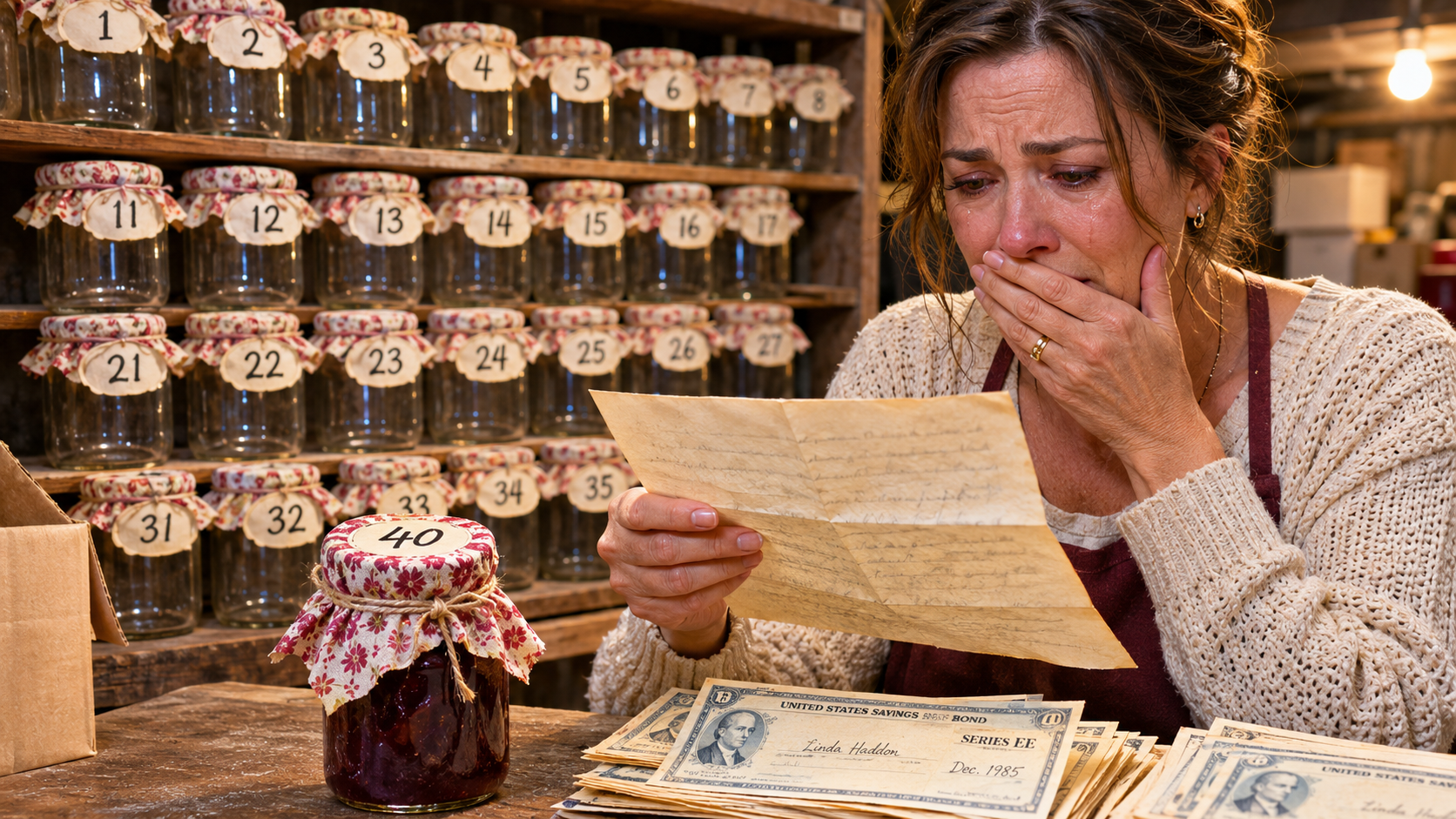
I wiped my eyes and continued reading.
“Carol and Jeanette always believed love could be measured by the price of a gift. When they were little, I made the mistake of encouraging that belief. I bought them beautiful things because I wanted them to have what I never had.
“But beautiful things became expectations. Expectations became demands. And eventually, my daughters began to mistake generosity for something they were owed.
“You were different, Linda.
“The first Christmas you spent in my home, I gave you a jar of plum jam because it was all I could afford after buying presents for the children.
“You were twenty-four. You wore a blue sweater with a loose thread at the sleeve. I remember because you kept pulling it down over your hands.
“Carol laughed when you opened your present.
“Jeanette asked whether I had forgotten to buy you something.
“But you looked at that little jar as though I had handed you something precious.
“And when you hugged me, you whispered, ‘Thank you for making something just for me.’
“Nobody had thanked me that way in years.”
I lowered the letter.
The memory came rushing back.
Ruth’s kitchen in 1985.
The smell of cinnamon.
A Christmas tree with uneven branches.
My husband, Thomas, standing behind my chair with his hands resting on my shoulders.
I remembered the jam.
I remembered the laughter.
But I had forgotten what I said to Ruth.
She hadn’t.
For forty years, she had remembered every word.
I raised the letter again.
“That night, after everyone went home, I sat at the kitchen table and cried.
“Not because I was sad, but because I realized how long it had been since someone appreciated something I had made with my own hands.
“Your father-in-law had been gone barely a year. The farm was struggling. I was frightened of losing everything.
“Yet somehow, you made me feel rich.
“The following Monday, I went to the bank and purchased a fifty-dollar savings bond in your name.
“I intended to give it to you the next Christmas.
“But then I heard Carol telling Jeanette that Thomas had married a woman who would eventually take part of their inheritance.
“I listened as they discussed what belonged to them, what belonged to their brother, and what you should never be allowed to touch.
“And I realized something terrible.
“If they knew I had bought you that bond, they would spend the next forty years making you feel guilty for accepting it.”
My stomach tightened.
Because I knew she was right.
Carol had never liked the idea that I might receive something from Ruth.
Even when Thomas was alive, she treated everything in her mother’s home as though it already belonged to her.
Once, when I admired a little porcelain bird on Ruth’s windowsill, Carol immediately said, “That was Grandma’s. Mom promised it to me.”
I hadn’t asked for it.
I had merely said it was pretty.
Still, Carol watched me suspiciously for the rest of the afternoon.
Ruth noticed things like that.
Apparently, she noticed far more than I ever imagined.
I continued.
“So I hid the bond inside the lid of your Christmas jar.
“The next year, I bought another.
“Then another.
“Some years I could afford very little. Other years, when the farm did well or I sold enough preserves at the market, I purchased larger bonds.
“I began thinking of them as your freedom fund.
“Not an inheritance.
“Not payment for being a good daughter-in-law.
“Something that would belong to you, and only you, when you needed it.
“I thought you would discover the first one when you opened the jar.
“But you didn’t.
“The following Christmas, I noticed that you had returned the jar to my shelf, empty and carefully washed, before taking it home with you. I wondered whether you had found the bond and decided not to mention it.
“So I kept quiet.
“By the fifth year, I realized you had never looked beneath the folded paper lining I used inside the lids.
“And then I learned something else.
“You were saving my jars.
“All of them.
“Thomas told me you had a shelf in your basement where you kept every Christmas gift I had ever made for you.
“Linda, I cannot tell you what that meant to me.
“My daughters kept their jewelry in boxes.
“You kept my empty jam jars as though they were treasures.”
At that sentence, I began to sob.
Not delicate tears.
Not the quiet, dignified crying I had mastered at funerals.
I cried the way a little girl cries when she discovers that someone has loved her all along.
I pressed Ruth’s letter against my chest.
“Oh, Ruth,” I whispered.
“Why didn’t you tell me?”
The basement gave no answer.
Only the humming of the furnace and the occasional creak of the old wooden stairs.
Then I noticed there were still two pages left.
And the next paragraph changed the entire meaning of those forty Christmases.
“There is something I must confess, Linda.
“I knew how my daughters treated you.
“I heard the jokes. I saw the little smiles they exchanged when they opened their expensive gifts and you unwrapped another jar.
“And I should have stopped them.
“I should have stood up at that table and told them that the worth of a woman cannot be measured by what she receives.
“But I was a coward in one particular way.
“I was afraid that if I defended you openly, they would punish you when I wasn’t there.
“So I tried to protect you in secret.
“I understand now that secret kindness cannot always undo public cruelty.
“For that failure, I am deeply sorry.”
I stared at those words for a long time.
Ruth Haddon had never been a woman who apologized easily.
I once watched her argue with a mechanic for forty-five minutes over a twelve-dollar repair charge.
She could endure pain without complaining.
She could bury a husband and still milk the cows the following morning.
But saying she was wrong?
That had always been difficult for her.
Now, from beyond the grave, she was doing it.
And suddenly, I understood something I had been unable to put into words for decades.
Ruth had not been indifferent to my humiliation.
She had seen it.
She had hated it.
And she had carried her own guilt over it.
I turned the page.
“When Thomas died, I thought I had lost the last reason you would ever want to remain part of this family.
“You had already given us thirty-one years of your life.
“You were free to walk away.
“But you didn’t.
“You still brought me groceries on Thursdays.
“You still drove me to the doctor.
“You still came over every Sunday afternoon and sat with me at the kitchen table.
“Sometimes we barely spoke.
“You would drink tea and I would peel apples.
“I loved those afternoons more than you know.”
My tears fell onto the paper.
Thomas had died eight years earlier.
A sudden heart attack.
Sixty years old.
One ordinary Tuesday morning, he kissed me goodbye before leaving for work.
By lunchtime, I was a widow.
The world had split into a before and an after.
For months, Ruth and I barely knew how to speak to one another.
She had lost her only son.
I had lost my husband.
Neither of us knew who had the greater right to grieve.
So we sat together.
We drank tea.
Sometimes we cried.
Sometimes we talked about him.
And sometimes we said nothing at all.
I had always believed I was visiting Ruth because she needed someone.
I never considered that perhaps I needed her just as badly.
The next sentence nearly broke me.
“Thomas was my son by birth.
“But you, Linda, became my daughter by choice.”
I covered my mouth.
For forty years, I had waited for Ruth to call me her daughter.
She never had.
Not once.
And now the words were there.
Written in the familiar, cramped handwriting I had seen on recipe cards, birthday envelopes, and Christmas gift tags.
I wanted one more afternoon.
One more cup of tea.
One more opportunity to take her hand and tell her that she had been my mother, too.
But the kitchen chair where she used to sit was empty.
And I could never get that afternoon back.
Then I reached the final page.
At the top, Ruth had written three words in capital letters.
PLEASE READ CAREFULLY.
My tears stopped.
Because the handwriting beneath those words was different.
More forceful.
Almost urgent.
“There is one final thing I need you to know.
“Carol and Jeanette believe they understand everything about my money.
“They do not.
“They have spent years discussing what they will receive when I die. They have made plans for my house, my land, and even the furniture I am still sitting on.
“But there is one thing they have never understood.
“Some gifts were given long before my death.
“And some debts have already been paid.
“If either daughter tries to claim that your bonds belong to my estate, you must contact my attorney, Samuel Bennett.
“He has a sealed envelope with your name on it.
“Inside are the records I kept because I knew this day might come.
“Please do not argue with my daughters before speaking to him.
“And Linda, there is something in that envelope about Thomas that I could never bring myself to tell you while he was alive.”
I read the final sentence again.
Then again.
Something about Thomas?
My husband had been dead for eight years.
What could Ruth possibly know that I didn’t?
I looked down at the forty empty jars.
Forty Christmases suddenly seemed like the smallest part of the mystery.
Because Ruth’s last sentence was this:
“Whatever you discover, remember that Thomas loved you. Even when he was too ashamed to tell you the truth.”
I sat completely still.
And for the first time that night, I felt afraid.
Not of Carol.
Not of Jeanette.
Not even of losing the money.
I was afraid of what my husband might have hidden from me.
The Secret My Husband Took to His Grave
I didn’t sleep that night.
At four in the morning, I was still sitting at the kitchen table with Ruth’s letter spread before me.
The forty jars stood in neat rows on the counter.
I had carried them upstairs one at a time, afraid that leaving them in the basement would somehow make everything feel unreal.
Beside them lay thirty-nine savings bonds.
Thirty-nine pieces of paper that had been waiting decades for me to discover them.
And one terrible question.
What had Thomas been too ashamed to tell me?
At seven-thirty, my telephone rang.
Carol.
I let it ring four times before answering.
“Linda? I hope you got home all right.”
Her voice was unusually cheerful.
“I did.”
“Good. Listen, I was thinking about that last jar Mom made.”
My fingers tightened around the telephone.
“What about it?”
“Well, Jeanette said something interesting after you left.”
I waited.
“She remembered Mom putting numbers on those jars. Isn’t that strange? Forty years of keeping track of jam.”
“Ruth was very organized.”
Carol laughed.
“That’s one way of putting it. Anyway, I was wondering whether you still had the old jars.”
My heart began to pound.
“Why?”
“Oh, no reason. Jeanette just thought it might be nice to have some of Mom’s old things.”
I looked at the thirty-nine bonds lying on the table.
“Carol, you divided your mother’s jewelry before the flowers from her funeral had wilted. You took her dining room furniture. Jeanette took her silverware. You even argued over her curtains.”
“That isn’t fair.”
“And now you want my empty jam jars?”
A silence followed.
Then Carol said something that made my blood run cold.
“Mom was behaving strangely toward the end, Linda. She was hiding things.”
I sat up.
“What things?”
“Papers. Little envelopes. She would put them away whenever I came into the room.”
“Maybe she wanted privacy.”
“She was ninety-one. People that age get confused.”
Ruth’s final instructions flashed through my mind.
Please do not argue with my daughters before speaking to Samuel Bennett.
So I kept my voice steady.
“Is there something you need, Carol?”
“No. Just checking.”
“Then thank you for calling.”
Before I could hang up, she added, “And Linda?”
“Yes?”
“Whatever Mom gave you, remember that we’re all family.”
The line went dead.
I stared at the telephone.
Forty years of being told I wasn’t quite family.
And now, suddenly, Carol wanted to remind me that we were.
I wondered what she already knew.
Samuel Bennett’s law office was located above a pharmacy in the next town.
I remembered him from Ruth’s funeral.
A silver-haired man with kind eyes who had stood quietly near the back of the church.
When I called, his secretary asked my name.
Then she put me on hold.
Less than a minute later, Samuel himself answered.
“Mrs. Haddon?”
“Yes.”
There was a pause.
Then he asked, “Did you find the fortieth jar?”
I nearly dropped the phone.
“You knew?”
“I knew Ruth had arranged something for you. I didn’t know whether you would ever discover it.”
“She left a letter.”
“Then I think we should speak in person.”
His voice became serious.
“And, Mrs. Haddon, please bring the letter and whatever else you found. There are things Ruth insisted I explain to you personally.”
I arrived at his office that afternoon.
He offered me coffee.
I declined.
He closed the door, sat behind his desk, and placed a thick brown envelope in front of me.
My name was written across it.
Linda Haddon.
Ruth’s handwriting.
I touched the envelope but didn’t open it.
“Mr. Bennett, how much did you know?”
He folded his hands.
“Ruth came to see me eighteen months before she died. She was still remarkably sharp. She brought records she had kept for decades.”
“About the bonds?”
“Those, among other things.”
I swallowed.
“Do the bonds actually belong to me?”
“Assuming the ownership details and documents check out, they appear to be gifts issued in your name. Ruth did not intend them to pass through her estate.”
He leaned forward.
“Some may have stopped earning interest years ago. They will need to be verified and valued properly, and there may be tax consequences. But your mother-in-law was very deliberate about how she purchased them.”
“Do you know what they’re worth?”
“Not precisely. We should obtain the official values before making any decisions.”
He slid a folder toward me.
Inside was a handwritten ledger.
Thirty-nine entries.
Each one corresponded to a Christmas jar.
Some purchases had been small.
Fifty dollars.
A hundred.
Two hundred.
Then, as Ruth’s income improved, the amounts grew.
She had saved carefully, year after year, even when money was tight.
Samuel pointed to a note written beneath the last entry.
For Linda. Because she never asked.
I pressed my lips together.
“She didn’t have to do this.”
“No,” Samuel said gently. “She didn’t.”
He opened another folder.
“Now I need to show you something more difficult.”
There were two columns written in Ruth’s handwriting.
One labeled CAROL.
The other labeled JEANETTE.
Beside each name were years, dates, and amounts.
Carol’s first house deposit.
Jeanette’s divorce expenses.
A loan for Carol’s business.
Money toward Jeanette’s daughter’s college tuition.
Car repairs.
Medical bills.
Mortgage payments.
Emergency cash.
The entries went on for pages.
I scanned the totals.
Carol had received more than ninety thousand dollars in financial help over the years.
Jeanette had received more than seventy thousand.
That was separate from the jewelry, furniture, and other gifts Ruth had given them.
I stared at the numbers.
“They always told me Ruth favored them.”
Samuel gave me a sad look.
“In a sense, she did give them a great deal. But they rarely remembered what they had already received.”
I shook my head.
“Why would Ruth keep such detailed records?”
“Not because she wanted to punish them. She wanted to remember what she had done for each of her children. She worried that after her death they might mistake the final distribution of her belongings for the entire history of her generosity.”
Then he turned to a page dated seventeen years earlier.
And everything inside me went cold.
There was a check.
Thirty-two thousand dollars.
Signed by Thomas.
Payable to Carol.
Beneath it was a handwritten agreement promising repayment within twenty-four months.
Carol’s signature was unmistakable.
I felt the blood drain from my face.
“Where did you get this?”
“Thomas gave copies to his mother.”
I could barely speak.
“Why?”
Samuel looked at me for a long moment.
“Because he never got the money back.”
My breathing became shallow.
Seventeen years earlier, Thomas and I had been saving to buy a little cottage near Lake Michigan.
Nothing luxurious.
Just a small white house where we could spend our retirement listening to waves instead of traffic.
We had already picked out curtains.
We had even driven past the property one Sunday afternoon and stood outside imagining where our rocking chairs would go.
Then Thomas came home from work looking exhausted.
He told me his contracting business had suffered a serious financial setback.
“We’re going to have to use some savings, Linda,” he said.
“How much?”
“More than I wanted.”
We didn’t buy the cottage.
I took a second job at a local medical office, working evenings for nearly two years.
I told myself that marriage meant carrying each other through difficult seasons.
And I never once resented him.
Not even when I came home after midnight with swollen feet and found him asleep in his chair.
Now I understood.
The financial setback had never been a business problem.
It had been Carol.
I looked up.
“He told me the company lost money.”
Samuel’s expression tightened.
“I know.”
“He let me work two jobs.”
“I believe that was one of his greatest regrets.”
My voice broke.
“He watched me come home exhausted every night.”
Samuel said nothing.
And somehow his silence hurt more than any explanation could have.
I looked at the signed agreement again.
Carol had borrowed thirty-two thousand dollars from my husband.
My husband had hidden it from me.
And Ruth had known.
All three of them had known.
While I cleaned medical offices after everyone went home.
While I packed cheap lunches to save money.
While I told Thomas we could always buy our dream cottage another year.
They had known.
I pushed the papers away.
“Why didn’t Ruth tell me?”
Samuel answered carefully.
“Thomas asked her not to. He had promised Carol he would protect her privacy, and he was ashamed of having made such a large decision without speaking to you.”
“That doesn’t make it right.”
“No,” Samuel said. “It doesn’t.”
I wiped my cheeks.
“Did Carol ever repay him?”
“Ruth’s records show no repayment. Thomas apparently stopped asking.”
I laughed once.
It was a terrible sound.
“Of course he did.”
Samuel reached into the envelope.
“There is one more thing.”
He handed me a small white envelope.
Across the front, in handwriting I recognized instantly, were two words.
For Linda.
Thomas.
I hadn’t seen his handwriting in eight years.
My fingers trembled as I broke the seal.
Inside was a single page.
The paper was folded so many times that the creases had nearly worn through.
I opened it.
“My darling Linda,
“If you’re reading this, then Mom finally found the courage that I never had.
“I owe you the truth.
“When Carol came to me asking for help, she said she was going to lose her business and her home. She begged me not to tell anyone.
“I believed I could lend her the money, have it returned within two years, and tell you everything once the problem was solved.
“But the money never came back.
“And every month that passed made it harder to admit what I’d done.
“You trusted me.
“I repaid that trust with a lie.
“I convinced myself I was protecting our family. The truth is, I was protecting myself from the shame of disappointing you.
“Watching you take that second job was the worst thing I ever did to you.
“You were so tired, Linda.
“And you still came home smiling.
“You would kiss me on the forehead and say, ‘We’ll get through this together.’
“You thought you were helping me through a business crisis.
“But you were carrying the burden of my mistake.
“I am sorry.
“I should have told you.
“I should have trusted you enough to let you be angry.
“I should have stood beside you when my sisters laughed at you, instead of asking you to ignore them.
“You deserved a braver husband.
“I loved you every day of our marriage. But love without honesty can still cause terrible pain.
“If I could give you one thing now, it would be the freedom to stop sacrificing yourself to keep everybody else comfortable.
“Please don’t spend the rest of your life doing that.
“All my love,
“Thomas.”
I read it until the words dissolved.
For eight years, I had remembered my marriage as something beautiful but unfinished.
Now a shadow had appeared inside it.
Thomas had loved me.
I knew that.
He had held me when my father died.
He had stayed beside me through illness.
He had filled our ordinary days with kindness.
But he had also lied to me.
And his love did not erase that.
I put his letter on the desk.
“I wish he had told me.”
Samuel nodded.
“You had every right to know.”
I cried for the husband I missed.
And for the woman I had been.
The woman who believed being understanding meant never asking difficult questions.
The woman who worked two jobs to protect a secret everyone else already knew.
When I finally looked up, Samuel was waiting patiently.
“There’s something Ruth wanted me to tell you,” he said.
I wiped my face.
“What?”
“She knew you might be hurt when you learned the truth. She didn’t expect you to excuse Thomas, and neither do I.”
He turned over the last page of Ruth’s ledger.
There, written in her familiar hand, was a single sentence.
“I cannot undo what my children kept from Linda, but I can finally stop helping them keep it.”
I stared at it.
Then Samuel added, “Ruth spent the last years of her life preparing to tell you everything. She wanted you to have the documents, the bonds, and the chance to make your own decisions.”
He placed a smaller envelope beside the ledger.
“There’s another reason she wanted you to come here.”
Inside was a handwritten list.
Not of money.
Not of jewelry.
But of forty dates.
Christmas Day.
Every year.
Next to each date, a brief description.
1985 — She thanked me for the jam.
1988 — She stayed to wash dishes when everyone else left.
1994 — She sat with me through the night when I had pneumonia.
2001 — She brought me roses from her own garden.
2010 — She defended me when Carol said I was becoming difficult.
2018 — She held my hand on the first Christmas without Thomas.
2023 — She fell asleep in the chair beside me. I covered her with my best blanket.
I pressed my hand to my mouth.
Ruth had kept a record of me.
Not just what she gave.
But what I had given her.
Things I didn’t even remember doing.
Small ordinary moments.
A cup of tea.
A car ride.
A bowl of soup.
A blanket.
At the bottom of the page, she had written:
“When people ask what Linda contributed to this family, show them this. She gave us the part of herself that no one could buy.”
I couldn’t speak.
Samuel quietly reached for a tissue box.
After a long while, I asked the question that had been frightening me since Carol’s telephone call.
“Does Carol know about any of this?”
Samuel hesitated.
“She knows more than she admitted to you.”
My stomach tightened.
“How much more?”
“She contacted me two months after Ruth died. She asked whether Ruth had kept any financial records outside the estate papers.”
“What did you tell her?”
“That I could not disclose another person’s private documents without authorization.”
I felt anger rising through my grief.
“Carol has been looking for this money.”
“Possibly. She seemed particularly interested in what Ruth might have given you over the years.”
I looked down at Thomas’s letter.
“And she knows exactly what she took from my husband.”
Samuel nodded.
“She signed the agreement.”
I sat quietly.
Then, for the first time in my life, I asked a question without feeling guilty.
“What happens if I decide I don’t want these women in my life anymore?”
Samuel leaned back.
“Linda, that’s not a legal question.”
“I know.”
He smiled sadly.
“But it is a decision you’re allowed to make.”
And something inside me shifted.
For forty years, I had tried to earn a place at the Haddon family table.
For forty years, I had smiled at jokes that weren’t funny.
I had swallowed insults because Thomas asked me to keep the peace.
I had convinced myself that kindness meant enduring whatever people chose to give me.
But Ruth had spent forty years quietly preparing a different kind of future for me.
One in which I wouldn’t have to beg anyone to treat me with dignity.
I gathered the papers.
And I made a decision.
I was finished being the woman they laughed at.
The Christmas Gift They Tried to Take Back
Two days later, Carol and Jeanette appeared on my doorstep.
I had just finished making tea when someone knocked hard enough to rattle the glass.
Through the window, I saw Carol standing with her arms crossed.
Jeanette stood slightly behind her.
Neither looked happy.
I opened the door.
“Hello, girls.”
Carol didn’t bother with a greeting.
“We need to talk.”
“About what?”
“Mom’s money.”
There it was.
Not how I was feeling.
Not whether I was coping with our first Christmas without Ruth.
Money.
Always money.
I stepped aside and let them enter.
Carol walked directly into the living room.
Jeanette followed, looking uncomfortable.
“We found some paperwork in Mom’s desk,” Carol announced.
“What paperwork?”
“Bank receipts. Records of savings bond purchases.”
I said nothing.
Carol narrowed her eyes.
“And some of them had your name on them.”
I folded my hands.
“Did they?”
“Don’t play games, Linda.”
Jeanette spoke quietly.
“Carol, maybe we should let her explain.”
Carol ignored her.
“Mom was ninety-one years old. She was confused toward the end. If she put money in your name, we need to know how much.”
I looked at her.
“Why?”
“Because we’re her daughters!”
“And?”
“And that money should have been divided among her children.”
I felt something inside me become very still.
For forty years, Carol had treated me as an outsider.
Now she was standing in my living room demanding an explanation for gifts her mother had given me.
I walked to the sideboard.
There, beneath a small framed photograph of Ruth and Thomas, lay the folder Samuel had prepared.
I picked it up.
“Before we discuss what your mother gave me, there’s something I want to show you.”
Carol’s expression changed.
I placed a copy of the thirty-two-thousand-dollar loan agreement on the coffee table.
“Do you recognize this?”
Carol glanced down.
Her face went pale.
Jeanette leaned forward.
“What is that?”
I kept my eyes on Carol.
“Seventeen years ago, Thomas lent your sister thirty-two thousand dollars.”
Jeanette gasped.
“Thirty-two thousand?”
Carol looked toward the door.
“That was a private matter.”
“Yes,” I said softly. “Apparently it was private from me, too.”
Carol swallowed.
“Thomas offered to help.”
“You signed an agreement promising to repay him.”
“It was a difficult time.”
“Did you repay him?”
She said nothing.
I waited.
“Carol. Did you repay my husband?”
Finally, she snapped, “He never asked for it again!”
I nodded.
“No. He didn’t.”
My voice trembled, but I continued.
“Because he was ashamed to tell me what he had done. So he told me his business was struggling.”
Jeanette slowly turned toward her sister.
“Carol?”
I looked directly into Carol’s eyes.
“Do you know what I did when Thomas told me we had lost our savings?”
Carol didn’t answer.
“I took a second job.”
The room became completely silent.
“I worked evenings at a medical office. Sometimes I didn’t get home until after midnight. I stopped buying new clothes. I canceled a vacation. We gave up the little cottage we’d been planning to buy.”
Carol’s lips parted.
I took a breath.
“And every Christmas during those years, you opened jewelry from your mother and laughed because I received another jar of jam.”
Jeanette covered her mouth.
I wasn’t finished.
“Your mother knew what had happened. Thomas eventually confessed to her. She kept records because she was afraid that one day you would try to take from me again.”
Carol’s expression hardened.
“Are you saying Mom gave you all that money because of me?”
“No.”
I shook my head.
“That’s the part you still don’t understand.”
I placed Ruth’s forty-year list on the table.
“She gave me those gifts because she loved me.”
Jeanette stared at the page.
I watched her read.
I watched her find the entry about the night I sat beside Ruth when she was sick.
Then the Christmas after Thomas died.
Then the Sunday afternoons.
Her eyes filled with tears.
“Mom wrote all this?”
“Yes.”
Jeanette touched the paper carefully.
“She never kept anything like this about me.”
I took a seat across from her.
“Maybe she did, Jeanette. Maybe there are things about your relationship with her that you haven’t discovered yet.”
Carol let out a bitter laugh.
“So that’s it? You’re keeping everything?”
“The bonds were gifts in my name.”
“But it’s not fair!”
I looked at her for a long moment.
Then I asked one question.
“Was it fair when you laughed at me for forty years?”
Carol opened her mouth.
Nothing came out.
“Was it fair when I worked two jobs while you kept money you had promised to return?”
Silence.
“Was it fair when you divided Ruth’s jewelry and never once asked whether there was something I might want to remember her by?”
Carol’s face reddened.
“You never asked!”
I nodded slowly.
“That’s true.”
And then I said the words I should have said decades earlier.
“I shouldn’t have had to.”
Jeanette began crying.
Carol stood abruptly.
“I’m not staying here to be accused of stealing from my own family.”
“Then don’t.”
She stared at me.
I had never spoken to her that way.
Not once in forty years.
“You’re throwing us out?”
“No, Carol. I’m telling you that you are free to leave. Just as I am free to decide what happens to the gifts Ruth gave me.”
She grabbed her purse.
“This isn’t over.”
I met her eyes.
“For me, it is.”
She walked out and slammed the door.
Jeanette remained sitting on my sofa.
Her hands were trembling.
For several minutes, neither of us spoke.
Then she looked up.
“Linda?”
“Yes?”
“Why didn’t you ever tell us how much we hurt you?”
I felt an old sadness settle over me.
“Jeanette, I did.”
She frowned.
“I don’t remember.”
“Not in big speeches. But I stopped laughing at the jokes. I changed the subject. I left rooms when Carol started making comments.”
Tears rolled down her cheeks.
“You always smiled.”
“Because I didn’t want to make Christmas miserable for everyone.”
Jeanette looked down.
“I thought you didn’t care.”
“I cared every single time.”
She began to cry harder.
“I was awful to you.”
I didn’t rush to comfort her.
For once, I let the silence remain.
She needed to sit with what she had done.
Finally, she whispered, “I’m sorry.”
I nodded.
“Thank you.”
She wiped her face.
“Can you forgive me?”
I looked toward the photograph of Ruth.
The old woman stood beneath her plum tree, smiling with an expression so rare that Thomas had insisted on taking a picture.
“I don’t know yet,” I answered.
Jeanette nodded slowly.
And for the first time, she didn’t ask me to make her feel better.
The weeks that followed were strange.
Carol sent angry messages.
Then she sent a letter suggesting the bonds might belong to Ruth’s estate.
Samuel answered through the proper legal channels, explaining the ownership documents and the distinction between gifts Ruth had made while alive and assets belonging to her estate.
Carol eventually stopped demanding the bonds.
I didn’t hear from her for months.
Jeanette called twice.
Both times, she asked how I was doing.
Both times, she listened to the answer.
That was new.
Meanwhile, I began the careful process of having the savings bonds verified and valued.
Some of the oldest had reached their final maturity years earlier.
Others had continued accumulating interest according to their terms.
When the accounting was complete, the estimated total value, before taxes, was more than I could have imagined.
One hundred eighty-three thousand, four hundred twenty-seven dollars and sixty-two cents.
I sat in my kitchen staring at the paperwork.
Ruth had built that gift over thirty-nine Christmases.
One careful decision at a time.
One dollar saved here.
One unnecessary purchase avoided there.
Year after year.
She had never been wealthy.
She had simply believed that small things, protected long enough, could become something extraordinary.
But the money wasn’t what changed my life most.
It was the permission I finally gave myself to live differently.
I stopped apologizing for saying no.
I stopped attending gatherings where I was treated as an inconvenience.
I stopped answering every telephone call simply because someone expected me to.
And that summer, I did something Thomas and I had dreamed about for years.
I rented a small cottage near Lake Michigan.
It had white curtains.
A narrow porch.
And two wooden rocking chairs overlooking the water.
The first evening, I sat in one of those chairs with a cup of tea.
Beside me stood a little mason jar containing plum jam.
Number forty.
I had washed it carefully and saved the letter inside my desk.
The sun sank slowly over the water.
For a moment, I imagined Thomas sitting in the empty chair beside me.
I thought about the good years.
The difficult years.
The things he had told me.
And the things he hadn’t.
I wasn’t ready to say that everything was forgiven.
But I no longer needed every memory to be perfect in order to treasure what had been real.
“I made it here, Tom,” I whispered.
A breeze lifted the edge of the curtain behind me.
And for the first time in years, I didn’t feel as though my life had ended when his did.
I felt as though a new part of it had finally begun.
The Forty-First Christmas
The following December, I decided to make plum jam.
Ruth had left me her recipe in the packet Samuel gave me.
It was written on an old index card, stained with sugar and faded purple fingerprints.
At the bottom, beneath the ingredients, she had added a small note.
“Use ripe fruit. Don’t rush the boiling. And never be afraid to add a little more sweetness when life has been sour.”
I laughed when I read it.
“That sounds like you, Ruth.”
I spent the entire afternoon in my kitchen.
The house filled with the familiar scent of simmering plums.
I sterilized the jars.
Prepared the lids.
Cut little squares of calico fabric.
Then I sat at the table with a paintbrush.
For a long time, I simply stared at the blank lid in front of me.
Finally, I painted a number.
41.
My hand trembled as I made the final stroke.
Forty-one.
The first Christmas without a jar from Ruth.
The first Christmas when I had to make one for myself.
I tied the calico over the lid and placed the jar beside her photograph.
Then I said something I wished I had told her when she was alive.
“Thank you for seeing me.”
Not for the bonds.
Not for the money.
For seeing the exhausted young woman who helped wash the dishes.
For seeing the widow who still came on Sundays.
For remembering the small kindnesses I had forgotten.
For recognizing a daughter where the rest of the family saw an outsider.
That evening, someone knocked at my door.
I opened it.
Jeanette stood on the porch.
She held a small wrapped package.
“Hi, Linda.”
“Hello, Jeanette.”
She looked nervous.
“I know Christmas is difficult without Mom.”
I nodded.
She swallowed.
“I found something while sorting through the last of her sewing things.”
She handed me the package.
Inside was a small porcelain bird.
White, with pale blue wings.
I recognized it immediately.
The bird I had admired on Ruth’s windowsill decades earlier.
The one Carol had quickly announced belonged to her.
“Carol gave this to you?” I asked.
Jeanette shook her head.
“No. Mom kept it in her sewing cabinet. There was a note wrapped around it.”
She handed me a folded slip of paper.
Ruth’s handwriting.
“Linda liked this little bird. I hope one day she has a sunny windowsill where it can sit.”
I closed my eyes.
Even now.
Even after death.
Ruth was still remembering.
Jeanette whispered, “I thought you should have it.”
I looked at her.
“Thank you.”
She glanced past me into the kitchen.
“Are you making jam?”
I smiled.
“I am.”
“Plum?”
“Of course.”
Jeanette laughed softly.
Then her face grew serious.
“Linda, I know an apology doesn’t fix forty years.”
“No,” I said. “It doesn’t.”
“But I’d like to try being a better sister-in-law. If you’ll let me.”
I studied her face.
She wasn’t demanding forgiveness.
She wasn’t asking me to pretend nothing had happened.
She was simply standing there, holding the door open to something different.
So I stepped aside.
“Would you like some tea?”
Her eyes filled.
“Yes,” she whispered. “I’d like that.”
We sat at my kitchen table.
For the first time in forty years, we talked without competition.
Without Carol making jokes.
Without anyone counting presents.
Jeanette told me how frightened she had been when her marriage ended.
How Ruth had helped her financially.
How she had confused that help with being the daughter her mother loved most.
“I think I needed to believe that,” she admitted.
“Why?”
“Because if Mom loved you just as much, then I had to ask myself why I had spent so many years trying to prove I mattered more.”
I reached across the table and gently touched her hand.
“Your mother had enough love for all of us, Jeanette.”
She nodded.
“I know that now.”
We sat in silence for a while.
Then she noticed the jar beside Ruth’s photograph.
“Forty-one?”
I smiled.
“I thought the tradition should continue.”
Jeanette looked at the jar.
Then she asked, almost shyly, “Would you teach me how to make it?”
I felt my throat tighten.
After forty years of mocking my Christmas gift, one of Ruth’s daughters wanted to learn how to make it.
I looked at the recipe card.
At the stained handwriting.
At the little porcelain bird waiting on the windowsill.
And I nodded.
“I’d love to.”
Carol never apologized the way Jeanette did.
Not that Christmas.
Not the following spring.
But one afternoon, she mailed me a card.
Inside, she had written:
“I found an old photograph of Mom holding three Christmas presents. Two were jewelry boxes. One was a jar of jam.
“I used to think the picture was funny.
“I don’t anymore.
“I’m not ready to talk about everything, but I wanted you to know that.”
I read the card twice.
Then I placed it in a drawer.
I didn’t call her.
I didn’t rush to forgive.
But I didn’t throw it away, either.
Some relationships can be repaired.
Some need distance.
And some require people to do the difficult work of changing before they can begin again.
I had spent too many years confusing forgiveness with permission to be hurt again.
I wouldn’t make that mistake anymore.
Last week, I went down into the basement.
The forty jars were still arranged on the old shelf.
I had cleaned them.
Polished the glass.
And placed the forty-first jar at the end.
I stood looking at them for a long time.
For most of my adult life, those jars had represented something I couldn’t explain.
I thought I kept them because they were the only gifts Ruth ever gave me.
Now I understood.
They were proof of a relationship that everyone else had underestimated.
Forty years of ordinary kindness.
Forty years of quiet observation.
Forty years of a woman loving me in the only way she knew how, while struggling to say the words aloud.
I took jar number one from the shelf.
The painted number had faded slightly.
I remembered opening it as a twenty-four-year-old bride.
I remembered Carol’s laughter.
I remembered Ruth standing by the stove, pretending not to listen.
Then I remembered her letter.
“You looked at that little jar as though I had handed you something precious.”
I held the glass against my chest.
“Oh, Ruth,” I whispered.
“You had.”
I placed the jar back on the shelf.
Then I turned off the basement light and went upstairs.
The sun was streaming through my kitchen window.
The little porcelain bird stood on the sill.
Ruth’s photograph sat beside a fresh jar of plum jam.
And for once, I didn’t feel the need to prove to anyone that I belonged.
I had belonged all along.
I just hadn’t known how deeply.
People sometimes ask me whether the money was the greatest gift Ruth left behind.
I always tell them no.
The bonds gave me security.
Thomas’s letter gave me a painful truth I deserved to know.
The records gave me the courage to stop accepting cruelty as the price of family.
But Ruth’s greatest gift was something else.
She taught me that being overlooked by the loudest people in the room doesn’t mean nobody sees you.
She taught me that love is sometimes recorded in tiny moments that never appear in a photograph.
And she taught me that I could remain kind without allowing others to take advantage of my kindness.
Forty years ago, I opened a jar of plum jam and thanked a woman for making something just for me.
I had no idea that behind her quiet expression, she was beginning a promise she would spend the rest of her life keeping.
A promise to remember me.
To protect something for me.
And, eventually, to leave me with enough courage to protect myself.
For forty years, Carol and Jeanette believed I had received the cheapest Christmas present.
They were wrong.
Because the real gift wasn’t hidden beneath the lid.
It was in the heart of the woman who had painted those forty numbers.
And when I finally understood that, I stopped wishing Ruth had given me jewelry.
I only wished I could have one more Christmas with her.
Not to ask about the money.
Not to question the secrets.
Not even to hear her call me her daughter.
Just to sit beside her at the kitchen table.
Spread a little plum jam on warm toast.
And say the five words I had waited too long to say.
“I love you too, Mom.”
