Victoria’s fingers snapped in the first-class lounge—sharp, commanding, and loud enough to cut through the soft hum of expensive comfort.
“Alex, stop sipping that pointless coffee,” she said, tilting her chin like she was addressing staff. “Take my Louis Vuitton trunks to the gate. I don’t trust those union porters. They ‘accidentally’ ruin things.”
Then she turned to the stranger beside her and offered a sugary, conspiratorial smile. “My son-in-law,” she announced, as if presenting a household tool. “He’s used to manual work. Keeps him humble. His father always said he had a mechanic’s hands, not an executive’s.”
I didn’t argue. I didn’t correct her. For fifteen years, I’d mastered the quiet skill of letting people underestimate me—especially her.
- I stayed calm.
- I stayed quiet.
- I stayed focused on what mattered.
I closed my laptop with deliberate care. Victoria had no idea what sat on that drive: the board’s meeting notes and a notarized document that became effective this very morning—transferring 51% of AeroVance’s controlling shares into a trust in my name.
The airline she was about to fly.
The airline she spoke about like it was a family accessory.
And, more importantly, the airline that was now—legally—mine to protect.
I lifted her three heavy trunks, each packed with gala gowns and the kind of “just in case” outfits that never see daylight. Victoria watched me with open satisfaction, enjoying the performance she believed she’d arranged.
She didn’t see a partner. She saw a porter.
What she couldn’t see was this: the same arms carrying those bags had carried an entire struggling company through its worst stretch—while she spent her savings chasing a newer face and a grander image.
We moved toward the gate. Victoria marched ahead and slipped past the long line as though rules were for other people. She headed straight to priority boarding, not even glancing back—just flicking her hand for me to follow like luggage with legs.
The boarding agent, a tired-looking woman with a name tag that read Brenda, mustered a polite smile as she scanned Victoria’s pass.
“Welcome aboard, Ms. Vance,” Brenda said.
Victoria didn’t respond. She simply stepped forward as if gratitude required too much effort.
Then I approached, held my phone under the scanner, and waited for the usual confirmation beep.
BIP.
Not the normal sound.
This was different—three tones, lower and unmistakably official. Brenda’s screen flashed with a bright red banner I recognized instantly:
CODE: RED-ALPHA-ONE. OWNER ON BOARD.
- Brenda’s eyes widened.
- Her breath caught.
- Her hand moved toward the intercom—pure instinct.
I met her gaze and calmly lifted a finger to my lips.
Silence.
Brenda froze, caught between what she’d been trained to do and what she now understood she must not do. Her eyes darted from my jeans and blazer back to the warning banner, as if her brain needed a second pass to accept the reality in front of her.
A small sheen of sweat appeared on her forehead—less from fear of me, and more from the sudden realization of what my presence meant.
Because if the owner was boarding quietly, it was usually for one reason:
Something was about to be addressed.
And it wouldn’t be addressed gently.
Victoria, of course, noticed none of this. She was already basking in the attention first-class service always gave her, already acting as though the cabin belonged to her by birthright.
Some people mistake a seat assignment for a crown.
As we stepped onto the jet bridge, she finally looked back—only to make sure I was still carrying everything.
“Don’t scuff them,” she warned, as if I’d never handled a suitcase before.
I set her bags down where they belonged, then walked forward at my own pace. The plane waited, polished and prepared, the crew ready for another routine flight.
But this flight wouldn’t be routine.
Because respect isn’t optional in any cabin—economy, first class, or otherwise.
When we were seated, Victoria made her preferences clear in the way she always did: by taking the best for herself and leaving others to “learn their place.” She settled into first class with theatrical comfort while I took an economy seat without comment.
The aircraft pushed back. The engines rumbled. The runway stretched ahead.
Then the plane stopped.
A pause—not long, but noticeable. The kind that makes people look up from their screens.
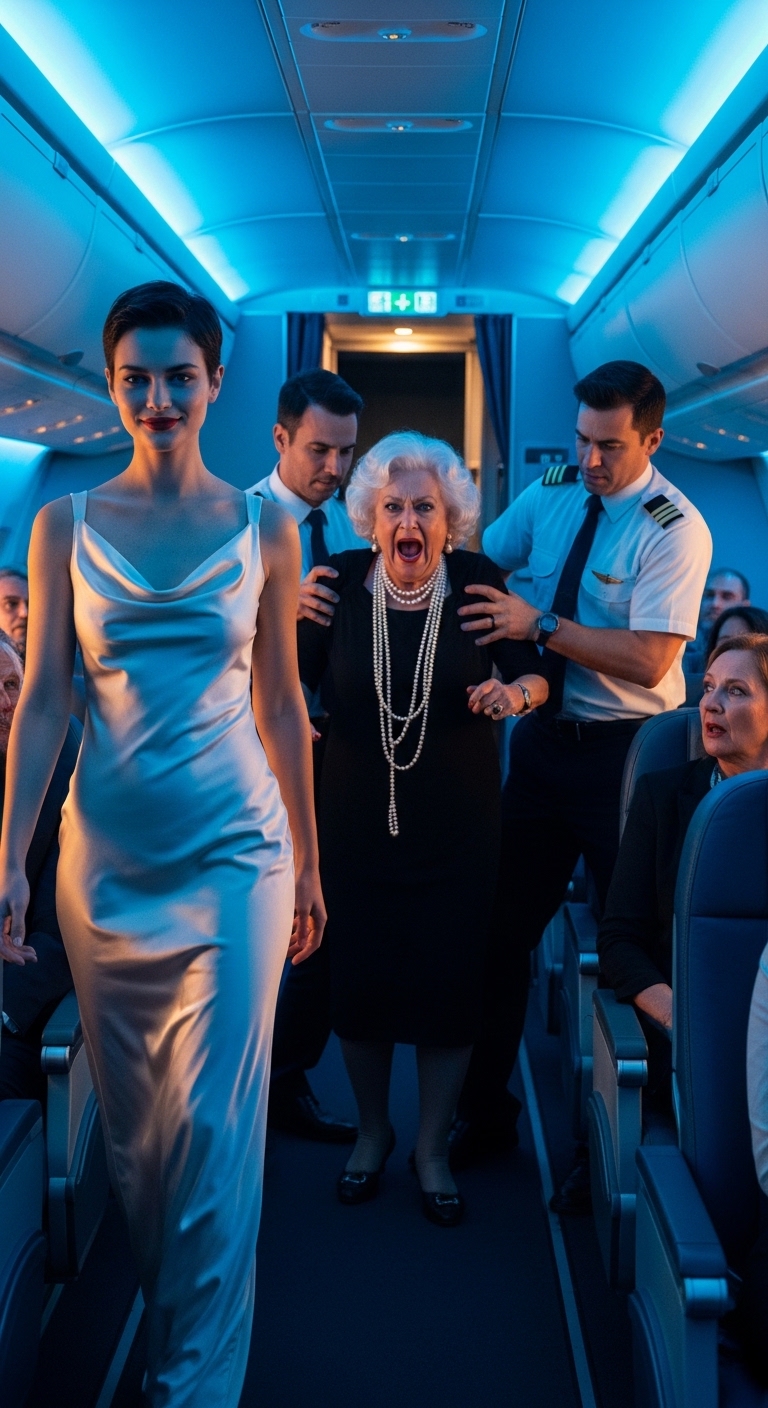
A moment later, the cockpit door opened, and the pilot stepped out.
- He didn’t scan the cabin for a VIP.
- He didn’t approach Victoria.
- He walked straight past her.
He stopped beside my row, offered a respectful nod, and spoke clearly—calmly—so the nearest passengers could hear.
“Ma’am,” he said, “we can’t take off with passengers who treat others without basic respect.”
The cabin fell quiet in that way crowds do when they sense a boundary being drawn.
I stood, smoothing my blazer, and looked toward Victoria. For the first time that day, she seemed unsure what expression to wear—annoyance, confusion, or disbelief.
So I chose the simplest words. The fairest words.
And the words she never expected to hear from the person she’d been trying to shrink for years.
“Get off my plane. Now.”
Victoria’s face tightened, as if her pride was scrambling for an exit. She opened her mouth, ready to protest—ready to demand, to threaten, to perform.
But this wasn’t a living room where snapping fingers got results.
This was an aircraft with rules, staff, and safety procedures—and an owner who had finally decided that dignity mattered more than silence.
In the end, the message was simple: titles and wealth don’t excuse cruelty, and no amount of privilege buys the right to look down on others.
Conclusion: That day, Victoria didn’t just learn who owned the airline—she learned that respect is the real ticket you need to stay on board.