At 3:47 a.m., most of the world feels like it’s holding its breath. Hospitals don’t. Even so, my office at St. Catherine’s is usually calm at that hour—just the soft buzz of fluorescent lights and the steady glow of next week’s surgical roster on my monitor.
Then my phone lit up with a name I never expected to see in the middle of the night: Ethan.
My son didn’t call at that hour unless something was deeply wrong. He was twenty-two, three hours away at State, and proud in that particular way young adults are—confident they can handle anything without help.
I answered immediately.
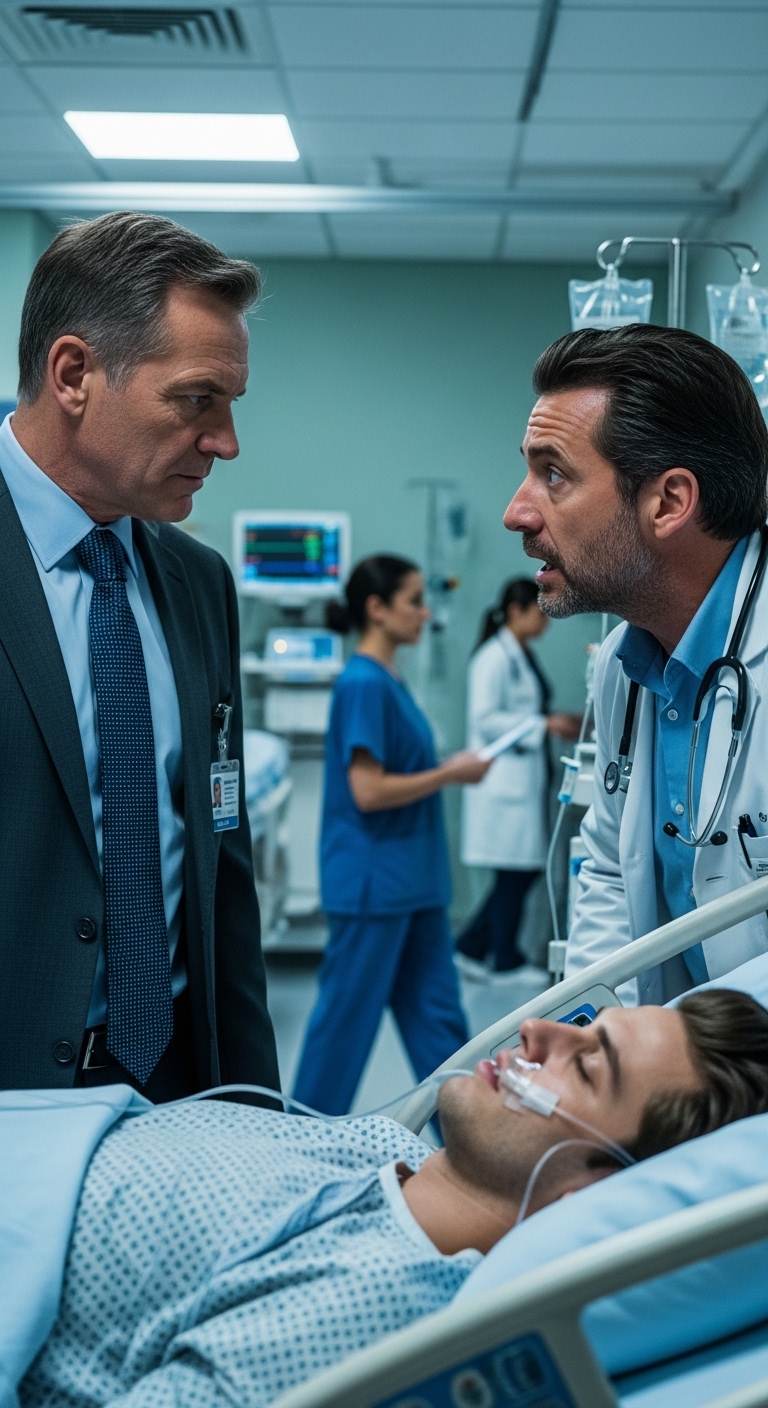
“Dad,” he said, and the strain in his voice made my stomach drop. “I’m in Mercy General’s ER. I’ve been here two hours. The doctor keeps saying I’m pretending—like I’m here for drugs. He won’t treat me.”
In that silence after his words, my mind did what it’s been trained to do: it started sorting symptoms. But the father in me heard only one terrifying possibility—if they send him home, he could get much worse.
The Symptoms That Didn’t Add Up With “Nothing’s Wrong”
I was already moving—standing, reaching for my coat—while he tried to explain between shallow breaths.
“It’s low, on the right,” Ethan said. “Sharp. Like something’s pulling. It started around midnight and it keeps getting worse. I’m nauseous. I threw up twice. I’m sweating. I think I’ve got a fever.”
As a surgeon, those details click into place fast. As a parent, they land like a weight.
Right lower abdominal pain. Nausea. Vomiting. Possible fever.
It sounded dangerously consistent with appendicitis—something you don’t ignore and don’t “wait out.”
“Do you know your temperature?” I asked, forcing my voice to stay even.
“They took it earlier. The nurse said it was kind of high.”
“And the doctor examined you?”
Ethan hesitated. “Barely. He pressed once—like a quick tap—and then he started asking if I’ve used opioids. He kept staring at my arms. Like my tattoos meant more than the pain. He told the nurse to give me Tylenol and send me home.”
- Severe pain isn’t “solved” by a quick glance.
- Suspecting someone doesn’t replace proper evaluation.
- Even when a case seems unclear, basic checks still matter.
What I Told My Son to Do Before I Left
“Listen carefully,” I said. “Do not leave the ER. Tell them your father is Dr. Garrison Mills, Chief of Surgery at St. Catherine’s. Tell them I’m driving there now.”
He inhaled shakily. “Dad—”
“Ethan,” I cut in, my voice breaking despite my best effort. “If this is your appendix and it ruptures, the situation can turn serious fast. That isn’t drama. That’s how the body works. Do you understand?”
“I understand,” he whispered. “I’m scared.”
“I know. Stay where you are. If you can, keep your phone on.”
I ended the call and pushed out into the winter rain, trying not to make noise in the hallway where residents slept between cases. Outside, the parking lot glistened, empty and slick, and my hands fumbled my keys like they belonged to someone else.
Medicine can be extraordinary—but it can also be casually unkind, especially when assumptions enter the room before the patient’s story does.
The Part No Textbook Prepares You For: Bias
I’ve been in this profession long enough to know a hard truth: some people get believed faster than others.
Ethan has full-sleeve tattoos. He wears his hair long. On his twentieth birthday he got a small nose ring and told me it made him feel more like himself. I joked about it the way dads do, but privately I admired the confidence it took to be comfortable in his own skin.
Now, on a hospital stretcher under harsh ER lights, I couldn’t stop picturing him curled around his pain while someone looked at his appearance and decided—without evidence—what kind of patient he must be.
I started the car. Three hours away. In my head, I did the math and knew I’d find a way to make it less.
A Night Drive That Felt Like a Countdown
The highway before dawn feels like a different world—just wet pavement, the occasional set of taillights, and exits that flash by like unfinished thoughts.
Ethan stayed on speaker as long as his phone allowed. In the background I could hear the ER’s muffled announcements and the distant squeak of wheels rolling down corridors.
Then his voice shook again. “Dad… he asked if I’d ever been arrested.”
My grip tightened on the steering wheel. “What did you say?”
“No. Because I haven’t.”
“And then what?”
“He just smiled. Like he didn’t believe me anyway.”
- Suspicion is not a diagnosis.
- Appearance is not a medical history.
- Compassion should not be something a patient has to earn.
The Standard of Care Isn’t Optional
In my mind, I ran through what should have been happening: full vitals, a thorough abdominal exam, basic labs, and imaging if warranted. If appendicitis is on the table, a surgical consult shouldn’t be treated like an inconvenience.
Pain relief, too, isn’t a “reward” for being believed. It’s part of humane care. And even if a clinician suspects someone is seeking medication, that suspicion does not justify overlooking a potentially urgent condition.
Bias doesn’t change physiology. Inflammation doesn’t pause because someone looks different. An appendix does not care about tattoos, hair, or jewelry.
Near the outskirts of the city, the call dropped. A text came through shortly after: still here. worse.
I called back. Straight to voicemail.
I didn’t realize I’d started sweating until I wiped my forehead and my hand came away cold.
A Phone Call That Confirmed My Fear
At 5:12 a.m., I called a colleague I trusted—an ER physician who had worked shifts in multiple hospitals over the years.
“What’s going on?” he asked, half-asleep.
“My son’s at Mercy General,” I said. “Right-sided lower abdominal pain, vomiting, fever. Their attending is Leonard Vance. He’s trying to discharge him.”
There was a pause—too long.
“Vance,” my colleague said quietly.
“You know him?”
“Unfortunately. He’s quick to label patients—especially young men. If someone doesn’t look ‘clean-cut,’ he assumes the worst.”
“Has anyone ordered imaging?” he asked.
“Not that I’ve heard. Tylenol and discharge.”
“Get there as fast as you safely can,” he said. “And keep track of everything—times, names, what was said. If you speak to the nurses directly, many will be honest with you.”
Anger can be loud, but that morning mine was cold and focused: my job was to get to my son before a bad decision became a tragedy.
I hung up and drove on, the road stretching ahead like a narrow corridor, every mile a reminder that the people we love are sometimes only as safe as the person willing to listen.
In the end, this wasn’t only a story about one painful night in an ER. It was a reminder that good medicine requires more than knowledge—it requires humility, attention, and the willingness to see the patient in front of you as a human being first.
Conclusion: When someone says they’re in serious pain, the safest, most decent response is to assess carefully—without assumptions. Families shouldn’t need titles or connections to be taken seriously, and no one should have to prove they “deserve” care before they receive it.