“Excuse me, sir… could you please tell me the balance on my account?”
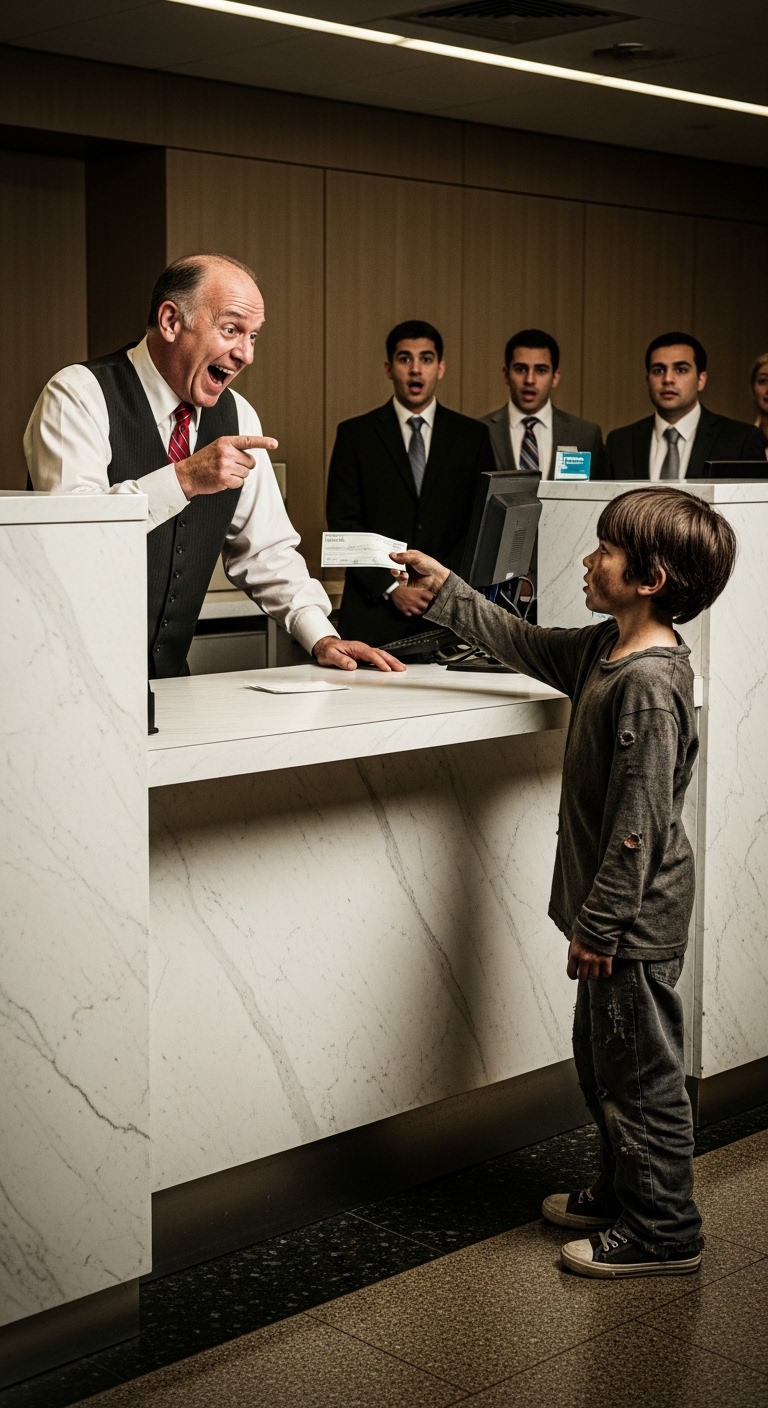
At the counter stood a young Black boy—no more than ten. His shoes were scuffed and tired, the laces frayed, and an oversized jacket hung on his small frame like it belonged to someone else.
The bank’s manager paused as if the request had interrupted something important. He looked the boy up and down, then let out a loud, careless laugh that echoed across the marble lobby.
“Your balance?” he said, letting the words drip with ridicule. “This is First National Heritage Bank—not some charity desk for street kids.”
Bradley Whitmore stepped forward, expensive cologne trailing behind him, his expression sharp with judgment.
“Look at those shoes. Look at—” he added, making assumptions he had no right to make. “Another kid who thinks he can walk in here and get handouts. Leave before I call security. We serve real customers here.”
- A security guard edged closer, watching the boy as if he were a problem to remove.
- A well-dressed customer muttered loudly from behind, complaining the boy “didn’t belong.”
- Snickers and whispers rolled through the lobby, turning into open laughter.
No one stepped in. No one asked a single kind question. The boy stood alone in a room full of adults who should have known better.
But Wesley Brooks didn’t run. He didn’t shout. He stayed upright—just the way Grandma Eleanor had taught him.
“Sir,” he said again, voice unsteady but determined, “I do have an account here.”
He swallowed and continued. “My grandmother opened it for me. She passed away two months ago. She left me… this.”
He held up a plain brown envelope. Inside were the account documents, a bank card, and a letter his grandmother had written before she died—her final instructions and a small piece of comfort meant for him.
Some people think confidence is loud. But sometimes it’s a quiet child refusing to be pushed out of a place he has every right to stand in.
The manager rolled his eyes as if he were watching a performance.
“Your grandmother, huh?” Bradley said, playing to the crowd. “Let me guess—she left you a mansion and a private jet too?”
Laughter burst out again, quick and smug. The onlookers enjoyed the spectacle more than they cared about the truth.
Nearby, the head teller, Chelsea Morrison, leaned forward with a tight, dismissive expression.
“Sir,” she said to the manager, “should I call the police? This looks like a scam.”
Bradley waved a hand. “Not yet. Let’s see what little act he’s trying to pull.”
Before Wesley could react, Bradley snatched the envelope from his hands and pulled the papers out roughly, flipping through them with bored impatience.
Then he saw the card.
It was black—sleek, heavy-looking, and unmistakably premium. The kind of “Platinum Reserve” card only issued to clients with significant assets and carefully verified accounts.
For a brief second, Bradley’s face changed. Confusion broke through his certainty. Doubt flickered, unwanted and inconvenient.
- His laughter stopped.
- The teller’s posture stiffened.
- The lobby’s noise softened as people sensed something had shifted.
But prejudice is stubborn. It tries to protect itself by doubling down.
Bradley’s jaw tightened. He lifted the card like it was evidence.
“Where did you steal this?” he demanded. “You expect us to believe a kid from a poor neighborhood is holding a Platinum Reserve card?”
Wesley’s hands trembled, not with guilt, but with the weight of being accused when he’d done nothing wrong.
“I didn’t steal anything,” he said quietly. “It’s mine.”
And in that moment, the room had to face a truth it didn’t want to admit: the problem was never the boy at the counter. It was the assumptions made about him before anyone bothered to listen.
Conclusion: Wesley came in for a simple balance check, but he walked into a wall of judgment. The manager and the crowd treated appearances like proof—until a single detail challenged their story. In the end, the real lesson wasn’t about money at all, but about respect, dignity, and the harm caused when people decide who belongs before they know the facts.