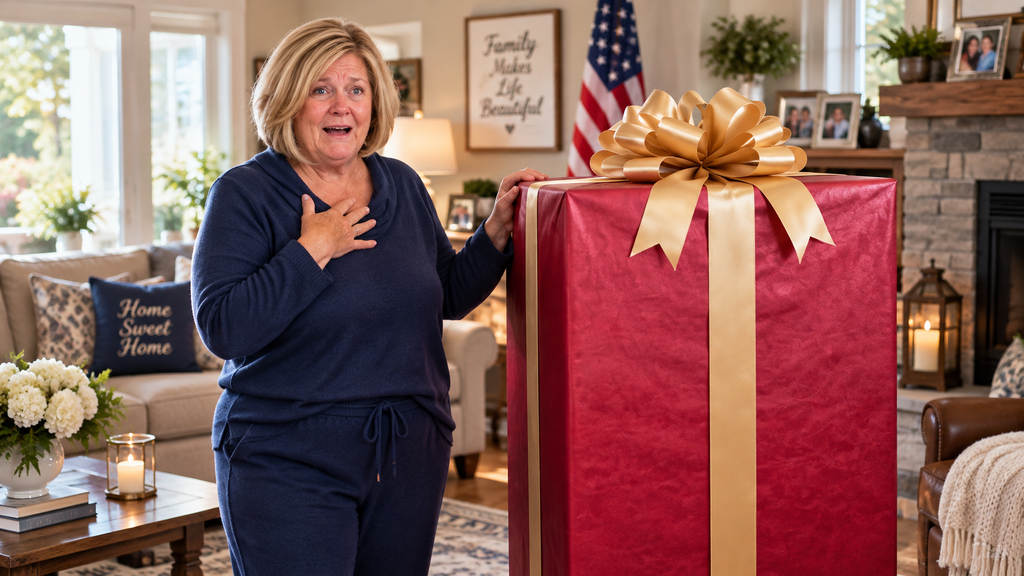
I looked down at the enormous cardboard box sitting between David and me.
Twelve birthday presents.
Twelve.
All of them were there.
The necklace I had mailed Chloe when she turned eighteen.
The handbag I had sent at twenty-one.
The cookbook at twenty-five.
The scarf I had chosen because I remembered blue had once been her favorite color.
The small framed photograph I had sent when she turned twenty-seven—a picture of David, Chloe, and her mother taken when Chloe was a little girl.
I had spent hours restoring that photograph.
I had worried it might hurt her.
I had almost not mailed it.
But I had included a note telling her I hoped the picture reminded her that love did not disappear simply because a person was gone.
That package was sitting in front of me.
Unopened.
Not rejected by Chloe.
Not refused.
Not unwanted.
Hidden.
Returned.
Manipulated.
My hands felt numb.
I reached for the first package.
The postal label still carried my handwriting.
CHLOE BENNETT.
Below it was her old college address.
Across the front, in thick black marker, were the words that had broken my heart twelve separate times.
RETURN TO SENDER.
I ran my finger across the handwriting.
Something about it suddenly looked familiar.
I stared.
Then I slowly turned toward David.
“Did you write this?”
He didn’t answer.
“David.”
His jaw tightened.
“Did you write this?”
He looked toward the window.
That was when I knew.
I had seen that handwriting thousands of times.
Shopping lists.
Christmas cards.
Notes on the refrigerator.
Checks.
Birthday cards to his coworkers.
It had never occurred to me to compare them.
Why would it?
Why would a wife ever look at a returned birthday present and wonder whether her own husband had written RETURN TO SENDER across the package?
I picked up another.
Same handwriting.
Another.
Same.
My stomach twisted.
“You did.”
David finally looked at me.
“Alice, this is more complicated than it looks.”
I laughed.
I didn’t mean to.
The sound came out thin and strange.
“More complicated?”
“A lot happened back then.”
“You told me she sent these back.”
“She did not want contact.”
“You told me she hated me.”
“She was angry.”
“You told me you had spoken to her.”
“I did.”
“You told me she said she couldn’t stand having me in this house.”
He stood abruptly.
“I was trying to protect everyone.”
I stared at him.
That sentence did something inside me.
Not because it explained anything.
Because I had heard it before.
David had used some version of it throughout our marriage.
I’m only trying to protect you.
You don’t need to worry about this.
I already handled it.
Let me deal with Chloe.
Don’t call her right now.
She needs space.
Don’t send another message.
It’ll only upset her.
I had mistaken control for competence.
I had mistaken secrecy for protection.
And worst of all, I had mistaken his lies for kindness.
I stood too.
“Protect everyone from what?”
David rubbed both hands over his face.
“Alice, please.”
“From what?”
He glanced at the box.
Then something changed in his expression.
Fear.
Not guilt.
Not embarrassment.
Fear.
And suddenly I understood something terrifying.
The birthday presents were not the whole story.
They were only the beginning.
I lowered my eyes toward the box.
Beneath the returned packages were several thick envelopes.
One had Chloe’s name on it.
My handwriting.
Another.
And another.
Letters.
I recognized them immediately.
I had written them years ago.
Not birthday cards.
Letters.
Letters I had given David because he had told me he would mail them himself.
I remembered one especially clearly.
Chloe had been twenty.
I had sat at our kitchen table until almost two in the morning writing it.
I had apologized if my presence in her father’s life had ever made her feel that her mother had been replaced.
I told her that her mother’s photographs would always have a place in our house.
I told her she did not owe me love.
She did not owe me the word “Mom.”
She did not owe me forgiveness for something I still didn’t understand.
I only wanted her to know that our door would never be closed to her.
David had kissed my forehead the next morning.
“I’ll send it,” he had said.
He never did.
I picked up the envelope.
Still sealed.
My knees nearly gave out.
“You kept this.”
David stepped toward me.
“Alice—”
I moved away so fast that he stopped.
“Don’t touch me.”
His hand dropped.
There were more letters.
Six that I could remember writing.
Maybe more.
Some addressed to apartments Chloe had lived in.
One to her graduate school.
One simply marked PERSONAL because I had been terrified a roommate might open it.
All still sealed.
All hidden.
My chest started aching.
“Where did she find these?”
David said nothing.
I looked at Chloe’s note again.
Until I found your old letters hidden in his office.
His office.
Twenty feet down the hallway.
The room I dusted every week.
The room where I brought him coffee.
The room where I sometimes stood in the doorway and asked whether he wanted lunch.
For twelve years, evidence of his betrayal had been sitting inside my own house.
Maybe only a few feet away.
I felt suddenly sick.
I reached deeper into the box.
There was a folder.
Inside were postal receipts.
Tracking numbers.
Copies of addresses.
Dates.
Then I found photographs.
Not photographs I had seen before.
Screenshots.
Text messages.
Some were between Chloe and David.
Others appeared to be from old emails.
I read the first one.
It was dated nearly twelve years earlier.
Chloe:
Dad, please stop asking me to come home while she’s there. I don’t know what you told her, but I’m not doing this anymore.
David:
Alice doesn’t want you here anyway.
Chloe:
You said she wanted me gone.
David:
She thinks you’re a reminder of the past.
My breath caught.
I read it again.
A reminder of the past.
I had never said anything remotely like that.
Never.
There was another screenshot.
Chloe:
Why did she send me a friend request if she doesn’t want contact?
David:
Probably for appearances. Don’t engage.
Another.
Chloe:
Did Alice really say Mom’s things need to go?
David:
Yes. She says it’s unhealthy having another woman’s belongings everywhere.
My vision blurred.
I lowered the page.
For years, one entire wall of our upstairs hallway had displayed photographs of Chloe’s mother.
I had insisted they stay.
David had once suggested moving them into storage.
I had told him absolutely not.
“That was her home before it was mine,” I had said.
“Chloe should never walk through this house and feel like her mother has been erased.”
David had smiled.
He had called me compassionate.
And then he had apparently told Chloe the opposite.
My fingers shook as I turned another page.
Chloe:
I want Grandma’s necklace back.
David:
Alice has it.
I actually gasped.
I knew exactly which necklace Chloe meant.
A gold locket that had belonged to her maternal grandmother.
After Chloe’s mother died, David told me Chloe had taken it to college.
I had never touched it.
I had never even seen it.
Another message.
Chloe:
Why would she take Mom’s jewelry?
David:
I told you what she’s like.
I dropped the page.
“What did you do with the necklace?”
David’s face hardened.
“Alice, enough.”
“Where is it?”
“It was years ago.”
“That is not an answer.”
“I sold some things.”
The room seemed to tilt.
“You what?”
“We needed money.”
“No.”
“Yes.”
“We did not need money.”
“You didn’t know everything about our finances.”
The words hit me like cold water.
I stared at him.
“What finances?”
He closed his eyes.
And that was when Chloe’s final sentence in the letter came back to me.
Look inside, and you’ll understand everything.
I looked inside again.
At the very bottom of the box was another folder.
This one was thick.
Legal-sized.
A rubber band held it closed.
Written across the front were four words.
MOM’S ESTATE — DAD.
I looked at David.
He moved.
Not toward me.
Toward the folder.
Instinct took over.
I grabbed it first and stepped backward.
“Alice, give me that.”
“No.”
“That is private.”
“Apparently our entire marriage has been private.”
“Alice.”
He reached again.
I backed toward the fireplace.
“Do not come any closer.”
Something in my voice must have convinced him.
He stopped.
I removed the rubber band.
Inside were copies of bank statements.
Trust documents.
Letters from attorneys.
Property records.
Statements from an investment account.
At first, I couldn’t understand what I was seeing.
Then I found a document with Chloe’s name printed across the top.
BENNETT FAMILY EDUCATION TRUST.
Beneficiary: Chloe Marie Bennett.
Initial balance: $184,600.
My eyes widened.
I had never known Chloe had a trust.
Her mother had created it.
There were withdrawals.
Large ones.
Twenty-five thousand.
Forty thousand.
Another thirty-two.
All occurring after her mother’s death.
Before Chloe turned eighteen.
The authorization signatures belonged to David.
By the time Chloe reached college, less than fourteen thousand dollars remained.
I looked up.
“What is this?”
He said nothing.
“What did you do?”
“Alice, you don’t understand what was happening.”
“You took her college money?”
“I borrowed money.”
“From your seventeen-year-old daughter?”
“I was going to replace it.”
“Did you?”
Silence.
“Did you replace it?”
“No.”
I stared at him.
The memory came instantly.
Chloe’s first year of college.
David had complained constantly about tuition.
“She refuses to take responsibility,” he had said.
“She expects me to pay for everything.”
I had written a check.
Twenty thousand dollars.
From money I had inherited from my aunt.
I told David to use it toward Chloe’s tuition.
I had been afraid Chloe would refuse if she knew it came from me, so I asked David not to mention my name.
He had hugged me.
Called me generous.
Told me it would mean the world to his daughter someday.
I whispered, “My twenty thousand.”
David looked away.
“You said it went to her tuition.”
“It covered expenses.”
“What expenses?”
“Household things.”
“We were not struggling.”
“My business was.”
I stared at him.
David had owned a small construction company then.
He told me it had gone through a slow period but recovered.
Apparently, I had known nothing.
“How much?”
He frowned.
“How much money did you take?”
“Alice—”
“HOW MUCH?”
My voice cracked through the room.
David flinched.
For the first time in our marriage, I saw him look frightened of me.
Not because I was dangerous.
Because I finally knew enough to stop believing him.
He lowered his voice.
“About two hundred and thirty thousand.”
I felt my mouth go dry.
“From Chloe?”
“Not all of it.”
“From where else?”
He looked toward the floor.
“My retirement account.”
“That was your money.”
“And some of yours.”
I stopped breathing.
“What?”
“It was joint money.”
“What money?”
“Your investment account.”
My legs nearly failed.
After my aunt died, I had inherited money.
Not a fortune.
Enough to provide security.
I had placed most of it in an investment account.
David helped manage household paperwork because he had always claimed he was better with finances.
I had trusted him.
My voice was barely audible.
“How much of mine?”
He didn’t answer.
I stepped closer.
“How much?”
“About ninety thousand.”
I felt something inside me break.
Not loudly.
Quietly.
Like ice cracking beneath weight.
I had spent twelve years thinking I had failed a seventeen-year-old girl.
I had spent twelve years apologizing to a person who never received my apologies.
I had spent twelve years blaming myself for a wound David had deliberately created.
And while I was busy questioning my own heart, my husband had been stealing from both of us.
But even then, money was not the worst part.
Money could perhaps be repaid.
Years could not.
I held up the screenshots.
“You made her believe I stole her mother’s jewelry.”
David’s shoulders sagged.
“She already hated the idea of me remarrying.”
“So you fed it.”
“I was trying to keep her away from the financial situation.”
“By making her hate me?”
“If she had stayed close to you, she would have told you things.”
There it was.
Finally.
The truth.
Not protecting her.
Not protecting me.
Protecting himself.
He had needed two women who loved him to never compare stories.
So he made us enemies.
I laughed again, but this time tears came with it.
“You were afraid we would talk.”
David didn’t deny it.
“You knew if Chloe told me about her trust, I’d ask questions.”
Silence.
“You knew if I told Chloe I had given you money for her tuition, she would ask where it went.”
Silence.
“You knew if she told me you said I wanted her mother’s belongings removed, I would know you were lying.”
Silence.
Every unanswered question became an admission.
I pressed one hand over my mouth.
I suddenly remembered a hundred small moments.
Chloe leaving the room when I entered.
The expression on her face when I had once touched a framed picture of her mother.
The way she had stared at me during dinner shortly before leaving for college.
At the time, I thought it was hatred.
Now I wondered if it had been fear.
She had believed I was trying to erase her mother.
And I had believed she resented me for simply existing.
All because David stood between us translating love into cruelty.
“How could you?”
He finally looked at me.
“I panicked.”
“For twelve years?”
“It started as one lie.”
“No.”
“Alice—”
“No. Do not minimize this.”
He stepped toward me again.
I raised my hand.
“One lie does not intercept twelve birthday presents.”
He stopped.
“One lie does not hide six letters.”
My voice was shaking now.
“One lie does not delete messages.”
Tears blurred my vision.
“One lie does not tell a grieving daughter that her stepmother hates her.”
David’s face tightened.
“You don’t know what Chloe was like then.”
“And you don’t get to use her grief as an excuse.”
“She was angry at everyone.”
“She was seventeen.”
“She threatened to expose everything.”
I froze.
“Everything?”
He knew immediately he had said too much.
I looked back into the folder.
There had to be more.
I turned page after page.
Then I found a handwritten letter.
Not mine.
Chloe’s.
It was dated two weeks before she left for college.
Dad,
I found the withdrawal notices.
I know Mom’s education account didn’t disappear because of the market like you told me.
There are your signatures on everything.
You also sold Grandma’s locket, and I know because I called the jeweler.
If you don’t tell Alice the truth, I will.
She keeps trying to be nice to me, and I don’t think she knows any of this.
I don’t trust you anymore.
Chloe.
I read those last two lines again.
She keeps trying to be nice to me.
I don’t think she knows.
My hand went to my chest.
Even at seventeen, Chloe had known.
At least for a moment.
She had known I wasn’t the enemy.
I looked at David.
“What did you do after she wrote this?”
His expression told me he didn’t want to answer.
“What did you do?”
“I spoke to her.”
“What did you tell her?”
“It doesn’t matter now.”
“It matters to me.”
His mouth tightened.
I stepped closer.
“What did you tell that seventeen-year-old girl to make her leave this house and never come back?”
David stared at me for several long seconds.
Then he sat heavily on the sofa.
He suddenly looked older.
Not softer.
Just smaller.
“I told her you knew.”
The words barely registered.
“What?”
“I told Chloe you knew about the money.”
I stared at him.
“I told her some of it had been your idea.”
For a moment, I genuinely thought I might collapse.
He continued quickly, perhaps believing momentum would somehow make the confession easier.
“I told her you thought the trust should be used for the household because we were married and everything needed to be shared.”
I could hear my heartbeat.
“I told her you thought her mother had left too much money under Chloe’s control.”
My eyes filled.
David looked away.
“And I told her you wanted her gone before she started college.”
I couldn’t speak.
“She believed you?”
“At first.”
“At first?”
“She confronted me again later.”
“What happened?”
“She wanted to talk to you privately.”
A memory flashed.
One summer evening.
Chloe standing at the kitchen doorway.
She had looked nervous.
“Alice, can I ask you something?”
Before I could answer, David had entered behind her.
He put his arm around her shoulders.
“Chloe and I need to talk.”
She had gone pale.
He guided her out of the room.
Twenty minutes later, I heard the front door slam.
I never saw her again before she left for college.
I had asked David what happened.
He told me Chloe had called me a gold digger.
I believed him.
God help me.
I believed him.
“What did you say to her that night?”
David rubbed his forehead.
“I told her if she involved you, our marriage might end.”
I waited.
“And?”
“I told her you had been through enough.”
“And?”
He didn’t answer.
“David.”
“I told her you had depression.”
My entire body went cold.
I had never suffered from clinical depression.
I had struggled after my first husband died years before meeting David.
For several months I had attended grief counseling.
That was all.
“What exactly did you say?”
“I said you were emotionally fragile.”
My face burned.
“I told her if she confronted you and something happened, she would have to live with it.”
I stared at him in horror.
“You made a grieving seventeen-year-old believe telling me the truth might cause me to hurt myself?”
He said nothing.
I stepped backward.
That was the moment something in me ended.
Not began to end.
Ended.
My marriage did not die because David stole money.
It did not die because he hid packages.
It did not even die because he lied.
It died because I suddenly understood exactly what kind of fear he had placed inside a child.
Chloe had not stayed away because she hated me.
She had stayed away because she thought she was protecting me.
Just as I had stayed away from her because I thought I was respecting her wishes.
David had taken the best instincts in both of us and weaponized them.
Her concern.
My restraint.
Her grief.
My patience.
Our love for him.
He had twisted every decent thing into a lock and then kept the key.
I sank into the armchair.
Tears came silently.
David moved toward me.
I looked up.
“Leave.”
“Alice.”
“Get out.”
“This is my house too.”
“Then go to a hotel.”
“We need to talk.”
“We have been talking for twelve years.”
“That isn’t fair.”
I stared at him.
For once, the absurdity was almost funny.
“Fair?”
He opened his mouth.
I stood.
“No. You do not get that word.”
“Alice, I made mistakes.”
“Mistakes?”
“Yes.”
“You forgot an anniversary once. That’s a mistake.”
My voice rose.
“You burned dinner. That’s a mistake.”
I pointed toward the box.
“This took planning.”
“Alice—”
“You intercepted mail.”
I pointed toward the office.
“You hid letters.”
I pointed toward his phone lying on the table.
“You deleted messages.”
My chest heaved.
“You stole from your daughter.”
He looked down.
“You stole from me.”
Silence.
“And then you spent more than a decade watching me cry every time one of those packages came back.”
That finally made him look at me.
Because he remembered.
Of course he remembered.
My forty-sixth birthday.
I had gone upstairs early after Chloe’s package came back.
David found me sitting on the edge of the bed.
He held me while I cried.
He told me I had tried.
He told me some people simply did not want love.
He told me to stop blaming myself.
The man who created the wound had comforted me for bleeding.
I whispered, “You watched me.”
His eyes filled.
Maybe with shame.
Maybe with fear.
I didn’t care anymore.
“You sat beside me.”
“Alice…”
“You held me while I cried over something you had done.”
“I didn’t know how to undo it.”
“You could have told the truth.”
“It would have destroyed everything.”
I looked around the room.
The photographs.
The furniture.
The wedding picture on the wall.
“No, David.”
My voice became very quiet.
“The truth wouldn’t have destroyed everything.”
I looked directly into his eyes.
“You did.”
He left forty minutes later.
Not because he wanted to.
Because I called my attorney.
Her name was Margaret Ellis.
She had handled my aunt’s estate years earlier.
I had not spoken to her in almost a decade.
When she answered, I said six words.
“Margaret, I think David stole money.”
Her tone changed immediately.
“Do you have documents?”
“Yes.”
“Are you safe?”
“Yes.”
“Is he in the house?”
“Yes.”
“Do not let him take or destroy anything. Photograph every page. Send copies somewhere he cannot access. Change passwords to any financial accounts in your name. If you believe he might become threatening, call the police.”
David stood across the room listening.
The color slowly disappeared from his face.
Margaret continued.
“And Alice?”
“Yes?”
“Do not sign anything he gives you.”
I almost laughed.
For twelve years I had signed whatever David placed in front of me.
Tax documents.
Insurance forms.
Investment forms.
Mortgage papers.
He would put little yellow tabs beside the signature lines.
“Just sign here.”
And I would.
Because he was my husband.
Because trust makes ordinary things invisible.
The moment I hung up, David said, “You’re really calling lawyers?”
I looked at him.
“You really stole from your daughter?”
His expression hardened.
“I told you, I borrowed—”
“Leave.”
“Alice, if lawyers get involved, this becomes ugly.”
“It became ugly when you told a seventeen-year-old girl she might destroy me by telling me the truth.”
He grabbed his coat.
At the door, he turned.
“You’re going to throw away thirteen years of marriage?”
I stared at him.
Then I looked at the box.
“No.”
My voice broke.
“You threw away thirteen years.”
The door closed.
I locked it.
Then I locked the back door.
Then I changed the code on the alarm system.
Then I stood alone in the hallway and realized something.
Chloe.
I had not called her.
My hands shook so badly I nearly dropped my phone.
I had her number.
Of course I had her number.
I had always had it.
I had called it dozens of times over the years.
David told me she blocked me.
Sometimes the call went straight to voicemail.
Sometimes it rang.
I had stopped leaving messages because David told me they upset her.
Now I stared at her name.
CHLOE.
I pressed call.
One ring.
Two.
Three.
My courage began disappearing.
Four.
Then someone answered.
Neither of us spoke.
I heard breathing.
Then a woman’s voice.
Older than the teenager I remembered.
But unmistakably hers.
“Alice?”
One word.
My name.
After twelve years.
I started crying before I could stop myself.
“Chloe.”
Silence.
Then I heard her inhale sharply.
“I got the box.”
“I know.”
“I read everything.”
Another silence.
“I’m sorry,” we both said at exactly the same time.
That shattered me.
“No,” I said quickly. “No, sweetheart, you have nothing to apologize for.”
The word sweetheart slipped out naturally.
I expected her to pull away.
She didn’t.
“I should have called you years ago,” she said.
“I should have driven across the country and found you.”
“He told me you didn’t want me.”
“He told me you hated me.”
“I believed him.”
“So did I.”
We both went quiet.
There was something unbearable about realizing how perfectly we had been manipulated.
Two women standing on opposite sides of the same locked door, each believing the other had turned the key.
“Chloe,” I whispered, “did you really never get any of the presents?”
“No.”
Her voice cracked.
“Not one.”
I closed my eyes.
“I thought you sent every one of them back.”
“I didn’t even know you were sending them.”
I pressed my fist to my mouth.
She continued.
“I found the box in Dad’s office six days ago.”
“How?”
“He asked me to find an old insurance file.”
“You were here?”
“No. He has a storage office near his business.”
I hadn’t known that.
“He gave me the key because he was out of town for a meeting. I opened a cabinet looking for the insurance papers.”
Her voice became unsteady.
“And I saw my name.”
I sat slowly on the sofa.
“There were twelve packages.”
“Yes.”
“I thought they were things from Mom at first.”
That sentence hurt in a different way.
“Then I saw your handwriting.”
She started crying.
“I opened one.”
I covered my eyes.
“The necklace.”
“The one from when you were eighteen?”
“Yes.”
“I’m sorry.”
“Why are you apologizing?”
“Because I thought maybe it was too personal.”
“Alice…”
Her voice disappeared for a moment.
Then she came back.
“I wore it yesterday.”
I stopped breathing.
“What?”
“The necklace.”
I began sobbing.
“I opened the package and found the note.”
I knew the note.
I had written:
You never have to call me your mother. But I hope one day, when this doesn’t hurt so much, you might be able to call me your friend.
Chloe whispered, “I read it probably twenty times.”
I couldn’t answer.
“Then I opened everything.”
“All of them?”
“Yes.”
“The cookbook?”
A little laugh came through her tears.
“Yes.”
“It was probably outdated.”
“It’s terrible.”
I laughed.
For the first time that day, I genuinely laughed.
“So you hate it?”
“No.”
Her voice softened.
“I love it.”
We both cried again.
Then she said something that broke my heart more gently.
“I kept wondering why you remembered things.”
“What things?”
“That I liked baking.”
I looked at the old box.
“Of course I remembered.”
“I thought you barely noticed me.”
“I noticed everything.”
Silence.
“You used to leave flour on every surface in the kitchen.”
She laughed through tears.
“You hated that.”
“I pretended to hate it.”
“You complained constantly.”
“Because you somehow got flour inside the silverware drawer.”
“I still don’t know how that happened.”
“I do.”
“How?”
“You were seventeen.”
She laughed harder.
And suddenly, for ten seconds, twelve years disappeared.
She was seventeen again.
I was standing in a flour-covered kitchen.
There was banana bread burning in the oven.
She was rolling her eyes at me because I had told her baking soda and baking powder were not interchangeable.
I could almost smell it.
Then the laughter faded.
“Alice?”
“Yes?”
“I need to tell you something else.”
My stomach tightened.
“What?”
“I didn’t send that box just because of the gifts.”
I looked toward the folders.
“The money.”
“Yes.”
“I saw the trust records.”
“I only found out today.”
“There’s more.”
I closed my eyes.
Of course there was.
“How much more?”
“I don’t know yet.”
“What do you mean?”
“I’ve been gathering documents all week.”
She paused.
“Dad didn’t just take from the education trust.”
I went still.
“There was another account.”
“What account?”
“Mom left money for me that I wasn’t supposed to access until I turned thirty.”
“How much?”
“Almost four hundred thousand originally.”
My mouth went dry.
“Is it gone?”
“Most of it.”
I stood.
“How?”
“Dad was trustee.”
I understood enough to know what that meant.
“He had legal control?”
“Until I turned thirty.”
“And you’re thirty now?”
“Thirty-one.”
“Did he ever transfer it to you?”
“No.”
My knees weakened.
“He told me the trust had been dissolved years ago because of tax problems.”
“Is that possible?”
“My attorney says not the way he described it.”
“Your attorney?”
“I hired one four days ago.”
I closed my eyes.
Good.
She had not faced this alone.
“My lawyer is named Elena Park. She specializes in trust litigation. She says some of the signatures may have been forged.”
The room felt suddenly cold.
“Whose signatures?”
“Mine.”
I sat again.
Then Chloe said, “Alice, some of yours might be too.”
I stopped.
“What?”
“I found paperwork involving your inheritance account.”
“I know about the ninety thousand.”
“No.”
A pause.
“It’s more.”
I looked toward the hallway as though David might somehow still be listening.
“How much?”
“I don’t know yet.”
My mouth dried.
“But I think you need to freeze everything immediately.”
“I already called Margaret Ellis.”
“Your attorney?”
“Yes.”
“Good.”
There was a long silence.
Then Chloe whispered, “I’m sorry I sent it without warning.”
“I’m glad you did.”
“I almost called first.”
“Why didn’t you?”
“Because…”
She hesitated.
“I was afraid you would tell him.”
That hurt.
Not because she had done anything wrong.
Because David had destroyed her ability to know whom she could trust.
“I understand.”
“I didn’t know if you were part of it.”
“I understand.”
“I wanted you to see the evidence before he could explain it away.”
“You did the right thing.”
Her voice broke again.
“I wanted you to believe me.”
I closed my eyes.
“Chloe.”
“Yes?”
“I believe you.”
Silence.
“I believe you.”
She began crying.
So did I.
And for the first time in twelve years, I was crying because something lost had begun finding its way home.
The next three days were chaos.
Margaret came to the house the following morning.
She brought a forensic accountant named Peter Lawson.
Until that day, I had believed forensic accountants existed mostly in movies and corporate scandals.
Peter was sixty, soft-spoken, and terrifyingly efficient.
He sat at my dining room table with two laptops and asked me questions that made me realize just how little I knew about my own financial life.
Who prepared the taxes?
David.
Who received investment statements?
David.
Who had online access?
David.
Who handled insurance?
David.
Who communicated with our financial adviser?
David.
Who opened the mail?
Usually David.
Peter finally removed his glasses.
“Alice, did you ever review these accounts independently?”
The shame came instantly.
“No.”
Margaret interrupted.
“There is no shame in trusting your spouse.”
I looked at her.
“There is when your spouse is David.”
She shook her head.
“The shame belongs to the person who abuses trust, not the person who gives it.”
I wanted to believe that.
Eventually, I would.
But not yet.
For the next forty-eight hours, every discovery seemed worse than the last.
The ninety thousand dollars David admitted taking from my investment account?
It was one hundred and seventy-six thousand.
The twenty thousand I gave him for Chloe’s tuition?
It had gone into his company’s operating account.
The following week, fourteen thousand of it had been transferred to a personal credit card.
There were cash withdrawals.
Casino charges.
Hotel expenses.
Payments to a private lender.
Peter looked at several statements.
“This wasn’t one bad business decision.”
“What was it?”
“A pattern.”
I already knew that.
But hearing someone else say it made it real.
David had spent years moving money between accounts to cover earlier losses.
He borrowed from Chloe’s trust to save the business.
Then borrowed from my inheritance to cover Chloe’s missing trust funds.
Then used credit to cover my missing investments.
Every lie required another lie.
Every theft required another theft.
Every person who might compare notes had to be separated.
That explained us.
Chloe and me.
We were dangerous together.
Separated, we were easy to control.
Together, we had dates.
Receipts.
Memories.
Questions.
Together, we could see the whole picture.
On the third evening, Margaret looked at me over a stack of documents.
“You need to prepare yourself.”
“For what?”
“There is enough here that this may become more than a divorce case.”
I knew what she meant.
“Criminal?”
“Potentially.”
I stared at the table.
For thirteen years, David had slept beside me.
He knew how I liked my coffee.
He knew I hated thunderstorms.
He knew I slept better with the bedroom door slightly open.
He bought me tulips every spring.
He rubbed my shoulders when I had headaches.
He remembered the anniversary of my first husband’s death and never complained when I visited the cemetery.
People imagine betrayal arrives wearing a villain’s face.
It doesn’t.
Sometimes betrayal makes your coffee.
Sometimes it asks whether you remembered your umbrella.
Sometimes it kisses your forehead before bed.
That is what makes it betrayal.
My phone rang.
David.
I watched it.
Margaret looked at me.
“You don’t have to answer.”
“I know.”
It rang again.
Then stopped.
A message appeared.
PLEASE TALK TO ME BEFORE YOU RUIN OUR FAMILY.
I stared at it.
Something about those words almost made me angry enough to laugh.
Our family.
I typed nothing.
Thirty seconds later, another message arrived.
CHLOE IS MANIPULATING YOU BECAUSE SHE WANTS MONEY.
I showed Margaret.
She photographed the screen.
“Save everything.”
Another message.
SHE HAS ALWAYS BEEN VINDICTIVE.
I felt sick.
Even now.
Even with everything exposed.
He was still trying to turn us against each other.
Still trying the only strategy that had ever worked.
I typed one sentence.
Do not contact me except through my attorney.
His response came instantly.
ALICE PLEASE.
Then:
I LOVE YOU.
I stared at those words for a very long time.
Once, they had mattered more than almost anything.
Now they looked strangely small.
I blocked his number.
That evening, Chloe called.
“I’m coming tomorrow.”
I sat upright.
“Here?”
“Yes.”
My heart began pounding.
“You don’t have to.”
“I know.”
“You can take your time.”
“I’ve taken twelve years.”
I closed my eyes.
“When?”
“My flight lands at eleven.”
“I’ll pick you up.”
“No.”
The answer came quickly.
My heart fell.
Then she added, “I already rented a car.”
I smiled through tears.
“Of course you did.”
“I’m thirty-one, Alice.”
“You’ll always be seventeen in my kitchen with flour in your hair.”
She laughed.
Then there was a pause.
“Are you nervous?”
“Yes.”
“Me too.”
“What if it’s awkward?”
“It will be.”
I laughed.
“Probably.”
“What if we don’t know what to say?”
“Then we’ll sit quietly.”
Another pause.
“Alice?”
“Yes?”
“Do you still make that terrible chicken casserole?”
I put my hand over my heart.
“It is not terrible.”
“It has canned soup in it.”
“That’s why it’s good.”
“I’ll be there around one.”
“I’ll make it.”
“You really don’t have to.”
“I know.”
The next morning, I cleaned the house like someone preparing for royalty.
Then I stopped myself.
Chloe was not royalty.
She was family.
Or at least, perhaps, she could be again.
So I stopped polishing the silver.
I left the cushions alone.
I put the chicken casserole in the oven.
Then I did something I had not done in twelve years.
I opened the closet in the upstairs hallway.
Inside were boxes containing things from Chloe’s childhood.
David had wanted to throw them away years earlier.
I refused.
School yearbooks.
A ceramic horse Chloe painted when she was nine.
A sweater belonging to her mother.
Three photo albums.
A tiny pair of red rain boots.
I had kept them because I told myself one day she might want them.
I carried the albums downstairs.
At 1:17 p.m., a car pulled into the driveway.
I stood in the kitchen.
For several seconds, I couldn’t move.
Then I heard a car door close.
Footsteps.
The doorbell rang.
My own front door.
Chloe had lived in this house once.
Now she was ringing the bell.
I walked toward it.
My hand paused on the knob.
Twelve years.
On the other side of a piece of wood.
I opened the door.
Chloe stood there.
Thirty-one years old.
Her hair was shorter.
There were faint lines at the corners of her eyes.
She wore jeans, a cream sweater, and the necklace I had mailed for her eighteenth birthday.
When I saw it, my breath caught.
She touched it instinctively.
Neither of us spoke.
Then Chloe smiled.
Not a big smile.
A nervous one.
“Hi, Alice.”
I started crying immediately.
“Oh, that’s embarrassing.”
She laughed through tears.
Then she started crying too.
“So much for being normal.”
“I don’t think normal is available anymore.”
We stood there looking at each other.
I wanted to hug her.
But I didn’t know whether I had the right.
Maybe she saw the question on my face.
Because she stepped forward.
And wrapped both arms around me.
I had imagined that hug many times.
During holidays.
Birthdays.
Lonely Sunday afternoons.
I imagined I would say something perfect.
Something meaningful.
Instead I made a broken sound and held her so tightly I worried I might hurt her.
She held me just as tightly.
“I’m sorry,” she whispered.
“No.”
“I wasted so much time.”
“No.”
“I should have known.”
“No, Chloe.”
I pulled back and took her face between my hands.
“You were a child.”
“I was seventeen.”
“A child.”
“I became an adult.”
“An adult who had been lied to by the person she trusted most.”
Her eyes filled.
“You believed him too.”
“Yes.”
“So maybe we were both idiots.”
I laughed.
“That is an interpretation I can live with.”
She smiled.
Then she looked past me.
“Is he here?”
“No.”
Her shoulders relaxed visibly.
That hurt to see.
I stepped aside.
“Come home.”
She froze.
The words had come naturally.
For a moment, I worried I had gone too far.
Then Chloe walked inside.
The first thing she noticed was the wall.
Her mother’s photographs.
Still there.
All of them.
She stopped.
“You kept these?”
“Of course.”
“Dad said you hated them.”
“I know.”
Her hand rose toward one photograph.
Her mother laughing on a beach.
Chloe touched the frame.
“He said you wanted everything of hers boxed up.”
“No.”
A tear slid down Chloe’s cheek.
“He told me you threw away her clothes.”
“They’re upstairs.”
She looked at me.
“What?”
“Not all of them. Some were donated because your father told me that was what you wanted. But I kept several boxes because it didn’t feel right getting rid of everything.”
Her lips parted.
“You kept them?”
“Yes.”
She started crying again.
I took her hand.
“Come upstairs.”
We sat on the floor of the hallway closet for nearly an hour.
She opened boxes slowly.
A sweater.
Her mother’s recipe cards.
Old birthday photographs.
A perfume bottle.
A scarf.
A handwritten Christmas list.
When Chloe picked up the sweater, she pressed it against her face.
For a moment, she looked seventeen again.
I looked away to give her privacy.
She reached for my hand.
So I stayed.
That afternoon, we ate chicken casserole at the kitchen table.
She took one bite.
“It’s worse than I remembered.”
“Leave.”
She laughed.
“I just got here.”
“Then show some respect.”
She took another bite.
“Still terrible.”
“You’re eating it.”
“I’m hungry.”
It was absurd.
Ordinary.
Beautiful.
After lunch, we opened the birthday presents together.
Not because she needed to.
Because I wanted to see what twelve lost birthdays looked like when finally given back.
The eighteenth-birthday necklace was already around her neck.
At nineteen, I had sent a fountain pen.
“I was studying journalism,” she said.
“I remembered.”
She stared at me.
“You remembered that?”
“Of course.”
At twenty, I had sent a thick wool blanket because David told me her apartment heating was terrible.
She unfolded it.
“You sent this?”
“Yes.”
“I was freezing that winter.”
My heart hurt.
At twenty-one was the handbag.
At twenty-two, a set of earrings.
At twenty-three, a framed recipe handwritten by her mother.
Chloe stared at it.
“Where did you get this?”
“It was stuck inside one of her old cookbooks.”
She covered her mouth.
At twenty-four, a pair of gardening gloves and heirloom tomato seeds.
“You remembered the garden.”
“You destroyed my tomatoes when you were seventeen.”
“They were already dying.”
“You watered them with sports drink.”
“It had electrolytes.”
We both laughed until we cried.
At twenty-five, the cookbook.
At twenty-six, a blue scarf.
At twenty-seven, the restored family photograph.
At twenty-eight, a journal.
At twenty-nine, a small silver bracelet.
I watched her open it.
Inside I had engraved:
FOR ALL THE ROADS THAT BRING YOU HOME.
Chloe stared at the words.
“I didn’t know,” she whispered.
“I know.”
At thirty, I had sent a small wooden box.
Inside was a key.
She looked confused.
“What does this open?”
I smiled.
“The lake cabin.”
Her eyes widened.
“What?”
“My aunt left me a small cabin in Vermont.”
“I remember.”
“I put your name on it.”
She stared at me.
“When?”
“Three years ago.”
“Why?”
“Because I didn’t have children of my own.”
Her face changed.
“And because whether you wanted me in your life or not, I always considered you family.”
She began crying.
“Alice…”
“I didn’t do it to make you feel obligated.”
“Why didn’t Dad tell me?”
I gave her a sad smile.
“I think we know.”
She looked at the key for a very long time.
Then came the twelfth package.
The final returned birthday present.
Thirty-one.
A photo album.
Empty.
The first page contained one sentence in my handwriting.
Maybe one day we can fill this with something new.
Chloe closed the album.
Neither of us spoke.
Then she looked at me.
“We can.”
My eyes filled.
“We can?”
She nodded.
“We lost twelve years.”
“Yes.”
“I don’t want to lose thirteen.”
That was the moment I stopped mourning only what had been stolen.
Because something remained.
Time.
Not the time behind us.
The time ahead.
That evening we talked until nearly midnight.
Chloe told me about her life.
She had become an editor for a small publishing company.
She lived outside Boston.
She had been married once.
Briefly.
I had not known.
That hurt.
She saw my face.
“It lasted fourteen months.”
“I’m sorry.”
“Don’t be.”
“Was he terrible?”
“No.”
“That almost makes it worse.”
She smiled.
“We were just wrong for each other.”
I nodded.
“Any children?”
Her expression changed.
“No.”
Then she looked at me carefully.
“But I’m engaged.”
My mouth fell open.
“You’re what?”
She laughed.
“Engaged.”
“To whom?”
“His name is Marcus.”
“How long?”
“Three years.”
“Three years?”
“I had a whole life while we weren’t speaking.”
“I know.”
I tried to smile.
But tears came.
Chloe reached across the table.
“Hey.”
“I missed everything.”
“I know.”
“I missed your wedding.”
“It wasn’t much of a wedding.”
“I missed your divorce.”
“That was more exciting.”
I laughed through tears.
“I missed meeting Marcus.”
“You can meet him.”
I looked at her.
“You want me to?”
“Of course.”
That word.
Of course.
As though twelve years of silence had never been meant to exist.
“When is the wedding?”
“Next June.”
My heart ached.
“That’s wonderful.”
She hesitated.
“There’s something else.”
I smiled nervously.
“At this point, why not?”
She took my hand.
“I want you there.”
My throat tightened.
“I’d love to be there.”
“No.”
She squeezed my fingers.
“I mean…”
Her voice trembled.
“I want you there with me.”
I frowned slightly.
“Of course.”
“My mom can’t be there.”
My eyes filled.
“I know.”
“And I would never ask anyone to replace her.”
“I know.”
“But…”
She swallowed.
“I don’t want to walk into that day alone.”
I could barely breathe.
“Chloe…”
“Would you help me get ready?”
Tears spilled down my face.
“Would you…”
She laughed nervously through tears.
“Would you maybe stand with me before the ceremony?”
I reached across the table and pulled her into my arms.
“Yes.”
The word came out broken.
“Yes.”
She buried her face against my shoulder.
And for the first time, I understood something.
Love does not always need the title people expect.
I was not Chloe’s mother.
I would never replace the woman whose photographs still hung in our hallway.
I didn’t want to.
But I had loved her.
Quietly.
Imperfectly.
From a distance I never chose.
And perhaps love does not become less real simply because somebody spent twelve years trying to hide it.
The next morning, David came to the house.
He did not call first.
The doorbell rang at 8:10.
Chloe and I were drinking coffee.
She froze when she saw him through the window.
David saw her too.
His expression changed immediately.
I walked toward the door.
“Alice,” Chloe said.
I looked back.
She was pale.
“You don’t have to answer.”
For twelve years, David had controlled the doors.
Who entered.
Who left.
Who spoke.
Who stayed silent.
That morning, I made the decision.
I opened it.
But I left the security chain in place.
David looked exhausted.
His clothes were wrinkled.
His eyes were red.
“Alice.”
“You need to leave.”
“I need five minutes.”
“No.”
Then he looked past me.
“Chloe.”
She stood.
Something in his face softened.
“Honey.”
Chloe flinched.
“Don’t.”
David looked wounded.
“You’re my daughter.”
“And you spent twelve years making me believe she hated me.”
“I made mistakes.”
Chloe walked closer.
“Stop calling them mistakes.”
I almost smiled.
Apparently we had both reached the same conclusion.
David gripped the door frame.
“I was trying to hold everything together.”
“You stole from me.”
“I was going to pay it back.”
“I was seventeen.”
“The business was collapsing.”
“So you took Mom’s money.”
“It was family money.”
“No.”
Chloe’s voice became steel.
“It was money she left for me.”
David looked at me.
“Alice, tell her you understand how desperate things were.”
I stared at him.
“I didn’t know.”
“You knew the business struggled.”
“You told me it was temporary.”
“It was.”
“For thirteen years?”
His expression hardened.
Chloe stepped closer to the door.
“Did you sell Grandma’s necklace?”
David looked at her.
“You already know the answer.”
“I want to hear you say it.”
He sighed.
“Yes.”
Chloe’s eyes filled.
“Why?”
“We needed cash.”
“That necklace wasn’t worth enough to save a company.”
“It helped.”
“It was mine.”
“I was your father.”
“That didn’t make it yours.”
He looked away.
She continued.
“Did Alice know?”
“No.”
“Did she ever ask you to remove Mom’s pictures?”
“No.”
“Did she ever say she wanted me gone?”
“No.”
“Did she know you were taking money from my trust?”
“No.”
“Did she take my mother’s jewelry?”
“No.”
“Did she tell you not to let me come home?”
“No.”
Every answer came quieter.
Chloe stood with tears streaming down her face.
For twelve years, I had imagined confronting the person who hated me.
Now I watched Chloe confront the person who had taught her to.
“Why?”
She asked it softly.
Not angrily.
That made it worse.
“Why did you do this to us?”
David looked at his daughter.
For a long time, he said nothing.
Then his face collapsed.
“I was scared.”
Chloe laughed bitterly.
“Of what?”
“Losing everything.”
“So you made sure we lost each other?”
“I thought I could fix the money.”
“And when you couldn’t?”
“I needed time.”
“Twelve years?”
“I kept thinking another project would come through.”
“So every year when Alice mailed me something…”
His eyes closed.
Chloe waited.
“You intercepted it.”
“Yes.”
“And every year she thought I returned it.”
“Yes.”
“And every year I thought she forgot me.”
David looked at the floor.
Chloe wiped her face.
“You know what the worst part is?”
He didn’t answer.
“I would have forgiven the money.”
David looked up.
Her voice broke.
“I was seventeen. I was angry. But if you had sat me down and said the business was failing and you panicked, maybe someday I could have forgiven you.”
She took a trembling breath.
“But you took my mother away twice.”
David’s face changed.
“You made me believe the only woman trying to keep her memory alive wanted her erased.”
He started crying.
Chloe did not stop.
“And then you took Alice away too.”
David whispered, “I’m sorry.”
Chloe shook her head.
“I don’t know what to do with that yet.”
He looked at me.
“Alice.”
“No.”
“Please.”
“There is nothing you can say through this door that changes what happened.”
“Thirteen years have to mean something.”
“They do.”
I looked at Chloe.
“They taught me what happens when trust exists without truth.”
He winced.
“Alice, I love you.”
I had wondered what I would feel when he said that again.
Anger?
Grief?
Weakness?
Instead, I felt clarity.
“You may believe that.”
His face crumpled.
“But love that requires two people to remain confused is not something I want anymore.”
He gripped the door frame.
“Please don’t do this.”
“I already filed.”
He went still.
“For divorce?”
“Yes.”
“When?”
“Yesterday.”
He looked as though I had struck him.
“You didn’t even talk to me.”
I stared.
“Twelve years, David.”
He closed his eyes.
“You had twelve years to talk.”
I closed the door.
He knocked once.
Then again.
Then stopped.
Chloe stood behind me.
Neither of us spoke.
Finally she whispered, “Are you okay?”
I leaned against the door.
“No.”
She nodded.
“Me neither.”
I looked at her.
Then, strangely, we both smiled.
“But I think we will be.”
The legal process lasted eleven months.
I wish I could say truth made everything simple.
It didn’t.
Truth rarely arrives with clean edges.
There were attorneys.
Depositions.
Bank records.
Arguments.
David denied some accusations.
Admitted others.
His lawyer described the financial transfers as “informal family loans.”
Chloe’s attorney disagreed.
Strongly.
The forensic accountant documented years of unauthorized transfers.
Several signatures were determined to be fraudulent.
Some of the missing funds had been used to keep David’s company alive.
Others had gone toward gambling debts he had hidden from both of us.
That discovery hurt in a strangely ordinary way.
Not because gambling was worse than everything else.
Because I remembered all the times David criticized Chloe for spending money in college.
“She needs to learn responsibility.”
He had said that sentence repeatedly.
Meanwhile he was gambling with money her dead mother left behind.
There is a special cruelty in being lectured about the virtue someone else is secretly violating.
The district attorney eventually became involved.
I will not pretend I felt victorious.
I didn’t.
Watching someone you loved face consequences is not the same thing as winning.
Sometimes justice still feels like grief.
David pleaded guilty to several financial offenses related to the trusts and forged documents.
He avoided the longest possible sentence by cooperating, selling business assets, and agreeing to restitution.
His company collapsed.
The house was sold as part of the divorce settlement.
I expected losing it to devastate me.
It didn’t.
By then, the house felt like a museum of a life built on missing information.
I took the photographs.
Especially Chloe’s mother’s photographs.
I gave most of them to Chloe.
She insisted I keep two.
“You were part of this family too,” she said.
I moved into a smaller house twenty minutes away.
Two bedrooms.
A little garden.
A porch barely large enough for two chairs.
I loved it immediately.
For the first time in years, every piece of mail that arrived belonged to me.
No one opened it first.
No one filtered it.
No one decided what I was allowed to know.
Chloe visited the first weekend after I moved.
She carried a cardboard box.
For half a second, seeing it made my stomach twist.
She noticed.
“Bad choice of packaging?”
“A little.”
“Sorry.”
“What’s inside?”
She smiled.
“Open it.”
I lifted the flaps.
Inside was the empty photo album I had mailed her for her thirty-first birthday.
Except it wasn’t empty anymore.
The first photograph showed Chloe standing at my old front door the day she returned.
She had apparently taken a selfie in the driveway before ringing the bell.
The second was the chicken casserole.
Underneath it she had written:
STILL TERRIBLE.
The third showed us sitting on the floor surrounded by opened birthday gifts.
The fourth showed her wearing the blue scarf.
The fifth showed me laughing while holding the cookbook.
The sixth was a picture of Chloe and Marcus.
My first real introduction to him had happened through video chat two weeks after Chloe’s visit.
He was kind.
Patient.
And when he learned what had happened, he never tried to tell Chloe how she should feel about her father.
That alone made me respect him.
Chloe flipped another page.
There was a photograph of the lake cabin.
“You went?”
“Last month.”
“Without me?”
“You gave me a key.”
“I was emotionally vulnerable.”
She laughed.
“We’re going together next spring.”
I looked at the album again.
The final page contained a photograph of a dress.
White.
Simple.
Wedding dress.
My eyes widened.
“You found one.”
“I did.”
She grinned.
“And before you ask, no, Marcus hasn’t seen it.”
“Good.”
“I need help with something.”
“What?”
She handed me an envelope.
Inside was a small card.
ALICE,
I spent twelve years believing you didn’t want to be part of my life.
I don’t intend to waste any more time making that mistake.
Will you stand beside me when I marry Marcus?
I looked up.
Chloe’s eyes were already wet.
“I thought you just wanted me to help you get ready.”
“I changed my mind.”
My mouth trembled.
“You’re sure?”
“Yes.”
“You don’t have to do this because of everything that happened.”
“I’m not.”
“Chloe…”
“Alice.”
She took both my hands.
“My mother is my mother.”
I nodded.
“She always will be.”
“I know.”
“You aren’t replacing her.”
“I would never try.”
“I know.”
She squeezed my fingers.
“That’s exactly why I want you there.”
I cried.
Obviously.
At that point Chloe had started carrying tissues whenever she visited because she claimed I had “the emotional stability of a leaking faucet.”
Six months later, I stood in a hotel suite buttoning the back of Chloe’s wedding dress.
She looked at herself in the mirror.
For a moment neither of us spoke.
Her mother’s locket was gone forever.
But Chloe’s attorney had found photographs of it.
A jeweler recreated something similar.
Inside, Chloe placed a tiny photograph of her mother.
When she showed me, I cried.
“Faucet,” she said.
“Be quiet.”
She smiled.
Then she opened a jewelry box.
Inside was the necklace I had sent her at eighteen.
She handed it to me.
“Will you put this on me?”
My hands trembled.
“Of course.”
I stood behind her.
Lifted the chain.
Fastened it.
Thirteen years after I bought it, I finally got to see her wear it on a birthday—or something even better.
A beginning.
She touched the pendant.
“I wore this the day I met your lawyer.”
“Did it bring luck?”
“She terrifies people, so maybe.”
We laughed.
Then someone knocked.
Marcus’s sister called through the door.
“Ten minutes!”
Chloe suddenly became very still.
“Nervous?”
“Yes.”
“Want to run?”
She looked horrified.
“No.”
“Good. These shoes are terrible for running.”
She laughed.
Then her expression softened.
“I wish Mom were here.”
My heart tightened.
“I know.”
“I wonder what she’d think.”
I looked at the photograph inside the locket.
“I think she’d be proud of you.”
“You never met her.”
“No.”
I touched Chloe’s shoulder.
“But I know she raised a daughter who survived something very difficult without becoming cruel.”
Chloe’s eyes filled.
“That tells me something about her.”
She looked down.
“You really think so?”
“Yes.”
She nodded.
Then she surprised me.
“You know what I think?”
“What?”
“I think she would have liked you.”
That sentence meant more to me than Chloe could possibly know.
The ceremony took place outdoors.
Marcus stood beneath an arch covered with white flowers.
When Chloe and I reached the entrance, she stopped.
Her hand trembled inside mine.
“You okay?”
She nodded.
Then whispered, “Don’t let go yet.”
“I won’t.”
We walked together.
Not mother and daughter.
Not exactly.
Something else.
Something that belonged only to us.
Two women who had lost twelve years to somebody else’s fear.
Two women who had finally compared stories.
Two women who had discovered that sometimes reconciliation is not about returning to what existed before.
Sometimes there is no before worth returning to.
Sometimes you build something new.
At the front, Chloe kissed my cheek.
“Thank you.”
“For what?”
“For still sending the gifts.”
I smiled.
“Even when you thought I hated you?”
“Yes.”
“I almost stopped sooner.”
“But you didn’t.”
“Eventually I did.”
She laughed softly.
“For three days.”
“Worst three days of my life.”
She squeezed my hand.
Then walked toward Marcus.
I sat in the front row.
Beside an empty chair.
On the chair was a photograph of Chloe’s mother.
Chloe had placed a small bouquet beside it.
I looked at that photograph.
A woman I never knew.
A woman whose daughter I had once desperately wanted to reach.
And silently, perhaps foolishly, I made her a promise.
I will never replace you.
But I will love her for as long as she lets me.
A year passed.
Then another.
David wrote several letters.
The first arrived six months after the divorce.
I recognized his handwriting immediately.
For almost an hour, I left it unopened on the kitchen table.
The irony was impossible to miss.
Twelve years of Chloe’s letters and gifts had remained unopened because of him.
Now his letter waited for me.
Eventually, I read it.
He apologized.
Not perfectly.
There were still explanations.
Still sentences about pressure.
Fear.
Business.
Grief.
His inability to handle Chloe’s anger after her mother died.
But there was also something new.
Responsibility.
He wrote:
I told myself every lie was temporary.
Then I told another lie to protect the first one.
Eventually, I was no longer protecting anyone.
I was protecting the version of myself I wanted you both to believe.
By the time I realized what I had done, telling the truth meant losing everything.
I thought silence would save me.
Instead, silence cost me my daughter and my wife.
I read that paragraph three times.
Then folded the letter.
I did not write back.
Forgiveness and reconciliation are not the same thing.
I eventually stopped carrying rage toward David.
Not because he deserved peace from me.
Because I deserved peace from him.
But peace did not mean inviting him back into my life.
Chloe struggled longer.
She occasionally spoke to him through letters.
Sometimes months passed between them.
I never pushed.
I never asked for details unless she volunteered them.
One afternoon she said, “I think I forgive him.”
I looked at her.
“How does that feel?”
“Complicated.”
“That sounds right.”
“It doesn’t mean I trust him.”
“No.”
“It doesn’t mean I want things to go back to normal.”
“No.”
“It just means I’m tired of being angry.”
I smiled.
“Then maybe that’s enough.”
She nodded.
“Did you forgive him?”
I thought for a moment.
“I stopped needing him to understand what he did.”
She considered that.
“Is that forgiveness?”
“I don’t know.”
And I didn’t.
Some things do not need perfect names.
Three years after the box arrived, Chloe’s birthday came around again.
Her thirty-fourth.
This time I did something that would once have terrified me.
I mailed her a present.
No tracking obsession.
No checking the porch every hour for a return package.
No dread.
I simply mailed it.
Two days later my phone rang.
“You are ridiculous,” Chloe said.
“Happy birthday.”
“Why did you send me a bread maker?”
“You bake.”
“I own an oven.”
“You also burn things.”
“That happened once.”
“You set off a smoke alarm last Thanksgiving.”
“Marcus distracted me.”
“I’m sure.”
She laughed.
Then her voice softened.
“Thank you.”
“You’re welcome.”
“And Alice?”
“Yes?”
“It arrived.”
Three ordinary words.
It arrived.
I had to sit down.
She noticed the silence.
“Oh no.”
“I’m fine.”
“You’re crying.”
“No.”
“You absolutely are.”
“Something got in my eye.”
“You’re inside.”
“Dust.”
“Alice.”
I laughed through tears.
“It arrived.”
“Yes.”
“It actually arrived.”
“And I opened it.”
My throat tightened.
“Immediately?”
“Well…”
“Chloe.”
“I waited twenty minutes.”
“Ungrateful.”
She laughed.
Then said, “I love you.”
I closed my eyes.
For years, I had imagined what it might feel like if Chloe ever said those words to me.
I expected fireworks.
Instead it felt warm.
Simple.
Like coming inside after standing too long in the cold.
“I love you too.”
There was a pause.
Then Chloe said, “Marcus and I have some news.”
My heart stopped.
“What kind of news?”
“The kind where you’re going to cry so loudly I should probably lower the phone volume.”
I stood.
“Chloe.”
She laughed.
“I’m pregnant.”
My free hand flew to my mouth.
“No.”
“Yes.”
“Oh my God.”
“Here we go.”
I started crying.
“I knew it.”
“When?”
“Fourteen weeks.”
“Fourteen weeks! You waited fourteen weeks to tell me?”
“We wanted to make sure everything was okay.”
“Is everything okay?”
“Yes.”
“Are you okay?”
“Yes.”
“Is the baby okay?”
“Yes.”
“Do you know what—”
“Alice.”
“What?”
“Breathe.”
I laughed through tears.
“I am breathing.”
“You sound like a broken accordion.”
“When are you due?”
“February.”
I grabbed a pen even though there was absolutely no reason to write anything down.
“February what?”
“The doctor says around the eighteenth.”
“What do you need?”
“Nothing.”
“Crib?”
“No.”
“Clothes?”
“No.”
“Blankets?”
“Alice.”
“I can come stay.”
“No.”
“I won’t interfere.”
“You will reorganize our kitchen.”
“Your kitchen needs reorganizing.”
She laughed.
Then became quiet.
“There is one thing.”
“Anything.”
“We’ve been talking about names.”
My heart softened.
“If it’s a girl…”
She paused.
“We’re thinking Eleanor.”
I smiled.
“That’s beautiful.”
“It was Mom’s middle name.”
My eyes filled.
“Oh, Chloe.”
“And Alice.”
“Yes?”
“The middle name.”
My heart somehow knew before she said it.
“Eleanor Alice Bennett.”
I covered my face.
“No.”
“If you hate it—”
“No.”
My voice shattered.
“No, I don’t hate it.”
“You’re crying harder.”
“I am not.”
“You sound like you’re underwater.”
I laughed.
“Are you sure?”
“Yes.”
“Chloe, you don’t have to—”
“I know.”
There it was again.
I know.
Not obligation.
Choice.
That mattered.
Four months later, I was in Boston painting the nursery with Marcus while Chloe sat in a chair giving instructions she insisted were “supervision.”
“You missed a spot.”
Marcus looked at me.
“Ignore her.”
“I heard that.”
“You were supposed to.”
I laughed.
The room smelled like fresh paint.
Tiny clothes were folded inside a dresser.
A white crib stood by the wall.
On a bookshelf was the terrible cookbook I had sent Chloe when she was twenty-five.
I pointed.
“You kept it.”
She rubbed her stomach.
“I told you I loved it.”
“You called it terrible.”
“Both things can be true.”
I looked around the nursery.
There were photographs on the wall.
Chloe’s mother.
Marcus’s parents.
Chloe and Marcus on their wedding day.
And one photograph of Chloe and me standing beside my new little house.
I stared at it.
She noticed.
“You okay?”
“Yes.”
“You have the faucet face.”
“I do not.”
“You do.”
I looked at her.
“I was just thinking about how strange life is.”
“That’s dangerously philosophical.”
“I’m serious.”
“I know.”
“For twelve years, I thought you wanted me gone.”
“For twelve years, I thought you didn’t want me.”
“And now I’m painting your baby’s room.”
She smiled.
“Badly.”
“Marcus.”
He raised both hands.
“I’m staying out of this.”
I threw a paint rag at him.
Three months later, Eleanor Alice was born.
Six pounds, eleven ounces.
Dark hair.
Tiny hands.
A furious little cry that could probably be heard two hospital floors away.
When Chloe called, I was already halfway to Boston.
She had gone into labor early.
I drove like every police officer in New England had personally granted me immunity.
When I reached the hospital, Marcus met me outside the room.
“She’s exhausted.”
“Is she okay?”
“Yes.”
“The baby?”
“Perfect.”
My knees nearly buckled.
He hugged me.
Then opened the door.
Chloe was in bed.
Pale.
Tired.
Beautiful.
In her arms was the smallest person I had ever seen.
I stopped.
“Oh.”
Chloe smiled.
“That’s all you’ve got?”
“Oh.”
She laughed softly.
“Come here.”
I walked closer.
The baby made a tiny sound.
My eyes filled.
“Would you like to hold your granddaughter?”
The word struck me.
Granddaughter.
I looked at Chloe.
Her smile trembled.
“You’re sure?”
She rolled her eyes.
“Stop asking me that.”
“I just…”
“Alice.”
She held the baby toward me.
“You are her grandmother.”
My hands shook as I took Eleanor.
She was warm.
Impossibly light.
Her little face wrinkled as she shifted against my chest.
I looked down at her.
Then at Chloe.
“I don’t know what to say.”
“That has never happened before.”
“Be quiet.”
She laughed.
I looked at Eleanor again.
“Hello, sweetheart.”
Her tiny fingers curled around mine.
And something opened inside me.
Not healed.
Opened.
There is a difference.
Healing does not erase what happened.
It does not return lost birthdays.
It does not give Chloe her twenties back.
It does not let me attend her graduation.
It does not let me help her through her first marriage.
It does not bring back all the Christmases when I set a place in my mind for someone who never came.
Healing does not rewrite history.
It changes what history gets to control.
I looked at that baby and realized David had stolen twelve years.
But he would not get thirteen.
He would not get fourteen.
He would not get the rest.
A few weeks after Eleanor was born, Chloe called and asked whether I remembered the final birthday gift.
“The album?”
“Yes.”
“Of course.”
“It’s full.”
“What?”
“We filled the last page today.”
I smiled.
“So buy another one.”
“I already did.”
Months later, when I visited, she showed me.
Album number two.
The first photograph was Eleanor sleeping against my chest in the hospital.
Underneath, Chloe had written:
FOR ALL THE ROADS THAT BRING YOU HOME.
I stared at those words for a long time.
They had once been engraved inside a bracelet I mailed to a woman I believed hated me.
Now they were underneath a photograph of her daughter in my arms.
I touched the page.
“Life has a strange sense of humor.”
Chloe rested her head against my shoulder.
“You almost didn’t send that thirteenth gift.”
“I didn’t.”
She smiled.
“Exactly.”
That was true.
The year everything changed, I finally stopped sending gifts.
I thought I was giving up.
I thought I was accepting rejection.
I thought I was closing a door that had been shut for twelve years.
But three days after I stopped trying, that enormous box arrived.
And inside were all the years I thought Chloe had thrown away.
Every present.
Every letter.
Every piece of love I believed had been rejected.
None of it had reached her.
That truth destroyed my marriage.
But it also gave something back.
Not the years.
Nothing can return time.
What it gave back was the truth about those years.
Chloe had never hated me.
I had never failed her in the way I believed.
We had both loved across a distance somebody else deliberately created.
And once we finally knew that, the distance became something we could cross.
People sometimes ask whether I regret marrying David.
I never know how to answer.
If I say yes, I erase every good memory that once felt real.
If I say no, I ignore the damage he caused.
So I stopped trying to reduce thirteen years into one word.
I regret the lies.
I regret the silence.
I regret every birthday I spent staring at a returned package and wondering what was wrong with me.
I regret trusting without asking enough questions.
I regret how easily two people can be separated when they rely on a third person to tell them what the other supposedly feels.
But I do not regret loving Chloe.
Not for one year.
Not for one birthday.
Not for one returned box.
Because those presents were never foolish.
They were proof.
Proof that love existed even when neither of us could see where it was going.
On my sixty-second birthday, I woke to the sound of someone knocking loudly on my front door.
When I opened it, Chloe stood there.
Marcus beside her.
Eleanor, now three, holding a gift almost as large as she was.
“Happy birthday!” Eleanor shouted.
I laughed.
“What is this?”
“Present!”
“I can see that.”
“You have to open it!”
Chloe smiled.
“Apparently immediately.”
We went inside.
Eleanor climbed onto my sofa and supervised while I tore the paper.
Inside was a wooden mailbox.
Small.
Decorative.
Painted white.
Across the front Chloe had written:
NOT RETURNING THIS ONE.
I started laughing.
Then crying.
Naturally.
Chloe sat beside me.
“Too much?”
“Absolutely.”
“You love it.”
“Unfortunately.”
Eleanor looked confused.
“Grandma sad?”
That word still did something to me.
Grandma.
I pulled her into my lap.
“No, sweetheart.”
“Why crying?”
I looked at Chloe.
She looked at me.
How could we explain twelve birthdays to a three-year-old?
How could we explain that sometimes adults build walls children should never have to understand?
So I kissed Eleanor’s hair.
“Because sometimes people cry when something makes them very happy.”
She considered this.
Then said, “That’s weird.”
Marcus burst out laughing.
Chloe nodded.
“She’s right.”
I laughed too.
Later, after cake, Eleanor fell asleep on my sofa.
Marcus carried her upstairs.
Chloe and I sat on the porch.
The evening was cool.
Quiet.
She handed me a thin envelope.
“What’s this?”
“One more thing.”
“No more birthday surprises.”
“Open it.”
Inside was a single sheet of paper.
A photocopy.
At first I didn’t recognize it.
Then I did.
It was the note I had written with the necklace thirteen years earlier.
You never have to call me your mother.
But I hope one day, when this doesn’t hurt so much, you might be able to call me your friend.
Below it, Chloe had written something new.
Alice,
You were right.
You never became my mother.
You became something I didn’t know I was allowed to have.
Someone who stayed.
Someone who kept remembering my birthday even when she thought I hated her.
Someone who protected my mother’s memory when I wasn’t there to see it.
Someone who loved me without demanding the right title in return.
Friend isn’t quite enough anymore.
Stepmother doesn’t explain it either.
So I think I’ll just call you family.
Love,
Chloe.
I couldn’t read the final line clearly because of the tears.
Chloe smiled.
“Faucet.”
I laughed.
“Come here.”
She moved closer.
I hugged her.
We sat there while the sun disappeared behind the trees.
No dramatic music.
No courtroom.
No shouting.
No returned packages.
Just quiet.
And perhaps that was the greatest victory.
Ordinary peace.
For years, David had made everything complicated because confusion kept him safe.
Truth turned out to be simpler.
Chloe loved her mother.
She loved me too.
Neither love threatened the other.
I could remember the good parts of my marriage without returning to it.
Chloe could someday forgive her father without pretending he had not harmed her.
We could grieve lost years without sacrificing the years still ahead.
And love did not need permission from anyone who had tried to hide it.
Before Chloe left that night, she stopped beside the little decorative mailbox.
“You know what I still think about?”
“What?”
“The year you stopped.”
I nodded.
“My thirty-first birthday.”
“Yes.”
“You had already bought me something.”
“I had.”
“What was it?”
I smiled.
“I never told you?”
“No.”
I stood.
“Come with me.”
I went to the hallway closet.
At the very back, behind winter coats and a box of old tax records, was a package.
Still wrapped.
Thirteen years later.
Chloe stared.
“You kept it?”
“I couldn’t throw it away.”
“What is it?”
“Open it.”
She sat on the floor.
I sat beside her.
Just like I had sat alone years earlier when I made the decision not to mail it.
She removed the paper carefully.
Inside was a plain wooden recipe box.
Chloe frowned.
Then opened it.
Her breath caught.
Inside were recipe cards.
Dozens.
Some belonged to her mother.
Some belonged to me.
Banana bread.
Christmas cookies.
Chicken soup.
Apple pie.
Her mother’s chocolate cake.
And, unfortunately, my chicken casserole.
Chloe pulled out the first card.
There was a note in my handwriting.
I never mailed this because I finally believed you wanted me to stop reaching for you.
But if life ever brings us back to the same table, maybe we can add our own recipes too.
Chloe covered her mouth.
I watched tears fill her eyes.
“You wrote this before you knew?”
“Yes.”
“Before the box?”
“Yes.”
She looked at me.
“You really believed I hated you.”
“I did.”
“And you still wrote that?”
I shrugged through tears.
“I suppose some part of me hoped life was longer than our misunderstanding.”
Chloe reached for a blank recipe card.
Then she stood and walked to the kitchen.
“What are you doing?”
She picked up a pen.
“Adding something.”
She wrote for several seconds.
Then placed the card into the box.
I pulled it out.
At the top she had written:
ALICE & CHLOE’S SECOND-CHANCE BIRTHDAY CAKE.
Ingredients:
One terrible misunderstanding.
Twelve unopened gifts.
Too many tears.
Enough truth to finally fill the room.
As much forgiveness as you can honestly manage.
One family, rebuilt carefully.
Instructions:
Do not return to sender.
I laughed so hard I cried.
Again.
Chloe leaned against me.
And in that moment, I thought about the enormous package that had arrived at my door years earlier.
When I first saw Chloe’s name on the label, I thought something terrible waited inside.
In a way, I was right.
That box contained the end of my marriage.
The proof of theft.
The evidence of years of manipulation.
The ugliest truths about the man I trusted.
But it contained something else too.
Twelve unopened gifts.
Twelve chances that had never truly been rejected.
Twelve pieces of evidence that the story I believed was not the truth.
And sometimes that is what changes a life.
Not discovering that nothing painful happened.
Discovering that the pain did not mean what you thought it meant.
I had spent twelve years believing Chloe saw my love and refused it.
She had spent twelve years believing I had never sent any.
We were both wrong.
The love had always existed.
It had simply been intercepted.
And once the truth finally reached its destination, neither David nor the lost years nor all the lies between us could send it back.
So yes, every birthday present I mailed my stepdaughter for twelve years came back unopened.
In the thirteenth year, I finally stopped.
Three days later, the biggest package I had ever received arrived at my front door.
Inside were all twelve gifts.
All my missing letters.
Documents exposing years of lies.
And the truth that ended my marriage.
But that box did not destroy my family.
The lies had already done that.
The box gave me the chance to build a new one.
And now, every year on Chloe’s birthday, I still send her something.
Sometimes a book.
Sometimes jewelry.
Sometimes something ridiculous she doesn’t need.
And every single year, she sends me a photograph after she opens it.
No RETURN TO SENDER.
No silence.
No wondering.
Just one message.
It arrived.
And every time I read those two words, I smile.
Because after twelve lost birthdays, one destroyed marriage, countless tears, and more truth than either of us ever expected to uncover…
so did we.
We finally arrived.
Back in each other’s lives.
Back at the same table.
Back where love had been trying to reach us all along.
And this time, no one stood between us.
