It showed Ethan asleep in a hotel bed, one arm stretched across a pillow. His wedding ring was still on his finger.
Vanessa had taken the picture from beside him.
Underneath it, she had written:
You can take away his job, Laurel. But you can’t make him stop loving me.
I stared at those words for a long moment.
Outside my bedroom window, rain whispered against the glass. The same white roses that had decorated my wedding ceremony two days earlier were beginning to wilt in the garden below.
My wedding gown hung from the wardrobe door.
My mother’s careful hands had brushed the dirt from its hem, but there was still a faint gray mark where the fabric had touched the driveway when I stepped out of the limousine.
I remembered that moment with painful clarity.
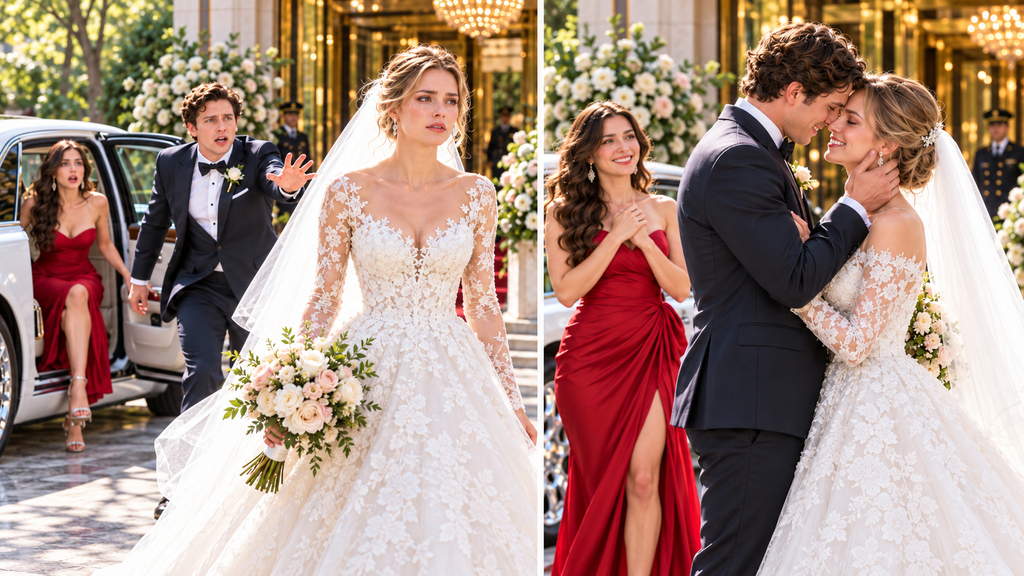
The open car door.
Vanessa’s red dress.
Ethan’s irritated expression.
And those eight words.
“Laurel, just shift over a little so she can fit.”
Eight words.
That was all it had taken to end a relationship I had spent four years building.
But the photograph on my phone told me something I hadn’t understood until that morning.
Ethan wasn’t ashamed.
He wasn’t heartbroken.
He wasn’t even particularly frightened.
He believed this was another disagreement he could eventually talk his way out of.
He still thought the worst consequence would be losing an argument with his wife.
He had no idea what was waiting for him at nine o’clock.
I placed my phone on the bedside table and reached for the blue folder Rebecca Hayes had delivered the previous evening.
Inside were forty-three pages of financial findings.
Invoices.
Bank transfers.
Hotel reservations.
Corporate reimbursements.
Copies of electronic approvals.
And a list of transactions that suggested my husband and his former girlfriend had been using Whitmore Development as their personal bank account.
The confirmed suspicious payments totaled $403,000.
That amount alone was devastating.
But the final page contained something even more troubling.
A transaction request for $1.8 million.
It had not yet been completed.
The request was scheduled for authorization later that week.
And the beneficiary was a company I had never heard of.
Northbridge Capital Advisory LLC.
I had spent most of the previous night examining its registration records.
Northbridge had been established only eleven weeks earlier.
Its business address was a private mailbox.
Its registered agent was a company that specialized in forming anonymous business entities.
And its listed managing member was someone whose name had appeared in my father’s address book for more than twenty years.
Grant Holloway.
Grant wasn’t a stranger.
He was one of Whitmore Development’s longest-serving board members.
He had attended my high school graduation.
He had sent flowers when my grandmother died.
At my wedding, he had stood beside my father, raised a champagne glass, and told me I was marrying a wonderful man.
Now his name appeared on a document connected to a suspicious $1.8 million transfer.
I sat motionless on the edge of my bed.
Then I picked up my phone and called Rebecca.
She answered on the third ring.
“Laurel?”
“Did you get the registration records?”
“Yes.”
“Tell me there’s an explanation.”
She was silent for a moment.
“There may be,” she said carefully. “But it isn’t one I would accept without evidence.”
I closed my eyes.
“Does Dad know?”
“Not yet. We wanted to verify the ownership information before bringing him into it.”
I looked toward the window.
The rain had become heavier.
“Then we have another problem.”
“We have several.”
I heard paper moving on her end.
“Laurel, I need you to listen carefully. The outside accounting firm identified another attempted authorization after midnight.”
My stomach tightened.
“For how much?”
“Four hundred and sixty thousand dollars.”
I stood.
“To Northbridge?”
“No.”
Rebecca’s voice changed.
“This one was directed to an account held by Vantage Strategic Solutions.”
Vanessa’s company.
I gripped the edge of my desk.
“Ethan knows we’re investigating.”
“Possibly. Or someone has warned him.”
“Can we stop it?”
“The bank’s fraud team has placed a temporary hold following our notification. We are working through the company’s authorized procedures to prevent any further releases.”
I exhaled slowly.
“And Ethan?”
“He hasn’t been informed about the hold.”
For the first time that morning, I felt something other than grief.
I felt the cold, steady beginning of determination.
“Good.”
Rebecca hesitated.
“There’s one more thing.”
“What?”
“Someone accessed your corporate email account at 11:43 p.m.”
I frowned.
“That’s impossible. I was asleep.”
“I know.”
“From where?”
“A hotel network.”
My throat went dry.
Rebecca continued.
“The same hotel where Ethan and Vanessa appear to be staying.”
I looked at the photograph Vanessa had sent me.
Suddenly, I understood why it had arrived so early.
It wasn’t only a cruel reminder.
It might also have been intended to distract me.
“What did they access?”
“We’re still determining that.”
I opened my laptop.
Rebecca spoke quickly.
“Don’t log into anything until our security team gives clearance. We have already restricted the session and preserved the access records.”
I stepped away from the desk.
“Rebecca?”
“Yes?”
“When Ethan walks into that boardroom today, I don’t want him to know we’re aware of Northbridge.”
“Agreed.”
“And I don’t want Grant warned.”
Another pause.
“Then today is going to be more complicated than we planned.”
I looked once more at my wedding dress.
“No,” I whispered.
“Today is going to be exactly what it should have been from the beginning.”
“What’s that?”
I removed my wedding ring from the velvet box where I’d placed it after the ceremony.
“A day when people finally tell the truth.”
Chapter One: The Boardroom
At 8:42 a.m., I entered the headquarters of Whitmore Development wearing a charcoal-gray suit, black heels, and the pearl earrings my grandmother had given me for my twenty-first birthday.
I had considered wearing something brighter.
Something that announced confidence.
But I wasn’t going to a celebration.
I was going to confront the man I had married less than forty-eight hours earlier.
The receptionist, Melissa, looked up when I walked through the glass doors.
Her expression softened.
“Good morning, Ms. Whitmore.”
“Morning, Melissa.”
She glanced at my left hand.
I saw her notice the absence of a ring.
She didn’t say anything.
I appreciated that more than she probably knew.
The building was unusually quiet.
Our headquarters occupied seven floors of a renovated brick warehouse downtown. My father had purchased it when the business was small enough for everyone to know one another’s children.
I had grown up in those hallways.
At eleven, I sat beneath the conference table drawing pictures while Dad negotiated his first major construction partnership.
At sixteen, I worked summers in accounts payable, sorting invoices and learning that the difference between a successful company and a failing one wasn’t always a brilliant idea.
Sometimes it was whether someone bothered to question a number that didn’t make sense.
At twenty-four, I persuaded Dad to abandon a development that looked profitable on paper but would have displaced elderly residents from a neighborhood they had lived in for decades.
We lost a significant amount of potential revenue.
Dad later told me it was the moment he knew I should eventually lead the company.
And three years earlier, after a carefully structured ownership transition, he had transferred a controlling sixty-one percent interest in Whitmore Development to me.
It had not been a ceremonial gift.
I had worked for it.
I had expanded our affordable housing division.
I had negotiated financing through two difficult economic years.
I had made mistakes, learned from them, and earned the confidence of people who had known me since I was a girl.
Ethan knew all of that.
What he didn’t know was the exact ownership structure.
He had never asked.
Whenever my father and I discussed company matters, Ethan assumed Dad had the final word.
I had corrected that assumption more than once.
Ethan usually responded with a smile.
“Of course, sweetheart. You’re Dad’s right hand.”
After a while, I stopped explaining myself to a man who only listened when he thought the speaker had more power than he did.
The elevator opened on the seventh floor.
Rebecca was waiting.
She wore a navy suit and carried a leather briefcase.
“You look composed,” she said.
“I don’t feel composed.”
“That’s not a requirement.”
She handed me a folder.
“The independent directors have received the preliminary forensic report. The corporate security team has preserved the relevant systems. Our outside counsel is prepared to advise on the employment and fiduciary issues.”
“Has Ethan arrived?”
“Not yet.”
“Grant?”
“Already here.”
Of course he was.
Grant Holloway had always been early to important meetings.
It had once been one of the things my father admired about him.
I looked through the glass wall of the boardroom.
Grant sat near the far end of the table, reading a document.
His silver hair was perfectly combed.
His suit was expensive but understated.
He looked like every respectable executive who had ever advised my father to be cautious.
My father sat two chairs away from him.
He looked exhausted.
When he saw me, he stood.
“Laurel.”
I crossed the room.
He opened his arms.
For a moment, I was no longer a woman preparing to confront corporate fraud.
I was simply a daughter whose wedding had become a humiliation witnessed by two hundred people.
I stepped into his embrace.
“I’m sorry,” he whispered.
I pulled back.
“Why are you apologizing?”
“Because I encouraged you to trust Ethan.”
I looked into his eyes.
“You didn’t make him betray me.”
“No.”
Dad swallowed.
“But I helped put him in a position where he could betray the company.”
I couldn’t deny that.
Ethan’s appointment as chief operating officer had surprised several senior managers.
He had impressive credentials, but his experience came primarily from smaller private firms.
Dad believed Ethan could bring fresh energy to Whitmore’s operations.
I had wanted to believe it too.
Looking back, I wondered how much of our confidence had been affection disguised as judgment.
My father touched my shoulder.
“Whatever happens in that room, remember something.”
“What?”
“You don’t owe anyone your dignity just because you’ve already given them your trust.”
I managed a small smile.
“Grandma used to say that.”
“She was usually right.”
The boardroom door opened again.
Grant approached us.
“Laurel, my dear.”
His expression was filled with rehearsed sympathy.
“I heard about the wedding. Such an unfortunate misunderstanding.”
I stared at him.
“Misunderstanding?”
He sighed.
“Young marriages can be difficult. Ethan was careless, certainly, but I hope you’re not making permanent decisions because of one emotional moment.”
My father stiffened.
“Grant.”
But I raised my hand slightly.
“It’s all right, Dad.”
I looked directly at Grant.
“Did Ethan tell you what happened?”
“He mentioned a disagreement involving an old friend.”
“An old friend?”
“Vanessa, I believe.”
“His former girlfriend.”
Grant spread his hands.
“Labels can be misleading.”
I smiled.
Not because anything was funny.
Because I had just discovered how deeply some people expected women to participate in their own humiliation.
“You’re right, Grant.”
He relaxed.
“Good. I’m glad we can be reasonable.”
“Labels can be misleading,” I repeated. “That’s why this morning we’ll be focusing on documents.”
His smile faltered.
“Documents?”
“Financial records.”
I held his gaze.
“Numbers are usually much harder to misunderstand.”
For a brief instant, something moved behind his eyes.
Then he recovered.
“Naturally.”
He returned to his seat.
Rebecca leaned close to me.
“Nicely done.”
I took my place at the head of the table.
“Let’s see how long he stays comfortable.”
At exactly 8:59 a.m., the boardroom doors opened.
And my husband walked in.
Ethan Caldwell looked as though he’d come to collect an award.
Dark suit.
Freshly shaved face.
A silver watch I had purchased for his birthday.
His wedding ring glimmered under the recessed lights.
Behind him stood Vanessa.
She wore a cream-colored blouse and a pencil skirt.
Her hair was pulled into an elegant knot.
She had apparently decided that dressing like a corporate attorney might make everyone forget how she had behaved at my wedding.
Ethan stopped when he saw me.
Then he smiled.
“Laurel. Good. You’ve finally come to your senses.”
Nobody answered.
He looked around the table.
“What’s this? Some kind of family intervention?”
Vanessa laughed softly.
“Maybe they want us all to clear the air.”
Rebecca stepped forward.
“Ms. Reed, this is a confidential board meeting. You are not authorized to attend.”
Vanessa blinked.
“Excuse me?”
Ethan frowned.
“She’s with me.”
“That doesn’t change her status.”
He looked toward my father.
“Arthur, tell them she’s allowed. She’s here as my professional consultant.”
My father remained seated.
“No.”
Ethan’s smile disappeared.
“What?”
“Vanessa is not a board member,” Dad said. “She is not an employee. And she is not authorized to attend this meeting.”
Vanessa’s cheeks reddened.
“This is ridiculous.”
I finally spoke.
“Vanessa, you’re welcome to wait in the reception area.”
She turned toward me.
“Oh, so now you’re in charge of the seating arrangements?”
I looked at her calmly.
“No.”
Then I gestured toward the empty chair beside the door.
“I’m in charge of determining who is permitted in this meeting. The same way I should have been in charge of who sat beside my husband on my wedding day.”
The room went silent.
Vanessa opened her mouth.
Closed it.
Then glanced at Ethan.
“Are you going to let her speak to me that way?”
Ethan took a step toward me.
“Laurel, apologize.”
I looked at him.
“Sit down, Ethan.”
His eyebrows lifted.
“What did you just say?”
“Sit down.”
He laughed.
It was a short, incredulous sound.
“Sweetheart, we’re not doing this.”
The word sweetheart made my stomach turn.
I had once loved the way he said it.
Now it sounded like a command wrapped in affection.
“Ethan,” Rebecca said, “this meeting concerns serious financial irregularities identified during an independent review of company expenditures.”
His expression changed.
Only slightly.
But I saw it.
The quick narrowing of his eyes.
The way his shoulders became rigid.
“What irregularities?”
Rebecca indicated the chair.
“We will explain once the meeting begins.”
Vanessa stepped closer to him.
“Don’t let them intimidate you.”
Ethan nodded.
“Exactly. I know what this is.”
He pointed at me.
“You’re angry about the wedding, and now you’re trying to use your father’s company to punish me.”
I folded my hands.
“Ethan, your personal conduct and the company’s financial affairs are separate matters.”
He scoffed.
“Then why is your lawyer here?”
Rebecca answered before I could.
“Because I am advising Laurel in her personal legal matters, and independent corporate counsel is advising the board. We have taken care to distinguish those roles.”
Ethan stared at her.
“Fine. Then let’s get this over with.”
He sat down.
Vanessa remained behind him.
Rebecca looked toward security.
“Ms. Reed, please.”
Vanessa hesitated.
For one second, I thought she might refuse.
Then Ethan waved a hand.
“Go wait downstairs, Vanessa. This won’t take long.”
She gave me a triumphant little smile.
The kind that said she believed Ethan was still choosing her.
I said nothing.
She walked out.
The door clicked shut.
And my father looked toward the independent director who had been appointed to oversee the investigation.
“Elise,” he said, “you may begin.”
Chapter Two: The First Lie
Elise Morgan had served on Whitmore Development’s board for eight years.
She was sixty-one, a former federal banking examiner, and one of the most quietly intimidating people I had ever met.
She didn’t raise her voice.
She didn’t interrupt.
And when someone lied to her, she had a habit of becoming very still.
That morning, she wore dark glasses and had a neat stack of documents in front of her.
“Mr. Caldwell,” she began, “thank you for attending.”
Ethan leaned back.
“Of course.”
“The board has authorized an independent review of certain payments approved by your office.”
His eyes flickered toward me.
“Let me guess. Laurel requested that.”
“The review began before your wedding,” Elise replied.
That stopped him.
“For several months,” she continued, “Whitmore Development’s accounting team has been examining payments to outside consultants whose deliverables could not be verified.”
Ethan folded his arms.
“Consulting arrangements are often confidential.”
“Confidential from whom?”
“From people without operational responsibility.”
Elise nodded.
“Would the chief financial officer qualify as someone with operational responsibility?”
Ethan hesitated.
“Of course.”
“Then perhaps you can explain why these invoices were processed without being entered into the normal vendor review system.”
He glanced toward the documents.
“I’d need to see them.”
Elise slid the first page across the table.
“Vantage Strategic Solutions.”
Ethan didn’t touch it.
“Yes?”
“Two hundred and eighty-seven thousand dollars.”
He shrugged.
“That’s hardly unusual for a company of our size.”
“It is unusual,” Elise said, “when the vendor cannot produce evidence of the work it was paid to perform.”
Ethan leaned forward.
“Vantage provides strategic intelligence.”
“What kind?”
“Market assessments. Acquisition research. Competitive positioning.”
“Who received those reports?”
“Various department heads.”
“Names?”
His jaw tightened.
“I don’t remember every distribution list.”
Elise placed another page in front of him.
“We interviewed the relevant department heads. None reported receiving work from Vantage.”
“Then somebody failed to circulate it.”
“Can you produce the reports?”
“I’ll have my team look.”
“Your team already looked.”
Ethan’s face hardened.
“Are you accusing me of something?”
Elise clasped her hands.
“I’m asking you to account for company money.”
He turned toward my father.
“Arthur, this is absurd. You know how consulting works.”
Dad didn’t respond.
Ethan looked at me.
“Laurel, tell them.”
I held his gaze.
“Tell them what?”
“That you knew about Vantage.”
“I knew the company was receiving money,” I said. “That’s why I requested documentation.”
He pointed at me.
“Exactly. So you approved it.”
“No, Ethan.”
I slid another document across the table.
“I asked why your office had approved invoices with no supporting work product. That’s not approval.”
He stared down at the page.
His initials appeared beside several transaction entries.
Elise continued.
“The investigators also identified $116,000 in reimbursements submitted through executive expense accounts under your control.”
Ethan exhaled sharply.
“Oh, for God’s sake.”
Elise didn’t react.
“Several charges appear to have been personal.”
“Business travel.”
“Hotel suites booked under Vanessa Reed’s name.”
“Client entertainment.”
“Jewelry purchases?”
“Executive gifts.”
“Weekend spa packages?”
“Relationship management.”
I felt my nails press into my palms beneath the table.
Relationship management.
That was what he called it.
The weekend in Charleston when he’d told me he was meeting investors.
The diamond bracelet I’d discovered on a boutique’s social media page and admired without knowing he had bought it for Vanessa.
The luxury hotel in Savannah where he’d stayed the week he proposed to me.
Every deception had been purchased using company money.
And now he was describing those purchases as ordinary business expenses.
Elise pulled out a receipt.
“This one is particularly interesting.”
She slid it toward Ethan.
“Four thousand nine hundred and twenty dollars. Private villa reservation. Three nights.”
Ethan glanced at it.
“Fine. Client retreat.”
“Which client?”
“I’d have to check.”
“Ms. Reed was the second registered guest.”
“She was assisting.”
“Assisting with what?”
He glared.
“With business.”
Elise nodded slowly.
“Then explain the expense description.”
She turned the receipt around.
I watched Ethan read it.
His face drained of color.
I already knew what it said.
The hotel had classified the package as a romantic getaway.
The guest notes included a request for rose petals, champagne, and a custom message.
Forever us. No more hiding.
Ethan swallowed.
“That was a personal note. It doesn’t mean the trip wasn’t business-related.”
Elise looked at him over her glasses.
“Mr. Caldwell, the hotel confirmed that no conference rooms were booked, no meetings were scheduled, and no business services were requested.”
Silence.
Then Ethan laughed.
A desperate sound.
“You’re basing a financial investigation on a hotel’s guest notes?”
“No,” Elise replied.
“We’re basing it on bank records, payment authorizations, interviews, communications, and the absence of legitimate business support.”
Ethan shifted in his chair.
“I want an attorney.”
“That is your right,” Elise said. “We will accommodate appropriate representation. The board can also make interim decisions regarding access and authority while the investigation continues.”
He looked at my father.
“You’re really going to let them do this?”
Dad spoke quietly.
“I asked you to explain the payments.”
“And I have.”
“No,” my father said.
“You’ve explained why you don’t think you should have to explain.”
The words hung between them.
For a moment, Ethan appeared genuinely stunned.
He had become so accustomed to Dad’s approval that he couldn’t understand what it meant to lose it.
Then he turned on me.
“This is because I let Vanessa ride in the car.”
I stared at him.
“Let her?”
“Yes. That’s what this entire circus is about. You were jealous, and now you’re trying to destroy my reputation.”
I took a breath.
“Ethan, if Vanessa had needed a ride, there were other vehicles at the house. There were drivers. There were guests. There were a dozen solutions that didn’t require humiliating your bride.”
He scoffed.
“Oh, here we go.”
“But you didn’t even ask me. You told me to move.”
“Because it was fifteen minutes!”
I leaned forward.
“Then why was she wearing the necklace you purchased with company funds?”
His mouth closed.
For the first time, he looked genuinely frightened.
I hadn’t planned to ask that question.
But the necklace had haunted me since I’d seen the photograph from the reception.
A delicate emerald pendant.
Vanessa had worn it against her red dress.
I’d assumed it was costume jewelry.
The forensic report revealed that it had cost $18,400.
Ethan had submitted the purchase as a gift for a prospective international investor.
“How do you know about that?” he asked.
I looked at the document in front of him.
“Because you made the company pay for it.”
Ethan pushed his chair back.
“That’s enough.”
Elise raised her hand.
“Mr. Caldwell, please remain seated.”
He pointed at me.
“You went through my personal finances!”
“No,” I answered.
“The accounting firm examined company expenditures.”
“Same thing!”
And there it was.
The admission nobody needed to explain.
Ethan had become so comfortable treating Whitmore Development’s money as his own that he no longer recognized the difference.
Elise turned another page.
“Mr. Caldwell, we have not yet discussed the most significant finding.”
He froze.
“What finding?”
“The pending $1.8 million transfer.”
For a heartbeat, nobody moved.
Then Ethan looked at Grant.
It was a tiny glance.
Barely noticeable.
But I saw it.
And Grant saw that I saw it.
Elise placed the authorization request on the table.
“Northbridge Capital Advisory.”
Ethan’s face became unreadable.
“That’s a legitimate transaction.”
“Then perhaps you can explain its purpose.”
“Land acquisition advisory services.”
“For which development?”
“Riverside Commons.”
My stomach tightened.
Riverside Commons was the largest affordable housing project in our portfolio.
A $76 million redevelopment scheduled to provide more than four hundred residential units, including housing for veterans, elderly residents, and families transitioning out of temporary accommodation.
The project mattered to me more than any other work Whitmore had undertaken.
I had personally spent two years negotiating its financing.
Ethan knew that.
And now he was invoking its name to justify a suspicious payment.
Elise looked at her notes.
“The Riverside project manager has no record of engaging Northbridge.”
“That’s because the engagement was handled at the executive level.”
“Who approved it?”
“I did.”
“Under whose authority?”
Ethan sat straighter.
“As chief operating officer.”
Elise shook her head.
“Your delegated authority does not extend to a payment of this size without additional approvals.”
He smiled thinly.
“Arthur was aware.”
My father looked up.
“No, I wasn’t.”
Ethan blinked.
“Arthur—”
“I have never heard of Northbridge Capital Advisory.”
“Then you must have forgotten.”
Dad’s expression changed.
I had seen my father angry before.
I’d seen him negotiate contracts worth tens of millions of dollars without losing his temper.
But I had rarely seen the look that appeared on his face then.
It was the expression of a man who had finally realized someone thought he was too old to remember the truth.
“I may be seventy years old, Ethan,” Dad said, “but my memory is perfectly fine.”
Ethan said nothing.
Elise continued.
“The board has also been informed that Northbridge’s managing member is Grant Holloway.”
Every eye turned toward Grant.
He remained motionless.
Then he slowly removed his glasses.
“That information requires context.”
My father stared at him.
“Grant?”
Grant folded his hands.
“I was going to disclose the arrangement once the transaction was finalized.”
Dad looked as though he’d been struck.
“You own Northbridge?”
“It’s an investment vehicle.”
“You’re a director of Whitmore Development.”
“That doesn’t prohibit all outside business interests.”
“No,” Elise said, “but it creates disclosure and approval obligations when those interests are involved in transactions with the company.”
Grant’s face tightened.
“I have complied with my duties.”
“Then where is the disclosure?”
Silence.
Elise leaned forward.
“Where is the approval from the disinterested directors?”
Grant glanced at Ethan.
Ethan stared at the table.
I realized, in that moment, that this was no longer merely a story about an unfaithful husband.
It was a conspiracy hidden inside a company my family had spent nearly thirty years building.
And the two men sitting across from me had not yet revealed their worst secret.
Chapter Three: The Document With My Name on It
“Before anyone jumps to conclusions,” Grant said, “I’d like to clarify the purpose of the transaction.”
Elise nodded.
“Go ahead.”
Grant straightened his tie.
“Northbridge was engaged to facilitate the acquisition of several adjacent properties necessary for the Riverside Commons development.”
“Which properties?” I asked.
He looked at me.
“Several parcels near the eastern boundary.”
“Parcel numbers?”
“I don’t have those memorized.”
“Then perhaps you can name one owner.”
He hesitated.
“Laurel, this isn’t an interrogation.”
“You’re asking my company to transfer $1.8 million to an entity you control, Grant. I think a property address is a reasonable place to start.”
Grant’s jaw tightened.
“My understanding was that your father had approved the strategy.”
Dad slowly turned toward him.
“Stop saying that.”
Grant blinked.
“Arthur—”
“Stop putting my name on decisions I never made.”
Silence settled over the room.
Grant looked away.
And then Ethan did something astonishing.
He reached into his briefcase and removed a blue folder.
“I think this will settle the matter.”
Rebecca glanced at me.
Ethan opened the folder.
Inside was a document bearing the Whitmore Development logo.
He placed it on the table with deliberate care.
“Written authorization for the Northbridge engagement.”
Elise reached for it.
Ethan stopped her with one finger.
“Signed by the company’s controlling shareholder.”
I stared at him.
Something cold passed through me.
Ethan smiled.
“Your father.”
He slid the document toward Dad.
For several seconds, my father didn’t move.
Then he picked it up.
I watched his eyes travel down the page.
His expression shifted from confusion to disbelief.
Finally, he spoke.
“That’s not my signature.”
Ethan sighed.
“Arthur, you signed it six weeks ago.”
“No.”
“You may not remember—”
“I said no.”
Ethan raised both hands.
“Fine. We can verify it.”
Rebecca held out her hand.
“May I see the document?”
Dad passed it to her.
She examined the final page.
Then she looked at me.
Something in her expression made my pulse accelerate.
“Laurel.”
I stood and walked around the table.
She turned the document toward me.
At the bottom was a signature.
It resembled my father’s handwriting.
But it was not his name.
It was mine.
Laurel Whitmore.
I stared.
Above the signature was a title.
Controlling Shareholder and Authorized Principal.
For a moment, the room seemed to tilt.
Ethan was watching my father.
He had not yet noticed the mistake.
Grant had.
His face turned an unhealthy shade of gray.
Rebecca placed the paper flat on the table.
“Mr. Caldwell,” she said, “you just represented this document as an authorization signed by Arthur Whitmore.”
Ethan frowned.
“Yes.”
“Would you mind reading the signature?”
He leaned forward.
Looked down.
And went completely still.
I watched his eyes move over the page.
Once.
Twice.
Then he looked up at me.
“What is this?”
I didn’t answer immediately.
I wanted him to hear himself.
“What is what, Ethan?”
He pointed at the document.
“Why is your name there?”
Rebecca spoke.
“Because Laurel Whitmore owns sixty-one percent of the voting shares in Whitmore Development.”
Ethan stared.
Then he laughed.
A short, bewildered sound.
“No.”
Nobody responded.
He looked at Dad.
“Arthur?”
My father folded his arms.
“It’s true.”
Ethan shook his head.
“That’s impossible.”
I returned to my seat.
“Why?”
“Because you told me your father owned the company.”
“No, Ethan.”
I spoke gently, which somehow made the room feel colder.
“I told you he founded it.”
Ethan opened his mouth.
Closed it.
I continued.
“I told you he had transferred control during our restructuring three years ago. I discussed shareholder matters in front of you. You never asked for details.”
“That’s ridiculous.”
“What’s ridiculous is that you married a woman without knowing what she did for a living.”
His cheeks reddened.
“I knew what you did.”
“Then what was my role?”
“You handled strategy.”
“Yes.”
“And you worked with your father.”
“Yes.”
“So how was I supposed to know you owned it?”
I studied him.
“You could have listened.”
He looked at Rebecca.
“This doesn’t change anything. The authorization is legitimate.”
“No,” I said.
“It isn’t.”
I lifted the document.
“Because I never signed this.”
Ethan’s eyes flicked toward Grant.
Grant stared straight ahead.
Rebecca turned to the independent corporate attorney.
The attorney, Daniel Ross, was a silver-haired man who had spent much of his career investigating financial misconduct.
“Mr. Caldwell,” Daniel said, “do you know how this document was created?”
Ethan swallowed.
“It came through the normal approval process.”
“Which approval system?”
“Our electronic signature platform.”
“Who initiated it?”
“I’d have to check.”
“Do you have the original transaction identification number?”
“No.”
Daniel nodded.
“Interesting.”
He opened his laptop.
“Our IT security team checked the company’s authorized signature platform this morning. There is no corresponding transaction record.”
Ethan’s face tightened.
“Systems lose records.”
“Not ordinarily.”
Daniel turned the screen toward the independent directors.
“The document appears to have been generated using a third-party editing program. The signature image was inserted separately.”
I felt a wave of nausea.
My handwriting.
My name.
My authority.
Someone had taken all three and arranged them on a piece of paper to steal money from the company.
Daniel continued.
“The signature image appears to match an image taken from a document associated with your prenuptial agreement.”
My heart stopped.
I looked at Ethan.
He stared back at me.
For the first time since our wedding ceremony, I saw genuine fear in his eyes.
“My prenup?” I whispered.
Rebecca nodded.
“The signature has several identical pixel characteristics, including a small mark created by the pen pressure at the bottom of the final letter.”
I remembered signing the agreement.
Six weeks earlier.
Rebecca had walked Ethan and me through the financial provisions.
He had acted bored.
He’d kissed my forehead afterward and joked that he was marrying me for my cooking, not my bank account.
Then he’d insisted on taking copies of the signed documents for his own records.
I had thought nothing of it.
Now I understood.
The same marriage agreement intended to protect me had given him access to an image of my signature.
I looked at him.
“Ethan.”
He said nothing.
“Did you copy my signature from our prenup?”
His face hardened.
“This is getting insane.”
“Answer me.”
“I didn’t forge anything.”
“I didn’t ask whether you forged it.”
He pushed back from the table.
“I want to call my attorney.”
Daniel nodded.
“You may do that.”
Ethan stood.
Grant rose as well.
“Perhaps we should recess.”
Elise looked at him.
“Grant, before you leave, the independent directors need to address your participation in these matters.”
Grant stiffened.
“On what basis?”
“Your undisclosed interest in Northbridge.”
“This is an outrageous overreaction.”
Elise’s voice remained calm.
“Then you’ll have an opportunity to respond through counsel. For now, you should not participate in decisions concerning the investigation.”
My father stared at his longtime friend.
“Grant, did you know the signature was fake?”
Grant looked offended.
“Of course not.”
Dad didn’t blink.
“Did you know Northbridge was going to receive company money without a legitimate approved contract?”
“Arthur, we’ve known each other for twenty-eight years.”
My father nodded slowly.
“That’s not an answer.”
Grant’s mouth tightened.
For a moment, I thought he might finally speak honestly.
Instead, he picked up his briefcase.
“I won’t sit here and be insulted.”
He walked toward the door.
Ethan followed.
I watched them leave.
And then I sat back down.
My hands were shaking so badly that Rebecca quietly moved a glass of water toward me.
I took it.
My father stared at the empty doorway.
“He was at your baptism,” he whispered.
I looked at him.
“Who?”
“Grant.”
Dad’s voice was barely audible.
“He held you when you were six months old.”
There are some betrayals that begin with a stranger.
Those are easier to understand.
But the most terrible betrayals are committed by people who know exactly where your heart is vulnerable.
People who have watched you grow up.
People who know the passwords to your memories.
People who have sat at your kitchen table, eaten your mother’s food, and called themselves family.
My father pressed his hand against his forehead.
“I trusted him.”
I reached across the table.
“I know.”
He looked at me.
“And Ethan.”
I swallowed.
“So did I.”
For several seconds, neither of us spoke.
Then Elise closed her folder.
“We need to continue.”
I looked up.
“What happens now?”
“Subject to the company’s governing documents, we should proceed with an immediate suspension of Mr. Caldwell’s operational access and authority pending the completion of the investigation. We should also notify the appropriate insurers, banks, and law enforcement authorities.”
I nodded.
“Agreed.”
“The independent directors will handle the matters involving Mr. Holloway.”
“Good.”
“And Laurel?”
I looked at her.
“Yes?”
“There’s a reason I wanted you to see the authorization document before we concluded today’s meeting.”
My stomach tightened.
“What reason?”
She turned another page.
“The forensic accountants found a second document.”
I stared at her.
“Another forgery?”
“We haven’t established that yet.”
She slid it toward me.
It was a proposed share-transfer agreement.
At the top was a date.
The day after my wedding.
At the bottom was an unsigned acknowledgment page bearing my name.
And in the main agreement, a paragraph had been highlighted.
I read it once.
Then again.
The document proposed transferring a significant block of Whitmore Development shares into a holding structure controlled by Northbridge.
My mind raced.
“That’s impossible,” I whispered.
Elise nodded.
“It wasn’t completed.”
“How did they think they could make me sign it?”
She looked toward the closed door.
“We believe someone intended to present it as part of a routine postmarital financial restructuring.”
Suddenly, the pieces began moving into place.
Ethan’s insistence that I shouldn’t worry about paperwork.
His enthusiasm for combining financial advisers after our wedding.
His repeated jokes about how marriage meant there shouldn’t be secrets between us.
And the strangest part?
He had scheduled a meeting with a private wealth consultant for the Thursday after our honeymoon.
At the time, I had thought it was an unnecessary but harmless gesture.
Now I looked at Rebecca.
“Did he really think I’d sign this?”
Rebecca’s expression was grave.
“We don’t know what he believed. But the preparatory correspondence suggests he expected you to be persuaded.”
I looked down at the document.
There was a handwritten note in the margin.
Three words.
After honeymoon. Easy.
I recognized Ethan’s handwriting.
My chest tightened.
All the romantic plans.
The private villa in the Maldives.
The champagne.
The elaborate honeymoon he had insisted on arranging.
What if it had never been about celebrating our marriage?
What if it had been about getting me somewhere quiet, far away from my father and Rebecca, where Ethan could pressure me into signing papers while I was distracted, exhausted, and desperate to be a good wife?
I closed the folder.
My voice emerged as a whisper.
“He didn’t just marry me for money.”
Rebecca looked at me.
“Laurel—”
“He married me for the company.”
No one contradicted me.
And somehow, that silence hurt more than anything they could have said.
Chapter Four: The Woman at the Elevator
By 11:30 a.m., Ethan had been formally notified of his suspension.
His company laptop had been collected.
His building access was restricted.
His corporate credit card was disabled.
His spending and approval authority had been withdrawn.
The board had not issued a final determination about every allegation. Those would require further investigation, documentation, and legal review.
But the immediate danger to the company had been contained.
At least, that was what we believed.
I was waiting for the elevator when Vanessa appeared at the end of the hallway.
She was alone.
Her expensive heels clicked against the polished floor.
When she saw me, she smiled.
“So?”
I pressed the elevator button.
“So what?”
“Did you get your revenge?”
I looked at her.
“Is that what you think this is?”
She folded her arms.
“Please. You couldn’t handle the fact that Ethan and I still have a connection, so you dragged his career into it.”
I stared at her.
A part of me wanted to laugh.
Another part wanted to ask what had happened to the girl she must once have been.
The girl who had perhaps dreamed of being loved.
The girl who had grown into a woman willing to stand beside another woman’s husband and call humiliation a victory.
“Vanessa,” I said, “the investigation began months before the wedding.”
She tilted her head.
“Sure.”
“Your company received $287,000 in payments that investigators haven’t been able to connect to legitimate services.”
Her smile faltered.
“Vantage provided consulting.”
“Then you’ll have records.”
“Of course we do.”
“Good. Your attorney can provide them to the investigators.”
Her eyes narrowed.
“Are you threatening me?”
“No.”
I looked at her steadily.
“I’m explaining that this is no longer a conversation between two women about a man.”
She laughed sharply.
“You’re still upset because he chose me.”
The elevator doors opened.
I didn’t step inside.
For some reason, I wanted to answer her properly.
“Vanessa, I loved Ethan.”
She blinked.
“I loved him when he lost his first consulting contract and spent three weeks convinced he was a failure.”
Her expression shifted.
“I loved him when his mother needed surgery and he cried in the hospital parking lot because he thought he might lose her.”
Vanessa’s smile disappeared.
“I loved him when he had nothing to offer me except the person I thought he was.”
I took a breath.
“And when he told me to move over in that car, I realized he had no idea what I’d actually been giving him.”
Vanessa stared at me.
I continued.
“You think this is a competition because you believe the prize is Ethan.”
I stepped into the elevator.
“But I don’t want him anymore.”
The doors started closing.
Then Vanessa spoke.
“You should.”
I caught the doors with my hand.
“Why?”
Her expression changed.
Something ugly and triumphant flashed across her face.
“Because you have no idea what he’s capable of when he feels cornered.”
A chill passed through me.
I looked at her.
“Is that a warning?”
She smiled again.
“Call it friendly advice.”
The elevator doors closed between us.
And for the first time that day, I wondered whether Vanessa was simply cruel.
Or whether she was afraid.
By the time I reached my car, my phone had seventeen missed calls from Ethan.
I didn’t return them.
Instead, I called Rebecca.
“Vanessa just threatened me.”
Rebecca immediately became alert.
“What did she say?”
I repeated the conversation.
“Don’t engage with either of them again without counsel present,” Rebecca said.
“Agreed.”
“Where are you going?”
“Home.”
“Good. I’ll have someone from corporate security review the footage from that hallway, and we should document exactly what she said.”
I opened my car door.
“Rebecca?”
“Yes?”
“Do you think they’re going to run?”
She hesitated.
“I think people who are losing control can make unpredictable decisions.”
I looked at the office building.
Through the seventh-floor windows, I could see the room where my father had just learned his oldest friend might have betrayed him.
“And what about Grant?”
“We’ll find out how deeply he’s involved.”
I glanced at my phone again.
Another message from Ethan.
You need to fix this before it gets ugly.
I read it aloud.
Rebecca sighed.
“Save it.”
“I will.”
“And Laurel?”
“Yes?”
“Don’t underestimate how desperate they may be.”
I closed my eyes.
For four years, I had loved Ethan enough to defend him even when his behavior made me uncomfortable.
Now, for the first time, I was beginning to understand how much danger that loyalty had concealed.
I got into the car.
Before I could start the engine, another message arrived.
This one wasn’t from Ethan.
It was from an unknown number.
There was no greeting.
No explanation.
Only a photograph.
It showed a dark wooden desk.
A document lay open on its surface.
Across the top were the words:
CONFIDENTIAL — RIVERSIDE COMMONS REDEVELOPMENT
Underneath the photograph was a message.
If you want to know why Ethan really married you, ask your father about March 14.
I stared at the screen.
March 14.
The date meant nothing to me.
At least, not immediately.
Then I remembered something.
March 14 was the date my father had suffered a minor stroke.
It had happened three years earlier, during a business trip.
And for nearly two weeks afterward, I had taken over nearly every major decision at Whitmore Development.
I called Rebecca again.
She answered immediately.
“What is it?”
I whispered, “I think there’s something Dad hasn’t told me.”
Chapter Five: The Secret My Father Kept
My father was sitting in the library when I arrived home.
The library had always been his refuge.
Tall bookshelves lined the walls, filled with biographies, architecture books, and old leather-bound journals.
A photograph of my grandparents stood beside the fireplace.
My mother had brought him tea, but the cup remained untouched.
He looked up when I entered.
“Laurel.”
I held up my phone.
“Do you know what happened on March 14?”
His expression changed so quickly that I knew the answer before he spoke.
“Why?”
“Someone sent me a message.”
I handed him the phone.
He studied the photograph.
Then the date.
His face went pale.
“Who sent this?”
“I don’t know.”
He stared at it for several seconds.
Then placed the phone on the table.
“Sit down, sweetheart.”
My stomach tightened.
“Dad.”
“Please.”
I sat across from him.
He rubbed his hands together.
The gesture made him look suddenly older.
“Three years ago,” he began, “when I had the stroke, there was something happening at the company that I didn’t want you to know about.”
I felt the room go cold.
“What?”
He looked down.
“Whitmore Development was under pressure from one of our lenders.”
I frowned.
“I knew about the refinancing negotiations.”
“Not all of them.”
He exhaled.
“We had a significant liquidity problem. Two projects had gone over budget, interest rates had increased, and a prospective investor withdrew at the worst possible time.”
I stared at him.
“Why wasn’t I told the full extent?”
“Because I was trying to resolve it before it threatened the company.”
“Dad, I was already responsible for strategy.”
“I know.”
“Then why hide it?”
He looked at me with such sadness that my anger softened.
“Because I was ashamed.”
I said nothing.
He continued.
“I had spent my life building that business. And suddenly I was looking at the possibility of losing control of it.”
I remembered those months.
The late-night phone calls.
The board meetings that stretched past midnight.
Dad’s exhaustion.
The way he’d insisted everything was under control.
Then the stroke.
“Grant helped arrange emergency financing,” Dad said.
My breath caught.
“Northbridge?”
“No. A different lender.”
He shook his head.
“At least, that’s what I believed.”
“What do you mean?”
“Grant introduced me to a private investor. The financing was supposed to bridge the company through a difficult period.”
“And?”
“It came with conditions.”
I leaned forward.
“What conditions?”
Dad looked toward the fireplace.
“An option to purchase certain development rights if we failed to satisfy the repayment schedule.”
“Which development rights?”
He didn’t answer.
I felt a terrible suspicion forming.
“Dad.”
He whispered, “Riverside.”
I stood so quickly my chair scraped against the floor.
“Riverside Commons?”
“Part of the land assembly.”
I stared at him.
“That project was supposed to be protected.”
“I know.”
“We promised the city those units would remain affordable.”
“I know.”
“We built the entire financing structure around those commitments!”
“Laurel—”
“How could you agree to something that could put those rights at risk?”
My voice cracked.
Dad looked as though each word physically hurt him.
“Because at the time, I thought it was the only way to save the company.”
I turned away.
For several seconds, I could barely breathe.
Riverside Commons wasn’t just a project.
It was the reason I had stayed in the family business when I could have built my own career somewhere else.
The site had once been a derelict industrial district.
For decades, families had lived around abandoned warehouses and contaminated lots while developers ignored the area.
Whitmore Development had partnered with local organizations to transform it into a mixed-income neighborhood.
A place where people could live without being pushed out the moment their neighborhood became desirable.
I had made promises to community leaders.
To residents.
To families who had already spent too much of their lives waiting for someone with money to care.
And now I was learning that my father had once pledged part of that future as collateral.
“What happened to the financing?” I asked.
“We repaid it.”
“Completely?”
“That’s what I was told.”
“By whom?”
Dad closed his eyes.
“Grant.”
I stared at him.
“Dad, did you ever see the release documents?”
“Grant brought them to me.”
“Did outside counsel verify them?”
Silence.
I felt sick.
Dad leaned forward.
“I know what you’re thinking.”
“Then tell me I’m wrong.”
He couldn’t.
I sat down again.
“Why didn’t you tell me when you transferred control?”
His eyes filled.
“Because I believed the issue was resolved. And because I didn’t want the worst decision of my career to become the first burden of yours.”
The room was silent.
Then I said something I had never said to my father before.
“You should have trusted me with the truth.”
He nodded.
“Yes.”
The simplicity of his answer surprised me.
No excuses.
No attempt to remind me how much he’d sacrificed.
Just yes.
I looked down at my hands.
“When Ethan came into the company, did Grant recommend him?”
Dad’s expression changed.
“Yes.”
I felt my stomach drop.
“How strongly?”
“Very.”
“When?”
“About eight months before Ethan’s appointment.”
I closed my eyes.
That meant Grant had encouraged Ethan’s hiring long before the wedding.
Possibly long before Ethan proposed.
I opened my eyes.
“Did Grant know we were dating?”
“Of course.”
“Did he ever suggest Ethan should join the business?”
Dad nodded slowly.
“Several times.”
I remembered Grant at family dinners.
Grant praising Ethan’s intelligence.
Grant telling Dad it would be wonderful to have a younger executive who understood both business and family.
Grant laughing that one day Ethan might become the son Dad never had.
I had thought it was harmless affection.
Now those conversations sounded like strategy.
“Dad,” I whispered, “what if Ethan wasn’t Grant’s discovery?”
“What do you mean?”
“What if Grant placed him near us?”
My father stared at me.
I continued.
“What if this wasn’t about Ethan falling in love with your daughter?”
The words caught in my throat.
“What if falling in love with your daughter was part of the plan?”
Dad looked down at the photograph on my phone.
Then he said something that frightened me more than any denial.
“There’s something else you need to know.”
I couldn’t speak.
He reached into the drawer beside his chair and removed an old envelope.
It was yellowed at the edges.
Inside was a printed letter.
He handed it to me.
“I received this six months before Ethan asked you to marry him.”
I unfolded it.
The letter was anonymous.
It contained only four sentences.
Arthur Whitmore, someone inside your company is preparing to take advantage of your family.
The person you trust most is not the person you think.
Ask who benefits from the Riverside financing.
And do not let your daughter marry Ethan Caldwell.
I felt the blood drain from my face.
I looked up.
“You knew?”
Dad shook his head.
“I didn’t know. I suspected it was someone trying to damage Ethan’s reputation.”
“Why didn’t you show me?”
His eyes filled with shame.
“Because I thought I was protecting your happiness.”
I stood.
“Protecting me?”
“Laurel—”
“You got a letter warning you not to let me marry him, and you said nothing?”
“I didn’t believe it.”
“Did you investigate?”
He looked away.
That was the answer.
I pressed the paper against my chest.
For a moment, I was so angry I couldn’t speak.
Not because Dad had trusted the wrong people.
I had done that too.
But because he had decided I was too fragile to handle information about my own life.
He had tried to protect me by leaving me unprotected.
I turned toward the door.
“Laurel, please.”
I stopped.
His voice was trembling.
“I was wrong.”
I stared at the hallway.
He continued.
“I thought if I ignored the letter, it would turn out to be nothing. I wanted you to have something beautiful that wasn’t connected to the company.”
My eyes burned.
“Dad, I didn’t need a beautiful lie.”
He bowed his head.
“I know.”
I swallowed.
“I needed the truth.”
He nodded.
I left the library before he could see me cry.
I went upstairs to my childhood bedroom.
My wedding gown was still hanging by the wardrobe.
I stared at it for several seconds.
Then I sat on the floor.
And finally, I cried.
Not the kind of crying that comes with anger.
Not the theatrical sobbing Ethan had expected when he humiliated me.
This was quiet.
Painful.
The kind that seemed to come from somewhere beneath my ribs.
I cried for the woman who had spent four years believing she was loved.
For the wedding vows I’d spoken with complete sincerity.
For the honeymoon I’d never take.
For the husband who had kissed me beneath the roses and promised to choose me every day.
And for the possibility that none of it had ever been real.
My mother found me there twenty minutes later.
She didn’t ask questions.
She simply lowered herself beside me and wrapped her arms around my shoulders.
For a while, we sat together in silence.
Then I whispered, “Was any of it real, Mom?”
She stroked my hair.
“I don’t know, sweetheart.”
I closed my eyes.
“How can someone pretend for so long?”
She was quiet.
Then she said, “Some people pretend because they want what love gives them without accepting what love asks of them.”
I pulled back slightly.
“What does that mean?”
“It means Ethan may have liked being loved by you. He may even have felt something he called love.”
A tear slid down my cheek.
“But real love isn’t just enjoying the good things someone brings into your life.”
She touched my face.
“It’s caring about the person when doing so costs you something.”
I thought about the limousine.
The open door.
My husband’s irritated expression.
And the fact that protecting my feelings would have cost him almost nothing.
He only needed to say one sentence.
Vanessa, you’ll need another car. I’m riding with my wife.
One sentence.
Instead, he had chosen to make me feel small.
I leaned against my mother.
“What am I supposed to do now?”
She kissed my forehead.
“First, you let yourself be sad.”
I wiped my eyes.
“And then?”
“Then you remember that a wedding is one day.”
She glanced toward the gown.
“But your life is still yours.”
I held onto her as the rain continued against the windows.
Downstairs, my father was learning the consequences of trusting the wrong friend.
Across town, my husband was probably trying to find a way to regain control of a company he had never owned.
And somewhere, someone who knew about the conspiracy was sending me anonymous warnings.
The worst part of my wedding wasn’t over.
It was only beginning.
Chapter Six: The Envelope Beneath the Door
At 7:36 that evening, the security camera outside my parents’ gate recorded a woman leaving a brown envelope.
She wore a hooded raincoat.
Her face was partially covered by an umbrella.
She didn’t ring the bell.
She didn’t approach the front door.
She simply slipped the envelope through the narrow opening beside the gate, looked toward the camera, and hurried back to a waiting car.
Inside the envelope were three things.
A flash drive.
A photograph.
And a handwritten note.
The photograph showed Ethan, Vanessa, and Grant seated around a restaurant table.
The date printed on the back was September 18, four years earlier.
That was six weeks before Ethan and I met.
My heart began pounding.
I recognized the restaurant.
The Copper Room.
It was a private dining club where my father had entertained clients for years.
In the photograph, Grant was leaning toward Ethan, pointing at a document.
Vanessa sat beside them, smiling.
I turned over the note.
Laurel, I’m sorry I couldn’t make you believe me the first time.
The people in that photograph were discussing you before you ever met Ethan.
If you want the truth, ask what happened to the Riverside financing records after your father’s stroke.
Do not open the drive on a personal computer. Give it to your attorney.
And please don’t tell Grant I contacted you.
There was no signature.
Only a telephone number.
My mother was standing beside me in the kitchen when I finished reading.
She touched my arm.
“Sweetheart?”
I looked up.
“Whoever sent the first warning knew about Ethan before we started dating.”
My mother took the photograph.
Her expression hardened.
“Grant introduced Ethan to your father at a charity fundraiser, didn’t he?”
I nodded.
“That’s what I remember.”
She studied the image.
“But this is before the fundraiser.”
“Six weeks before.”
My mother put the photograph down.
“Then someone has been lying for a very long time.”
I called Rebecca.
She arranged for the drive to be collected and for the information to be examined by the forensic team in a controlled environment.
Then she called the number on the note.
No answer.
She tried again.
On the third attempt, a woman picked up.
“Hello?”
Rebecca identified herself.
There was silence.
Then the woman said, “Is Laurel safe?”
I took the phone.
“Who is this?”
Her breath caught.
“Ms. Whitmore?”
“Yes.”
“I’m sorry.”
Her voice trembled.
“I’m so sorry.”
“Tell me your name.”
Another silence.
Then she whispered, “Mara Ellis.”
I closed my eyes.
I knew that name.
Mara had been Grant Holloway’s executive assistant for almost seventeen years.
When I was younger, she had been the woman who remembered everyone’s birthdays, organized holiday parties, and kept spare candy in the bottom drawer of her desk.
She had left Whitmore Development two years earlier.
The official explanation had been that she wanted to spend more time with her family.
I had sent her flowers.
“Mara?”
“Yes.”
“Why are you hiding?”
She made a small sound.
At first, I thought she was coughing.
Then I realized she was crying.
“Because I tried to tell your father once, and afterward everything fell apart.”
I gripped the phone.
“What happened?”
“I can’t explain over the telephone.”
“Where are you?”
“I’m staying with my sister.”
“Are you in danger?”
“I don’t know anymore.”
I looked at Rebecca.
She was listening through the speaker.
“We can arrange a safe, private meeting with independent counsel present,” Rebecca said. “You don’t have to make any decisions tonight.”
Mara’s breathing grew uneven.
“I have documents.”
“We can help preserve them,” Rebecca replied.
“Documents Grant thought I’d destroyed.”
My stomach tightened.
“What kind?”
Mara hesitated.
Then she said five words that made my knees weak.
“Your husband was never accidental.”
I gripped the edge of the counter.
“What do you mean?”
“I mean,” she whispered, “Ethan Caldwell didn’t meet you by chance.”
Then the line disconnected.
The next morning, Rebecca and I met Mara at the office of an independent attorney.
Mara was fifty-four, but she looked older than I remembered.
Her dark hair had developed streaks of gray.
Her hands trembled as she wrapped them around a paper cup of coffee.
When I entered the conference room, she stood immediately.
“Laurel.”
I crossed the room.
She looked as though she wanted to embrace me but wasn’t sure she had the right.
I solved the problem by stepping forward.
She held onto me.
“I’m sorry,” she whispered.
I swallowed.
“Please sit.”
Mara lowered herself into the chair.
Rebecca introduced Daniel Ross, who would coordinate the company’s handling of any relevant documents.
Then Mara opened a worn leather handbag.
She removed a notebook.
Its pages were covered with dates, initials, and brief descriptions.
“I kept records,” she said.
Grant’s assistant had recorded his appointments for years.
When confidential meetings didn’t appear on the official calendar, she entered them in her personal notebook so she could remember which rooms had to be prepared, which drivers had to be called, and which bills needed to be processed.
“Grant trusted me because I never asked questions,” she explained.
She gave a bitter laugh.
“The truth is, I asked plenty of questions. I just learned not to ask him.”
Rebecca leaned forward.
“Tell us about the photograph.”
Mara opened the notebook to a marked page.
“September eighteenth. Private dinner. Copper Room. Grant Holloway, Ethan Caldwell, Vanessa Reed.”
I stared at the entry.
“And the purpose?”
Mara looked at me.
“Your family.”
Nobody spoke.
She continued.
“At first, I thought it was an investment proposal. Grant had been trying to arrange a new financing partner after the problems with the Riverside project.”
I nodded slowly.
“But then I overheard him on the telephone the following morning.”
“What did he say?”
Mara swallowed.
“He said, ‘Arthur would never give us control directly. We need to get close to the daughter.’”
My chest tightened.
“And Ethan?”
“He was the person Grant wanted to get close to you.”
I pressed my hands together.
“Why him?”
“Because he’d already worked with Grant on two private acquisitions. Because he was charming. Because he knew how to make people believe he was on their side.”
She looked down.
“And because Vanessa knew him better than anyone.”
I frowned.
“What does Vanessa have to do with it?”
Mara’s face became grave.
“Vanessa wasn’t just Ethan’s ex-girlfriend.”
My stomach dropped.
“What?”
“She was his business partner.”
I stared.
“They had formed Vantage Strategic Solutions together years earlier, before the company was formally registered under its current name.”
Rebecca made a note.
Mara continued.
“They’d worked on consulting arrangements for real estate acquisitions. Ethan handled the relationships. Vanessa handled the money and paperwork.”
I felt dizzy.
“Are you saying they were still together?”
Mara hesitated.
“I can’t tell you exactly what their personal relationship was at every point. But I can tell you they were working together before Ethan met you, and they continued working together afterward.”
I looked away.
I remembered my first date with Ethan.
A restaurant overlooking the river.
He had arrived carrying a small bouquet of white tulips because I’d once mentioned that roses were beautiful but predictable.
I’d been impressed by how carefully he listened.
He’d asked about my childhood.
My hopes.
My work.
He’d listened while I talked about Riverside Commons and the kind of neighborhoods I wanted to build.
Now I wondered how many of those questions had been rehearsed.
Mara opened another page.
“October twenty-ninth. Grant arranged for Ethan to attend the Whitmore Foundation fundraiser.”
My breath caught.
October twenty-ninth.
The night we met.
“He told Ethan where you’d be sitting,” Mara said. “What time you’d arrive. Who you’d be speaking to.”
I closed my eyes.
A memory surfaced.
I had been standing near the silent auction display when Ethan approached.
He’d pretended to be interested in a framed photograph of the old Riverside district.
“Do you know who took this?” he’d asked.
I had smiled.
“Actually, I did.”
He’d laughed.
“Then I suppose I’m lucky I asked the right person.”
For four years, I’d remembered that moment as charming.
A coincidence.
A sweet beginning.
Now I saw the possibility that he’d known exactly what photograph I had taken and exactly where I’d be standing.
Tears burned behind my eyes.
“Did he know who I was?” I whispered.
Mara nodded.
“Yes.”
I looked at her.
“From the beginning?”
“Yes.”
I wanted to stand.
To walk out.
To find somewhere nobody knew my name and scream until my throat hurt.
Instead, I sat perfectly still.
Rebecca’s voice was gentle.
“Mara, what were they trying to accomplish?”
She turned to another page.
“Grant believed Arthur’s financing problems had created a way to acquire control over the Riverside project.”
“Through the old bridge loan?” I asked.
She nodded.
“He had arranged the financing through a lender connected to one of his investment groups. When Whitmore repaid the loan, Grant told Arthur the security had been released.”
“But it wasn’t?”
“Not properly.”
Daniel leaned forward.
“Do you have evidence?”
Mara removed several photocopied pages.
“These are copies of documents Grant instructed me to destroy.”
One was a recorded assignment of a security interest.
Another concerned rights associated with the development land.
There was also correspondence referring to a disputed fee.
$94,600.
I recognized the amount immediately.
A figure that had appeared in the old financing records as a disputed closing adjustment.
My father had told me the lender waived it.
Mara looked at me.
“Grant didn’t waive the fee.”
“Then what happened?”
“He used the unpaid amount as a basis for claiming certain obligations remained outstanding.”
I looked at Daniel.
“Could that actually give him control over Riverside?”
Daniel chose his words carefully.
“Not automatically. The enforceability of any security interest or default claim would depend on the original agreements, the repayment history, applicable law, and the accuracy of these documents.”
Mara nodded quickly.
“I understand. But Grant believed it would give him leverage.”
“For what?”
“To force a settlement.”
I stared at her.
She continued.
“The original plan was to create enough pressure that Arthur would sell certain development rights rather than risk litigation.”
“And Ethan?”
Mara looked miserable.
“When your father transferred controlling ownership to you, the plan changed.”
My heart pounded.
“How?”
“Grant needed your cooperation.”
I knew the answer before she said it.
“Ethan.”
She nodded.
“He believed Ethan could persuade you to sign whatever was necessary.”
I stared at the notebook.
Mara spoke softly.
“Laurel, I wanted to tell you. I did.”
“Why didn’t you?”
“I tried.”
She reached for another piece of paper.
It was a copy of the anonymous letter Dad had shown me.
The same warning.
The same words.
Do not let your daughter marry Ethan Caldwell.
My throat tightened.
“You sent it.”
She nodded.
“Six months before the proposal.”
“What happened after?”
“Grant suspected me. He didn’t have proof, but he started questioning my work. Then he told me my position was being eliminated.”
She stared into her coffee.
“My husband had just lost his job. My daughter was in college. We were barely managing our mortgage.”
Her voice broke.
“Grant offered me a severance package if I signed a confidentiality agreement.”
Rebecca asked, “Did the agreement include language concerning misconduct reports?”
“I didn’t understand all of it. I was frightened.”
Daniel spoke carefully.
“Nothing in an ordinary confidentiality agreement necessarily prevents a person from reporting suspected crimes or cooperating with lawful investigations. We’ll review what you signed.”
Mara nodded.
“I know that now.”
I reached across the table.
“Why come forward again?”
She looked at me.
“Because I saw the photograph from your wedding.”
My eyes burned.
“The one with Vanessa holding my bouquet?”
She nodded.
“My sister showed it to me. It was circulating online.”
I closed my eyes.
Mara’s voice trembled.
“And I saw your face in the background, walking toward the house.”
She wiped a tear away.
“I knew then that they hadn’t just targeted your family business. They’d broken your heart.”
For several seconds, none of us spoke.
Then Mara opened the notebook to the final marked page.
“There’s something else.”
I looked up.
She hesitated.
“This is the part I’m most ashamed of.”
“What?”
“The wedding car.”
I felt the room grow cold.
Mara looked directly at me.
“Vanessa’s car didn’t break down.”
I stared.
She continued.
“There was a meeting three weeks before your wedding. Grant was there. Ethan was there. Vanessa was there.”
My hands clenched.
“What meeting?”
“A discussion about how they could make you appear emotionally unstable before the upcoming financing negotiations.”
I felt sick.
Mara swallowed.
“Vanessa said she could provoke you.”
I stared at her.
“Provoke me how?”
“She said she knew exactly how to make a bride lose control.”
The room went silent.
Mara looked down at her hands.
“They wanted a public scene. Something embarrassing. Something they could record.”
My voice emerged in a whisper.
“At my wedding?”
She nodded.
“Ethan was supposed to pressure you in front of witnesses. Vanessa was supposed to keep pushing until you reacted.”
“Why?”
“Grant believed that if you behaved badly enough, they could use the incident to damage your credibility with lenders and business partners.”
I looked toward Rebecca.
Her expression had gone hard.
Mara continued.
“They also thought you’d eventually forgive Ethan because you wouldn’t want to lose him.”
I felt a strange sensation in my chest.
Not quite anger.
Not quite disbelief.
Something emptier.
“They planned it,” I whispered.
Mara nodded.
“Yes.”
“The car?”
“Yes.”
“Vanessa’s red dress?”
“I don’t know about the dress.”
“The way Ethan told me to move?”
Mara looked away.
“I believe that was planned too.”
For a moment, I couldn’t hear anything except my own heartbeat.
I remembered standing beside the limousine, holding the skirt of my wedding gown.
I remembered the guests laughing in the garden behind us.
I remembered thinking that perhaps Ethan was just being thoughtless.
Perhaps it was a momentary lapse in judgment.
Perhaps I was overreacting.
Now I understood why Vanessa had been smiling.
Why Ethan had seemed almost eager for an argument.
Why neither of them had tried to stop me when I walked away.
They’d wanted a scene.
They had expected tears.
A slap.
A screaming bride.
Something they could show a bank or a board member later while whispering that Laurel Whitmore couldn’t be trusted with important decisions.
Instead, I had simply gone home.
And called my lawyer.
I looked at Mara.
“Do you have proof?”
She nodded.
“There’s an audio recording on the drive.”
Rebecca’s expression sharpened.
“How was it obtained?”
Mara explained that the file appeared to have come from a meeting-room recording system used for legitimate transcription. She had found a copy among archived material Grant had asked her to reorganize.
Daniel cautioned that they would need to establish its authenticity and determine how it could lawfully be used.
But when the forensic analyst later confirmed the file’s contents, I heard something I would never forget.
Ethan’s voice.
Cold.
Careless.
Almost amused.
“She’ll get upset, obviously. But she’ll apologize by the end of the night.”
Then Vanessa laughing.
“Not if I take her seat.”
Grant spoke next.
“Just make sure someone records it. We need her reaction.”
And Ethan said:
“Trust me. Laurel cares more about keeping me than being right.”
I listened once.
Only once.
Then I asked the analyst to stop.
Because there are moments when hearing the truth twice doesn’t make it any clearer.
It only makes the wound deeper.
Chapter Seven: The Husband Who Came Back
Ethan arrived at my parents’ house at 9:18 that night.
I knew because the security guard called from the gate.
“Ms. Whitmore, Mr. Caldwell is here.”
I was sitting in the dining room with Rebecca, reviewing the documents Mara had provided.
My mother was in the kitchen.
Dad had gone upstairs to rest after a difficult afternoon.
I looked at Rebecca.
She shook her head.
“I wouldn’t recommend speaking with him alone.”
“I won’t.”
I turned back to the phone.
“Tell him I don’t wish to see him.”
The guard hesitated.
“Ma’am, he’s asking to speak with your father.”
“He’s not available.”
“Understood.”
I disconnected.
Thirty seconds later, my phone rang.
Ethan.
I let it ring.
Then a text appeared.
Laurel, I’m at the gate. Open it.
Another.
We are married. You can’t keep me away forever.
Then:
I know your father is in there. Stop hiding behind him.
I handed the phone to Rebecca.
She read the messages.
“Preserve them.”
I nodded.
Then the security guard called again.
“Ms. Whitmore, Mr. Caldwell says he has important information concerning the company.”
Rebecca looked at me.
“He’s trying to force contact.”
I stood.
For one moment, I considered ignoring him completely.
But there was something I needed to know.
Something no financial record could answer.
I wanted to look into his eyes and ask whether any part of our marriage had mattered to him.
“Let him come to the front courtyard,” I said, “but not inside the house. Rebecca and security will be present.”
Rebecca studied me.
“Are you sure?”
“Yes.”
We stepped onto the covered terrace.
The rain had stopped, but the garden smelled of wet roses and fresh soil.
The white wedding arch still stood at the far end of the lawn.
I had asked the decorators not to remove it yet.
I wasn’t sure why.
Perhaps some part of me needed to see the place where my marriage had begun before I could accept that it had already ended.
Ethan appeared beneath the garden lights.
He looked different.
His suit jacket was wrinkled.
His hair was disheveled.
Dark circles shadowed his eyes.
When he saw me, his expression softened dramatically.
“Laurel.”
He took a step forward.
I stayed where I was.
“Don’t.”
He stopped.
For a moment, he looked genuinely hurt.
“Sweetheart, please.”
I felt nothing at the word.
It frightened me how quickly something once precious could become meaningless.
“What do you want, Ethan?”
He glanced at Rebecca.
“Can we talk privately?”
“No.”
He sighed.
“Of course. You need an audience now.”
Rebecca remained silent.
Ethan turned back to me.
“Look, I know things got out of hand.”
I stared.
“Things?”
“The wedding. The board meeting. Everything.”
I folded my arms.
“Go on.”
He took a breath.
“I made a mistake.”
I waited.
“Vanessa shouldn’t have been there.”
I almost laughed.
“Which part?”
“What?”
“At the wedding? In our bridal car? At the reception? In the hotel room afterward?”
His face tightened.
“Don’t do this.”
“Which mistake are you apologizing for, Ethan?”
He ran a hand through his hair.
“All of it.”
I nodded.
“Then tell me why she was there.”
He looked away.
“Her car broke down.”
I felt the final thread of something inside me snap.
“Try again.”
He frowned.
“What?”
“Her car didn’t break down.”
His eyes returned to mine.
I continued.
“She arrived in a hired vehicle. We have the transportation records.”
Ethan’s face changed.
Only for a second.
Then he shrugged.
“Fine. Maybe she wanted to congratulate me.”
“By climbing into the car with us?”
He sighed.
“Laurel, you’re obsessing over details.”
“No.”
I took a step forward.
“I’m finally paying attention to them.”
He looked toward Rebecca.
“Have you been feeding her this nonsense?”
Rebecca answered calmly.
“I’m here as counsel, Mr. Caldwell. Laurel is speaking for herself.”
Ethan turned back to me.
“Listen, I don’t know what Grant told the board, but I didn’t steal anything.”
I stared at him.
“I didn’t ask whether you stole.”
He blinked.
“I mean, obviously that’s why you’re doing all this.”
I studied his face.
His jaw.
The familiar line between his eyebrows.
The small scar near his left temple from a childhood bicycle accident.
For four years, I had known the geography of that face as intimately as my own.
And suddenly, I couldn’t recognize the person behind it.
“Ethan,” I said quietly, “did you know who I was before we met?”
He froze.
“What?”
“Before the foundation fundraiser.”
He laughed uncertainly.
“Of course not.”
I nodded.
“Did Grant introduce you to Vanessa?”
He stared at me.
“Laurel, what are you talking about?”
“Did you meet with Grant and Vanessa six weeks before you approached me?”
Silence.
The garden lights hummed softly overhead.
Then Ethan’s expression changed.
“Who have you been talking to?”
I felt my stomach drop.
Not because I was surprised.
Because part of me had still hoped.
“That’s your answer?”
He took another step forward.
“Laurel, you need to understand something.”
I waited.
“Business is complicated.”
My throat tightened.
“Love shouldn’t be.”
He looked irritated.
“Don’t make everything emotional.”
I stared at him.
“We’re standing beneath the arch where you promised to love me for the rest of your life.”
He glanced toward it.
“Exactly. And now you’re threatening to ruin both our futures because of one stupid incident.”
“One incident?”
“You know what I mean.”
“No, Ethan. I don’t.”
My voice rose.
“I don’t understand how the man who held my hand while I buried my grandmother could use my signature to authorize a fake transaction.”
His face went pale.
I continued.
“I don’t understand how you could tell me you were going to a conference and then spend company money taking Vanessa to a luxury resort.”
“Laurel—”
“I don’t understand how you could look into my eyes and promise me a family while secretly planning how to take control of my father’s company.”
He stared.
Then his expression hardened.
“You’re being manipulated.”
“By whom?”
“Your father. Rebecca. Whoever is feeding you these stories.”
I shook my head.
“The evidence isn’t a story.”
He laughed bitterly.
“Evidence? You have no idea how corporations actually operate.”
I felt myself become perfectly still.
Ethan looked at me.
“Your father built the business. Grant brought in financing. I modernized the operations. And you think signing a few strategy papers makes you a business genius?”
Rebecca glanced at me.
I raised a hand slightly.
I wanted him to finish.
Ethan continued.
“People like you inherit power and then act as if you’ve earned every inch of it.”
His words struck harder than I expected.
Not because I believed them.
But because I’d heard him express the opposite so many times.
He had told me he admired my dedication.
He had praised my work.
He had called me brilliant.
Now, without the need to impress me, he was showing me what he had thought all along.
I looked at him.
“Is that really how you see me?”
He hesitated.
Then said, “I’m saying you don’t understand what it’s like to build something from nothing.”
I glanced toward the house.
My father’s first office had been a rented room above a hardware store.
My mother had balanced his books at the kitchen table while holding me on her lap.
I had grown up watching them work.
And Ethan believed he could erase those memories because my family had eventually become successful.
“You married me knowing I had money,” I said.
He scoffed.
“I married you because I loved you.”
“Then why did you bring Vanessa to our wedding?”
“Because she matters to me!”
The words burst out of him.
For one second, we both froze.
Then he looked away.
I felt a painful calm settle over me.
“There it is.”
He shook his head.
“That’s not what I meant.”
“Yes, Ethan. It is.”
I swallowed.
“You could have told me she mattered to you before you asked me to marry you.”
He stared at the ground.
I continued.
“You could have told me you weren’t finished loving her.”
“That’s not fair.”
“You could have let me choose whether I wanted to spend my life with someone whose heart was somewhere else.”
He lifted his head.
“Vanessa understands me.”
I felt a small, sharp pain.
“Then why didn’t you marry her?”
Silence.
A long silence.
The kind that contains an answer nobody wants to say aloud.
Finally, Ethan whispered, “Because it wasn’t that simple.”
I nodded.
“Of course not.”
He looked at me.
“Laurel—”
“Vanessa had your history. I had the company.”
His mouth opened.
Then closed.
And I knew.
I knew with a certainty that made my chest ache.
I had been the marriage he wanted on paper.
Vanessa had been the relationship he intended to keep.
I stepped back.
“Leave.”
Ethan’s expression hardened.
“We’re not finished.”
“We are.”
He took another step.
“Laurel, I can make this ugly.”
Rebecca moved slightly closer.
“Mr. Caldwell, I suggest you leave.”
Ethan ignored her.
“You think you can suspend me and humiliate me? I’ve spent months building relationships with Whitmore’s partners.”
I stared at him.
“Those relationships belong to the company.”
He smiled coldly.
“Not all of them.”
My pulse quickened.
“What does that mean?”
He reached into his pocket.
Removed a folded paper.
And held it up.
“A notice from one of the Riverside financing partners.”
Rebecca’s expression sharpened.
Ethan continued.
“They’re reviewing the project. Your little boardroom performance has made people nervous.”
I stared.
He smiled.
“Do you know what happens if they withdraw their support?”
I didn’t answer.
“Millions in financing could be delayed. Contractors could lose work. Your precious affordable housing project could collapse.”
His voice softened.
“Now, I can help you fix that.”
The audacity was almost breathtaking.
“How?”
He extended his hand.
“Reinstate me.”
I stared.
“And?”
“Withdraw the allegations until we’ve worked everything out privately.”
Rebecca stepped forward.
“Mr. Caldwell, are you proposing that Laurel interfere with an independent investigation in exchange for your assistance?”
Ethan looked annoyed.
“I’m proposing a practical solution.”
I shook my head.
“No.”
He blinked.
“What?”
“No.”
“Laurel, don’t be stupid.”
My voice remained steady.
“You don’t get to threaten my company and call it a negotiation.”
His expression changed.
“You really think you can beat me?”
I looked at the man I’d married.
I remembered all the little moments when I’d made myself smaller to keep him comfortable.
The promotions I had downplayed.
The arguments I’d abandoned.
The dinners where I’d let him tell stories about deals I had actually negotiated.
I had convinced myself that protecting his pride was kindness.
Now I saw the cost.
“Ethan,” I said, “I don’t need to beat you.”
He stared.
“I need to protect the company from what you’ve done.”
I looked toward security.
“Please escort Mr. Caldwell out.”
Ethan stepped forward.
“Laurel!”
I didn’t move.
He looked past me toward the house.
“Arthur! Arthur, get out here!”
The security guard approached.
“Sir, it’s time to leave.”
Ethan pointed at me.
“You’ll regret this.”
I felt Rebecca tense beside me.
But I didn’t look away.
“I already regret something, Ethan.”
He paused.
“What?”
I looked toward the wedding arch.
“Believing that someone who needed me to disappear in small ways would ever stand beside me when it mattered.”
His face twisted.
Then he laughed.
“Vanessa was right about you.”
I nodded.
“She usually knows what you’re going to say before you do.”
That struck him.
I saw it.
For a heartbeat, uncertainty crossed his face.
Then he turned and walked away.
The gate closed behind him.
And the man who had been my husband for less than three days disappeared into the darkness.
I stood beneath the terrace lights until I could no longer hear his car.
Then Rebecca spoke.
“Laurel?”
I looked at her.
“Yes?”
“We need to call the financing partners first thing in the morning.”
I nodded.
“And the police?”
“The evidence is being prepared for referral.”
I looked at the empty driveway.
“Good.”
Rebecca studied my face.
“How are you feeling?”
I considered lying.
I considered saying I was fine.
Strong.
Ready.
Instead, I told the truth.
“Like I just attended my own funeral.”
Her expression softened.
I looked toward the wedding arch.
“But I think the person who died was the woman who believed she had to accept anything to be loved.”
Chapter Eight: The $18 Million Betrayal
The following Thursday, Whitmore Development received a formal notice from one of the lenders associated with Riverside Commons.
It was worse than Ethan had suggested.
The lender was not immediately withdrawing.
But it had learned of the disputed historical financing documents and wanted clarification before releasing the next scheduled construction draw.
The project couldn’t afford a long delay.
Contractors had already been hired.
Materials were being ordered.
Families had received projected move-in dates.
And a legal dispute over the development rights could threaten the entire financing structure.
At 7:00 a.m., I sat in the executive conference room with Elise, our chief financial officer Priya Nair, and the company’s outside counsel.
My father attended as an adviser.
Rebecca joined by telephone for matters concerning the parallel personal and legal issues.
Priya projected a spreadsheet onto the wall.
“We can continue essential work using available funds for a limited period,” she explained. “But if the draw is delayed beyond the reserve period, we’ll have to revise the construction schedule.”
I studied the numbers.
“Can we move liquidity from another project?”
“Some, but not enough without jeopardizing separate obligations.”
“What about the revolving line?”
“Restricted for certain uses.”
I looked at Elise.
“Has the lender identified who contacted them?”
She nodded.
“Their compliance team received an anonymous package.”
My stomach tightened.
“What was inside?”
“A copy of the disputed authorization document. A summary of the corporate investigation. And a statement alleging that Laurel Whitmore had failed to disclose material risks.”
I stared.
“Someone sent them the forged document?”
“Yes.”
Priya looked furious.
“They presented it as evidence of improper management by Laurel.”
I leaned back.
Of course.
They had forged my signature.
Then sent the forged document to a lender as supposed evidence that I couldn’t be trusted.
The sophistication of the deception made my skin crawl.
Elise continued.
“The lender has agreed to a meeting tomorrow. They’re not making a final decision until they’ve reviewed our response.”
I nodded.
“Then we give them everything they need.”
Priya looked at me.
“Laurel, there’s another issue.”
She changed the screen.
A diagram appeared.
At the top was the old bridge lender.
Below it were several entities connected by arrows.
One was Northbridge.
Another was Vantage.
The third name was unfamiliar.
Ashcroft Property Partners.
I leaned forward.
“What is that?”
Priya took a breath.
“Our forensic accountants traced correspondence suggesting that Northbridge intended to transfer certain disputed Riverside rights to Ashcroft.”
“For how much?”
She looked at Elise.
Then back at me.
“Eighteen million dollars.”
The room went silent.
I stared at the screen.
“Eighteen million?”
Priya nodded.
“According to a draft agreement, Ashcroft was considering paying that amount for a package of rights and interests, assuming the seller could establish clear entitlement.”
I pressed my hand against the table.
“Which they couldn’t.”
“Correct. The legal rights remain disputed. But the proposed transaction helps explain the financial incentive.”
My mind raced.
Ethan and Grant weren’t merely trying to siphon hundreds of thousands of dollars through fake consulting invoices.
Those payments might have been the beginning.
They were positioning themselves to profit from a much larger transaction.
And the development they were targeting wasn’t some abandoned warehouse.
It was the affordable housing project I’d spent years creating.
“What would Ashcroft do with the rights?” I asked.
Priya hesitated.
“We don’t know for certain. Their draft investment materials discuss converting portions of the land to higher-end residential and commercial uses, subject to approvals and legal restrictions.”
I felt something fierce rise inside me.
A luxury development.
They wanted to turn the future homes of hundreds of ordinary families into another collection of expensive apartments and private amenities.
I looked at my father.
He was staring at the screen.
“Dad?”
He lifted his head.
For the first time since learning about Grant, I saw anger replace the shame in his expression.
“I know the people behind Ashcroft.”
I frowned.
“Who?”
He leaned forward.
“Years ago, when we first proposed Riverside, they offered to buy the entire site.”
I remembered.
The original competing bid.
They had wanted to demolish the warehouses and build luxury towers.
Whitmore had offered less money but secured a development partnership because of our affordable housing commitments and community support.
Dad continued.
“I told them no.”
I stared at the screen.
“And they never forgot.”
He shook his head.
“They tried twice more to persuade us to sell.”
“Did Grant know?”
Dad gave a bitter laugh.
“Grant was the one who brought me their first offer.”
The room went silent.
I stared at my father.
He looked back.
“We thought it was over,” he said.
I slowly shook my head.
“It wasn’t.”
Elise leaned forward.
“We need to distinguish legitimate competing business interests from the alleged misconduct. Ashcroft may be acting on representations it believes are valid. We’ll notify them of the dispute through counsel.”
I nodded.
“Good.”
Then I looked at Priya.
“What’s the next step?”
“We have a meeting with the lender tomorrow. Our legal team is preparing challenges to the questionable security claims and reviewing whether emergency court relief is necessary.”
“And the missing money?”
“The bank has confirmed that the attempted $460,000 transfer was blocked. The proposed $1.8 million transfer was never completed.”
I exhaled.
At least those funds were safe.
“For the earlier $403,000,” Priya continued, “the tracing is ongoing. Some of the funds remain in identifiable accounts, and counsel is evaluating recovery options.”
I nodded.
“Then we keep going.”
Elise studied me.
“Laurel, you should know that this may become public.”
I glanced at the screen.
“People deserve to know if the project is at risk.”
“Yes, but we need to protect the investigation and avoid making unsupported accusations.”
“I understand.”
I stood.
“Then we’ll tell the truth we can prove. We’ll protect the employees. We’ll protect the housing commitments. And we’ll let the investigators do their work.”
My father looked at me.
There was something in his expression I hadn’t seen in days.
Pride.
Not the loud kind he displayed at company celebrations.
Something quieter.
More personal.
He looked at the diagram again.
“Grant always wanted the biggest deal in the room.”
I watched him.
Dad shook his head.
“He never understood why you cared so much about Riverside.”
“Neither did Ethan.”
“No.”
Dad looked at me.
“But I do.”
For a moment, I saw the man who had taught me to read building plans when I was ten.
The man who had taken me to construction sites in oversized safety boots.
The man who had once told me that buildings mattered because people lived their lives inside them.
I reached for his hand.
“Then help me save it.”
He held my fingers.
“With everything I have.”
Chapter Nine: The Woman Who Knew Too Much
Vanessa Reed called me the following afternoon.
I almost ignored the number.
But something about the timing made me answer.
“Hello?”
Her voice was different.
Gone was the smug amusement.
Gone was the theatrical confidence.
“Laurel, I need to see you.”
I looked at Rebecca, who was seated across from me reviewing a financial disclosure.
“Why?”
“Because Ethan is lying.”
I almost laughed.
“That isn’t news.”
“No. You don’t understand.”
Vanessa sounded as though she’d been crying.
“He’s lying to everyone.”
I leaned back.
“Then speak with your attorney and the investigators.”
“I already called an attorney.”
“Good.”
“Laurel, please. I need to explain something.”
I stared at the window.
Three days earlier, Vanessa had stood in my wedding car wearing a red silk dress and told me not to be insecure.
Now she was calling me for help.
The irony would have been satisfying if the situation weren’t so dangerous.
“What do you want to explain?”
She hesitated.
“There’s money missing.”
I felt my pulse quicken.
“From where?”
“Vantage.”
I looked at Rebecca.
She had stopped writing.
“How much?”
Vanessa took an unsteady breath.
“More than eight hundred thousand dollars.”
I went still.
Rebecca leaned forward.
“Put her on speaker.”
I did.
“Vanessa,” Rebecca said, “this is Rebecca Hayes. I’m Laurel’s attorney. You should be aware that this conversation may involve matters relevant to an ongoing investigation. If you have counsel, I’d strongly recommend arranging communications through them.”
Vanessa made a small sound.
“I don’t care anymore.”
“Why?”
“Because Ethan told me everything would be fine.”
Her voice cracked.
“He promised we’d be together when it was over.”
I stared at the phone.
“Together?”
Vanessa began crying.
“He said Laurel would eventually sign the restructuring papers. Then he’d separate from her once the business situation was settled.”
I felt a strange numbness.
She continued.
“He told me the marriage was temporary.”
Temporary.
The word floated through my mind like something poisonous.
My wedding vows.
My mother’s tears.
The white roses.
The first dance we’d practiced in our kitchen.
All temporary.
I didn’t speak.
Vanessa continued.
“He said the Riverside transaction would give us enough money to start over somewhere else.”
Rebecca’s voice sharpened.
“Ms. Reed, are you saying you knowingly participated in plans to obtain company money or assets improperly?”
Vanessa stopped crying for a moment.
“I didn’t know all of it.”
“Then you need to explain your role to your attorney accurately.”
Vanessa’s breathing became uneven.
“I thought the consulting contracts were real.”
I closed my eyes.
Rebecca said, “We aren’t going to conduct an informal interview by telephone. Your attorney can contact the independent investigators or appropriate authorities.”
“Laurel!” Vanessa cried.
I opened my eyes.
“What?”
“He’s going to blame everything on me.”
I said nothing.
She continued.
“He transferred money out of Vantage. He told me it was for taxes and reserves. But the accountant says the accounts don’t balance.”
I looked at Rebecca.
Her expression was grave.
Vanessa lowered her voice.
“There’s an offshore account.”
I sat straighter.
“Whose?”
“Ethan’s.”
I felt a chill.
“How do you know?”
“Because I found the transfer instructions.”
Rebecca spoke immediately.
“Do not alter, destroy, or conceal anything. Preserve what you have and discuss it with your attorney. The independent team can arrange an appropriate evidence transfer.”
Vanessa sobbed.
“You don’t understand. Grant is furious. Ethan says I need to disappear for a while.”
The room went quiet.
I stared at the phone.
“Disappear?”
“He says if I stay here, I’ll ruin everything.”
“Vanessa, are you physically safe?”
She hesitated.
“I think so.”
“Where are you?”
“In my apartment.”
“Is Ethan there?”
“No.”
I looked at Rebecca.
She nodded slightly.
I spoke carefully.
“If you believe you’re in immediate danger, call emergency services. Otherwise, contact your attorney and tell them exactly what you’ve told us.”
Vanessa was quiet.
Then she whispered, “Laurel?”
“What?”
“Did you know?”
I frowned.
“Know what?”
“That Ethan was using me too?”
I stared at the telephone.
For a moment, I didn’t know whether to feel pity or fury.
Then I answered.
“Vanessa, you knew he was marrying me while he was still involved with you.”
She began crying again.
“You knew he was humiliating me at my own wedding.”
“I know.”
“You stood in my bridal car and told me not to be insecure.”
Her breathing became ragged.
I continued.
“You watched me walk away in a wedding dress, and you laughed.”
“Laurel—”
“So whatever Ethan has done to you, don’t ask me to pretend you didn’t know what you were doing to me.”
Silence.
Then she whispered, “I’m sorry.”
I stared at the rain beginning outside my office window.
For a second, I considered saying I forgave her.
It would have been easy.
Two words.
A neat ending.
The kind of thing people say when they want a painful conversation to finish.
But forgiveness wasn’t a performance.
And I wasn’t ready.
“I hear you,” I said.
She cried harder.
“I really am.”
“Then tell the investigators the truth.”
The line went quiet.
Finally, Vanessa whispered, “I will.”
The call ended.
I placed the phone on the desk.
Rebecca sat silently for several seconds.
Then she said, “That may change the investigation significantly.”
I nodded.
But I was thinking about something else.
Ethan had promised Vanessa a future.
He had promised me forever.
And he had apparently been moving money into an account that might allow him to abandon both of us.
For the first time, I wondered whether Ethan had ever truly chosen anyone other than himself.
Two days later, Vanessa’s attorney contacted the independent investigators.
She agreed to provide financial records, correspondence, and information concerning the transactions involving Vantage and Northbridge.
I wasn’t present for her interviews.
I didn’t need to be.
I was done making Vanessa the center of my life.
But some of what she eventually provided became relevant to the company’s recovery efforts.
The investigators traced several additional transfers between accounts connected to Vantage and entities associated with Ethan.
They identified emails discussing the proposed Riverside transaction.
And they found a draft financial distribution schedule.
It was dated twelve days before my wedding.
The schedule listed anticipated proceeds from a proposed sale.
Beside Grant Holloway’s name was a percentage.
Beside Ethan Caldwell’s name was another.
And beside Vanessa Reed’s name was a smaller amount.
Then there was a fourth entry.
Contingency reserve — E.C. personal control.
When Rebecca showed me the document, I studied it for several moments.
“Is that the account Vanessa mentioned?”
“Potentially. The investigators are tracing it.”
I looked at Ethan’s initials.
“He was planning to keep money for himself.”
“That’s what the document suggests.”
I thought about Vanessa crying on the telephone.
She had believed she was his partner.
He had apparently treated her as another person to manage.
Another person to deceive.
The realization didn’t erase what Vanessa had done.
It didn’t make us allies.
But it stripped away the last illusion of a great romance between two people who simply couldn’t stay apart.
Their relationship had been built on secrets, greed, and the excitement of hurting someone who trusted them.
And now those same things were turning them against each other.
Rebecca closed the folder.
“Laurel, there’s something I want to make sure you understand.”
I looked up.
“What?”
“Whatever the investigators establish about Vanessa’s conduct, you do not have to become responsible for rescuing her.”
I nodded.
“I know.”
“People who betray others sometimes become very persuasive when they begin suffering consequences themselves.”
I looked out the window.
“I don’t hate her anymore.”
Rebecca studied me.
“Really?”
I thought about it.
Then I shook my head.
“No. Hate would mean she still takes up too much space in my life.”
Rebecca smiled faintly.
“And Ethan?”
I looked down at the wedding ring in the little velvet pouch inside my handbag.
I had carried it with me for several days without knowing why.
“I don’t think I’m there yet.”
She nodded.
“That’s all right.”
I closed the pouch.
“But I’m getting closer.”
Chapter Ten: The Story They Tried to Tell About Me
On Monday morning, the first article appeared.
The headline read:
WHITMORE DEVELOPMENT FACES LEADERSHIP TURMOIL FOLLOWING OWNER’S FAILED WEDDING
Below it was a photograph of me walking away from the limousine.
My dress billowed behind me.
My face was partially turned away.
The caption described me as an heiress who had abandoned her husband during their wedding celebration.
I stared at the screen.
The reporter had not contacted me before publishing.
The article relied heavily on anonymous sources.
One source claimed I had been “emotionally volatile” for weeks.
Another alleged that my involvement in the business had created tension among senior executives.
A third claimed I had removed Ethan from his position after a personal argument.
There was one sentence that made my blood run cold.
Sources familiar with Whitmore Development’s operations have questioned whether recent leadership decisions were motivated by private grievances rather than business considerations.
I read it twice.
Then I called Priya.
“Have you seen the article?”
“Yes.”
“How bad is it?”
She sighed.
“It’s spreading.”
My stomach tightened.
“Employees?”
“People are worried.”
“Investors?”
“Several calls already.”
I closed my eyes.
This was what Grant had wanted.
Not necessarily to make me cry at my wedding.
That had merely been the beginning.
He wanted everyone who depended on Whitmore Development to wonder whether I was capable of making rational decisions.
He wanted banks to become nervous.
He wanted partners to reconsider contracts.
He wanted uncertainty.
And he wanted to exploit that uncertainty while the company fought to defend itself.
I called Elise.
She answered immediately.
“I assume you’ve seen it.”
“Yes.”
“We’re preparing a statement.”
I looked at the photograph.
“Not a personal statement.”
“Agreed.”
“A company statement. We shouldn’t discuss the wedding.”
Elise sounded relieved.
“Exactly.”
I continued.
“We explain that Whitmore Development’s operations remain stable, that appropriate interim governance measures are in place, and that the independent review is ongoing.”
“And we avoid speculation.”
“Yes.”
I took a breath.
“Also, I want a meeting with department heads today.”
Elise hesitated.
“That’s a good idea, but—”
“No rumors. No attacks on employees. No pressure for people to pick sides.”
“Agreed.”
“And I want everyone to understand their jobs aren’t bargaining chips in my divorce.”
There was a pause.
Then Elise said, “That’s the right message.”
At eleven o’clock, I stood in the main conference hall before nearly seventy managers and team leaders.
Some looked sympathetic.
Others looked nervous.
A few avoided meeting my eyes.
I couldn’t blame them.
From the outside, the situation must have looked like a disaster.
The founder’s daughter had walked out of her wedding.
Her new husband had been suspended as COO.
A longtime director was under investigation.
And one of the company’s largest projects was facing a financing review.
I stepped to the microphone.
“Good morning.”
The room became quiet.
I looked at the faces before me.
People I had worked with for years.
Some had attended my wedding.
Some had helped build Whitmore from a small family operation into a respected regional development company.
“I know the last several days have been unsettling.”
Nobody moved.
“I also know many of you have questions.”
I took a breath.
“There are matters I cannot discuss while an independent investigation is ongoing. I won’t ask you to take sides in my personal life, and I won’t use this company to settle a personal disagreement.”
Several people shifted in their seats.
I continued.
“But I can tell you this: Whitmore Development has obligations to its employees, its contractors, its partners, and the communities we serve.”
I looked toward Priya.
“Those obligations do not disappear because someone in leadership makes a mistake.”
I paused.
“Nor do they disappear because someone is related to the founder.”
The room grew still.
“We will review financial transactions according to the same standards regardless of who approved them. We will cooperate with the appropriate authorities. And we will not hide misconduct simply because the truth is embarrassing.”
I heard someone exhale.
I continued.
“As for Riverside Commons, we remain committed to completing the project.”
A few people nodded.
“We have legal and financial teams working through the current issues. I won’t promise there will be no delays. That would be dishonest.”
I looked around the room.
“But I will promise that we are going to communicate openly about what we know, protect the project as best we can, and make decisions based on the company’s long-term responsibilities.”
I hesitated.
Then I added something that wasn’t in my prepared remarks.
“My father built Whitmore Development because he believed a company should leave a place better than it found it.”
I felt my throat tighten.
“That’s the standard I intend to honor.”
For several seconds, nobody spoke.
Then someone began clapping.
I looked toward the back of the room.
It was Melissa.
The receptionist.
She stood near the doorway, her eyes bright with tears.
Others joined her.
Not everyone.
Not immediately.
But enough.
I felt something inside me loosen.
For days, I had been living inside the wreckage of my wedding.
For the first time, I remembered there were people who still depended on me to show up for a future that had nothing to do with Ethan.
I stepped away from the microphone.
And went back to work.
That afternoon, my mother called.
“Sweetheart, there’s someone here to see you.”
I frowned.
“Who?”
She hesitated.
“Ethan’s mother.”
I closed my eyes.
Carol Caldwell.
The woman who had hugged me before the wedding and told me she was grateful her son had found someone who made him happy.
She had helped choose the flowers.
She’d given me a lace handkerchief embroidered with the initials I was supposed to adopt after the ceremony.
I had liked her.
I still did.
But I wasn’t sure I could bear another conversation about Ethan.
“Why is she there?”
“She says she needs to return something.”
I looked at my calendar.
Three meetings remained.
But something in Mom’s voice told me this was important.
“I’ll come home.”
Carol was sitting at the kitchen table when I arrived.
She wore a plain blue cardigan.
Her eyes were swollen.
Beside her was a small cardboard box.
When she saw me, she stood.
“Laurel.”
I approached cautiously.
“Carol.”
She looked at my face.
Then began crying.
“I’m so ashamed.”
I stopped.
“Carol, you haven’t done anything to me.”
She shook her head.
“He’s my son.”
I swallowed.
“That doesn’t make you responsible for his decisions.”
She sat down.
For several moments, she couldn’t speak.
Then she opened the box.
Inside were the lace handkerchief, several photographs from the rehearsal dinner, and a velvet jewelry case.
I recognized the case.
It contained the gold bracelet Carol had given me the night before the wedding.
“I wanted you to have these,” she whispered.
I looked at the bracelet.
“Carol, you don’t have to return gifts.”
“No, sweetheart. I’m not returning them.”
She looked up.
“I’m making sure they’re still yours.”
My throat tightened.
She wiped her eyes.
“Ethan came to see me yesterday.”
I waited.
“He asked me for money.”
I sat across from her.
“How much?”
“Two hundred thousand dollars.”
My stomach dropped.
“What?”
“He said his accounts were temporarily restricted and he needed help with legal fees.”
I stared at her.
“Did you give it to him?”
She shook her head.
“No.”
I exhaled.
Carol looked down.
“He was furious.”
I remembered the way Ethan had spoken to me when I questioned his spending.
The sharp change in his tone.
The way affection disappeared whenever I stopped agreeing.
“What did he say?”
“He told me that if I really loved him, I’d trust him.”
I closed my eyes.
Of course he did.
Carol continued.
“He said you were trying to ruin his life.”
I looked at her.
“What did you tell him?”
She straightened.
“I told him I had attended the wedding.”
I stared.
She continued.
“I told him I watched Vanessa approach the bridal car. I watched Ethan tell you to move. I watched you get out.”
Her voice trembled.
“And I told him that whatever happened afterward, I couldn’t pretend he had treated you with kindness.”
Tears burned behind my eyes.
Carol looked at me.
“He said you were too proud.”
I almost laughed.
She shook her head.
“I told him pride had nothing to do with it. Respect did.”
For a moment, we sat in silence.
Then she reached into her handbag.
“I brought something else.”
She placed a small envelope on the table.
Inside was a handwritten letter.
My name appeared on the front.
I frowned.
“What’s this?”
Carol hesitated.
“Ethan wrote it before the wedding.”
My heart began pounding.
“What?”
“I found it in his old room when he came to collect some things.”
I looked at the envelope.
“He never gave it to you,” she said.
I stared.
“Why would he write me a letter and not give it to me?”
Carol looked ashamed.
“I don’t know.”
I opened it slowly.
Inside was a sheet of cream stationery.
Ethan’s handwriting filled the page.
Laurel,
I know I haven’t always been the man you deserve.
You see the best in people, even when they make it difficult.
Sometimes I wonder whether you love the person I am or the person you believe I can become.
I stopped reading.
My eyes blurred.
I took a breath and continued.
There are things I should have told you before we reached this point.
Things about the company. About Grant. About Vanessa.
My heart pounded.
Every time I think about telling you, I imagine losing you.
And then I decide to wait.
I looked up.
Carol was watching me.
I returned to the letter.
I don’t know whether what I’ve done can be forgiven. I only know that when I’m with you, I sometimes wish I had been a better man before I met you.
The letter ended there.
No signature.
No date beyond a handwritten note indicating it had been drafted eleven days before the wedding.
I stared at it.
My hands trembled.
For the first time since the limousine, I felt something dangerously close to hope.
Not hope that we could reconcile.
Hope that some part of Ethan had understood what he was doing.
That somewhere inside the lies, there had been a moment of genuine remorse.
I looked at Carol.
“Do you think he meant it?”
She studied me.
Then answered with painful honesty.
“I think he may have meant it when he wrote it.”
My eyes filled.
She continued.
“But meaning something for a moment isn’t the same as living by it.”
I looked back at the letter.
Carol reached across the table.
“Laurel, I love my son.”
I nodded.
“I know.”
“But I spent too many years making excuses for him.”
Her voice broke.
“When he was little, I called him ambitious. When he hurt other children, I said he was competitive. When he lied, I told myself he was afraid of disappointing people.”
She wiped her eyes.
“And somehow, I raised a man who believed he could do terrible things as long as he found the right explanation afterward.”
I squeezed her hand.
“Carol, you can’t undo every choice your adult son makes.”
She nodded.
“I know.”
Then she looked at me.
“But I can stop helping him avoid the consequences.”
I held her hand for a long time.
When she left, she hugged me at the doorway.
“You would have been a wonderful daughter-in-law,” she whispered.
I closed my eyes.
“You were kind to me.”
She kissed my cheek.
“And you deserved kindness from my son.”
After she drove away, I returned to the kitchen.
The unfinished letter lay on the table.
I read it one more time.
Then I folded it and placed it inside the envelope.
For several minutes, I thought about calling Ethan.
I wanted to ask why he’d written those words.
Why he’d known he was doing something wrong and still walked down the aisle.
Why he’d stood before two hundred people and promised me a life he was already planning to betray.
But I didn’t call.
Because the letter revealed something important.
Ethan hadn’t been ignorant of the harm he was causing.
He had understood enough to feel ashamed.
And then he had chosen to do it anyway.
I placed the envelope in a drawer.
Some questions didn’t require another conversation.
Sometimes the answer was already written in what someone had done.
Chapter Eleven: The Last Attempt to Take Riverside
The meeting with Riverside’s primary construction lender took place on a cold Friday morning.
Three senior representatives sat across from us in a conference room overlooking downtown.
They were polite.
Professional.
And clearly concerned.
The lead representative, a woman named Caroline Foster, opened a folder.
“Ms. Whitmore, we’re not here to make judgments about your personal life.”
I nodded.
“I appreciate that.”
“But we have a responsibility to evaluate risks that could affect this project’s title, financing, and completion.”
“Of course.”
She looked at Elise.
“The documents sent to us raise questions about ownership interests and prior financing obligations.”
Daniel Ross leaned forward.
“We believe several representations in that package are materially misleading.”
Caroline studied him.
“Can you demonstrate that?”
“We can demonstrate significant inconsistencies. The independent investigation is ongoing, and we are obtaining certified records concerning the original financing.”
She folded her hands.
“And the claim involving Northbridge?”
“We dispute its asserted rights. The matter is being addressed through counsel.”
Caroline paused.
“Until we understand whether there is a valid competing interest, our credit committee cannot simply ignore the notice.”
I understood.
And I hated it.
Not because Caroline was being unreasonable.
She was doing her job.
But because Ethan and Grant had created a situation where even false or questionable claims could cause real harm while the truth was established.
I leaned forward.
“May I ask you something?”
Caroline nodded.
“Of course.”
“If Whitmore provides independent evidence that the disputed security interest was satisfied, together with appropriate assurances and legal protections, would the bank consider restoring the construction schedule?”
She looked at her colleagues.
“Potentially.”
“That’s all I’m asking.”
She studied me.
“Ms. Whitmore, I understand this project is personally important to you.”
“It is.”
“But sentiment cannot substitute for legal clarity.”
I nodded.
“I agree.”
Then I looked directly at her.
“And that’s why I’m not asking you to trust me because this is my family’s company.”
I gestured toward the documents.
“I’m asking you to evaluate the evidence. If there is a legitimate defect, we will address it. If someone has manufactured a dispute to extract money, we will challenge it.”
Caroline watched me closely.
I continued.
“We have more than four hundred households whose future housing is connected to this development. We have workers and local businesses depending on construction continuing.”
I took a breath.
“I won’t ask you to overlook risk. But I am asking you not to let someone turn a disputed claim into a weapon without examining its foundation.”
The room was quiet.
Then Caroline nodded.
“That’s reasonable.”
By the time we left, the lender had agreed to review an expedited package from our counsel.
It wasn’t a victory.
But it was an opening.
And I had learned something during the meeting.
Power wasn’t always the ability to force someone to agree.
Sometimes it was the ability to remain steady enough that the truth could be heard.
At 4:12 that afternoon, Priya called.
Her voice was unusually tense.
“Laurel, you need to come back to the office.”
“What happened?”
“We found something in the old financing records.”
My heart accelerated.
“What?”
“I don’t want to explain it over the telephone.”
“Priya.”
She took a breath.
“There’s a missing release document.”
I frowned.
“We already know the release wasn’t properly recorded.”
“No. I mean we found evidence that an original executed release existed.”
I gripped the phone.
“Where?”
“In a closed storage file from the refinancing.”
I stood.
“Is it signed?”
“Not the copy we have. But there’s a record of delivery to an outside attorney.”
“Which attorney?”
She hesitated.
“Martin Ellery.”
I knew that name.
Martin had represented my father during the company’s early years.
He had retired after a heart attack and died two years later.
His old practice had been absorbed by another firm.
My mind raced.
“Can we locate his files?”
“Daniel is already working on it.”
I stared at the wall.
For days, we’d been fighting to prove what Grant claimed was untrue.
Now we might have evidence of what had actually happened.
“I’ll be there in twenty minutes.”
The office was nearly empty when I arrived.
Priya and Daniel were in the records room, surrounded by file boxes.
A scanner hummed quietly in the corner.
Priya looked up.
“Here.”
She handed me a copy of a closing checklist dated three years earlier.
It contained a line item.
Final release and satisfaction documents — delivered to Ellery & Finch.
Beside it was a handwritten notation.
Received by M.E., 3/21.
March twenty-first.
One week after my father’s stroke.
I stared.
“Who prepared this?”
“A member of the closing team.”
“Did Grant sign it?”
“Not this one.”
Daniel stepped forward.
“The document suggests there may have been an executed release held by outside counsel. We’re trying to locate the original through the successor firm.”
I looked at him.
“If the release exists, what does it mean?”
“It could be highly significant. We’d still need to verify execution, scope, and any recordation requirements, but it would substantially weaken the claim that the old loan remained enforceable.”
I swallowed.
“And if it doesn’t exist?”
Daniel looked at me.
“Then we continue with the evidence we have.”
I stared at the checklist.
One piece of paper.
A single line.
A notation someone had written three years earlier.
It might be the difference between a development continuing and hundreds of families being left waiting.
I thought about all the years I’d worked with financial statements, contracts, and construction schedules.
I had learned that extraordinary disasters often begin with ordinary things people fail to examine.
An invoice.
A signature.
An overlooked fee.
A missing document.
Now our future depended on finding one.
The following Monday, Daniel received a call from the successor firm.
They had located Martin Ellery’s archived file.
Inside was a signed original release.
There was also a letter confirming the lender had accepted full settlement of the financing obligations.
I was in my office when Daniel delivered the news.
I stood so quickly that my chair rolled backward.
“Are you certain?”
“We have the documents. They’re being authenticated.”
My eyes filled.
“Does Grant know?”
“Not from us.”
I placed my hand over my mouth.
For several seconds, I couldn’t speak.
Then I laughed.
A stunned, disbelieving sound.
I had spent days preparing myself for the possibility that Riverside might be tied up in litigation for years.
Now, at least, we had powerful evidence that the historical obligation had been satisfied.
Daniel continued.
“There’s another detail.”
I looked up.
“What?”
“Martin’s file contains correspondence showing that Grant was sent a copy of the release.”
I froze.
“When?”
“Three years ago.”
My stomach tightened.
“He knew?”
“According to the delivery acknowledgment, his office received it.”
I closed my eyes.
Grant had been claiming a debt still existed.
He had used that claim as leverage.
He had apparently built an entire scheme around a disputed financial obligation.
And there was evidence he’d known all along that the underlying loan had been satisfied.
I opened my eyes.
“Preserve everything.”
“Already underway.”
“And notify the lender.”
“We’re preparing the package now.”
I looked toward the framed photograph of my father and grandfather on the wall.
I wanted to call Dad immediately.
To tell him we had found something.
That the mistake he’d carried for years might not destroy the project after all.
But before I could pick up the phone, Rebecca called.
“Laurel.”
Something in her voice made me stop.
“What’s wrong?”
“Ethan’s attorney has contacted me.”
My chest tightened.
“What does he want?”
“To propose a settlement.”
I stared.
“Of what?”
“Your marital dissolution, certain related civil matters, and his cooperation concerning the financial investigation.”
I felt a chill.
“He’s offering cooperation?”
“That’s how the proposal is framed.”
“What does he want in return?”
Rebecca hesitated.
Then she said, “Five million dollars.”
For a moment, I thought I’d misheard.
“Five million?”
“Yes.”
I stared at the wall.
“Why?”
“He claims he has information that could protect Whitmore Development from significant financial loss.”
I felt something cold settle in my stomach.
“And he’s demanding money for it?”
“His attorney hasn’t provided a satisfactory explanation for that amount. We’ll need to handle the proposal carefully.”
I looked down at the original release checklist.
Then an idea occurred to me.
“Ethan doesn’t know we’ve found the release.”
“Probably not.”
I sat slowly.
“Then he still thinks we need him to save Riverside.”
“That’s possible.”
I looked toward the window.
And for the first time since our wedding, I smiled without sadness.
“Ethan always did overestimate what I was willing to pay to keep him.”
Chapter Twelve: The Price of a Signature
The proposed settlement meeting took place four days later.
It was held in a neutral office.
Rebecca attended with me.
Ethan arrived with two attorneys.
I had agreed to attend only after our lawyers established clear ground rules and confirmed that the meeting wouldn’t interfere with the independent investigation or any government inquiry.
I wasn’t interested in making secret deals.
I wanted to understand what Ethan believed he could still demand.
He entered the room looking exhausted.
His suit hung loosely from his shoulders.
The expensive watch I had given him was gone.
For one ridiculous instant, I wondered whether he’d sold it.
Then I reminded myself that I had no obligation to worry about his finances anymore.
He sat across from me.
“Laurel.”
I nodded.
“Ethan.”
His attorney cleared his throat.
“We appreciate everyone’s willingness to explore a resolution.”
Rebecca responded politely.
“We’re prepared to hear the proposal.”
The attorney opened a folder.
He described a possible global settlement involving personal property, dissolution terms, and cooperation with civil recovery efforts.
Much of it was preliminary.
Some of it was impossible without the involvement of parties who weren’t present.
Then he reached the central demand.
Ethan wanted a payment of five million dollars.
He wanted Whitmore Development to issue a statement that his departure had been mutually agreed upon.
And he wanted assurances that the company would not pursue certain civil claims against him.
Rebecca listened without interrupting.
When the attorney finished, she closed her notebook.
“That proposal isn’t acceptable.”
Ethan leaned forward.
“You haven’t even discussed it.”
I looked at him.
“There isn’t much to discuss.”
His face tightened.
“Laurel, you don’t understand the position you’re in.”
I almost smiled.
“Explain it.”
He leaned back.
“Riverside is frozen. Your lenders are nervous. Grant’s claims could tie everything up for years.”
I watched him.
He continued.
“I can help resolve those issues.”
“How?”
“I know the people involved.”
“Obviously.”
His expression hardened.
“Laurel, this is your chance to end everything quietly.”
Rebecca intervened.
“Mr. Caldwell, any factual information you possess concerning potential misconduct should be provided through appropriate legal channels. Payment in exchange for withholding or selectively disclosing material information isn’t a basis for an acceptable agreement.”
Ethan’s attorney shifted uncomfortably.
“That’s not how we’re characterizing the proposal.”
Rebecca nodded.
“Then let’s be precise about what is being offered.”
Ethan looked frustrated.
“Can we stop speaking like this is a criminal trial?”
I stared at him.
“You’re right, Ethan.”
His expression softened slightly.
“This isn’t a criminal trial.”
I leaned forward.
“But it is the first time you’ve sat across from me without being able to end the conversation by telling me I’m too emotional.”
His jaw tightened.
I continued.
“So I’d like you to answer one question.”
He stared.
“Did you know the Riverside bridge loan had been repaid?”
Silence.
Ethan looked at his attorney.
Then back at me.
“What?”
“The loan Grant claims remained outstanding.”
He hesitated.
“I’d need to review the documents.”
I nodded.
“Of course.”
Then I opened my folder.
I placed a copy of the original release on the table.
Ethan glanced at it.
And stopped breathing for a moment.
I watched his eyes travel across the page.
He looked toward his attorney.
His attorney leaned forward, read the heading, and frowned.
Rebecca spoke calmly.
“This is a copy of the executed release recovered from the original closing attorney’s archived records. Its authenticity and legal effect are being reviewed by the relevant parties.”
Ethan’s face went pale.
I continued.
“We also have correspondence showing Grant’s office received a copy three years ago.”
He stared at the paper.
His mouth opened.
Nothing came out.
I sat back.
“Now, Ethan, perhaps you can explain why a supposedly outstanding debt became the foundation for an $18 million transaction.”
His attorney raised a hand.
“My client won’t be answering substantive questions concerning those allegations today.”
Rebecca nodded.
“That’s understood.”
I looked at Ethan.
He was staring at the document as though it had appeared from nowhere.
For the first time, I realized how much of his confidence had depended on other people not checking.
He’d built a life on the assumption that charm could outrun evidence.
That anger could silence questions.
That someone else would always be too embarrassed, too frightened, or too emotionally invested to expose him.
Now, the paper on the table was doing something I had never managed during our relationship.
It was making him quiet.
Ethan finally looked up.
“Where did you find this?”
I met his eyes.
“By asking the questions you hoped I wouldn’t.”
His face tightened.
“Grant told me—”
He stopped.
The room went silent.
His attorney touched his arm.
“Ethan.”
But the words had already escaped.
Grant told me.
I watched my husband realize what he’d said.
Rebecca remained expressionless.
“Mr. Caldwell,” she said, “we understand your attorney’s position. Any further discussion of those matters should occur through the proper channels.”
Ethan looked away.
For a moment, I felt something unexpected.
Not pity.
Not satisfaction.
A terrible sense of distance.
This man had once slept beside me.
He knew which side of the bed I preferred.
He knew I couldn’t drink coffee after three in the afternoon.
He knew I cried at old films even when I knew the endings.
And yet we were sitting across a conference table discussing forged documents, money, and the possible destruction of a housing project.
I wondered when we’d become strangers.
Then I realized perhaps we always had been.
I stood.
Rebecca began gathering her papers.
Ethan looked up.
“Where are you going?”
I paused.
“Back to work.”
“Laurel, wait.”
I looked at him.
For a moment, he seemed younger.
Almost frightened.
“Can I ask you something?”
I hesitated.
Then nodded.
He glanced at the attorneys.
“Would you have forgiven me?”
The question struck me unexpectedly.
I stared at him.
“For what?”
He swallowed.
“The wedding.”
I looked down at my bare left hand.
Then back at him.
“If Vanessa’s car had truly broken down?”
He nodded.
“If you’d told her to take another car?”
He said nothing.
“If you’d apologized sincerely when you saw that I was hurt?”
His eyes filled.
I took a breath.
“Ethan, I could have forgiven thoughtlessness.”
He looked at me.
“Then—”
“But you didn’t make a thoughtless mistake.”
My voice trembled despite my effort to keep it steady.
“You planned to humiliate me.”
He stared.
“You used my trust to reach my family’s business.”
His expression changed.
“And when I walked away, you didn’t come after me because you were worried about my heart.”
I swallowed.
“You came after me because you were worried about losing access to my money.”
He looked down.
For several seconds, nobody spoke.
Then Ethan whispered, “I did love you.”
I felt something ache.
“Maybe you believed that.”
He lifted his head.
“I did.”
I looked at him for a long moment.
“Then you should have loved me enough to tell me the truth.”
Tears slipped down his cheeks.
I had never seen Ethan cry like that.
Not even when his mother was in the hospital.
Once, I would have moved around the table.
Held him.
Told him everything would be all right.
But I stayed where I was.
Because I finally understood something.
His pain did not erase mine.
And his regret did not require me to return.
I turned toward the door.
Behind me, Ethan spoke.
“Laurel?”
I stopped.
“Do you hate me?”
I thought about it.
Then answered quietly.
“No.”
He exhaled.
For one moment, he almost looked relieved.
I turned back.
“But I don’t trust you.”
His expression collapsed.
“And trust was the part of our marriage you couldn’t afford to lose.”
I walked out.
I didn’t look back.
Chapter Thirteen: The Day the Truth Became Public
Over the following six weeks, the investigation moved beyond our company’s boardroom.
Outside forensic accountants continued tracing payments.
Law enforcement authorities received relevant records.
Attorneys worked to recover company funds and address the disputed Riverside claims.
Grant retained counsel and resigned from the board.
Ethan’s employment was terminated following the completion of the relevant corporate review procedures.
Vanessa’s company ceased operating.
And Whitmore Development filed civil claims seeking recovery of improperly paid funds and damages arising from the alleged misconduct.
Not everything happened quickly.
Some documents took weeks to obtain.
Some witnesses refused to speak voluntarily.
Bank records required formal processes.
Attorneys argued over access, confidentiality, and the scope of discovery.
I learned more about patience during those weeks than I had in the previous four years.
I also learned that wanting justice immediately did not make the legal process move faster.
There were mornings when I wanted to call every person involved and demand an answer.
There were evenings when I lay awake imagining what other lies remained hidden.
But Rebecca kept reminding me of something essential.
“We’re not trying to win an argument, Laurel. We’re trying to establish facts that will withstand scrutiny.”
So I waited.
I worked.
I answered questions.
And I let the investigation proceed.
Eventually, the truth began to emerge.
The disputed Riverside security documents were challenged using the recovered release and related records.
The financing partners received independent legal opinions and verification of the company’s current governance controls.
After additional review and protective arrangements, the primary lender authorized the next construction draw.
I remember the call.
Priya burst into my office holding her phone.
“Laurel!”
I looked up.
“What?”
Her face was shining.
“They approved it.”
I stood.
“What?”
“The draw. The bank approved the release.”
For a second, I couldn’t move.
Then I covered my mouth.
Priya laughed.
“We’re back on schedule, subject to the revised milestones.”
I stared.
“Are you sure?”
She held up the confirmation.
I read it.
Then I read it again.
My eyes filled.
Riverside wasn’t completely out of danger.
There were still legal issues to resolve.
But the immediate threat of a financing shutdown had passed.
I called my father.
He answered on the first ring.
“Sweetheart?”
“Dad.”
Something in my voice made him sit up.
“What happened?”
I laughed through tears.
“Riverside is moving.”
He was silent.
Then I heard him inhale sharply.
“Laurel.”
“They approved the draw.”
For several seconds, my father said nothing.
Then his voice broke.
“Your grandmother would be so proud of you.”
I closed my eyes.
I could almost hear her.
My grandmother had never cared much for titles or wealth.
She cared whether people kept their promises.
She used to say that a person’s character became visible when keeping a promise grew inconvenient.
I had not kept my marriage.
But I was keeping a promise I had made to hundreds of families.
And for the first time, I understood that some commitments were worth saving.
Others were worth ending.
The public announcement concerning the investigation came months later.
By then, prosecutors had reviewed extensive evidence.
Charges were brought against Ethan Caldwell, Grant Holloway, and Vanessa Reed in connection with the financial scheme.
The specific allegations differed among them.
The legal process would take additional time.
I refused to celebrate when the charges were announced.
Not because I felt sympathy for what they had done.
But because the thought of anyone facing criminal proceedings was too serious to turn into entertainment.
My father and I had spent months trying to repair damage caused by people we trusted.
We had recovered some company funds and prevented larger proposed transfers.
We had also spent enormous amounts of time and money on forensic accounting, litigation, strengthened internal controls, and protecting the projects that might otherwise have been disrupted.
The financial cost was substantial.
But the personal cost was harder to measure.
I had lost a husband.
My father had lost a friend.
Our employees had lost confidence in people they once admired.
And for a long time, I had struggled with a question that refused to leave me alone.
How many warning signs had I ignored because I wanted to believe in the best version of someone?
That question followed me into therapy.
It followed me into quiet evenings.
It followed me when I drove past restaurants where Ethan and I had once celebrated anniversaries.
But slowly, it changed.
Instead of asking why I hadn’t noticed everything sooner, I began asking what I could learn from what I knew now.
I had confused accommodation with love.
I had treated Ethan’s ego as something fragile I needed to protect.
I had kept giving him the benefit of the doubt long after doing so required me to disregard my own judgment.
And I had mistaken the absence of conflict for the presence of respect.
Those realizations hurt.
But they also freed me.
Because they meant I could make different choices in the future.
One afternoon, nearly eight months after the wedding, I received a letter from Vanessa.
It came through her attorney.
I considered leaving it unopened.
Then I sat at my desk and read it.
Laurel,
I don’t expect you to forgive me.
For a long time, I told myself you were the obstacle between Ethan and the life we wanted.
That was easier than admitting what I was doing.
I knew he was marrying you. I knew he was using your family’s connections. I knew the wedding car incident was meant to hurt you and make you react.
I stopped reading.
My chest tightened.
Then I continued.
I told myself it was a game. That you were rich enough and strong enough that nothing would really damage you.
I was wrong.
I made choices that hurt you, your family, and people who had nothing to do with our relationship.
I have given the investigators the records I have. I know cooperating now does not erase what I did.
I also know that I laughed when you walked away from that car.
I think about that moment more than you could imagine.
You were wearing your wedding dress, and I was so determined to feel like I’d won something that I couldn’t see how cruel I had become.
I am sorry.
Van
