Don Enrico had a reputation that traveled faster than his luxury SUV: one of the wealthiest businessmen in the country, sharp-minded, untouchable—and difficult to please. Money had built his empire, but it had also built a wall around him. He rarely smiled, and he trusted even fewer people.
In his world, every compliment sounded like flattery with a price tag. Every friendly gesture felt like a hand reaching for his wallet. To Don Enrico, kindness often came with an invoice.
There was only one person he relied on, even if just a little: his longtime driver, Don Néstor. For fifteen years, Néstor had shown up early, driven carefully, and stayed loyal—never asking for anything more than his wages and a bit of respect.
A Saturday Ride With an Unexpected Passenger
One Saturday morning, Néstor arrived looking uneasy. He had a problem he couldn’t solve: he needed to bring his eight-year-old son, Buboy, along for the trip. There was no one at home to watch the boy. His wife had passed away, and his mother-in-law was currently in the hospital.
Standing near the car door, Néstor spoke quietly, as if the request itself might offend.
“Forgive me, sir,” he pleaded. “Buboy is well-behaved. He’ll sit in the back and won’t make a sound.”
Don Enrico’s eyes narrowed, and his voice stayed cold. “He better be,” he said. “I don’t like noise.”
- Néstor took the driver’s seat, hands firm on the wheel.
- Buboy climbed into the far back row, feet tucked in.
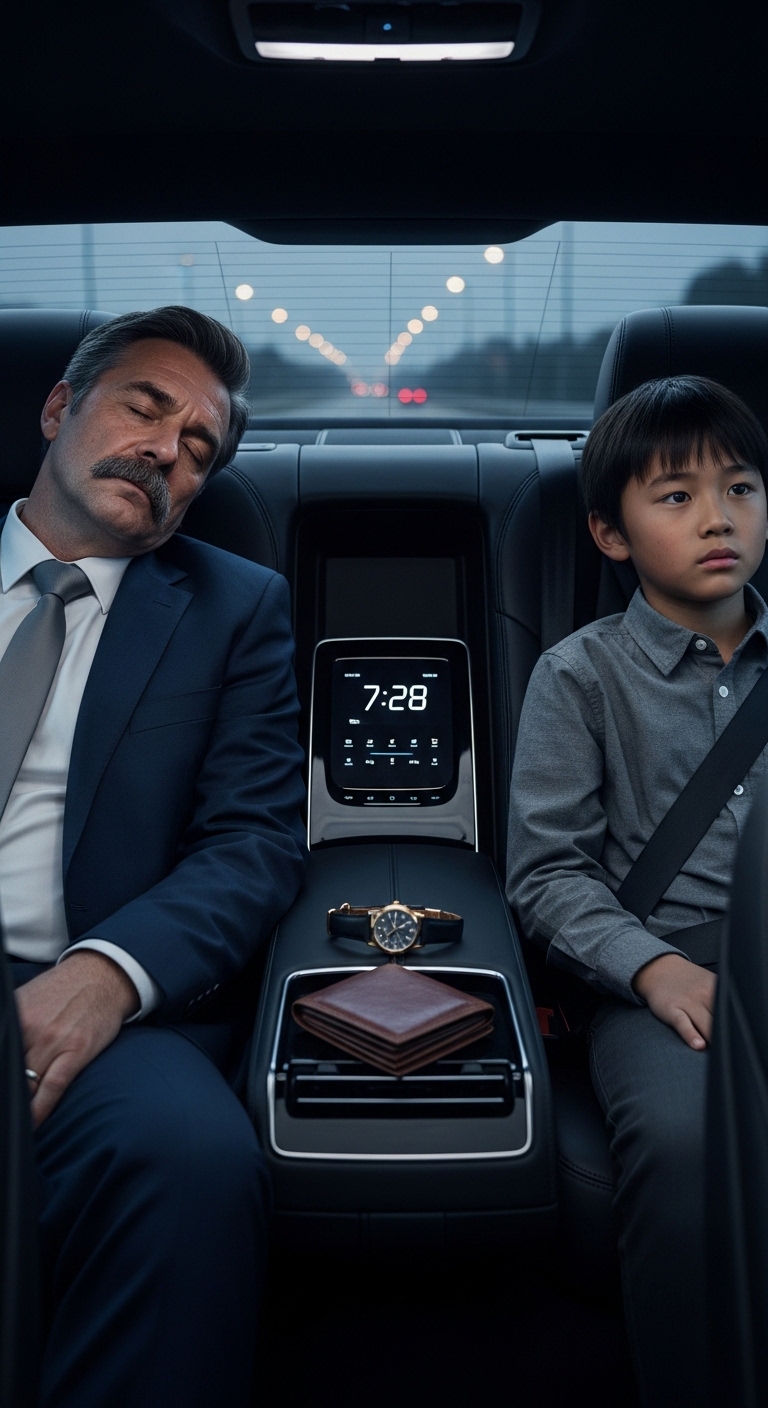
- Don Enrico settled into the captain’s chair in the middle, as if the car were his moving office.
A Test Born From Suspicion
As the vehicle rolled down the highway, Don Enrico’s mind drifted—not toward the scenery, but toward doubt. A bitter thought took root: What if Néstor’s family is only pretending to be honest?
Then an idea formed, quiet and calculating.
“I’m going to sleep for a bit,” Don Enrico announced, loud enough for both father and son to hear.
He leaned back, shut his eyes, and even made a soft snoring sound. But his mind stayed alert. One eyelid remained barely open—just enough to watch.
To set the stage, he placed his thick wallet near the edge of his seat, positioned so it could slip easily. His gold watch also caught the light on his wrist, impossible to miss.
“Let’s see,” he thought. “A child from a poor home won’t resist that.”
The Wallet Falls
Minutes later, the SUV hit a bump in the road. The wallet slid off as if on cue, dropped to the floor, and rolled backward until it stopped near Buboy’s feet.
Don Enrico kept his face relaxed, pretending to sleep. Inside, though, he waited for what he was sure would happen next.
Would the boy grab it and hide it? Would he whisper to his father? Would greed show itself the moment opportunity appeared?
The car continued forward, steady again after the bump. In the quiet, Don Enrico listened for small movements—rustling, quick breathing, the telltale sound of someone doing something they shouldn’t.
And then, Buboy moved.
- He leaned down carefully, as if afraid to disturb anyone.
- He picked up the wallet with both hands, holding it like something important.
- He glanced toward the middle seat where Don Enrico “slept.”
Don Enrico’s chest tightened. Here it comes, he thought, bracing himself for disappointment he already believed was guaranteed.
But the boy didn’t stuff it into his pocket. He didn’t grin, and he didn’t look around like a thief. Instead, Buboy did something small—yet so sincere—that it cut through Don Enrico’s suspicion like sunlight through fog.
He reached forward and gently tried to place the wallet back where it had been—slowly, carefully, doing his best not to wake the man.
When the wallet wouldn’t balance properly on the seat edge, Buboy hesitated. He looked toward his father at the wheel, unsure whether to speak. The boy’s face showed worry—not the worry of getting caught, but the worry of doing the right thing the right way.
In that moment, Don Enrico realized the child wasn’t tempted by wealth—he was concerned about returning it.
And as Don Enrico watched, something he hadn’t expected rose in him: shame. Not at the boy, but at himself—for assuming the worst before seeing anything at all.
His eyes burned, and he felt tears gather—quiet tears he would have once mocked as weakness. Yet they came anyway, because what he witnessed wasn’t cleverness or performance. It was honesty without an audience.
Conclusion
Don Enrico’s “test” was meant to expose greed, but instead it revealed something far more powerful: integrity in a child and dignity in a family he had judged too quickly. In a single, gentle act—returning what wasn’t his—Buboy reminded a hardened man that trust isn’t bought with money. It’s earned through character, even in the smallest moments.