Adrián was the kind of man whose name had almost become a brand. He was the founder of a successful logistics technology company, a favorite of business magazines: a “visionary,” a “strategist,” a leader known for strict discipline. His life was scheduled down to the minute, and his calendar was more crowded than morning traffic in Budapest.
But that day, everything went differently. There were no investors, no meetings, and no cameras. Only the old city park, trees turning yellow with autumn, and his mother—Margit—holding his hand tightly, the way she had when he was a child.
“You’re always rushing,” the woman said softly. “You don’t even notice how the seasons change.”
Adrián gave a polite smile and nodded as if he were listening… and at that exact moment, his gaze caught on a bench a little farther away.
He saw her.
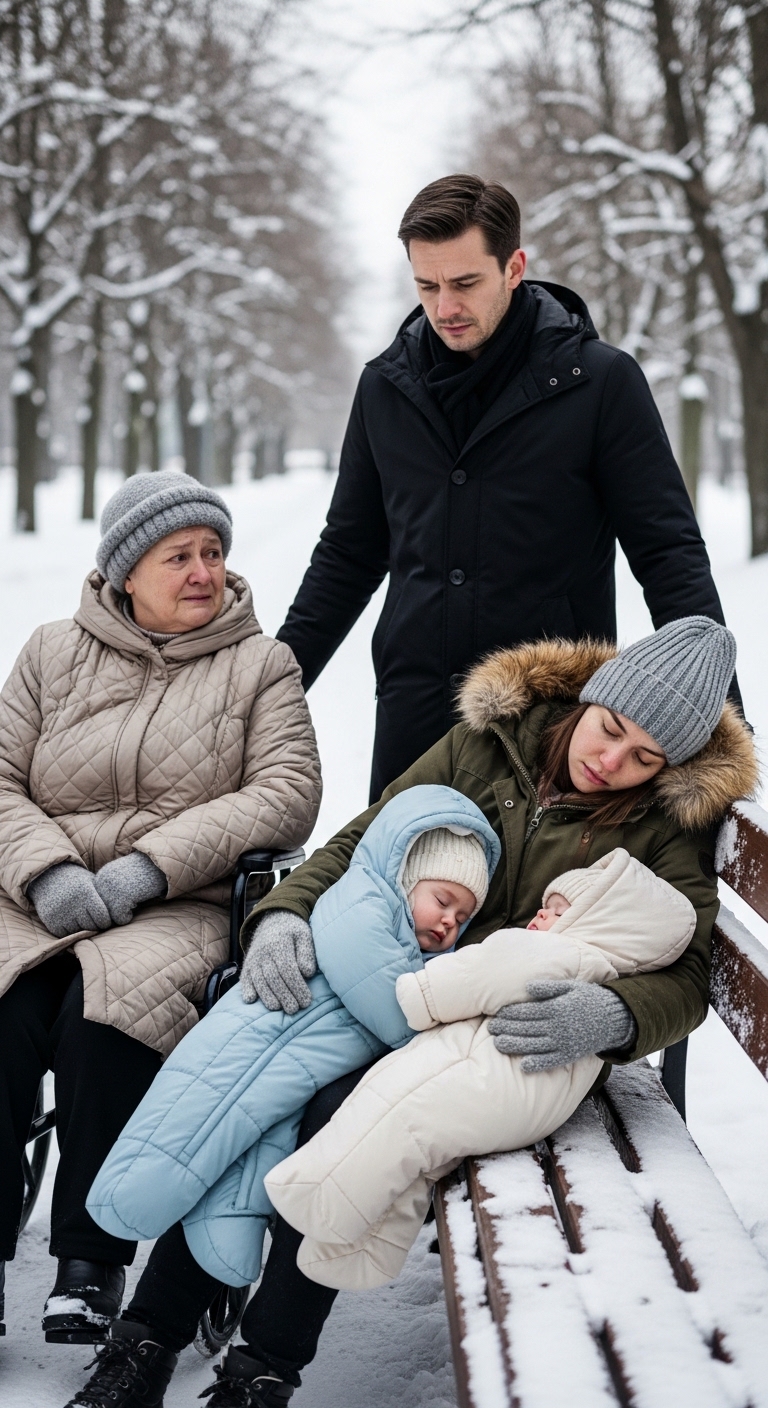
At first he couldn’t believe his eyes. The familiar face, partly hidden by slightly messy hair. The same features, the same mouth. But everything else had changed. She looked thin and pale, as if her strength were slowly fading.
And beside her—two infants. Wrapped in worn blankets. So small. So quiet. As if two fragile secrets were lying there next to her.
Adrián stopped so suddenly that Margit almost stumbled.
“Adrián?..” she whispered in surprise.
He didn’t answer. He just stared. His heart pounded, and questions raced through his mind so fast he could barely breathe.
Who are these children?
Why is she here?
And what truth is hidden in this moment that seems accidental—yet feels life-changing?
What happened next, and the secret that came to light, left him completely shaken…
The park bench that changed everything
Adrián stood as if his feet had grown roots. The world he used to control with schedules, numbers, and decisions suddenly narrowed to one ordinary park bench. There was Klara—the woman he once loved—and beside her, two tiny bundles from which the softest breathing could be heard.
Margit, his mother, was the first to speak, her voice barely above the wind.
“Is it… him?”
Adrián could only nod. His throat tightened, and language failed him. He remembered Klara as spirited and stubborn, quick to laugh, the kind of person who could debate for hours and slam a door on the way out—yet never seemed defeated. Now she had dozed off sitting upright, one baby held close against her chest. The other lay beside her, and even in sleep her hand rocked the child on instinct.
“I’m going over,” Adrián managed, the words rough and unsteady.
He took one step, then another. Inside him, everything resisted—fear, guilt, and shame. He had left long ago with convenient excuses: no time for family, the company was taking off, they didn’t understand each other. Back then he believed he was in control. In that moment, the illusion crumbled.
Recognition—and a truth he didn’t expect
Klara woke at the shadow falling across her. She flinched and pulled the babies closer, worry flashing in her eyes before recognition softened her expression.
“Adrián…” she whispered, as if his name weighed too much to say.
The silence between them felt thick. Margit stepped nearer, unable to look away from the infants.
“They…” she began, but stopped.
Klara answered quietly, steadying her breathing.
“They’re mine. They’re ours.”
That single word—ours—hit harder than any accusation. Adrián’s knees went weak, and he sat on the edge of the bench, staring at the babies as if he might finally understand his own life.
- He had built a career that looked perfect from the outside.
- He had chased deadlines and deals instead of conversations.
- And yet, nothing he owned compared to this moment.
What Klara carried alone
“This can’t be real,” Adrián murmured. “You never told me. Back then I—”
“What would you have done?” Klara asked. There was no sharp anger in her tone—only deep exhaustion. “You didn’t even have time for one honest talk. You were signing contracts, flying from place to place, building your empire. And I was left alone with two beating hearts.”
She spoke without tears, like someone who had already spent them all. She explained that she learned about the pregnancy only after the divorce. She had written him a letter, then folded it away when she saw headlines about his next big investment and realized he was still running.
She told them she didn’t want to disrupt his life. At first she managed—work, a small rental, occasional help. Then came health complications, a job loss, and bills that piled up too quickly. When the babies were barely three months old, she lost her housing. The bench in the park became a temporary refuge.
“I didn’t want them to be a burden,” she said softly. “I just wanted them to be safe.”
Margit pressed her lips together, holding back emotion. Then, gently, she brushed a fingertip along one baby’s cheek.
“That chin,” she said to Adrián, “it’s just like yours. And those eyebrows too.”
Choosing warmth, not pride
Adrián watched the children—alive, warm, needing care—and something inside him shifted, not with pain, but with clarity. Awards, rankings, and applause suddenly felt hollow without this truth: he was a father.
“Let’s go home,” he said at last.
Klara gave a small, guarded smile.
“To where? Your glass tower?”
“To somewhere warm,” Adrián replied, firm for the first time in a way that mattered. “A bed, food, a doctor. The rest… we’ll figure out.”
- Warmth first.
- Health next.
- And trust—rebuilt slowly.
Klara hesitated. The last few years had taught her how easily promises can collapse. But Margit reached for her hand.
“Give us one chance,” she said. “For them.”
A house that finally sounded like a family
Adrián’s home filled with noises it had never held before: a baby’s cry, the soft rustle of diapers, the hush of lullabies Margit hummed as if remembering her own early days of motherhood. Doctors checked the infants. They were healthy, only worn out from too much uncertainty.
For the first time in a long while, Klara slept in a real bed—without jolting awake from cold or fear.
Weeks passed. Adrián canceled meetings and reshaped his schedule. He learned how to hold a bottle properly, how to change diapers, and how to tell the difference between a hungry cry and a tired one. He watched Klara return to herself little by little, carefully, like someone surfacing after holding their breath for too long.
He didn’t try to repair the past with grand speeches—he repaired the present with presence.
The conversation that mattered most
One evening, Klara stood by the window with their daughter in her arms. The city lights reflected faintly on the glass.
“I don’t want to live as a shadow in your life,” she said. “And I don’t want them growing up feeling like their birth was a mistake.”
Adrián stepped beside her.
“The mistake was that I left,” he answered quietly. “Everything else is a chance. My chance to make things right.”
He didn’t rely on dramatic apologies. He proved himself through patience, attention, and consistency. He changed paperwork and plans, yes—but more importantly, he changed his days, his priorities, his habits. He began building a life that had room for people, not just success.
A year later, the same path—different hearts
One year later they walked through the same park, along the same tree-lined path where everything had turned. The babies slept in the stroller. Margit walked beside them with a gentle, content smile. Klara looked at Adrián, her voice thoughtful.
“Sometimes I wonder… what if you hadn’t seen us that day?”
Adrián squeezed her hand.
“It wasn’t an accident,” he said. “Even the most precise plan can’t overwrite what’s meant to wake you up. Life just waited until I finally stopped.”
In the end, what saved them wasn’t money or pride—it was the decision to stay, to listen, and to choose family every single day