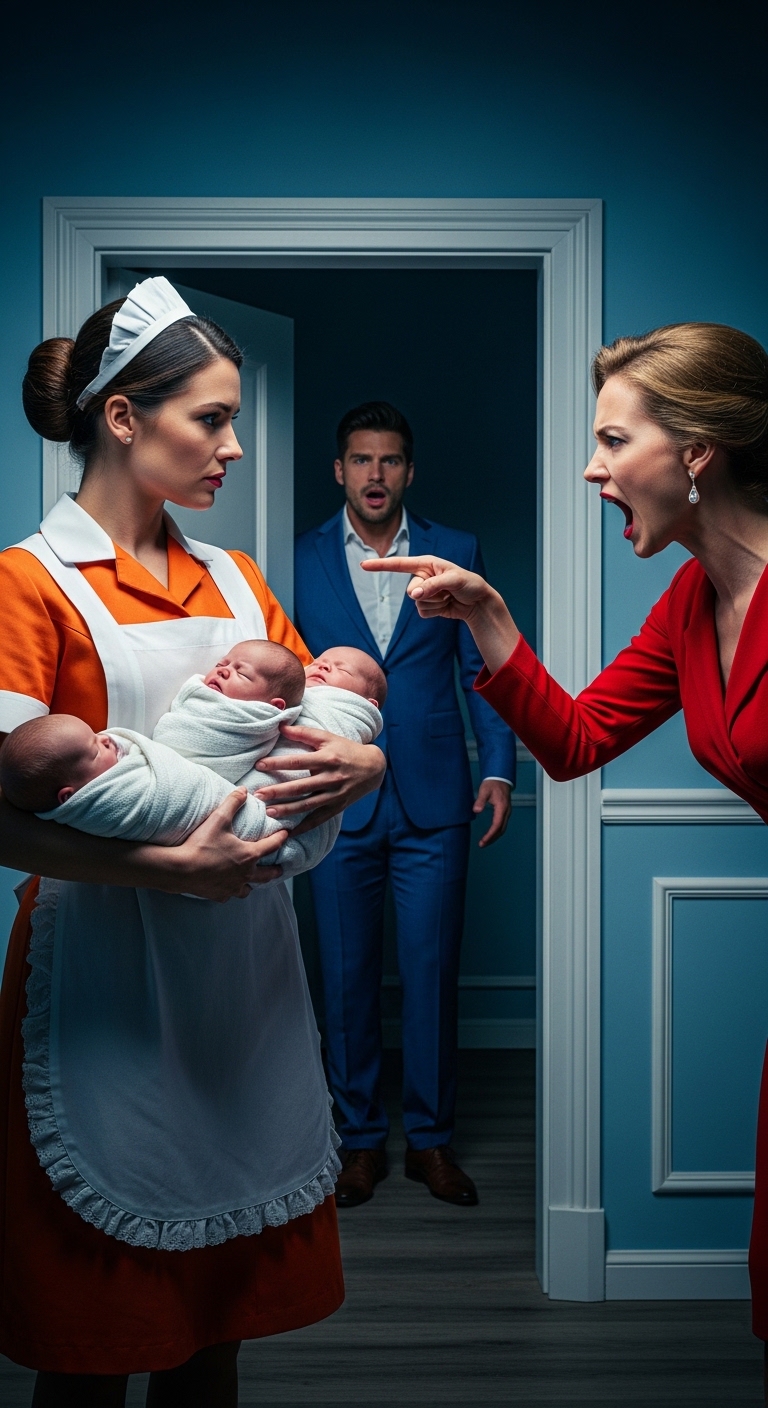
“Don’t you take another step.”
The housekeeper’s voice trembled—
but it didn’t give in.
Behind her, three infants cried loudly in the dim nursery.
Ethan Reed pressed himself against the hallway wall, holding his breath.
Twelve hours earlier, he’d said goodbye like any ordinary partner. He rolled a suitcase to the car and waved like someone leaving town for three days.
But he didn’t actually go anywhere.
He drove around the block.
Slipped back in through a concealed service entry.
And before sunrise, in the still hours when the home felt quiet, he set up small cameras.
Not for entertainment.
Not to control anyone.
For one purpose:
To answer the question he couldn’t bring himself to say out loud—
Who keeps my children protected when I’m not there?
Inside the nursery, Lena Park—his housekeeper, the person many barely noticed—held one baby close in her arms.
The other two cried in their cribs, flushed and overwhelmed.
In the doorway stood Ethan’s wife, Celeste Veil.
A carmine dress. High heels. Perfect lipstick. Perfect posture.
And a cold expression.
“You’re just staff,” Celeste said, her tone loaded with contempt. “You don’t get to stand between me and my home.”
Lena didn’t back down.
“Then dismiss me,” she said. “Call security. But I’m not moving until these babies are safe.”
Ethan’s stomach tightened.
He and Celeste had adopted the triplets months earlier.
In photos, Celeste looked like the image of motherhood—smiling, radiant, posting captions about love and gratitude.
But in real life, Ethan was hearing something very different.
Harshness dressed up as refinement.
“You’re forgetting your role,” Celeste said quietly.
A quiet that can cut deeper than yelling.
The room felt smaller with her in it—like every step was meant to intimidate.
The crying rose and fell behind Lena, raw and urgent.
“My role,” Lena repeated, lifting her chin, “is right here. With them.”
Celeste gave a short laugh—hollow and icy.
“You clean. You leave. That’s the arrangement.”
“No,” Lena said, her voice shaking just enough to sound real.
“That’s neglect.”
From the hallway, Ethan felt those words hit hard.
He watched his wife move forward.
Watched Lena refuse to step aside.
Watched the tension shift from cruel words… to something more serious.
“I can destroy you,” Celeste said evenly, as if making a casual request.
Lena swallowed. Tears pooled in her eyes.
But she stayed planted.
“Then do it,” she said quietly. “But don’t go near them.”
Something broke open in Ethan’s chest.
This wasn’t fair.
This was someone with power bearing down on someone with none—except determination.
And for the first time, Ethan understood what he’d been avoiding:
Care doesn’t always look like polished smiles and social posts.
Sometimes care shows up shaking.
Sometimes it shows up frightened.
And it still holds its ground.
Ethan’s legs wouldn’t move, but his mind was racing in the shadows.
If he stayed silent, he protected himself.
If he stepped in now… he risked everything.
Then—
creak.
His shoe shifted on the floorboard.
A small sound.
But it shattered the moment instantly.
Celeste’s head snapped toward the hallway.
Lena tensed.
The babies cried louder.
And Ethan realized there was no hiding now.
Because now they knew—
someone was there, watching.
The head housekeeper held her ground in the hallway, voice shaking but firm. “Don’t take another step.”
Behind her, three babies cried in sharp, helpless bursts that made the mansion feel smaller than it looked.
Ethan Reed stood just out of sight, pressed to the wall, trying to steady his breathing. Half a day earlier, he had kissed his wife goodbye, loaded a suitcase into the car, and waved like a man noting a routine business trip. But he hadn’t gone anywhere. He drove around the block, circled back, and slipped into the house through a discreet rear entrance.
Before sunrise, he placed tiny cameras in key rooms—quietly, carefully. Not for entertainment, not out of jealousy. He did it because one question kept gnawing at him: When I’m not here, who is really keeping my children safe?
Sometimes the most important truth in a household isn’t what people say in public—it’s what they do when they think no one is watching.
In the nursery, the scene Ethan found was nothing like the polished photos his wife posted online. Lena Park—the cleaner most people barely noticed—was holding one of the triplets tight against her chest, rocking gently as though her own heartbeat could calm the tiny body. The other two babies cried in their cribs, faces red, arms waving in exhausted frustration.
At the doorway stood Celeste Veil, Ethan’s wife, dressed as if she were heading to a gala: a crimson dress, tall heels, perfect hair, and an expression as cold as glass. She didn’t look at the babies with tenderness. She looked at Lena like an inconvenience.
“You’re staff,” Celeste said, words clipped and contemptuous.
Lena didn’t step aside. “Then fire me. Call security if you want,” she answered, voice steady even as her arms trembled from strain. “I’m not leaving until they’re safe.”
Ethan’s stomach tightened. He had adopted the triplets months ago. Celeste had posed beside them with a practiced smile, captions about “blessings” and “love.” Yet here, in real life, her tone told a different story—one that didn’t fit the shiny version the world had been sold.
- Lena kept one baby close to quiet the sobs.
- The other two cried, not from drama, but from being overwhelmed and needing comfort.
- Celeste treated the moment like a power contest, not a parenting emergency.
Celeste’s voice softened into something sharper than yelling. “You’re forgetting your place.”
Perfume hung heavy in the air. The doorway felt blocked not only by Celeste’s body, but by the authority she assumed she owned. One baby clutched Lena’s shirt with surprising strength, like instinct had already decided where safety lived.
For months, Lena had moved through the mansion quietly: wiping counters, folding laundry, carrying out tasks no one praised. But she had also learned each baby’s cues—who settled when someone hummed, who needed a hand on their back to sleep, who startled easily and calmed with slow rocking. She had been the steady presence long before anyone asked her to be.
When Celeste demanded she leave, Lena lifted her chin. “My place is here,” she said simply. “With them.”
Celeste laughed, empty and dismissive. “You clean. You go home. That’s how this works.”
“No,” Lena replied, her voice cracking just enough to reveal the fear under her courage. “That’s how neglect works.”
From the hallway, Ethan felt the word hit him like a physical blow.
Love doesn’t always arrive wearing elegance. Sometimes it shows up shaking, exhausted, and unwilling to walk away.
Celeste stepped closer, speaking as if she were casually discussing schedules and errands. “I can ruin you,” she said, calm and confident, as though the threat was routine.
Lena swallowed hard, tears gathering. Still, she didn’t move. “Then ruin me,” she whispered. “But don’t touch them.”
Something in Ethan cracked—not with drama, but with clarity. This wasn’t an argument between equals. This was someone with wealth and influence pressing down on someone with no cushion at all. Lena had no lawyers, no connections, no safety net. She had only her reminder of what mattered: three babies who couldn’t defend themselves.
Ethan had told himself he was being careful. He had hidden to observe, to collect proof. He believed powerful people didn’t lose unless you could demonstrate what they’d done. Yet every second he waited, the babies cried harder and Lena stood more alone.
Silence had always helped Ethan win in business—hold your cards, watch, time the move. But here, silence wasn’t strategy. It was abandonment.
Celeste folded her arms, already bored, already convinced she would be believed over a cleaner. “You don’t matter,” she said. “No one will listen to you.”
Lena closed her eyes for a single breath, then opened them again. “Maybe,” she replied, quiet but unbreakable. “But I’ll be able to live with myself.”
- Ethan realized his “plan” protected his reputation, not his children.
- Lena’s choice was immediate: safety first, consequences later.
- Celeste’s certainty relied on one thing—people assuming she was the “right” kind of mother.
That was the moment Ethan stepped forward. The floor creaked beneath his shoe, and the tiny sound felt enormous—like the end of one life and the beginning of another.
Celeste turned, surprise flashing before her face rearranged into a warm, public-ready smile. “Ethan,” she said lightly, as if this were a misunderstanding. “You came home early.”
Lena looked past her and met Ethan’s eyes. There was no relief in his expression—only urgency and regret.
Celeste rushed to frame the narrative. “You shouldn’t have heard that,” she added sweetly. “She’s emotional.”
Ethan didn’t answer. His gaze moved across the room: the cribs, the flushed faces, Lena’s protective hold. He didn’t explode. He didn’t shout. He simply saw—fully, clearly.
Celeste exhaled as if inconvenienced. “Fine,” she said. “You want honesty?”
She didn’t move to comfort the babies. She didn’t even really look at them. Instead, she spoke like someone listing reasons for returning an unwanted purchase.
“I tried,” Celeste continued. “I smiled for pictures. I learned the right lines. But this—” She gestured vaguely toward the cribs. “This isn’t the life I married into.”
Her voice sharpened. “I didn’t marry you to disappear into bottles and sleepless nights. I married you for freedom. For travel. For us.”
Ethan felt the words land—cold, heavy, final.
Then Celeste said the part that made the nursery go quiet in a deeper way. She suggested they could “start over,” implying the children were temporary, replaceable. Not family—just an inconvenient detour.
Lena shook her head, tears slipping down without shame. “They’re not objects,” she said. “They’re lives.”
Celeste rolled her eyes. “That’s why people like you lose.”
Ethan finally spoke, voice low but solid. “No,” he said. “People like you lose.”
A parent doesn’t become strong by winning arguments. They become strong the first time they choose their child over their comfort.
Ethan moved between Celeste and the cribs. His hands shook slightly, not from uncertainty, but from the force of restraint. “You didn’t only lie to me,” he said. “You put my children at risk.”
For a brief second, Celeste’s mask slipped. In that small gap, Ethan saw the calculation—the lack of care where care should have been.
He didn’t keep arguing. He knew a direct confrontation could turn into a performance: tears on demand, rewritten details, him painted as unstable. So he stepped away and made a different choice—one built on preparation rather than shouting.
Later that night, Ethan locked himself in his office and pulled up the camera feeds. He needed undeniable evidence—something that couldn’t be smoothed over by charm.
The screens failed to load. Files were missing. Backups wouldn’t run. Someone had interfered.
Cold fear slid through him, but it didn’t stop him. He searched again and found a restored folder: one surviving file, audio only.
When he hit play, Celeste’s voice filled the room—unpolished, casual, and unsettlingly confident. She laughed with someone about money, timing, and how easily she could convince a professional that Ethan was overwhelmed. She spoke about taking control of the narrative, about leaving “free,” about treating the triplets like a reversible decision.
Ethan stopped the recording halfway, breath tight in his chest. This wasn’t a moment of stress. It was a plan.
- The video evidence was tampered with, suggesting deliberate concealment.
- An audio file remained, capturing Celeste’s real intent.
- Ethan shifted from “husband trying to reason” to “father preparing to protect.”
At dawn, without sleep, Ethan placed a call to his attorney. “I need you at your office at seven,” he said. “This is about custody—and my wife.”
She didn’t ask for details. “I’ll be there,” she replied.
That evening, Ethan gathered key family members in the living room. The space felt too bright, like a stage lit for a verdict. His mother sat rigidly on the couch. His brother stood by the window, arms crossed, already sensing something permanent. Lena waited near the entrance, hands folded, posture straight—quiet, but steady.
Celeste came down last, immaculate as always. “What is this?” she asked, lightly confused. “You said you were traveling.”
“I never left,” Ethan answered.
He turned on the television. The first clip played: Celeste near the cribs, irritation plain on her face, complaining about the crying. The room tightened. His mother’s breath caught.
The next clip revealed more—Celeste speaking on the phone, admitting she had married for money, not for the responsibilities that came with children. Then Ethan played the preserved audio: the planning, the manipulation, the cold certainty.
When it ended, silence filled every corner.
Celeste’s face drained of color as she searched the room for someone to rescue her story. She found only disbelief—and something heavier than anger: disappointment.
“You don’t understand,” she said, voice trembling. “I was overwhelmed. I didn’t mean it.”
Ethan’s reply was quiet. “Or was that the first time you were honest?”
When the truth is finally spoken aloud, excuses shrink quickly—especially in front of the people who once believed the mask.
Lena stepped forward. Her hands trembled, but her voice stayed steady. “Those babies aren’t a phase,” she said. “They aren’t a burden. They’re children who deserve safety.”
Celeste forced a weak laugh. “You think you matter here?”
Before Ethan could answer, his mother stood up, voice fierce and unmistakable. “She matters more than you ever did,” she said, pointing toward Lena. “She seen them. She stayed. She protected them.”
Celeste opened her mouth, then closed it again. With no room left to rewrite the story, she grabbed her purse and walked out. The door shut behind her with a hard finality that echoed through the house.
No one cheered. The mansion didn’t feel triumphant—it felt bruised. The truth had won, but it left a mark.
Upstairs, soft humming drifted down from the nursery—an old lullaby. The babies gradually quieted, one by one, soothed by the steadiness they had been missing.
Ethan turned toward Lena. She stood near the entrance as if unsure whether she was allowed to belong now that everything was exposed.
“I owe you an apology,” he said.
Lena shook her head. “You don’t owe me anything.”
“I do,” Ethan insisted, voice raw with sincerity. “I didn’t see you. I walked past you and never asked who you were, or why you cared. I trusted someone because she looked right—and I ignored the person who showed up when it mattered.”
Tears gathered in Lena’s eyes—tears she had postponed for months.
“I didn’t do it to be noticed,” she said softly. “I did it because someone had to.”
Ethan nodded. “Then stay,” he said. “Not as staff. As their legal guardian, with real support—stable pay, security, a future for you and your daughter. Not charity. Recognition.”
Lena hesitated, hope and fear colliding. “I can’t accept that for myself.”
“Accept it for them,” Ethan replied. “And for the promise you kept when no one was watching.”
- Ethan acknowledged his failure to recognize quiet devotion.
- Lena’s role shifted from unseen worker to trusted protector.
- The focus moved from appearances to the children’s real needs.
Lena lowered her head as a quiet sob escaped. “Then yes,” she whispered. “For them.”
Later, Ethan sat in the nursery, rocking gently as the triplets slept. The house still carried the aftermath of lies, but something new began to settle in—presence. Responsibility. The kind of love that doesn’t perform, it persists.
Lena appeared in the doorway with a blanket, draped it over Ethan’s shoulders without fanfare, and sat near the cribs the way she always had: steady, real, and attentive.
In that quiet, Ethan finally understood his home not as a property he owned, but as a family he was learning to protect.
Three months later, the mansion no longer woke in silence. Morning light filled the kitchen while Lena warmed bottles, humming softly. Her daughter did homework at the table, feet swinging. Upstairs, the triplets stirred one by one—small sounds that felt like the house breathing again.
Ethan noticed the change in the smallest habits: waking early because he wanted to, not because he had to; checking on his children before checking his phone; speaking to Lena with respect instead of assumption.
Celeste didn’t return. The divorce moved forward without the power she once believed she could wield. Ethan didn’t feel victorious. He felt relieved—and quietly saddened by how far someone can drift when they live behind a polished mask for too long.
One afternoon, Ethan found Lena in the nursery holding an old photograph of two teenage girls smiling—young, hopeful, unaware of the storms ahead. Lena whispered to the picture like a promise that the babies were safe, loved, and growing. Ethan stepped back without interrupting. Some vows deserve privacy.
Later, sitting together in the calm of evening, Ethan asked, “Do you regret staying?”
Lena smiled—this time not from endurance, but from peace. “Family isn’t only blood,” she said. “It’s who stays when everything falls apart.”
Ethan looked down the hallway toward three sleeping children and understood the truth he’d been avoiding: his life was no longer perfectly managed. It was real. And real was better.
Conclusion: This story is a reminder that genuine care often comes from the people we overlook—and that protecting children requires more than appearances. When Ethan finally chose action over silence, he made space for the kind of family built on safety, accountability, and steady love.