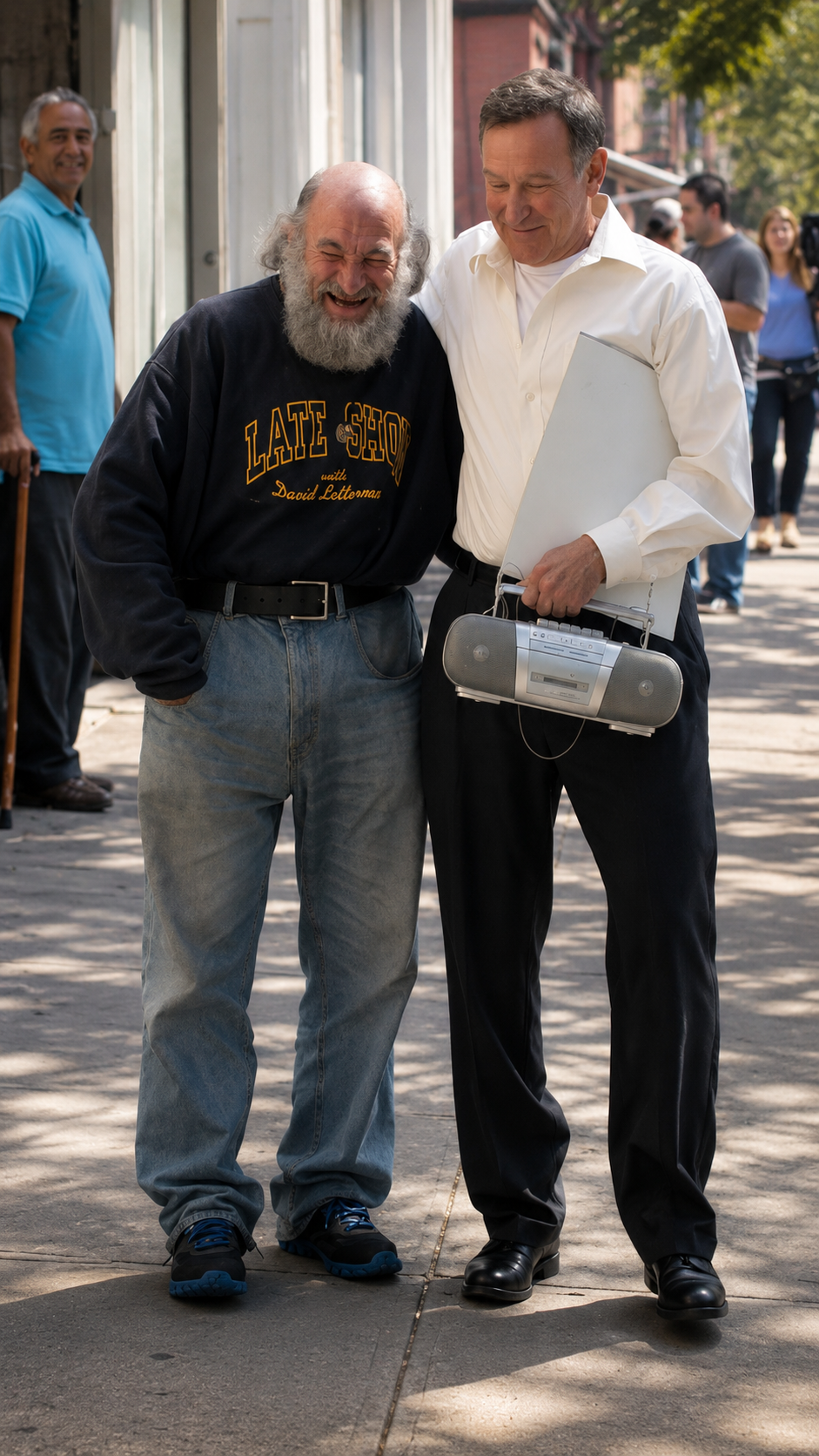
Some people are remembered for what they did on screen. Others for what they did when no cameras were watching. Robin Williams seemed to belong to both worlds at once. While audiences knew him for his electric humor and emotional depth, there was another side to him that moved quietly behind the scenes—one shaped by a deep, almost restless compassion for people who had been pushed to the edges of society, especially those experiencing homelessness.

That compassion didn’t stay abstract. On several film sets, Williams made an unusual demand as part of his contract: if he was going to join a project, the production had to open its doors to people experiencing homelessness. Not as charity in the background, but as real workers—extras, assistants, people given a chance to step into a professional environment. It was his way of turning influence into opportunity rather than sentiment.

Over time, those conditions quietly accumulated into something remarkable. Reports suggest that more than 1,500 people who were homeless were given paid work through these arrangements. For many of them, it wasn’t just a day on a film set—it was a rare entry point into stability, a line on a résumé, and a reminder that they were still seen as capable of contributing. Williams rarely spoke loudly about it; he didn’t seem interested in credit, only in whether it worked.

His kindness wasn’t limited to systemic efforts. In 2004, he learned about a young girl named Jessica, seriously ill and supported by the Make-A-Wish Foundation, whose greatest wish was simple: to meet him. When her condition worsened and travel became impossible, Williams didn’t hesitate. He flew privately to North Carolina and spent the day with her—playing games, talking, and offering a kind of presence that no script could ever replicate. Those who were there later described it not as a celebrity visit, but as a deeply human encounter.

When he died on August 11, 2014, at 63, the news left a silence that felt larger than his fame. His death by suicide added a painful layer to how he was remembered, but it didn’t eclipse what he had already given. Films like Dead Poets Society, Jumanji, Bicentennial Man, and What Dreams May Come continue to carry his range, while the documentary Robin Williams: Come Inside My Mind revisits the brilliance and vulnerability that lived side by side in him. In the end, what stays is not just the laughter, but the way he used it to make room for others.
