But Vanessa wasn’t laughing.
Her hands were trembling.
“Your husband has arranged for your left kidney to be removed tonight,” she repeated, her voice barely above a whisper. “The preliminary testing is complete. The operating team has been paid. And according to these documents, you’ve already given your consent.”
I looked down at the thick medical folder.
My name was printed on the first page.
SOFIA ELIZABETH MERCER.
Beneath it was my date of birth, my address in Southlake, my blood type, and several pages of medical information I had never knowingly provided.
At the bottom of the final page was a signature.
Mine.
Or something that looked enough like mine to fool a stranger.
I touched the paper with one shaking finger.
“I didn’t sign this.”
“I know.”
“I didn’t agree to any surgery.”
“I know, Sofia.”
I lifted my eyes.
“Then why is my name on it?”
Vanessa swallowed.
“Because Julian told me you had agreed to become a living kidney donor. He said you were afraid of hospitals and preferred not to remember the preliminary procedures.”
For one terrible moment, I couldn’t even speak.
Then I laughed.
It wasn’t a normal laugh. It sounded like something breaking.
“He told you I wanted to be unconscious?”
Vanessa looked away.
“At first, I believed he had your permission. But after the second visit, I started questioning him.”
“And yet there were four visits.”
She didn’t answer.
“Four times,” I repeated. “Four times his brother gave me something to drink. Four times I woke up with bruises and pain I couldn’t explain.”
Vanessa lowered her head.
“I’m sorry.”
Those two words made something hot and furious rise inside my chest.
“Sorry?”
My voice echoed through the silent office.
“You’re a doctor. I came into your clinic unconscious, and you didn’t think to ask whether I wanted to be here?”
“Sofia, please—”
“Did you see me?”
She hesitated.
That hesitation told me everything.
“Did you touch me? Did you examine me while I couldn’t speak? Did you know I hadn’t agreed?”
Tears gathered in Vanessa’s eyes.
“Yes.”
I took a step backward.
The room seemed to tilt.
For weeks, I had believed something was wrong with my body.
I had blamed myself for being tired. I had bought vitamins, changed my diet, scheduled appointments I later canceled because Julian insisted I was overreacting.
I had even signed up for a gym membership.
My husband had watched me struggle with the consequences of what he was doing and laughed in my face.
And now I was standing in a doctor’s office, looking at paperwork proving that my body had been treated like property.
“Who?” I whispered.
Vanessa frowned.
“Who needs my kidney?”
She slowly closed the folder.
“There’s something else you need to know.”
My stomach twisted.
“Tell me.”
“The intended recipient is a sixteen-year-old girl.”
I stared at her.
“Your daughter?”
Vanessa nodded.
“Her name is Iris.”
“And Julian is helping because you’re involved with him?”
A tear slipped down her cheek.
“No, Sofia.”
She reached into her desk and pulled out a photograph.
It showed Julian standing beside a teenage girl with dark hair and gray-green eyes.
His arm was wrapped around her shoulders.
The girl had his smile.
The exact same crooked smile I had fallen in love with eight years earlier.
Vanessa pushed the photograph toward me.
“Julian is helping because Iris is his daughter.”
1. The Family I Never Knew Existed
I couldn’t stop staring at the photograph.
Julian looked younger in it, perhaps forty, wearing a blue polo shirt I recognized from a vacation he had supposedly taken with his college friends.
The girl was laughing.
She had her father’s chin.
His eyebrows.
His expression.
Everything about her was familiar, and that familiarity made me feel sick.
“How old did you say she was?”
“Sixteen.”
Julian and I had been married for seven years.
For seven years, he had told me he wanted children but wasn’t ready.
For seven years, he had reassured me that our family would come when the time was right.
He had taken my hands after every disappointing pregnancy test and kissed my forehead.
“We have all the time in the world, sweetheart.”
All the while, he already had a daughter.
“Does she know about me?” I asked.
Vanessa nodded.
“She knows her father is married.”
“And she knows he wants to take my kidney?”
Vanessa’s silence was answer enough.
I pressed my hand against my mouth.
“Does she want this?”
“No,” Vanessa said quickly. “She doesn’t know the truth about how the donation was arranged. She believes you volunteered.”
The word volunteered felt like a slap.
“Of course she does.”
Vanessa moved closer.
“Iris has a serious kidney condition. She’s been receiving treatment for years. Her health has deteriorated, and Julian became obsessed with finding a compatible donor.”
“So he chose his wife?”
“He arranged for you to have blood tests during a routine health screening last year.”
I remembered that appointment.
Julian had surprised me with an expensive wellness package at a private clinic.
“An anniversary present,” he had called it.
He’d even taken me to dinner afterward.
I remembered thanking him.
I remembered telling my sister how thoughtful he’d been.
My knees weakened.
“That’s when he found out?”
Vanessa nodded.
“The preliminary results suggested that you might be compatible with Iris. More testing was needed. Julian told me you wanted to help but were terrified of medical procedures.”
“Then why didn’t he ask me?”
Vanessa looked at me with an expression I would remember for the rest of my life.
“Because he was afraid you’d say no.”
I shook my head.
The awful irony was that I didn’t know what I would have said.
Had Julian sat me down, told me about his daughter, explained her condition, and asked whether I would consider being tested, perhaps I would have listened.
Perhaps I would have been angry.
Perhaps I would have needed months to process the betrayal.
But I would have had a choice.
Instead, he had decided that my consent was an inconvenience.
And once he made that decision, every lie became easier.
I stared at Vanessa.
“Why tonight?”
Her expression darkened.
“Because Julian believes he’s running out of time.”
“For Iris?”
“That’s what he keeps saying.”
There was something strange about her answer.
“What do you mean?”
Vanessa glanced toward the closed office door.
“Iris needs a transplant, Sofia. That’s true. But she’s being treated, and her specialists are continuing to evaluate legitimate options. There is no medical reason to conduct this operation secretly tonight.”
“Then what is the rush?”
Vanessa gripped the edge of her desk.
“Julian has been moving money through a private medical company. He’s borrowed against assets he doesn’t own outright. And yesterday, someone demanded repayment.”
I felt cold all over.
“Who?”
“I don’t know. But he told Marcus that once the operation was done, every financial problem would disappear.”
I looked back at the folder.
“An operation doesn’t make debts disappear.”
“No,” Vanessa whispered. “It doesn’t.”
She reached beneath the paperwork and pulled out another document.
A printed insurance policy.
I saw my name again.
Then an amount.
$3,000,000.
My heart began to hammer.
“What is this?”
Vanessa’s face drained of color.
“I found it in a file Julian left here. I don’t know why he brought it, but I think—”
She stopped.
“Think what?”
She couldn’t meet my eyes.
I grabbed the paper.
The policy listed Julian as the beneficiary.
My husband had taken out a three-million-dollar life insurance policy on me.
And I had never known it existed.
“Vanessa.”
My voice sounded almost unrecognizable.
“Was I supposed to wake up after the surgery?”
She looked at me.
Then she began to cry.
“I don’t know.”
2. The Message on His Phone
I wanted to scream.
I wanted to grab every document in that room and throw it into the street.
More than anything, I wanted to go back seven years and refuse the hand of the man who had stood before a wedding altar promising to protect me.
But before I could say anything, Vanessa’s phone vibrated.
The screen lit up.
JULIAN — INCOMING CALL
We both froze.
She looked at me.
I looked at the phone.
Then I whispered, “Answer it.”
“Sofia—”
“Put it on speaker.”
Vanessa hesitated.
Then she pressed the green button.
“Hello?”
Julian’s voice filled the office.
Warm.
Confident.
Familiar.
“Vanessa, are we all set for tonight?”
My stomach tightened.
Vanessa stared at me as if she were asking permission to breathe.
“Yes,” she managed.
“Good. The team wants final confirmation before six. Marcus says Sofia doesn’t suspect anything.”
The room went absolutely still.
Julian continued.
“I’ve arranged dinner at home. She’ll think we’re celebrating her promotion. Afterward, Marcus will handle transportation.”
I closed my eyes.
The promotion.
Three weeks earlier, I had been made senior accounting manager at my firm.
Julian had promised to take me somewhere special.
He had postponed the celebration twice.
Now I knew why.
He was saving it for tonight.
Vanessa cleared her throat.
“Julian, I think we need to reconsider.”
Silence.
Then his voice changed.
“Reconsider what?”
“The procedure. She’s your wife.”
“She’s the only compatible donor we’ve confirmed.”
“But Iris—”
“Don’t start with me.”
His tone became sharp.
“I have spent months putting this together. I’ve paid people who don’t appreciate last-minute doubts.”
Vanessa’s fingers tightened around the phone.
“She hasn’t signed a valid consent.”
Another pause.
Then Julian laughed softly.
“That’s already been handled.”
My throat closed.
Vanessa glanced at me.
“What if she finds out?”
“She won’t.”
“How can you be sure?”
“Because Sofia believes whatever I tell her.”
There it was.
Seven years of marriage reduced to a single sentence.
Julian continued with a chuckle.
“Last night, she asked why her back hurt. I told her she needed to exercise, and she apologized for complaining.”
I remembered that conversation.
I had apologized.
God help me, I had actually apologized.
Vanessa looked as though she might be sick.
“Julian, this has gone too far.”
His voice dropped.
“Listen very carefully. You knew what we were doing. Don’t suddenly pretend you’re innocent.”
“I never agreed to—”
“You signed the preliminary records, Vanessa. Your name is on the evaluations. Your clinic received the payments. If this falls apart, you’re going down with the rest of us.”
A long silence followed.
Then he added something that made my blood run cold.
“And make sure those files are locked away. Sofia has been asking questions lately.”
Vanessa’s eyes flew to mine.
“Questions?”
“She asked Marcus about one of the drives home. Said she couldn’t remember getting out of the car.”
Julian gave a contemptuous laugh.
“Honestly, I don’t know how she balances corporate accounts when she can’t remember where she left her shoes.”
I felt tears burning behind my eyes.
Not because he had insulted me.
Because I recognized the enjoyment in his voice.
He hadn’t simply been hiding the truth.
He had been enjoying how easily he could manipulate me.
Then he said, “I’ll call when I’ve got her ready.”
The call ended.
For several seconds, Vanessa and I stood facing each other without speaking.
Finally, I reached across the desk and picked up my purse.
“I’m going to the police.”
Vanessa went pale.
“If you do that, Iris could lose her chance.”
I turned so sharply she stepped backward.
“Don’t.”
“Sofia—”
“Don’t use that child to make me feel guilty.”
I could barely hold my voice steady.
“I didn’t cause her illness. I didn’t lie to her. I didn’t forge medical documents. And I didn’t drug another human being.”
Vanessa began crying again.
I didn’t comfort her.
“You’re her mother,” I said. “You should have protected her from this.”
“I was trying to save her.”
“No. You were trying to save her without having to hear me say no.”
That stopped her.
I placed the insurance document on top of the folder.
“And now you’re going to help me make sure nobody else gets hurt.”
She stared at me for a long moment.
Then she whispered, “What do you need?”
“Copies. Everything. The test results, the signatures, the payment records, every appointment.”
Vanessa nodded.
She opened a drawer and removed a small black flash drive.
“I made this last night.”
I took it.
“What is it?”
“Scanned records, internal messages, payment receipts. I started collecting them when Julian changed the surgical date without consulting me.”
“Why didn’t you go to the police yourself?”
Her lips trembled.
“Because I was afraid I’d lose my daughter.”
I looked at her for a long time.
“Vanessa, you may still lose your medical license. You may go to prison. And I can’t promise to protect you from the consequences.”
She nodded slowly.
“I understand.”
“Good.”
I slipped the flash drive into my purse.
At that exact moment, someone knocked on the office door.
Three sharp knocks.
Vanessa stiffened.
A man’s voice came from the hallway.
“Vanessa? Open up.”
It was Marcus.
My brother-in-law.
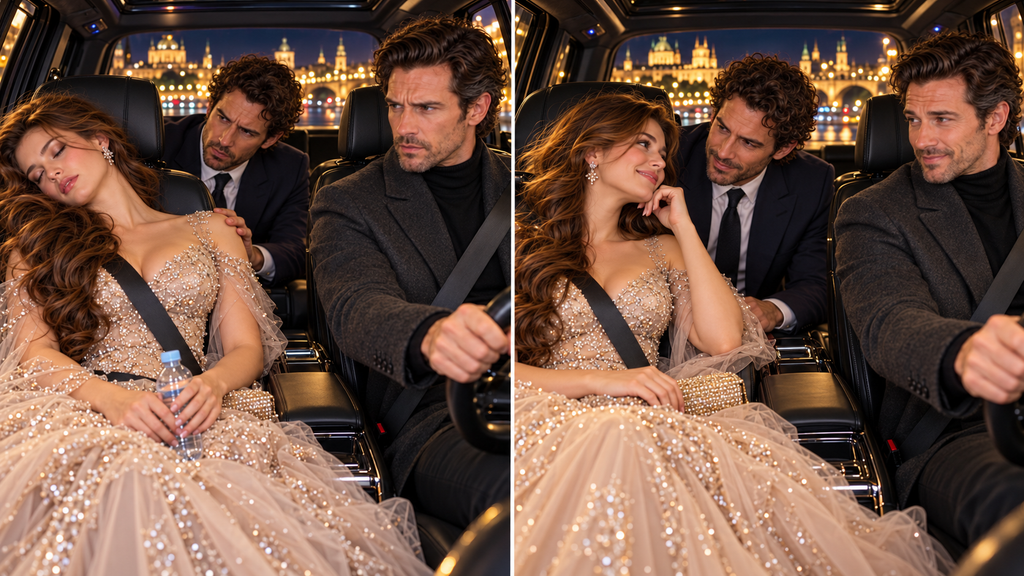
The same man who had handed me four opened bottles of water.
The same man who had reclined my seat while I was unconscious.
And now he was standing less than ten feet away.
3. The Door That Shouldn’t Have Opened
Vanessa’s eyes darted toward the door.
Marcus knocked again.
“Vanessa, I know you’re in there.”
I could hear impatience building in his voice.
Then he said something that stopped my breathing.
“Julian said Sofia’s car is outside.”
Vanessa stared at me.
I hadn’t considered that he might recognize my car.
I had parked directly across the street.
Marcus tried the handle.
The locked door rattled.
“Open it.”
Vanessa leaned toward me.
“There’s a records room behind that cabinet. It connects to the staff corridor.”
I glanced at the tall wooden cabinet beside her desk.
She hurried to it and pushed against one side.
A narrow door appeared behind it.
“Go,” she whispered.
I didn’t argue.
I slipped through the opening just as Marcus began pounding on the office door.
“Vanessa!”
The hidden passage led into a dim room filled with filing cabinets and medical supply boxes.
I pulled the door nearly closed, leaving a narrow crack.
From the other side, I heard Vanessa unlock her office.
“What are you doing here?” she asked.
Marcus didn’t bother answering.
“Where is Sofia?”
“Why would she be here?”
“Her car is outside.”
“Perhaps you’re mistaken.”
I heard him walk into the office.
His boots struck the tile with heavy, deliberate steps.
“Don’t play games with me.”
I held my breath.
Then he said, “Julian called me. He wants the donor file moved before tonight.”
Donor.
He said it as casually as another man might say package.
Vanessa sounded furious.
“Her name is Sofia.”
Marcus laughed.
“I know her name.”
“Then use it.”
“Fine. Where is Sofia’s file?”
I pressed my hand against my mouth.
There was a long pause.
Then the sound of paper sliding across a desk.
Marcus spoke again.
“Why is this folder open?”
Vanessa didn’t respond.
And suddenly I knew he understood.
“She’s been here.”
Silence.
“Vanessa, look at me.”
I heard a chair scrape.
“Did you tell her?”
My pulse hammered in my ears.
Vanessa’s voice was barely audible.
“Marcus, you’re frightening me.”
“Answer the question.”
I stepped backward in the dark records room.
My heel struck a metal wastebasket.
It tipped.
The sound was small.
Barely a clatter.
But in the silence, it might as well have been an explosion.
Marcus stopped talking.
Then I heard him say, very quietly, “What’s behind that wall?”
I ran.
I pushed through the far door and emerged into a narrow staff corridor.
A young receptionist stood beside a copier holding a stack of papers.
Her eyes widened when she saw me.
“Mrs. Mercer?”
I grabbed her arm.
“Where’s the back exit?”
She pointed.
“Through that door. Down the stairs.”
Behind us, I heard Marcus shout.
“SOFIA!”
I sprinted toward the stairs.
My purse struck against my hip.
The recorder and flash drive inside felt impossibly heavy.
I had just reached the first landing when a door slammed above me.
Footsteps.
Fast.
I ran harder.
My lungs burned.
My hands shook so violently that I nearly dropped my keys.
At the bottom of the stairs, I shoved through the emergency exit and stumbled into the alley behind the clinic.
Bright Texas sunlight struck my face.
For one second, the world seemed painfully ordinary.
A delivery truck idled near a dumpster.
Birds perched on a power line.
Somewhere beyond the buildings, traffic moved through Highland Park as though nothing had happened.
Then the rear door banged open.
Marcus emerged.
“Sofia! Stop!”
I ran toward the street.
He followed.
“Listen to me! You’re misunderstanding everything!”
I reached the corner and almost collided with a woman walking a golden retriever.
“Please,” I gasped, “call 911.”
The woman stared at me.
Then she looked behind me.
Marcus stopped running.
His expression changed instantly.
He straightened his jacket and gave the woman a friendly smile.
“Sorry,” he said. “My sister-in-law’s having a panic attack. We’re trying to help her.”
I stared at him.
Even now.
Even with everything exposed.
He was still using the same trick.
Making me look unstable.
Making himself look reasonable.
I lifted my phone with trembling fingers and began recording video.
“Say that again, Marcus.”
His smile vanished.
I spoke louder.
“Tell this woman why you gave me something that made me unconscious four different nights.”
His eyes narrowed.
“Sofia, lower your voice.”
“Tell her why you took me to a clinic without my permission.”
A passing driver slowed.
Marcus took a step backward.
“You’re not thinking clearly.”
I looked directly into my camera.
“His name is Marcus Mercer. He’s my brother-in-law. I believe he drugged me and transported me to a medical clinic without my consent. I am afraid he will hurt me.”
The woman with the dog had already pulled out her phone.
Marcus noticed.
He looked from her to me.
Then he whispered something I would never forget.
“You have absolutely no idea how much trouble you’ve just caused.”
He turned and walked quickly toward his SUV.
I stood shaking on the sidewalk until he disappeared.
And then, finally, my legs gave out.
I sank onto the curb.
The woman crouched beside me.
“My name’s Emily,” she said gently. “I’m calling the police. Stay with me.”
I tried to speak.
But all I could think was:
Julian knows.
My husband knows I’ve discovered the truth.
And somewhere in Dallas, a group of people was preparing for a surgery that was never supposed to be my choice.
4. The First Person Who Believed Me
The first police officer arrived seven minutes later.
His name was Officer Daniel Brooks, and he looked no older than thirty.
He approached slowly, crouched beside me, and asked, “Ma’am, are you injured?”
I opened my mouth.
Nothing came out.
Emily sat beside me, one hand resting gently on my shoulder.
“She was being chased,” Emily explained. “A man followed her out of that medical building. He claimed she was having some kind of episode.”
Officer Brooks looked at me.
“Is that true?”
I swallowed.
“The part about him chasing me is.”
“What’s your name?”
“Sofia Mercer.”
“Can you tell me what happened?”
I looked down at my purse.
For the first time, I understood that everything I needed was inside it.
The recorder.
The flash drive.
The insurance document.
The photographs.
My phone.
The evidence that could keep me alive.
I took a breath.
“My husband and his brother have been making me unconscious without my consent. I believe they planned to remove one of my kidneys tonight.”
Officer Brooks didn’t laugh.
He didn’t tell me I was tired.
He didn’t suggest that I needed a gym membership.
He simply reached for his radio.
“I need a supervisor here,” he said. “And medical assistance.”
Then he turned back to me.
“Mrs. Mercer, you’re safe with me right now. I’m going to need you to tell us everything.”
I started crying.
Not because I finally felt weak.
Because someone had finally believed me.
Within twenty minutes, the quiet street outside Vanessa’s clinic was filled with police vehicles.
An ambulance arrived.
A female paramedic examined the bruising near my collarbone and asked whether I could recall the previous night’s events.
“No,” I whispered. “Only part of the car ride. I have a recording.”
“Were you given anything to drink?”
“Yes.”
“Do you know what it was?”
“Water. At least, that’s what he told me.”
She exchanged a glance with her partner.
Then she said gently, “We need to get you evaluated at a hospital.”
I shook my head immediately.
“No hospitals.”
The words escaped before I could stop them.
The paramedic softened her voice.
“Sofia, I understand why you’re frightened. But what happened to you needs medical attention. You can choose who examines you, and we’ll explain everything before anything is done.”
I looked at her hands.
They were open.
Waiting.
She was asking my permission.
After four nights of having that simple right taken away from me, her words nearly broke my heart.
“Okay,” I whispered.
At the hospital, I met Detective Leah Navarro.
She was a woman in her late forties with dark hair pulled into a low ponytail and the kind of calm expression that made people stop talking nonsense.
She sat beside my bed while a nurse brought me water in a sealed bottle.
I stared at it.
The nurse noticed.
“Would you prefer something else?”
“No,” I said quickly. “It’s not you.”
She placed the bottle on the table without opening it.
“You can open it yourself whenever you’re ready.”
I couldn’t look at her.
Such a small kindness.
Such a terrible reminder.
Detective Navarro waited until the nurse left.
Then she said, “Mrs. Mercer, I listened to part of your recording.”
I looked up.
“Did you hear my husband?”
“Yes.”
“Did you hear what he said about not leaving marks?”
“Yes.”
My hands began trembling again.
“And the doctor?”
“We’re speaking with Dr. Hale. We’ve also secured the materials you provided.”
I swallowed.
“Are they going to arrest Julian?”
“We’re working to establish everything that happened. We have officers looking for both men, and we’re treating the threat of tonight’s surgery as urgent.”
“Please don’t let them take me.”
The detective leaned forward.
“Sofia, look at me.”
I raised my eyes.
“You did the right thing by asking for help. We will take your safety seriously. Right now, I want you to focus on your examination and on telling us what you remember.”
I nodded.
Then I asked the question that had been haunting me since the clinic.
“Detective, what if this isn’t the first time they’ve done something like this?”
Her expression changed.
It was subtle.
Just a slight tightening around her eyes.
“Why do you ask?”
“Because Marcus didn’t sound frightened on that recording. He sounded experienced.”
She sat very still.
Then she took out a notebook.
“Tell me exactly what you heard.”
5. What the Doctors Found
The next few hours were a blur of questions, examinations, and memories I wished I didn’t have.
With my consent, the hospital collected samples for toxicology testing.
A physician explained that the timing might allow some substances to be detected, although the absence of a substance wouldn’t prove I hadn’t been drugged.
He checked the bruises on my collarbone, my arms, and my lower back.
When he examined a small mark near my elbow, he frowned.
“Do you remember having blood drawn recently?”
“No.”
“Not during your annual physical?”
“Not since last year.”
He showed me two faint puncture marks.
“These are consistent with recent needle access. I can’t tell you exactly what was done from the marks alone.”
I turned my head away.
The thought of strangers handling me while I lay unconscious made my stomach churn.
The doctor paused.
“Would you like a moment?”
I nodded.
He stepped back.
Detective Navarro remained by the door.
I stared at the ceiling.
White tiles.
Fluorescent lights.
A distant monitor beeping in the hallway.
I had spent my adult life believing that if I worked hard, made responsible decisions, and treated people kindly, the world would generally make sense.
I balanced financial reports for a living.
I loved numbers because they were honest.
Two plus two would always equal four.
A missing dollar had to be somewhere.
A mistake could be traced.
But there was no formula for discovering that your husband had spent months planning to steal part of your body.
And there was no spreadsheet capable of explaining how a man could kiss his wife goodnight after arranging for someone else to hurt her.
I closed my eyes.
And for the first time, I remembered something from the third drive home.
Not a full memory.
Just a fragment.
Marcus’s voice.
A bright overhead light.
A cold surface beneath my back.
And someone saying:
“Her blood pressure is dropping. Stop.”
I sat up so suddenly the monitor beside me beeped.
The doctor turned.
“Mrs. Mercer?”
I grabbed the blanket.
“I remember something.”
Detective Navarro approached immediately.
“What?”
I told her.
Every word.
She wrote it down.
Then she asked, “Did you recognize the person who said it?”
I shook my head.
“No. But I remember another voice.”
“Whose?”
“A woman.”
“Dr. Hale?”
“I don’t think so.”
I closed my eyes again.
The memory was incomplete, like looking through a fogged window.
Then another fragment came.
The smell of antiseptic.
An unfamiliar woman’s voice.
And five words.
“This donor isn’t fully cleared.”
I opened my eyes.
“Detective.”
“Yes?”
“There was someone else in that room.”
6. The Account My Husband Forgot I Could Trace
By late afternoon, I had been moved to a quieter room.
Detective Navarro told me that officers had visited our home in Southlake.
Julian wasn’t there.
Neither was Marcus.
Their phones were going unanswered.
My husband had also called my employer, claiming I’d suffered a nervous breakdown and asking whether anyone knew my location.
Hearing that made my skin crawl.
“He’s trying to make me look unstable,” I said.
Navarro nodded.
“That’s one possibility. We’re documenting it.”
Then she handed me my phone.
“You have a call from someone named Grace Bell. She says she’s your closest friend.”
Grace and I had worked together for almost ten years.
She was a financial auditor, a divorced mother of two, and the only person outside my family who knew the complicated details of my marriage.
I had texted her from the ambulance.
Something terrible has happened. I’m safe for now. Please don’t contact Julian.
She answered on the first ring.
“Sofia?”
The relief in her voice was so strong I nearly started crying again.
“I’m here.”
“Oh, thank God. What happened? Are you hurt?”
“I don’t know how to explain.”
“Then don’t explain yet. Tell me what you need.”
I closed my eyes.
Grace had always been like that.
When my father died, she hadn’t asked me how she could help. She had simply arrived with groceries and stayed until I was ready to speak.
When I lost a pregnancy two years earlier, she had sat beside me on the bathroom floor while I cried over the small box of baby clothes I had bought too early.
She had never made promises she couldn’t keep.
“I need you to look at something,” I told her.
“What?”
“Do you remember when Julian asked me to help him organize records for his investment company?”
“Unfortunately. I also remember telling you he should hire his own accountant.”
“He gave me access to the family financial portal.”
“Okay.”
“I need you to bring the backup statements I sent you last month.”
Grace went quiet.
“Sofia, why?”
“Because I think my husband has been moving money, and I think some of it involves me.”
There was a long pause.
Then Grace said, “I’m coming.”
She arrived after the detective cleared her visit.
The moment she stepped through the hospital door, she crossed the room and hugged me.
I held on to her.
For nearly a minute, neither of us spoke.
Then she drew back and looked at my face.
“Oh, Sofia.”
I tried to smile.
“It gets worse.”
She sat beside me.
“Then we’ll deal with worse.”
I told her everything.
I watched her expression change from disbelief to horror.
When I described the insurance policy, her eyebrows drew together.
“Three million dollars?”
I nodded.
“Julian is the beneficiary.”
“And you never authorized it?”
“No.”
Grace stared at the wall.
Then she opened her laptop.
“Remember the strange insurance charges we saw in that household account?”
I did.
Six months earlier, I had noticed recurring payments to a company I didn’t recognize.
Julian said they were related to executive liability coverage for his business.
I’d believed him.
Grace opened an old statement.
“There.”
On the screen was a payment of $1,284.60.
Then another.
And another.
All sent to an insurance administrator.
She looked at me.
“Sofia, those payments started shortly after your anniversary wellness screening.”
My mouth went dry.
I remembered dinner that night.
Julian had ordered champagne.
He had smiled at me across the candlelit table and said, “Here’s to our future.”
Our future.
He had already begun preparing a different one.
Grace kept scrolling.
Then she stopped.
“Wait.”
“What?”
She leaned closer to the screen.
“This account received a large transfer three weeks ago.”
“How large?”
“Two hundred and seventy-five thousand dollars.”
“From whom?”
She enlarged the transaction.
The sender was a limited-liability company called Ashford Medical Consultants.
I had never heard of it.
“Could it be related to Vanessa’s clinic?” I asked.
“Maybe.”
Grace clicked through the available transaction details.
“There’s a memo.”
She read it aloud.
“Procurement completion, first installment.”
A terrible silence settled between us.
“Procurement?” I repeated.
Grace looked at me.
“Sofia, I think Julian was paid for arranging something.”
I stared at the number.
Two hundred and seventy-five thousand dollars.
The amount seemed impossibly small compared with what had been taken from me already.
Then Grace found another transaction.
This one was scheduled.
A pending transfer of $1,125,000.
The description read:
BALANCE UPON COMPLETION.
Grace slowly turned the laptop toward me.
“Sofia, whatever Julian arranged, someone agreed to pay him almost one and a half million dollars.”
The hospital room seemed to grow colder.
I thought of Vanessa.
Of Iris.
Of the forged donor documents.
And suddenly, one detail didn’t make sense.
If Julian was doing all this to save his daughter, why was someone paying him?
7. The Girl Who Was Supposed to Receive My Kidney
At 5:43 p.m., an unfamiliar number sent me a text.
Mrs. Mercer, I know you don’t know me. My name is Iris Hale. Please don’t delete this message.
I stared at the screen.
Then a second message appeared.
My dad told me you agreed to help me. I just found out that isn’t true.
My chest tightened.
A third message followed.
I’m so sorry.
I read those words three times.
Then I called Detective Navarro.
She returned to my room a few minutes later.
“Who contacted you?”
I showed her the messages.
She studied the screen.
“Have you replied?”
“No.”
“Good. Let us verify who’s behind them first.”
Within an hour, investigators had confirmed that the messages came from Vanessa’s daughter.
Iris was at a children’s hospital in Dallas under the care of her regular medical team.
Her mother had been detained for questioning.
Her father was missing.
And apparently, the girl was frightened enough to reach out to the woman she’d been told was saving her life.
After speaking with her care team and a hospital advocate, Detective Navarro helped arrange a supervised video call.
I almost refused.
I didn’t know what I could possibly say to her.
Then her face appeared on the screen.
She had long brown hair pulled into a loose braid.
Her skin was pale.
Her eyes were tired.
And she looked so much like Julian that for a second, I had trouble breathing.
“Hi,” she whispered.
“Hello, Iris.”
She stared down at her hands.
“I don’t know what my mom told you.”
I swallowed.
“She told me you’re sick.”
Iris nodded.
“My kidneys don’t work properly. I’ve been having treatments for a long time.”
“I’m sorry.”
She looked up.
“Please don’t say you’re sorry. You didn’t do anything.”
Something inside me softened.
She was only sixteen.
A frightened girl living with an illness she hadn’t chosen, surrounded by adults who had made terrible choices on her behalf.
“Iris,” I said gently, “did your father tell you I was going to donate a kidney?”
“Yes.”
“When?”
“About two months ago.”
“What exactly did he say?”
She hesitated.
“He said you were really kind. He said you understood how sick I was and that you wanted to help because we were technically family.”
Family.
The word hurt more than I expected.
Iris continued.
“I wanted to thank you. I asked him if I could call you.”
“What did he say?”
“He said you didn’t want to talk about it until after the surgery.”
I looked away.
Of course.
If we had spoken even once, the entire scheme would have collapsed.
Iris wiped at her eyes.
“I thought you were doing this amazing thing for me. I even wrote you a letter.”
My throat tightened.
“I’m sure it was a lovely letter.”
She shook her head.
“No. It was stupid. I thanked you for something you never agreed to do.”
“It wasn’t stupid, Iris.”
Her chin trembled.
“I told my dad I wanted to meet you. He got angry. Really angry. He said if I kept bothering him, I’d ruin everything.”
I took a slow breath.
“Listen to me. None of this is your fault.”
“I know, but—”
“No. I need you to hear me. You’re sick, and you deserve care. You deserve every safe, legitimate treatment available to you. But your father had no right to hurt another person in order to help you.”
Tears began rolling down her cheeks.
“I don’t want your kidney, Mrs. Mercer.”
I pressed my lips together.
“I believe you.”
“I told him that.”
My pulse quickened.
“When?”
“This morning.”
“What happened?”
“He told me I was being dramatic.”
I closed my eyes.
How familiar.
That word.
Dramatic.
Julian used it whenever someone challenged him.
Iris drew a shaky breath.
“Then I told him something my specialist said.”
“What?”
“He said I wasn’t ready for transplant surgery right now. I’ve been dealing with an infection, and they need to get that cleared first.”
I stopped breathing.
“Your specialist told you that?”
“Yes. A few days ago. My mom knew too. But Dad said he’d found another team that could fix everything.”
I looked toward Detective Navarro.
She was standing a few feet away.
Her expression had changed.
“Iris,” I said carefully, “did your father tell you when your surgery was supposed to happen?”
She looked confused.
“He said maybe in a few months. Why?”
I felt the room shift.
“Not tonight?”
Iris frowned.
“Tonight? No.”
My heart began to pound.
“Iris, are you absolutely sure?”
“Yes.”
She stared at me through the screen.
“Mrs. Mercer, what’s happening?”
I couldn’t answer.
Because in that moment, I understood something horrifying.
Vanessa believed my kidney was being taken for Iris.
Iris believed her surgery was still months away.
But Julian had arranged an operation for tonight.
And someone had already paid him nearly three hundred thousand dollars.
I looked at Detective Navarro.
Then I said the words that changed the entire investigation.
“Iris isn’t the patient.”
8. The Name Behind the Money
Detective Navarro ended the call gently, assuring Iris that an investigator would speak with her and her medical team.
Then she turned toward me.
“Tell me what you’re thinking.”
I was already reaching for Grace’s laptop.
“Ashford Medical Consultants,” I said. “The company that paid Julian.”
Navarro pulled up a chair.
“What about it?”
“I work with financial records every day. Businesses can use legitimate-looking names to hide the purpose of a transaction. The company’s name doesn’t tell us who controls it.”
Grace nodded.
“And that scheduled payment is enormous. If it relates to Sofia’s operation, we need to know who authorized it.”
Navarro took notes.
“We’ll pass the details to our financial-crimes investigators.”
I leaned back against my pillow.
I had never felt so tired.
But my mind wouldn’t stop.
I remembered something from the previous December.
Julian had hosted a dinner for one of his wealthy investment clients.
His name was Harold Whitcomb.
He was in his early sixties, a real estate developer with homes in Dallas, Aspen, and Palm Beach.
He had arrived looking pale and exhausted.
I remembered Julian asking if he was feeling better.
Harold had shaken his head.
“Still waiting,” he’d said.
At the time, I assumed he meant waiting for test results.
Then Julian had quietly changed the subject.
I looked at Grace.
“Do you remember Harold Whitcomb?”
“Your husband’s client?”
“Yes.”
“What about him?”
I swallowed.
“He was ill.”
“Lots of people are ill, Sofia.”
“He talked about being on a transplant waiting list.”
Grace went still.
Detective Navarro looked between us.
“Do you have a reason to believe he’s connected?”
“Not yet,” I admitted. “But Julian told me he was desperate to help Harold with some private medical expenses.”
Grace’s fingers flew across her keyboard.
She opened a publicly available company filing she had previously saved as part of an audit.
Then she looked up.
“Ashford Medical Consultants has a management company listed as one of its owners.”
“Which company?”
“Whitcomb Family Holdings.”
My blood ran cold.
Grace read the filing again.
Then she slowly closed the laptop.
“His client has a financial connection to the company paying him.”
The detective rose.
“I need to make a call.”
She stepped into the hallway.
I stared at Grace.
A thought was forming in my mind.
Ugly.
Unbearable.
But increasingly difficult to ignore.
Julian had convinced Vanessa that he was saving their daughter.
He had convinced Iris that her stepmother was a willing donor.
He had convinced me that I was simply tired and unfit.
What if he had been telling three different stories to three different women because the truth was something none of us would have accepted?
Grace reached across the bed and held my hand.
“Sofia.”
I looked at her.
“What?”
“Promise me something.”
I nodded weakly.
“Whatever happens next, don’t start blaming yourself for not seeing this sooner.”
I wanted to argue.
I wanted to tell her about every warning sign I’d ignored.
Every strange financial charge.
Every unexplained absence.
Every time Julian had made me feel foolish for asking a reasonable question.
But Grace squeezed my fingers.
“He worked hard to make you trust him. That’s not the same as you choosing to be deceived.”
I looked down.
For the first time since listening to the recording, I allowed myself to remember my wedding day.
Julian had cried when I walked down the aisle.
Actual tears.
He had whispered, “I can’t believe I get to spend my life with you.”
Now I wondered whether that man had ever truly existed.
Or whether I had fallen in love with someone who knew exactly how to become whatever I needed.
Detective Navarro returned.
Her expression was grave.
“We’ve located a confidential scheduling document associated with the surgical team,” she said.
My heart accelerated.
“Whose name is on it?”
She looked directly at me.
“The proposed recipient is Harold Whitcomb.”
For a moment, nobody moved.
Then Grace whispered, “Oh, my God.”
I stared at the detective.
“So Iris…”
“Was not listed as the recipient for tonight’s operation.”
I felt something inside me turn to ice.
Julian hadn’t merely tried to take my kidney.
He had sold it.
He had used his sick daughter to manipulate her mother.
He had used our marriage to control me.
And he had planned to collect more than a million dollars for something that belonged to neither of them.
I closed my eyes.
Then I whispered:
“He didn’t choose between his wife and his daughter.”
My voice broke.
“He chose money.”
9. The Call I Never Wanted to Answer
At 7:16 p.m., my phone rang.
Julian.
His photograph appeared on the screen.
It was a picture I’d taken during our honeymoon in Maui.
He was standing on the beach at sunset, smiling into the camera with his wedding ring visible.
I had once loved that photograph.
Now I wanted to throw the phone against the wall.
Detective Navarro looked at the screen.
“Do you want to answer?”
I shook my head.
Then I changed my mind.
“Yes.”
She studied my expression.
“Sofia, you don’t have to speak to him.”
“I know.”
My hands were cold.
“But I need to hear what he says when he realizes I know.”
The detective explained how the call could be documented and made sure I understood that I could end it whenever I wanted.
Grace remained beside me.
I pressed Answer.
“Hello?”
For a moment, there was only breathing.
Then Julian spoke.
“Sofia, sweetheart. Thank God.”
I shut my eyes.
His voice sounded exactly as it always had.
Concerned.
Affectionate.
Almost tender.
“I’ve been looking everywhere for you,” he continued. “Your office said you called in sick, and then Marcus told me you had some kind of misunderstanding at a doctor’s clinic.”
A misunderstanding.
That’s what he called it.
I stared at the hospital ceiling.
“Julian.”
“Yes, baby?”
“Where are you?”
“At work. Why?”
Another lie.
“Are you sure?”
He hesitated.
“Of course. What’s going on?”
I took a breath.
“I went to Vanessa’s clinic.”
The silence that followed was so complete I could hear Grace shifting in her chair.
Finally, Julian said, “Vanessa?”
“Dr. Vanessa Hale.”
“Oh.”
Just one word.
But his entire voice had changed.
“Why would you go there?”
“Because I heard the recording.”
Another pause.
“What recording?”
“The one where Marcus called you while I was unconscious.”
Julian said nothing.
I continued.
“The one where you told him not to leave marks on me.”
I heard him exhale.
“Sofia, listen. I can explain that.”
“Then explain.”
“Marcus was helping me arrange some medical tests.”
“Without telling me?”
“It was complicated.”
“Why did I keep losing consciousness?”
“Sofia, you know you’ve been under a tremendous amount of stress.”
There it was again.
The familiar attempt to make me doubt myself.
I gripped the blanket.
“I saw the donor documents.”
He stopped breathing for a moment.
Then he said, very softly, “You went through private medical records?”
I almost laughed.
“That is what you’re worried about?”
“You had no right to go through confidential patient information.”
“My name was on the folder.”
“Sofia—”
“My signature was forged.”
His voice hardened.
“Be careful what you accuse people of.”
“Did you sell my kidney, Julian?”
Silence.
Long enough that I could hear him moving somewhere.
Then he said, “Who told you that?”
I looked toward Navarro.
She gave a small nod.
I kept going.
“Was it Harold Whitcomb?”
Julian inhaled sharply.
And I knew.
I didn’t need another document.
I didn’t need another confession.
His reaction told me exactly how close I was to the truth.
“You don’t understand the situation,” he said.
“Then explain it to me.”
“Sofia, Harold is dying.”
“So is your daughter?”
“Don’t bring Iris into this.”
I felt a surge of anger.
“You brought her into it. You used her illness to convince Vanessa to help you.”
His voice became sharper.
“I have responsibilities you know nothing about.”
“Apparently.”
“I have people depending on me.”
“And I was depending on you!”
My shout echoed through the room.
For a moment, tears blurred my vision.
“Julian, I was your wife.”
He went quiet.
I swallowed hard.
“I loved you. I trusted you more than anyone in the world. I let your brother drive me home because you told me he’d take care of me.”
“Sofia—”
“Four times, Julian.”
My voice cracked.
“Four times I woke up hurting, and you laughed at me.”
He said nothing.
“Did you ever feel guilty?”
A long silence followed.
Then he sighed.
It was the same impatient sigh he made when I questioned a business expense.
“You have no idea what kind of financial pressure I’ve been under.”
I stared at the phone.
“That doesn’t answer my question.”
“I made some bad investments. Harold offered a way to help me get out of trouble while helping himself.”
I felt Grace’s hand tighten around mine.
“By buying my kidney?”
“Sofia, don’t use words like that.”
“What words would you prefer?”
“You would have been compensated.”
I closed my eyes.
Compensated.
As though we were negotiating the sale of a car.
“I never agreed.”
“We could have worked something out.”
“Then why didn’t you ask me?”
He hesitated.
Then he said the words I would remember every time I thought about our marriage.
“Because you would have made it emotional.”
For several seconds, I couldn’t speak.
Then I whispered, “It’s my body.”
“I know.”
“No, Julian. You don’t.”
He became angry.
“Do you understand how many lives you’re disrupting right now? Harold has a family. Iris needs treatment. I’ve got investors threatening lawsuits. And you’re acting as though I’m some kind of monster.”
I stared at the wedding photograph on my phone.
The smiling man on the beach.
The man I’d believed would grow old beside me.
Then I asked one final question.
“What were you planning to do with me after the surgery?”
Silence.
“Julian?”
He didn’t answer.
“What was the three-million-dollar life insurance policy for?”
I heard a sharp intake of breath.
Then his voice became frighteningly calm.
“Where are you, Sofia?”
I didn’t respond.
“Tell me where you are.”
“Goodbye, Julian.”
“Sofia, if you hang up this phone, you’re going to regret it.”
I looked at Detective Navarro.
Then I said, “No.”
My voice was steady now.
“For the first time in this marriage, I think I’m finally doing something I won’t regret.”
I ended the call.
And I began to shake.
10. The Woman in the White Coat Finally Told the Truth
An hour later, Detective Navarro returned with news.
Vanessa had agreed to cooperate.
Not because she was innocent.
Not because she suddenly deserved forgiveness.
But because investigators had confronted her with the audio recording, the forged records, and the financial evidence.
And she had finally understood that Julian had been lying to her too.
“She initially insisted Iris was the recipient,” Navarro explained. “When we showed her the other records, she admitted she’d never seen the final surgical schedule.”
I looked up.
“So she didn’t know?”
“She knew you weren’t knowingly participating in those medical procedures. She knew the consent documentation was false. She admitted that.”
I felt no sympathy.
“Then she knew enough.”
Navarro nodded.
“But she’s now providing information about the operation.”
“What information?”
“The name of the doctor Julian hired.”
My stomach tightened.
“Who?”
“Dr. Elias Ward.”
I frowned.
The name sounded vaguely familiar.
Navarro continued.
“He previously worked in a surgical practice in North Texas. His privileges were restricted after serious professional complaints. Vanessa says Julian connected with him through a private medical intermediary.”
I thought of the voice I’d remembered.
This donor isn’t fully cleared.
“Was he there during the other visits?”
“Possibly. We’re still confirming that.”
“Where is he tonight?”
The detective’s expression turned serious.
“That’s what we’re trying to establish.”
I looked toward the window.
Dallas glittered in the darkness beyond the hospital.
Thousands of people were eating dinner, putting children to bed, watching television, or driving home after work.
Somewhere in that enormous city, men who had planned to steal a kidney were still expecting their patient to arrive.
Me.
My entire body trembled.
“What happens if they can’t find the operating site?”
Navarro pulled a chair closer.
“We are following several leads, Sofia. You’re not responsible for locating these people.”
I looked down at my hands.
“I know.”
But another thought was growing in the back of my mind.
Something I hadn’t told anyone.
I remembered a conversation Julian had had three weeks earlier.
We were eating breakfast.
He’d received a call and walked onto the patio.
Through the open kitchen window, I’d heard him say:
“Silver Creek is private. Nobody asks questions out there.”
When he came inside, I’d asked whether he was buying another property.
He’d smiled.
“Just looking into a business investment.”
At the time, I’d forgotten the conversation almost immediately.
Now the words returned with horrible clarity.
“Detective?”
She looked at me.
“Silver Creek.”
“What?”
“Julian mentioned a place called Silver Creek. He said it was private and nobody asked questions.”
Navarro took out her notebook.
“When was this?”
“About three weeks ago.”
“Did he give a location?”
I thought hard.
“Something south of Dallas. He said it was near an old ranch property.”
She wrote quickly.
“Anything else?”
“He complained that the drive would take more than forty minutes.”
Navarro rose.
“I’ll pass it on.”
As she reached the door, I called after her.
“Detective?”
She stopped.
“Do you think he was planning to kill me?”
For the first time since meeting her, Navarro looked genuinely saddened.
“I can’t tell you what was in his mind,” she said carefully. “But the insurance documents and the threats are part of what we’re investigating.”
I nodded.
Then she added, “What I can tell you is that his plans do not determine your future anymore.”
I held on to those words.
Because at that moment, I desperately needed to believe them.
11. What Marcus Did With the Other Three Women
At 9:04 p.m., the investigation took another turn.
Detective Navarro entered my room with a man in a charcoal suit.
He introduced himself as Special Agent Richard Bell, an investigator assisting with the financial and medical fraud allegations.
I immediately sat up.
“Did you find Julian?”
“Not yet,” Bell answered.
My heart sank.
“But we found something important.”
He placed a photograph on the table.
It showed a woman standing outside an office building.
She was about thirty-five, with shoulder-length black hair and a tired smile.
“Do you recognize her?”
I studied the photograph.
“No.”
“Her name is Elena Ruiz.”
I shook my head.
“Who is she?”
“She reported an unexplained medical incident two years ago. Her account shares several similarities with yours.”
My mouth went dry.
“What similarities?”
Bell looked at Navarro.
Then he continued carefully.
“Elena described losing consciousness after accepting a drink from a man who offered to drive her home. She later discovered unexplained marks on her arm.”
I stared at him.
“Was that man Marcus?”
“We’re investigating that connection.”
“What happened to her?”
“She survived. She filed a police report, but at the time, there wasn’t enough evidence to establish what had occurred.”
I looked at the photograph again.
Then I noticed something.
A silver necklace.
A tiny crescent moon.
I had seen it before.
Not on Elena.
On a photograph in Marcus’s office.
I remembered visiting his house for Christmas two years earlier.
He had displayed a framed group picture from a charity event.
Several men and women stood around a banquet table.
Julian was there.
Marcus was there.
And the woman with the crescent-moon necklace stood beside them.
I looked up sharply.
“I’ve seen her.”
Bell leaned forward.
“Where?”
I described the photograph.
The event.
The house.
Everything I remembered.
He asked me to repeat it.
Then he glanced at Navarro.
“That lines up with the event records.”
A dreadful feeling crawled up my spine.
“How many women?”
Neither investigator spoke immediately.
I felt my throat tighten.
“How many?”
Bell answered.
“We have identified two other women whose complaints may be relevant. We have not established that all the incidents involved the same crime.”
Three women.
Not counting me.
I stared at the ceiling.
Earlier that day, I had believed my husband had betrayed me because he wanted to save his secret daughter.
Then I thought he’d done it for money.
Now I was beginning to wonder whether the men involved had turned this into something they believed they could repeat.
A business.
People reduced to medical information.
Trust converted into profit.
Bell continued.
“We’ve also spoken with someone who worked briefly for Dr. Ward.”
My attention snapped back.
“Who?”
“A former surgical nurse named Rachel Bennett.”
I felt my chest tighten.
“Did she tell you anything?”
“She recalled being asked to participate in a procedure that raised serious consent concerns. She refused and later reported what she knew.”
I whispered, “Did she say anything about me?”
Bell nodded.
“She remembers a woman who was unconscious during a preliminary examination. She raised concerns about the documentation.”
My heartbeat quickened.
“Was she the one who said I wasn’t cleared?”
“We believe so.”
I covered my mouth.
The memory came back in another flash.
Bright lights.
A woman’s voice.
Someone insisting they needed to stop.
Then a man’s irritated reply.
I pressed my fingers against my temples.
“I remember him.”
Navarro stepped closer.
“Who?”
“I couldn’t remember before, but I think I heard Julian.”
“What did he say?”
My breathing became uneven.
“He said…”
I shut my eyes.
Then the words returned.
“She doesn’t need to understand. She just needs to be ready.”
I began crying.
For weeks, I had been searching for a reason my husband had become so cruel.
Now I realized I had been asking the wrong question.
He hadn’t suddenly changed.
I had simply discovered what he was capable of when he believed nobody could stop him.
12. The Night the Police Found Silver Creek
At 9:38 p.m., Detective Navarro received a call.
I watched her expression change as she listened.
“Yes,” she said. “I understand.”
A pause.
“Keep me updated.”
When she put the phone away, I sat up.
“What happened?”
She looked at me.
“Investigators found a property associated with Silver Creek outside Waxahachie.”
I stopped breathing.
“Is it the clinic?”
“It’s a private surgical facility operating under a different business name. We’re checking the connections and coordinating with the appropriate agencies.”
“Is Julian there?”
“Officers are working on that now.”
I gripped the edge of the blanket.
“Please tell me they can stop it.”
Navarro looked straight at me.
“We are doing everything we can to prevent anyone from being harmed.”
She didn’t make a dramatic promise.
She didn’t tell me everything would be fine.
And somehow, I trusted her more because of that.
After she left, Grace came back into the room carrying a paper bag.
“I brought your favorite sandwich,” she said.
I stared at her.
“How can you think about food right now?”
“Because you haven’t eaten since breakfast.”
“I can’t.”
“I know. But I’m putting it here anyway.”
She placed the bag on the table.
Then she sat beside me.
We remained silent for several minutes.
Finally, she asked, “Do you remember the first time you met Julian?”
I gave a sad laugh.
“Unfortunately.”
“At that fundraiser?”
I nodded.
“He spilled coffee on my dress.”
Grace smiled faintly.
“And bought you a new one?”
“He tried.”
I remembered it so clearly.
Julian had been charming and apologetic.
He’d insisted on paying for the dry cleaning.
Then he called the next day.
And the day after.
He remembered little details.
My favorite flowers.
The way I drank coffee.
The anniversary of my father’s death.
He had seemed so attentive.
So thoughtful.
I stared at the hospital wall.
“Do you think any of it was real?”
Grace considered the question.
“I think people can show us moments that feel real and still make terrible choices. You may never know exactly what was sincere.”
“That doesn’t help.”
“I know.”
I wiped my eyes.
“I don’t know how to trust my own judgment anymore.”
Grace leaned forward.
“Sofia, today you listened to your instincts. You gathered evidence. You walked into a terrifying situation, and you got help. That’s judgment.”
I looked at her.
She continued.
“You’re not the same woman he convinced to apologize for being in pain.”
I thought of the bruise beneath my collarbone.
Of the opened water bottles.
Of the recorder hidden inside my purse.
Then I whispered, “I nearly didn’t buy that recorder.”
Grace frowned.
“What?”
“After the third blackout, I stood in the electronics aisle for twenty minutes. I kept telling myself I was being paranoid.”
I gave a small, broken laugh.
“I almost put it back.”
Grace took my hand.
“But you didn’t.”
“No.”
“And that matters.”
I looked toward the hospital window.
For the first time all day, the darkness outside didn’t feel endless.
Somewhere out there, people were searching for the men who had destroyed my marriage.
And I was alive to tell them what happened.
13. The Last Lie
At 10:02 p.m., my phone vibrated again.
This time, it wasn’t a call.
It was a message from Julian.
I know you’re at the hospital.
My stomach dropped.
Before I could respond, another message appeared.
You have no idea how much damage you’re doing.
I called for the detective.
She arrived within moments.
I handed her the phone.
While she documented the messages, another appeared.
We can still fix this if you stop talking.
I stared at those words.
Seven years of marriage.
Thousands of mornings waking beside him.
Holidays.
Birthdays.
Anniversaries.
Funerals.
Family vacations.
And even now, he thought our problem was that I wouldn’t stop talking.
The next message was longer.
Iris needs a father. Vanessa is going to prison because of you. Harold won’t survive without help. You can destroy all of us, or you can be reasonable.
My hands stopped shaking.
Something changed inside me.
Not because I stopped being afraid.
I was still terrified.
But fear was no longer the only thing I felt.
I felt anger.
And beneath it, something stronger.
Clarity.
I looked at Detective Navarro.
“May I reply?”
She read the messages again.
After discussing it with the other investigators, she told me they wanted any communication preserved and gave me guidance about keeping the exchange safe.
I typed:
Julian, did you ever intend to tell me the truth?
His answer came almost immediately.
After everything was over.
I stared at the screen.
Then typed:
After you removed my kidney?
A minute passed.
Then two.
Finally, he answered.
You were going to be taken care of.
I felt nauseated.
And if something went wrong?
No response.
Then my phone rang.
Julian again.
The detective prepared to document the call.
I answered.
“What?”
His voice was harsh.
“Stop sending messages.”
“You called me.”
“Sofia, you’re acting like you have no sense of loyalty.”
I closed my eyes.
“Loyalty?”
“Yes. Marriage means standing by each other when things get difficult.”
I almost laughed.
“Marriage doesn’t mean selling your wife’s organs.”
He exhaled angrily.
“Harold wasn’t buying anything from you personally. There was an arrangement between his advisers and mine.”
“What arrangement?”
“One that would have made you financially secure for the rest of your life.”
“Did you tell Harold I consented?”
Silence.
“Julian?”
“He was told the paperwork was in order.”
“And the life insurance?”
Another pause.
“That was protection.”
“For whom?”
“For us.”
I stared at the wall.
“There won’t be an us.”
His tone changed instantly.
“Sofia, don’t be foolish.”
I said nothing.
“You think a lawyer is going to fix your life? You think the police are going to protect you forever?”
My heart beat faster.
Then he said quietly, “I know things about you too.”
I frowned.
“What things?”
“The account information you handled for my company. The documents you signed. You were involved in those transactions, Sofia.”
There it was.
His final weapon.
He planned to blame me for his financial crimes.
I remembered every time he had handed me a document and said, “It’s just routine paperwork, sweetheart.”
I remembered his impatience when I tried to read the fine print.
Now I understood.
He hadn’t merely used my trust to access my body.
He had used my name and professional reputation to shield his business.
I swallowed.
“Then the investigators should examine every document.”
He went silent.
I continued.
“Every signature. Every transfer. Every email. Every instruction you gave me.”
“Sofia—”
“And while they’re doing that, they can compare those records with the medical consent forms you forged.”
His voice turned cold.
“You’re making a mistake.”
“No,” I whispered.
“The mistake was believing I’d always be too frightened to stand up to you.”
He didn’t answer.
Then I heard another voice in the background.
A man’s voice.
“Julian, we have to go.”
Marcus.
I recognized him immediately.
Julian moved the phone away, but I heard him snap, “Shut up.”
The detective leaned closer.
I held my breath.
A car door slammed.
Then Julian returned to the call.
“I have to go.”
“Where are you?”
He gave a bitter laugh.
“You’d like to know, wouldn’t you?”
Then he said one final sentence.
“You should have stayed home tonight.”
The call ended.
I stared at the screen.
And then Detective Navarro received a message of her own.
She read it.
Her expression sharpened.
She looked at me.
“Stay here, Sofia.”
“What happened?”
She was already moving toward the door.
“Officers have located your husband’s vehicle.”
14. The Raid
I didn’t witness the raid.
For a long time afterward, I was grateful for that.
Everything I learned came from investigators, court testimony, and the security footage that would eventually become part of the case.
But even now, I can picture it.
The private medical facility stood behind a long gravel driveway, surrounded by trees and a tall security fence.
From the outside, it resembled a luxury wellness retreat.
Warm lights glowed behind large windows.
A polished sign near the gate read:
SILVER CREEK RECOVERY CENTER
Inside, however, investigators found rooms equipped for procedures far more serious than the name suggested.
The facility had been prepared for an operation that had no legitimate authorization.
Harold Whitcomb was there.
So was Dr. Elias Ward.
And Julian was standing in a private office, arguing with Marcus.
According to the evidence later presented in court, Marcus had been panicking for hours.
He knew I’d gone to the police.
He knew Vanessa was cooperating.
And he wanted to leave.
Julian refused.
“She’s just trying to scare us,” he insisted.
Marcus shook his head.
“She has the recording.”
“So?”
“She has my voice, Julian.”
“Then say you were joking.”
Marcus stared at him.
“Joking about what? Drugging your wife?”
Julian slammed a file onto the desk.
“Lower your voice.”
“No. This whole thing is finished. We need to get out.”
But Julian was still thinking about money.
He had already spent much of the first payment.
His investors were demanding repayment.
His business was close to collapse.
And the second installment depended on the surgery being completed.
According to Marcus, Julian believed he could still save the arrangement by finding another way to pressure me.
“He’ll talk to her,” Julian reportedly said. “She’s emotional right now. Once she calms down, she’ll understand.”
Marcus told investigators he’d looked at his brother and realized something he should have understood years earlier.
Julian didn’t believe he was doing anything wrong.
He believed the only problem was that people had stopped obeying him.
The officers moved in after investigators established the grounds for the operation.
By the time Julian realized law enforcement had surrounded the property, the staff were being ordered away from the procedure rooms.
Dr. Ward attempted to leave through a rear corridor.
He was stopped.
Marcus ran toward a side exit.
He was arrested near the parking area.
Harold Whitcomb remained inside.
And Julian?
Julian demanded to speak to the person in charge.
He insisted there had been a misunderstanding.
He claimed all the paperwork was legal.
He said I was a willing donor who had experienced a sudden emotional crisis.
He was still repeating that explanation when an investigator played part of the recording I’d made in Marcus’s SUV.
My husband’s voice filled the room.
“Perfect. Bring her over. Vanessa is already here. And don’t be an idiot—don’t leave any marks on her like you did last time.”
According to one of the officers, Julian stopped talking.
For the first time that night, he had nothing to say.
He was handcuffed before midnight.
And I was still in my hospital bed when Detective Navarro called to tell me.
“We have him, Sofia.”
I pressed my hand against my mouth.
“Julian?”
“Yes.”
“And Marcus?”
“Both are in custody.”
I began to cry.
“Is it over?”
There was a pause.
“The immediate danger is over. There’s still an investigation ahead, and we’ll continue taking precautions.”
I nodded even though she couldn’t see me.
Then I asked, “What about the man who was supposed to get my kidney?”
“He’s alive. He’s receiving medical care. His role in the arrangement is under investigation.”
I closed my eyes.
I didn’t feel victorious.
I didn’t feel powerful.
I felt exhausted.
But beneath the exhaustion was something I hadn’t felt in weeks.
Relief.
I was going to wake up the next morning with both my kidneys.
I was going to be able to decide what happened to my body.
And the man who had believed he owned me would no longer be sleeping beside me.
15. The Secret Julian Had Prepared for My Death
Three days later, I learned about the final document.
I had been discharged from the hospital and moved into a temporary apartment with security arrangements coordinated through the investigators.
Grace helped me pack a few things from our house.
I couldn’t bear to go there myself.
Not yet.
The thought of walking into our bedroom made me nauseated.
My clothes were still hanging beside Julian’s.
Our wedding photograph was still on the dresser.
My favorite coffee mug was still in the kitchen cabinet.
Everything looked like the home of a happily married couple.
And that was what frightened me most.
How ordinary evil could look from the outside.
That afternoon, Detective Navarro visited with an update.
She sat across from me at the small kitchen table.
“We’ve recovered additional records from the facility,” she said.
I looked at her.
“What kind of records?”
“Documents about what was supposed to happen after the operation.”
My stomach tightened.
She placed a folder on the table.
Inside was a printed statement.
It had my name at the top.
The first paragraph described my supposed decision to voluntarily donate a kidney.
The second explained that I understood the risks.
The third stated that I wished to recover privately after the procedure.
Then I reached the final page.
And stopped.
It was a letter.
Written as if I had composed it.
Dear Julian,
I know my recent medical treatment has been difficult for us both. If anything happens to me, I want you to know that I made my decision freely and with full understanding of the risks.
My vision blurred.
I kept reading.
Please don’t blame yourself. You have always been a loving husband, and I know everything you’ve done has been for our family.
I pushed the paper away.
“No.”
Navarro waited.
I stared at the letter.
“No.”
My voice rose.
“He wrote this?”
“We believe it was prepared as part of the plan. We’re examining its origins.”
I looked at her.
“If I died, he was going to tell everyone I volunteered?”
She nodded.
“That is what the document suggests.”
I pressed my fingers against my lips.
Suddenly, I remembered something Julian had said two months earlier.
We’d been watching a news story about a wealthy couple going through a bitter divorce.
He’d shaken his head.
“Some people will say anything to make their spouse look bad.”
Then he’d turned to me.
“You’d never do that to me, would you, sweetheart?”
I’d laughed.
“Of course not.”
He’d kissed my cheek.
“That’s why I love you.”
I had interpreted it as affection.
Now I wondered if he had already been testing how easily he could control the story if I ever challenged him.
Navarro turned another page.
A separate file contained a draft statement about a hypothetical medical complication and instructions for contacting the insurance company.
My throat closed.
“The policy?”
“Yes.”
“Was he really expecting three million dollars if I died?”
“We have evidence that he anticipated a claim. Whether any insurer would have paid it is another matter.”
I stared at the papers.
I wanted to ask whether Julian had planned for me to die.
But I understood that no document could reveal every thought in his head.
The truth was already monstrous enough.
He had prepared the paperwork for my survival.
And he had prepared another version for my death.
In both versions, he was innocent.
In both versions, I had willingly given him everything.
I looked at the detective.
“Do you know what hurts the most?”
She shook her head.
“I don’t think he ever considered that I might live long enough to tell my own story.”
Navarro gently closed the folder.
“Well,” she said, “you are here.”
I looked at her.
“And you’re telling it.”
16. My Brother-in-Law’s Confession
Marcus began cooperating with prosecutors before Julian did.
I learned that from my attorney two weeks later.
His lawyer had apparently explained just how serious the evidence was.
The audio recording.
The financial transfers.
The clinic records.
The witness statements.
The forged consent forms.
The phone calls.
There was too much to deny.
So Marcus started talking.
At first, he attempted to minimize his involvement.
He claimed Julian had convinced him that the medical testing was legitimate.
He said he’d only provided transportation.
He insisted he hadn’t understood the full purpose of the arrangement.
But investigators confronted him with a message he’d sent Julian after the second blackout.
She woke up earlier than expected. Next time someone needs to make sure that doesn’t happen.
After that, his story changed.
Marcus admitted he knew I was being made unconscious without consent.
He admitted he’d transported me to the clinic on four occasions.
And he admitted he’d been paid.
Twenty thousand dollars.
That’s what his cooperation was worth to Julian.
Twenty thousand dollars to betray someone who had treated him like a brother.
I remembered the Christmases I’d hosted.
The birthday presents.
The dinners I’d cooked when Marcus was out of work.
The money I’d quietly lent him three years earlier when his truck broke down.
He had never repaid all of it.
I had never asked.
He was family.
At least, that was what I’d believed.
My attorney, Patricia Sloan, sat beside me as I reviewed the information.
“Are you okay?” she asked.
I gave a humorless laugh.
“No.”
She waited.
I looked down at the document.
“Marcus used to call me his favorite sister-in-law.”
Patricia said nothing.
“He once told me I was the only person in the family who didn’t judge him when he was struggling financially.”
My voice cracked.
“I helped him.”
Patricia closed the file.
“Sofia, helping someone doesn’t make you responsible for what they later choose to do.”
I wiped my eyes.
“I know.”
But knowing and feeling are two different things.
For days, I kept remembering small moments.
Marcus carrying groceries into my kitchen.
Marcus fixing a loose cabinet hinge.
Marcus calling me on my birthday.
Had he been pretending every time?
Or had there been a moment when loyalty turned into greed?
I didn’t know.
And eventually, I understood I might never know.
During his confession, Marcus also revealed something that made the case even more disturbing.
Julian had rehearsed conversations with him.
They had discussed what to say if I complained of headaches.
What to say if I remembered parts of the drives.
What to say if I noticed bruises.
The answer was almost always the same.
Make her doubt herself.
Tell her she worked too hard.
Tell her she was getting older.
Tell her she’d probably bumped into something.
Tell her she was imagining things.
And above all, remain calm.
Because a calm liar can look more believable than a frightened person telling the truth.
When I heard that, I finally understood why Julian had laughed whenever I expressed concern.
His laughter wasn’t a reaction.
It was part of the plan.
17. The Letter From Iris
About six weeks after Julian’s arrest, I received a letter.
It arrived in a plain white envelope.
There was no return address.
Inside was a folded sheet of lavender stationery.
The handwriting was small and careful.
Dear Mrs. Mercer,
I don’t know if you want to hear from me.
I asked my aunt if I should write, and she said I should only do it if I didn’t expect an answer.
So please don’t feel like you have to reply.
I sat at my kitchen table and continued reading.
I used to think my dad was the bravest man in the world.
When I was little, he visited me in the hospital and brought me a stuffed rabbit. He told me he’d always find a way to make things better.
I believed him.
When he said someone had offered to give me a kidney, I thought it was a miracle.
I prayed for you every night.
Then I found out what really happened.
My eyes filled with tears.
I know saying sorry doesn’t fix anything.
But I need you to know that I would never have wanted you to be hurt for me.
I’m still doing my treatments. My doctors say there are other options, and we’re going to keep trying.
I don’t want to be saved by someone else’s suffering.
I want to get better the right way.
I stopped reading.
For a long time, I just sat there holding the paper.
Then I reached the final paragraph.
My mom told me she was afraid of losing me.
I understand that fear.
But I wish she had loved me enough to tell me the truth instead of helping Dad hurt you.
I’m sorry that the people who were supposed to protect us let us both down.
Love, Iris.
I pressed the letter against my chest.
And for the first time since everything began, I cried for someone other than myself.
I cried for a sixteen-year-old girl who had discovered that the father she adored was willing to destroy another person for money.
I cried for the innocent years she had lost.
For the guilt she might carry even though she had done nothing wrong.
And I cried because, in another life, she and I might have met under very different circumstances.
Perhaps I would have been her stepmother.
Perhaps we would have gone shopping together.
Perhaps I would have sat beside her during treatments, held her hand, and helped her find the courage to face another difficult day.
But that choice had been stolen too.
Julian hadn’t merely damaged his marriage.
He had destroyed the possibility of a family built on truth.
That evening, I wrote Iris a reply.
It took me three attempts.
I tore up the first two because they sounded too formal.
Finally, I wrote:
Dear Iris,
Thank you for telling me the truth.
You have nothing to apologize for.
Your illness is not your fault, and neither are the choices your father and mother made.
You deserve love, honesty, and medical care that respects every person involved.
I hope you get well. I truly do.
And when you think about what happened, please remember that being loved should never require another person to lose their freedom.
Take care of yourself.
Sofia.
I folded the letter.
Then I placed it in an envelope.
For the first time, I wasn’t writing to someone out of fear or obligation.
I was writing because I wanted to.
Because the choice belonged to me.
18. The Day I Faced Julian in Court
The criminal case took months.
There were hearings.
Investigations.
More interviews.
Records to review.
Witnesses to locate.
At times, the process felt endless.
Julian’s defense team tried to portray the situation as a complicated family dispute involving an intended medical donation.
They argued that my husband’s intentions had been misunderstood.
They suggested that Vanessa had exaggerated certain details to protect herself.
They questioned whether Marcus had acted independently.
But the evidence was overwhelming.
The recording.
The payments.
The forged signatures.
The falsified medical documents.
The communications discussing my unconsciousness.
The proposed surgical schedule.
And the paperwork prepared in case I died.
The financial investigation also revealed that Julian’s investment company had been struggling for more than a year.
He had concealed major losses from me.
He had misrepresented assets to several lenders.
And he had used forged documents bearing my name to support transactions I had never approved.
The promised payment from Harold Whitcomb’s intermediaries wasn’t going to save our marriage.
It was going to keep Julian’s failing business alive just long enough for him to escape the consequences of his own decisions.
Harold himself claimed he believed the donor was willing.
But investigators found communications showing that serious questions about my consent had been raised and ignored.
The people involved had treated those questions as administrative obstacles rather than reasons to stop.
That detail haunted me.
Because it meant there had been opportunities.
Moments when someone could have said no.
Moments when the entire plan could have ended.
But money kept the machinery moving.
When the time came for me to testify, I wore a simple navy-blue suit.
Grace helped me straighten the collar.
“You look beautiful,” she whispered.
I shook my head.
“I feel sick.”
She smiled sadly.
“You can feel sick and still do this.”
I took a breath.
Then I entered the courtroom.
Julian was already seated beside his lawyers.
For the first time in months, I saw him in person.
He looked thinner.
Older.
His once-perfect hair was streaked with gray.
He wore a dark suit, but it couldn’t disguise the strain around his eyes.
When he saw me, he stared.
I had imagined that moment a thousand times.
I thought I might feel rage.
Or grief.
Or perhaps even a terrible longing for the man I had loved.
Instead, I felt something unexpectedly simple.
Distance.
He looked like a stranger wearing my husband’s face.
When I took the witness stand, my hands trembled.
I described the four drives home.
The water bottles.
The blackouts.
The pain.
The recording.
The clinic.
The forged signatures.
I told the court how Julian had dismissed my concerns.
How he’d laughed.
How he’d convinced me that I was weak and out of shape.
At one point, I had to stop speaking.
The judge allowed me a moment.
I took a sip of water from the sealed bottle I’d brought with me.
Then I continued.
Julian’s attorney asked whether I had ever expressed sympathy for his daughter’s condition.
“Yes,” I answered.
“Did you know she needed a kidney transplant?”
“Not until the day I discovered the scheme.”
“Would you have considered helping her if you’d been asked?”
I looked at the attorney.
For a moment, I could feel every person in the courtroom watching me.
Then I answered honestly.
“I don’t know.”
He raised his eyebrows.
“You don’t know?”
“No. I don’t.”
I sat straighter.
“I might have agreed to be evaluated. I might have needed time. I might have refused. I was never given the chance to make that decision.”
The attorney paused.
I continued.
“And that is the point.”
The courtroom fell silent.
“My husband wasn’t entitled to decide what I would sacrifice because he believed his reasons were important.”
My voice strengthened.
“He wasn’t entitled to make me unconscious. He wasn’t entitled to forge my signature. He wasn’t entitled to sell something that belonged to my body.”
I looked toward Julian.
For the first time, he lowered his eyes.
I turned back to the court.
“If someone had asked me to risk my health to save a child, that would have been a difficult, deeply personal decision.”
I swallowed.
“But nobody asked.”
A long silence followed.
Then I said the sentence I had been carrying inside me for months.
“I was his wife, not his property.”
19. What Happened to Everyone
By the time the criminal proceedings concluded, several people had been held accountable.
Marcus entered a guilty plea to serious offenses connected with the drugging, transportation, and unlawful medical procedures.
He received a substantial prison sentence.
Dr. Elias Ward also faced criminal consequences and the loss of his ability to practice medicine.
Investigators uncovered evidence that he had been involved in other questionable medical arrangements before Julian contacted him.
His operation at Silver Creek was shut down.
The clinic’s records became part of a much wider investigation into fraudulent donor documentation and illegal financial arrangements surrounding transplant-related services.
Vanessa cooperated with investigators.
Her testimony helped establish how Julian had used Iris’s illness to persuade her to participate.
But cooperation did not erase her responsibility.
She admitted she’d knowingly allowed medical procedures to occur without valid consent.
She lost her medical license and faced criminal penalties.
I heard later that she wrote me a long apology.
I didn’t read it.
Perhaps someday I will.
But I didn’t owe her my attention simply because she finally regretted what she’d done.
Harold Whitcomb and others involved in arranging the payment faced legal proceedings of their own.
I learned enough to understand that the scheme extended beyond one desperate husband and one wealthy patient.
There were people who knew how to hide questionable transactions behind respectable names.
People who treated forged signatures as paperwork problems.
People who believed wealth could purchase exceptions to rules that existed to protect human beings.
And then there was Julian.
He fought the charges for as long as he could.
He blamed Marcus.
He blamed Vanessa.
He blamed his investors.
At one point, he even tried to blame me.
But the evidence he had helped create followed him into court.
His messages.
His instructions.
His financial records.
His own recorded voice.
He was convicted of multiple serious offenses connected with the conspiracy and received a lengthy prison sentence.
When the judge announced the sentence, Julian turned toward me.
Our eyes met.
He looked stunned.
As though he genuinely believed someone would intervene.
As though he expected the world to rearrange itself one final time to accommodate him.
I didn’t smile.
I didn’t celebrate.
I simply sat beside Grace and breathed.
Because justice, I had learned, didn’t always feel like happiness.
Sometimes it felt like a door closing.
A door you had spent months being afraid to walk past.
And when it finally closed, you realized you were standing on the safe side.
20. The Divorce Papers
My divorce from Julian became final several months after his arrest.
The process was complicated by the financial fraud investigation, but my attorney helped separate my legitimate assets and earnings from the accounts Julian had misused.
Our house in Southlake had to be sold.
At first, that devastated me.
I had chosen the paint colors.
Planted the roses beside the front porch.
Spent weekends searching for the perfect dining table.
I knew which floorboards creaked.
Which kitchen window caught the morning sunlight.
Which room grew coldest during winter storms.
I had imagined growing old in that house.
I thought selling it would feel like surrendering the last piece of my marriage.
Instead, on the day the sale closed, I sat in my car across the street and watched the new owners carry boxes through the front door.
A young couple.
They looked happy.
The woman was laughing at something her husband had said.
For a moment, my chest tightened.
Then I realized something.
The house hadn’t betrayed me.
The marriage had.
The walls hadn’t lied.
The flowers hadn’t lied.
The kitchen where I had cooked thousands of meals hadn’t done anything wrong.
I had loved that home.
And I was allowed to remember that love without wanting my old life back.
Before leaving, I walked to the front garden.
I touched one of the rosebushes.
My father had taught me how to plant roses when I was twelve.
He used to say that a good garden needed patience, sunlight, and the courage to cut away things that were no longer healthy.
I had always thought he was talking about plants.
Now I understood why he’d smiled whenever he said it.
I got back into my car.
And for the first time, I drove away without looking in the rearview mirror.
21. Learning to Sleep Again
People imagine that once the person who hurt you is arrested, the fear disappears.
It doesn’t.
At least, it didn’t for me.
For months, I struggled to sleep.
A car door slamming outside my apartment could send my heart racing.
I checked the locks three times before bed.
I avoided accepting drinks from anyone.
Even Grace.
The first time she handed me a bottle of water after everything happened, I froze.
She noticed immediately.
And without saying a word, she placed it on the table and stepped away.
That simple gesture made me cry.
I hated how frightened I’d become.
I hated that ordinary things felt dangerous.
I hated that Julian and Marcus still occupied so much space in my mind when they were no longer part of my daily life.
Eventually, I started seeing a therapist.
Her name was Dr. Elaine Foster.
During our first session, she asked what I wanted to work on.
I laughed bitterly.
“Everything.”
She smiled gently.
“That’s a large project.”
I looked down.
“I want to stop being afraid.”
She nodded.
“That’s understandable.”
“And I want to stop feeling stupid.”
That made her pause.
“Why do you feel stupid?”
I stared at my hands.
“Because I trusted them.”
She waited.
I continued.
“I work with fraud detection. I spend my days looking for inconsistencies and dishonest behavior. And somehow I couldn’t recognize what was happening in my own house.”
Dr. Foster leaned forward.
“Sofia, when you audit a company, do you begin by assuming every person involved is entitled to deceive you?”
“No.”
“You examine records. You ask questions. You expect certain professional and legal boundaries to exist.”
I nodded.
“Marriage has boundaries too,” she said. “Trust is not evidence of incompetence. It is something another person has a responsibility not to exploit.”
I looked away.
Then she asked, “When did you begin suspecting something was wrong?”
“After the third blackout.”
“And what did you do?”
“I bought a recorder.”
“Why?”
“Because I wanted proof.”
“And when you obtained it?”
“I went to the clinic. Then the police.”
She sat back.
“So when the evidence contradicted what you’d been told, you acted.”
I swallowed.
“Yes.”
“Then perhaps the story you tell yourself shouldn’t be that you failed to recognize danger.”
I looked at her.
“Perhaps it should be that you recognized danger despite someone working very hard to conceal it.”
I began crying.
Not because she’d magically healed anything.
But because, for the first time, I could imagine looking back at myself without shame.
Recovery wasn’t immediate.
Some nights were terrible.
Some mornings, I woke up from dreams where I was trapped in Marcus’s SUV, unable to move.
But slowly, the good days began to outnumber the bad.
I returned to work.
I spent weekends with Grace and her children.
I learned to enjoy quiet evenings.
I bought myself flowers.
I started running—not because Julian had told me I was out of shape, but because I liked the feeling of moving through the world under my own power.
One spring morning, I ran three miles around a lake near my new home.
When I finished, I stood beside the water, breathing hard.
My muscles ached.
My heart pounded.
My face was flushed.
And I smiled.
Because for the first time in a very long time, the feeling in my body belonged entirely to me.
22. A Birthday Card From Someone Unexpected
Almost a year after Julian’s arrest, I received another letter from Iris.
She had turned seventeen.
Her condition had stabilized, and her doctors had been able to resume evaluating her for a legitimate transplant.
She was still undergoing treatment.
Still facing difficult days.
But she was planning for a future.
Inside the envelope was a birthday card.
On the front was a watercolor picture of a small yellow bird perched on a branch.
Inside, Iris had written:
Dear Sofia,
I don’t know if you remember, but my birthday was last week.
I’m seventeen now.
I got my driver’s permit, and my aunt says I’m the most cautious student driver she’s ever seen.
I smiled.
Then I continued.
I wanted to tell you something.
For a long time, I thought my illness had ruined everyone’s lives.
I thought if I hadn’t been sick, my dad wouldn’t have hurt you, and my mom wouldn’t have made such terrible decisions.
My counselor told me that wasn’t true.
She said being sick doesn’t make me responsible for what other people do.
I blinked back tears.
I’m trying to believe her.
I also wanted you to know that I’m going to study medicine someday.
I want to become the kind of doctor who listens when people say no.
I covered my mouth.
The final paragraph was short.
You didn’t give me a kidney.
But you showed me that I’m allowed to tell the truth, even when people I love don’t want to hear it.
Thank you for that.
Love, Iris.
I sat quietly for a long time.
Then I placed the card on my bookshelf.
Not beside my wedding photographs.
Those were gone.
Not beside the documents from the court case.
Those were locked away.
I put the card beside a photograph of my father standing in his rose garden.
Two reminders.
One from the man who had taught me to be strong.
And one from the girl who was learning what strength meant for herself.
23. The Unexpected Visit
Eighteen months after the night I listened to the recording, I received a phone call from an unfamiliar Dallas number.
Usually, I ignored calls I didn’t recognize.
But that afternoon, I answered.
“Hello?”
A familiar voice replied.
“Mrs. Mercer?”
I frowned.
“Yes?”
“This is Iris Hale.”
I sat down.
“Iris?”
“Hi.”
Her voice was brighter than I remembered.
Stronger.
“How are you?”
There was a pause.
Then she laughed nervously.
“That’s actually why I’m calling.”
My chest tightened.
“Is everything okay?”
“Yes.”
She took a breath.
“I got a kidney.”
For a moment, I couldn’t speak.
She continued quickly.
“A real transplant. Through the hospital program. From a deceased donor. Everything was approved, and my doctors say I’m recovering well.”
My eyes filled with tears.
“Oh, Iris.”
“I know.”
She laughed again.
“I keep looking at myself in the mirror, expecting to feel completely different.”
I smiled through my tears.
“Do you?”
“Not really. I just feel like me. A very tired version of me.”
“That sounds wonderful.”
“It is.”
I sat quietly for a moment.
Then Iris said, “Sofia?”
“Yes?”
“Can I ask you something?”
“Of course.”
“Would you ever want to have coffee with me?”
My throat tightened.
She hurried to add, “You don’t have to. I know everything’s complicated. I just thought maybe someday we could meet without all the horrible stuff.”
I looked out the window.
It was a beautiful Saturday afternoon.
Sunlight streamed across my kitchen floor.
A breeze moved the curtains.
For the first time, the idea didn’t frighten me.
“I’d like that,” I said.
She went quiet.
“Really?”
“Really.”
We arranged to meet two weeks later at a small café in Dallas, with her aunt bringing her.
When I arrived, Iris was already seated near the window.
She looked healthier.
Her cheeks had more color.
She wore jeans, white sneakers, and a yellow cardigan.
When she saw me, she stood.
For a moment, we simply stared at each other.
Then she smiled shyly.
“Hi.”
“Hi, Iris.”
She glanced at the empty chair.
“I didn’t know if you’d come.”
I smiled.
“I said I would.”
She nodded.
Then she said something that almost made me cry.
“My dad used to say things like that all the time.”
I paused.
Then I answered gently.
“Well, I try to mean it.”
She smiled.
We ordered coffee and pastries.
At first, the conversation was awkward.
We talked about school.
Her plans.
Her recovery.
The terrible hospital food she’d endured.
She told me she wanted to visit New York someday.
I told her I had always wanted to see the coast of Maine in autumn.
Eventually, she looked down at her cup.
“Can I ask you something about him?”
I knew who she meant.
“Of course.”
“Did you ever really love my dad?”
The question hit me unexpectedly.
I looked at her.
Then I answered truthfully.
“Yes.”
Her eyes filled with tears.
“I did.”
She swallowed.
“Do you still?”
I thought about it.
About the man I’d married.
The life I’d imagined.
The years I’d spent trying to understand why he had become so cold.
Then I shook my head.
“No, Iris.”
She lowered her eyes.
I continued.
“But I don’t regret that I once believed love was possible with him. I regret what he chose to do with my trust.”
She sat quietly.
Then she whispered, “I still love him sometimes.”
My heart ached.
I reached across the table, but stopped before touching her hand.
“That’s okay.”
She looked up.
“It is?”
“Yes. He’s your father. You’re allowed to have complicated feelings about him.”
Tears slipped down her cheeks.
“I hate what he did.”
“I know.”
“But I remember when he used to read to me at the hospital.”
“You don’t have to erase those memories.”
She wiped her face.
“Do you think I’m weak?”
I shook my head.
“No.”
Then I smiled gently.
“I think you’re seventeen and learning something that takes many people a lifetime.”
“What?”
“That loving someone doesn’t mean you have to excuse everything they do.”
Iris stared at me for a moment.
Then she reached across the table.
This time, I took her hand.
And for a little while, we sat together in the sunlight.
Two women whose lives had been changed by the same man.
Not because we had forgiven him.
Not because we had forgotten.
But because we had decided his choices would not define every chapter of our lives.
24. The Final Envelope
Two years after my marriage ended, I moved into a small house with a garden.
It wasn’t impressive.
There was no grand staircase.
No expensive marble kitchen.
No three-car garage.
But it had tall windows, a cozy living room, and a little patch of land behind the kitchen.
I planted roses.
Pink ones.
Yellow ones.
And a row of deep red bushes along the fence.
On the first anniversary of moving in, I invited Grace and her children over for dinner.
We cooked too much food.
We laughed loudly.
We stayed up late.
At one point, Grace looked around my living room and smiled.
“You seem happy.”
I thought about that.
Then I nodded.
“I am.”
And I meant it.
Not happy every minute.
Not untouched by what had happened.
But happy in a quieter, steadier way.
The kind of happiness that didn’t depend on someone else’s approval.
A week later, a letter arrived from the correctional facility where Julian was serving his sentence.
I recognized his handwriting immediately.
The envelope was thick.
My name was written across the front.
SOFIA MERCER.
For several minutes, I stood beside the kitchen counter holding it.
The old Sofia would have opened it immediately.
She would have wondered whether he was sorry.
Whether he missed her.
Whether he finally understood.
She would have searched every sentence for evidence that the man she loved had somehow survived inside the person who hurt her.
But I was not that woman anymore.
I knew what the letter probably contained.
An explanation.
An apology.
Perhaps a request for forgiveness.
Perhaps another attempt to blame his circumstances.
And suddenly, I realized something important.
I didn’t need to know.
I didn’t need to hear one more version of the truth from someone who had spent years rewriting it.
I picked up my phone and called Patricia, my attorney.
“Julian sent me a letter.”
She asked whether I’d opened it.
“No.”
“Would you like me to review it?”
I looked down at the envelope.
“Yes.”
“Of course.”
I placed it inside a larger envelope addressed to her office.
Then I went into the backyard.
The roses were beginning to bloom.
I knelt beside the smallest bush and carefully removed a few dead leaves.
The afternoon sun warmed my shoulders.
A breeze moved through the trees.
And I thought about how different my life had become.
Two years earlier, I had sat in Marcus’s SUV, confused and frightened, unable to explain why I kept waking up in pain.
I had believed my husband when he told me I was weak.
I had believed him when he said I worried too much.
I had believed him when he told me my memory couldn’t be trusted.
I had allowed his voice to become louder than my own instincts.
But when the evidence finally appeared, I listened.
I chose to believe what I saw and heard.
And that choice saved my life.
25. The Last Thing I Want You to Know
People sometimes ask whether I wish I had confronted Julian earlier.
Whether I wish I’d questioned Marcus after the first drive.
Whether I wish I’d gone to the police instead of the clinic.
The truth is, I have spent enough time wondering about things I cannot change.
I cannot go back and undo the first bottle of water.
I cannot erase those four nights.
I cannot make Julian the husband I believed I married.
I cannot give Iris back the innocence she lost.
And I cannot force Vanessa or Marcus to become people who would have chosen compassion over money.
But I can tell you what I learned.
Trust should never require silence.
Love should never depend on fear.
And marriage does not give one person ownership of another.
The person who loves you should want you to feel safe enough to ask questions.
They should want you to make informed decisions about your life.
They should be able to hear the word no without treating it as betrayal.
For years, Julian told me that a good wife was loyal.
That she supported her husband.
That she trusted his judgment.
But what he really wanted was obedience.
He wanted me to ignore my instincts.
To apologize for my pain.
To doubt my own memories.
To accept every explanation, no matter how unreasonable.
And when he believed he’d finally convinced me to stop questioning him, he arranged to take something from my body that I could never get back.
He thought I’d never discover the truth.
He thought I would remain the quiet, trusting wife who believed everything he said.
He was wrong.
Last Sunday, I woke up early and made myself coffee.
I opened the kitchen window and watched the morning sunlight fall across the roses.
My phone rang.
It was Iris.
She wanted to tell me about a scholarship interview.
We talked for twenty minutes.
She laughed about how nervous she was.
I told her she’d do wonderfully.
Before hanging up, she said, “Sofia, can I tell you something?”
“Of course.”
“I’m really glad you’re still here.”
I looked out at the garden.
My throat tightened.
“Me too, Iris.”
After the call, I sat quietly for a while.
Then I walked into my bedroom and opened the bottom drawer of my dresser.
Inside was a small wooden box.
I lifted the lid.
There were a few things I had kept from that terrible time.
A copy of the police report.
The original medical evidence inventory.
The letter Iris had written me.
And the tiny digital recorder that had changed everything.
I picked it up.
It was smaller than my palm.
Plain black plastic.
A scratched screen.
A little red recording button.
Nothing remarkable.
I thought about the day I’d bought it.
How embarrassed I’d felt standing in the store.
How I’d told myself I was being ridiculous.
How I’d almost walked away.
Then I remembered sitting in my bathroom, listening to Marcus call Julian.
She’s out cold again.
Perfect. Bring her over.
Don’t leave any marks.
Those words had once made me feel powerless.
Now they reminded me of something else.
The moment I stopped accepting explanations that didn’t make sense.
The moment I began searching for the truth.
I returned the recorder to its box.
Closed the lid.
And placed it back in the drawer.
Then I went outside.
The air smelled of fresh soil and roses.
Somewhere down the street, a child was laughing.
A dog barked.
A lawn mower hummed in the distance.
Everything was wonderfully ordinary.
I knelt beside the roses and began watering them.
For a long time, I had wondered what the rest of my life would look like after Julian.
Would I ever feel safe?
Would I ever trust anyone?
Would I ever look in the mirror without remembering what almost happened?
I didn’t have every answer.
But I knew this much.
I was alive.
I was free.
My body was mine.
My future was mine.
And my story would no longer be written by the man who tried to destroy me.
Because my husband had made one terrible miscalculation.
He believed that if he took away my ability to remember those missing hours, he could take away my ability to discover the truth.
He forgot that even the deepest betrayal can leave evidence.
And sometimes, all it takes is one small voice recorder, one moment of courage, and one decision to stop believing the lies.
I looked down at the roses.
A new bud was opening.
Small.
Fragile.
Determined.
I smiled.
And for the first time in years, I wasn’t afraid of what tomorrow might bring.
Julian had planned to take something from me permanently.
Instead, I took back the one thing he believed I’d lost forever.
My right to choose my own life.