Mason’s grin disappeared.
Vanessa slowly lowered her phone.
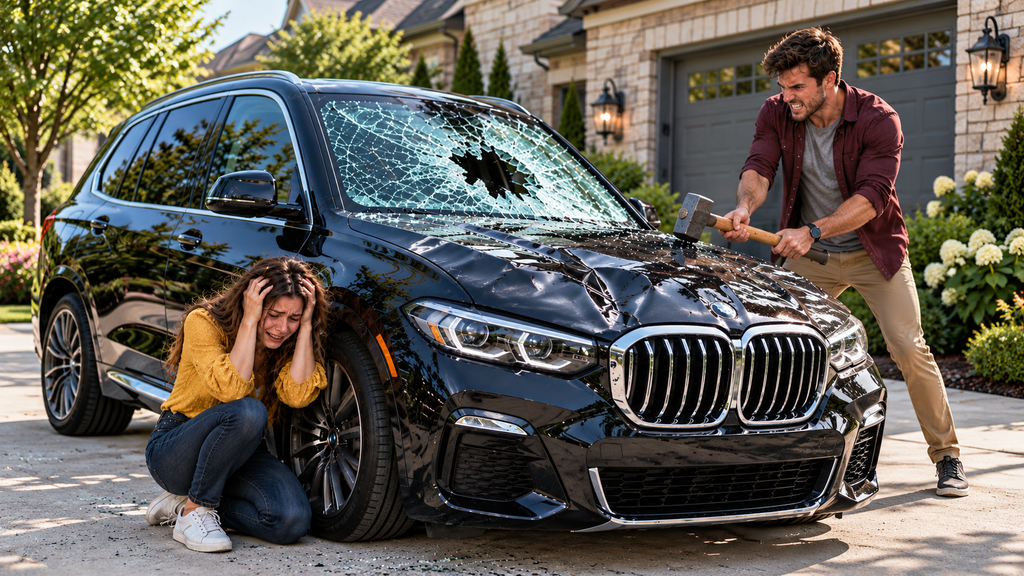
And I stood beside the wreckage of my $78,000 SUV, trying to understand what I had just heard.
“Stolen?” I repeated.
The older officer turned toward me.
“Sir, are you Ethan Walker?”
“Yes.”
“And you’re the registered owner of this vehicle?”
“I am.”
He glanced at the tablet in his hand.
“According to the information available to us, somebody contacted the police yesterday and reported that this vehicle had been taken without permission.”
My stomach tightened.
“That wasn’t me.”
The officer’s expression changed.
“Are you certain?”
“Officer, I drove that SUV here less than an hour ago. It was sitting in my garage yesterday. I have both keys.”
He studied me for a moment.
Then he looked at Mason.
“Interesting.”
Mason cleared his throat.
“Look, Officer, there’s obviously been some misunderstanding.”
The younger officer, whose name tag read Bennett, stepped closer.
“What kind of misunderstanding?”
Mason spread his hands.
“Family stuff. My brother gets dramatic about everything. We were arguing, things got heated, and there was a little accident.”
I looked at the shattered windshield.
The broken headlights.
The driver’s door hanging crookedly from its frame.
The crushed hood.
“A little accident?” I asked.
Mason shot me a warning look.
“Ethan, shut up for five seconds.”
Officer Bennett turned sharply.
“Sir, don’t tell him to shut up.”
My mother hurried forward.
“Please, officers. These are my boys. We don’t need to turn a family disagreement into something terrible.”
The older officer didn’t look at her.
He was still watching Mason.
“Mr. Walker, I’m going to ask you another question.”
Mason swallowed.
“Okay.”
“Did you personally report this SUV stolen yesterday?”
Vanessa made a small sound.
Almost a whimper.
Mason looked at her.
That was when I knew.
Something had happened before I ever arrived at my mother’s house.
Something they had planned.
Something that had gone horribly wrong.
And whatever it was, the police already knew more than they were saying.
My name is Ethan Walker.
I’m thirty-eight years old.
And until that Sunday, I believed the worst thing my family could do was take advantage of my kindness.
I was wrong.
They were willing to destroy my property.
Steal my identity.
Lie to the police.
And sacrifice my entire future if it meant protecting my brother from the consequences of his own decisions.
But the thing that still chills me when I think about that afternoon isn’t the sound of the tire iron hitting my windshield.
It isn’t the sight of Mason driving his pickup into my SUV.
It’s the memory of my mother’s face when the officer mentioned the stolen-vehicle report.
Because she didn’t look confused.
She looked terrified.
Like somebody had just opened a door she thought would remain locked forever.
And standing there beside my ruined vehicle, I began to realize that the argument over the SUV had never really been about the SUV.
It had been about something much bigger.
Something my father had warned me about before he died.
Something I had been too trusting to see.
“I’m waiting for an answer,” the older officer said.
Mason wiped his palms against his jeans.
“No, I didn’t report anything stolen.”
Officer Bennett looked down at his notes.
“That’s strange.”
“Why?”
“Because the reporting party provided your name, Mr. Walker.”
Mason’s jaw tightened.
“My name?”
“Yes.”
“Someone must’ve used it.”
Vanessa suddenly spoke.
“That’s probably what happened.”
Everyone turned toward her.
She adjusted her sunglasses, although the afternoon sun was already disappearing behind the trees.
“Identity theft,” she said quickly. “People do that all the time.”
Officer Bennett raised an eyebrow.
“They do.”
Vanessa nodded eagerly.
“Exactly.”
“Which is why we’ll need to investigate.”
Her expression faltered.
My mother stepped between Mason and the officers.
“Can’t you just write down that there was an accident and let these boys work it out?”
The older officer finally looked directly at her.
“Ma’am, I need you to step aside.”
“But—”
“Now, please.”
Something in his voice made her obey.
I had never seen that happen before.
My mother was a woman who could silence an entire Thanksgiving table with one disapproving glance.
She had spent my childhood deciding who was right, who was wrong, and whose feelings mattered most.
Usually, Mason was right.
Usually, I was wrong.
And almost always, I was the one expected to apologize.
But these officers didn’t know our family rules.
They didn’t care that Mason was her favorite.
They didn’t care that Vanessa was supposedly trying to give her a grandchild.
And they certainly didn’t care about my mother’s opinion that a $78,000 SUV was “just a car.”
They cared about facts.
And facts were something my family had never been particularly comfortable with.
Officer Bennett asked me to step away from the others.
We walked toward the sidewalk.
My neighbor, Mr. Harris, was standing beside his mailbox.
He was seventy-two, a retired high school principal with a white beard and the kind of quiet manner that made people underestimate him.
He had lived across from my mother for almost twenty years.
He had watched Mason grow up.
He had watched me carry groceries into the house when Mom had her knee surgery.
And he had watched my father spend his final months sitting beneath the oak tree in the front yard.
Mr. Harris had seen more of our family than most people realized.
“Ethan,” he said gently, “I’ve got the whole thing.”
I nodded.
“Thank you.”
He lifted his phone.
“Three cameras. Front porch, garage, and driveway. I checked the recordings while you were waiting for the police.”
Officer Bennett looked interested.
“May I see them, sir?”
“Of course.”
Mr. Harris opened a video.
There was my SUV.
Perfectly intact.
There was Mason approaching it with the tire iron.
There was the first blow.
The second.
The third.
And then came something I hadn’t noticed while it was happening.
Vanessa was laughing.
Not nervously.
Not in disbelief.
She was laughing like she was watching something entertaining.
She even moved closer to record the destruction from a better angle.
Then the video captured my mother.
Her voice came through clearly.
“Mason, that’s enough! You’ll make it impossible to fix!”
Not “Stop hurting your brother.”
Not “You’re committing a crime.”
Not even “What are you doing?”
She was worried the damage would be too expensive.
As if I would be the one paying for it.
Officer Bennett watched silently.
Then came the moment Mason climbed into his pickup.
The engine roared.
The truck lurched forward.
Metal folded.
Glass scattered.
And my SUV slammed into the curb.
I hadn’t realized how close I had been standing.
On the recording, I saw myself stumble backward.
If I hadn’t moved when I did, the vehicle could have struck me.
Officer Bennett replayed that section.
Then he looked at me.
“Mr. Walker, did your brother know you were standing there?”
“Yes.”
“Did he make any effort to warn you before accelerating?”
“No.”
He looked toward Mason.
His expression had hardened.
“Stay here.”
The officers separated everyone.
Mason stood beside his pickup.
Vanessa waited near the porch.
My mother sat on the front steps with a tissue pressed dramatically against her face.
I remained beside Mr. Harris.
The neighborhood had gone strangely quiet.
A woman two houses down was watching from behind her curtains.
Someone’s dog barked.
A lawn sprinkler clicked steadily against a flower bed.
Ordinary Sunday afternoon sounds.
And in the middle of them stood the ruins of the car I had worked three years to buy.
That SUV had been my first truly extravagant purchase.
For most of my adult life, I had been careful with money.
I worked as a commercial construction project manager.
Long hours.
Early mornings.
Frequent travel.
Plenty of stress.
But the salary was good, and I had learned to save.
I paid off my student loans before I turned thirty.
Bought a modest house.
Built an emergency fund.
Helped my parents whenever they needed something.
When my father died, I handled almost everything.
The funeral arrangements.
The insurance paperwork.
The estate documents.
The repairs to my mother’s house.
Mason had been too overwhelmed to help.
At least, that was what he told everyone.
Yet somehow, he had found time to buy a new fishing boat three weeks after the funeral.
I remembered standing in my father’s garage that summer, looking at the empty workbench where Dad had spent countless evenings repairing lawnmowers and building wooden toys for neighborhood children.
Mason had walked in wearing an expensive watch.
“Mom says Dad wanted me to have his tools,” he’d announced.
I had looked at him.
“Did she?”
“Yeah.”
Dad had left no instructions about the tools.
There was no written bequest.
But I let Mason take them.
Because what was the point of arguing?
Dad was gone.
Mom was grieving.
And I was tired.
That had been my mistake.
Not the generosity itself.
The belief that surrendering small things would eventually make everyone satisfied.
It never did.
Every time I gave something away, the next demand grew larger.
A few hundred dollars became a few thousand.
A favor became an obligation.
And eventually, a $78,000 SUV became something my brother believed belonged to him simply because he wanted it.
About twenty minutes after the officers arrived, the older one approached me.
His name was Sergeant Collins.
He looked to be in his fifties, with tired eyes and a calm voice.
“Mr. Walker, I need to clarify something.”
“Okay.”
“Do you know whether your brother has ever had access to your vehicle registration?”
I thought about it.
“Probably. My mother keeps copies of some of my paperwork.”
“Why?”
“After Dad passed, I helped organize the estate. I left a folder at her house with copies of my insurance information, identification, and some financial documents.”
Sergeant Collins exchanged a look with Officer Bennett.
“Was your vehicle registration in that folder?”
“Yes.”
“Was there a copy of your driver’s license?”
My throat went dry.
“Yes.”
He nodded slowly.
“Have you given your brother permission to purchase, sell, insure, or make ownership representations concerning your SUV?”
“No.”
“Have you ever agreed to transfer it to him?”
“Absolutely not.”
“Has he previously asked you for it?”
I let out a humorless laugh.
“He’s been asking for three months.”
Sergeant Collins waited.
So I told him everything.
How Vanessa had seen the SUV at a family barbecue.
How she’d spent an entire dinner talking about how perfect it would be when she had children.
How Mason had called two days later asking whether I would consider “helping them out.”
How helping them out apparently meant giving them my vehicle and buying myself something cheaper.
How my mother had called afterward to tell me I needed to stop being materialistic.
And how, just the previous Thursday, Mason had sent me a text message.
I still had it.
I opened my phone.
You have until Sunday to decide whether you want to do the right thing.
Sergeant Collins read it.
“Did you respond?”
“Yes.”
I scrolled down.
My reply was short.
My SUV is not for sale or transfer. Stop asking.
Mason’s response had been even shorter.
You’ll regret being selfish.
The sergeant studied the screen.
“Please preserve these messages.”
I nodded.
Then he asked another question.
“Do you know why your brother would report the vehicle stolen before confronting you today?”
I stared at him.
“No.”
He hesitated.
“We’re still establishing the full sequence of events. But we have reason to believe the report may be connected to an attempted insurance or ownership transaction.”
My chest tightened.
“What kind of transaction?”
“I’m not ready to speculate.”
He looked toward the house.
“But I strongly recommend that you contact your insurer and your financial institutions as soon as possible.”
That was when fear finally pushed through my anger.
Because this was no longer just a case of a furious brother destroying a car.
Someone had been using my personal information.
And I had no idea how far they had gone.
The officers continued questioning Mason.
I couldn’t hear every word, but I saw his confidence unravel.
At first, he kept his arms folded.
Then he started pacing.
Then he pointed toward me repeatedly.
At one point, Vanessa tried to join the conversation.
Officer Bennett asked her to remain where she was.
She became visibly irritated.
“I’m his wife,” she said.
“I understand that, ma’am.”
“Then why can’t I talk to him?”
“Because we’re speaking with him separately.”
“This is ridiculous.”
“That’s your opinion.”
Vanessa looked toward my mother.
“Do something.”
Mom stood immediately.
“Officer, my daughter-in-law is under a lot of stress.”
Sergeant Collins turned.
“Mrs. Walker, please sit down.”
“But she’s trying to start a family.”
“I hope things go well for her. Right now, we need to finish our investigation.”
Mr. Harris made a quiet sound beside me.
I glanced over.
He was trying not to smile.
“Never thought I’d see the day,” he murmured.
“What day?”
“Somebody telling your mother to sit down and her actually doing it.”
Despite everything, I almost laughed.
It was the first time I’d felt anything resembling relief since the tire iron hit my windshield.
Then my phone rang.
A number I didn’t recognize.
I almost ignored it.
Something made me answer.
“Hello?”
“May I speak with Ethan Walker?”
“Speaking.”
“Mr. Walker, this is Allison Price from the fraud prevention department of Meridian Auto Finance.”
My blood turned cold.
“Fraud prevention?”
“Yes, sir. We’re calling regarding an application submitted under your name.”
I looked at my wrecked SUV.
Then toward Mason.
“What application?”
“A request involving a vehicle-backed loan.”
I felt the ground tilt beneath me.
“How much?”
There was a pause.
“Forty-eight thousand dollars.”
I closed my eyes.
“Ma’am, I didn’t apply for any loan.”
Her voice became more serious.
“Thank you for confirming that. We need to verify several details, and I recommend you place a fraud alert with the credit reporting agencies.”
“Was the application approved?”
“I’m unable to discuss all aspects until we’ve completed identity verification, but the transaction was flagged during our review.”
I looked toward Sergeant Collins.
“I have police officers standing here right now because my brother destroyed the vehicle involved.”
The woman paused.
Then she said something I’ll never forget.
“Mr. Walker, please tell those officers that the application included documents claiming you had already agreed to transfer the vehicle to a relative.”
I couldn’t speak.
For several seconds, all I could hear was the wind moving through the trees.
Then I asked, “When was that application submitted?”
“Friday afternoon.”
Two days earlier.
Mason had sent his threatening text on Thursday.
The fraudulent application had been submitted Friday.
The stolen-vehicle report had appeared Saturday.
And on Sunday, my brother had destroyed the SUV.
It wasn’t random.
It wasn’t a momentary loss of control.
It was a sequence.
A plan.
And I was only beginning to understand it.
Sergeant Collins took the information seriously.
He asked me to write down the lender’s name, the representative’s name, and the case reference number.
He explained that additional investigators might need to review the financial records.
Then he turned toward Mason.
“Mr. Walker, we need to discuss some inconsistencies.”
Mason forced a laugh.
“More inconsistencies?”
“Yes.”
“Look, I already told you, this was just a family argument.”
The sergeant’s voice remained steady.
“Did you submit a financing application using your brother’s personal information?”
Mason froze.
Vanessa turned away.
My mother’s hand flew to her mouth.
Nobody said anything.
That silence told me more than a confession would have.
Mason finally spoke.
“I don’t know what you’re talking about.”
“Then this is your opportunity to explain.”
“I haven’t submitted anything.”
“Did you or your wife attempt to obtain a loan against this vehicle?”
Vanessa suddenly shouted from the porch.
“We were going to pay it back!”
Every head turned.
Mason looked as if somebody had slapped him.
“Vanessa!”
She stared at him.
“What? They’re acting like we robbed a bank!”
Officer Bennett stepped forward.
“Ma’am, please remain where you are.”
Vanessa ignored him.
“We weren’t stealing anything! Ethan was supposed to give us the SUV anyway!”
I felt something inside me snap.
“Supposed to?”
She turned toward me.
“Yes, Ethan! You knew we needed it!”
“You asked me for it. I said no.”
“You don’t have children!”
“Neither do you!”
Her face flushed.
My mother gasped.
“Ethan, that was cruel.”
I looked at her.
“Cruel?”
She pressed her lips together.
I pointed toward the wrecked SUV.
“Mom, he smashed my windows, destroyed the hood, and rammed my car with his truck. You told me to lie to my insurance company. And you’re calling me cruel because I pointed out that Vanessa isn’t pregnant?”
Vanessa suddenly looked down.
Something in her expression changed.
My mother stared at me with an anger so familiar I could almost hear the childhood lectures coming.
“You always have to be right,” she whispered.
“No,” I said. “I just want to stop being punished for telling the truth.”
For the first time in my life, she had no immediate response.
Sergeant Collins asked Vanessa whether she wanted to clarify what she’d said about paying the money back.
Mason shook his head at her.
She noticed.
And her expression hardened.
“Why are you looking at me like that?” she demanded.
Mason spoke through clenched teeth.
“Stop talking.”
“Don’t tell me what to do!”
“Vanessa.”
“No! You told me everything was handled!”
Officer Bennett stepped between them.
“Both of you need to calm down.”
Vanessa pointed at Mason.
“He said his brother had already agreed!”
I felt the words hit me physically.
“Agreed to what?”
She looked at me.
“The transfer.”
I stared at her.
“What transfer?”
Mason closed his eyes.
Vanessa answered before he could stop her.
“The SUV. He told me you signed the paperwork last month.”
I couldn’t believe what I was hearing.
“I never signed anything.”
Her face drained.
“What?”
“I said I never signed anything.”
She turned slowly toward her husband.
“Mason?”
He wouldn’t look at her.
She took one step backward.
Then another.
“You told me Ethan was just being difficult about the timing.”
Mason said nothing.
“You told me the car was legally ours.”
Silence.
“You told me his name was still on the registration because the paperwork hadn’t processed!”
I looked at my brother.
And suddenly, I understood why Vanessa had walked out of the house that afternoon holding her phone like she was about to record a celebration.
She had believed Mason.
At least about part of it.
She thought she was collecting a vehicle that had already been promised to her.
And when I refused, she assumed I was trying to take back something her husband said belonged to them.
That didn’t excuse her laughter.
Or her encouragement.
Or her willingness to benefit from a fraudulent transaction.
But it explained the confidence.
The sunglasses.
The smirk.
The way she had looked at my SUV as if I were merely delaying the inevitable.
Mason had built an entire lie around my supposed generosity.
And now the lie was collapsing in front of everyone.
The next hour felt like a dream.
A tow truck arrived.
The driver examined my SUV and shook his head.
“That’s a rough one.”
I stood beside him as he photographed the damage.
“Can it be fixed?”
He looked at the crumpled front end.
“That’s for the insurance adjuster to determine, but the impact looks significant.”
I nodded.
I knew cars could be repaired.
Metal could be replaced.
Glass could be installed.
But I also knew something else.
The moment Mason drove his pickup into my SUV, he hadn’t just broken a machine.
He had destroyed the last fragile piece of trust I still held for him.
And unlike the car, I wasn’t interested in rebuilding it.
My mother approached while the tow truck driver secured the vehicle.
Her eyes were swollen.
“Ethan.”
I didn’t turn.
“Not now, Mom.”
“Please.”
I faced her.
She looked suddenly older.
The afternoon light caught the fine lines around her mouth.
Her hair had come loose from its careful bun.
For a split second, I saw the woman who used to sit beside my bed when I was sick.
The woman who taught me to tie my shoes.
The woman who cried when I graduated college.
I wanted desperately to believe that version of her still existed.
Then she spoke.
“You need to tell them Mason didn’t mean it.”
And the feeling vanished.
I stared at her.
“He hit my car with a tire iron.”
“I know.”
“He rammed it with his truck.”
“I know.”
“He apparently tried to use my identity to get a loan.”
Her mouth tightened.
“We don’t know all the details.”
“Mom.”
“He’s your brother.”
“I know exactly who he is.”
She lowered her voice.
“If he goes to jail, what will happen to Vanessa?”
“That’s not my responsibility.”
“She’s trying to have a baby.”
“Then maybe they should think about their decisions before committing crimes.”
My mother recoiled.
“You sound just like your father.”
The words stopped me.
Dad.
For years, she had used that comparison like an accusation.
Dad had been stubborn.
Too principled.
Too unwilling to overlook Mason’s behavior.
At least, that was how she described him.
But after his death, I began discovering a different side of the story.
A side my mother rarely mentioned.
I looked at her.
“Maybe that’s not the insult you think it is.”
Her eyes narrowed.
“Your father would never have called the police on his own family.”
Something inside me went very still.
Because I knew that wasn’t true.
Not anymore.
Three months before Dad died, he asked me to visit him alone.
He was already sick.
Cancer had stolen nearly forty pounds from his body.
His hands trembled.
He spent most afternoons in his favorite chair by the living room window.
That day, my mother had gone shopping.
Mason was supposedly working.
And Dad had insisted I come over before sunset.
When I arrived, he was sitting at the kitchen table with a brown envelope.
“Close the door,” he said.
I did.
He pushed the envelope toward me.
“What is this?”
“Something I should’ve told you years ago.”
I smiled nervously.
“Dad, you’re making it sound like a spy movie.”
He didn’t smile.
“Ethan, listen carefully.”
I sat down.
He looked at the envelope for a long time.
Then he said, “Your brother has always believed he deserves whatever you earn.”
I shifted uncomfortably.
“Dad—”
“Let me finish.”
His voice was weak but firm.
“When you were twelve, Mason broke your bicycle because you wouldn’t let him ride it.”
I remembered.
Of course I remembered.
It had been a red mountain bike.
My birthday present.
Dad had worked overtime to buy it.
Mason had been seventeen.
He wanted to borrow it.
I said no because he’d already damaged the brakes twice.
That evening, I found the front wheel bent.
Mason claimed he’d accidentally backed into it.
Mom told me not to make a fuss.
Dad repaired it.
And I learned a lesson I didn’t understand until much later.
My possessions weren’t safe if Mason wanted them.
Dad continued.
“When you were seventeen, he took the money you saved for your first car.”
My chest tightened.
I’d forgotten how angry I’d been.
Seven hundred dollars.
Months of mowing lawns.
Mason said he’d borrowed it.
Mom insisted he’d return it.
He never did.
Dad quietly replaced the money.
I hadn’t realized Dad knew the truth.
“He did worse things after that,” Dad whispered.
I looked up.
“What things?”
His eyes filled with regret.
“I kept thinking he’d grow out of it.”
He tapped the envelope.
“Read this when you’re ready.”
I wanted to open it immediately.
But Dad shook his head.
“Not here.”
“Why?”
“Because your mother still believes protecting Mason is the same as loving him.”
I swallowed.
“Dad, what’s in it?”
He looked directly at me.
“Proof that sometimes the person you need protecting from shares your last name.”
I took the envelope.
And for reasons I still struggle to explain, I didn’t open it.
Not that night.
Not after his funeral.
Not during the months of estate paperwork.
I put it in my home office desk.
Then life kept moving.
And I told myself that Dad had simply been worried.
Now, standing outside my mother’s house beside the wreckage of my SUV, I remembered every word.
Especially the last thing he said before I left.
“Ethan, if Mason ever tries to make you responsible for something he did, promise me you won’t carry it for him.”
I had promised.
Then I’d spent the next two years breaking that promise in smaller ways.
Until Sunday.
Until the tire iron.
Until the police.
Mason was not immediately taken away while the officers were collecting their initial statements.
Instead, the officers told him that the property damage, the possible false report, and the financial documents would require further investigation.
His pickup was examined and photographed.
The officers recorded visible damage to its bumper.
They took contact information from witnesses.
They gave me an incident number.
And they made it clear that the matter was not resolved simply because my mother wanted it to disappear.
Before leaving, Sergeant Collins pulled me aside.
“Mr. Walker, can I offer you some advice?”
“Please.”
“Don’t discuss the evidence privately with your brother.”
“Okay.”
“Preserve everything. Text messages, emails, photographs, financial notices, and any documents connected to the vehicle.”
“I will.”
“And if you believe your identity has been used without permission, report it promptly to the relevant institutions.”
I nodded.
He paused.
“One more thing.”
“What?”
“People sometimes feel pressured to change their statements when the person involved is family.”
I looked toward my mother.
She was holding Mason’s hand.
Vanessa stood several feet away, staring at her phone.
Sergeant Collins followed my gaze.
“Your statement needs to remain truthful,” he said.
I met his eyes.
“It will.”
He nodded once.
“Good.”
Then he left.
And the moment the police cruiser disappeared around the corner, my brother came toward me.
Not walking.
Charging.
“What the hell is wrong with you?”
I stood beside Mr. Harris.
“Mason, don’t.”
“You humiliated me!”
I looked at him in disbelief.
“You destroyed my car.”
“You know what I mean!”
“Actually, I don’t.”
He pointed toward the street.
“You let those cops treat me like some criminal!”
Mr. Harris stepped forward.
“Mason, that’s enough.”
My brother rounded on him.
“This has nothing to do with you, old man.”
Mr. Harris didn’t flinch.
“It became my business when you endangered people on my street.”
Mason opened his mouth.
Then closed it.
Perhaps he remembered the cameras.
Perhaps he finally understood that someone outside our family had seen him clearly.
Not as the charming son.
Not as the hardworking husband.
Not as the misunderstood brother.
But as a grown man smashing another man’s property because he couldn’t accept the word no.
I looked at him.
“Stay away from me.”
He laughed bitterly.
“Or what? You’ll call the cops again?”
“Yes.”
The answer came so easily it surprised me.
Mason stared.
I repeated it.
“Yes, Mason. If you threaten me, damage my property, or try to steal from me again, I’ll call the police.”
My mother’s voice rose from the porch.
“Ethan Walker!”
I turned toward her.
“What?”
“Don’t speak to your brother that way!”
I looked at the empty space where my SUV had been parked.
Then at her.
And suddenly I was twelve years old again, standing beside my bent bicycle wheel.
Seventeen, searching for my missing savings.
Twenty-four, paying Mason’s overdue electric bill because Mom said he was having a difficult month.
Thirty, lending him money for a business that never opened.
Thirty-five, paying for repairs to Mom’s roof while Mason bought another truck.
Every version of me stood there at once.
And for the first time, none of them wanted to apologize.
“Goodbye, Mom.”
She looked stunned.
“Where are you going?”
“Home.”
“What about Sunday dinner?”
I stared at her.
She actually meant it.
My SUV had been destroyed.
The police had come.
My identity might have been stolen.
And she was still worried about Sunday dinner.
I shook my head.
“I’m not staying.”
Then I walked away.
I took a rideshare home.
The driver was a middle-aged woman named Denise.
She noticed I was quiet.
“Long day?” she asked.
I looked out the window.
“You could say that.”
She glanced at me in the rearview mirror.
“Bad long or just exhausting long?”
I thought about it.
“Both.”
She nodded.
“Those are the worst.”
For a while, neither of us spoke.
Then she said, “Whatever happened, I hope you get home to someplace peaceful.”
That simple kindness nearly broke me.
Because I realized how rarely anyone in my family had wished me peace.
They wished me success when success could benefit them.
They wished me health when they needed me available.
They wished me happiness when happiness didn’t interfere with what they wanted.
But peace?
No.
Peace would have required them to stop demanding things.
I thanked Denise when we reached my house.
Then I went inside.
Locked the door.
And stood in the entryway.
Everything was exactly as I’d left it.
My shoes beside the bench.
A jacket hanging on the coat rack.
The faint scent of coffee from that morning.
The framed photograph of Dad and me on the hallway table.
I picked it up.
We were standing beside a fishing lake.
I was twenty-six.
Dad was smiling beneath an old baseball cap.
His arm was draped across my shoulders.
For a long time, I stared at his face.
Then I whispered, “I think I finally understand.”
I carried the photograph into my office.
Opened the bottom desk drawer.
And took out the brown envelope.
The paper had yellowed slightly at the edges.
Dad’s handwriting was still unmistakable.
Strong, blocky letters.
He had written my name across the front.
ETHAN — PRIVATE.
My fingers shook as I opened it.
Inside were bank records.
Copies of checks.
Several printed emails.
A handwritten letter.
And a document that made my stomach drop.
A promissory note.
For $62,000.
Signed by Mason Walker.
Dated four years earlier.
I stared.
Dad had loaned Mason sixty-two thousand dollars.
Not for medical bills.
Not for a family emergency.
Not for anything my mother had mentioned.
According to the paperwork, Mason had claimed he needed the money to purchase equipment for a landscaping business.
The business never existed.
But the payments from Dad’s savings account were real.
I turned to the next document.
Another transfer.
$18,500.
Then another.
$9,000.
Then a cashier’s check.
$12,000.
I started adding the amounts.
By the time I finished, my hands were cold.
My father had given Mason more than $100,000 over several years.
And that was only what the envelope documented.
I sat back in my chair.
Dad had worked as a maintenance supervisor for thirty-seven years.
He wore the same winter coat for almost a decade.
He clipped coupons.
He repaired appliances instead of replacing them.
He drove an old sedan long after he could afford something newer.
He had been careful with every dollar.
And Mason had taken advantage of that care.
I opened the handwritten letter.
The first sentence made my eyes fill.
Son, if you’re reading this, it means I didn’t find the courage to explain everything while I was alive.
I swallowed.
Then continued.
I spent too many years making excuses for your brother because I thought helping him would make him responsible. Instead, I taught him that consequences were something other people paid.
I paused.
The room blurred.
Dad had never been a man who spoke easily about his mistakes.
He believed in fixing things.
Showing up.
Working hard.
And keeping promises.
But in that letter, he admitted something I had never heard him say out loud.
He had failed.
Not because he loved Mason.
But because he had mistaken rescuing Mason for raising him.
I kept reading.
Your mother knows about some of the loans, but not all of them. She believes Mason will repay everything once his business succeeds. I no longer believe that.
Then came the line that changed everything.
I recently discovered that Mason attempted to use our house as collateral for a loan without my permission.
I sat upright.
Our house.
My mother’s house.
The very house where Mason had destroyed my SUV.
I read the sentence again.
He obtained copies of property records and tried to persuade a private lender that he had authority to borrow against the house. The lender contacted me before releasing funds.
My heart pounded.
There were more documents.
Emails from a lending company.
Copies of unsigned paperwork.
A letter from Dad’s attorney.
My father had quietly stopped the transaction.
He had changed account passwords.
Placed additional protections around his finances.
And warned Mason never to attempt anything like it again.
But he had not told me.
Or at least, he hadn’t told me until the final months of his life.
At the bottom of the letter, Dad had written:
I hope your brother changes. I truly do. But hope is not a financial plan, and love is not permission to steal.
Then one final paragraph.
Ethan, you have spent your whole life trying to make things easier for everyone. I am proud of your kindness. But I need you to understand something I learned too late: kindness without boundaries can become an invitation to people who never intended to respect you.
I read that paragraph three times.
Then I put my head in my hands.
And cried.
Not because of the car.
Not because of the money.
But because my father had understood the family I was living in.
And he had spent his final days worrying that I would inherit the burden he had carried.
My phone buzzed at 8:43 that evening.
Mason.
I let it ring.
Then another call.
Mom.
Then Vanessa.
Then Mom again.
Finally, a text appeared.
You need to call me. This has gotten way out of hand.
I stared at it.
No apology.
No concern.
No question about whether I was okay.
Just another instruction.
I turned my phone face down.
Ten minutes later, another message arrived.
If Mason gets arrested, I will never forgive you.
I read those words slowly.
My mother had threatened me with the loss of her love.
As if that love hadn’t already been conditional for most of my life.
I wanted to respond.
I wanted to tell her about Dad’s letter.
About the loans.
About everything he had hidden from her.
But something stopped me.
Dad had spent years trying to manage Mason’s behavior privately.
I was not going to repeat that mistake.
The truth needed to be handled carefully.
With documentation.
With professionals.
Without giving Mason time to destroy or alter evidence.
I saved the messages.
Then blocked notifications for the night.
Monday morning, I called my insurance company.
I told the representative everything.
The deliberate damage.
The police report.
The witness recordings.
The suspicious financing application.
The false stolen-vehicle report.
I refused to embellish anything.
I refused to leave anything out.
The representative transferred me to a specialist.
Then another.
By noon, a claims investigator had been assigned.
I also contacted my bank.
Changed passwords.
Reviewed account activity.
Placed a fraud alert on my credit reports.
Requested copies of my credit files.
And called an attorney.
Her name was Rachel Donovan.
She had handled a commercial contract dispute for my company several years earlier.
Sharp.
Calm.
Unimpressed by excuses.
When I explained the situation, she listened without interrupting.
Then she said, “Ethan, I’m going to ask you something, and I need a direct answer.”
“Okay.”
“Do you want to protect your brother from the consequences of his actions?”
I looked at Dad’s letter lying on my desk.
“No.”
“Good. Then our priority is protecting you.”
I almost smiled.
It sounded so simple.
For thirty-eight years, I’d been taught that protecting myself was selfish.
Now someone was telling me it was reasonable.
Rachel continued.
“Don’t confront him about the financial documents yet. We’ll preserve the evidence, review the ownership records, and coordinate appropriately with the investigators.”
I nodded.
“Understood.”
“And Ethan?”
“Yes?”
“Stop discussing this with your mother.”
I sighed.
“She’s going to be furious.”
“She’s already furious.”
“True.”
“Her feelings don’t change your legal rights.”
That sentence stayed with me.
Her feelings don’t change your legal rights.
I wrote it on a sticky note.
And put it beside Dad’s photograph.
By Tuesday, the story had begun spreading through our extended family.
I knew because my cousin Leah called.
She was Dad’s youngest niece.
Forty-one years old.
A school counselor.
The only person in our family who had consistently treated Mason and me like two separate adults instead of assigning us permanent roles.
“Ethan,” she said, “what happened?”
I leaned back in my office chair.
“What have you heard?”
She hesitated.
“Aunt Carol says you called the police because Mason accidentally bumped your car while moving his truck.”
I closed my eyes.
Of course.
“And she says you’re trying to ruin his marriage because you’re jealous that he’s starting a family.”
I laughed.
It wasn’t a happy sound.
“Leah, he smashed my windshield with a tire iron.”
Silence.
Then she whispered, “What?”
“And drove his pickup into the front end.”
“Oh my God.”
“I have video.”
She took a breath.
“Please tell me you’re okay.”
That question nearly undid me.
Because it was the first time a family member had asked.
“Yes,” I said quietly. “I’m okay.”
“Are you sure?”
“I wasn’t hit.”
“That’s not what I meant.”
I rubbed my eyes.
For a long moment, I couldn’t answer.
Finally I said, “I don’t know.”
Leah’s voice softened.
“I’m coming over.”
“You don’t have to.”
“I know.”
She paused.
“That’s why I’m coming.”
Leah arrived that evening with two containers of homemade soup and a loaf of bread.
She didn’t ask me to forgive anyone.
She didn’t tell me to think about Mom.
She didn’t say Mason had a good heart underneath his temper.
She simply put the food in my refrigerator and sat across from me at the kitchen table.
“Show me,” she said.
I played Mr. Harris’s video.
She watched without speaking.
When Mason swung the tire iron into the windshield, she flinched.
When the pickup slammed into the SUV, she covered her mouth.
Then she asked me to play it again.
I did.
This time, she focused on my mother.
When the video ended, Leah shook her head.
“I knew things were bad,” she whispered. “I didn’t realize they were this bad.”
I told her about the loan application.
The false stolen-vehicle report.
The documents Dad had left me.
She listened carefully.
Then I showed her the letter.
She read it slowly.
When she finished, tears stood in her eyes.
“Uncle Robert tried to warn you.”
I nodded.
Leah folded the letter carefully.
“Ethan, there’s something I think you should know.”
I looked up.
“What?”
She hesitated.
“I promised your dad I wouldn’t get involved unless something serious happened.”
My heart began pounding.
“What are you talking about?”
She looked toward his photograph.
“About six months before he died, Uncle Robert came to see me.”
I sat very still.
“He was worried about Mason,” she continued.
“Because of the loans?”
“Partly.”
“What else?”
Leah swallowed.
“He told me he suspected Mason was taking money from Aunt Carol without her realizing how much.”
I frowned.
“Mom gave Mason money all the time.”
“Yes. But this was different.”
“How?”
“Your dad believed Mason had access to her online banking.”
I felt cold.
“Did he?”
“I don’t know. Robert wasn’t certain. He said withdrawals kept appearing that Carol couldn’t explain, but whenever he questioned her, she insisted Mason was handling something for her.”
I thought about the folder I’d left at Mom’s house.
Copies of my personal documents.
Vehicle registration.
Insurance information.
Driver’s license.
My stomach twisted.
“What did Dad do?”
“He tried to convince her to change her passwords.”
“And?”
Leah looked sad.
“She accused him of not trusting their son.”
Of course she did.
I stared at the table.
Then Leah added, “There’s something else.”
I looked up.
“What?”
“Your father told me he changed his will shortly before he died.”
My heart skipped.
“What?”
“He said he was making sure you wouldn’t be punished for Mason’s decisions.”
I shook my head.
“Leah, I handled the estate paperwork. I know what Dad’s will said.”
She hesitated.
“Are you sure you saw the latest one?”
The kitchen seemed to go silent.
“What do you mean?”
She leaned forward.
“Robert told me he had signed new documents with an attorney. He specifically said he wanted you to know someday.”
I stared at her.
“The will I saw was dated six years before he died.”
Leah’s expression changed.
“That can’t be right.”
I felt a chill move down my spine.
“Why not?”
“Because he visited the attorney less than two months before he passed.”
That night, I barely slept.
I kept replaying conversations from the weeks after Dad’s death.
Mom telling me she had already gathered the estate documents.
Mom insisting I didn’t need to bother with the attorney because everything was straightforward.
Mason volunteering to help remove boxes from Dad’s office.
Me being too exhausted to question any of it.
I remembered the funeral.
The dark suits.
The flowers.
The smell of coffee in the church basement.
My mother crying against my shoulder.
Mason standing at the front of the receiving line, accepting condolences like he had been Dad’s devoted caregiver.
And me believing that grief had made everyone temporarily fragile.
I hadn’t wanted to argue about paperwork.
I hadn’t wanted to question my mother’s decisions.
I had wanted to bury my father with dignity.
But now I couldn’t stop wondering.
Had I been protecting my family?
Or had I been helping them hide something?
At 2:17 in the morning, I sat up in bed.
I knew what I had to do.
I needed to find Dad’s attorney.
Rachel Donovan helped me make the call the next morning.
The attorney’s name was Harold Mercer.
He was seventy-one, semi-retired, and had practiced estate law in our county for more than forty years.
I remembered him vaguely.
A thin man with silver glasses who had attended Dad’s funeral but left before the reception.
When Rachel explained the situation, he asked whether I could come to his office.
That afternoon.
I agreed.
His office occupied the second floor of an old brick building downtown.
The lobby smelled faintly of polished wood and old paper.
A receptionist led us into a conference room.
Mr. Mercer entered carrying a leather folder.
He shook my hand.
“Ethan. I’m sorry we never had a chance to speak properly after your father’s death.”
I felt a strange uneasiness.
“Why didn’t we?”
He sat down.
“That’s one of the things I’d like to understand.”
Rachel opened her notebook.
Mr. Mercer looked at me.
“Your father came to see me eight weeks before he passed away.”
I nodded.
“He wanted to revise his estate plan.”
My throat tightened.
“What did he change?”
Mr. Mercer opened the folder.
“Before we get into the specifics, I need to clarify which documents were executed and what happened afterward.”
Rachel nodded.
“Of course.”
He removed several pages.
I recognized Dad’s signature immediately.
Strong, careful letters.
Even though his health had already begun failing.
Mr. Mercer continued.
“Your father was concerned about substantial loans he’d made to Mason. He was also worried that further transfers might be attempted.”
My hands clenched beneath the table.
“He left me a letter about that.”
Mr. Mercer nodded.
“He told me he planned to.”
Then he looked directly at me.
“Ethan, your father signed an updated estate plan that included a provision addressing those loans.”
I swallowed.
“What kind of provision?”
“He intended for the documented debts to be considered when determining distributions between his sons, to the extent enforceable under the applicable documents and law.”
I stared.
Dad had not wanted Mason to receive the same benefit after already taking so much.
He had tried to make things fair.
Not equal in appearance.
Fair in reality.
Mr. Mercer continued.
“He also signed instructions concerning a separate account he wanted preserved for your benefit.”
My heart began pounding.
“A separate account?”
“Yes.”
“How much?”
He looked down.
“At the time, approximately $146,000.”
I couldn’t breathe.
“Dad had that much money?”
“He had saved carefully over many years.”
I stared at my hands.
I thought about his patched winter coat.
His old sedan.
His habit of turning off unnecessary lights.
The way he always insisted on paying cash for small purchases.
Then I whispered, “Where is the money?”
Mr. Mercer hesitated.
“That is precisely what we need to determine.”
Rachel sat forward.
“Can you explain?”
He nodded.
“The account was supposed to be handled according to its ownership and beneficiary records. Your father provided instructions, but after his death, I was informed by your mother that she would be using another attorney to administer the estate.”
I blinked.
“Another attorney?”
“Yes.”
“She told me you had retired.”
Mr. Mercer’s expression darkened.
“I had reduced my practice. I had not retired.”
Rachel asked, “Did you receive formal notice of substitution or representation?”
“Not directly from Ethan. I received a short communication indicating the family had decided to proceed elsewhere.”
I stared at him.
“I never authorized that.”
Silence.
Then Mr. Mercer asked me a question that made my stomach turn.
“Ethan, who provided you with the copy of your father’s will?”
“My mother.”
“And who told you it was the operative document?”
I swallowed.
“My mother.”
We spent the next two hours reviewing records.
There were limits to what Mr. Mercer could disclose immediately.
Some documents needed to be retrieved.
Some records required formal requests.
Some questions could only be answered by financial institutions or through legal proceedings.
But one thing became clear.
The estate paperwork I had relied on did not tell the whole story.
Dad had made changes.
My mother knew he had visited an attorney.
Mason had removed boxes from Dad’s office shortly after the funeral.
And nobody had ever told me about the separate account.
When we left, the late afternoon sky was gray.
I stood beside Rachel in the parking lot.
For a long moment, I couldn’t speak.
Finally I asked, “How much more could there be?”
She looked at me.
“I don’t know.”
“Do you think Mom knew?”
“We need evidence before drawing conclusions.”
I nodded.
She placed a hand briefly on my shoulder.
“Ethan, don’t let the amount of money distract you from the real issue.”
I looked at her.
“What is the real issue?”
“Whether someone used deception to interfere with your legal rights.”
I stared toward the street.
A delivery truck passed.
People walked along the sidewalk carrying shopping bags.
The world continued as if nothing had changed.
But my understanding of my family had been shattered again.
First the car.
Then the loans.
Then Dad’s letter.
Now the estate.
It felt like discovering that the house I’d grown up in had been built over a sinkhole.
And every time I took another step, the ground collapsed beneath me.
That evening, my mother called from an unfamiliar number.
I answered because I thought it might be someone from the insurance company.
“Ethan?”
I went still.
“Mom?”
“Don’t hang up.”
I said nothing.
Her voice was softer than usual.
“Can we talk?”
“About what?”
“About everything.”
I looked at the documents spread across my desk.
“Do you know what Dad changed in his will before he died?”
Silence.
Then she said, “What?”
“You heard me.”
“Why are you bringing up your father?”
“Because I spoke to Harold Mercer today.”
The silence that followed was different.
Heavy.
Frightened.
Then my mother whispered, “You had no right.”
I closed my eyes.
There it was.
Not confusion.
Not surprise.
Anger that I had looked.
“Mom, he was my father.”
“I know who he was.”
“Then why didn’t you tell me he’d changed his estate documents?”
She inhaled sharply.
“Because your father was sick.”
I sat upright.
“What does that mean?”
“He wasn’t thinking clearly toward the end.”
“Mr. Mercer said he assessed Dad’s understanding when he signed.”
“Lawyers will say anything.”
“Mom.”
“He was angry with Mason!”
“Maybe he had a reason.”
My mother’s voice hardened.
“You don’t know what your brother went through.”
I almost laughed.
That sentence.
That same sentence.
My entire life.
Mason went through things.
Mason struggled.
Mason needed help.
Mason deserved patience.
And I was expected to absorb whatever consequences spilled over.
I asked quietly, “Did you know about the loan application against Dad’s house?”
She didn’t answer.
I repeated the question.
“Mom?”
Finally she said, “Your father made everything sound worse than it was.”
My heart sank.
“You knew.”
“It was a misunderstanding.”
“He tried to borrow money against a house he didn’t own.”
“He was going to pay it back!”
There it was again.
The phrase that apparently erased every boundary in my family.
He was going to pay it back.
As if intention canceled deception.
As if promises were the same as consent.
As if the future repayment of money excused taking it without permission today.
I looked at Dad’s photograph.
“Mom, did you know about the $146,000 account?”
She inhaled.
And said nothing.
“Mom?”
Her voice dropped to a whisper.
“Ethan, please don’t do this.”
I felt sick.
“Where is the money?”
“Your brother needed help.”
The room seemed to spin.
I gripped the edge of my desk.
“What did you do?”
“He had debts.”
“What did you do?”
“People were threatening him.”
I closed my eyes.
“Mom.”
She began crying.
“You don’t understand what it’s like to watch your child suffer.”
I opened my eyes.
“I am your child.”
Silence.
I waited.
For an apology.
For an acknowledgment.
For anything.
But my mother said nothing.
And somehow, that silence hurt more than every insult she’d ever thrown at me.
I ended the call.
Then I called Rachel.
She listened as I repeated the conversation.
When I finished, she was quiet for several seconds.
“Did you record it?” she asked.
“No.”
“Did anyone else hear it?”
“No.”
“Write down the conversation now while it’s fresh.”
I did.
Every sentence I could remember.
Every admission.
Every deflection.
Rachel advised me not to discuss the account with my family again.
She would pursue the appropriate records.
And I would cooperate with the investigation into the SUV.
I agreed.
Then she asked, “Are you somewhere safe?”
“Yes.”
“Do you have reason to believe your brother might come to your house?”
I hesitated.
“I don’t know.”
“Given what happened Sunday, take that possibility seriously.”
After we hung up, I checked my security cameras.
Locked the side gate.
And called a locksmith to change the exterior locks.
Mason had once kept a spare key to my house.
I had never asked for it back.
I didn’t know whether he’d copied it.
I wasn’t taking chances.
Thursday morning brought the next surprise.
Vanessa called me.
I almost ignored the number.
Then a text appeared.
Please answer. Mason doesn’t know I’m calling.
I stared at it.
After a moment, I answered.
“What do you want, Vanessa?”
She sounded exhausted.
“Ethan, I need to tell you something.”
I sat down.
“I’m listening.”
She hesitated.
“I’m sorry about your car.”
It was the first apology I’d received from anyone involved.
But I wasn’t ready to accept it as meaningful.
“You laughed while he destroyed it.”
“I know.”
“You recorded him.”
“I know.”
“You were standing there like it was entertainment.”
Her voice broke.
“I know.”
I waited.
Then she said, “I thought the SUV was already ours.”
“That doesn’t excuse anything.”
“I understand.”
“Do you?”
She took a shaky breath.
“I’m starting to.”
I looked at the clock.
“Tell me why you called.”
She lowered her voice.
“Mason lied to me.”
I said nothing.
“About the SUV. About our finances. About almost everything.”
I leaned back.
“What finances?”
She hesitated.
Then asked, “Did you know we were behind on our mortgage?”
“No.”
“Four months.”
I frowned.
Mason and Vanessa lived in a large house with stone columns, a three-car garage, and a swimming pool.
They hosted expensive parties.
Took weekend trips.
Posted photographs from luxury hotels.
Their social media pages looked like advertisements for a life most people could only dream of.
But apparently the dream was built on overdue notices.
Vanessa continued.
“He told me his business was doing great.”
“What business?”
“The contracting company.”
I stared at the wall.
Mason had talked about starting a contracting company for years.
He had business cards.
A logo.
A website.
But I’d never seen him complete a commercial project.
“He said he had investors,” Vanessa whispered.
I closed my eyes.
“What investors?”
“Your father.”
I felt a chill.
“Dad died two years ago.”
“I know. Mason told me your father left him a business investment that was being released in stages.”
I rubbed my forehead.
“Vanessa, Dad loaned him money years before he died. He wasn’t an investor.”
She began crying.
“I didn’t know.”
I waited.
Then she said something that changed the direction of everything.
“Ethan, there’s a folder in Mason’s office with your name on it.”
My heart began pounding.
“What kind of folder?”
“I saw copies of your driver’s license, your vehicle registration, and some documents from your father’s estate.”
I sat upright.
“Where?”
“At our house.”
“Have you read them?”
“Some.”
“What do they say?”
She hesitated.
“One document says you authorized Mason to act for you in certain financial matters.”
My skin went cold.
“I never authorized that.”
“I figured.”
“Why?”
Her voice dropped.
“Because the signature doesn’t look like yours.”
For a long moment, neither of us spoke.
Then I asked, “Vanessa, why are you telling me this?”
She sniffed.
“Because Mason told me yesterday that if the police come back, I’m supposed to say I filled out the loan application myself.”
I stared at the phone.
“What?”
“He said it would be better if I took responsibility.”
“Why?”
“Because he has a prior fraud conviction.”
The words hit like a punch.
I stood up.
“A what?”
She whispered, “He told me it was a misunderstanding from before we met.”
I had no idea what she meant.
Mason had been in trouble when he was younger.
A few minor legal problems.
Unpaid fines.
A suspended license.
Nothing my mother had ever described as serious.
But a fraud conviction?
No.
That was new.
Vanessa continued.
“He said if he gets another charge, things could be worse.”
I leaned against the wall.
“So he wants you to take the blame?”
She cried harder.
“Yes.”
I closed my eyes.
And suddenly the full shape of my brother’s character came into focus.
He would use Dad’s money.
Mom’s loyalty.
My identity.
Vanessa’s fear.
Anyone.
Everyone.
As long as he remained untouched.
I said quietly, “Vanessa, you need your own attorney.”
“I can’t afford one.”
“There may be options, but you need independent advice.”
“Can you help me?”
I looked at Dad’s letter.
The old version of me would have opened my wallet before she finished the sentence.
I would have tried to fix the situation.
Paid for legal representation.
Smoothed things over.
Protected the whole family from embarrassment.
But that version of me had died beside my SUV.
“I can give you the contact information for legal resources,” I said. “But I can’t make your decisions for you.”
She sniffed.
“I understand.”
“And don’t destroy or alter any documents.”
“I won’t.”
“If investigators need information, tell the truth.”
She was silent.
Then whispered, “I’m scared of him.”
My expression changed.
“Has Mason threatened you?”
Another silence.
Finally she said, “Not directly.”
I waited.
“He punches walls when he’s angry. Throws things. Breaks furniture.”
I thought about the tire iron.
The windshield.
The pickup.
My stomach turned.
“Vanessa, if you’re in immediate danger, leave and call emergency services.”
She whispered, “Okay.”
“And don’t tell him I said that if it puts you at risk.”
She began crying again.
Then said, “Ethan?”
“Yes?”
“I’m sorry I laughed.”
I closed my eyes.
This time, the apology sounded different.
Less like an attempt to escape consequences.
More like someone realizing what she had become.
I answered carefully.
“I appreciate you saying that. But what happened still matters.”
“I know.”
Then she hung up.
That afternoon, Rachel called with an update.
She had contacted the relevant institutions and was beginning to obtain records concerning Dad’s estate and the disputed financial transactions.
But the most urgent issue was something else.
“Ethan, we need to talk about that purported authorization document Vanessa mentioned.”
I sat down.
“Okay.”
“If someone forged your signature on a financial authorization, that could have consequences beyond the SUV.”
I swallowed.
“How far beyond?”
“It depends on what the document says and where it was used.”
I stared at the desk.
“Could Mason have used it to access Dad’s account?”
“We don’t know yet.”
“Could he have sold something in my name?”
“We need to check.”
“Could he have borrowed money?”
“Potentially, if someone accepted the document. That’s why we’re reviewing the records.”
I felt suddenly nauseated.
For years, I had assumed the worst Mason could do was ask for money.
Now I understood that he might have stopped asking because he’d found ways to take it.
Rachel continued.
“One more thing. I’ve spoken with the investigating officer. They’re aware of the possible forged documents and can coordinate the appropriate referrals.”
I nodded.
“Thank you.”
“Ethan?”
“Yes?”
“Has anyone pressured you to withdraw or change your statement?”
I almost laughed.
“Every day.”
“Save everything.”
“I am.”
“Good.”
Then she said something unexpected.
“Your father sounds like he was trying to protect you.”
I looked at the envelope.
“He was.”
“Let him.”
After we hung up, I sat silently for a long time.
Then I took Dad’s letter out again.
I read the final paragraph.
And for the first time, I didn’t feel only grief.
I felt gratitude.
Because even at the end of his life, when his own strength was failing, Dad had been trying to give me something I hadn’t learned to give myself.
Permission to say no.
Friday evening, my mother appeared at my front door.
I saw her on the camera before she rang.
She wore her church coat and carried a foil-covered casserole dish.
The same kind she used to bring whenever she wanted a difficult conversation to feel ordinary.
I stood in the hallway watching the monitor.
Then the doorbell rang.
“Ethan?”
I didn’t answer.
She rang again.
“I know you’re home.”
I sighed.
Then spoke through the doorbell camera.
“Mom, what do you need?”
She looked directly at the lens.
“I brought you dinner.”
“Thank you, but I don’t want a visit.”
Her face tightened.
“Are you seriously going to leave your mother standing outside?”
I closed my eyes.
There it was.
The old pattern.
Start with kindness.
Turn it into obligation.
Then use guilt when the obligation is refused.
“Mom, please go home.”
She lifted the casserole.
“Ethan, I made your favorite.”
“I ate already.”
“You always loved my chicken and rice.”
“Mom.”
Her voice cracked.
“Can’t we stop fighting?”
For one brief moment, I wanted to open the door.
I wanted to invite her in.
Sit at the kitchen table.
Eat the food.
Pretend Sunday had never happened.
Pretend Dad’s documents didn’t exist.
Pretend I could still make everyone happy by sacrificing enough of myself.
But then she spoke again.
“Mason says his lawyer thinks you could make this all go away.”
I stared at the monitor.
And the temptation vanished.
“That’s why you’re here?”
She looked offended.
“I’m here because I love you.”
“Then why did you bring up Mason’s lawyer?”
She hesitated.
“He’s under terrible stress.”
“So am I.”
“You don’t understand what this could do to him.”
I felt a dull ache behind my ribs.
“Mom, do you understand what he did to me?”
She looked down.
“It was a car.”
I stood very still.
A week had passed.
The police had been called.
Fraud allegations had emerged.
My identity had been compromised.
And she was still saying it.
It was a car.
I spoke slowly.
“It wasn’t just a car. It was my property. It was my safety. It was my brother deciding that if he couldn’t have something, he’d destroy it. And you stood there and asked me to commit insurance fraud to protect him.”
She shook her head.
“I was upset.”
“So was I.”
“I didn’t mean it.”
“You repeated it three times.”
Her eyes filled.
“I don’t remember that.”
“The video remembers.”
She looked up sharply.
I continued.
“Mom, I’m not changing my statement. I’m not lying to my insurance company. I’m not paying Mason’s debts. And I’m not discussing the investigation with you.”
She stared at the camera.
Then her expression shifted.
The tears disappeared.
Her jaw tightened.
“You’ve become a very cold person, Ethan.”
I felt the words land.
They hurt.
Of course they hurt.
But they didn’t change my mind.
“No,” I said quietly. “I’ve become a person who finally believes he deserves to be treated with respect.”
My mother’s face hardened.
“Your father filled your head with nonsense.”
I looked toward Dad’s photograph.
“Dad told me the truth.”
She flinched.
Then whispered, “You’ll regret turning your back on your family.”
I swallowed.
“I’m not turning my back on my family, Mom.”
I paused.
“I’m refusing to let my family keep turning its back on me.”
She stood there for several seconds.
Then set the casserole dish on my porch.
And walked away.
I didn’t open the door until her car disappeared.
When I finally stepped outside, the dish was still warm.
For some reason, that hurt almost as much as everything else.
I carried it inside.
Placed it on the counter.
And stood there looking at it.
Love shouldn’t arrive wrapped around a demand.
But in my family, it almost always had.
The next week, investigators contacted me for additional information.
They wanted the messages Mason had sent.
The documentation related to the financing application.
The information Vanessa had shared.
And a copy of Dad’s letter where it might be relevant.
Rachel helped me organize everything.
We created folders.
Dates.
Timelines.
Copies of records.
Witness information.
I had spent years managing complicated construction projects.
Keeping track of contracts, change orders, inspections, and budgets.
I knew the value of documentation.
But this time, instead of protecting my employer from financial loss, I was protecting myself from my own brother.
The irony wasn’t lost on me.
One morning, Rachel asked me to review a timeline she’d prepared.
Thursday: Mason demanded the SUV.
Friday: A financing application was submitted using my information.
Saturday: A false stolen-vehicle report appeared.
Sunday: Mason destroyed the SUV.
Monday: The lender’s fraud department confirmed the suspicious application.
As I read the sequence, something bothered me.
I pointed to Saturday.
“Rachel, why report the SUV stolen before he destroyed it?”
She nodded.
“That’s a key question.”
I looked at the timeline.
“If he wanted a loan against the vehicle, why create a stolen-vehicle report?”
She studied me.
“What’s your theory?”
I thought about Mason’s behavior.
The tire iron.
The pickup.
His grin.
Vanessa’s confidence.
My mother’s demand that I lie to insurance.
Then something clicked.
“What if the stolen report was supposed to help pressure me?”
Rachel waited.
“What do you mean?”
“What if Mason wanted the SUV flagged as stolen so I’d have trouble using it? Maybe he thought he could claim some ownership dispute and force me into signing paperwork.”
“It’s possible. We shouldn’t assume motive without evidence.”
I nodded.
Then another thought came.
“Or what if the report was part of an insurance scheme?”
Rachel looked at me.
“Explain.”
“He reports it stolen. Then damages it. Then expects me to make a matching claim.”
She leaned forward.
“But your mother specifically told you to say someone stole it.”
“Exactly.”
We looked at each other.
I felt cold.
Had Mom known about the report?
Had she been repeating a plan she’d already discussed with Mason?
Rachel made a note.
“We’ll let the investigators establish that.”
I nodded.
But I couldn’t stop thinking about it.
Because suddenly, the sentence my mother had screamed that Sunday sounded less like panic.
And more like an instruction.
Just lie to insurance.
Three days later, Vanessa sent me a message.
I found something. Mason left papers in his desk. I gave copies to my lawyer. Please tell the detective to contact her.
I read it twice.
Then forwarded it to Rachel.
She responded quickly.
Do not ask Vanessa to take anything else. I’ll notify the appropriate contact.
I agreed.
That evening, Vanessa called again.
I answered.
“Are you safe?”
“Yes,” she whispered. “I’m at my sister’s.”
I sat down.
“Okay.”
“Mason doesn’t know where I am.”
“Good.”
She was quiet for a moment.
Then said, “Ethan, I need to apologize for something else.”
I closed my eyes.
“What?”
“The baby.”
I frowned.
“What about the baby?”
She hesitated.
“I’m not pregnant.”
“I know.”
“No. I mean… we weren’t even trying yet.”
I stared at the phone.
“What?”
She began crying.
“Mason told your mother we were trying because he knew she’d help us get the SUV.”
I felt an old, familiar anger rise.
“He used that?”
“Yes.”
I rubbed my forehead.
“Vanessa, why would you go along with it?”
“Because I wanted the car.”
The answer was so simple that I almost didn’t know what to do with it.
She continued.
“I wanted the lifestyle, Ethan. The house, the clothes, the vacations. Mason made everything seem possible. He told me you had money you didn’t need. That you never helped anyone. That you thought you were better than us.”
I stared at Dad’s photograph.
She sniffed.
“And I believed him.”
I let the silence settle.
Then she whispered, “I didn’t want to know if he was lying.”
That sentence stayed with me.
Because it was one of the few genuinely honest things I’d heard from anyone in that house.
She hadn’t been innocent.
She had chosen not to ask questions.
She had enjoyed the benefits.
She had laughed while I was being hurt.
But now she was beginning to understand the cost of those choices.
“I can’t erase what happened,” she said.
“No,” I answered. “You can’t.”
“Do you think you’ll ever forgive me?”
I looked out the window.
The sun was setting.
The streetlights flickered on.
I thought about how often I’d been told to forgive before anyone had changed.
How forgiveness had become another duty.
Another way to make uncomfortable people comfortable again.
“I don’t know,” I said.
She began crying.
I continued.
“But forgiveness isn’t the same as trust. And it doesn’t erase responsibility.”
“I understand.”
“Then keep telling the truth.”
She whispered, “I will.”
The insurance adjuster called the following Monday.
The preliminary assessment was grim.
The windshield was destroyed.
Multiple body panels were severely damaged.
The front suspension had been affected.
The frame required further inspection.
Several safety systems had registered faults.
And the cost of repairs was likely to be substantial.
After additional review, the insurer determined the SUV was a total loss under the applicable claim assessment.
I sat at my kitchen table while the representative explained the valuation process.
It was businesslike.
Professional.
Almost strangely calm.
For a vehicle that had been destroyed so violently, the paperwork sounded ordinary.
Market value.
Deductible.
Lienholder information.
Documentation.
I had paid $78,000 when I bought it.
I knew that didn’t mean I’d receive the purchase price back.
Vehicles depreciated.
Claims depended on policy terms and circumstances.
And the deliberate act by a family member introduced issues that needed careful review.
But my insurer was handling the claim based on what actually happened.
Not the false stolen-vehicle story my mother had wanted me to tell.
After we finished speaking, I sat quietly.
I expected to feel devastated.
Instead, I felt something unexpected.
Relief.
Because the vehicle could be replaced.
I had insurance.
Savings.
A job.
A home.
What Mason had tried to take from me wasn’t just transportation.
It was control.
And despite all the damage, he hadn’t succeeded.
A month after the incident, Sergeant Collins called.
“Mr. Walker?”
“Yes.”
“We have developments in the case. I’d like to arrange a time to speak with you and your attorney.”
My pulse quickened.
“Is it about Mason?”
“Yes.”
I looked at the calendar.
“When?”
He gave me the details.
After we hung up, I called Rachel.
She was quiet when I explained.
Then she said, “I’ll be there.”
The meeting took place the following Wednesday.
Sergeant Collins was joined by a detective named Alicia Moreno.
She was in her forties, with dark hair pulled into a bun and the focused expression of someone who disliked wasting time.
She placed a folder on the table.
“Mr. Walker, we’ve been reviewing the events surrounding the vehicle damage, the earlier report, and the documents submitted to the lender.”
I nodded.
She continued.
“We’ve obtained information that helps explain the false stolen-vehicle report.”
My heart began pounding.
“Okay.”
Detective Moreno looked at me.
“The report was made using your brother’s name and contact information. The circumstances suggest he was attempting to create a record that the vehicle was already missing before the confrontation.”
I swallowed.
“Why?”
She glanced at Rachel.
“We believe the report may have been intended to support a false insurance narrative after the vehicle was damaged.”
My hands went cold.
“Like my mother told me?”
Detective Moreno nodded.
“Her statement to you is relevant.”
I stared at the folder.
“Did she know?”
The detective chose her words carefully.
“We have evidence of communications between your brother and your mother discussing how the vehicle damage might be explained.”
I felt sick.
“When?”
“Before Sunday.”
The room seemed to shrink.
Before Sunday.
Before Mason approached me.
Before he pulled out the tire iron.
Before my mother screamed for me to lie.
They had discussed it.
My mother had known something was coming.
I couldn’t speak.
Detective Moreno continued.
“The precise roles and intentions of everyone involved are still matters for the investigation, but this was not simply an argument that escalated without warning.”
I looked at Rachel.
Her expression was serious.
Then I asked the question that had been haunting me for weeks.
“Was the SUV ever supposed to be given to Vanessa?”
Detective Moreno opened the folder.
“Based on the records we’ve reviewed, your brother was attempting to obtain money using the vehicle as security. The vehicle itself was not legally transferred to him.”
I nodded slowly.
“So he wanted the SUV because he needed it for the loan?”
“Possession of the vehicle may have been part of his plan, yes.”
“And when I refused?”
She paused.
“The evidence suggests he had prepared an alternative explanation involving theft and insurance.”
I leaned back.
The pieces finally fit.
Mason hadn’t just wanted to give Vanessa a nice car.
He needed control of an asset that wasn’t his.
He had lied to his wife.
Used my personal information.
Tried to borrow money.
And when I refused to cooperate, he destroyed the vehicle in a way he hoped could be disguised.
My mother had been ready with the story.
Someone stole it.
Insurance would pay.
Family comes first.
I pressed my hands against the table.
For a moment, I thought I might be sick.
Rachel quietly asked whether I needed a break.
I shook my head.
“No.”
Detective Moreno waited.
Then said, “There’s another issue.”
I looked up.
“The forged authorization document.”
My heart pounded.
“What about it?”
She opened another section of the folder.
“The signature submitted with the financing application does not appear consistent with your verified signatures. The lender also has records of how the application was submitted.”
I swallowed.
“Was it Mason?”
“The evidence links the submission to accounts and devices associated with him. The investigation and any charging decisions will address responsibility.”
I stared at the table.
For years, Mason had told people I was selfish.
Greedy.
Ungenerous.
Obsessed with money.
And all that time, he had been willing to forge my name for money he couldn’t obtain honestly.
I thought about Dad.
His letter.
His warning.
And for the first time, I understood why he had sounded so afraid that afternoon at the kitchen table.
He hadn’t simply worried that Mason would ask too much of me.
He’d worried Mason would stop asking.
The estate investigation unfolded more slowly.
There were bank records to obtain.
Documents to authenticate.
Ownership interests to examine.
Questions about what Dad’s updated estate plan actually controlled.
Rachel warned me repeatedly not to assume that every suspicious transaction was illegal or that every dollar could be recovered.
She was right.
Financial disputes involving deceased relatives could be complicated.
Some accounts passed outside a will.
Some transfers had been authorized.
Some decisions were terrible without necessarily being criminal.
But the records still mattered.
And gradually, they began showing a pattern.
Money had moved from accounts Dad controlled during his lifetime.
Some transfers matched the loans documented in his envelope.
Others required explanation.
After his death, funds from the separate account had been handled in a way inconsistent with what Mr. Mercer understood Dad to have intended.
The bank’s records became central to determining who had authority and what instructions actually applied.
I learned that my mother had benefited from certain transfers.
Mason had received others.
And I had never been told the account existed.
One afternoon, Rachel called me into her office.
She spread several pages across the conference table.
“Ethan, we’ve confirmed something important.”
I sat down.
“What?”
“Your father had named you as the beneficiary on a separate account.”
My heart pounded.
“The $146,000?”
“Yes.”
I swallowed.
“Then what happened?”
She pointed to a document.
“An attempted change was submitted before his death.”
I stared at the page.
The beneficiary designation had been altered.
My name had been replaced.
With Mason’s.
I felt the blood drain from my face.
“Dad did this?”
Rachel looked at me.
“That’s the question.”
I examined the signature.
It looked like Dad’s handwriting at first glance.
But something was wrong.
The letters were too careful.
The final stroke was too long.
Dad’s signature had become shakier as his illness progressed, but it had never looked like this.
I shook my head.
“That doesn’t look right.”
Rachel nodded.
“We’ve raised that issue.”
I stared at the date.
Two weeks before Dad died.
He had been in the hospital that week.
I remembered visiting him.
He could barely hold a cup.
He slept most of the day.
And someone had submitted a beneficiary-change document bearing his signature.
My hands shook.
“Rachel.”
“Yes?”
“He couldn’t have signed this.”
She looked at me carefully.
“Tell me why.”
I explained.
His condition.
The hospital.
The medication.
The weakness in his hands.
The days he couldn’t even lift his phone.
Rachel took notes.
Then said, “We’ll need medical records and other evidence before reaching conclusions.”
I nodded.
But inside, something had already changed.
The possibility that Mason had exploited Dad while he was dying was almost unbearable.
Money was one thing.
A car was another.
But my father?
His final days?
His last attempt to protect me?
That was a violation I didn’t know how to process.
That evening, I went to the cemetery.
I hadn’t visited in nearly three months.
Dad’s grave sat beneath a maple tree near the back of the grounds.
The headstone was simple.
ROBERT WALKER.
BELOVED HUSBAND AND FATHER.
I knelt beside it.
The grass was damp.
A few fallen leaves rested against the stone.
For a while, I didn’t speak.
Then I said, “Dad, I’m sorry.”
My throat tightened.
“I should’ve opened the envelope sooner.”
The wind moved softly through the branches.
I looked at his name.
“I thought keeping the peace was what you wanted.”
My eyes burned.
“I thought being the good son meant never making things harder.”
I swallowed.
“But I think I finally understand.”
I placed one hand against the stone.
“You weren’t asking me to fight Mason.”
My voice broke.
“You were asking me to stop letting him hurt me.”
I stayed there until the sunlight began fading.
When I stood, my knees were stiff.
My chest still hurt.
But something inside me felt steadier.
I had spent years trying to be the son my mother demanded.
Now I wanted to become the man my father had hoped I would be.
Two weeks later, Mason was arrested.
I learned about it from Sergeant Collins.
The case involved allegations connected to the deliberate vehicle damage, the false report, and fraudulent financial documents.
The specific charges would be handled through the court.
I didn’t celebrate.
I didn’t smile.
I didn’t call anyone to boast.
I sat at my kitchen table with a cup of coffee and stared out the window.
For years, I had imagined that if Mason ever faced consequences, I would feel vindicated.
Instead, I felt sad.
Not guilty.
Not responsible.
Just sad.
Because my brother had spent his entire adult life choosing shortcuts over responsibility.
And now those choices had finally led somewhere my mother couldn’t talk him out of.
My phone rang that afternoon.
Leah.
“Ethan?”
“Hey.”
“Did you hear?”
“Yes.”
She was quiet.
Then said, “How are you feeling?”
I thought about it.
“Strange.”
“That’s understandable.”
“I don’t feel happy.”
“You don’t have to.”
I stared at the coffee.
“I don’t want him destroyed, Leah.”
“I know.”
“I just wanted him to stop.”
Her voice softened.
“Sometimes stopping someone means not protecting them from what they’ve done.”
I closed my eyes.
Dad would have liked that sentence.
My mother called from another unfamiliar number that evening.
I answered against my better judgment.
“Ethan!”
Her voice was sharp with panic.
“They arrested your brother!”
“I know.”
“Do something!”
I stared at the wall.
“What do you want me to do?”
“Call the detective!”
“Why?”
“Tell them it was a misunderstanding!”
“Mom, it wasn’t.”
“He’s terrified!”
“So was I when he drove his truck into my car.”
She made a furious sound.
“How can you compare a car to your brother’s freedom?”
I closed my eyes.
“I’m not comparing them.”
“Yes, you are!”
“No, Mom. Mason’s choices brought him here. I’m not the one who made those choices.”
She began crying.
“You’ve ruined this family.”
The words hit hard.
Even though I’d expected them.
Even though I knew they weren’t true.
I took a slow breath.
“Mom, Mason destroyed my SUV.”
Silence.
“He used my information without permission.”
Silence.
“He tried to get money through false documents.”
Silence.
“And you encouraged me to lie to insurance.”
Her voice became small.
“I was trying to protect my son.”
I swallowed.
“So was Dad.”
She stopped crying.
“What?”
“Dad was trying to protect his son too.”
“What are you talking about?”
“He was trying to protect me.”
For a long moment, neither of us spoke.
Then she whispered, “Ethan, please.”
I waited.
And for the first time, I heard something close to regret in her voice.
“I didn’t think it would go this far.”
I closed my eyes.
There it was.
The closest thing to an admission I had ever heard.
“You knew something was going to happen Sunday?”
She cried softly.
“Mason said he could make you cooperate.”
My chest tightened.
“And you believed him?”
“He said you were being stubborn.”
I stared at Dad’s photograph.
“Mom, I had already said no.”
“I know.”
“Then why didn’t you tell him to stop?”
She didn’t answer.
I waited.
Finally she whispered, “Because I thought you’d give in.”
I felt the last of my hope break.
Not dramatically.
Not with anger.
Quietly.
Like a thread snapping under too much weight.
She had known Mason intended to pressure me.
She had expected me to surrender.
And when I didn’t, the plan fell apart.
I asked one final question.
“Mom, did you know he might damage the SUV?”
She was silent for a long time.
Then said, “He was angry.”
I closed my eyes.
That was answer enough.
The months that followed were difficult.
There were interviews.
Legal filings.
Insurance documents.
Financial records.
Court dates.
Family rumors.
People I hadn’t spoken to in years suddenly felt entitled to an opinion.
An aunt called to tell me that forgiveness was important.
I agreed.
Then explained that forgiveness didn’t require me to lie.
An uncle said brothers should stick together.
I told him brothers should also refrain from stealing each other’s identities.
A distant cousin accused me of caring more about money than blood.
I asked whether he would give Mason his own car.
He ended the conversation.
Eventually, the calls became less frequent.
Not because everyone understood.
But because I stopped participating in arguments designed to make me feel ashamed for protecting myself.
I learned that silence could be powerful.
Not the fearful silence I’d grown up with.
The deliberate silence of someone who no longer needed to justify every boundary.
When someone said, “But he’s your brother,” I answered, “Yes.”
And stopped.
When someone said, “Your mother is devastated,” I answered, “I’m sorry she’s hurting.”
And stopped.
When someone said, “You should fix this,” I answered, “I’ve already done what I needed to do.”
And stopped.
It was astonishing how quickly manipulation lost its power when I stopped supplying explanations for people to argue with.
Three months after the incident, I bought another vehicle.
Not another $78,000 SUV.
Not because I couldn’t afford one.
But because I wanted something different.
I chose a comfortable, reliable crossover in dark blue.
Nothing flashy.
Nothing I needed to defend.
Nothing that announced success to people who measured relationships by what they could extract from them.
The salesman asked whether I wanted a larger model.
I smiled.
“No, thank you.”
He seemed surprised.
“Are you sure? We have a special offer.”
I laughed softly.
“Yes. I’m sure.”
It felt strangely good to say no without expecting punishment.
When I drove home, I parked in my garage.
Turned off the engine.
And sat in the quiet.
I thought about the black SUV.
How proud I’d been when I bought it.
How carefully I’d maintained it.
How I had felt standing beside its broken windows.
Then I looked around my new vehicle.
And realized I wasn’t thinking about revenge.
I was thinking about freedom.
The legal case eventually moved toward resolution.
Mason, through his attorney, negotiated with prosecutors over the charges arising from his actions.
The documented property damage and fraudulent transactions were central to the proceedings.
The court imposed consequences that included financial restitution obligations and supervision requirements, along with other terms appropriate to the case.
The financial disputes related to Dad’s estate required separate work.
Some issues were resolved through documented agreements.
Others involved records that took far longer to untangle.
I learned that the attempted beneficiary change had serious irregularities.
The bank’s investigation, the signatures, the medical records, and the surrounding evidence all mattered.
Ultimately, the disputed designation did not stand as a valid expression of Dad’s wishes.
The account was handled according to the legally established beneficiary rights.
I received money Dad had intended for me.
But by then, the amount felt almost secondary.
It wasn’t a prize.
It wasn’t revenge.
It wasn’t proof that I was better than Mason.
It was evidence that my father had tried to protect me even when he could barely protect himself.
I placed most of the money into long-term savings.
And used a small portion to establish an annual scholarship at the community college Dad had attended.
For students studying skilled trades.
Electrical work.
Construction.
Mechanical repair.
The kind of work Dad respected.
The kind that required patience, honesty, and showing up every day.
When the college sent me the first scholarship recipient’s thank-you letter, I sat at my kitchen table and cried.
Because for the first time since Dad died, something connected to his money had created hope instead of conflict.
Vanessa filed for divorce.
I learned that from Leah.
She had moved in with her sister.
Found a job at a medical billing office.
And begun paying down her own debts.
Months later, she sent me a handwritten letter.
I almost threw it away.
Then I recognized the envelope wasn’t from Mason.
I opened it.
She wrote that she had been selfish.
That she had enjoyed the appearance of wealth without questioning where it came from.
That she had allowed Mason to convince her I was the problem because blaming me was easier than confronting the truth about their marriage.
She didn’t ask me for money.
She didn’t ask me to speak on her behalf.
She didn’t ask me to forgive her.
She simply apologized.
At the bottom, she wrote:
The worst thing I did that day wasn’t wanting your SUV. It was smiling while someone else hurt you because I thought I would benefit.
I read that sentence twice.
Then folded the letter.
I didn’t respond immediately.
But I kept it.
Because genuine accountability was so rare in my family that I recognized it when I saw it.
My relationship with my mother was more complicated.
For almost six months, we barely spoke.
She sent holiday cards.
A few short messages.
Sometimes flowers appeared at my door.
But every attempt at conversation eventually returned to Mason.
His difficulties.
His embarrassment.
His finances.
His ruined reputation.
At first, I responded politely.
Then less often.
Finally, I sent her one clear message.
I told her I loved her.
I told her I wanted her to be well.
But I would not discuss Mason’s legal problems or provide him financial help.
I told her I needed her to acknowledge what happened before we could rebuild any kind of trust.
And I told her that if she wanted a relationship with me, it had to exist independently of what I could do for my brother.
She didn’t answer for eleven days.
Then she sent six words.
I don’t know how to do that.
I stared at the message.
For the first time, I believed her.
Because my mother had spent more than thirty years arranging our family around Mason.
Protecting him.
Excusing him.
Explaining him.
Rescuing him.
And asking me to pay the difference.
She didn’t know how to be my mother without making me responsible for him.
That realization hurt.
But it also freed me from something.
I no longer believed I could fix her by sacrificing more.
One Sunday morning, nearly eight months after the SUV was destroyed, I received a call from Mom.
I was making breakfast.
The house smelled like coffee and toasted bread.
For once, I didn’t feel dread when I saw her number.
I answered.
“Hi, Mom.”
Her voice was quiet.
“Ethan.”
“Everything okay?”
“Yes.”
She hesitated.
“I was wondering if you might have coffee with me.”
I leaned against the counter.
“Coffee?”
“Yes.”
“About Mason?”
A long pause.
Then she said, “No.”
I waited.
“I want to talk about you.”
Something tightened in my chest.
“Okay.”
“Would that be all right?”
I looked toward the hallway.
At Dad’s photograph.
At the quiet house.
At the life I had been rebuilding one boundary at a time.
“Yes,” I said finally. “We can have coffee.”
We met at a small café halfway between our houses.
It was a place Dad used to take us for pancakes when we were children.
Nothing fancy.
Vinyl booths.
Coffee served in thick white mugs.
A waitress who called everyone sweetheart.
Mom was already there when I arrived.
She looked thinner.
Older.
Her hair had more gray than I remembered.
She stood when she saw me.
For a moment, we looked at each other awkwardly.
Then she asked, “Can I hug you?”
I hesitated.
Then nodded.
She held me longer than usual.
When we sat down, she stirred her coffee without drinking it.
“I’ve been thinking,” she said.
I waited.
“About your father.”
My throat tightened.
“Okay.”
She looked at the table.
“He warned me about Mason.”
I didn’t speak.
“He warned me for years.”
A tear slipped down her cheek.
“I thought he was too hard on him.”
I looked at her carefully.
She continued.
“I thought Mason needed someone to believe in him.”
I nodded slowly.
“Believing in someone isn’t the same as protecting them from consequences.”
She closed her eyes.
“I know that now.”
I wanted to believe her.
But I had learned not to confuse words with change.
So I waited.
Mom reached into her purse.
And pulled out a folded piece of paper.
My heart began pounding.
“What is that?”
She slid it across the table.
I opened it.
It was a handwritten list.
Dates.
Amounts.
Money she had given Mason over the years.
At the bottom was a total.
$217,400.
I stared.
Two hundred seventeen thousand four hundred dollars.
My mother watched my face.
“I didn’t realize how much it was until I added everything.”
I swallowed.
“Mom.”
She looked away.
“I sold some investments.”
I stared at her.
“Why?”
“To help him.”
“With what?”
“Debts. Business expenses. His mortgage. Things he said were emergencies.”
I shook my head slowly.
“Did Dad know?”
“Not all of it.”
My chest ached.
She began crying.
“I thought if I gave him enough, he’d finally be okay.”
I looked at her.
And for the first time, I saw the trap she’d built for herself.
Every payment had been a promise that the next one would solve everything.
Every excuse had protected her from admitting the previous one had failed.
And every time Mason returned, she convinced herself it meant he needed her.
Not that he was using her.
I asked quietly, “Why are you showing me this?”
She wiped her eyes.
“Because I finally understand why your father was afraid.”
I looked down at the list.
Then back at her.
She whispered, “I helped Mason become someone who thought he could take anything.”
I didn’t answer.
She continued.
“And I taught you that being a good son meant letting him.”
My eyes filled.
There it was.
The acknowledgment I’d wanted for years.
Not perfect.
Not enough to erase the past.
But real.
For a moment, I couldn’t speak.
Then she reached across the table.
“Ethan, I am sorry.”
I stared at her hand.
She was trembling.
“I am sorry I stood there while he destroyed your car.”
My throat tightened.
“Mom—”
“Please let me finish.”
I nodded.
She swallowed.
“I’m sorry I asked you to lie. I’m sorry I blamed you for calling the police. And I’m sorry I made you feel that your brother mattered more.”
A tear slid down my cheek.
Because some wounds remain painful even after you stop letting people reopen them.
I asked the question that had lived inside me since childhood.
“Did you love him more?”
She started crying harder.
“No.”
I looked at her.
“Then why did it always feel that way?”
She covered her mouth.
For a long moment, she couldn’t answer.
Finally she whispered, “Because I was afraid of losing him.”
I stared.
She continued.
“Mason was always difficult. Even as a boy. I thought if I said no, he’d leave. If I pushed him, he’d hate me. So I kept giving him things.”
She wiped her face.
“And you were different.”
I looked down.
“You were steady. Kind. Responsible. I thought you’d always understand.”
My voice shook.
“So you made me pay for being easier to love?”
She closed her eyes.
“Yes.”
One word.
No excuse.
No argument.
Just yes.
And somehow, that honesty hurt and healed at the same time.
We sat there for a long time.
The waitress refilled our coffee.
People came and went.
A young couple laughed over pancakes.
An older man read the newspaper near the window.
The world kept moving.
Eventually Mom said, “I don’t expect you to forgive me today.”
I nodded.
“Good.”
She managed a sad smile.
“I deserve that.”
I shook my head.
“This isn’t about what you deserve.”
“What is it about?”
“Whether things can actually be different.”
She looked at me.
I continued.
“I love you, Mom. But I can’t go back to being the person you called whenever Mason needed something.”
She nodded.
“I know.”
“I won’t lend him money.”
“I know.”
“I won’t change my statement.”
“I know.”
“I won’t pretend what happened was just a family argument.”
Tears filled her eyes.
“I know.”
“And I won’t let you make me feel guilty for protecting myself.”
She reached for her coffee.
Her hand shook slightly.
Then she whispered, “I’m going to try.”
I looked at her.
“That’s all I can ask.”
But inside, I knew something important.
Trying would have to become action.
Not just tears.
Not just promises.
Not just one emotional conversation over coffee.
Trust would take time.
And I was finally willing to let it take as long as it needed.
Almost a year after the day Mason destroyed my SUV, I received a letter from him.
It arrived on a rainy Thursday afternoon.
Plain white envelope.
My name written in handwriting I had known my entire life.
I stood beside the mailbox for a long time.
Then carried it inside.
Made coffee.
Sat at the kitchen table.
And opened it.
The letter was three pages long.
At first, it sounded like the Mason I knew.
He wrote about how difficult the past year had been.
How embarrassed he felt.
How people judged him.
How much his marriage had suffered.
How unfair some of the consequences seemed.
I almost stopped reading.
Then, halfway through the second page, the tone changed.
I keep thinking about the moment I picked up the tire iron.
I stared at the sentence.
I knew you were going to say no. I knew you had every right to say no. But I’d spent so many years getting what I wanted that I couldn’t stand hearing it.
My chest tightened.
I kept reading.
When you wouldn’t give me the SUV, I wanted to punish you.
I closed my eyes.
There it was.
The truth.
Not stress.
Not an accident.
Not a misunderstanding.
Punishment.
He had wanted to hurt me because I refused to give him something.
The letter continued.
I told myself you were selfish. I told Vanessa you didn’t care about us. I told Mom you thought you were better than everyone. But the truth is, I was jealous of you.
I leaned back.
Jealous?
Of me?
Mason had been the golden child.
The one Mom praised.
The one everyone accommodated.
The one who got second chances without earning them.
What could he possibly have envied?
Then I read the next paragraph.
You always had something I didn’t. You could work for things and feel proud of them. You didn’t need everyone to tell you that you mattered. I hated that.
I felt tears fill my eyes.
Dad knew it. That’s why we fought so much. He kept telling me to stop comparing myself to you. But every time I saw you succeed, I felt like I was failing.
I stared at Dad’s photograph.
For years, I had believed Mason thought I was beneath him.
Apparently, his cruelty had grown out of a different poison.
He couldn’t tolerate seeing me build a life without shortcuts.
And rather than change his own life, he tried to drag mine down.
The final page was shorter.
I don’t expect you to forgive me.
I know I destroyed your car.
I know I used your information.
I know I lied about Dad’s money.
And I know Mom helped me because I kept making her afraid.
I swallowed.
Then came the last lines.
I’m not asking for money. I’m not asking you to fix anything.
I’m sorry, Ethan.
You were a good brother.
I was not.
I sat there until the coffee went cold.
Then I folded the letter.
And placed it beside Dad’s.
Two brothers.
Two very different kinds of regret.
One man had spent his final days trying to warn me.
The other had spent years ignoring every warning.
I didn’t know whether Mason would truly change.
A letter was not proof.
Words were not restitution.
Remorse was not responsibility.
But for the first time in our lives, my brother had admitted that I wasn’t the problem.
And that mattered.
I didn’t respond immediately.
I took several weeks.
Not because I wanted to punish him.
But because I needed to be sure my answer came from peace rather than guilt.
Eventually, I wrote a short letter.
I told him I had read what he’d written.
I appreciated the apology.
I hoped he continued taking responsibility for his actions.
I wished him a better future.
But I wasn’t ready for a relationship.
And I didn’t know when, or whether, I would be.
I ended with one sentence.
I forgive you for what happened, but I will not give you another opportunity to make my life the price of your choices.
I mailed it.
And felt no need to explain anything else.
The following spring, I invited my mother to dinner.
Just her.
No Mason.
No Vanessa.
No hidden agenda.
She arrived carrying flowers.
Not a casserole.
Not a list of things I needed to do.
Just flowers.
We made pasta.
Talked about her garden.
Discussed Leah’s new job.
Remembered Dad.
At one point, Mom walked into my home office and noticed the two framed letters on the shelf.
Dad’s.
And Mason’s.
She stood there quietly.
Then touched the edge of Dad’s frame.
“He loved you so much,” she whispered.
I nodded.
“I know.”
She looked at me.
“I wish I’d listened to him sooner.”
I stood beside her.
“Me too.”
For a moment, we watched the late afternoon sunlight move across the floor.
Then she asked, “Are you happy, Ethan?”
The question surprised me.
Not because it was complicated.
Because it was the first time in years she’d asked without immediately mentioning what someone else needed.
I thought about my life.
My work.
My home.
My friends.
The scholarship.
The quiet mornings.
The boundaries.
The absence of constant demands.
Then I smiled.
“Yes, Mom.”
She looked relieved.
“Good.”
And for once, she didn’t ask me to give any of that happiness away.
There’s one final detail about that Sunday afternoon I haven’t told you.
Something Mr. Harris revealed months later.
We were standing in his driveway one evening, talking about the maple tree near the sidewalk.
He had been trimming branches.
I offered to help.
He smiled and waved me off.
Then he said, “Ethan, your father used to worry about you.”
I looked at him.
“Really?”
Mr. Harris nodded.
“We talked sometimes. After he retired.”
I leaned against the fence.
“What did he say?”
Mr. Harris looked toward the street.
“He said you had a habit of carrying everybody else’s burdens.”
I smiled sadly.
“That sounds like Dad.”
“He told me he was afraid Mason would eventually do something you couldn’t fix.”
I felt a chill.
Mr. Harris continued.
“And he asked me for a favor.”
I looked up.
“What favor?”
“He said if I ever saw something serious happen between you and Mason, I shouldn’t look the other way just because you were family.”
My throat tightened.
“He said that?”
Mr. Harris nodded.
“He told me, ‘Ethan will try to keep the peace. He always does. But sometimes he needs someone else to tell the truth.’”
I stared at him.
The driveway.
The cameras.
The footage.
The way he’d appeared immediately after the destruction.
Suddenly, the timing made sense.
“You remembered?”
Mr. Harris smiled gently.
“Your father was a good man. I don’t forget promises to good men.”
I couldn’t speak.
He placed a hand on my shoulder.
“And for what it’s worth, son, I’m proud of how you handled yourself.”
The words broke something open inside me.
Because they sounded so much like Dad.
I looked away quickly.
But Mr. Harris had already seen the tears.
He didn’t embarrass me.
Didn’t ask questions.
He simply stood beside me until I was ready to speak.
Sometimes I think about that afternoon.
The quiet Sunday.
The sound of sprinklers.
The sunlight reflecting off my black SUV.
Mason walking toward me with that familiar arrogance.
Vanessa smiling behind her sunglasses.
My mother standing on the porch.
And the moment I said one word.
“No.”
One small word.
Two letters.
Nothing dramatic.
Nothing cruel.
Nothing complicated.
But in my family, it was enough to start a war.
Because people who benefit from your lack of boundaries often experience your first boundary as a betrayal.
Mason believed my success was an insult.
Mom believed my independence was selfishness.
Vanessa believed my possessions were available because I had more than she did.
And I had spent most of my life trying to prove them wrong by giving more.
More money.
More time.
More patience.
More forgiveness.
More pieces of myself.
But the truth was painfully simple.
There was no amount I could give that would satisfy people who believed they were entitled to take.
I had to stop.
Not because I stopped loving them.
But because I finally began respecting myself.
The police officer’s question had left them speechless that Sunday.
“Why was this vehicle reported stolen yesterday?”
At first, I thought it exposed one lie.
Then I discovered the loan application.
The forged documents.
The insurance scheme.
Dad’s hidden warnings.
The estate records.
The years of manipulation.
One question had opened the door to thirty years of secrets.
But in the end, the most important question wasn’t the one Sergeant Collins asked my brother.
It was the question I finally asked myself.
How much of my own life am I willing to lose just to keep people comfortable who don’t care when I’m hurting?
And for the first time, I knew my answer.
None of it.
Not my peace.
Not my future.
Not my self-respect.
Not another single day.
Last Sunday, I drove to the lake where Dad used to take me fishing.
I parked my blue crossover beneath a stand of oak trees.
The morning was cool.
Mist hovered above the water.
A few fishermen stood silently along the bank.
I brought Dad’s old tackle box.
The one Mason hadn’t taken.
The one I’d found in a dusty corner of the garage after the estate was settled.
Inside were rusted hooks.
A faded measuring tape.
A pocketknife.
And a photograph of Dad holding a fish that was barely larger than his hand.
On the back, in his handwriting, were five words.
Good days don’t need much.
I smiled.
Then sat on the wooden dock.
For a long time, I did absolutely nothing.
No phone calls.
No demands.
No emergencies caused by someone else’s irresponsibility.
Just the sound of water touching the shore.
Birds calling overhead.
The distant hum of a boat engine.
And the quiet satisfaction of knowing I was exactly where I wanted to be.
I thought about the car I’d lost.
The brother I’d finally stopped rescuing.
The mother I was learning to love without surrendering myself.
And the father who had tried, even at the end, to teach me one final lesson.
I looked out over the water.
Then whispered, “I kept my promise, Dad.”
The wind moved gently across the lake.
And for the first time in years, I felt completely at peace.
Because my brother had destroyed a $78,000 SUV.
But he hadn’t destroyed my life.
He had accidentally forced me to save it.
And if there’s one thing I’ve learned from everything that happened, it’s this:
Family is supposed to be the place where your safety matters, not the place where your silence is demanded.
Love doesn’t require you to accept abuse.
Forgiveness doesn’t require you to abandon justice.
And saying no to someone who wants to take everything from you doesn’t make you selfish.
Sometimes, it’s the first honest act of love you ever give yourself.
I lost a car that Sunday.
But I gained something no amount of money could have bought.
My freedom.
My dignity.
And the right to finally live my own life.
