Part 2 of 5
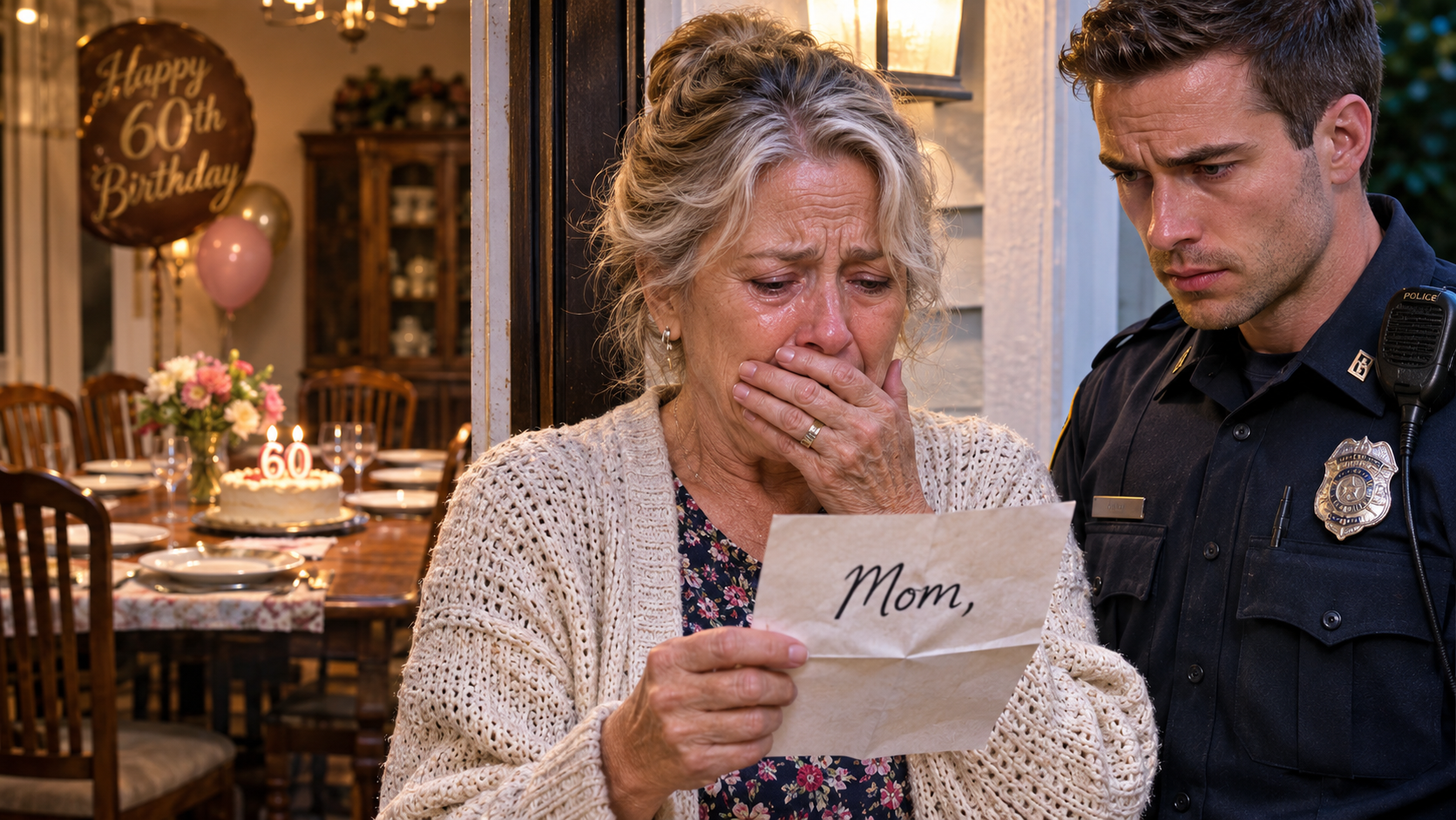
For several minutes, I couldn’t touch the envelope.
My mother’s handwriting had always been unmistakable.
Tall letters.
Sharp T’s.
An elaborate curl beneath every capital L.
As a child, I’d seen that handwriting on lunchbox notes.
Good luck on your test.
Don’t forget your sweater.
Love, Mom.
Later it appeared on birthday cards addressed to my children and little labels taped to Christmas presents.
Now those same familiar letters seemed foreign.
Linda, I owe you the truth.
Rachel sat beside me.
“You don’t have to read it tonight.”
I almost laughed.
“When exactly would be a better time?”
Nobody answered.
I opened the envelope.
Inside were eight handwritten pages.
The first line was dated twelve years earlier.
My mother had written it shortly before the stroke that eventually took much of her speech.
I began reading silently.
Then stopped.
“Read it aloud,” Thomas said softly.
I looked at him.
“Are you sure?”
He nodded.
“We should hear it together.”
So I did.
“Linda, if you’re reading this, then either I finally found enough courage to give it to you, or I died without finding that courage.”
My voice faltered.
Grant placed a glass of water near me.
I continued.
“Henry did send money after he left. The first payment came to my account because he believed you would refuse anything bearing his name. He asked me to transfer it to you without telling you where it came from.”
I stopped again.
A memory surfaced.
My mother standing in my kitchen in 1991, unloading canned soup into my cupboards.
“You don’t owe me anything,” she’d said.
“Families help.”
I’d hugged her.
I’d been so grateful.
I returned to the letter.
“At first, I gave you most of what he sent. I told myself it didn’t matter that you believed it came from me.”
My hands began trembling.
“But after several months, I started keeping some.”
Across the table, Emma quietly covered her mouth.
My mother’s confession continued.
It began with medical expenses.
My father’s long illness had left debts she never told me about.
She borrowed from Henry’s payments.
She intended to repay them.
Then she borrowed again.
A leaking roof.
A car repair.
An investment recommended by a family friend.
That investment failed.
By the time she realized how much she had taken, she was frightened.
Ashamed.
And trapped by her own lie.
“Henry never knew?” I whispered.
Grant shook his head.
The letter answered anyway.
“Henry believed you were receiving everything. I allowed him to believe that. I allowed you to believe he had forgotten you.”
I lowered the page.
Anger came slowly this time.
Not hot.
Cold.
Dense.
Almost heavy enough to feel inside my chest.
My mother had watched me leave the house at nine at night after putting six children to bed.
She had watched me arrive home at two in the morning smelling of industrial cleaning solution.
She had listened to me worry about electricity bills.
She knew.
“Why?” I whispered.
Rachel squeezed my hand.
I continued reading.
The answer was complicated.
Evelyn hated Henry for leaving.
When Henry began sending money, she’d decided he should not be allowed to purchase forgiveness.
She told herself she was protecting me from him.
When she later needed money herself, moral certainty became convenience.
Convenience became deception.
And eventually deception became a prison.
“I convinced myself that because he abandoned you, nothing he sent could repair the harm. But by hiding what he did send, I created another harm.”
My voice broke.
The final paragraph was hardest.
“You became stronger than I ever imagined, Linda. Everyone praised you for surviving. I praised you too, though I knew some of what you survived was harder because of me. That truth has followed me every day. I hope someday you will forgive me, though I understand if you cannot.”
Below her signature was a bank name.
An account number.
And an instruction.
“There may still be money remaining.”
Michael leaned forward.
“We checked.”
I looked at him.
“How much?”
“About forty-three thousand dollars.”
Nobody spoke.
Forty-three thousand.
I remembered winter boots repaired with duct tape.
A refrigerator I’d kept running by striking the thermostat housing with a wooden spoon.
A school trip Thomas didn’t attend because I couldn’t afford the fee.
A dental appointment I postponed for nearly two years.
And yet the strangest part wasn’t the money.
It was the theft of certainty.
For decades I had built my understanding of the past around one fact:
Henry left and never looked back.
Now that foundation had cracked.
It didn’t excuse him.
Money didn’t erase abandonment.
It didn’t replace bedtime stories or school concerts or frightened children asking where their father had gone.
But truth mattered.
And I’d been denied part of it.
I looked at my children.
“Is this why you missed dinner?”
Michael exhaled.
“Partly.”
“Partly?”
Grant closed the suitcase.
“We argued.”
That, at least, sounded believable.
“About what?”
“About whether you should ever know.”
I stared at him.
Rachel spoke quickly.
“Not because we wanted to keep secrets. We were trying to decide what would hurt you less.”
“And you decided making me think all six of you had forgotten my birthday would hurt less?”
Emma winced.
“No.”
“Then explain it.”
Michael stood and paced several steps away.
“At five this afternoon, Grant received another message from Dad’s attorney.”
“What message?”
“He said there was a deadline.”
“For what?”
“An appointment tonight.”
The door behind us opened.
A woman in a charcoal coat entered carrying a leather briefcase.
She was perhaps in her late fifties, with silver beginning at her temples.
Grant stood.
“Mom, this is Helen Marsh.”
She approached and extended her hand.
“Mrs. Henderson.”
I didn’t take it.
“You’re Henry’s lawyer?”
“No. I represent the firm handling his estate in the United States.”
“And you scheduled a meeting on my birthday?”
Her expression softened.
“I didn’t know it was your birthday until this afternoon. When Grant told me, I offered to postpone.”
I turned toward Grant.
“Then why didn’t you?”
His face changed.
“Because she told us someone else had requested access to Dad’s records.”
“Who?”
Helen answered.
“We don’t know.”
I frowned.
“Then how do you know someone requested them?”
“Because Mr. Henderson placed certain documents under restricted release. Yesterday, another party attempted to claim them.”
Michael returned to the table.
“That’s why Officer Ortiz is here.”
I looked toward the entrance.
Daniel stood quietly by the wall.
Suddenly his presence made more sense.
“Was a crime committed?”
“Not necessarily,” Helen said. “Officer Ortiz is here primarily because Grant asked him to be. He was worried you might panic when you saw a police officer, but he also didn’t want a stranger driving you across town.”
Grant gave an embarrassed shrug.
“I didn’t think that part through.”
For the first time that evening, despite everything, a tiny laugh escaped me.
“You certainly didn’t.”
His shoulders relaxed.
Only slightly.
Helen opened her briefcase.
“Mr. Henderson left one further instruction.”
She removed a small brass key.
“This key opens a safe-deposit box.”
“Where?”
“First Union Bank.”
My heart tightened.
That was the bank in the photograph.
“What’s inside?”
“We don’t know.”
“Henry knew?”
“Presumably.”
“Then why not put it in his will?”
Helen paused.
“Because the box isn’t in his name.”
Something about the way she said it sent a chill through me.
“Whose name?”
She looked directly at me.
“Yours.”
I stared at her.
“I don’t have a safe-deposit box.”
“According to the bank, you’ve had one since September 1989.”
September 1989.
One month after Henry left.
“That’s impossible.”
“Someone has been paying the rental fee annually.”
“Who?”
“We don’t know.”
“Henry?”
“No.”
“Then my mother?”
“We believed so.”
“Believed?”
Helen reached into the briefcase.
“Until today.”
She placed a single sheet of paper on the table.
It was an authorization form from the bank.
The latest annual payment had been made only three months ago.
I stared at the date.
My mother had been dead for six years.
I looked around the room.
“Who paid it?”
Helen’s answer was barely above a whisper.
“That’s what we’re hoping the box will tell us.”
The bank manager agreed to meet us after hours because Helen had spent half the afternoon arranging it.
I almost refused.
Part of me wanted to go home, scrape the cold birthday food into containers and crawl into bed.
But thirty years of my life had changed in less than an hour.
I knew I wouldn’t sleep.
So the seven of us drove downtown.
My children followed in three cars.
This time, I rode with Grant.
For several blocks he said nothing.
Then:
“I’m sorry.”
I watched buildings pass outside.
“For which part?”
“The dinner.”
I didn’t answer.
“I thought we’d finish here by seven.”
“You could have called.”
“I know.”
“You heard my messages.”
“I know.”
I turned toward him.
“Why didn’t you answer?”
His hands tightened on the wheel.
“Because Michael said if one of us answered, we’d all start explaining different parts and make everything worse.”
“Michael has been bossing you around since you were six.”
A smile flickered.
“True.”
“But you’re thirty-four now.”
“Thirty-five.”
“Then you’re old enough to ignore him.”
His smile disappeared.
“I was afraid.”
That surprised me.
“Of me?”
“Of disappointing you.”
“You accomplished that rather efficiently.”
He flinched.
I immediately regretted it.
Not because the sentence was untrue.
Because I recognized something in his expression.
The same frightened boy who used to hide report cards beneath his mattress.
I softened my voice.
“Grant.”
He looked at me.
“You can disappoint me and still be my son.”
His eyes filled unexpectedly.
He looked back at the road.
“I know.”
“No,” I said. “I’m not sure you do.”
The rest of the drive passed quietly.
But something between us had shifted.
Not healed.
Opened.
At the bank, the manager led us into a private viewing room.
Only Helen, Grant and I were permitted inside.
The box was longer than I expected.
Number 314.
The manager placed it on a table, inserted his key, then nodded toward mine.
My hand shook as I turned the brass key.
Click.
The lid lifted.
Inside sat three things.
A thick envelope.
A small cassette tape.
And a photograph.
I reached for the photograph first.
It showed my six children standing in front of our old house.
Young.
Michael about fourteen.
Emma still a baby.
I remembered the day.
A neighbor had taken the picture.
But someone had been cut from the photograph.
Only half an arm remained at the edge.
Henry.
I turned it over.
On the back was a message.
Not Henry’s handwriting.
Not my mother’s either.
I read the words aloud.
“Linda, Evelyn was not the only person who lied to you.”
Grant went still.
Helen leaned closer.
Below that sentence was a signature.
I knew the name.
For more than thirty years, I’d believed that person had disappeared along with my husband.
But apparently they had been watching my family long after he left.
I whispered the name.
“Margaret Shaw.”
Grant frowned.
“Who is Margaret Shaw?”
I looked at my son.
And suddenly I understood that the story of why his father left had never been as simple as an affair with a woman overseas.
“She was your father’s sister.”
Grant stared at me.
“I didn’t know Dad had a sister.”
“Neither did you,” I said slowly, staring at the photograph, “because Henry told me Margaret died in 1987.”
On the back of the photograph, beneath her signature, Margaret had written one more sentence.
I am still alive, Linda. And if you’re finally reading this, you deserve to know why Henry really left.
-END OF Chapter 2–