The leather photo album hit my porch with the weight of something meant to be noticed.
No card tucked inside. No warm message. No familiar sign-off. Only my parents’ return address, written in my mother’s tidy, controlled handwriting—the kind that always suggested she kept everything neat, measured, and “proper.”
I brought it inside anyway. Old habits can be stubborn. When you grow up trained to treat anything from your parents as important, your hands move before your mind catches up.
The cover felt expensive, like an item meant to protect something treasured. But the moment I opened it, my stomach tightened.
Page one: my family smiling in Miami Beach. Sunlit faces. My sister Lydia leaned into my dad as if she’d always belonged there. My mom held a drink with a tiny umbrella, relaxed and pleased with herself. The photo looked like a finished puzzle.
And I wasn’t in it.
The album that answered every question
I flipped forward. Yellowstone. Washington, D.C. California. The Bahamas. Greece.
It wasn’t one missed trip. It was a pattern—years of proof arranged neatly behind plastic sleeves. My absence wasn’t a mistake. It was tradition, curated and preserved like a family heirloom.
I kept turning pages anyway, because part of me needed the truth in one full view—like pulling off a bandage fast so it couldn’t be debated afterward.
Halfway through, a smaller picture slid out from behind one sleeve and drifted into my lap.
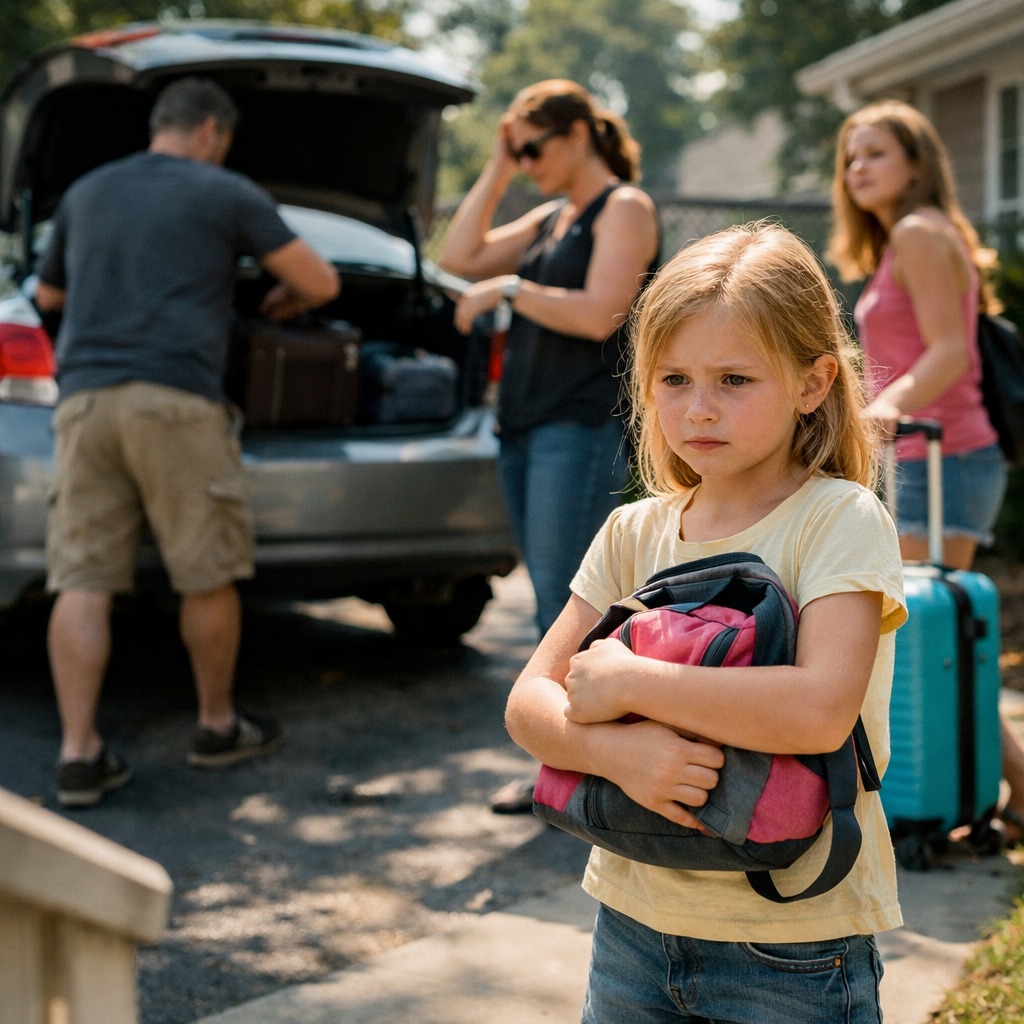
The shot was slightly blurry, tilted like it had been taken quickly. My parents’ car sat at the end of our driveway, packed and ready.
And there, in the front of the frame, was me—eight years old—holding a duffel bag like it was the only thing keeping me steady.
My face was turned toward the camera.
I was crying.
Someone had photographed the moment I was left behind.
And someone had kept it.
Some memories fade because they’re unimportant. Others are stored carefully because they’re exactly the point.
Eight years old, and already “the problem”
I was eight the first time they took a vacation without me. Oddly enough, the destination wasn’t what hurt most.
What hurt most was how easily I accepted their explanation—how quickly I learned to blame myself.
That spring, I drew beaches in crayon: palm trees like green fireworks, a huge orange sun, stick-figure families holding hands under a bright blue sky. I taped the pictures to the fridge as if they could turn into a promise.
Lydia, three years older and overflowing with confidence, laid her purple suitcase open on her bed and packed like it never occurred to her she might not belong.
I stood in her doorway watching, trying to contain my excitement.
“What are you doing?” she asked, not even bothering to look up.
“Waiting,” I said. “Mom said we’re going to Florida.”
Lydia made a little sound, half laugh, half scoff, and shoved flip-flops into her suitcase. “Yeah. We are.”
I glanced back at my own room. My duffel bag sat open on my bed—empty, ready, hopeful.
I waited for my mom to appear and say the obvious: Time to pack.
She walked past my doorway again and again, arms full of travel-size bottles and sunscreen, ponytail swinging like a clock. She never paused. She never asked if I had a swimsuit. She never even glanced toward my bag.
By the time my dad started loading the trunk, I felt sick with confusion.
I padded outside barefoot onto the warm driveway.
“Dad?” I tried.
He kept working.
“Where’s my suitcase?”
The trunk shut with a final metallic thud. He straightened and finally looked at me—like I’d surprised him simply by existing.
“You’re staying with Grandma Ruth this week,” he said.
The air seemed to leave my chest.
“But… I thought we were going to Florida.”
“We are,” my mom said from the passenger seat, buckling her seatbelt with casual certainty. She leaned toward the open window with a bright, practiced smile. “You get carsick, sweetie. Remember that time in Ohio?”
I blinked hard. “I got sick once.”
From the back seat, Lydia popped up, hair glossy from the special shampoo my mom bought “for the trip.”
“You’re gross,” she said, almost happily. “You ruined everything.”
- I understood their excuse didn’t hold up.
- I understood it wasn’t about nausea.
- I understood they simply didn’t want me there.
The houses I stayed in were quiet, but the message was loud
Grandma Ruth’s home smelled like old paper and closed curtains. The living room stayed dim even at midday because she kept the drapes partly drawn to “save the furniture.” She wasn’t unkind, exactly—just distant, careful, as if she were hosting someone else’s child.
She set game shows on the television and offered butter cookies without asking what I liked. I sat in her recliner each afternoon watching strangers win prizes—especially trips—while I learned what it felt like to be excluded politely.
Then the postcard arrived.
A glossy picture of Miami Beach: bright sand, blue water, umbrellas lined up like candy.
Lydia’s handwriting sprawled across the back.
THE OCEAN IS AMAZING. WISH YOU WERE HERE. NOT REALLY 
I stared at it until my eyes burned, not because it was clever, but because it matched what I already feared was true.
When my family returned, they came home noisy with stories—boat tours, restaurant meals, a pool that was “like something out of a movie.” My dad handed me a cheap flamingo keychain and ruffled my hair like I’d done a good job staying out of the way.
My mom smiled brightly, as if we were all sharing the same reality. “See? You had fun with Grandma, right?”
I nodded. I’d already learned that telling the truth didn’t change the outcome—it only made things colder.
That summer taught me my family’s unspoken rule: if you want affection, don’t create extra work.
Over time, the exclusion became a system
It didn’t end after Florida. It became routine, almost efficient—like they’d discovered a method that made their vacations smoother and never questioned the cost.
At ten, they went to Yellowstone. I stayed with Aunt Lorraine, who worked nights and slept through most days. She left frozen meals and sticky notes on the counter: “Microwave 4 minutes. Don’t burn it.”
I ate alone, listening to the hum of the house, watching the Weather Channel because it felt calmer than cartoons.
At twelve, they toured Washington, D.C. I pleaded to come.
“I want to see the Smithsonian,” I said. “I want to see the monuments.”
My mom smiled like I’d suggested something sweet and unrealistic. “You wouldn’t enjoy museums. You hate walking.”
I stared at her. “I run track.”
She waved her hand as if facts were optional. “Vacation walking is different.”
Nothing I said could compete with the story they preferred to tell about me.
And the irony was impossible to miss: Lydia complained on trips. Lydia got motion sick. Lydia even had an embarrassing moment on a bus once that my dad retold for years as a “fun family memory.”
But Lydia looked like my mom—blonde, soft features, familiar dimples. Lydia laughed at my dad’s jokes. Lydia never asked uncomfortable questions.
I did.
- Lydia fit their image of “easy.”
- I reminded them that families are supposed to be fair.
- They treated my difference like a flaw instead of a fact.
At sixteen, they stopped pretending
When I was sixteen and they booked a fancy resort trip to San Diego, I didn’t even ask to go. By then, I’d learned that asking only bought me a new excuse and a fresh dose of embarrassment.
My mom stood at the kitchen counter making lists—chargers, sunscreen, swimsuits—and said, casually, “We’ll be gone two weeks. There’s money for groceries.”
“That’s it?” I asked.
My dad didn’t lift his eyes from his phone. “You’ll be fine.”
And I was.
For the first time, staying behind didn’t feel like punishment. It felt like stepping out of a role I never agreed to play. It wasn’t belonging, but it was relief.
I got a job at a local coffee shop and worked early shifts. I learned how to keep smiling when customers were rude, how to count tips, how to push down the old instinct to apologize for taking up space.
During those two quiet weeks, something in me settled into clarity:
Maybe I wasn’t “too much.” Maybe I was simply surrounded by people who needed me to be smaller.
Distance started to feel like oxygen
I began chasing scholarships like it was my second job. I chose a state school six hours away on purpose. The miles felt like breathing room.
At graduation, my mom put on a show in front of relatives. She cried dramatically, clinging to my dad’s arm.
“My baby’s leaving,” she sobbed.
I watched mascara streak down her face and felt something sharp but steady inside me.
You’ve been leaving me behind for years, I thought. Don’t act shocked that I learned how to leave too.
Conclusion: The album didn’t just document vacations—it documented a long, deliberate pattern of exclusion. Seeing it all at once forced me to stop questioning my own worth and start questioning the family story I’d been handed. Sometimes the first step toward building a new life is accepting that the old one was never designed to hold you gently.