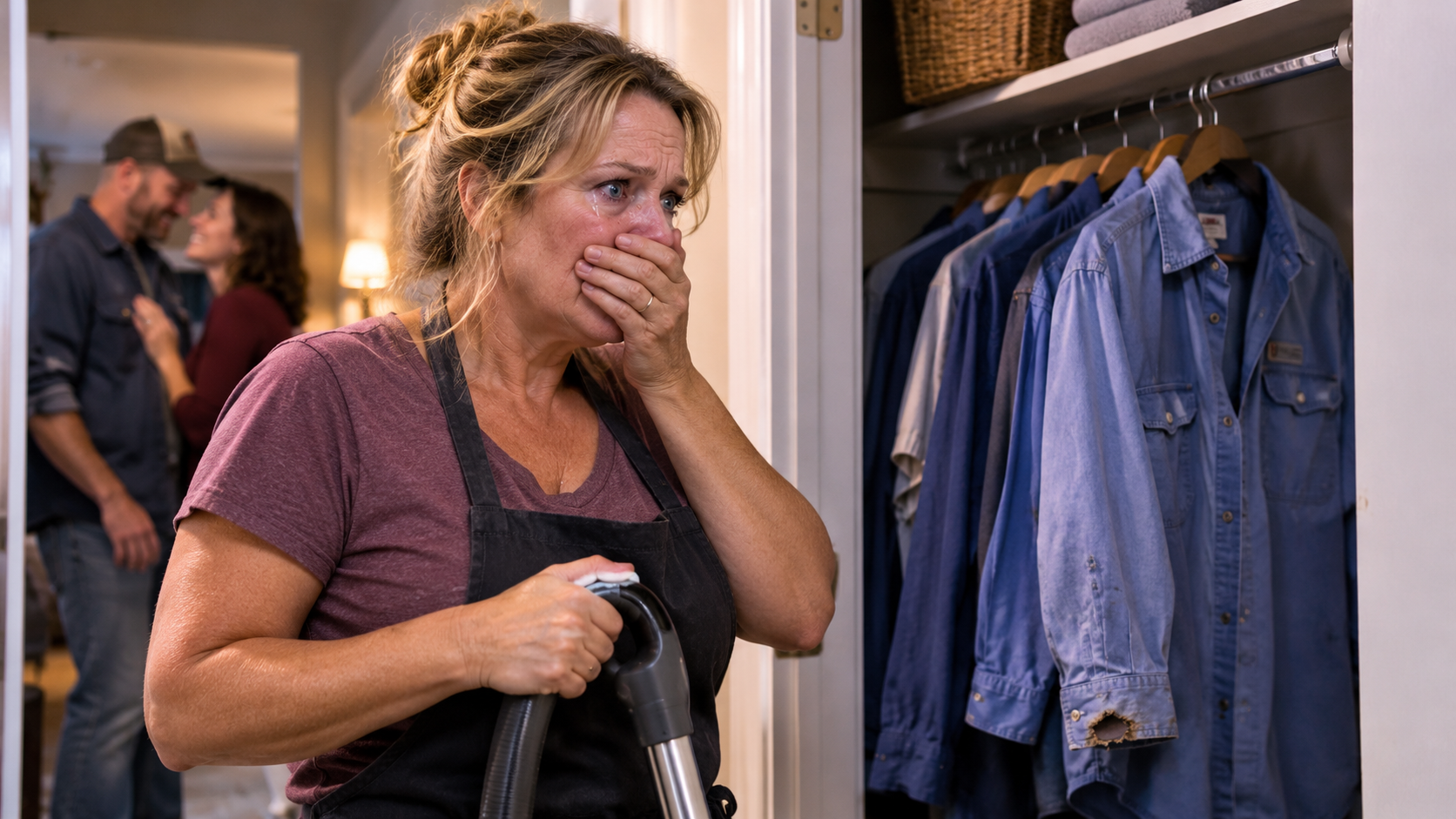
They were my husband’s shirts.
Not shirts like his. Not the same brand or the same shade of blue. His.
The second one from the left had a small dark mark near the cuff where a spark had burned through the fabric years earlier. I remembered the night it happened because he had come home complaining about the ruined sleeve, and I had spent twenty minutes trying to scrub away something that could not be washed out.
I stood inside a house belonging to a woman I barely knew and stared at clothes I had washed hundreds of times.
“Ray?” I said quietly.
The name sounded ridiculous in the empty hallway.
No one answered.
Outside, a delivery truck rolled somewhere along the street. The refrigerator clicked on in the kitchen. The vacuum cord lay across the hardwood floor behind me, exactly where I had dropped it.
I had been cleaning this house every Tuesday for nearly a year.
The woman who lived there had hired me through a recommendation from another client. She worked irregular hours, so we almost never saw each other. She left a key for me, an envelope containing my payment, and usually a small handwritten note describing anything extra she wanted done.
That morning the note had been beside the fruit bowl.
Sheets today, please. Thank you!!
Two exclamation marks. She always used two.
Until that Tuesday, she had simply been another client whose private life was none of my concern.
I cleaned four houses a week around Owensboro, Kentucky, and had been doing that kind of work for eleven years. People sometimes assume house cleaners are curious because we see things other people do not. The truth is that curiosity makes the job harder.
You learn not to care why someone keeps sleeping on the couch when there is a perfectly good bedroom upstairs. You do not wonder why two toothbrushes suddenly become one. You do not ask why a framed wedding photograph disappears from the mantel and comes back three months later.
You clean around people’s lives without entering them.
At least, that was the rule I had always followed.
I looked again at Ray’s shirts.
My first instinct was to invent a reasonable explanation. Perhaps he had left them here after doing some work. Perhaps the woman knew him through his job. Perhaps she had borrowed something. Perhaps there was an explanation so ordinary that I would later feel ashamed for imagining anything else.
But Ray did not work at this house.
I knew that.
And five shirts were not something a man accidentally forgot.
I reached toward the nearest sleeve, then stopped before touching it.
The room seemed strangely close around me.
Ray and I had been married long enough that there were certain things about him I recognized without thinking. I knew the sound of his truck before it entered our driveway. I could identify his footsteps coming through the kitchen. I knew how he folded receipts into his wallet and how he left loose change beside the bed.
I knew the way he rolled the sleeves of those shirts.
Once, years earlier, I might have rushed home and demanded an answer before I even finished the job. Age had changed me. So had eleven years of cleaning other people’s homes.
Evidence looked different when you spent your days surrounded by the quiet remains of people’s decisions.
I closed the closet.
Then I finished vacuuming the hall.
My hands trembled for the first few minutes, but routine gave me something solid to hold on to. I dusted the living room. I wiped fingerprints from the kitchen appliances. I scrubbed the bathroom counter.
Under the bathroom sink, I reached for the cleaning products the homeowner kept there.
That was when I saw the razor.
Ray used the same kind.
I crouched on the tile and stared at it longer than I should have.
There was shaving cream beside it, from the three-pack I regularly bought because it was cheaper that way. I had purchased another package less than two weeks earlier.
My stomach tightened.
One coincidence might have survived explanation.
Two were harder.
I closed the cabinet and sat back on my heels.
For the first time, I allowed myself to say the word silently.
Affair.
Even then, part of me resisted it.
Ray and I had been married since 1998. A marriage that long accumulates so many ordinary acts that betrayal begins to feel almost mathematically impossible. I had washed his clothes, packed lunches, sat beside him at hospital beds, attended funerals for relatives I barely knew because they mattered to him.
I had stood in grocery aisles comparing prices because money was tight. I had driven him to work when his truck would not start. I had learned which medicine he wanted when he had a cold and exactly how much sugar he took in his coffee.
Those things did not guarantee loyalty.
But until that moment, I had believed they meant something permanent.
I finished the bathroom because I did not know what else to do.
When I entered the kitchen again, I opened a drawer looking for the spare trash bags the homeowner normally kept beneath a stack of household papers.
The bags were there.
So was a stapled document.
I did not pull it out because I was searching for evidence. The top page was partly turned, and one word printed near the upper edge caught my attention.
LEASE.
My pulse started pounding in my ears.
I should have closed the drawer.
Instead, I looked.
The agreement covered twelve months. The property address was the same house in which I was standing. The lease had been signed in January.
Two tenants were listed.
The first was my client.
The second was Raymond Carter.
My husband.
I read his name once.
Then again.
I had signed my own name next to his on documents since we were young enough to believe every problem could be solved by working harder.
Ray’s signature sat at the bottom of the page.
There was no mistaking it.
Behind the lease lay a receipt from a moving company.
January 4.
The lease itself had been signed January 6.
I stood there holding the edge of the drawer while a different date rose in my memory.
March 11.
Ray had brought refinance paperwork home in March.
He had spread the documents over our kitchen table after dinner. I could still picture the little colored tabs marking the places where I was supposed to sign.
He had been unusually serious that evening.
“One bad winter could put us behind far enough for the bank to come after everything,” he had said.
I had stared at the mortgage documents. “Are things that bad?”
“They could be.”
Ray ran a small contracting business, and there had been months when cash flow was uneven. I knew that much. What I did not know was how dangerous things actually were.
“What are we supposed to do?”
He tapped the paperwork.
According to Ray, moving the house entirely into my name would protect it if creditors came after him. He spoke quickly but confidently, the way he always did when he wanted uncertainty to sound like foolishness.
I had asked whether putting the house only in my name would cause problems between us.
He had almost smiled.
“I’m still living here, aren’t I?”
At the time, those words comforted me.
Standing in another woman’s kitchen, I understood how carefully they had avoided answering my question.
January 4.
Moving company.
January 6.
Lease.
March 11.
Our house transferred into my name.
The sequence rearranged my entire memory of that spring.
Ray had not been frightened that creditors would take our house.
Or at least that might not have been the whole truth.
Before he convinced me to carry the responsibility for our home alone, he had already arranged another place to live with another woman.
My knees felt weak.
I lowered myself into a kitchen chair.
For several minutes, I simply watched afternoon light stretch across a spotless countertop.
I thought I would cry.
I did not.
Instead, I became aware of absurd details. A tiny chip in the edge of a ceramic bowl. A grocery receipt underneath a magnet. A faint coffee ring I had missed near the sink.
Then I realized something else.
For nearly a year, I had been cleaning the place where my husband kept another life.
I had washed sheets from that bedroom.
I had scrubbed that shower.
I had emptied their trash.
I had wiped his fingerprints from cabinets without knowing they belonged to him.
A bitter heat moved through my chest, but I forced myself to remain seated until it passed.
Taking the lease would have been easy.
So would photographing everything.
But the house was not mine, and I had spent eleven years building a reputation on never crossing a client’s boundaries.
Whatever Ray had done, I would not destroy myself trying to prove it.
I replaced the papers precisely where I had found them.
The lease went beneath the household documents. The moving receipt went behind it.
I closed the drawer.
Then I finished the kitchen.
I changed the sheets upstairs.
That nearly broke me.
I removed them from the bed and carried them down the hallway thinking about Ray sleeping there. I imagined him leaving our house under one excuse or another, driving across town, parking outside this place.
How many times had I washed the evidence of his betrayal and folded it neatly afterward?
I stopped myself.
Imagining things I could not prove would not help me.
Facts would.
Ray’s shirts were there.
His razor was there.
His name was on the lease.
The lease was signed before the refinance.
Those facts were enough.
When I finished, I placed the cleaning supplies in their normal spot.
The envelope waited on the counter.
My payment was inside.
For several seconds, I considered leaving it.
Then I took it.
I had done the work.
Whatever this woman was to my husband, she had hired me to clean her house, and I had completed the job.
Outside, I loaded my supplies into the car and sat behind the wheel without starting the engine.
Going home suddenly felt impossible.
Ray might already be there.
I could not look at him yet.
More importantly, I did not trust myself to speak without revealing everything.
So I drove somewhere else.
My sister Dee lived about fifteen minutes away.
When she opened her front door, she took one look at my face and stopped smiling.
“What happened?”
I walked past her into the kitchen.
“I need to tell you something, but you have to let me finish before you say anything.”
Dee pulled out a chair.
I started with the shirts.
Then the razor.
Then the lease.
Finally, I told her the dates.
January for the lease.
March for the refinance.
When I finished, Dee stayed silent for several seconds.
Then she asked a question I had not expected.
“Do you still have your cleaning ledger?”
I frowned.
“My work book?”
“All of it.”
“Of course.”
“Then take it somewhere safe tonight.”
I almost laughed.
“Dee, it’s addresses and payments.”
Her expression did not change.
“It’s also proof you’ve been working at that house for a year without knowing what Ray was doing.”
The room became quiet.
Until that moment, I had been thinking like a wife who had discovered an affair.
Dee was thinking about something larger.
“What are you saying?”
“I’m saying you don’t confront him yet.”
Every instinct in me resisted.
“He’s my husband.”
“And apparently someone else’s tenant.”
I flinched.
Dee softened her voice.
“Listen to me. He signed that lease before he convinced you to put the house in your name. Maybe there’s an explanation. Maybe there isn’t. But you need to know exactly what he arranged before you tell him what you found.”
I stared at my hands.
For the first time that afternoon, fear replaced anger.
Not fear of losing Ray.
Fear that losing Ray might have been part of his plan long before I knew there was anything to lose.
Dee reached for her phone.
“I know a lawyer in Evansville.”
I looked up sharply.
“A lawyer?”
“Yes.”
“I’m not filing for divorce tonight.”
“I didn’t say you were.”
She unlocked her phone.
“You’re going to find out what you signed.”
That sentence landed harder than anything else she had said.
I thought again about the refinance papers waiting somewhere in my own house.
Papers Ray had placed beneath my hand.
Papers I had signed because I believed he was protecting us.
Dee found the number and looked at me.
“Do you want me to call?”
I closed my eyes for one moment.
When I opened them, I realized the marriage I had walked out of that morning no longer existed, whether Ray knew it yet or not.
“Call.”
I listened to her explain that her sister had discovered something disturbing involving a jointly occupied marriage, a house, and documents signed months apart. Dee was careful not to dramatize anything. She described the dates exactly.
That steadied me.
Dates did not cry.
Dates did not accuse.
January 4: moving company.
January 6: lease.
March 11: refinance.
When Dee handed me the phone, a woman introduced herself and asked me to repeat the situation in my own words.
I told her about the north-side house.
I told her how long I had cleaned it.
I explained that I had found Ray’s clothing while putting away a vacuum and later saw a lease while retrieving supplies from a drawer.
The lawyer interrupted only to clarify details.
“You did not remove the lease?”
“No.”
“Photograph it?”
“No.”
“Did you open private files looking for it?”
“No. I saw it while I was working.”
“Good.”
I did not understand why the distinction mattered so much, but the firmness in her voice made me grateful I had resisted the impulse to take anything.
Then she asked about our home.
“Whose name is currently on the deed?”
“Mine.”
“And the mortgage?”
I hesitated.
“I believe mine after the refinance.”
“You believe?”
“Ray handled most of it.”
There was a small pause.
“Bring every document you have.”
My face grew warm.
That answer exposed something about my marriage I had never considered embarrassing before.
Ray handled those things.
Insurance.
Mortgage paperwork.
Taxes.
Bank questions.
I earned money and kept records for my business, but when it came to our household finances, I had gradually allowed him to become the interpreter of everything complicated.
Not because I was incapable.
Because trust is convenient.
The lawyer asked when Ray had presented the refinance documents.
“March.”
“And you are certain the other lease was January?”
“Yes.”
“How certain?”
“I read the date several times.”
She asked what Ray had told me when I signed.
I repeated his explanation about creditors and protecting the house.
“Did he disclose another residence?”
“No.”
“Did he tell you he had signed a lease with another woman?”
“No.”
The lawyer exhaled softly.
“Bring the documents before you discuss any of this with him.”
My fingers tightened around the phone.
“He’ll know something is wrong.”
“You do not need to explain everything immediately.”
“He’s my husband.”
“I understand.”
“No, I mean—we live in the same house.”
“I understand that too.”
Her tone remained calm.
“What you need right now is information. You have one version of why those papers were signed. Before you confront him, you should know exactly what the documents say.”
I looked toward Dee.
She nodded.
“What do I do tonight?” I asked.
“Gather your papers. Keep them somewhere secure. Don’t remove anything from the other property. And don’t make threats or accusations based on assumptions.”
“I’m not assuming he signed the lease.”
“No. But there may be financial or legal details you have not seen yet. Let the documents tell us what happened.”
When the call ended, Dee poured coffee neither of us really wanted.
“You’re staying here tonight if you need to,” she said.
“I can’t.”
“Why?”
“Because if I don’t go home, he’ll know.”
She leaned against the counter.
“And if you go home?”
“I act normal.”
She raised an eyebrow.
“You?”
Despite everything, I almost smiled.
Dee knew me too well.
I had never possessed much talent for pretending.
Still, I went home.
Ray’s truck was not in the driveway when I arrived.
That gave me enough time to locate the refinance papers.
They were in a file box in the bedroom closet beneath insurance statements and old tax documents. I carried the whole box to the kitchen.
Reading legal language after discovering infidelity is an unusual experience. Every sentence seems designed to remind you how little you understand about your own life.
I recognized my signature.
March 11.
Again.
Again.
Again.
Ray’s signature appeared where necessary, including acknowledgments showing that the transfer arrangement had been made with his participation.
I sat at the same table where he had originally pushed the documents toward me.
I remembered his finger landing on each colored tab.
Here.
Here.
Initial this one.
Sign there.
He had kissed my forehead afterward.
I had cried because I thought we had nearly lost our home.
Now I wondered whether he had been preparing to leave it.
Ray came home shortly after seven.
I heard his key turn in the door and immediately slid the papers back into their folder.
“You eat?” he called.
“Not yet.”
He entered the kitchen carrying a gas-station coffee and looked exactly like the man who had left that morning.
That was perhaps the strangest part.
Betrayal changes the person who discovers it instantly.
The person committing it can walk through the door unchanged.
Ray opened the refrigerator.
“There’s leftover chili.”
“I know.”
He glanced over his shoulder.
“You okay?”
I looked at the back of his blue work shirt.
Another one.
For one reckless second, I wanted to ask how many he kept at her house.
Instead, I said, “Long day.”
“Mine too.”
He heated food and talked about a supplier who had delivered the wrong material to a job site.
I listened.
Occasionally I answered.
Nothing in his manner suggested that the world underneath our marriage had shifted.
Later, lying beside him in bed, I remained awake long after his breathing became slow.
I wondered how many nights he had slept there and gone to her house the next day.
I wondered whether she knew about me.
Then I remembered the envelopes.
Every Tuesday.
Payment on the counter.
She knew my name through my cleaning business, but we had almost never been face-to-face. Our arrangements happened mostly through brief messages.
Had Ray ever mentioned his wife’s name?
Had she deliberately hired me?
The possibility struck so sharply that I sat upright.
Ray stirred.
“What?”
“Bathroom.”
I walked into the hall and closed the door behind me.
Standing under the harsh bathroom light, I forced myself back to the facts.
I did not know what she knew.
I did not know when the affair began.
I did not even know whether Ray considered the other house his primary home or merely somewhere he stayed.
The only useful thing I could do was learn more without inventing answers.
Wednesday morning, I retrieved my cleaning ledger.
I had kept some version of that book for eleven years.
Each page contained names or initials, addresses, dates, amounts paid, cancellations, extra tasks, and occasionally practical notes.
Dog outside Tuesday.
Use unscented cleaner in nursery.
Key moved to planter.
North-side house first appeared almost a year earlier.
I traced my finger down the entries.
Tuesday after Tuesday.
The woman had paid reliably.
Sometimes she rescheduled.
Once she asked me to skip a week because she was traveling.
Nothing in my notes suggested Ray.
That fact suddenly mattered.
My records showed I had been entering the home openly as an employee before I knew anything about his relationship with the woman.
Dee had been right.
It was more than a cleaning book.
It was a timeline.
I put it with the refinance papers.
Thursday passed with agonizing normality.
Ray left for work.
I cleaned two houses.
We ate dinner.
He watched television.
I watched him.
Once he caught me staring.
“What?”
“Nothing.”
He turned back toward the screen.
Friday morning, I drove to Evansville for my appointment.
The lawyer’s office was on the second floor of a plain brick building. I carried my paperwork inside a grocery sack because I had not thought to buy anything more professional.
The receptionist did not care.
Neither did the lawyer.
Her name was Margaret Hale. She looked to be somewhere in her fifties and wore narrow glasses that she removed whenever she wanted to look directly at me.
She reviewed my cleaning ledger first.
Then the refinance documents.
She asked me to recount the lease again.
I gave her the date.
January 6.
She wrote it down.
“Moving receipt?”
“January 4.”
“And refinance?”
“March 11.”
Her pen stopped.
She returned to several pages in my documents.
After nearly twenty minutes, she leaned back.
“Do not say anything to your husband about what you saw.”
I stared at her.
“You already told me that.”
“I’m telling you again now that I’ve seen these.”
“What exactly are you seeing?”
“I’m seeing an arrangement involving your home that occurred after he had already entered another residential lease.”
My throat tightened.
“So he planned this?”
“I’m not saying that yet.”
“But—”
“I’m saying chronology matters.”
She tapped the papers.
“His intentions would require more evidence. The documents themselves establish dates. That is useful because dates don’t depend on either spouse’s memory.”
I nodded.
“What happens to my house?”
Margaret chose her words carefully.
“You are currently the sole owner according to the documents you brought me. That does not mean every question about marital property disappears. But it does mean your situation is not what you seemed to believe it was when you walked in.”
I looked down at the grocery sack beside my chair.
“I clean houses for a living.”
She waited.
“I don’t understand any of this.”
“You understand more than you think.”
“No, I don’t.”
“You noticed the dates.”
I looked at her.
“You preserved your records. You did not steal documents from someone else’s property. You came for advice before confronting him. Those were good decisions.”
Something loosened inside me.
Until then, I had felt like the stupidest woman in Kentucky.
Margaret organized my papers into a cleaner stack.
“There’s something else.”
“What?”
“You said Tuesday is your regular cleaning day at that house?”
“Yes.”
“Are you scheduled next week?”
The idea made my stomach turn.
“Yes.”
“Go.”
I thought I had misheard her.
“You want me to clean my husband’s girlfriend’s house?”
“I want you to behave exactly as you behaved before learning what you learned.”
“I don’t think I can.”
“You don’t confront her. You don’t search. You don’t photograph documents. You do the work you were hired to do.”
“Why?”
“Because right now your conduct is straightforward. You were hired to clean a residence, and you discovered information incidentally while performing your normal work. Keep it that way.”
I imagined entering that bedroom again.
Changing those sheets.
Seeing his shirts.
My mouth went dry.
“And if Ray is there?”
Margaret paused.
“Has that ever happened?”
“No.”
“Then if circumstances change, call me afterward. But do not provoke a confrontation inside someone else’s home.”
I gathered the papers.
At the door, I turned.
“What if I can’t pretend?”
Margaret put her glasses back on.
“You don’t need to pretend your marriage is fine.”
She glanced toward the ledger.
“You only need to do your job.”
Tuesday arrived far too quickly.
I parked in my usual place.
Carried my supplies to the porch.
Unlocked the door.
The house smelled faintly of coffee and lemon cleaner.
The envelope waited on the counter.
Beside it lay another handwritten message.
Sheets today, please. Thank you!!
Same request.
Same cheerful punctuation.
I stood there reading it, realizing the woman had no idea that the person she had paid to change those sheets now knew whose body had been sleeping between them.
Then I heard a vehicle outside.
A door slammed.
Heavy footsteps crossed the porch.
I froze beside the kitchen counter.
The front door opened.
And my husband’s voice called from downstairs.
“Are you here?”
Then I looked at the bed beside me.
Not our bed.
Her bed.
Their bed, perhaps.
I stood in the upstairs bedroom holding a clean pillowcase while footsteps moved through the foyer below.
“Are you here?” Ray called again.
I did not answer.
The stairs creaked.
One step.
Then another.
My heartbeat seemed louder than his shoes.
Margaret’s instructions came back to me.
Do not provoke a confrontation.
Do your job.
That sounded simple inside an attorney’s office.
It sounded impossible while my husband climbed the stairs of another woman’s house and I stood beside the bed I had been paid to make.
He reached the landing.
Our eyes met.
Ray stopped.
For several seconds, his entire face emptied of expression.
His gaze moved from me to the cleaning caddy on the floor, then toward the stripped bed.
He looked almost as though he had opened the wrong door and hoped staring long enough might change what was behind it.
“You?”
His voice came out thin.
I folded the pillowcase once.
“Yes.”
“What are you doing here?”
The question was so absurd I nearly laughed.
Instead, I held up the linen.
“Working.”
Ray’s eyes flicked toward the hallway.
“You clean this house?”
“Every Tuesday.”
Color faded from his face.
“How long?”
“About a year.”
He rubbed his forehead.
“I didn’t know.”
“I know.”
My calmness unsettled him more than anger would have.
He stepped into the room.
“What do you know?”
There it was.
Not who hired you.
Not why didn’t you tell me.
What do you know?
I noticed it immediately.
A guilty man does not always confess, but sometimes his questions do.
I returned to the bed and fitted the pillowcase over the pillow.
“I know I’m supposed to change the sheets today.”
“Come on.”
I smoothed the fabric.
“You asked.”
“That’s not what I mean.”
“I know.”
Ray stared at me.
I wondered whether he was mentally cataloging everything in the house.
The shirts.
The razor.
The lease.
The receipt.
Perhaps there were things I had not noticed.
He looked toward the closet.
The movement was tiny.
It told me enough.
“Where is she?” he asked.
“I don’t know.”
“She didn’t tell you I was coming?”
“No.”
“Did you tell her you were my wife?”
“No.”
His eyes snapped back toward me.
“Why not?”
“She hired a cleaner. She didn’t ask for my family history.”
He paced once toward the window, then back.
“This is crazy.”
I kept working.
Ray lowered his voice.
“Have you been going through her things?”
I stopped.
The accusation irritated me more than I expected.
“No.”
“You had to see—”
He stopped himself.
I looked at him.
“See what?”
His jaw tightened.
“Nothing.”
“Then why are you worried?”
“I’m not worried.”
“You look worried.”
He turned away.
“This shouldn’t be happening.”
Something inside me hardened.
“You’re right.”
For one second, I thought he understood.
Then he said, “You shouldn’t be here.”
I straightened.
“This is my job.”
“Not anymore.”
“You don’t decide that.”
“She hired you without knowing who you were.”
“She hired me because someone recommended my work.”
“You know what I mean.”
“Yes.”
I stepped around him and reached for the fitted sheet.
“I also know she paid me to clean today.”
Ray stared as I stretched one corner over the mattress.
The normality of the movement seemed to make him uncomfortable.
He had apparently imagined many ways his two lives might collide.
His wife quietly making his girlfriend’s bed had not been one of them.
“Stop cleaning,” he said.
“No.”
“We need to talk.”
“Not here.”
“Then come outside.”
“I have work to finish.”
His face reddened.
I had spent years adjusting myself to Ray’s moods. Not out of fear exactly. More from habit. If he came home frustrated, I made fewer demands. If he was worried about money, I waited before mentioning an expense.
Marriage teaches patterns.
Sometimes those patterns become obedience without either person naming them.
That afternoon, something changed.
He said stop.
And I did not.
“I’ll talk to you at home,” I said.
“When?”
“After I’m done.”
His shoulders rose with an impatient breath.
“What exactly have you seen?”
I looked at him.
The answer could have ended everything immediately.
Your shirts.
Your razor.
Your lease.
The moving receipt.
Instead, I remembered Margaret’s instructions.
“I’m working, Ray.”
“You keep saying that.”
“Because you keep interrupting me.”
His mouth tightened.
He walked into the hallway.
For a moment I thought he might leave.
Instead, he turned back.
“You really came here every week?”
“Yes.”
“For a year?”
“Yes.”
His expression shifted.
The realization was finally reaching him.
Every week.
Every room.
Every Tuesday.
Whatever secret life he had built here, I had unknowingly been moving through its physical remains for months.
“How did I not know?”
I pulled the sheet tight.
“You never asked which houses I cleaned.”
That answer seemed to bother him.
He walked downstairs without another word.
A cabinet opened.
Then shut.
Water ran briefly in the kitchen.
I waited, listening for the front door.
Eventually it closed.
His truck started outside.
I remained motionless until the sound disappeared.
Then my knees weakened.
I sat on the edge of the freshly made bed.
For several minutes, I pressed my palms together to stop them shaking.
The encounter had lasted perhaps ten minutes.
It felt like an hour.
My first instinct was to call Dee.
My second was to call Margaret.
Instead, I finished cleaning.
That decision mattered to me.
Ray had already taken enough from the day.
He would not take my work.
I cleaned the remaining bedroom furniture, wiped the upstairs bathroom, vacuumed the stairs, and checked the kitchen before leaving.
The envelope remained in my purse.
I locked the door behind me.
Only when I was inside my car did I call Margaret.
She answered after her receptionist transferred me.
“He showed up.”
“Your husband?”
“Yes.”
“Did he threaten you?”
“No.”
“Did you argue?”
“Not really.”
“What did you tell him?”
“That I’ve cleaned there for a year.”
“Anything about the lease?”
“No.”
“Good.”
I leaned my forehead against the steering wheel.
“He knows I found something.”
“Why do you say that?”
“Because he asked what I knew.”
Margaret was quiet.
“What happened after that?”
“He told me I shouldn’t be there.”
“What did you say?”
“That it was my job.”
To my surprise, Margaret made a small sound that might have been approval.
“Where is he now?”
“I don’t know.”
“Will you be safe going home?”
The question startled me.
“Ray has never hit me.”
“That wasn’t exactly my question.”
I considered it.
“He’ll be angry.”
“Do you have somewhere else you can stay?”
“Dee’s.”
“All right. You can speak with him if you choose, but don’t let him pressure you into signing anything, handing over documents, or making financial decisions tonight.”
“Can I ask about the lease?”
“You can ask your husband questions.”
“What shouldn’t I say?”
“You don’t need to reveal everything we’ve discussed or every record you possess.”
I understood.
For the first time in my marriage, information itself felt like protection.
When I reached our house, Ray’s truck was already there.
I stayed in the driveway for several minutes.
Then I went inside.
He sat at the kitchen table.
The same table.
March paperwork.
January lease.
So much of my marriage had apparently been negotiated across wooden grain I had wiped down thousands of times.
Ray did not greet me.
“You’ve been cleaning her house.”
“Yes.”
“For a year.”
“Yes.”
He leaned forward.
“And you never once thought to mention the address?”
“I clean four houses every week. You’ve never asked for their addresses.”
“I ask what you do.”
“You ask whether I’m working.”
He shook his head.
“You know that’s not the same thing.”
“No, apparently I didn’t.”
His expression hardened.
I hung my coat over the chair opposite him.
“Who is she?”
Ray looked away.
I waited.
He picked at a scratch in the tabletop.
“It’s complicated.”
“It looked very simple from upstairs.”
“Don’t do that.”
“Do what?”
“Turn everything into an accusation.”
I almost admired the sentence.
He had walked into another woman’s house carrying his own key, apparently expected her to be there, kept clothes and toiletries inside, and shared a lease with her.
Yet somehow my tone threatened fairness.
I sat down.
“How long?”
He rubbed his face.
“It didn’t start the way you think.”
“I haven’t told you what I think.”
“You don’t have to.”
“How long, Ray?”
He remained silent.
I tried another question.
“Did you know she hired me?”
“No.”
That answer came quickly.
I believed it.
“Does she know who I am?”
“I don’t know.”
“You don’t know whether the woman you’re seeing knows your wife’s name?”
His eyes narrowed.
“I didn’t say I was seeing her.”
“No?”
“No.”
“Then why are your shirts in her closet?”
His reaction was immediate.
His body became very still.
There.
The first confirmation.
I had not imagined it.
He knew exactly which shirts I meant.
Ray looked toward the living room.
“You went through the closet.”
“I opened it to put away a vacuum.”
“And then what?”
“I recognized my husband’s clothes.”
He stood.
“This is exactly why this is a problem.”
I stared at him.
“You having clothes in another woman’s house is a problem because I noticed?”
“You’re twisting what I’m saying.”
“No. I’m finally hearing what you’re saying.”
He paced toward the counter.
“We were having problems.”
“Were we?”
“You know we were.”
“I knew money was tight.”
“That’s part of it.”
“What was the other part?”
“You were never around.”
That almost made me laugh.
“I was working.”
“So was I.”
“At her house?”
He slammed his hand against the counter.
“Stop.”
The noise startled both of us.
Silence followed.
Ray looked down at his hand.
When he spoke again, his voice was quieter.
“I’m under more pressure than you understand.”
The phrase sounded familiar.
Pressure.
Banks.
Creditors.
Risk.
Ray had always been skilled at turning his decisions into emergencies I was expected to accommodate.
“What pressure?”
“It doesn’t matter.”
“It mattered when you wanted my signature.”
His face changed.
Only slightly.
But I saw it.
“Why did you refinance the house?” I asked.
He looked at me.
“You know why.”
“Tell me again.”
“Because of the business.”
“Because creditors might come after it?”
“Yes.”
“And putting it in my name protected it?”
“That was the point.”
I nodded slowly.
“When did you sign the lease?”
His eyes moved away.
There was my answer before he spoke.
“What lease?”
I almost felt sad for him.
“The one with your name beside hers.”
Ray looked directly at me.
For the first time that evening, he had no prepared expression.
No irritation.
No explanation.
No injured dignity.
Only surprise.
“You saw that.”
It was not a question.
“Yes.”
He sat down again.
His movements had become slower.
“You shouldn’t have read private papers.”
“You shouldn’t have signed private papers that affected our marriage.”
“That lease has nothing to do with the house.”
“It was signed in January.”
Ray said nothing.
“The refinance was March.”
Still nothing.
I leaned forward.
“Why did the lease come first?”
He rubbed his jaw.
“It’s not what you’re making it.”
“Then make it something else.”
He stood again.
“I was handling things.”
“What things?”
“You wouldn’t understand.”
“Try me.”
“The business. Money. Everything.”
I waited.
He continued speaking in fragments.
The contracting work had been unstable.
He had needed flexibility.
He had been scared of losing assets.
The other place was supposedly temporary.
Nothing had happened according to a plan.
But every explanation avoided the simplest question.
Why had he secured another home with another woman before convincing his wife to become solely responsible for theirs?
Finally I asked it again.
“The lease was January, Ray. Why?”
He stared toward the kitchen.
No answer.
I thought about every Tuesday I had entered that house.
All the rooms I had cleaned.
All the evidence I had handled without recognizing it.
Then I asked quietly, “Have you been living there?”
Ray did not look at me.
He did not need to.
I stood.
“You need to leave tonight.”
His head snapped toward me.
“This is my house.”
“Your name isn’t on it.”
The words came out before I fully considered them.
For the first time since this began, something like fear crossed his face.
Not heartbreak.
Not shame.
Fear.
And in that instant I understood that the house mattered to him for reasons I still did not know.
“Don’t start talking about whose name is on what.”
“I didn’t start it.”
“You know what I mean.”
“No,” I said. “I’m beginning to realize I don’t.”
He remained near the counter, shoulders tense.
For years, I had known Ray’s anger in all its ordinary forms. The irritation when a tool went missing. The silence after a bad week. The clipped answers when a customer refused to pay.
This was different.
This was fear wearing anger because fear would reveal too much.
“You agreed to put the house in my name,” I said.
“To protect us.”
“Were you protecting us in January when you signed another lease?”
He rubbed both hands over his face.
“You’re combining two separate things.”
“They became the same thing when you asked me to sign papers without telling me you had already arranged somewhere else to live.”
“I did not arrange to leave you.”
“Then why did you need another house?”
“It wasn’t like that.”
“Whose idea was the lease?”
Ray hesitated.
“Hers?”
No answer.
“Yours?”
Still nothing.
I had spent years interpreting his silences generously.
That night, I stopped.
“Was she already your girlfriend when you signed it?”
“Don’t call her that.”
“What should I call the woman whose bed you sleep in?”
His eyes flashed.
“You don’t know anything about what happened.”
“I know your shirts are in her closet.”
“That doesn’t mean—”
“I know your razor is beneath her sink.”
He stopped.
I continued.
“I know you walk into her house without knocking.”
His jaw worked.
“And I know your name is on her lease.”
Ray turned away.
The room was so quiet I could hear the kitchen clock.
At last he said, “We got close.”
The sentence almost offended me more than a direct confession would have.
“Got close?”
“I didn’t plan it.”
“You signed paperwork.”
“It wasn’t planned like that.”
“Ray, people do not accidentally sign twelve-month leases.”
He pushed a chair back with enough force that its legs scraped the floor.
“You want me to say I made mistakes? Fine. I made mistakes.”
“Mistakes are forgetting an anniversary.”
“That’s not fair.”
I looked at him.
“You’re worried about fairness?”
He lowered his voice.
“I’m trying to talk to you.”
“No. You’re trying to give me just enough information to stop me asking for the rest.”
That landed.
His face hardened again.
“You talked to Dee.”
It was not a question.
I stayed silent.
“You did.”
“What does Dee have to do with this?”
“She gets in your head.”
I almost laughed.
“You signed a lease. Dee didn’t.”
“She’s never liked me.”
“She invited you to Thanksgiving for twenty-five years.”
“That doesn’t mean anything.”
“It means you don’t get to blame my sister because I finally asked a question you don’t want to answer.”
Ray walked toward the hallway.
“Where are you going?”
“To get some air.”
“You need to take a bag.”
He stopped.
“What?”
“You heard me.”
“I’m not leaving my own home because you’re upset.”
I felt strangely calm.
“This isn’t about me being upset.”
“What is it about?”
“I need you somewhere else tonight.”
“And tomorrow?”
“We’ll deal with tomorrow tomorrow.”
He shook his head.
“No.”
I picked up my phone.
His eyes narrowed.
“What are you doing?”
“Calling Dee.”
“For what?”
“Because I asked you to leave and you said no.”
His expression changed again.
That small shift mattered.
Ray had always preferred our disagreements to remain private. Privacy gave him room to explain himself differently depending on the day.
Witnesses changed that.
“Put the phone down,” he said.
I dialed.
Dee answered quickly.
“Are you home?”
“Yes.”
“How bad?”
“Can you come over?”
There was no hesitation.
“I’m leaving now.”
Ray heard.
He looked toward the bedroom.
Several seconds passed.
Then he walked down the hallway.
I remained in the kitchen, listening.
Closet door.
Drawers.
Footsteps.
A zipper.
When he returned, he carried a small duffel.
“This is ridiculous.”
I did not respond.
“You’re throwing away nearly thirty years because you found some clothes.”
“No.”
“What do you call this?”
“I call it asking my husband to sleep somewhere else after discovering he shares a lease with another woman.”
He tightened his grip on the bag.
“There are explanations.”
“You had all evening to give me one.”
“I tried.”
“You gave me excuses.”
He stepped closer.
For a moment, the old version of me wanted to retreat.
Instead, I stayed where I was.
Ray looked at me for several seconds.
“You’re going to regret letting Dee turn this into something bigger than it is.”
I almost answered.
Then I realized there was no point.
The lease existed.
The dates existed.
No argument could shrink them.
Ray left before Dee arrived.
I watched his truck pull from the driveway.
I did not know where he went.
But I could guess.
The north-side house was less than twenty minutes away.
The thought hurt, but not in the way I expected.
Before discovering the lease, I might have imagined him choosing between two women.
Now I understood that choice had already occurred months earlier.
What I needed to discover was what else he had arranged around it.
Dee arrived ten minutes later carrying an overnight bag even though I had not asked her to stay.
“Where is he?”
“Gone.”
“To her?”
“Probably.”
She looked at my face.
“Did he admit it?”
“Enough.”
I explained the conversation.
When I mentioned his reaction after I said the house was in my name, Dee became very still.
“What exactly did he say?”
“He told me not to start talking about names on documents.”
“That scared him.”
“I noticed.”
She set her bag beside the table.
“You’re calling Margaret tomorrow.”
“I planned to.”
“Tonight if she has an emergency number.”
“Dee.”
“I’m serious.”
“I know.”
I sat down.
Something inside me finally began to crack.
Not loudly.
No dramatic collapse.
Just exhaustion.
“I changed their sheets today.”
Dee’s face softened.
“I know.”
“No. I actually stood there and made the bed while he watched me.”
She pulled out the chair beside mine.
“I kept thinking about all the Tuesdays before this one.”
I stared at the tabletop.
“What kind of woman does that make me?”
“A woman who was lied to.”
“I cleaned their toilet.”
“That has nothing to do with your worth.”
“I folded towels he used.”
Dee reached across and covered my hand.
“You were doing honest work. He was the one hiding.”
I looked away because that sentence nearly made me cry.
After a moment, Dee asked, “Do you think she knew?”
“I don’t know.”
“About you cleaning there?”
“I honestly don’t know.”
“About you being his wife?”
“I don’t know that either.”
That uncertainty stayed with me.
It would have been easier to hate the woman if I knew she had deliberately hired me while sleeping with my husband.
But I had no proof of that.
Perhaps Ray had lied to her too.
The thought did not make me feel sympathy yet.
It simply kept me from inventing another enemy before I understood the one I already had.
We called Margaret’s office and left a message.
She returned the call less than an hour later.
I summarized what had happened.
When I reached the moment Ray refused to leave, Margaret interrupted.
“Is he there now?”
“No.”
“Do you know where he went?”
“No.”
“Any threats?”
“No.”
“Any attempt to take documents?”
“No.”
“Good. Where are the refinance papers?”
“With me.”
“Keep them secure.”
I glanced at Dee.
“What happens next?”
“We review the financial situation more thoroughly.”
“You already reviewed it.”
“I reviewed what you brought.”
“What else is there?”
“Bank accounts. Mortgage history. Business liabilities. Tax documents. Anything showing what obligations existed when the transfer occurred.”
My stomach tightened.
“Do you think he was trying to trick me?”
“I think we should investigate before assigning motives.”
Margaret’s discipline occasionally frustrated me.
I wanted certainty.
She gave me process.
But process, I was learning, had its own value.
“What about the house?”
“We need to distinguish legal title, marital interests, mortgage obligations, and anything related to the refinance. Those are not always identical questions.”
“So being the only person named doesn’t automatically settle everything?”
“No.”
That frightened me.
Perhaps Margaret heard it.
“But,” she continued, “your husband voluntarily participated in documents transferring his interest before he entered this current dispute with you. And the timing relative to the other lease is relevant.”
I breathed slowly.
“What should I do about the cleaning job?”
“For now, don’t go back until we speak again.”
Relief washed through me so quickly I nearly laughed.
“I thought you wanted me to keep going.”
“Until your husband appeared. Circumstances changed. Continuing now creates unnecessary opportunities for conflict.”
“What do I tell her?”
“That you are unavailable to continue the job. Keep it professional.”
I nodded, though she could not see me.
“Should I tell her who I am?”
“Not yet.”
Dee frowned but stayed quiet.
After the call, I opened my ledger again.
North-side address.
Nearly a year of Tuesdays.
I flipped backward through the pages.
Then something caught my attention.
The first date I had ever cleaned that house was the previous autumn.
Months before the January lease.
I checked twice.
“That’s strange.”
Dee leaned over.
“What?”
“I started cleaning for her before Ray signed the lease.”
“So?”
“I assumed he had already been involved with her when she hired me.”
“Maybe he was.”
“Maybe.”
I traced the dates.
“But I don’t know.”
That changed something.
If the woman had hired me before Ray officially joined her lease, then several possibilities existed.
Perhaps she knew who I was and sought me out deliberately.
Perhaps she had no idea.
Or perhaps Ray met her after I had already started cleaning there.
The timeline remained incomplete.
I copied the relevant dates onto a separate sheet.
Later that night, Dee slept on the couch despite my protests.
I went into the bedroom alone.
Ray’s side of the closet suddenly looked different.
Some shirts were missing.
How long had I ignored that?
I counted hangers.
Then stopped.
I refused to turn myself into a detective chasing every missing object from the last year.
I needed documents.
Not imagination.
The next morning, Ray texted.
We need to talk before lawyers make this worse.
I stared at the message.
He knew.
Maybe Dee had mentioned Margaret weeks or months earlier in some unrelated conversation. Maybe he guessed.
Or perhaps my restraint had frightened him more than shouting would have.
I did not answer.
A second message came.
You don’t understand what you’re doing with the house.
That sentence changed everything.
Not our marriage.
Not us.
The house.
I showed Dee.
She read it twice.
“Send that to Margaret.”
I did.
Margaret called within half an hour.
“Do not delete those messages.”
“I won’t.”
“Has he requested documents or asked you to sign anything?”
“No.”
“If he does, send it to me first.”
“What does he mean that I don’t understand what I’m doing with the house?”
“I don’t know yet.”
The word yet mattered.
“When can we find out?”
“I want to review the original transaction records and financial documents connected to the refinance.”
I looked toward the file box sitting on the table.
“There may be statements here.”
“Bring everything.”
That afternoon I searched our household records more carefully.
Mortgage statements.
Business notices.
Tax papers.
Insurance documents.
Then I found an envelope from the bank dated several weeks before Ray had brought the refinance papers home.
Inside was correspondence I did not remember seeing.
The language was technical, but one thing was clear.
Ray had been discussing changes involving the property before the night he presented the plan to me as an urgent reaction to financial danger.
It had not been sudden.
He had prepared.
I sat on the floor surrounded by papers while the pieces rearranged themselves again.
The other lease.
January.
The bank correspondence.
February.
The refinance.
March.
My phone buzzed.
Another message from Ray.
Please don’t do anything stupid until I explain.
I read it twice.
For decades, he had made decisions and then presented them to me as circumstances.
Now that I had stopped accepting circumstances as explanations, he was frightened.
I gathered the bank letter, the refinance documents, my cleaning ledger, and every relevant statement I could find.
I placed them inside a proper folder this time instead of a grocery sack.
Then I called Margaret.
“I found something else.”
“What?”
“Bank correspondence from before the refinance.”
There was a pause.
“Bring it.”
“When?”
“Tomorrow morning.”
I looked down at Ray’s signature on the March paperwork.
The affair had broken my heart.
But sitting among those documents, I understood that my heart might not have been the only thing he had expected me to carry after he left.
And for the first time, I began to wonder whether putting the house entirely in my name had protected me from Ray rather than protected Ray from his creditors.
I sat across from her desk with my hands wrapped around a paper cup of coffee that had gone cold before I took the first sip. Dee sat beside me, one ankle hooked behind the other, watching Margaret’s face for any reaction I might miss.
The office was quiet except for the faint hum of traffic below the second-floor windows.
Finally, Margaret placed the letter beside the refinance packet.
“This changes the chronology again.”
My stomach tightened.
“How?”
“The bank discussions started earlier than you were told.”
“I know that much.”
“You know they started before March. What you don’t know yet is why.”
She pulled another document from the stack, then lined three papers across her desk.
“January lease. February bank correspondence. March refinance.”
Seeing them arranged that way made the months look less like separate events and more like steps.
“What was he doing?”
“I still won’t guess at motive.”
Dee shifted in her chair.
“Can you at least tell us what the documents suggest?”
Margaret looked at her, then at me.
“They suggest your husband was planning around two residences and one marriage at the same time.”
The sentence landed quietly.
Perhaps because I had already suspected it.
Perhaps because part of me had moved beyond being shocked by Ray’s ability to compartmentalize his life.
Margaret tapped the February letter.
“This correspondence refers to restructuring obligations connected to the property and separating certain liabilities.”
“Separating them from what?”
“Potential claims tied to his business.”
“That is what he told me.”
“Partly.”
I watched her carefully.
“What did he leave out?”
“The timing.”
She leaned back.
“If someone truly makes a sudden protective move because of an unexpected financial threat, the paper trail usually reflects urgency. What I’m seeing here is preparation.”
“Preparation for what?”
“That is the question.”
Dee muttered, “Leaving.”
Margaret did not agree.
She did not disagree either.
Instead, she asked whether we had access to old household bank statements.
“Yes.”
“Joint accounts?”
“One checking account. One savings account.”
“Business accounts?”
“Ray handled those.”
“Do you have copies of tax returns?”
“I think so.”
“Bring them.”
I rubbed my forehead.
“How far back?”
“Two years is enough to start.”
I almost laughed.
“Start?”
Margaret’s expression softened slightly.
“You are discovering that the affair and the finances may overlap. I know that feels overwhelming. We don’t need to understand everything today.”
“I do.”
The words came out sharper than I intended.
Margaret paused.
“I need to understand how someone can share my bed, ask me to sign papers, leave shirts at another woman’s house, and somehow make me responsible for whatever he was trying to escape.”
She let the silence settle.
“Then we’ll follow the records.”
I left her office with a list of documents to gather and a new fear I had not possessed before.
Until then, I had imagined Ray’s deception emotionally.
Another woman.
Another bed.
Another address.
Now there were accounts, liabilities, payments, and dates.
Numbers could hurt you differently.
A lie might break your heart.
A signature could follow you for years.
Back at home, Dee and I opened every file box in the bedroom closet.
There were tax returns, old insurance papers, mortgage statements, receipts from Ray’s business, and envelopes I recognized only vaguely because he had always dealt with them.
We spread everything across the dining table.
For the first hour, nothing made sense.
Then Dee found a monthly statement.
“What’s this payment?”
I leaned over.
A recurring transfer had gone from our joint account to an account number I did not recognize.
The amount was not enormous.
Eight hundred and fifty dollars.
But it appeared every month.
“That isn’t our mortgage.”
“No.”
“Car payment?”
“No.”
She traced the dates with one fingernail.
“December. January. February. March.”
My chest tightened.
December was before the lease.
“What happens after March?”
We flipped forward.
April.
No transfer.
May.
No transfer.
June.
Nothing.
Then a different payment appeared.
Eight hundred and fifty dollars again.
Same day of the month.
Different recipient code.
Dee looked at me.
“Could that be rent?”
I did not answer.
The amount sounded plausible.
Too plausible.
I pulled out my cleaning ledger and found the north-side address.
The woman had first hired me in September.
Ray’s first visible financial transfer connected to something unknown appeared in December.
The lease came in January.
“What if he was paying her before he got on the lease?”
Dee asked.
“Or paying toward something.”
“We don’t know.”
I hated saying that.
Every new fact produced three possible explanations.
I wanted one clean line.
Instead, I had a knot.
My phone buzzed on the table.
Ray.
I let it ring.
A minute later, a message appeared.
Can we please talk like adults?
Dee read it upside down.
“That’s rich.”
“Don’t.”
“What?”
“If I start getting angry at every sentence, I’ll never get through this.”
She studied me for a moment.
“You’re right.”
Another message arrived.
I can explain the house and the money.
I stared at the last two words.
The money.
He knew I had found something.
Maybe he was guessing.
Maybe Margaret had contacted someone.
Maybe Ray understood his own paper trail well enough to know where any careful person would eventually look.
I showed Dee.
“Don’t answer,” she said.
“I wasn’t going to.”
But I did not delete it.
Margaret had told me to save everything.
We kept sorting.
That afternoon, I found a canceled check written to a name I recognized.
Not the woman’s first name.
Her surname.
I had seen it on the envelopes she left me.
The check was dated December 3.
Eight hundred and fifty dollars.
The memo line contained one word.
House.
My hands began to shake.
Dee took the check from me.
“Well.”
I sat back.
“So he was paying before the lease.”
“Looks that way.”
“Why would she hire me if she knew?”
“We still don’t know that she knew.”
“I’ve been in her house since September.”
I looked at the ledger.
“Three months before this payment.”
Dee sat across from me.
“Maybe Ray met her through you.”
The idea was so unsettling that I said nothing.
She immediately raised a hand.
“I’m not saying he did. I’m saying that’s another possibility.”
I tried to remember whether Ray had ever asked about that client.
Had I mentioned the woman’s neighborhood?
Her work schedule?
A story about her house?
Cleaning clients become ordinary conversation sometimes.
Someone has a difficult dog.
Someone buys a ridiculous couch.
Someone cancels because relatives are visiting.
I had talked about clients without using names.
Could Ray have connected one of those stories to her?
Or had they met entirely separately?
My memory offered nothing useful.
By evening, my dining table looked like a records room.
I had labeled piles by month.
September.
October.
November.
December.
January.
February.
March.
April onward.
The structure helped.
For the first time, I could see where the unknowns were.
Ray’s involvement with the woman appeared financially in December.
His lease appeared in January.
His bank planning involving our house appeared in February.
He brought the refinance to me in March.
Afterward, the regular payment changed form.
A sequence.
But not yet an explanation.
I slept badly.
Sometime after two in the morning, headlights moved across the bedroom wall.
I sat up.
A truck slowed outside.
For one breath, I thought Ray had returned.
It kept moving.
I lay back down and stared at the ceiling.
I wondered whether he was sleeping in the bed I had made.
The next morning, I drove to work.
Margaret had advised me to continue my other cleaning jobs as normally as possible.
Routine became an anchor.
At my first client’s house, I scrubbed a stove.
At the second, I cleaned fingerprints from glass doors.
At both places, I found myself noticing ordinary evidence of married life.
Two coffee mugs.
Shoes kicked beneath a bench.
A grocery list written in two different handwritings.
Things that once meant nothing now seemed painfully intimate.
When I returned home, there was a car in my driveway.
Not Ray’s truck.
A small gray sedan.
A woman sat behind the wheel.
My heart began pounding before I could see her clearly.
As I pulled alongside, she opened the driver’s door.
I recognized her immediately.
My client.
The woman whose house I had cleaned every Tuesday.
She looked older outside her own home.
Or perhaps simply frightened.
I turned off my engine but did not get out.
She approached slowly, stopping several feet from my car.
I lowered the window.
“I’m sorry,” she said.
Her voice shook.
“I didn’t know if I should come.”
I stared at her.
“How did you find my house?”
“Ray gave me the address.”
That answer sharpened everything.
“Today?”
She shook her head.
“A long time ago.”
I remained inside the car.
“Why are you here?”
She glanced toward the house.
“Because he told me you knew.”
My grip tightened on the steering wheel.
“Knew what?”
Her eyes filled.
“About us.”
There it was.
No more euphemisms.
No complicated friendship.
No innocent lease.
Us.
I opened the car door and stood.
The woman stepped back, perhaps expecting anger.
I felt plenty.
But anger was not the question I needed answered.
“Did you know I was his wife when you hired me?”
She looked confused.
“When I hired you?”
“To clean your house.”
Her face changed.
Not guilt.
Shock.
“You were already cleaning for me before I met Ray.”
The driveway seemed to tilt.
I stared at her.
“What?”
She swallowed.
“I hired you in September.”
“I know.”
“I met him in November.”
Every piece of my timeline shifted.
November.
Not through the cleaning job.
Not before.
After.
I asked the next question carefully.
“How did you meet?”
“At a hardware store.”
I almost laughed from the cruelty of how ordinary it sounded.
“What did he tell you about me?”
She looked at the ground.
“That you were separated.”
My throat tightened.
“Since when?”
“He said you’d basically been living separate lives for years.”
I said nothing.
“He told me you stayed in the house because of finances.”
My face burned.
“He said the refinance was part of finalizing everything.”
“What?”
She looked up.
“He told me the house was going to you in the separation.”
I stared at her.
Not protecting the house from creditors.
Not a temporary financial move.
To her, the March transfer had been evidence that his marriage was already ending.
To me, it had been evidence he was protecting it.
One signature.
Two stories.
The woman began crying.
“I swear I did not know.”
I still did not comfort her.
I could not.
“What about the lease?”
“He said he needed his name there because he was moving in.”
“Before March.”
“Yes.”
“And you believed he was separated from me?”
“Yes.”
“Did he ever bring you here?”
“No.”
“Did he ever let you meet anyone in his family?”
Her silence answered.
I looked away.
The street remained painfully ordinary.
A lawn mower started somewhere nearby.
A dog barked behind a fence.
My husband’s girlfriend stood in my driveway telling me she had been lied to too.
Her name, I realized, had never been spoken between us.
Not truly.
I knew it from payments and client records.
But I had never needed to say it.
“Laura.”
She looked at me.
“What did Ray tell you this week?”
Her mouth tightened.
“That you’d found the lease.”
“Anything else?”
“He said you were trying to take everything from him.”
I almost smiled.
“Interesting.”
“He said you misunderstood why the house went into your name.”
“What did he tell you?”
“That it was part of your separation agreement.”
I felt something cold settle inside me.
There had been no separation agreement.
No discussion.
No decision.
Yet Ray had apparently described one in detail enough to build another relationship around it.
Laura reached into her handbag.
I tensed.
She removed a folded envelope.
“I brought this because I think you should see it.”
“What is it?”
“A copy of something he gave me.”
My instinct was to refuse.
Margaret had warned me about documents from another person’s property.
But Laura was holding it out voluntarily.
“What kind of document?”
“An email he printed.”
“From who?”
“From him to me.”
I took the envelope.
Inside was a printed message dated February 18.
Ray had written that the bank paperwork was moving along and that after March there would be “nothing tying me to that house anymore.”
I read the line three times.
Laura watched my face.
“He told me that meant you two had agreed on everything.”
I folded the paper again.
“He told me it meant he was protecting our home from business creditors.”
Her mouth fell slightly open.
Neither of us spoke for several seconds.
Two women.
Two explanations.
One man.
Same paperwork.
I gave the sheet back.
“You keep it.”
She seemed surprised.
“Why?”
“Because it belongs to you.”
“But you need it.”
“I need my lawyer to know it exists.”
Laura nodded slowly.
Then she said something I did not expect.
“He asked me for money.”
I looked at her.
“How much?”
“Five thousand dollars.”
“When?”
“February.”
“What for?”
“He said he needed it for legal costs connected to the separation.”
I thought of the bank correspondence.
February.
Again.
“Did you give it to him?”
She nodded.
“Cash?”
“Check.”
“Do you have records?”
“Yes.”
My hands went cold.
Ray had been telling me we were protecting ourselves from creditors.
At the same time, he had been telling Laura he was leaving me.
And collecting money from her to supposedly pay for a separation that did not exist.
“Laura.”
She waited.
“You need your own lawyer.”
She looked startled.
“I’m not trying to sue anyone.”
“Neither was I.”
The words sounded tired even to me.
“You need to know what he did with your money.”
She looked toward my house.
“I feel stupid.”
I understood that feeling too well.
“He was counting on both of us feeling that way.”
Her eyes returned to mine.
For the first time, we were not wife and mistress.
We were two people standing on opposite sides of the same lie.
She wiped her face.
“I should go.”
I nodded.
Before getting into her car, she turned.
“There’s something else.”
I waited.
“The lease wasn’t supposed to be for a year.”
My pulse quickened.
“What do you mean?”
“Ray insisted on twelve months.”
“Why?”
“He said he needed proof he had established another residence.”
“Proof for who?”
She shook her head.
“I don’t know.”
Neither did I.
But I knew exactly who I was calling next.
Then she stopped me.
“Those were Laura’s exact words?”
“As close as I can remember.”
“Proof he had established another residence?”
“Yes.”
“Did he say for whom?”
“She didn’t know.”
Margaret was quiet for several seconds.
I could hear paper moving on her end of the call.
“Do not contact Ray about that.”
“I wasn’t planning to.”
“Good.”
“Why would he need proof?”
“There are several possible reasons.”
“Divorce?”
“Potentially.”
My stomach dropped.
“You think he planned to file?”
“I think establishing a separate residence can become relevant in several contexts. I am not going to tell you which one applies until I have evidence.”
Her caution no longer frustrated me the way it had before.
I was beginning to understand that certainty should be earned.
Ray had spent years giving me certainty without evidence.
Margaret did the opposite.
“Laura also said he took five thousand dollars from her.”
“For purported legal fees?”
“Yes.”
“And told her the house transfer was part of a separation arrangement?”
“Yes.”
“Do you have that in writing?”
“She has a printed email.”
“Ask her to preserve it, but don’t pressure her to give it to you. She should speak with her own counsel.”
“I already told her that.”
There was a pause.
“Good.”
The word gave me more confidence than it should have.
After the call, I stood in the kitchen staring at Ray’s last message.
Please don’t do anything stupid until I explain.
I almost answered.
Not because I wanted his explanation.
Because I wanted him to know that the person he had underestimated for so long was no longer following his script.
Instead, I saved the message and put the phone down.
That afternoon, I found the tax returns.
Ray’s business showed declining income over the previous two years.
Nothing catastrophic.
Enough to create stress.
Not enough, at least to my untrained eye, to explain the panic he had performed at our kitchen table.
More interesting was a line associated with a business loan.
I recognized the bank.
The same one referenced in the February correspondence.
I put the returns aside for Margaret.
Then I found something else.
A notice dated late January.
It concerned a personal guarantee Ray had signed for business debt.
I did not fully understand it, but one phrase stood out.
Collateral exposure.
Our house had once been jointly titled.
By March, it was not.
I sat on the floor of the closet and slowly understood the possibility.
Ray might truly have wanted to protect the property from creditors.
That part could have been real.
But if so, why had he told Laura the transfer represented our separation?
Why establish another residence first?
Why take five thousand dollars for nonexistent legal expenses?
The truth, if there was one, might not be a single lie.
It might be several truths manipulated for different purposes.
That evening, Ray called from an unknown number.
I answered before realizing it was him.
“Why are you avoiding me?”
His voice was controlled.
“Because every time you speak, I discover a different version later.”
“That’s unfair.”
“Laura came here.”
Silence.
Then, “She what?”
“She came to the house.”
“Why?”
“You’d have to ask her.”
“Did you call her?”
“No.”
“How did she know where you live?”
“You tell me.”
His silence confirmed he remembered giving her the address.
“Listen,” he said. “Whatever she’s telling you—”
“Which version should I believe, Ray?”
“What does that mean?”
“The creditors version or the separation version?”
His breathing changed.
I continued.
“You told me transferring the house protected us from business debts.”
He said nothing.
“You told Laura it was part of ending our marriage.”
“She doesn’t understand.”
“That’s convenient.”
“It’s complicated.”
“No. It’s documented.”
“Stop talking like that lawyer.”
There it was.
“How do you know I have a lawyer?”
Another pause.
“I know Dee.”
“That isn’t what I asked.”
“Come on. She probably had you in an attorney’s office before I reached the end of the driveway.”
He was deflecting again.
I did not chase it.
“Why did you insist on a twelve-month lease?”
He inhaled sharply.
“She told you that too?”
“Answer me.”
“It was cheaper.”
“That’s not what you told her.”
“What did she say?”
“That you needed to prove another residence.”
Ray became very quiet.
I waited.
Eventually he said, “I was trying to protect myself.”
“From what?”
“Everything.”
“That’s not an answer.”
“My business was falling apart.”
“So you moved in with another woman?”
“No.”
“Your name is on her lease.”
“I needed an address.”
“Why?”
“For paperwork.”
“What paperwork?”
He hesitated.
I could almost hear him choosing which lie would cause the least damage.
“Insurance. Business things.”
“Then why did you tell Laura it was connected to our separation?”
“Because she wouldn’t have understood.”
I laughed once.
The sound surprised me.
“And I would?”
“You knew how bad things were.”
“I knew what you told me.”
“Exactly.”
“No, Ray. Not exactly.”
My voice remained quiet.
“You told each of us what made us easiest to use.”
He became angry.
“That’s ridiculous.”
“She gave you five thousand dollars.”
The line went silent.
For several seconds, I thought the call had disconnected.
Then he said, “That was a loan.”
“For legal costs.”
“She misunderstood.”
“Another misunderstanding?”
“You don’t know what you’re talking about.”
“I know she wrote you a check.”
“Stay out of my finances with her.”
The sentence struck me as almost comical.
“Your finances with your girlfriend affected my house.”
“They didn’t.”
“Then show me.”
“What?”
“Show me where the five thousand went.”
He exhaled hard.
“I’m not doing this on the phone.”
“Good.”
I hung up.
My hands shook afterward.
Not because he had frightened me.
Because I had finally heard the pattern clearly.
Every fact became somebody else’s misunderstanding.
Laura misunderstood the money.
I misunderstood the lease.
The bank misunderstood risk.
Dee manipulated me.
Margaret complicated things.
Ray alone, apparently, understood everything.
Yet he was the only person refusing to explain anything with documents.
Margaret reviewed the tax records the following morning.
She called in an accountant she often worked with, a quiet man named Peter who wore shirts with sleeves rolled to exactly the same point on each arm.
He explained the business loan in plain language.
Ray had personally guaranteed part of his company’s debt.
If the business failed under certain circumstances, creditors could potentially pursue personal assets.
“So transferring the house really could protect it?” I asked.
“Potentially,” Margaret said.
The answer startled me.
For the first time, something Ray had told me might have been substantially true.
I almost felt relief.
Then Peter added, “But timing and intent matter.”
“Meaning?”
“If someone transfers property solely to hinder legitimate creditors, that can create legal problems.”
My relief vanished.
“Did I do something wrong?”
Margaret immediately shook her head.
“There is no evidence before us that you knowingly participated in anything improper. You were told this was lawful protective planning.”
“Was it?”
“We’re determining that.”
Peter pointed to the statements.
“There is another issue.”
He showed us the monthly transfers.
December through March.
Then the missing months.
Then the restarted payments.
“I can’t identify the destination account from these statements alone, but the canceled December check helps.”
“Laura.”
“Likely.”
I told him about the lease payment.
He nodded.
“That would fit.”
“What bothers you?”
“The gap.”
April and May.
“No payments?”
“Not from this account.”
Margaret looked at me.
“Do you remember any unusually large cash withdrawals?”
I thought.
“Ray sometimes used cash for subcontractors.”
Peter scanned the statements.
“There are two.”
April 2.
May 5.
Each for nine hundred dollars.
“Rent,” I said.
“Possibly.”
“Why switch to cash?”
No one answered.
I knew better than to expect Margaret to guess.
Peter kept reading.
Then he stopped.
“Here’s something else.”
A transfer for twelve thousand dollars had moved out of our joint savings in late February.
My mouth went dry.
“Twelve thousand?”
“Yes.”
I leaned toward the statement.
I had never seen it.
“Where did it go?”
“Business account, according to the notation.”
“Did it come back?”
Peter flipped forward.
“No.”
I stared at the number.
Twelve thousand dollars.
Our emergency savings.
Money accumulated slowly over years.
Roof repairs.
Medical bills.
Bad months.
Ray had moved it without telling me.
“I would have remembered that.”
Margaret looked at me.
“Was he authorized to access the account?”
“Yes.”
“Then the transfer itself may have been permitted, but the purpose matters.”
I thought of Laura’s five thousand.
February.
Same month.
“What if he was collecting money from both of us?”
Peter looked at Margaret.
She answered carefully.
“We don’t know that yet.”
But I could tell the thought had occurred to her too.
That afternoon, Margaret asked whether I had received any mail addressed to Ray’s business at home.
I said yes.
“Keep all of it.”
“What are we looking for?”
“A clearer picture of his obligations.”
I returned home exhausted.
Dee had gone back to her own place after three nights with me, but she called twice a day.
That evening, I sat alone at the dining table with the financial documents.
For the first time since this began, I allowed myself to think about what I wanted.
Not what had happened.
Not what Ray planned.
What I wanted.
I knew I could not return to the marriage as it had been.
Too much had been exposed.
Even if every financial decision somehow turned out to be legal and reasonable, there was still Laura.
There was still the bed.
Still the shirts.
Still the twelve-month lease.
Still his elaborate fiction that we were separated.
The question was no longer whether the marriage could be restored.
The question was how to end it without allowing Ray’s hidden decisions to become my future.
The next morning, Laura called.
I almost did not answer.
“Hello?”
“It’s me.”
Her voice sounded cautious.
“Are you okay?”
“Not really.”
Neither was I.
“What happened?”
“I asked Ray about the five thousand.”
I sat down.
“What did he say?”
“That I gave it to him voluntarily.”
“Did you?”
“I gave it because he said he needed it for a lawyer.”
“Did he name a lawyer?”
“Yes.”
My pulse quickened.
“Who?”
She gave me a name.
I wrote it down.
“Have you called them?”
“No.”
“Do.”
“Why?”
“Because if he says he paid legal fees, there should be some record that he had legal services.”
Laura was silent.
Then she said, “There’s something else.”
I waited.
“He asked me to sign a paper in March.”
My stomach tightened.
“What kind of paper?”
“He said it was just confirming he lived at my address.”
“When in March?”
“A few days after he said your house transfer was finished.”
Every muscle in my shoulders tensed.
“What did the paper say?”
“I don’t know. I signed it.”
“Do you have a copy?”
“No.”
“What did he need it for?”
“He said insurance.”
The word echoed Ray’s explanation from our phone call.
Insurance.
Business things.
Another address.
Another paper.
Another signature someone had provided because he made it sound routine.
“Laura.”
“Yes?”
“Don’t sign anything else.”
“I won’t.”
“And call a lawyer.”
“I have an appointment tomorrow.”
I was relieved.
Before hanging up, she asked, “Do you hate me?”
The question caught me off guard.
I looked through the kitchen window at the yard Ray and I had worked on every spring.
“I don’t know you well enough to hate you.”
She breathed out shakily.
“I’m sorry.”
“I know.”
That was all I could give her.
After the call, I sent the lawyer’s name to Margaret.
She responded within minutes.
Then called.
“That attorney never represented Ray in a divorce.”
My heart began pounding.
“You checked?”
“I know the firm. I made a professional inquiry without disclosing unnecessary information.”
“Could they have represented him for something else?”
“Possibly. But not a marital separation from you.”
I closed my eyes.
“So the five thousand—”
“We still don’t know how it was used.”
“What about the residency paper?”
“That concerns me more.”
“Why?”
“Because he may have been documenting a separate domicile for a specific legal or financial purpose.”
“What purpose?”
“I need one more piece before I answer that.”
“What piece?”
“His business loan documents.”
“I don’t have them.”
“We can obtain relevant records through proper process if proceedings begin.”
Proceedings.
The word hung between us.
“You mean divorce.”
“If that is what you choose.”
I looked at Ray’s empty chair.
“I choose it.”
Margaret did not react emotionally.
She simply said, “Then we’ll proceed carefully.”
The decision felt nothing like I had expected.
No dramatic liberation.
No collapse.
Just clarity.
But later that afternoon, clarity gave way to alarm when a certified letter arrived.
It was addressed to me.
The return address belonged to Ray’s business lender.
I opened it at the kitchen counter.
By the second paragraph, my hands were trembling.
The bank was requesting information regarding the March property transfer.
Not because I had contacted them.
Because Ray had.
According to the letter, he had recently claimed the transfer into my sole name had been temporary and was never intended to permanently surrender his interest in the house.
I read the sentence again.
Then a third time.
Ray had told me the house needed to be mine to protect it.
He had told Laura the house became mine because our marriage was ending.
Now he was telling the bank that the house had never truly become mine at all.
We were back in her office the next morning.
This time I had not brought a grocery sack.
Everything sat inside a thick expanding folder divided by date.
September.
November.
December.
January.
February.
March.
After March.
I had become organized in a way grief alone could never have made me.
Fear had taught me precision.
Margaret finished the bank letter and placed it flat on her desk.
“When did this arrive?”
“Yesterday.”
“Envelope?”
“In the folder.”
“Good.”
Dee sat beside me again.
“What exactly is he trying to do?”
Margaret looked at both of us.
“At minimum, he is trying to characterize the March transfer differently now that it disadvantages him.”
“Can he just take it back?”
“No.”
The answer came immediately.
My shoulders loosened slightly.
“But that does not mean he cannot dispute it.”
“On what grounds?”
“He might claim mistake, temporary arrangement, fraud, undue influence, or some other theory depending on facts.”
I almost laughed.
“Undue influence? He was the one who brought me the papers.”
“Which is why contemporaneous evidence matters.”
She pulled out the text messages I had printed.
You don’t understand what you’re doing with the house.
Please don’t do anything stupid until I explain.
Margaret pointed to them.
“These help establish his present concern, but what matters even more is evidence of what he said when the transfer occurred.”
“I don’t have messages from March.”
“Maybe you do.”
I frowned.
“Check old texts, emails, anything.”
I had not thought to.
Ray and I rarely deleted messages deliberately. Old phones changed. Accounts synced unevenly. But some conversations remained in cloud backups and archived threads.
Dee leaned toward me.
“You still use the same email?”
“Yes.”
“What about the refinance?”
I remembered something.
Ray had emailed me a PDF the night before we signed.
My heart began beating faster.
“I think he sent me the paperwork.”
Margaret’s expression sharpened.
“Find that email.”
We did not wait until I got home.
I searched from my phone in her office.
March.
Ray.
Refinance.
Nothing.
Then I searched the bank’s name.
Several messages appeared.
Appointment confirmation.
Document notice.
And one email from Ray.
March 10.
Subject: Tomorrow.
My fingers went cold.
I opened it.
The message was short.
He had written that everything was ready and that once the paperwork was completed, the house would be “safe in your name no matter what happens with the company.”
I handed the phone to Margaret.
She read it.
Then looked at me.
“Forward this to yourself at another secure address and preserve the original.”
Dee smiled without humor.
“Temporary, huh?”
Margaret did not smile.
“This is useful.”
Useful.
The word felt almost beautiful.
For weeks, Ray had controlled the story because he had controlled the explanations.
Now his own words were beginning to disagree with him.
I searched further.
Another email.
March 12.
The day after signing.
Ray had written:
At least now I know you won’t lose the house because of me.
I stared at the sentence.
I remembered reading it at the time and feeling loved.
Protected.
Now it became something else.
Margaret took notes.
“Do not respond to the bank directly yet.”
“What happens?”
“I will send a letter indicating that you are represented and that any communications regarding disputed property should come through counsel.”
“Will that make things worse?”
“It will make things formal.”
That frightened me less than it once would have.
Formal meant records.
Formal meant dates.
Formal meant Ray could not simply sit at our kitchen table and explain reality until I accepted his version.
We began preparing divorce paperwork that day.
Margaret asked questions about income, property, retirement accounts, debts, vehicles, household expenses.
Every answer reminded me how much of our financial life I had delegated.
That shame returned.
Margaret noticed.
“Stop.”
I looked up.
“What?”
“You’re making the same face every time you say you didn’t know something.”
“What face?”
“The one where you blame yourself.”
I looked down at the forms.
“I should have known.”
“Marriage usually involves delegated responsibilities.”
“I gave him too much.”
“Perhaps.”
Her directness surprised me.
“But trusting a spouse with household finances is not permission for deception.”
I nodded.
“Learn from it. Don’t rewrite your entire marriage as stupidity.”
The sentence stayed with me.
Because there had been good years.
Real ones.
Whatever Ray had become—or perhaps whatever he had always been capable of—did not erase every Christmas morning, every hospital waiting room, every ordinary Sunday.
Betrayal was painful partly because something worth trusting had existed before it.
That afternoon, Laura called again.
Her attorney had reviewed her records.
“Ray’s check story doesn’t add up,” she said.
“What do you mean?”
“The five thousand never went to the lawyer he named.”
I closed my eyes.
“Where did it go?”
“My lawyer traced the deposit information from the canceled check.”
“Can you do that?”
“Apparently when you have your own bank records, yes.”
“And?”
“It went into Ray’s business account.”
February again.
Same month he transferred twelve thousand from our savings.
Seventeen thousand dollars total.
“Did he tell you why?”
“He says he used it to keep the business alive.”
“Then why call it legal fees?”
“He says I wouldn’t have given him the money otherwise.”
That answer was so nakedly selfish I had nothing to say.
Laura’s voice trembled.
“He admitted that?”
“By text.”
“Save it.”
“My lawyer already has it.”
Good.
We were learning.
“What about the residency paper?”
“My attorney wants a copy.”
“Does Ray have one?”
“He won’t send it.”
“Then let your lawyer handle it.”
Laura hesitated.
“There’s another thing.”
I almost smiled from exhaustion.
There was always another thing.
“What?”
“Ray wants me to say he didn’t really live at my house until after March.”
I sat upright.
“Did he?”
“No.”
“When did he start staying there?”
“January.”
“Before the refinance?”
“Yes.”
“How often?”
“Four or five nights a week at first.”
The room seemed to go quiet around me.
Ray had been sleeping elsewhere most nights while still living enough of a life with me that I had not understood what was happening.
Then I remembered.
January.
His “early jobs.”
His complaints about long drives.
His supposedly late starts.
Some nights he had claimed to sleep at a motel near a job site.
Had I really believed all of them?
Yes.
Because there had been no reason not to.
Laura continued.
“By February, he was there almost every night except two or three.”
My throat tightened.
“He came home.”
“What?”
“To my house.”
“Oh.”
She sounded horrified.
I realized she had believed he was elsewhere.
Neither of us had known his whole schedule.
“Why does he want you to change the date now?”
“My lawyer thinks it matters to his claim about the property.”
That matched Margaret’s concern.
“If he had already established another residence before the house transfer,” I said slowly, “then saying the transfer was only temporary becomes harder to explain.”
“That’s what my lawyer said.”
Two attorneys.
Two women.
One timeline.
Ray’s room for improvisation was shrinking.
I told Margaret what Laura had said.
She asked whether Laura was willing to provide a sworn statement if necessary.
“I don’t know.”
“Don’t pressure her.”
“I won’t.”
Later that evening, Ray appeared at the house.
I saw his truck through the front window.
My stomach tightened.
He knocked.
That alone told me something had changed.
For nearly thirty years, Ray had entered without permission.
Now he waited on the porch.
I called Dee before opening the door.
“I’m putting you on speaker, but don’t say anything unless I need you.”
“Got it.”
I slipped the phone into my pocket and opened the door without removing the chain.
Ray looked tired.
He had not shaved.
“Can I come in?”
“No.”
His jaw tightened.
“I need clothes.”
“Tell me what you need. I’ll arrange a time.”
“This is ridiculous.”
“It can be arranged through Margaret if you prefer.”
His expression hardened at the name.
“You’re really doing this.”
“Yes.”
“Divorce?”
“Yes.”
For the first time, I saw genuine pain in his face.
It almost undid me.
Almost.
“You won’t even try?”
“Try what?”
“Thirty years.”
“You had another address.”
“I made a mistake.”
“You built a second household.”
“I was scared.”
“So was I when you told me creditors might take our home.”
His eyes moved away.
“That part was true.”
“Which part?”
“The company was in trouble.”
“I believe that.”
He looked surprised.
“I believe you were afraid of losing money.”
I held his gaze.
“What I don’t believe is that protecting me was your only reason.”
He stepped closer to the door.
“The house was supposed to stay available to both of us.”
“That’s not what you wrote.”
His face changed.
“What are you talking about?”
“You emailed me.”
He frowned.
“You said the house would be safe in my name no matter what happened to the company.”
He looked past me into the house.
“That doesn’t mean—”
“The next day you said I wouldn’t lose it because of you.”
“That’s exactly what I’m saying now.”
“No. Now you’re telling the bank the transfer was temporary.”
His mouth tightened.
“I had to say that.”
“Why?”
“Because if they think I moved assets—”
He stopped.
Too late.
“If they think you moved assets to avoid them?”
Ray looked at me.
I waited.
He lowered his voice.
“You don’t understand how ugly this could get.”
“Then explain it to Margaret.”
“Lawyers make everything worse.”
“Paperwork made this worse.”
He shook his head.
“You think Laura is on your side?”
“I’m not asking her to be.”
“She’s angry because I ended things.”
“Did you?”
His face hardened.
“Yes.”
“When?”
“This week.”
I thought of her calling me voluntarily.
Perhaps he had.
Perhaps he had not.
It no longer mattered.
Ray leaned closer.
“You need to stop talking to her.”
“You don’t get to decide who I speak to.”
“She’s trying to save herself.”
“So am I.”
That stopped him.
For once, neither of us had anything to add.
Eventually he stepped back from the door.
“I need my winter clothes and tools from the garage.”
“I’ll arrange it.”
He walked toward the truck.
Then turned.
“Did you ever love me?”
The question was almost cruel.
Not because of what he had done.
Because I still knew the answer.
“Yes.”
He looked at me.
“That’s why this hurts.”
He left.
I closed the door and leaned against it.
From my pocket, Dee said softly, “You okay?”
“No.”
“Do you need me?”
“Not tonight.”
I disconnected.
Then I cried for the first time since finding the shirts.
Not because I doubted the divorce.
Because certainty does not erase grief.
The following morning, Margaret called.
She had received notice that Ray had retained counsel.
“Is that bad?”
“No.”
“Why does it sound bad?”
“Because now the disputed property issues will move through formal channels.”
“What is he claiming?”
“That the March transfer was made for creditor protection only and that you both understood he retained an equitable interest.”
I felt anger rise.
“I did not understand that.”
“We’ll state that.”
“Does his claim have a chance?”
“Every contested matter has risk.”
I hated that answer.
Then she continued.
“But we also have his emails, the timing of the separate lease, evidence of his residence elsewhere, and his communications to Laura portraying the transfer as part of a marital separation.”
I breathed out.
“So his stories conflict.”
“Substantially.”
“Is that enough?”
“It’s evidence.”
Again, not certainty.
Evidence.
I was learning to respect the difference.
Two days later, Laura’s lawyer sent Margaret a copy of the residency statement Ray had asked Laura to sign.
Laura had found it attached to an old email.
The document was dated March 18.
One week after the refinance.
It stated that Ray had established his principal residence at Laura’s address as of January 10.
January 10.
Before the transfer.
Before the bank discussions.
Before he placed the March documents in front of me.
I read the date three times.
Then I looked at the signature line.
Laura’s signature was there.
So was Ray’s.
He had told the bank the house transfer was temporary.
But one week after signing it away, he had created another written record saying his primary residence had already been somewhere else for two months.
His own paperwork had begun testifying against him.
January 6.
Ray signed Laura’s lease.
January 10.
According to the later statement, he considered her address his principal residence.
Late January.
His business lender warned him about personal exposure.
February.
He began discussing changes to our property with the bank.
February 18.
He emailed Laura saying the bank paperwork would soon leave “nothing tying me to that house anymore.”
Late February.
Twelve thousand dollars left our joint savings for his business.
Around the same time, Laura gave him five thousand dollars for supposed legal fees that also went into his business.
March 11.
I signed the refinance and property documents after Ray told me the change would protect our home from his creditors.
March 12.
He emailed me that I would not lose the house because of him.
March 18.
He and Laura signed a statement confirming he had already established his primary residence with her in January.
Margaret wrote the sequence on a legal pad.
Then she turned it toward me.
“Read that as if it belongs to someone you don’t know.”
I looked at her.
“Why?”
“Because emotion can make obvious patterns difficult to see when they involve your own life.”
So I read it.
A married man established a second residence.
Then financial trouble intensified.
Then he told his wife one reason for transferring a house.
He told another woman a different reason.
He took money from both households.
Then he documented that he lived somewhere else.
Now, after the wife discovered everything, he claimed the property transfer had never been intended to be permanent.
I felt sick.
“He wanted options.”
Margaret did not respond immediately.
“Explain what you mean.”
“He wanted the house protected from creditors.”
“Possibly.”
“He wanted Laura to believe he was leaving me.”
“Yes.”
“He wanted me to believe we were saving our marriage and our home.”
“Yes.”
“And if the business recovered, he could come back and say the transfer was temporary.”
Margaret watched me.
“That is one interpretation.”
“If the business failed, the house was in my name.”
“Correct.”
“If he left me, he had another residence.”
“Correct.”
“If things with Laura fell apart, he still had me.”
Margaret’s expression remained neutral.
“That part is more personal than legal.”
“I know.”
I looked back at the timeline.
“He wasn’t choosing between us.”
That realization hurt more than I expected.
“He was preserving exits.”
Margaret folded her hands.
“Whatever his emotional intentions were, the documents show he was creating different positions that could serve him under different outcomes.”
That was lawyer language.
But I understood it.
Ray had not built one plan.
He had built several doors.
The bank letter threatening his business pushed him toward one.
Laura pushed him toward another.
Our marriage remained available behind a third.
And as long as none of us compared what he had said, he could move between them.
The divorce filing went forward.
Ray’s attorney responded quickly.
He denied intentionally misleading me.
He acknowledged the relationship with Laura but claimed it began during a period when our marriage had “effectively broken down.”
I stared at that phrase.
Effectively broken down.
On the dates he claimed our marriage was broken down, I had been cooking dinner for us.
We attended his cousin’s birthday in January.
We bought a new washing machine in February.
On Valentine’s Day, he brought home grocery-store flowers and complained about the price.
Apparently one could be effectively separated while sharing a bed, a bank account, a house, meals, and plans.
Margaret was not impressed by rhetoric.
“We’ll focus on evidence.”
She said that often.
The phrase had become almost comforting.
Ray also claimed that I understood the March transfer was a temporary asset-protection strategy.
That one angered me more.
“I understood the protection part.”
“Yes.”
“I did not understand temporary.”
“Then say exactly that if you are asked.”
“I thought he was giving up his interest.”
Margaret shook her head slightly.
“Be precise.”
I caught myself.
“He told me the house would be in my name so creditors couldn’t take it because of his business.”
“Good.”
“He never told me he expected ownership rights back.”
“Good.”
“He never told me he was already leasing another residence.”
“Good.”
“He never told me he considered himself separated.”
“Exactly.”
Precision.
Not outrage.
Outrage could be dismissed.
Dates could not.
That week, I stopped cleaning Laura’s house permanently.
I sent her a simple message saying I would no longer be able to continue the account and wished her well.
She responded within minutes.
I understand. I’m sorry.
I did not answer.
There was no clean way to define what existed between us.
She had participated in my betrayal without knowingly participating in the lie that made it possible.
I could not become her friend.
I did not need to make her my enemy.
My other clients filled the Tuesday opening within days.
Work continued.
That mattered more than I expected.
For nearly a year, Tuesdays had unknowingly belonged partly to Ray’s secret.
Now I reclaimed them with ordinary houses.
Dust.
Floors.
Bathrooms.
Laundry rooms.
Honest work.
About three weeks after the filing, Margaret scheduled a formal meeting between the attorneys to discuss temporary financial arrangements and property access.
Ray would be there.
I dreaded it.
The meeting took place in a conference room with a polished table much too large for four people.
Ray sat across from me beside his attorney.
He wore a navy shirt I had bought him for Christmas two years earlier.
I noticed that immediately and hated myself for noticing.
Margaret opened with practical matters.
Access to belongings.
Household bills.
Insurance.
Vehicle use.
Temporary separation of accounts.
Ray’s attorney argued calmly.
Margaret answered calmly.
The meeting felt almost administrative until the house came up.
Ray’s attorney stated that Ray did not agree the March transfer represented a permanent surrender of his marital interest.
Margaret asked a simple question.
“Then why did Mr. Carter represent another address as his principal residence beginning January 10?”
Ray shifted.
His attorney responded.
“The separate residence is not determinative of ownership.”
“I did not say it was.”
Margaret placed the residency statement on the table.
“I asked why it was represented that way.”
Ray’s lawyer glanced at him.
The smallest movement.
But I saw it.
Perhaps Ray had not explained every document to his own attorney either.
His lawyer read the statement.
Then asked, “Where did this come from?”
“Through counsel for the other signatory.”
Ray’s face tightened.
Laura.
For the first time, he looked directly at me.
I held his gaze.
His attorney took several seconds.
“Mr. Carter, did you sign this?”
Ray looked down at the page.
“Yes.”
“And the January date accurately reflects when you began residing there?”
Ray hesitated.
“Part-time.”
Margaret spoke.
“The statement says principal residence.”
“It was for insurance.”
“What insurance?”
Ray looked at his attorney.
His attorney said, “My client can respond through appropriate discovery.”
Margaret nodded.
“Certainly.”
The conversation moved on.
But something had changed.
Ray’s attorney had seen surprise.
I had seen it too.
After the meeting, Margaret and I remained while the others left.
“He didn’t tell his lawyer about the statement.”
“Apparently not.”
“Is that important?”
“It suggests his lawyer may have been working with an incomplete factual picture.”
I almost laughed.
That made three of us.
Me.
Laura.
His attorney.
All receiving different versions.
Margaret gathered her papers.
“Don’t celebrate.”
“I wasn’t.”
“You looked close.”
“I was enjoying the symmetry.”
That earned the faintest smile from her.
A week later, formal document requests began.
Ray had to produce relevant business and financial records.
For the first time, we would see information he had controlled completely.
The records arrived electronically through counsel.
Peter reviewed them.
Two days later, he called Margaret.
Then Margaret called me.
“Come in.”
Her tone told me something mattered.
When I arrived, Peter already had a spreadsheet open.
“There is a payment we need to discuss.”
“Another one?”
He nodded.
“Remember the twelve thousand transferred from your joint savings?”
“Yes.”
“It entered Ray’s business account.”
“And?”
“Three days later, a portion of it paid overdue business debt.”
“How much?”
“About seven thousand.”
“What happened to the rest?”
Peter pointed to another line.
“Four thousand five hundred moved into a personal account.”
“Whose?”
“Ray’s.”
My mouth went dry.
“And after that?”
“Part of it funded the security deposit and advance rent associated with Laura’s house.”
I stared at the screen.
“Our savings paid for his house with her.”
Peter nodded carefully.
“At least in part.”
For a moment, I could not speak.
The financial betrayal finally became physical.
Those numbers were not abstract.
That savings account contained money from years of my work.
Winter mornings cleaning kitchens.
Sore shoulders.
Clients who paid late.
Weeks when I took extra houses because Ray’s jobs were slow.
I had unknowingly helped finance the place where he cheated on me.
Margaret waited.
I pressed both hands against my knees.
“How much of Laura’s five thousand went into the business?”
“Most of it.”
“So he took our savings to support the business and the other house.”
“Yes.”
“And took her money under a false explanation to support the business.”
“Based on the records and what she reported, yes.”
I closed my eyes.
It was almost elegant in its selfishness.
Two women.
Two sources of money.
Two different explanations.
One crisis Ray refused to face honestly.
Peter scrolled further.
“There is another account.”
I opened my eyes.
“Of course there is.”
He looked almost apologetic.
“A savings account in Ray’s name only.”
“How much?”
“At the end of March, roughly twenty-three thousand dollars.”
I stared.
“Twenty-three?”
“Yes.”
“While he told me our emergency savings had to go into the business?”
“Yes.”
“Where did that money come from?”
Peter had traced deposits.
Some came from business distributions.
Some appeared to be customer payments diverted legally or otherwise from amounts I did not understand.
One large deposit came from the sale of equipment.
“So he wasn’t broke.”
“The company had serious cash-flow problems.”
“That’s not what I asked.”
Peter shook his head.
“No. Personally, he had reserves you were not told about.”
My hands began shaking.
All those evenings.
Ray sitting at our kitchen table with his head in his hands.
Telling me we needed to cut groceries.
Delay replacing the furnace.
Avoid visiting my sister out of state because gas cost too much.
Move twelve thousand dollars from savings.
Sign the house over because everything was at risk.
Meanwhile, twenty-three thousand dollars sat in an account I did not know existed.
I felt something inside me go still.
Not break.
Settle.
The grief was changing form.
Ray had not merely fallen in love with someone else.
He had managed people.
He had managed information.
He had managed fear.
And he had counted on each of us seeing only the piece he handed us.
Margaret said, “This account will be addressed in the financial division.”
“Good.”
“You may also be entitled to seek credit for marital funds used for nonmarital purposes, depending on how the court views the facts.”
“His rent with Laura.”
“Potentially.”
The law could not restore dignity.
But accountability had its own weight.
Several days later, Ray requested a private conversation through his attorney.
Margaret advised against meeting without counsel.
So the four of us returned to the conference room.
Ray looked worse than before.
He spoke before his attorney could.
“I want to settle.”
Margaret remained expressionless.
“On what terms?”
“I’ll stop challenging the house.”
My heart began pounding.
His attorney placed a proposed agreement on the table.
Ray would acknowledge my sole title to the house.
In exchange, he wanted a more favorable division of certain business-related assets and retirement funds.
Margaret read silently.
I watched Ray.
“Why now?” I asked.
His lawyer began to speak.
Ray interrupted.
“Because this is getting out of control.”
I almost laughed.
“It was out of control in January.”
He looked at me.
“I was trying to keep the company alive.”
“With my money and Laura’s money.”
His jaw tightened.
“I was going to pay everything back.”
“When?”
“When work improved.”
“And the house?”
He looked down.
“I didn’t think you’d keep it.”
There.
The room went silent.
Even his attorney stopped moving.
I leaned forward.
“What did you think would happen?”
Ray glanced at Margaret, then his lawyer.
His lawyer said quietly, “You do not need to answer beyond our prepared position.”
But Ray was tired.
Perhaps tired of being cornered by documents.
Perhaps tired of carrying incompatible stories.
Or perhaps he finally understood that there was no explanation left that would restore the man he had pretended to be.
“I thought the business would recover,” he said.
No one interrupted.
“I thought once it did, we’d put things back.”
“We?”
“You and me.”
I stared at him.
“What about Laura?”
He rubbed his forehead.
“I didn’t know what I was doing.”
“That’s not true.”
His eyes lifted.
“You signed a lease. You opened accounts. You moved money. You had me sign papers. You had her sign papers. You told us different stories.”
My voice remained calm.
“You knew exactly what you were doing each time. You just didn’t know which outcome you’d want later.”
Ray looked at the table.
That silence was different from the others.
Not evasive.
Defeated.
I asked the question that had been waiting since the beginning.
“If the business recovered, what were you planning to do?”
His shoulders sagged.
“I thought I’d figure it out.”
“Between me and Laura?”
He did not answer.
“Between the two houses?”
Still nothing.
“Between the two versions of your life?”
He finally looked at me.
“I didn’t want to lose everything.”
The words landed without drama.
There it was.
Not love.
Not confusion.
Not pressure.
Fear of loss.
He had wanted to keep the marriage available.
Keep Laura available.
Keep the house protected.
Keep his money hidden.
Keep the business alive.
Keep every door open until he knew which one benefited him most.
And he had risked both of us to do it.
I sat back.
For the first time since finding the blue shirts, I no longer needed another explanation.
Ray had given me the only one that mattered.
He had tried to avoid losing everything.
In the process, he had made losing me inevitable.
I didn’t want to lose everything.
He had said it as though fear excused architecture—as though panic explained the lease, the hidden account, the money taken from Laura, the twelve thousand dollars moved from our savings, and the separate stories he had built for each of us.
That evening, I sat at my dining table without turning on the television.
For months, Ray had feared losing everything.
I finally understood that “everything” had never meant our marriage.
It meant options.
Margaret called before eight.
“Do not agree to the settlement tonight.”
“I wasn’t planning to.”
“Good. I want Peter to finish tracing the remaining accounts.”
I looked toward the folder that had become a permanent fixture on my table.
“Do you think there’s more?”
“I think we should behave as though every unanswered question deserves an answer.”
That was not comforting.
But it was sensible.
The next morning, Peter sent Margaret a preliminary accounting of the money he could trace.
I drove to her office after my first cleaning job.
He had separated the transactions into categories.
Business expenses.
Household expenses.
Transfers between accounts.
Payments connected to Laura’s residence.
Withdrawals he could not yet identify.
The numbers were not enormous by the standards of people who make headlines.
To me, they represented years.
A thousand dollars was not merely a number when you earned it one bathroom, one kitchen, one aching shoulder at a time.
Peter pointed to the twenty-three-thousand-dollar account.
“This is the most important unresolved piece.”
“What’s unresolved?”
“The source of several deposits.”
“I thought some came from his business.”
“They did.”
“Then what’s the problem?”
“Some appear to be payments that should have passed through business books differently.”
I frowned.
“Are you saying he stole?”
“No.”
Peter’s answer came quickly.
“I’m saying I cannot reconcile them from the records we have.”
Margaret added, “We are not going to accuse him of anything we cannot establish.”
I nodded.
That discipline again.
Facts first.
Names later.
Peter turned to another page.
“There is also the issue of the equipment sale.”
Ray had sold a trailer and several expensive tools in February.
I remembered the trailer.
He had told me it was at a job site.
“When did he sell it?”
“February 7.”
I stared at him.
“He told me he was still using it in March.”
Peter looked at Margaret.
Neither needed to comment.
Another unnecessary lie.
That was what stunned me most by then.
Some lies had protected money.
Some had protected the affair.
Others seemed to exist simply because Ray had become accustomed to controlling what everyone around him knew.
“What happened to the sale money?”
“Most went into the personal savings account.”
“So while he was telling me the business was desperate, he was moving business-related money somewhere I couldn’t see.”
“Some of it, yes.”
I sat back.
“Why would he offer me the house now?”
Margaret answered.
“Because certainty has value.”
“What does that mean?”
“If he continues disputing the property, he risks litigation over the transfer, scrutiny of the financial records, testimony regarding the separate residence, and potentially a less favorable overall result.”
“So he gives up the house to make the rest go away.”
“Possibly.”
Peter closed the spreadsheet.
“Which is why you shouldn’t decide until we know what ‘the rest’ includes.”
I drove home thinking about Ray’s proposal.
Months earlier, keeping the house would have sounded like victory.
Now I understood that property could become another distraction.
If I accepted something I already had a strong claim to in exchange for ignoring money he had hidden or spent elsewhere, I might be paying him for the privilege of keeping what he had already transferred to me.
The thought made me angry.
Then something else occurred to me.
I had spent our entire marriage accepting Ray’s framing of choices.
Sign this or creditors may take the house.
Move this money or the company may collapse.
Cut this expense or we may fall behind.
Now the choice was:
Take the house or fight over everything.
But perhaps those were not the only choices.
I called Margaret.
“I don’t want to negotiate from his question.”
There was a pause.
“What do you mean?”
“He keeps deciding what the choice is.”
“Go on.”
“He says the house in exchange for other assets. Before that, he said transfer the house or creditors might take it. Before that, everything was some emergency with two options.”
I looked around my kitchen.
“I want to know what a fair division looks like before I decide what I’m willing to trade.”
Margaret was quiet for a moment.
“That is exactly what we should determine.”
For the first time in weeks, I smiled.
Not because I had outsmarted Ray.
Because I had stopped letting him choose the shape of the conversation.
Three days later, Laura asked to meet.
I almost declined.
Our lives had become connected in a way neither of us wanted, and every conversation with her reopened something unpleasant.
But her attorney had found information related to the five-thousand-dollar payment.
We met at a coffee shop halfway between our homes.
She arrived first.
I noticed immediately that she was no longer wearing the small silver necklace I had seen on the bathroom counter during several cleaning visits.
I wondered whether Ray had given it to her.
Then I told myself it did not matter.
Laura slid a folder across the table.
“My lawyer said I could show you this, but your lawyer should get anything official through him.”
I nodded.
“What is it?”
“Messages.”
Ray had asked her for the five thousand in early February.
In the first message, he said legal expenses were higher than expected.
In another, he wrote that once “the property situation” was completed, he would finally be free.
I read the sentence twice.
“What did you think ‘property situation’ meant?”
“Our separation.”
She corrected herself.
“Your separation.”
I handed the page back.
“What happened after you gave him the money?”
“He became distant for a couple of weeks.”
“Did you ask why?”
“He said you were making the paperwork difficult.”
A strange laugh escaped me.
“I didn’t even know there was paperwork until he brought it home.”
Laura looked embarrassed.
“He told me you kept changing your mind.”
“I signed everything the night he asked.”
She closed her eyes briefly.
“I believed him.”
“So did I.”
That was the terrible simplicity of it.
Ray did not need elaborate lies when trust did most of the work.
Laura turned another page toward me.
This message was dated March 13.
Two days after the refinance.
Ray had written:
It’s finished. She has the house, and I’m finally clear.
I felt a pressure behind my ribs.
Not because the message revealed something new.
Because it eliminated another escape.
He had told Laura the transfer was complete.
He had told me the house was safe in my name.
Only after I discovered his other life had he begun calling the arrangement temporary.
“Your lawyer has this?”
“Yes.”
“Margaret needs it through him.”
“He said he’ll send it.”
I pushed the papers back.
Laura stirred her coffee.
“Ray moved out.”
I looked at her.
“When?”
“Yesterday.”
“From your house?”
She nodded.
“Where did he go?”
“I don’t know.”
I felt no satisfaction.
I had once imagined discovering an affair would create a simple triangle.
Wife.
Husband.
Other woman.
Then someone would be chosen.
Instead, the triangle had collapsed because Ray had never truly committed himself to either side.
“What happened?”
“I told him he couldn’t stay there while asking me to change dates for him.”
That made sense.
“He got angry.”
“Did he threaten you?”
“No. He said I was betraying him.”
I nearly laughed.
Laura did too, though there was no humor in it.
“He said the same kind of thing to me.”
“I know.”
She looked through the window.
“I keep wondering whether any of it was real.”
I understood the question.
But I no longer wanted to answer it.
“Some moments probably were.”
She looked at me.
“That doesn’t make the lies less real.”
Laura nodded.
Before we left, she said, “I’m selling the house.”
I was surprised.
“Why?”
“I don’t want to live there anymore.”
For one second, I pictured the rooms.
The hall closet.
The bathroom sink.
The bedroom.
The kitchen drawer where I found the lease.
A house could become contaminated by knowledge even when nothing about its walls changed.
“I understand.”
That Tuesday, I cleaned a new client’s house across town.
The woman had three children, a Labrador that shed enough hair to build another dog, and a kitchen floor that seemed permanently covered in cereal crumbs.
I loved every minute of it.
There were no blue shirts I recognized.
No hidden leases.
No evidence.
Just dirt.
When I finished, I sat in my car and realized ordinary work had become peaceful again.
That afternoon, Margaret called.
Ray’s attorney had sent a revised settlement proposal.
The house would remain entirely mine.
Ray would withdraw any claim that the March transfer was temporary.
He would also accept responsibility for specified business debts.
In exchange, he wanted to retain the personal savings account and avoid further claims related to funds spent during the affair.
“How much are we talking about?”
“Enough that I would not recommend accepting this version.”
“Why?”
“Because he is asking you to waive claims before we have completed the accounting.”
There it was again.
Take certainty now.
Stop asking questions.
I knew the pattern.
“No.”
Margaret sounded almost pleased.
“I assumed that would be your answer.”
The formal financial review continued.
Then Peter found a transaction that made Margaret request another meeting.
A cashier’s check had been issued from Ray’s hidden personal account in April.
Ten thousand dollars.
Payable to a title company.
“What did he buy?”
Peter looked at me.
“That is what we’re determining.”
My stomach tightened.
Another property?
Another vehicle?
Another debt?
The answer came the next day.
Ray had not bought anything.
He had placed ten thousand dollars into escrow toward a small parcel of land outside town.
The purchase had never closed.
“Why not?”
Peter showed me the cancellation.
The transaction collapsed in May.
The money returned to Ray’s account.
I stared at the paperwork.
“What was he going to do with land?”
Margaret had already asked his attorney.
The response arrived that afternoon.
Ray claimed he had considered building a small house.
I sat very still.
A third home.
Not mine.
Not Laura’s.
A future place of his own.
The escrow deposit had been made after the March transfer and while he was still telling Laura they were building a life together.
That night, I looked again at the timeline.
Ray had not merely preserved two exits.
He had quietly started preparing a third.
I did not need to see it.
Margaret told me that twice.
Still, one Saturday morning I drove there.
I stayed on the public road and slowed when the map on my phone indicated the property.
There was almost nothing to look at.
An open field.
A line of trees.
A gravel entrance.
No house.
No foundation.
No sign that my husband had once imagined living there.
I pulled onto the shoulder and turned off the engine.
For years, Ray and I had occasionally talked about retirement.
He wanted a workshop.
I wanted a porch.
We joked that if we ever had enough money, we would move somewhere with fewer neighbors and enough land for a garden.
Looking at that empty parcel, I wondered whether he had taken pieces of our shared dream and quietly redesigned them for himself.
Then I remembered the dates.
April.
He had put down the escrow money after transferring our house to me.
After establishing residence with Laura.
After telling Laura the property transfer meant he was free.
Even while living in her home, he had been considering another place.
That discovery changed my understanding of the affair.
Laura had not been his destination.
She had been another bridge.
Perhaps he had loved her.
Perhaps he had believed he did.
But he had still been preparing for a future in which she might not be there.
I drove away without getting out of the car.
The following Monday, Peter finished another section of the accounting.
He found that the returned escrow money remained in Ray’s personal account until June.
Then fifteen thousand dollars moved somewhere else.
“Where?”
Peter enlarged the transaction.
“An investment account.”
“His?”
“Yes.”
“Did he disclose it?”
“Not initially.”
My anger rose.
“So he hid another account?”
Margaret corrected me gently.
“It was omitted from the first production. His attorney has now supplemented the disclosure after our inquiry.”
“That sounds like lawyer language for yes.”
Margaret gave me a look.
“It sounds like lawyer language for saying exactly what we can prove.”
I almost smiled.
I was beginning to hear her voice in my own head.
Peter showed me the balance.
Just under eighteen thousand dollars.
I stared at it.
“How much money did he think he needed to keep from me?”
Peter did not answer.
Margaret did.
“The more useful question is how much marital property exists and how it should be addressed.”
That was why I paid her.
She kept dragging me away from outrage and toward decisions.
The revised accounting changed the settlement significantly.
Ray’s business was worth less than he had once claimed because of debt and declining contracts.
His retirement account had value.
So did mine, though mine was smaller.
The house had equity.
There were vehicles.
Savings.
The hidden accounts.
And then there were marital funds spent supporting his relationship with Laura and his attempt to establish another future.
Margaret explained that the court might consider some of those expenditures when dividing property.
“Might?”
“Yes.”
“I hate that word.”
“I know.”
“Why can’t anything be certain?”
“Because courts evaluate evidence, credibility, law, and circumstances. Anyone promising certainty is selling you something.”
That sentence reminded me painfully of Ray.
He had always promised certainty.
Sign here and the house is safe.
Give me time and the business will recover.
Don’t worry and everything will be fine.
Margaret never promised.
Yet I trusted her more.
Ray requested another settlement conference.
This time, his proposal was substantially different.
He would relinquish any claim to the house.
He would accept responsibility for most business liabilities.
He would disclose and divide the investment funds according to an agreed formula.
He would also reimburse a portion of the marital money traced to Laura’s residence.
In exchange, he wanted to keep his business and certain retirement assets without further litigation over their valuation.
Margaret walked me through every line.
“Is it fair?”
“Fair is subjective.”
“Margaret.”
She removed her glasses.
“It is within a range I would consider reasonable given the risks and costs of continued litigation.”
That was the closest she ever came to telling me what to do.
I read the agreement.
Something bothered me.
Not a number.
A sentence.
Ray wanted both parties to acknowledge that the March property transfer had been made as part of “mutual financial planning.”
I pointed to it.
“No.”
Margaret looked at me.
“You object to the wording?”
“It makes it sound like I knew everything.”
“It does not explicitly say that.”
“It implies it.”
She read it again.
“What wording would you accept?”
“The truth.”
She waited.
“I signed because Ray told me the transfer would protect the house from business creditors. I did not know about Laura’s lease, his other residence, or the accounts.”
Margaret nodded.
“We can propose neutral language stating the parties dispute the original purpose and agree not to litigate that issue further.”
I considered it.
“That doesn’t make me agree with his version.”
“No.”
“Fine.”
The wording changed.
That mattered to me more than several thousand dollars.
I had spent too long living inside explanations Ray created.
I would not sign another one.
A few days later, Laura called.
Her dispute with Ray over the five thousand had been resolved.
He agreed to repay it.
“All of it?”
“Yes.”
“Good.”
“He wanted me to sign something saying I misunderstood why he needed it.”
I closed my eyes.
“Of course he did.”
“I refused.”
“Good.”
“He still says he never meant to hurt either of us.”
I looked at the kitchen window.
“I believe him.”
Laura was silent.
“You do?”
“Yes.”
The answer surprised even me.
“I don’t think hurting us was his goal.”
“Then what was?”
“Protecting himself.”
There was a difference.
A person could cause enormous harm without waking each morning intending cruelty.
Ray’s selfishness had been more ordinary than that.
He wanted comfort.
Security.
Money.
Options.
Admiration.
Escape from consequences.
Whenever honesty threatened one of those things, he lied.
The damage accumulated around him.
Laura sighed.
“I think I kept waiting for him to become the man he said he was.”
“So did I.”
We did not speak again after that call.
There was no dramatic goodbye.
No promise to stay in touch.
Our connection had existed because of Ray’s deception.
As that deception unraveled, there was no reason to preserve the relationship it had accidentally created.
The settlement conference took place on a rainy Thursday.
Ray arrived early.
When I entered with Margaret, he was standing by the window.
He looked older.
Not ruined.
Not transformed.
Just older.
His attorney had the final documents arranged on the table.
We spent nearly three hours reviewing them.
Property.
Debt.
Accounts.
Retirement funds.
Vehicles.
Taxes.
Personal belongings.
The house would remain mine.
Not temporarily.
Not conditionally.
Mine.
Ray would retrieve his remaining possessions on an agreed date.
He would retain the business and its associated obligations.
Several financial adjustments accounted for marital funds used outside the marriage.
The hidden investment account was included.
The disputed language about March was gone.
I read every page.
Every sentence.
Every number.
When something confused me, I asked.
Ray became impatient once.
Margaret did not even look at him.
“Take your time.”
So I did.
That alone felt revolutionary.
No colored tabs.
No husband tapping a page and saying here, here, sign there.
I understood what I was signing.
Near the end, Ray asked for a break.
We stepped into the hallway separately.
I stood near a window overlooking the parking lot.
After a moment, Ray approached.
Margaret was several yards away.
His attorney remained inside.
“I’m sorry,” he said.
I looked at him.
There had been so many moments when I imagined hearing those words.
Now they seemed too small.
“I know.”
His face tightened.
“That’s all?”
“What do you want me to say?”
“I don’t know.”
“Neither do I.”
He looked through the window.
“I never thought it would end like this.”
I almost asked how he thought it would end.
Then I remembered.
He had planned not to know.
That was the entire point.
“You kept postponing the choice,” I said.
He looked at me.
“What choice?”
“Which life you actually wanted.”
His eyes dropped.
“I was scared.”
“I know.”
“The company was failing.”
“I know.”
“I thought if I could just get through a few months—”
“You might have.”
He frowned.
“What?”
“You might have gotten through it.”
I kept my voice quiet.
“If you had told me the truth about the business, I probably would have helped you.”
He looked away.
“If you had told Laura the truth about being married, maybe she would have walked away. Maybe she wouldn’t have. But at least that would have been her choice.”
Rain tapped against the window.
“You took everyone’s choices because you were afraid of what they might choose.”
Ray did not answer.
That, more than anything, was what I had finally understood.
His lies were not merely false statements.
They were ways of deciding for other people.
He decided I would sign without knowing he had another residence.
He decided Laura would give him money without knowing the real purpose.
He decided creditors, lawyers, and eventually even his own attorney would receive whichever version best served him.
He had called it protecting himself.
But protection built from other people’s ignorance eventually becomes a trap.
We returned to the conference room.
I signed the settlement.
Ray signed after me.
This time, when my pen left the final page, I knew exactly what the signature meant.
The house was mine.
The marriage was ending.
And there was no hidden version waiting in another room.
The date had been agreed through our attorneys.
Dee insisted on being there.
“You don’t have to supervise him like he’s robbing the place,” I told her.
“I’m not supervising him.”
“What are you doing?”
“Drinking coffee in your kitchen while coincidentally being extremely observant.”
I smiled.
It felt good.
Ray arrived at nine with a rented trailer.
He brought a friend from his contracting business, a man named Carl whom I had known for almost twenty years.
Carl looked uncomfortable when I opened the door.
“Morning.”
“Morning.”
None of us knew the correct etiquette for dismantling a marriage.
I had already separated Ray’s clearly personal belongings.
Tools.
Clothes.
Fishing equipment.
Boxes of old business records.
A collection of vinyl records he had owned before we met.
We had agreed on furniture in the settlement.
The process should have been mechanical.
It was not.
Every object contained history.
Ray picked up an old tackle box our son had decorated with stickers as a child.
He stood holding it longer than necessary.
“You want this?”
“It’s yours.”
He nodded.
Into the trailer it went.
He carried out the recliner he had complained was bad for his back but refused to replace.
A tool cabinet.
Two lamps.
Boxes from the garage.
The physical volume of thirty years surprised me.
So did how little of it mattered.
At one point, Ray entered the bedroom.
I stayed near the doorway.
Most of his clothes were already packed.
He opened the closet and stared at the empty section where his shirts had hung.
For a second, I remembered the closet at Laura’s house.
Five blue shirts.
That had been the beginning.
Now an empty row of hangers marked the end.
Ray touched one.
“You keeping these?”
“The hangers?”
“Yes.”
I almost laughed.
“No.”
He gathered them.
We had reached the stage where even hangers required division.
Then he found an old shoebox on the upper shelf.
“What’s this?”
I recognized it.
“Pictures.”
He lowered it.
Inside were photographs from before everything became digital.
Our wedding.
Vacations.
Birthday parties.
A photograph of Ray asleep in a hospital chair after I had surgery.
Another of us standing beside our first car.
He sat on the edge of the bed.
I remained standing.
“We looked young.”
“We were.”
He picked up a photograph from our twentieth anniversary.
“Were you happy?”
The question irritated me.
Not because it was unfair.
Because it invited me to rewrite decades based on their ending.
“Yes.”
He looked surprised.
“So was I.”
“I know.”
“You believe that?”
“Yes.”
Ray turned the photograph over.
“Then how did we get here?”
I leaned against the doorframe.
“You started making decisions you couldn’t tell me about.”
He looked down.
“It wasn’t one decision.”
“No.”
That was precisely the problem.
Betrayal rarely arrives fully constructed.
It is assembled.
One hidden conversation.
One explanation altered.
One account opened.
One night elsewhere.
One document.
Then another.
Eventually the person hiding things has built an entire structure and cannot remember where the first dishonest beam went in.
Ray placed the photograph back.
“I should have told you about the business.”
“Yes.”
“I thought you’d panic.”
“I might have.”
“I didn’t want that.”
“You didn’t want my reaction, so you removed my right to have one.”
He nodded slowly.
The fact that he finally understood did not repair anything.
But it mattered.
He took half the photographs.
I kept the rest.
No argument.
When he carried the last box outside, Carl closed the trailer.
Ray returned alone.
He stood in the kitchen where so much of our marriage had happened.
Breakfasts.
Arguments.
Bills.
Christmas cookies.
The March paperwork.
Our final confrontation.
“I’m staying in an apartment near the shop,” he said.
I had not asked.
“Okay.”
“Laura sold her place.”
“I heard she was going to.”
“She won’t talk to me.”
I said nothing.
He rubbed his jaw.
“The company might survive.”
“I hope it does.”
He looked surprised again.
“You do?”
“Yes.”
“I thought you hated me.”
“I don’t want to spend the rest of my life hating you.”
That was different from forgiveness.
Different from reconciliation.
Hatred still made Ray the center of my emotional life.
I had spent enough time there.
He looked toward the hallway.
“I really am sorry.”
“I know.”
“I wish I could change it.”
“So do I.”
His eyes reddened.
That nearly broke me.
Not because I wanted him back.
Because I remembered the man he had been before secrecy became easier than honesty.
Or perhaps the man I had believed him to be.
Either way, grief remained.
Ray opened the door.
Before leaving, he said, “Take care of the house.”
I looked around.
“I will.”
The truck and trailer disappeared down the street.
Dee emerged from the kitchen holding her mug.
“I was not listening.”
“You were absolutely listening.”
“I was observing acoustics.”
I laughed.
Then I cried.
Dee put the coffee down and held me.
The two emotions came together so unexpectedly that I could not separate them.
Relief.
Grief.
Freedom.
Loss.
They were not opposites.
They could occupy the same body.
After Ray left, I walked through every room.
The house looked strangely large.
His recliner was gone.
The garage had empty spaces.
Half the closet was bare.
I opened windows even though the weather was cool.
Fresh air moved through the rooms.
For years, I had cleaned other people’s houses for money.
That afternoon, I cleaned mine because I needed to touch every surface and understand that I still belonged there.
I washed the kitchen cabinets.
Vacuumed beneath the bed.
Scrubbed the bathroom.
Changed the sheets.
When I pulled the fitted sheet over the mattress, I stopped.
For one terrible second, I was back in Laura’s bedroom.
Ray standing in the doorway.
What do you know?
I sat on the edge of my own bed.
Then I stood again.
This bed was mine.
This room was mine.
This house was mine.
Not because a settlement said so.
Because I no longer had to wonder which parts of my life existed only in somebody else’s version.
The divorce still required final court approval.
There were procedural steps.
Paperwork.
Waiting.
Margaret warned me that settlements sometimes developed last-minute complications.
But Ray did not withdraw.
The agreement held.
Peter completed the accounting.
No new hidden account appeared.
That almost felt disappointing.
I had become conditioned to expect another secret behind every document.
Instead, the trail ended.
That mattered.
There was no international fortune.
No secret second family.
No elaborate criminal conspiracy.
There was a frightened, selfish man with a struggling business who had tried to manage every possible outcome by withholding different pieces of truth from different people.
The ordinary scale of it made the damage more believable.
People did not need grand evil to destroy trust.
They needed enough fear and enough opportunity to lie repeatedly.
A month later, I received a letter from Laura.
Not an email.
Not a text.
An actual envelope.
I considered throwing it away unopened.
Then I read it.
She wrote that her house had sold.
She had moved closer to her daughter.
Ray had repaid the five thousand under their agreement.
She apologized again for her role in the affair.
She did not ask me to forgive her.
I appreciated that.
Near the end, she wrote that hiring me had truly been a coincidence and that learning I was Ray’s wife had made her feel physically ill.
I believed her.
The timeline supported it.
She had hired me in September.
She met Ray in November.
That clue, which had once seemed so sinister, finally had its answer.
She had not brought me into their relationship.
Ray had entered two lives that already happened to touch.
The coincidence had eventually exposed him.
I folded the letter and put it with the case papers.
Not as a keepsake.
As closure.
The next Tuesday, I cleaned the cereal-crumb house again.
The Labrador followed me from room to room.
At one point, the youngest child asked why I always hummed while I worked.
“I do?”
“Yes.”
I had not noticed.
“What song?”
He shrugged.
“No words.”
That made me smile.
There had been months when I moved through houses carrying so much tension that I barely breathed normally.
Now I was humming without knowing it.
When I got home, Dee was waiting on the porch.
She held two small paint samples.
“What are those?”
“Your kitchen is depressing.”
“My kitchen is fine.”
“Your kitchen looks like oatmeal.”
“It has always looked like oatmeal.”
“Exactly.”
I laughed.
We painted it two weeks later.
Nothing dramatic.
No television makeover.
Just a different wall color, new curtains, and a small table where Ray’s business paperwork had once accumulated.
I paid for it myself.
I kept the receipt.
That detail made Dee laugh when I told her.
“I’m serious.”
“I know.”
“I want to know where my money goes.”
“There are worse lessons.”
She was right.
I started reviewing every bank statement monthly.
I learned what every insurance policy covered.
I met with a financial adviser recommended by Margaret.
I moved my cleaning business records into proper software but kept the old ledger.
I could not throw it away.
That worn notebook had been the first record that proved my memory was not the problem.
September.
First cleaning.
November.
Ray met Laura.
December.
First payment.
January.
Lease.
The truth had been sitting in dates long before anyone admitted it.
The final hearing was scheduled for a Monday morning.
The night before, I barely slept.
Not because I wanted to change my mind.
Because endings carry weight even when you choose them.
I made coffee before sunrise and sat at the kitchen table.
The chair across from me was empty.
For nearly thirty years, Ray had occupied that space.
The next morning, legally, he would become someone who used to.
I placed my hand on the tabletop.
Then I noticed a faint indentation near the edge.
A mark from years earlier when Ray had dropped a tool there.
I had always intended to sand it out.
For some reason, I decided not to.
A life did not need to become spotless to become yours again.
I arrived twenty minutes early.
Margaret was already there, carrying the same leather folder she had brought to every important meeting.
“You ready?”
“No.”
She nodded.
“Reasonable answer.”
I smiled.
Ray arrived with his attorney a few minutes later.
We acknowledged each other with small nods.
No anger.
No affection.
Just recognition.
That surprised me.
For weeks, I had imagined the final hearing as something enormous.
Instead, the courtroom was smaller than expected.
The judge reviewed the filings.
Our attorneys answered questions.
The settlement was entered.
Property division confirmed.
Financial responsibilities established.
The house remained mine.
The disputed claims surrounding the March transfer were resolved by agreement without either of us adopting the other’s explanation.
That detail mattered.
I had not been required to sign Ray’s rewritten history in order to end our marriage.
The judge asked whether I understood the agreement.
“Yes.”
“Did you enter it voluntarily?”
“Yes.”
“Do you believe the marriage is irretrievably broken?”
That question stopped time for half a second.
Nearly thirty years compressed into a legal phrase.
I thought of our wedding.
Our first apartment.
Ray asleep beside me during storms.
Arguments about money.
Christmas mornings.
Hospital rooms.
The blue shirts.
The lease.
The hidden account.
The conference table.
“Yes,” I said.
My voice did not shake.
The judge asked Ray the same question.
He answered yes.
A few procedural minutes later, it was finished.
No gavel struck dramatically.
No music played.
Nobody applauded.
A marriage that had occupied most of my adult life ended with signatures and ordinary voices.
Outside the courtroom, Margaret handed me copies of the final documents.
“Keep these somewhere safe.”
“I will.”
She smiled.
“I know you will.”
That meant more than she probably realized.
When I had first entered her office carrying papers in a grocery sack, I believed expertise belonged to other people.
Ray understood finances.
Banks understood documents.
Lawyers understood consequences.
I simply cleaned houses.
Months later, I understood that competence could be learned.
Questions could be asked.
Documents could be read slowly.
Trust did not require ignorance.
I shook Margaret’s hand.
“Thank you.”
“You did the difficult part.”
I knew better than to argue.
In the hallway, Ray waited near the elevator.
His attorney had already left.
For a moment, neither of us moved.
Then he said, “So that’s it.”
“Yes.”
The elevator doors opened.
Neither of us entered.
Ray looked older than he had the previous year.
I probably did too.
“I’ve thought about what you said.”
“What?”
“About taking away people’s choices.”
I waited.
“You were right.”
There was no satisfaction in hearing it.
Only sadness.
“I should have told you the company was in trouble.”
“Yes.”
“I should have told Laura I was still married.”
“Yes.”
“I should have told you about her.”
“Yes.”
He almost smiled.
“You could make this easier.”
“I spent thirty years making things easier.”
That silenced him.
Then I softened.
“I’m not trying to punish you, Ray.”
“I know.”
“I hope the business works out.”
“We picked up two contracts.”
“Good.”
He nodded.
“I’m living in a small apartment.”
“You told me.”
“It’s quiet.”
I understood what he meant.
My house was quiet too.
But silence felt different depending on whether you had chosen it.
The elevator returned.
This time, I stepped inside.
Ray remained in the hallway.
Just before the doors closed, he said my name.
I looked at him.
“I did love you.”
I believed that too.
“I know.”
The doors closed.
That was the last conversation we had about our marriage.
I drove home alone.
The weather was clear.
Nothing about the city looked different.
People waited at traffic lights.
A school bus stopped ahead of me.
Someone pushed a stroller along a sidewalk.
It felt strange that the world did not acknowledge what had happened.
Then I realized that was comforting.
Life had not ended.
Only one arrangement inside it had.
I stopped at a grocery store.
For years, I had shopped according to Ray’s preferences almost automatically.
His cereal.
His coffee.
His favorite lunch meat.
I stood in the aisle and laughed when I realized I had reached for his coffee.
I put it back.
Then I bought the one I preferred.
Such a small thing.
Freedom often was.
At home, I carried the groceries inside.
The kitchen Dee and I had painted looked warm in the afternoon light.
I placed the court documents in the cabinet where I now kept important papers.
Everything labeled.
Everything accessible.
No mysterious folders.
No documents I was afraid to read.
Then I made coffee.
My coffee.
I carried the cup to the porch.
The house had not become a trophy.
That surprised me.
During the legal fight, ownership had seemed enormous.
Mine.
His.
Temporary.
Permanent.
Creditor protection.
Marital property.
Equitable interest.
By the end, I understood that the building itself was not what I had fought hardest to keep.
I had fought for the right to know what was happening in my own life.
The house simply became the place where I practiced that right.
My cleaning business continued to grow.
I stopped accepting every available job.
That was another change.
For years, financial anxiety had trained me to say yes whenever someone offered work.
Ray’s business might have a bad month.
The furnace might fail.
Something might happen.
I had lived in preparation for emergencies without realizing how much of that fear came from information Ray controlled.
Once my finances became visible to me, fear became arithmetic.
I knew what I earned.
I knew what I owed.
I knew what I had saved.
Some months were tight.
But tight was less frightening than mysterious.
I hired another woman part-time the following spring.
Her name was Teresa.
On her first day, I showed her exactly how payments were recorded.
Exactly what percentage went to expenses.
Exactly when she would be paid.
She laughed.
“You really like paperwork.”
“I learned to.”
I did not tell her why.
Not every lesson needs its origin story.
Sometimes the lesson is enough.
The old handwritten cleaning ledger remained in my desk.
One afternoon, nearly a year after the divorce, I opened it.
I turned to the north-side address.
Laura’s name.
September.
The first cleaning.
I remembered walking into that house before Ray had ever met her.
Back then it had simply been another job.
A kitchen.
Two bathrooms.
Three bedrooms.
Vacuum upstairs.
Change sheets when requested.
Months later, the same ordinary rooms had exposed a marriage.
I traced the entry with one finger.
There was something almost impossible about the coincidence.
If Laura had hired another cleaner, how long would Ray have continued?
If I had never opened that closet?
If the vacuum had been stored somewhere else?
If the shirts had been hidden?
Those questions once consumed me.
They no longer did.
Eventually, secrecy creates its own carelessness.
Ray had built too many overlapping lives.
Sooner or later, something was going to touch.
In our case, it happened to be five blue shirts behind a winter coat.
I closed the ledger.
Dee came over that evening with dinner.
She still entered without knocking.
Some privileges survived divorce.
We ate at the kitchen table.
At one point she glanced toward the cabinet containing the legal files.
“You ever hear from Laura?”
“No.”
“Ray?”
“About practical things once or twice.”
“How’s his business?”
“Apparently better.”
Dee watched me.
“You really don’t care?”
“I care a little.”
She smiled.
“That sounds healthier than pretending you don’t.”
She was right.
I did not need Ray ruined.
His failure would not restore anything.
I wanted him to live with what he had done and perhaps become more honest because of it.
Whether he did was no longer my responsibility.
After Dee left, I washed the dishes.
I caught my reflection in the dark kitchen window.
For years, I had imagined strength as endurance.
Stay.
Work.
Forgive.
Carry more.
Complain less.
Protect the marriage.
Protect the house.
Protect Ray from worry.
Then I learned another form.
Ask.
Read.
Verify.
Refuse.
Leave when staying requires you to abandon what you know.
I had not become suspicious of everyone.
That would have allowed Ray’s choices to damage relationships he had never touched.
I still trusted people.
I simply understood that trust and attention could coexist.
Months later, a client asked whether I would take a new cleaning job on the north side.
The address was only two streets from Laura’s former house.
For a moment, I hesitated.
Then I accepted.
On the first Tuesday, I drove through the neighborhood.
When I passed Laura’s old street, I did not turn my head.
I did not need to see whether the new owners had changed the curtains.
The house belonged to someone else now.
So did that chapter of my life.
At my new client’s home, I unloaded the vacuum and supplies.
The homeowner showed me around.
Kitchen.
Living room.
Bathrooms.
Bedrooms.
A hall closet.
When she opened it, several men’s work shirts hung inside.
Blue.
I stared for half a second.
Then I laughed.
The woman looked puzzled.
“Something wrong?”
“No.”
I picked up the vacuum.
“Nothing at all.”
And there wasn’t.
A blue shirt was only a blue shirt again.
That was how I knew I had finally reached the other side.
I did not leave my marriage because I found clothing in a stranger’s closet.
I left because those shirts led me to a lease, the lease led me to dates, the dates led me to money, and the money exposed the choices Ray had been making while denying me the information required to make my own.
The house remained standing.
My business remained mine.
My savings began growing again.
But those were not the ending.
The ending was quieter.
One evening, I sat on my porch after work while sunlight stretched across the yard.
Nobody knew where I was except the people I chose to tell.
Nobody was rearranging my finances behind my back.
Nobody was asking me to sign something I did not understand.
Nobody needed me to remain uninformed so his life could function.
My coffee cooled beside me.
I looked through the open front door at the home I had once feared losing.
For months, I had thought Ray’s greatest betrayal was that he had built another life.
Eventually, I understood it differently.
He had tried to make decisions for mine.
That was what I reclaimed.
Not merely a house.
Not merely money.
My own informed consent to the life I was living.
And once I had that back, there was nothing left in his hidden rooms that I needed to find.