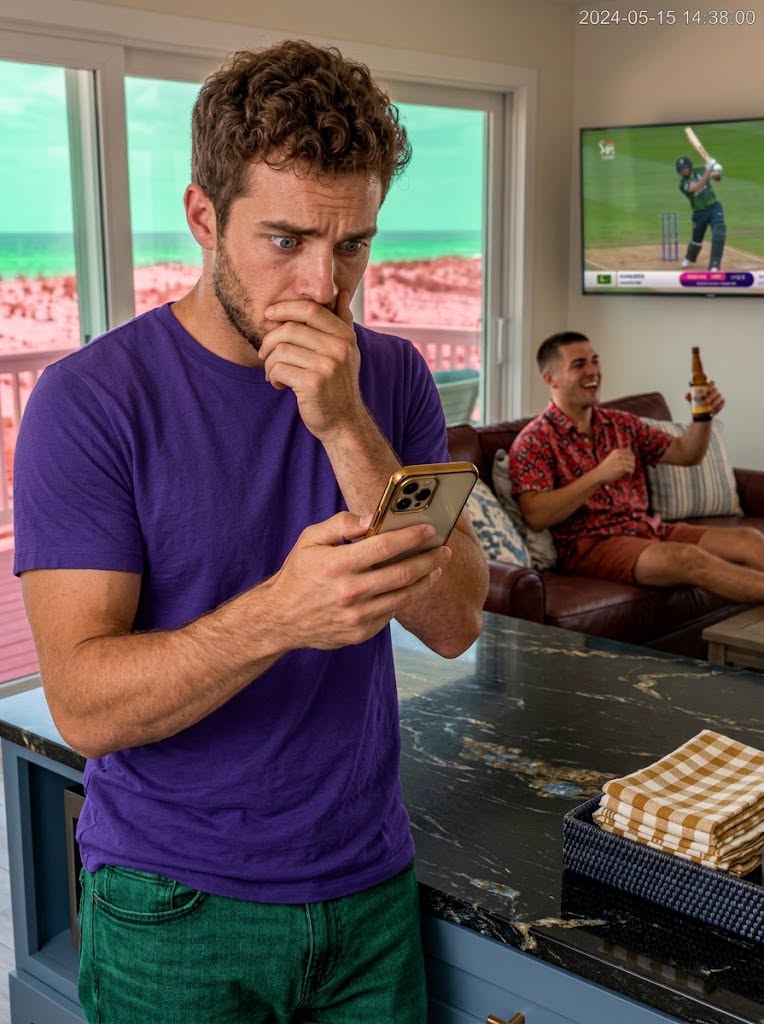
Beck tossed me his phone without even looking up from the ball game.
“Passcode’s the same as always,” he said. “Kids’ birthdays.”
I caught it with one hand. My own phone had died somewhere between the beach and the outdoor shower, and nobody in that big rental house felt like cooking. I had a Thai place pulled up in my head already, the one by the marina with the good reviews. All I needed was the app.
I typed in the code. The screen opened. And before I could even find the browser, a little gray bubble slid down from the top.
It was a text from Mom.
I only saw about fifteen words in the preview. Two of them were my name.
“Cole won’t even notice. He never checks, he just pays. Lol.”
I stood there in the kitchen with the phone in my hand and the smell of sunscreen still on my arms. Out in the living room, Dad laughed at something the announcer said. My nephews were fighting over a bag of chips. Paige was scrolling on her own phone, curled up on the sectional like a cat in a sunbeam.
I know I shouldn’t have tapped it. I know that. But when you see your own name in a message between your mother and your brother, something old and animal wakes up in your chest.
I tapped it.
It wasn’t a normal text thread. It was a group chat. Four people. Mom, Dad, Beck, and Paige.
I was not in it.
The chat was called “Fam” with a little palm tree emoji next to it. And when I started scrolling up, I realized it hadn’t been going for a day or two. It had been going for weeks. Hundreds of messages. Hundreds.
My name was everywhere.
My name’s Cole. I’m thirty-two years old. And until that moment, standing barefoot on the cool tile of a beach house in Destin, Florida, I truly believed my family loved me.
I don’t mean that in some complicated, therapy-couch way. I mean I thought we were solid. Sunday dinners. Birthday cards. Group texts with way too many emojis. The whole normal deal.
It turns out I was the punchline of a joke that had been running for years. And I was the only one who wasn’t laughing.
To understand how I ended up holding my brother’s phone with my heart pounding in my ears, you need to know a little about where I came from.
I grew up in a regular middle-class house outside of Louisville, Kentucky. Dad drove trucks for a regional carrier. He was gone a lot, and when he was home, he was tired, but he was the kind of man who’d still show you how to change a tire in the driveway on a Saturday. Mom worked the front desk at a dentist’s office. She knew everybody’s name and everybody’s business.
And then there was my older brother, Beckett. Everybody calls him Beck.
Beck was the golden child from the day he was born. I don’t say that with bitterness. I say it the way you’d say water is wet.
Beck was the football star. Beck was the homecoming king. Beck got a brand-new F-150 on his seventeenth birthday with a giant red bow on the hood. Mom took about two hundred pictures of it.
When I turned seventeen, I got Beck’s old Civic. The check engine light had been on since before I could ride a bike. Dad handed me the keys and said, “Don’t let the light scare you. It’s been on forever. Just means she’s still breathing.”
I didn’t hold it against anybody back then. I figured Beck was just louder, brighter, easier to love at first sight. Some kids walk into a room and their parents light up. I wasn’t that kid. That was fine. I had other things.
I worked part-time all through high school at a landscaping company, mowing lawns in the summer heat and hauling mulch until my shoulders burned. I saved almost every dollar in a little savings account at the credit union down the road. When the letter came telling me I’d gotten a partial academic scholarship to a state school, I opened it alone at the kitchen table. Mom was at Beck’s game.
I graduated with a business degree and zero student debt. Not a single dollar owed. I was proud of that. I still am.
Fast forward ten years.
I run a small logistics consulting firm out of Nashville. I help trucking companies and warehouses figure out how to move freight without bleeding money. I started it with a used laptop and a folding table in a studio apartment that smelled like the laundromat downstairs. Now it clears about $340,000 a year before taxes.
I bought a house two years ago. I paid cash for my truck. I don’t owe anybody anything.
Remember that last part. It matters later.
Beck went a different way. He married young. His wife, Paige, is fine, I guess. She’s one of those people who always seems a little disappointed, like the universe owes her an upgrade and keeps forgetting to deliver it.
Beck sells cars. Some months he does great. Some months he does nothing. They have two boys, a mortgage that makes my stomach hurt just thinking about it, and a lifestyle that runs about thirty percent above what they actually bring home.
But that was their business. I never said a word.
About three months before Destin, Mom called me on a Tuesday night.
“Cole, honey, I’ve been thinking,” she said. “When’s the last time we were all together? Really together? Not just a dinner where everybody leaves at eight?”
I couldn’t remember.
“Your daddy’s knees aren’t getting any better,” she went on. “I want one big trip. All of us. A whole week somewhere warm before he can’t walk on the sand anymore.”
I’ll be honest. It got to me. I pictured Dad on a beach, finally relaxing after forty years behind the wheel of a truck.
“That sounds really nice, Mom,” I said.
“Destin,” she said. “I’ve always wanted to see Destin. Beachfront house. The whole thing.”
Then she said the part I didn’t think twice about at the time.
“And honey, would you mind handling the booking? You’re so good with computers and planning. Beck gets overwhelmed with that stuff. We’ll all split it evenly, of course. Four adults, fair and square.”
“Sure, Mom,” I said. “I’ll take care of it.”
I found the house that same week. Five bedrooms. A wraparound deck that looked right out over the Gulf. A heated pool. A kitchen big enough to actually cook in. It was $8,400 for seven nights, which worked out to $1,200 a night.
Then I built out the rest of the budget like I would for any client. Groceries delivered before we arrived. Two nice restaurant dinners. A deep-sea fishing charter for Dad and Beck and the boys, with a $1,600 deposit. And a private sunset sail, because Mom had mentioned more than once that she’d always dreamed of being on a sailboat at sunset. That one alone was $1,200.
All in, the whole trip came out to about $14,000.
I put everything on my credit card. Not because I’m careless. I get good cashback on that card, and I figured everybody would pay me back long before the statement closed.
I made a clean spreadsheet. Every charge. Every confirmation number. Every amount split four ways. I sent it to the family with a message that said, “No rush, just Venmo me your share whenever you get home.”
Mom replied with three hearts. Beck replied with a thumbs up. Paige didn’t reply at all. Dad doesn’t really text.
At the time, I thought that was a yes.
We pulled into the driveway of that beach house on a Saturday afternoon. The boys screamed when they saw the pool. Mom put her hand on her chest and said, “Oh, Cole. Oh, honey, it’s perfect.”
I carried in the groceries. I fired up the grill. I put fresh towels on every bed and stocked little mini fridges with drinks in each room, because I knew what everyone liked. Dad likes Coors Banquet. Mom likes sweet tea in the glass bottles. The boys like those blue sports drinks that turn your tongue a color not found in nature.
I know how that sounds. Like I was trying too hard. But I like doing that stuff. It makes me feel useful.
That’s probably a whole therapy topic on its own.
The first two days were some of the best I’d had in years. That’s the part that still messes with my head.
We grilled steaks on the deck. We played cards until midnight. Dad told the same trucking stories we’d all heard forty times, like the one about the bear in Montana that wasn’t actually a bear, and we laughed like it was the first time. The boys built sand castles that looked like modern art. Mom sat in a beach chair with her sunglasses pushed up on her head and kept wiping her eyes.
“I’m just so happy,” she said. “Look at us. All together. This is all I ever wanted.”
I believed every single one of those tears.
Then came day three. My dead phone. Beck’s phone flying across the room. That gray bubble.
So there I was, standing in the kitchen, scrolling.
I’ll give you the highlights. Reading the whole thing would take you longer than this entire story. My hands were shaking so hard I couldn’t even screenshot most of it at first.
Mom had written that the whole trick was to make it feel like a “family bonding trip” so I’d be happy to front everything.
Beck answered, “It always works. Cole never says no when you frame it as a family thing.”
Paige asked, “Do you think he’ll cover the excursions too?”
Mom sent back a laughing face. “He already did. Every single one. Even my sailboat.”
Then two more laughing faces.
I kept scrolling. My thumb felt numb.
There was a thread from about two weeks before the trip. Beck had asked a simple question.
“Is anybody actually planning on paying him back?”
And my father answered.
Just one word.
“Nope.”
Followed by a crying-laughing emoji.
I read it again. Then again.
My father. The man who stood in the driveway when I was fifteen and taught me how to change a tire. The man who once told me, looking me dead in the eye, “Son, a man’s word is his bond. That’s all he really has.” That same man typed “nope” and a laughing face about taking $14,000 from his own son.
I set Beck’s phone down on the granite counter. Slowly. Carefully. Like it was made of glass and something radioactive.
“Did you find the Thai place?” Beck called from the couch.
“Not yet,” I said. My voice sounded normal. I don’t know how.
“Get me the drunken noodles,” he said. “Extra spicy.”
I didn’t answer. I walked out the sliding door onto the back deck and sat down in one of those plastic Adirondack chairs. The sun was getting low. The water was turning orange and pink, the exact kind of sunset Mom was supposed to see from a sailboat in three days.
I sat there and stared at it.
Nobody came out to check on me. Nobody asked where the food was. Nobody noticed I was gone for over an hour.
Honestly, that told me everything I needed to know.
When I finally came back inside, Paige had ordered pizza on her own phone. Nobody asked me why I’d disappeared. The boys were eating on the floor. Beck was on his third beer.
“There he is,” Dad said, not looking away from the TV. “Thought you fell in the Gulf.”
Everybody chuckled.
I smiled. I actually smiled. Then I went upstairs, plugged in my phone, locked my bedroom door, and opened my laptop.
I didn’t sleep that night.
I wasn’t crying into a pillow. I wasn’t throwing things. I was working. I sat on the edge of the bed with the lamp off and the laptop glowing, and I went through every booking confirmation email, every receipt, every cancellation policy, every refund window. The same way I’d go through a client’s contracts when they were bleeding money and didn’t know why.
Here’s what I found.
The rental house had a seventy-two-hour cancellation policy for a full refund. We were way past that. But buried in the terms of service was a provision for early departure. If the person who booked the house checked out early, the platform would refund the unused nights, minus fees.
We were on night three of seven. That meant four unused nights at $1,200 each. $4,800.
The person who booked the house was me.
The fishing charter was scheduled for day five. Full refund of the $1,600 deposit if canceled more than forty-eight hours ahead. I had room to spare.
The sunset sail was booked for day six. Same forty-eight-hour policy. $1,200, refundable.
The two restaurant reservations didn’t have any money attached. They were just reservations under my name. One phone call each.
I opened the notes app and built a timeline. Every confirmation number. Every customer service line. Every deadline down to the hour.
Then I booked myself a one-way flight home to Nashville. 6:15 in the morning out of Destin-Fort Walton Beach. I used airline miles. It cost me nothing.
Then I sat in the dark and waited for the house to go quiet.
Around midnight, I heard Beck and Paige laughing in their room down the hall. The walls in those beach houses are thin. Paige said something I couldn’t make out. Then Beck said, loud and clear, “Relax. Dude’s probably already forgotten about it. He just likes feeling needed.”
I closed the laptop. I set my alarm for 4:30. I lay down on top of the covers with all my clothes on.
I want to be clear about something. I wasn’t angry in the way you’d expect. I wasn’t shaking with rage. I wasn’t planning some big, loud scene.
What I felt was closer to clarity. Like someone had wiped off a window I didn’t even know was dirty. And now I could see the whole yard for the first time.
Every Christmas gift I bought that never got returned in kind.
Every restaurant check where everyone suddenly “reached” for a wallet that never quite came out.
Every “small loan” to Beck that nobody ever mentioned again.
Every time Mom put her hand on my cheek and said, “You’re the responsible one, Cole.”
I used to hear that as a compliment. Lying there in the dark, I finally heard it for what it was.
A job title.
I was the family ATM. And the password was guilt.
My alarm went off at 4:30. I didn’t need it. I was already awake.
I packed my bag. I stripped the bed and folded the sheets. I wiped down the bathroom so it looked like I’d barely been there. Then I carried everything to the front door without a sound.
The house was silent. Everyone was asleep, sunburned and full of the ribeyes I’d paid for the night before.
I walked into the kitchen. The coffee maker was set up for the morning. Mom always sets it up the night before.
On the counter by the fridge was a little notepad that came with the rental. It had cartoon crabs printed along the top, smiling and waving their claws.
I tore off one sheet. I wrote one note. Short. Direct. No drama.
“I saw the group chat. Every message. I know none of you plan to pay me back. Every reservation from this point forward has been canceled. The house checkout is today. You’ll need to make your own arrangements. Don’t call me.”
I didn’t sign it. They’d know.
I folded it once and set it right in the center of the counter, next to the coffee maker, where I knew Mom would see it first.
Then I picked up my bag and walked out the front door. I closed it softly behind me.
The Uber driver was an older man named Luis with a rosary hanging from his mirror. The ride to the airport took eighteen minutes.
“Heading home early?” he asked, glancing at me in the mirror. “Most people cry when they leave the beach.”
“I got everything I came for,” I said.
He laughed.
I didn’t.
At the gate, the sky was still dark blue. I sat down by a charging station with a coffee I didn’t drink, and I started making calls.
First, the fishing charter. A woman named Darlene answered on the second ring, sounding like she’d been up since three.
“I need to cancel a booking for Thursday,” I said, and read her the confirmation number.
“Oh, that’s a shame, hon. Weather looks perfect. Everything okay?”
“Plans changed.”
“Well, you’re well outside forty-eight hours. Full refund back to the card ending in 4417. Should see it in a few days.”
“Thank you, Darlene.”
$1,600. Back.
Next, the sunset sail. The captain himself picked up. He sounded disappointed.
“Your mom’s going to miss a heck of a sunset,” he said.
“I know,” I said. “She’s going to miss a lot of things.”
$1,200. Back.
I called both restaurants and released the reservations. Thirty seconds each.
Then I called the rental platform. I waited on hold for twenty-two minutes listening to a steel drum version of a song I couldn’t name. Finally, a young woman named Kayla came on the line.
“I’d like to start an early checkout on my reservation,” I said. “Today. And request the prorated refund for the unused nights.”
“Of course, sir. Can I ask if there was a problem with the property? We take that very seriously.”
“The property is beautiful,” I said. “The company was the issue.”
There was a short pause. “I’m so sorry to hear that,” she said, in a voice that told me she’d heard stranger things. “I’ve processed the early departure. Checkout time for the remaining guests will be noon today. You’ll see a refund of $4,800, minus the platform service fee, within five to seven business days.”
“And the guests will be notified?”
“Yes, sir. The host will reach out to the property directly this morning.”
“Thank you, Kayla.”
By the time they called my boarding group, I’d recovered, or was in the process of recovering, about $7,600 of the $14,000.
The other $6,400 was gone. The three nights we’d already stayed. The groceries. The steaks. The deposits that were past their windows.
I’d eat that loss. It was an expensive lesson. But it was the last tuition payment I’d ever make to that particular school.
My phone started buzzing at 7:45. I was already thirty thousand feet over Alabama.
Mom called first. Four times in a row.
Then Beck.
Then Paige. Paige had never once called me directly in the entire time she’d been married to my brother. Not on my birthday. Not when I bought my house. Never.
Then Mom again.
Then a text from Dad. Dad, who doesn’t text.
“Cole. Call your mother.”
I switched my phone to airplane mode. Not because I was hiding. Because I was done performing for them.
I landed in Nashville a little after nine. I drove home. I unpacked. I took the longest shower of my life. I made a full pot of coffee and sat on my back porch with my feet up on the railing, listening to the birds in my neighbor’s maple tree.
It was the most peaceful morning I’d had in years.
Around noon, I turned my phone back on.
Thirty-seven missed calls. I’m not exaggerating. Thirty-seven.
And a stack of text messages that read like the five stages of grief squeezed into two hours.
Mom’s first text was pure confusion. “Cole, where are you? What group chat? What are you talking about?”
Playing dumb. A solid opening move.
Fourteen minutes later, she switched to concern. “Honey, please call me. Whatever you think you saw, we can talk about it.”
Her third text was where the mask started slipping. “You can’t just cancel everything and leave. Your father is very upset. Beck is trying to figure out what to do about the house.”
And then the fourth. Sent at 11:08. The one that sealed it.
“This is really selfish, Cole. We’re your family. You don’t just abandon your family over a misunderstanding.”
A misunderstanding.
Hundreds of messages. Weeks of jokes. My father’s “nope.” And my mother’s official position was that I had misunderstood.
Beck’s texts were worse.
“Bro, what the heck?”
That was rich coming from the guy who told his wife I’d forget about it by morning.
“Mom is crying. You happy now?”
Then, about an hour later: “The rental company says we have to be out by noon. We have nowhere to go. The kids are upset. You need to fix this.”
I read that one three times.
You need to fix this.
The man who sat in a group chat planning with our parents how to stick me with $14,000 was telling me I needed to fix the consequences of what he did.
It was like watching a guy rob a bank and then complain that the alarm was too loud.
I didn’t answer any of it. Not one text. Not one call.
I made a turkey sandwich. I put on a ball game. I spent the rest of the afternoon doing absolutely nothing.
But here’s the part none of them knew yet.
The vacation wasn’t the only thing I’d been covering for this family. Not even close.
Buried in my financial records, under years of casual generosity and quiet “of course, Mom” moments, was a whole trail of co-signed loans, authorized user accounts, and monthly bills my family had been riding on like a free shuttle bus.
And I was about to pull that bus over to the side of the road.
The next morning, I sat down at my desk at seven with a fresh cup of coffee and a yellow legal pad. And I did something I should have done years ago.
I audited my own family.
I treated it exactly like I’d treat a struggling client. Every account. Every statement. Every dollar in and every dollar out that had anybody else’s name attached to it.
I want you to understand the scale of what I found. Because even I didn’t really get it until I saw it written down in my own handwriting.
First, Beck’s truck.
Three years ago, Beck called me late on a Wednesday night. I remember because I was still at the office finishing a proposal.
“Cole, man, I’m in a bind,” he said. “Bank turned me down for a loan. My credit took a hit after the boys were born, you know how it is. But I can’t sell cars driving a beater. The managers notice. Customers notice. I need something decent or I’m done.”
“What are you looking at?” I asked.
“A Tahoe. Used, low miles. Thirty-eight grand. I just need a co-signer. You’d just be on paper. I’ll make every single payment, I swear on the boys.”
I went down to the dealership the next Saturday and signed my name on a $38,000 auto loan. The finance manager slid the papers across the desk and said, “You understand that as co-signer, you’re equally responsible for this debt?”
“Yeah,” I said, looking at Beck. “He’s got it.”
Beck slapped me on the back. “Best brother in the world.”
For the first six months, he paid on time.
Then he started slipping. A late payment here. A missed month there. Partial payments that didn’t even cover the interest. Every time, the lender called me, because my name was right there on the paperwork. And every time, I quietly paid it so my credit score wouldn’t drop off a cliff.
I pulled every one of those payments out of my checking account statements and added them up on the legal pad.
$11,400.
Beck never mentioned a single one. Not a thank you. Not a “sorry, I’ll catch up.” Nothing.
Second, Mom’s credit card.
Two years ago, Mom sat at my kitchen table and asked if she could be an authorized user on one of my cards.
“Just for emergencies,” she said, holding my hand. “If your daddy’s truck breaks down on a run, or one of us ends up at urgent care. I’ll never touch it unless it’s life or death, Cole. I promise.”
I added her the next day.
I pulled two full years of statements. Within six months, there was a recurring $189 a month for a premium cable and streaming package. A $400 charge at a furniture store. Then a steady trickle, month after month, of groceries, gas, a salon, a boutique in a strip mall I’d never heard of.
None of it was life or death. Unless you count a recliner.
I’d been paying that card off every month and telling myself it was what a good son does. Total over two years: $16,800.
Third, the phone plan.
Four years ago, right after the wedding, Beck asked if he and Paige could hop on my business cell plan. “Your rates are way better than ours,” he said. “We’ll pay you for our lines every month. Easy.”
They never paid one month. Not one. At $180 a month for their two lines over four years, that was $8,640.
Then I wrote down the last number. The vacation. What I’d actually lost after the refunds. $6,400.
I drew a line under the column and added it up.
$43,240.
Just north of forty-three thousand dollars. Over four years.
And they were in a group chat laughing about it.
I sat there and stared at that number for a long time. The coffee went cold. Somewhere outside, a lawnmower started up, and I thought about seventeen-year-old me hauling mulch in July so I could put twenty dollars into a savings account.
Then I picked up the phone and called Rowan.
Rowan Slate and I were roommates for two years in college. Now he’s a consumer finance attorney in Nashville. Smart guy. Dry sense of humor. The kind of lawyer who wears cowboy boots with a suit and somehow pulls it off.
“Cole!” he said. “You only call me during business hours when something’s on fire.”
“Something’s on fire,” I said.
I told him everything. The group chat. The “nope.” The note on the counter. The Tahoe. The card. The phone plan. The legal pad.
When I finished, Rowan was quiet for about ten seconds. For a guy who usually talks like an auctioneer, that’s an eternity.
Then he said, “Cole, you’re not just being taken advantage of. You’re being financially exploited by people who know exactly what they’re doing. That group chat proves intent.”
“So what do I do?”
“We go one at a time. Biggest risk first. The Tahoe.”
He explained it plainly. As co-signer, I was equally on the hook for the whole remaining balance, which was still about $26,000. I couldn’t just call the bank and take my name off. The lender wouldn’t allow it.
“But here’s what we can do,” Rowan said. “I send Beck a formal written demand on my letterhead. He refinances that truck in his own name only, within thirty days. If he can’t, he sells it and pays off the loan. And because you’ve made $11,400 in payments that were his responsibility, we document that you’re reserving your right to go after reimbursement. In small claims or a civil suit if we have to.”
“And the card?”
“That’s the easy one. It’s your account. You remove her as an authorized user today. You don’t need her permission. You don’t need a reason.”
“Phone plan?”
“Same. Your business account. Call the carrier, remove the lines. They’ll get a notice and a window to move their numbers somewhere else.”
Then Rowan said something I hadn’t even thought about.
“Document everything. Every bank statement showing a Tahoe payment. Every credit card statement with her charges. Every phone bill. Screenshots of that chat if you can get them. If this ever ends up in front of a judge, I want a paper trail that could survive a hurricane.”
“Okay.”
“And Cole? Print it. Digital is great until a laptop dies. Rule number one.”
I spent the rest of that day building exactly that. I logged into every account I had. I downloaded years of statements. I made folders on my laptop labeled TAHOE, CARD, PHONE, DESTIN. I printed everything at the office and put it in a blue accordion file that I still keep in my desk drawer.
Then I made the calls.
The credit card company first. A representative named Marcus picked up after a short hold.
“I need to remove an authorized user from my account,” I said.
“No problem, sir. I can do that right now. Can I have the user’s name?”
I told him my mother’s name. It felt strange coming out of my mouth like that, like reading it off a list of suspects.
“Done,” Marcus said. “Her card is deactivated effective immediately. Would you like to dispute any charges made by the authorized user?”
I thought about it. “Not yet. But I’d like a note on my account that she was removed at my request, as of today’s date.”
“Noted, sir. Anything else?”
“No. Thank you.”
Eleven minutes, including hold time.
Next, the phone carrier. Because it was a business account with bundled lines, it took longer. Twenty-six minutes and two transfers later, a woman named Teresa told me Beck and Paige’s lines were scheduled for disconnection in seventy-two hours.
“They’ll get a text notification,” she said. “They can port their numbers to a new carrier before then. After that, the numbers get released.”
“Understood,” I said.
Not my problem anymore.
I didn’t call Beck about the Tahoe. Rowan wanted the letter to go first. He wanted it clean, formal, and impossible for Beck to claim he wasn’t properly notified. He sent it certified mail that afternoon.
That night, I got exactly one text that mattered. It was from Paige.
“Cole, I just want you to know Beck feels terrible about all of this. We’re back home now and the trip was basically ruined after you left. The kids were crying the whole drive. I hope you’re proud of yourself.”
I read it twice. Then I put my phone in a kitchen drawer and closed it.
Three days went by. No contact from me. Total silence.
I knew it was driving them crazy, because my family runs on a very specific cycle. First they push. Then they guilt. Then they get angry. And when none of that works, they send in a messenger.
On day four, the messenger called.
Aunt Jolene is Mom’s younger sister. She’s the family diplomat, which is a nice way of saying she’s who they send when they need someone to guilt you with a softer voice.
“Sweetheart,” she said, the second I picked up. “Your mama is beside herself.”
I let her talk. She went for about five minutes straight.
Mom wasn’t eating. Dad was barely speaking. Beck felt just awful. They all loved me so much. They just wanted to sit down and work this out as a family. Family is all we’ve got in this world, Cole. You only get one.
I waited until she was completely done. Then I said, “Jolene, did Mom tell you about the group chat?”
Silence.
“Did she tell you all four of them were laughing about getting me to pay $14,000 for that trip? And that when Beck asked if anybody was going to pay me back, Dad wrote ‘nope’ with a laughing face?”
More silence. I could hear a television somewhere in her house.
“Did she mention the $43,000?”
“The what?” Jolene said quietly.
“Forty-three thousand dollars, Jolene. Over four years. I’ve got the bank statements in a folder on my desk.”
There was a long pause.
“I’m going to call you back, honey,” she said.
She didn’t call back. Not that week. But I knew that conversation was going to ripple through the extended family like a rock dropped into a pond.
And honestly? That was fine with me. Because Beck’s letter from Rowan’s office was already in the mail. And that ripple was about to turn into a wave.
The letter arrived at Beck’s house on a Tuesday.
I know it was Tuesday, because my phone rang seventeen minutes after the mail usually comes in his neighborhood. When I answered, Beck’s voice sounded like someone had swapped his morning coffee for battery acid.
“Cole. What the hell is this?”
I let the silence sit there for about three seconds.
“Read it again,” I said. “Slower this time.”
The letter was simple. It said that I, as co-signer on the auto loan for the Chevy Tahoe, was formally requesting that Beck refinance the vehicle solely in his own name within thirty days. It said I had made approximately $11,400 in payments on his behalf over the past three years. And it said I was reserving my right to pursue reimbursement of those payments through appropriate legal channels.
Polite. Professional. Devastating.
Beck went straight to his playbook. “You’re seriously lawyering up on your own brother? Over a car?”
“Over forty-three thousand dollars, Beck,” I said. “The car is one line on the list.”
“What are you talking about? What forty-three thousand?”
“The Tahoe payments. Mom’s charges on my card. Your phone plan, which you’ve never paid once in four years. And the trip. It adds up. I did the math. I have the statements.”
He got quiet.
Not the quiet of a man thinking about what he did. The quiet of a man figuring out how much trouble he’s actually in.
Then he said, “You’re going to tear this whole family apart.”
“I didn’t build the bomb, Beck,” I said. “I just stopped standing on top of it.”
He hung up.
Within the hour, Mom called.
You have to understand something about my mother. She is a world-class emotional strategist. If guilt-tripping were an Olympic sport, she’d have more gold medals than Michael Phelps.
She opened with tears. I expected that.
“I can’t believe you would send a lawyer after your own brother,” she sobbed. “Your father hasn’t slept in days. His blood pressure is through the roof. You’re being cruel, Cole. Cruel and vindictive. Over a misunderstanding.”
I let her finish. All of it.
Then I said, “Mom, I removed you as an authorized user on my credit card.”
Dead silence. Not even breathing.
“Sixteen thousand eight hundred dollars in two years,” I said. “Emergencies only. Life or death. That’s what you told me at my kitchen table.”
She started to say something, and I could hear the exact moment she realized she couldn’t talk her way around this one. She switched gears so fast it almost gave me whiplash.
“Well, your father and I are on a fixed income, Cole. You know that. His Social Security barely covers the mortgage. We were going to pay it back. Eventually.”
“Eventually,” I said. “Like the vacation money?”
She didn’t have an answer. She started crying harder, said she had to go, and the line went dead.
Over the next week, the dominoes fell faster than I ever expected.
On Thursday, Beck and Paige’s phones went dark. The seventy-two-hour window had passed, and apparently neither of them had bothered to move their numbers to a new carrier. I guess they thought I’d change my mind.
Paige’s reaction was nuclear. She posted on Facebook. It was vague, but about as subtle as a billboard. Something about how sad it is when family members care more about money than relationships. A broken heart emoji. And a Bible verse about forgiveness.
Quoting scripture while defending what amounted to financial fraud. The irony was not lost on me.
Meanwhile, Beck was dealing with the Tahoe.
He went to his own bank first to refinance. Denied. Then he tried a credit union across town. Denied again. His credit score was somewhere in the low 500s. No lender was going to touch him without a co-signer.
And his usual co-signer had just sent him a certified letter from an attorney.
Rowan called me midweek.
“Your brother’s out of options,” he said. “His best move now is to sell the truck, pay off the loan, and walk away. If the sale doesn’t cover the full payoff, you’ll be on the hook for the gap as co-signer. But I’ll document every penny of it, and we add it to what he owes you.”
“Do it,” I said.
Rowan sent a second letter. It gave Beck a firm deadline. Refinance or sell the vehicle within thirty days, or I would file a civil complaint asking for reimbursement of every payment I’d made on his behalf, plus legal fees.
Rowan worded it like a friendly invitation to work things out. But anyone reading it could hear the clock ticking underneath.
That letter landed on a Friday.
By Saturday morning, Mom, Dad, Beck, and Paige had organized what I can only call a full family counterattack.
It started with Dad.
My father. The man who typed “nope” with a laughing face. He called me at eight o’clock in the morning.
“Son,” he said, in his deep, slow, end-of-a-long-haul voice. “I think it’s time we sat down and talked like men.”
I almost admired the nerve.
“Come to the house Sunday,” he said. “Dinner. We’ll clear the air. Make things right.”
“I’ll think about it,” I said.
An hour later, Mom texted me separately. “I’m making your favorite pot roast Sunday. With the little carrots. Please come home, baby.”
As if a $22 cut of beef could balance out $43,000. I appreciated the effort, Mom. But the exchange rate on that particular currency just doesn’t work in your favor.
Then Paige texted me. Except it clearly wasn’t written by Paige.
It used words like “accountability” and “mutual respect.” Words I have never once heard Paige say out loud. It said they wanted to sit down as a family and come up with a “fair resolution.”
Fair.
The word “fair,” coming from people who’d been laughing for weeks about how easy I was.
I had to put the phone down and walk around the block twice just to cool off.
When I got back, I called Rowan and told him about the dinner.
“You can go if you want,” he said. “That’s your call. But here are my rules. No verbal agreements. Sign nothing. Say nothing they can twist around later. And if they offer to pay you back in installments, it has to be in writing, with specific amounts and specific dates. A spoken promise from these particular people isn’t worth the air it’s carried on.”
“I agree,” I said.
I didn’t go.
Not because I was afraid. I was way past that.
I didn’t go because I knew exactly what it would be. Four people who got caught, sitting around a pot roast, performing a rehearsed apology designed to put me back on the payroll.
They didn’t want peace. They wanted the ATM switched back on.
Instead, I sent one text. To Mom, Dad, Beck, and Paige. The first time I’d written to all four of them together since Destin.
“I’m not coming to dinner. Any further communication about the financial matters should go through my attorney, Rowan Slate, at his office number. I love you all. But I’m done being used. That’s not up for discussion.”
I pressed send. I put the phone face down on the counter.
Within an hour, I had nine missed calls. I didn’t look at who they were from. It didn’t matter.
What mattered was Monday.
Because on Monday, Beck’s dealership called him into the general manager’s office. And around four that afternoon, Rowan called me, and the first thing he said was, “You’re going to want to sit down for this one.”
I sat down.
“So, your brother listed you as a personal reference on his employment file at the dealership,” Rowan said.
“Okay.”
“And every year, the dealership runs a routine financial review on its sales staff. It’s pretty common in that business. They’re handling financing paperwork, customer credit applications, all of that. They want to know their people are stable.”
“Okay.”
“The co-sign dispute and the attorney correspondence popped up in the review. He’s not in legal trouble at work. Nobody’s accusing him of anything there. But management is suddenly asking some very uncomfortable questions about his financial situation.”
For a guy who sells cars for a living, that’s about as welcome as a grease fire in a paper factory.
“How’s he taking it?” I asked.
“He’s panicking,” Rowan said. “And Cole, for the first time in this whole mess, I don’t think he’s panicking about what you might do. I think he’s panicking about what he already did.”
Beck sold the Tahoe.
He didn’t really have a choice. Two banks had turned him down, his manager was watching him, and Rowan’s thirty-day deadline was ticking like a metronome.
He listed it privately and found a buyer in under two weeks. A young guy who’d just started a roofing business and needed something big to haul ladders.
The sale price was $24,500. The payoff on the loan was $26,000.
That left a $1,500 gap. And since my name was on the loan, the gap was mine.
I paid it. I wired the $1,500 directly to the lender on a Thursday afternoon, and Rowan added it to the list of what Beck owed me. The loan was paid off. The title transferred to the roofer. And my name was finally off that anchor.
Beck started driving Paige’s old minivan to the dealership every day. A guy who sells pickup trucks and SUVs for a living, pulling into the employee lot in a beige minivan with a “My Child Is An Honor Student” sticker on the bumper.
I won’t pretend there wasn’t a little poetry in that.
The credit card situation fixed itself almost overnight. Once Mom was off the account, the charges stopped cold.
Funny how “emergencies” dry up the second you can’t charge them to somebody else.
Rowan told me I had a real case to go after the $16,800. Clear statements. A clear promise. A clear pattern.
“I could file in small claims,” he said. “You’d probably win.”
“I’d be suing my own mother,” I said.
“You would.”
I thought about it for a whole night. Then I called him back.
“Write it off,” I said. “The money cut is cleaner than the other kind.”
I filed it away in my head as the cost of a lesson I should have learned a lot sooner.
The phone plan sorted itself out too. Beck and Paige had to open their own account. Because of Beck’s credit, the carrier required a $400 deposit up front.
Paige was furious. I only know that because she complained about it on Facebook. Another vague post. Something about family who puts money over blood.
But her friends weren’t all on her side this time. A few people in the comments started asking questions. What happened? Who are you talking about? And then one woman, someone Paige went to high school with, wrote, “Usually when somebody cuts you off with money, there’s a reason.”
Paige stopped replying after that.
Then, about three weeks after I sent that last text, Aunt Jolene called me again.
This time, she wasn’t playing diplomat. She was furious. And not at me.
“Cole,” she said, “I owe you an apology for that first call. I didn’t know. I swear to you, I didn’t know.”
After our first conversation, Jolene had gone straight to Mom’s house and asked for the full story. Mom tried to wave it off. Said I was exaggerating. Said the group chat was just “normal family teasing.”
“So I asked to see it,” Jolene said. “And she wouldn’t show me. Her own sister. She put her phone in her purse and zipped it.”
So Jolene asked Beck. Beck changed the subject and started talking about the Titans.
“That’s when I knew,” Jolene said. “When people have nothing to hide, they hand you the phone.”
But Jolene didn’t stop there. She spent two weeks calling around the family, quietly, one by one, asking if anyone else had ever had trouble getting money back from Mom, Dad, or Beck.
The answer was yes. Across the board.
My Uncle Vance, Mom’s brother, had lent Beck $5,000 six years ago to help with the down payment on his house. Beck signed a little handwritten IOU on a napkin at a Cracker Barrel. Vance never saw a dollar.
My cousin Tully had loaned Mom $2,000 for what Mom called a “medical emergency.” A few months later, Tully saw pictures on Facebook of Mom and Dad on a cruise to Cozumel. When she asked about it, Mom said the trip was a gift from a friend.
My cousin Greer said Dad had asked her husband to co-sign on a loan for a used tractor. Dad said he wanted to start doing small hauling jobs on the side. He defaulted within eight months. Greer and her husband got stuck paying it off. It wrecked their credit score right when they were trying to refinance their own mortgage.
“They weren’t just doing this to you, Cole,” Jolene said. “They’ve been running the same play on everybody. You were just the biggest fish because you made the most money and you said yes the most.”
I didn’t say anything for a minute. I was looking out my kitchen window at nothing.
Then Jolene said something I’ll carry with me for a long time.
“Cole, you didn’t break this family. They broke the deal. You’re just the first one with the backbone to say it out loud.”
That hit me harder than anything in the group chat.
“Thank you, Jolene,” I said. “I love you. I mean that.”
“I love you too, baby. You did right.”
The fallout in the extended family was big.
Uncle Vance and his wife stopped going to Sunday dinners at Mom and Dad’s. Tully’s whole side of the family went quiet. Greer’s husband had a lawyer friend send Beck a demand letter of his own over the tractor loan, since Beck had apparently promised to help Dad cover it.
The family Mom had so carefully arranged around her dinner table was cracking apart. Not because of me. Because the truth was finally moving around without anyone filtering it.
About six weeks after Destin, I was working from home on a Wednesday afternoon when I heard tires on my driveway.
I looked out the front window. A beige minivan. Honor student sticker.
I sat there for a minute deciding whether to open the door. Part of me wanted to let him knock until his knuckles hurt. But another part of me wanted to hear what he had to say without a phone screen between us.
I opened the door.
Beck looked rough. Thinner. Tired around the eyes. He was wearing a wrinkled polo from the dealership, the kind of thing he would have ironed twice a few months ago, back when he still had the energy to care about how he looked.
“Can we talk?” he said. “No lawyers. Just us.”
I stepped aside and let him in.
We sat at my kitchen table. I didn’t offer him coffee. That might sound petty. But hospitality is earned, and he hadn’t earned anything in a long time.
He stared at his hands for a while. Then he started talking. And I’ll give him this much. He didn’t start with excuses.
“I know what we did was wrong,” he said. “I’m not going to sit here and pretend it wasn’t.”
“Okay,” I said.
“The chat started as a real thing. Mom made it to plan a surprise for you. A birthday dinner on night five. She’d booked a little place on the harbor, and she wanted us to keep it secret.”
I didn’t say anything. I hadn’t known about that.
“But once we were all in there,” he said, “she made some comment about how easy it was to get you to cover stuff. And instead of anybody shutting it down, we all just piled on. It snowballed. It got ugly. I felt sick about it, Cole. I did.”
I looked at him for a long time.
“Beck,” I said. “You typed the words, ‘Cole never says no when you frame it as a family thing.’”
He flinched.
“That’s not a joke that snowballed,” I said. “That’s a strategy.”
He didn’t have an answer for that. He just looked down at the table.
“I don’t need a speech,” I said. “And honestly, I don’t need an apology. What I need is a repayment plan. The $11,400 I paid on the Tahoe. Plus the $1,500 I wired to cover the gap when you sold it. That’s $12,900.”
He swallowed. “I don’t have twelve grand, Cole.”
“I know. That’s why it’s a plan. Rowan will draw up an agreement. Monthly payments you can actually make. Signed. Notarized. If you keep it, maybe one day we can talk about building something back. If you don’t, Rowan files in civil court. No more chances. No more favors.”
Beck nodded slowly.
“Okay,” he said. “Okay. I’ll do it.”
The next Monday, we met at Rowan’s office downtown. Rowan had the agreement printed and waiting on the conference table. $12,900. Monthly installments of $300 on the first of every month, with a clause that if he missed two payments in a row, the full remaining balance would come due.
A notary named Mrs. Abernathy came in from down the hall with her stamp and her big green logbook. She checked our driver’s licenses. She watched us both sign. She pressed the seal into the paper with a little crunch.
“All set, gentlemen,” she said.
Beck and I stood up and shook hands.
Not the warm, brotherly kind. The kind you give a contractor after you sign a service agreement. Professional. Distant. Accurate.
He left. I stood in the hallway of Rowan’s office for a minute, just breathing.
Rowan leaned in the doorway, arms crossed, cowboy boots crossed at the ankle.
“You okay?” he asked.
“Yeah,” I said. And I realized I meant it.
It’s been about four months since Destin now.
Beck has made three payments. $300 each. On time. Not cheerfully, I’m sure. But on time. The money shows up in my checking account on the first of the month, and every time it does, I forward the deposit confirmation to Rowan for the file.
Mom and Dad haven’t contacted me directly. Everything goes through Jolene, who turned out to be an amazing go-between.
A few weeks ago, Jolene told me Dad said he’s “too proud to apologize.”
I thought that was an interesting use of the word “proud,” coming from a man who typed “nope” about taking money from his own son.
Paige deleted her Facebook account after the comments got too pointed. I don’t know if that’s growth or just embarrassment. It doesn’t really matter to me either way.
As for me, I rebuilt my finances from the ground up.
No co-signs. No authorized users. No shared accounts of any kind with anybody who shares my last name. I pulled my credit report from all three bureaus to make sure nothing else was hiding with my name on it. It was clean. My accountant, a calm woman named Debra who has never once raised her voice, set me up with an automatic tracking system. Every dollar in and every dollar out gets logged and labeled.
It’s not paranoia. It’s infrastructure.
And here’s the thing I didn’t expect.
I’m not angry anymore.
I was angry for about two weeks. Then it just sort of drained out of me, like water out of a tub. And what filled the space was something that feels a lot like freedom.
I don’t owe anybody anything. Nobody owes me anything, except what’s written down, signed, and notarized.
The people in my life now are there because they want to be. Not because I’m paying for their cable.
Last weekend, I took a trip by myself. I rented a little cabin up in Gatlinburg with a porch that looked out over the Smokies. I brought a bottle of bourbon and two books I’d been meaning to read for a year.
For three days, I sat on that porch and watched the mountains do absolutely nothing.
It was the best vacation of my life.
No group chats. No hidden plans. Nobody laughing about me in the next room. Just me, the quiet, the fog lifting off the ridges every morning, and one simple understanding.
The most expensive thing I ever bought wasn’t the beach house. It wasn’t the Tahoe or the credit card bills or four years of somebody else’s phone plan.
It was the belief that if I kept giving, someday it would come back to me.
That belief cost me $43,000.
But letting go of it?
That was the best deal I ever made.
THE END…!