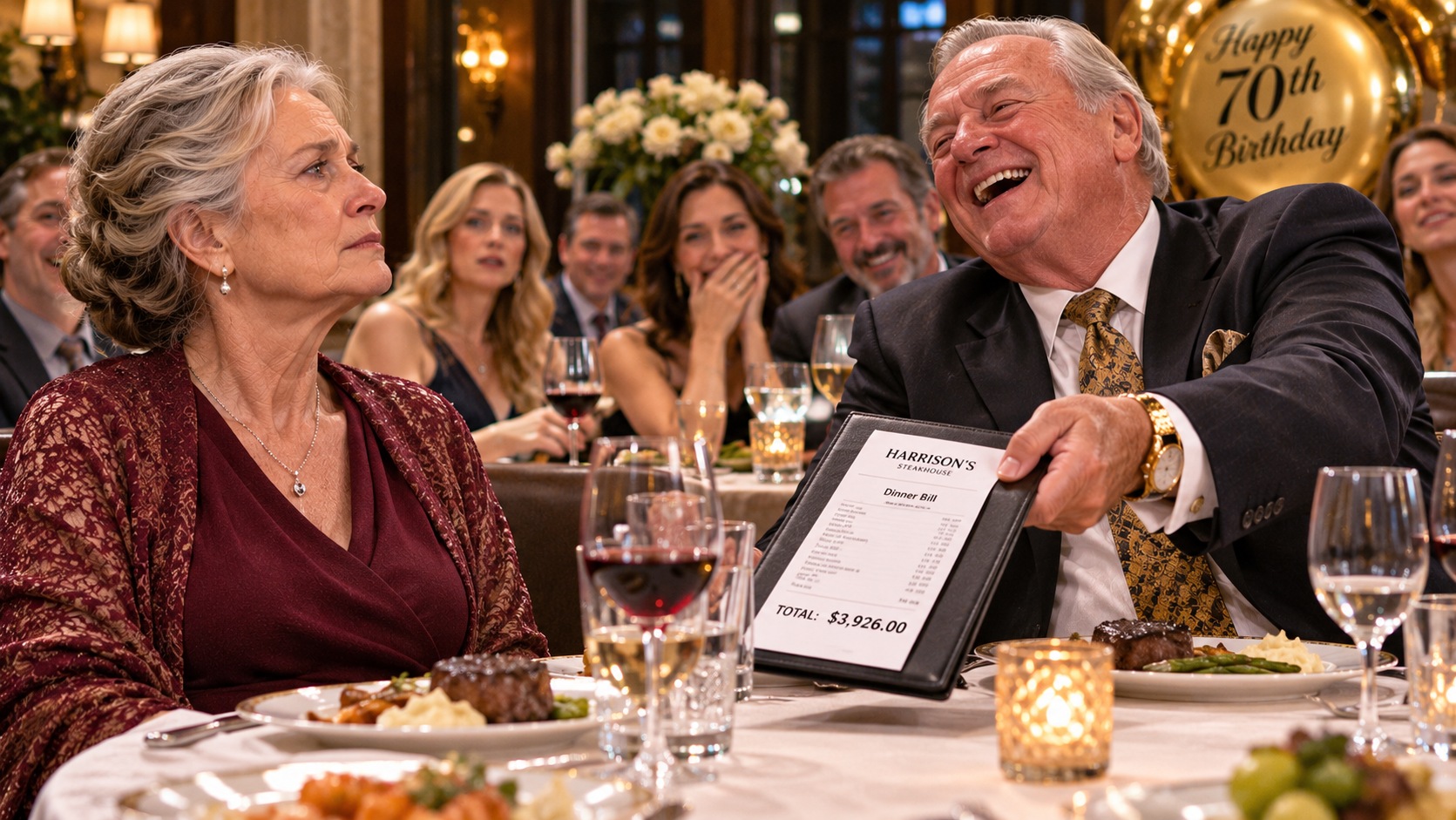
Black leather.
One white receipt inside.
$3,926.14.
Walter tapped it once.
“You can pay with that retirement money.”
For a second, I thought he was joking.
Then I looked at his face.
He wasn’t.
The private dining room still hummed around us.
Glasses.
Coffee.
Grandchildren arguing over the last bite of cake.
Walter’s brother laughing at something across the table.
Then Walter said:
“Well?”
I kept my voice low.
“No.”
He blinked.
“What do you mean, no?”
“I mean I’m not paying for this dinner.”
His smile returned.
Not warm.
The smile he used when he thought I was being temporarily unreasonable.
“Elaine, don’t be silly.”
“I’m not.”
He leaned closer.
“You have twenty-one thousand dollars sitting there.”
There.
As if my retirement payout were a pile of money on the table between the wine bottles.
I said:
“You invited these people.”
He shrugged.
“It’s my birthday.”
“Yes.”
“And we’re married.”
“Yes.”
“So pay the bill.”
I looked at the receipt again.
Then at him.
“No.”
This time, Rachel heard.
She was sitting two seats away.
Her eyes moved from me to Walter.
“What’s happening?”
Walter laughed.
“Your mother is making a point.”
“No,” I said. “I’m answering a question.”
Walter’s brother, Frank, turned toward us.
“What question?”
Walter raised his voice slightly.
“Apparently my wife thinks her money is separate now.”
The table quieted.
That was the moment he expected me to back down.
I knew it.
Forty-two years gave you an education in someone’s confidence.
Walter believed I would rather pay nearly four thousand dollars than let twenty people watch us disagree.
For most of our marriage, he would have been right.
I picked up the leather folder.
Then handed it back to him.
“The restaurant gave the bill to you.”
A few people shifted.
Walter’s face reddened.
“A wife doesn’t keep money from her husband.”
There it was.
Not:
We should discuss this.
Not:
I assumed we were using it.
Not:
Can we split it?
Ownership.
Entitlement.
I said:
“That money is from my retirement benefit. I told you I planned to visit Marianne.”
“You can still visit Marianne.”
“With what?”
“You have twenty-one thousand dollars.”
“And you just spent almost four of it without asking me.”
He waved his hand.
“It’s one dinner.”
“For people you invited without telling me.”
“It’s my seventieth birthday.”
“I know how old you are.”
Frank coughed into his napkin.
Rachel covered her mouth.
Walter stared at me.
I had never spoken to him that way in public.
Maybe anywhere.
He lowered his voice.
“You’re embarrassing yourself.”
That sentence did something unexpected.
It calmed me.
Because for years, embarrassment had been the leash.
Do not make a scene.
Do not argue in front of the children.
Do not discuss money with relatives.
Do not make Walter look controlling.
Do not look ungrateful.
I realized I was not embarrassed.
Walter was.
Different.
I said:
“I’m going to the lobby.”
He looked triumphant for half a second.
He thought I was leaving to cry.
Or call the bank.
Or reconsider.
Instead I stood.
Picked up my purse.
Put on my coat.
Rachel said:
“Mom?”
“I’m fine.”
Then I looked at Walter.
“You ordered the dinner. You pay the restaurant.”
I walked out.
My hands shook once I reached the hallway.
So badly I dropped my purse.
A hostess helped me pick it up.
“You okay?”
“Yes.”
Not exactly.
Still yes.
I sat on a bench near the coat check.
My heart pounded.
Forty-two years.
A mortgage.
Three children.
Deaths.
Illnesses.
Graduations.
Grandchildren.
All of it somehow narrowed into one leather folder.
Not because of $3,926.
Because Walter had spent money I earned before asking.
Because he assumed access.
Because he knew I wanted Oregon and decided his birthday mattered more.
And because I had finally said no before privately asking myself whether I had permission.
Rachel came out two minutes later.
She sat beside me.
“Mom.”
“I’m not paying.”
“I know.”
“No, I mean I’m really not.”
She nodded.
“I know.”
Then:
“Did Dad know you were saving it for Aunt Marianne?”
“Yes.”
Her face changed.
“All of it?”
“Yes.”
“He planned this?”
“I don’t know.”
That was important.
I refused to invent intent.
Maybe Walter saw the money and assumed.
Maybe he decided on the larger dinner after hearing about it.
Maybe he had other funds available and simply believed mine should be used because we were married.
Facts first.
Rachel looked toward the dining-room door.
“He looks furious.”
“I’m sure.”
“Do you want me to pay?”
“No.”
“I can put it on my card and you—”
“No.”
That was another old reflex.
A child rescuing parents from discomfort.
“No one needs to rescue this dinner.”
She nodded.
Then smiled slightly.
“What are you going to do?”
“I already did it.”
“No.”
“What?”
“You said no.”
The sentence felt embarrassingly large.
Yes.
That was what I had done.
The restaurant manager came into the lobby a few minutes later.
Not to confront me.
To ask whether everything was all right because Walter was disputing how the bill would be split.
Of course.
I said:
“The dinner was arranged by my husband. Please speak with him.”
The manager nodded.
Professional.
No interest in our marriage.
Good.
The restaurant did not care who felt morally entitled.
Someone had to pay.
Walter had reserved the room with his credit card.
That mattered.
Eventually, the charge went to the card on file after he approved it.
No police.
No public eviction.
No viral applause.
A restaurant bill.
Paid by the person who booked the party.
When Walter emerged twenty minutes later, his face was stiff.
Everyone else stayed inside.
He said:
“You made me look like a fool.”
I stood.
“No.”
“What would you call that?”
“I said no to paying for a party I didn’t plan.”
“You could have told me privately.”
“You asked me in front of everyone.”
He stared.
That landed.
Then:
“You wanted to punish me.”
I thought.
Did I?
Maybe a small part of me wanted him to feel the embarrassment he had expected me to absorb.
But the main thing was simpler.
I did not want to pay.
For once, that was enough.
“I wanted to keep the money for what I planned.”
He laughed without humor.
“My wife has her money now.”
“Yes.”
That word came out before fear could stop it.
Walter’s face changed.
And I knew the birthday dinner had become about something far larger than the check.
What I remember most about the walk to the lobby is how ordinary everything around me looked.
A busboy carried empty wine glasses.
Someone near the bar laughed.
A woman in a red coat searched for her scarf.
My marriage had shifted and the restaurant kept running.
That was useful.
Walter’s anger felt enormous because I had spent decades arranging myself around it.
Outside that room, it was one man being angry because his wife said no.
Not the end of civilization.
The hostess brought me water.
I thanked her.
Then realized I was apologizing for sitting on the bench.
“For what?” she asked.
I almost said:
For making this awkward.
Instead:
“Nothing.”
Even that felt new.
Later, Rachel told me Walter had tried to convince the table the misunderstanding was funny.
He joked that retirement had made me “financially independent overnight.”
Frank laughed.
Susan did not.
Mark looked down.
Walter kept smiling until nobody joined him enough.
Then he stopped.
That detail mattered because I had always imagined public disagreement would destroy him.
It did not.
He paid.
People finished coffee.
The evening ended.
Embarrassment passes.
That became one of the first things I learned.
Walter’s power in our marriage depended partly on my belief that his discomfort had to be prevented immediately.
Once I stopped treating discomfort like emergency, his reactions became manageable.
Not pleasant.
Manageable.
On the drive home with Rachel, I checked my purse three times to make sure the retirement letter was not inside.
Ridiculous.
It was at home.
Still, the money had become almost physical in my mind.
Something Walter might reach into the purse and take.
He had never done that.
I had to be careful not to turn one entitled demand into evidence he would steal.
Again, facts.
The next morning, I logged into the account portal associated with the benefit.
Changed the password.
Not because Walter knew it.
Because I wanted to know I could.
Then I printed the account documents.
Placed them in a folder.
For years Walter kept our important financial papers in one cabinet in his office.
I knew where.
I had access.
But I rarely opened it without asking.
That realization embarrassed me.
The cabinet had no lock.
The barrier was habit.
I put my new folder in my desk.
Not hidden.
Mine.
The distinction mattered.
I also wrote down exactly what happened at dinner.
Not for court.
Not because I planned divorce.
Because I knew Walter and I would remember the scene differently.
He would remember humiliation.
I would remember pressure.
Both memories would feel true.
I wanted the sequence.
He ordered freely.
I warned it was expensive.
He said he was not counting pennies.
The bill arrived.
He pushed it toward me.
Told me to use retirement money.
I said no.
He said a wife does not keep money from her husband.
I left.
The restaurant charged the card on file.
Sequence.
I stopped there.
No adjectives.
No:
Walter humiliated me deliberately.
No:
He plotted for weeks.
I did not know.
That practice—separating what happened from what I believed it meant—became useful later in counseling.
The meaning would be debated.
The facts did not need to be.
That night also taught me something about public pressure.
Walter had assumed witnesses would help him.
They did, in a way.
Not by siding with me.
By making the expectation visible.
At home, he could describe our decisions as mutual because nobody saw the process.
At Harrison’s, people saw the assumption happen in real time.
That changed how I understood embarrassment.
Sometimes embarrassment is not a signal that you behaved badly.
Sometimes it is what happens when a private pattern becomes visible.
I did not want to sit beside Walter for forty minutes.
He stayed for coffee.
Or to explain.
Or to recover the mood.
I did not ask.
In Rachel’s car, silence lasted almost ten minutes.
Then she said:
“Dad knew about Oregon.”
“Yes.”
“How long?”
“Three weeks.”
“And he never said he wanted to use the money for the dinner?”
“No.”
She gripped the steering wheel.
“Mom, that’s not normal.”
I almost defended him automatically.
Walter always—
He probably thought—
He has paid for—
I stopped.
That reflex had protected our marriage from accurate language for decades.
Instead:
“It isn’t fair.”
Rachel glanced at me.
That was the strongest thing she had ever heard me say about her father.
Maybe because it was simple.
No character attack.
No history speech.
Just this was not fair.
At home, I changed into pajamas.
Rachel stayed.
Made tea.
I told her about the retirement letter.
About Marianne.
About the coast.
About how light I felt when I realized some money existed that had come from my work.
Not inheritance.
Not Walter.
Not a joint tax refund.
Mine.
Rachel listened.
Then asked:
“Do you and Dad have separate accounts?”
“Not really.”
We had one checking account.
One savings account.
Walter’s pension deposited monthly.
Social Security.
My smaller Social Security.
Credit cards in both names, though Walter handled most statements.
I had access.
That was the thing.
Walter had never technically locked me out.
Financial control does not always look like one person hiding every password.
Sometimes both people can see the account, but only one person feels authorized to decide.
That was us.
I could buy groceries.
Gifts.
Household things.
Anything Walter considered normal.
Large personal purchase?
Discussion.
His golf equipment?
Apparently discussion optional.
I told Rachel.
She looked angry.
“Why did you put up with that?”
The question stung.
Not because she meant blame.
Because younger people often look backward at older marriages and assume each small rule arrived labeled clearly.
It did not.
It accumulated.
One year Walter earned more.
Then I stayed home.
Then his mother got sick.
Then children needed college.
Then he retired.
At each stage, him handling money seemed practical.
His authority grew inside practicality.
I said:
“I didn’t wake up one day and decide he got the final say.”
Rachel softened.
“I know.”
Then:
“Are you still going to Oregon?”
That question made me smile.
“Yes.”
“Good.”
Walter came home after midnight.
Rachel had left.
I pretended to sleep.
Cowardly maybe.
Necessary.
I did not want a midnight argument after wine.
Morning would be better.
At seven, I woke to cabinet doors closing harder than necessary.
Walter made coffee.
I entered the kitchen.
He did not look at me.
“You enjoyed that.”
“No.”
“Please.”
“I didn’t.”
He turned.
“Twenty people watched my wife refuse to help pay for my seventieth birthday.”
I sat.
“Twenty people watched you tell me to spend my retirement money after you planned a party without discussing it.”
“It’s not retirement money. It’s our money.”
There.
I asked:
“Why?”
His face tightened.
“Because we’re married.”
“Then why are your golf clubs not our golf clubs?”
He stared.
“That’s ridiculous.”
“Why?”
“They’re mine.”
Exactly.
The silence after that almost made me laugh.
Not because golf clubs equal retirement funds.
Because his language had exposed the rule.
My money was ours.
His purchases were his.
He recovered quickly.
“I paid for this family for forty years.”
“I know.”
“You lived in this house.”
“Yes.”
“Your children ate because of my salary.”
“Our children.”
“You know what I mean.”
I did.
And I also knew what he did not mean.
My childcare.
My years helping his mother.
My part-time wages.
My household work.
Those had not been serious expenses.
So they had never become serious contributions.
I said:
“I am grateful for what you earned.”
He looked slightly relieved.
Then I continued.
“That does not make everything I earn yours to allocate.”
His relief disappeared.
“You’re talking like a lawyer.”
“No. I’m talking like someone who wants to visit her sister.”
He sat across from me.
“This is because of Rachel.”
“No.”
“She put ideas in your head.”
I laughed.
That made him angrier.
“Walter, I am sixty-seven years old.”
“So?”
“I can have an idea without one of our children giving it to me.”
He looked away.
Then:
“You humiliated me.”
We returned to that.
I realized we could argue the dinner forever and never reach the real issue.
So I asked:
“If I had quietly told you no before the party, would you have changed the plan?”
He did not answer.
“Would you?”
He stared at his coffee.
“I would have explained why it made sense.”
There.
Not asked.
Explained.
Until I agreed.
That was our marriage.
Walter did not think of himself as controlling because he rarely barked orders.
He reasoned.
Repeated.
Waited.
Explained.
Eventually I got tired.
Then he called the outcome mutual.
I stood.
“I’m booking Oregon today.”
He laughed again.
“With what?”
I looked at him.
“The retirement money.”
For the first time, he did not answer.
Rachel stayed out of the bedroom conversation the next morning.
Good.
I knew she was awake in the guest room before she left, but she did not come downstairs to rescue me from Walter.
That restraint helped.
After she went home, I called Marianne.
Not to announce I was leaving Walter.
I said:
“I finally bought the ticket.”
She screamed.
Then:
“What happened?”
Sisters hear tone.
I told her about the dinner.
There was a long silence.
Then:
“He expected you to pay almost four thousand dollars without discussing it?”
“Yes.”
“With your old job money?”
“Yes.”
“What did you do?”
“Said no.”
Another silence.
Then she said:
“Good.”
I felt defensive.
Immediately.
“Walter has paid for a lot over the years.”
“I didn’t say he hasn’t.”
“The birthday was important.”
“I didn’t say it wasn’t.”
“You don’t understand our finances.”
“I didn’t say I did.”
She kept refusing to fight the argument I had prepared.
Finally:
“Elaine, I said good because you did what you actually wanted instead of automatically doing what kept him comfortable.”
That landed.
She asked whether I felt safe.
Important question.
“Yes.”
“Has he ever threatened you physically?”
“No.”
“Restricted access to accounts?”
“No.”
“Stopped you from seeing family?”
Not explicitly.
That answer came slowly.
Walter never said:
You cannot see Marianne.
He said:
Flights are expensive.
The weather is bad.
My knee hurts.
Grandchild birthday.
Maybe next spring.
Each reason plausible.
Together, eight years.
I had gone along.
So what category was that?
Not a prison.
Not total freedom either.
Marianne said:
“You don’t need a label tonight.”
Good.
Labels can help.
They can also rush understanding.
I spent much of that week noticing my own habits.
At the grocery store, I picked up a bottle of olive oil Walter considered overpriced.
Then put it back automatically.
I stared at the cheaper one.
Did I prefer it?
No.
I bought the first.
$8 difference.
I felt guilty in the parking lot.
Eight dollars.
Not because we were poor.
Because I had an internal Walter.
That was the part no separate bank account could fix quickly.
His voice had become my budgeting voice.
Sometimes useful.
Sometimes oppressive.
Distinguishing the two would take time.
I did not want to become financially reckless simply because thrift had been associated with him.
Walter had taught me good things too.
Pay bills on time.
Avoid high-interest debt.
Maintain the house.
Save.
Those were not controlling because he practiced them.
They were sound habits.
The problem was when sound habits became universal authority.
I wanted to keep discipline without keeping hierarchy.
That was more complicated than simply doing the opposite of Walter.
Rachel later called.
“Did you tell Aunt Marianne?”
“Yes.”
“She hates Dad.”
“No.”
“She kind of does.”
Fair.
I smiled.
Then I told Rachel:
“I’m not building a jury.”
She went quiet.
“What does that mean?”
“It means I don’t want you, Marianne, Mark, Susan, or anyone else deciding whether Dad is good enough for me.”
“Okay.”
“I need people to support me without voting.”
She said:
“That sounds healthy.”
I laughed.
“You’re forty. Stop sounding like a therapist.”
She laughed too.
That conversation set a useful boundary early.
Support.
Not jury.
I repeated it many times over the next year.
I also began noticing how often I asked permission in disguised language.
“Would it be okay if…”
“Do you mind if…”
Even for things that affected only me.
Rachel noticed too.
She said:
“Mom, you can just say you’re going.”
I laughed.
Then tried.
“I’m going to Oregon.”
The sentence felt almost rude.
It was not.
Clear information is not disrespect.
That small language change became one of the first practical signs that my internal rules were shifting.
That created another argument.
“You said you would pay it.”
“I did pay it.”
“You put it on the joint card.”
“It’s a joint card.”
True.
I had to be careful.
I could not object that household money was shared only when sharing hurt me.
The bill had become a joint debt legally and practically because the card was joint.
That irritated me.
It also forced clarity.
I said:
“I’m not paying the entire card from my retirement payout.”
“I didn’t ask you to.”
“You did last night.”
He sighed.
“Can we stop acting like I stole from you?”
Not yet.
But precision mattered.
He had not stolen the money.
He attempted to pressure me into paying.
Then used a joint card he was entitled to use.
Different.
I started looking at our finances more closely.
Not secretly.
Statements were accessible.
I realized I had not reviewed them carefully in years.
Walter paid everything online.
The balances were fine.
No hidden gambling.
No affair expenses.
No secret debt.
Good.
This was not a thriller.
It was something more ordinary.
One person had become the financial manager and then confused management with authority.
There were expenses I had not known about.
Golf club dues.
Charitable donations.
A storage unit.
Nothing catastrophic.
But Walter made those decisions without asking because he assumed his pension covered them.
Meanwhile, I still told him before buying a $180 coat.
That contrast mattered.
I wrote down categories.
Shared household.
Shared family.
Walter personal.
Elaine personal.
We had never named them.
Everything lived under:
Walter decides what is reasonable.
I did not want to replace that with:
Elaine decides now.
I wanted structure.
So I made an appointment with a financial counselor who worked with older couples.
Not a divorce lawyer.
Not yet.
A financial planner with no products to sell.
Walter refused to come.
“Absolutely not.”
“Why?”
“We don’t need someone telling us how to run our marriage.”
I went alone.
The planner, Denise Hall, asked what I wanted.
“I want to know what’s mine.”
She smiled.
“Legally, financially, or emotionally?”
Good question.
We started with financial.
The retirement payout was in my name.
Depending on the nature of the benefit and marital property law, rights could be more complicated than “mine because the check has my name.”
We were married.
Jurisdiction mattered.
Timing mattered.
Account titling mattered.
She told me to get legal advice before making assumptions if separation was possible.
Good.
No fake certainty.
But practically, I could direct the distribution to an account in my name and use it within applicable law.
I also had every right to understand our joint finances.
She recommended:
Full account inventory.
Credit report.
Beneficiary review.
House title.
Insurance.
Pensions.
Social Security.
Estate documents.
Not because Walter was dangerous.
Because I was sixty-seven and should know anyway.
That embarrassed me.
Forty-two years married.
I knew where the Christmas decorations were.
Not the exact terms of our home-equity line.
I went home with homework.
Walter found the folder.
“What’s that?”
“Financial planning.”
He laughed.
“For twenty-one thousand dollars?”
“No. For our whole life.”
That stopped him.
I asked for copies of pension statements.
He said:
“They’re online.”
“Show me.”
“You’ve never cared before.”
“I care now.”
His face hardened.
Then he opened the laptop.
Good.
Not hiding.
He walked me through accounts.
Some explanations became lectures.
I stopped him.
“I can read.”
He looked offended.
Still, he let me.
By the end of the evening, I understood more.
Our house was nearly paid off.
Retirement savings solid.
Walter’s pension secure.
We were not rich.
We were comfortable.
The $3,926 dinner had never needed my retirement money.
That was the fact that changed everything.
Walter could afford the party.
He simply believed my new money should be available because it existed.
I asked:
“Why did you want me to pay if we could cover it?”
He said:
“Because you finally had something to contribute.”
The room went still.
He knew immediately.
Too late.
I stood.
“Finally?”
He reached for my arm.
I moved back.
“I didn’t mean it like that.”
“How did you mean it?”
“You know what I meant.”
“No.”
He tried.
Cash contribution.
Direct contribution.
Big expense.
Not groceries.
Not part-time wages.
Not years caring for his mother.
Not raising the children.
Not running the house.
He kept explaining until the explanation became worse.
Finally, I said:
“Stop.”
He stopped.
Good.
I took my planner folder and went upstairs.
For the first time since the birthday, I thought:
Maybe this is not only about changing how we handle money.
Maybe I need to decide whether Walter understands what my life has been worth.
The financial inventory took three weeks.
Not because Walter hid documents.
Because our life had accumulated layers.
Pension.
Social Security.
Two IRAs.
House.
Savings.
Insurance policies.
A small brokerage account.
Credit cards.
Property taxes.
Medicare supplements.
Walter knew most of it by memory.
I knew pieces.
That imbalance frightened me more than any balance.
If Walter died tomorrow, could I manage?
Eventually yes.
On day one, not confidently.
That was unacceptable at sixty-seven.
I started learning.
Not because I expected divorce.
Because dependence had become risky regardless of marriage quality.
Walter resented the questions at first.
“Why do you need to know the beneficiary on that policy?”
“Because it affects me.”
“You’re the beneficiary.”
“I want to see it.”
He stared.
Then printed it.
Good.
We discovered one policy still listed an old address.
Fixed.
Another account had Mark as contingent beneficiary but not Rachel or Susan.
Old oversight.
Fixed.
My questions improved our planning.
That embarrassed Walter slightly.
He had prided himself on managing everything.
Managers miss things too.
One evening, he admitted:
“I thought I was protecting you from boring details.”
I said:
“You were protecting your role.”
He bristled.
Then thought.
“Maybe.”
That maybe mattered.
We also discovered I had more retirement credits from my part-time years than I realized.
Not huge.
Still mine.
Denise encouraged me to create a personal financial statement.
Assets.
Income.
Expenses.
Not because every married person needs completely separate books.
Because everyone should understand their own position.
I sat at the kitchen table doing math.
Walter passed.
“Need help?”
Old me would say yes.
New me asked:
“Do I?”
I checked.
“No.”
He nodded.
No offense.
The birthday-card balance arrived.
$3,926.14 from Harrison’s.
Plus ordinary monthly charges.
We paid the full card balance from joint checking because that was how we had always handled it and because I did not want interest.
I insisted the amount be categorized as Walter’s discretionary celebration when we reviewed our budget.
He rolled his eyes.
“Does that matter?”
“Yes.”
“Why?”
“Because if we are going to change, we need to stop pretending every expense is equally shared in intention.”
That was not legal accounting.
It was relational.
Walter agreed eventually.
The following month, he transferred the same amount from his accumulated personal discretionary savings into joint savings.
I had not asked.
He said:
“I don’t want the dinner coming out of money you think you didn’t agree to spend.”
I was moved.
Then suspicious.
Was this a stunt?
Dr. Greene later told me:
“Sometimes repair looks like money when money was part of the injury. You don’t have to distrust every concrete gesture.”
Right.
I thanked Walter.
Did not declare everything fixed.
Both possible.
He also stopped referring to my payout as “that twenty-one thousand.”
He used:
“your retirement benefit.”
Language shifted first.
Behavior followed unevenly.
At one point he asked whether I planned to “keep hoarding it.”
I said:
“Try again.”
He sighed.
“Are you planning to leave most of it invested?”
“Yes.”
“Okay.”
Practice.
We were both learning to catch old wording before it hardened into old dynamics.
I started noticing my own language too.
I called his golf dues “your wasteful club” once.
He said:
“Try again.”
Fair.
I apologized.
His hobby did not become stupid because my autonomy had been neglected.
Mutual respect requires not simply switching who gets contempt.
That lesson was harder than I expected.
The financial review also showed Walter had done many things well.
No hidden debt.
No unpaid taxes.
No secret second mortgage.
I forced myself to keep that in view.
Calling him controlling did not require inventing financial crimes that had not happened.
Precision protected both of us.
The problem was power, not embezzlement.
That distinction made counseling possible.
Walter could hear:
You managed responsibly and still treated your judgment as superior.
Harder truth.
More accurate.
Not to hide assets.
Important.
I disclosed what I was doing.
The twenty-one thousand stayed traceable.
No secret cash.
No moving money overseas.
No revenge.
I simply did not deposit it into our joint checking account.
Walter hated that.
“You’re creating separate property now?”
“I’m keeping the account separate while I understand our finances.”
“You’re planning to leave me.”
“I’m planning to visit Oregon.”
He dismissed that with a hand.
The plane ticket cost less than six hundred dollars.
I booked it.
Two weeks.
Marianne cried when I told her.
“You’re really coming?”
“Yes.”
“Walter too?”
“No.”
A pause.
Then:
“Good.”
I laughed.
She had never liked how he managed things.
She had mostly kept quiet.
Family peace again.
Before I left, I spent $240 on a good suitcase.
Walter saw it in the bedroom.
“How much?”
I looked at him.
Old reflex:
Explain sale.
Explain quality.
Explain wheels.
Instead:
“Two hundred forty.”
He waited.
I waited.
“That’s ridiculous for luggage.”
“I like it.”
“You could get one for eighty.”
“Yes.”
I kept folding clothes.
That tiny conversation exhausted me more than the restaurant.
Forty-two years of justification lived inside it.
Walter stood in the doorway.
“You’re doing this on purpose.”
“What?”
“Acting like my opinion doesn’t matter.”
“It matters.”
“You’re ignoring it.”
“No. I heard it. I disagree.”
His face changed.
We had no practice for that.
In our marriage, hearing Walter’s opinion usually meant eventually adopting it.
He called persistence discussion.
I called surrender peace.
Now I was hearing without complying.
It felt rude.
That was the conditioning.
I left for Oregon three days later.
Walter drove me to the airport.
Surprising.
The ride was quiet.
At the curb, he unloaded my suitcase.
“Call when you land.”
“I will.”
Then he said:
“Don’t spend the whole thing.”
I stared.
He smiled like it was a joke.
I did not laugh.
“Walter.”
“What?”
“Stop.”
His smile vanished.
He nodded.
Small.
I flew alone for the first time in twenty-nine years.
I had forgotten how much I liked airports.
Not delays.
Movement.
Anonymous people going somewhere.
No one asking whether my coffee cost too much.
Marianne met me in Portland.
She held a sign that said:
ELAINE ESCAPES AT LAST.
I almost turned around.
Then laughed so hard I cried.
She dropped the sign.
“Oh God. Too much?”
“No.”
I hugged her.
“Just accurate in a way I’m not ready for.”
Her house was smaller than ours.
Colorful.
Books everywhere.
No matching furniture.
She had been widowed six years.
She made decisions alone because she had to.
I envied that.
Then felt guilty.
Widowhood was not freedom to romanticize.
Marianne corrected me before I said anything.
“Do not envy the price I paid for this independence.”
Right.
We went to the coast after three days.
Cold.
Windy.
Beautiful.
I paid for the hotel.
Marianne objected.
“My trip.”
“Then dinner is mine.”
We negotiated in thirty seconds.
No lecture.
No moral meaning.
I began noticing how often ordinary decisions could be simple when no one treated them as authority.
Which restaurant?
We chose.
Which route?
We disagreed.
Then took one.
No one won.
That sounds childish.
At sixty-seven, it felt revolutionary.
Walter called nightly at first.
The first two calls were fine.
On the third:
“How much are you spending?”
I went silent.
He corrected himself.
“Sorry.”
That mattered.
Then:
“How’s Marianne?”
Better.
We talked ten minutes.
No account review.
Progress.
But on day eight, he said:
“I looked at the credit card.”
Of course.
I had used my own new card for travel.
But a joint hotel hold accidentally appeared on our shared card because I used the old one for incidentals.
Walter noticed.
“You spent four hundred at a hotel.”
“It’s a hold.”
“Why do you need a four-hundred-dollar hold?”
I laughed.
Not because it was funny.
Because he had crossed three states through a notification.
“Walter, I am not discussing every temporary charge while I’m on vacation.”
“You’re still my wife.”
“Yes.”
“That means something.”
“It does not mean remote expense supervision.”
Silence.
Then he hung up.
I stared at the ocean.
Marianne sat beside me.
“Still think this is about dinner?”
No.
I did not.
Oregon gave me time without Walter’s reaction in the room.
That was valuable.
But Marianne was careful not to turn the visit into anti-Walter camp.
One morning I complained about his hotel-charge call for fifteen minutes.
She listened.
Then asked:
“What do you miss about him?”
I was annoyed.
“I’m not required to miss him right now.”
“No.”
She buttered toast.
“I’m curious.”
I thought.
His coffee.
That surprised me.
Walter made strong coffee every morning.
Always had before I woke.
The newspaper folded beside my plate.
Him checking the weather and telling me even though my phone could.
His hand on my back in crowded places.
Forty-two years contained tenderness so habitual I barely noticed it until absent.
I cried.
Marianne did not say:
See, stay.
She said:
“Missing good things doesn’t cancel bad patterns.”
Exactly.
We drove to Cannon Beach in rain.
Stayed in a small inn.
I insisted on separate beds because Marianne snored.
She denied.
Lied.
At breakfast, two older women at the next table argued cheerfully about where to drive.
One wanted Astoria.
One wanted south.
Neither collapsed.
They flipped a coin.
I watched as if studying another culture.
Preference without moral meaning.
That became a theme.
Walter and I treated decisions like evidence of respect.
If he got the restaurant, did I matter?
If I got the vacation, did he?
Every disagreement carried status.
Maybe because one person usually got final say.
When power is more equal, losing a preference is less threatening.
You know you will get another turn.
I had not trusted that.
By the end of Oregon, I had spent around $2,000 including airfare, travel, gifts, and the ridiculous book.
Less than Walter’s birthday.
The comparison occurred automatically.
I stopped.
My trip did not need moral superiority because it cost less.
His dinner was not wrong because expensive.
The wrong part was assumption.
If we had discussed and agreed to spend $4,000, fine.
If I chose to spend $4,000 on travel from my personal funds within our plans, also fine.
Cost was not the whole issue.
Consent.
I called Walter the final night.
He asked:
“Did you have a good trip?”
“Yes.”
“Worth it?”
I almost answered in dollars.
Then understood.
“Yes.”
He said:
“Good.”
No joke.
We were both tired.
Then he said:
“I’m sorry I kept asking what things cost.”
I stared at the dark hotel window.
“Thank you.”
“I didn’t realize I did it that much.”
“I think you did.”
“I probably did.”
That was a decent apology.
Not complete.
A start.
When I flew home, I felt no triumphant independent-woman soundtrack.
I was nervous.
Would everything revert once I entered the house?
Habits live in places.
The kitchen table.
Walter’s chair.
Our bank statements.
The bedroom.
I decided before landing that I would not measure success by whether Walter never questioned me again.
I would measure whether I answered honestly when he did.
That put some responsibility back where I had control.
Not his behavior.
Mine.
On the flight home, I looked at the coastline disappearing below the clouds and felt unexpectedly sad.
Oregon had not turned me into a new person.
It had shown me the old one was still there.
That was different.
I did not need reinvention.
I needed room.
That realization made returning home less frightening.
I was not going back to surrender.
I was going back with more language than I had left with.
I almost wanted her to.
A strong word would have simplified everything.
Instead, she asked questions.
“Could you buy something without telling him?”
“Yes.”
“Could you?”
I thought.
“Sometimes.”
“Would you worry about the conversation afterward?”
“Yes.”
“Could Walter buy something without telling you?”
“Yes.”
“Would he worry?”
“No.”
There.
Not locked accounts.
Not an allowance.
Not every stereotype I had associated with financial abuse.
But power was uneven.
Marianne said:
“Control can be quiet.”
I stared at the ocean.
She continued.
“Sometimes the person with more money or more confidence becomes the default decider. Then everybody starts calling it practical.”
That was us.
Walter had not sat down at twenty-eight and created a forty-two-year plan to make me smaller.
Life distributed roles.
Then he liked his role.
I adapted.
Over time, adaptation became rule.
Rule became identity.
Walter the provider.
Elaine the one who should be grateful.
I said:
“He worked hard.”
“I know.”
“He paid for everything.”
“You worked too.”
“Not like him.”
Marianne looked at me.
There it was again.
His standard inside my mouth.
She did not argue.
“Who raised three children?”
“Both of us.”
“Who reduced work hours?”
“Me.”
“Who took Mom to appointments when she was dying?”
“Both of us, but mostly me.”
“Who helped his mother?”
“Me.”
“Did Walter lose wages for those years?”
“No.”
“Then somebody’s career made room for the family.”
I started crying.
Not because I had never known.
Because I had known only in fragments.
Housework.
Caregiving.
Part-time wages.
Emotional labor.
Every piece individually seemed small next to Walter’s salary.
Together, they were a life.
I had spent decades discounting my own contribution before he even needed to.
That realization made me angry at myself.
Marianne stopped me there.
“Do not turn his control into your failure.”
Good.
I had participated.
That did not make the power equal.
I asked whether she thought I should leave.
“No.”
“Really?”
“I think you should stop asking everybody else to decide what you should do.”
Of course.
Even my rebellion wanted permission.
We both laughed.
The next day we drove south along the coast.
No serious conversation for hours.
Cliffs.
Coffee.
Rain.
At a bookstore, I bought a first-edition poetry collection for $180.
Absurd.
Not investment quality.
I liked it.
I stood at the register feeling Walter’s imagined disapproval.
Then bought it anyway.
Not because spending proved freedom.
Because I wanted the book.
That distinction mattered.
If every purchase became an act against Walter, he would still be making the decision indirectly.
I wanted choices that belonged to me, not opposite-husband choices.
So I also declined a $400 jacket I did not love.
Freedom includes no.
That evening, Walter texted:
Rachel says you’re upset about more than the dinner.
I stared.
Marianne asked:
“You want to answer?”
“Yes.”
I wrote:
I am thinking about how we have handled money and decisions for many years. I will talk with you when I get home. Please do not involve the children as messengers.
Three dots.
Then:
I didn’t involve anyone.
I almost argued.
Stopped.
Rachel had clearly been discussing us.
Maybe she initiated.
Facts uncertain.
I replied:
Good. Then let’s both keep it that way.
That was enough.
On Sunday, our usual call with Marianne did not happen because I was sitting across from her eating waffles.
She laughed.
“We finally stopped talking about visiting.”
Eight years.
Why had it taken so long?
Money was one reason.
Walter’s preferences another.
My own habit of postponing myself the biggest.
I did not want to turn Oregon into the symbol of liberation.
It was a visit.
Still, by the time I left, I understood something practical.
A marriage can survive one person having preferences the other dislikes.
If it cannot, the problem is not the preference.
Marianne also helped me see a subtler danger.
I had started using the phrase my money like a weapon.
Every time Walter irritated me:
My money.
My account.
My trip.
She said:
“You sound like you’re trying to build a border.”
“Maybe I need one.”
“Maybe. But decide what the border is for.”
Good question.
Privacy?
Autonomy?
Punishment?
Preparing to leave?
I did not know yet.
She encouraged me to get legal information before using labels like separate property.
So I did.
A local attorney gave me a one-hour consultation after I returned.
Not because I was filing.
Information.
Long-term marriage.
Marital-property rules.
Retirement assets.
Pensions.
Home equity.
Potential support.
Estate planning.
I learned immediately that emotional ownership and legal ownership are different.
The payout came from employment during marriage.
Depending on plan type and jurisdiction, marital claims could exist even if the account was solely titled.
Important.
I stopped saying:
Legally mine.
I did not know.
Instead:
I am not agreeing to spend it on Walter’s party.
That position was enough.
You do not need complete legal independence to have a valid boundary about discretionary spending.
The attorney also warned against moving joint funds secretly or changing beneficiaries in retaliation.
I had no plan to.
Still good.
Walter later learned I saw an attorney.
He was furious.
“You talked to a divorce lawyer?”
“I talked to a family-law attorney.”
“Same thing.”
“Not necessarily.”
“You’re planning something.”
“I’m getting information.”
He paced.
Then:
“Why couldn’t you ask me?”
There.
I laughed.
Not kindly.
He saw it.
“What?”
“Because you are not a lawyer, Walter.”
His face reddened.
Then, to his credit, he laughed too.
“Fair.”
That broke some tension.
A week later, he got his own consultation.
I encouraged it.
Equal information.
Good.
He came home quieter.
“Apparently pensions are complicated.”
“Yes.”
“The house too.”
“Yes.”
He sat.
“I thought if we ever divorced, we’d just split everything.”
“Maybe parts. Maybe differently. I don’t know.”
Neither of us did.
Legal complexity made us less casual about threats.
We stopped saying:
Maybe we should just divorce
during fights.
That phrase had never been common, but after the birthday it hovered.
Now we treated it as a real decision, not a weapon.
That improved counseling.
Marianne’s biggest contribution was not persuading me to leave or stay.
It was reminding me that information creates options without requiring immediate action.
I had always thought asking questions might destabilize marriage.
Actually, ignorance had made me more afraid.
Knowing I could survive financially made staying less trapped.
That paradox changed everything.
Once I knew I had options, choosing the marriage became possible in a new way.
Marianne never let me make her house the headquarters of my independence.
When I complained too long about Walter, she eventually said:
“Go take a walk.”
I was offended.
Then grateful.
Support is not the same as endless agreement.
She wanted me to build judgment, not dependence on her approval.
That kept one authority from being replaced by another.
Not dramatically.
No family tribunal.
He called Rachel.
Then our son Mark.
Then our youngest daughter, Susan.
He described the dinner.
His version:
I had blindsided him publicly over a bill we could easily afford.
Not false.
Incomplete.
He said I had become secretive about money.
Again, not entirely false.
I had opened a separate account.
He did not mention I had told him.
He said I was “acting like a single woman.”
That phrase reached me through Rachel.
I called him.
“Do not tell our children I am acting single because I have an account in my name.”
“You told me not to involve them. Rachel called me.”
“Then answer questions about yourself. Do not ask them to judge me.”
“I didn’t.”
“Did you say I humiliated you?”
“Yes.”
“Did you say I was acting single?”
Silence.
“Yes.”
“Then you did.”
He sighed.
“Elaine, they’re our children.”
“Adult children.”
“They care.”
“They should not have to referee.”
That became a new boundary.
Walter hated it because family had always been one big information system.
Everyone knew things.
Everyone commented.
Rachel broke the pattern first.
She called both of us separately.
To Walter:
“I love you. I’m not deciding whether Mom was wrong to keep her money.”
To me:
“I love you. I’m not deciding whether Dad is controlling enough for you to leave.”
I almost laughed.
Good.
She refused the judge role.
Mark was less graceful.
He called me:
“Mom, Dad paid for our whole childhood.”
I felt the old guilt rise.
“Yes.”
“So why is one birthday dinner a big deal?”
“It isn’t only the dinner.”
“Then what?”
That was where boundaries become real.
I could either unload forty-two years onto our son or keep the marriage where it belonged.
I said:
“That is something Dad and I are working through.”
He was irritated.
“So I’m supposed to pretend nothing is happening?”
“No. You can know we’re having conflict. You do not need every detail.”
Adult children still feel like children when parents change the family structure.
I understood his anxiety.
I did not cure it by oversharing.
Susan surprised me.
She said:
“I always thought Dad checked your spending too much.”
I went still.
“You noticed?”
“Mom, everyone noticed.”
That hurt.
Not because Walter had fooled no one.
Because I had thought silence protected the children.
They had seen the pattern anyway.
Susan continued.
“He used to ask how much your haircut cost.”
I remembered.
I had forgotten.
“Why didn’t you say something?”
“I was fifteen.”
Of course.
Children are not responsible for confronting a parent’s marriage.
Another burden I almost handed backward.
I apologized.
She said:
“For what?”
“For asking.”
Good.
The family settled into discomfort.
Walter wanted consensus.
He did not get it.
Neither did I.
Rachel stayed neutral.
Mark leaned toward Walter emotionally.
Susan understood my position more.
That was okay.
Adult children are allowed their own interpretations.
I did not need three votes.
The bigger change came when Walter realized he could not use family disappointment to move me.
At dinner years earlier, embarrassment worked.
Now Mark saying:
I think you’re overreacting
did not make me cancel Oregon.
Rachel’s concern did not make me move the retirement funds into joint checking.
Susan’s support did not make me file for divorce.
I listened.
Then chose.
That was new.
Walter and I also agreed to one practical rule before I returned home.
No financial decisions over $1,000 without discussion if they affected joint accounts.
Same rule for both.
That included his golf expenses.
My travel if charged jointly.
Home purchases.
Gifts.
The retirement account remained separate pending broader planning.
Walter complained the rule felt bureaucratic.
“Yes.”
“We’ve been married forty-two years.”
“Then we should be able to handle one rule.”
He did not laugh.
Good.
The first test came quickly.
Walter wanted to renew a golf-club membership that had increased by $1,300.
He brought it up.
Not after paying.
Before.
“I want to renew.”
I almost said:
Absolutely not.
Old dynamic reversed.
Instead:
“Can we afford it?”
“Yes.”
“Does it affect other plans?”
“No.”
“Then okay.”
He blinked.
“You don’t care?”
“It’s your hobby.”
He looked confused by permission he had not asked for.
That showed how little actual collaboration we had practiced.
The goal was not to make him ask me like a parent.
It was to share information.
He renewed.
No resentment.
That small success gave me hope.
Not enough.
Some.
Rachel’s refusal to become referee changed how the other children behaved too.
At first Mark pushed.
“Dad says you’ve got separate accounts.”
“I do.”
“Is that normal?”
“For some couples.”
“Are you hiding money?”
“No.”
He waited.
I did not provide statements.
Adult children do not get audit rights because parents are in conflict.
That boundary was new.
Susan asked gentler questions.
“Are you okay?”
“Yes.”
“Really?”
“Some days.”
That was enough.
I stopped giving them false reassurance.
Not:
Everything’s fine.
They knew it wasn’t.
Also not detailed updates.
We found middle language.
“Dad and I are in counseling.”
“We’re working on finances.”
“We love you.”
“Nothing you need to solve.”
That last line became useful.
Nothing you need to solve.
We said it at least twenty times.
Walter eventually adopted it.
One Sunday, Mark called him angry on my behalf after hearing about the golf membership.
Walter said:
“This isn’t something you need to solve.”
Mark told me later.
I was impressed.
Walter had stopped recruiting and started protecting the boundary.
That was behavior.
The family also had to stop using humor as a pressure tool.
Frank made another joke:
“Elaine, keep your wallet away from Walter.”
I smiled once.
Then:
“Let’s not make our finances a running bit.”
Awkward.
Good.
Frank apologized.
No one died.
I had spent years fearing awkwardness as if it were injury.
The family adjusted quickly when I stopped laughing along.
Walter backed me.
That mattered.
At a grandchild’s birthday, one relative asked whether I still had “my little secret account.”
Walter answered before me:
“It’s not secret.”
Then changed the subject.
Perfect.
No explanation.
I thanked him later.
He said:
“I’m learning.”
He was.
So was I.
I learned not to use the children as witnesses to his progress either.
No:
See how much Dad changed?
They could observe.
Let relationship evolve.
Susan eventually told me:
“You seem louder.”
I laughed.
“Am I shouting?”
“No. You just say what you think.”
That comment stayed.
I had not realized how much softening I did.
Maybe.
I’m not sure.
Whatever you think.
If you want.
Those phrases are useful sometimes.
I had used them constantly.
I started replacing them.
“I prefer Saturday.”
“I don’t want that.”
“I need time.”
Not harsher.
Clearer.
Walter sometimes called it blunt.
Then admitted he was adjusting to hearing preferences that had always existed internally.
That was a strange grief for him.
He thought I had changed into someone new.
I told him:
“Some of this is new. Some of it is just audible now.”
He looked sad.
“I wish I’d heard it earlier.”
“So do I.”
No blame speech.
Just truth.
The children eventually learned not to report one parent’s comments to the other automatically.
At first Rachel said:
“Dad told me…”
Then stopped.
“Actually, never mind.”
Good.
Triangulation had been ordinary in our family.
Breaking it felt awkward.
Over time, direct communication became normal.
The less information traveled through the children, the less emotionally loaded family gatherings became.
Walter expected one.
He watched me unpack.
“So?”
“So what?”
“Are you leaving?”
“I just got home.”
“You know what I mean.”
I did.
I sat on the bed.
“I don’t know.”
That answer frightened him more than no.
Uncertainty cannot be argued with easily.
He said:
“We’ve been married forty-two years.”
“Yes.”
“You don’t throw that away over one dinner.”
“I’m not.”
“Then what are you doing?”
“Looking at forty-two years.”
His face hardened.
That sounded like prosecution.
I softened.
“Not only the bad.”
Because there had been good.
Walter sitting through labor with all three children.
Driving overnight when my father died.
Making pancakes every Sunday when the children were small.
Holding my hand through a biopsy.
Fixing Marianne’s roof without accepting payment years ago.
Marriage is rarely one category.
That is what makes harmful patterns hard to name.
The person can be loving and controlling.
Generous and entitled.
Reliable and dismissive.
Walter was all of those.
So was I more than one thing.
I had been loyal.
Patient.
Avoidant.
Passive-aggressive at times.
Grateful.
Resentful.
No clean villain.
He sat beside me.
“What do you want?”
I thought.
“Separate discretionary money.”
He frowned.
“We already have money.”
“Separate amounts each month that neither of us audits.”
“Why?”
“Because I do not want to explain a blouse.”
He looked embarrassed.
“I don’t do that anymore.”
“You asked about my suitcase last week.”
“That was different.”
“No.”
He stopped.
Good.
I wanted full access to joint financial information.
Already beginning.
Equal discussion of major expenses.
No calling my retirement money “ours” while his hobby purchases were “his.”
Travel without needing his participation.
Family decisions not routed through the children.
And counseling.
He hated that one.
“We don’t need a stranger taking sides.”
“Good counselors don’t.”
“How do you know?”
“I asked Marianne.”
His eyes narrowed.
I laughed.
“Sorry.”
We found Dr. Samuel Greene.
Late sixties.
No-nonsense.
Walter liked that he was male.
I noticed.
Said nothing.
First session, Dr. Greene asked why we came.
Walter said:
“My wife refused to pay my birthday dinner in front of the family.”
I almost rolled my eyes.
Then Dr. Greene asked:
“How did you come to expect she would?”
Walter began with marriage.
Shared finances.
His years providing.
Dr. Greene let him talk.
Then:
“Did Elaine agree beforehand?”
“No.”
“Did she help choose the guest list?”
“No.”
“Did you know she had plans for the retirement payout?”
“Yes.”
“Then what made the money available for your plan?”
Walter stopped.
Exactly.
Not law.
Not moral theory.
Expectation.
He said:
“I didn’t think she’d mind.”
I said:
“I told you the dinner was getting expensive.”
“That’s not the same as saying you wouldn’t pay.”
“I didn’t know you planned for me to pay.”
We had each assumed.
Difference:
His assumption spent my money.
Mine assumed he had planned his own party.
Dr. Greene did not declare winner.
He asked what the dinner represented.
Walter:
“Her pulling away.”
Me:
“Him assuming.”
Both.
That became counseling.
Not the $3,926.
Patterns.
Walter found the sessions exhausting.
So did I.
For years, our fights ended when one person got tired.
Usually me.
Counseling made tiredness insufficient.
The topic returned next week.
That felt almost cruel.
Also useful.
After the third session, Walter said:
“I feel like everything I did for this family is being used against me.”
I answered:
“No. Everything you did is being counted. So is everything I did.”
He looked at me.
That was the argument in one sentence.
Not subtracting his contribution.
Adding mine.
Coming home after Oregon also forced me to confront the physical habits of deference.
Walter sat at the head of our dining table.
Always.
No one assigned it.
He just did.
I sat to his right.
One evening I sat at the other end while sorting mail.
He entered.
Paused.
Then laughed.
“Revolution?”
I almost moved.
Then stayed.
“No. Better light.”
He sat in my usual chair.
That tiny shift revealed how ritual creates authority without explicit rules.
We did not rearrange the house to prove equality.
But I began noticing.
Walter opened all restaurant checks.
He drove most places.
He spoke first when contractors came.
He answered financial questions addressed to both of us.
No one had declared him household president.
Practice did.
So we experimented.
I handled the next contractor meeting.
Walter stayed quiet unless needed.
Painful for him.
The roofer asked:
“Sir, what color shingles?”
I answered.
The roofer looked at Walter.
Walter said:
“Ask Elaine. She’s handling it.”
I nearly applauded.
Did not.
We chose gray.
Walter hated gray slightly.
He survived.
Another day, I drove on a long trip.
Walter corrected my route twice.
The third time:
“Do you want to drive?”
“No.”
“Then let me.”
He stopped.
An hour later, I missed an exit.
He said nothing.
Too nothing.
I laughed.
“You can tell me I missed it.”
“I’m learning boundaries.”
“Don’t become ridiculous.”
We both laughed.
That exchange helped.
Equality did not require Walter to erase himself.
It required him to distinguish contribution from takeover.
I needed the same.
At counseling, Dr. Greene asked Walter what he feared would happen if he stopped managing.
“Things would cost more.”
We laughed.
He meant it.
Then deeper:
“I don’t know what my role is.”
There.
Retirement had already reduced his work identity.
Children grown.
House mostly stable.
Provider had been his main role.
If providing no longer granted authority, what was left?
Husband.
Companion.
Father.
Grandfather.
Friend.
Those roles felt less measurable.
No salary.
No bills paid as score.
I understood his fear better then.
Control had not only benefited him.
It had organized his identity.
Changing it meant grief.
Again, explanation not excuse.
But if we wanted a new marriage, Walter needed something to move toward, not only behaviors to stop.
He joined a veterans’ volunteer group later.
Took over maintenance projects.
Of course.
But there, people opted into his management.
Different.
He became useful without needing family obedience.
That change helped home life more than I expected.
Walter’s volunteer work became important because people there thanked him for organizing things.
At home, organization had become expected.
At the veterans’ group, it was chosen and appreciated.
That gave him a place to use the part of himself that liked control without making me the object of it.
Sometimes changing a relationship means finding healthier places for the same trait.
Walter straightened.
“Someone who makes sure the family has what it needs.”
Good.
Then:
“Does providing create decision rights?”
Walter hesitated.
“Some.”
There.
Honest.
He explained.
If his salary carried most expenses, he believed he deserved greater influence over big financial decisions.
Dr. Greene asked:
“What did Elaine’s unpaid work carry?”
Walter looked uncomfortable.
“Home.”
“Children?”
“Yes.”
“Your mother’s care?”
“Yes.”
“Did those contributions create greater decision rights for Elaine in those areas?”
Walter stared.
No.
I had handled them.
But Walter still felt entitled to intervene.
He corrected discipline.
Commented on groceries.
Questioned medical choices with his mother even when I attended the appointments.
His theory had only applied one direction.
Salary produced authority.
Caregiving produced responsibility.
That distinction broke something open.
Walter said:
“I never thought of it that way.”
I believed him.
That was the problem.
You do not need conscious malice to benefit from a system.
Dr. Greene also turned toward me.
“How did you respond when Walter overruled you?”
“I stopped arguing.”
“What did that teach him?”
I hated the question.
“That persistence works.”
Yes.
I had trained the pattern too.
Again, not equal power.
Mutual reinforcement.
I often vented to Marianne afterward instead of telling Walter clearly:
I disagree.
Then I acted pleasant.
Walter concluded we had resolved things.
Resentment accumulated underground.
That was mine to change.
So counseling homework became bizarrely simple.
Each of us had to express one preference each day without justification.
I want Italian.
I don’t want guests Saturday.
I want to watch this.
I want quiet.
No reasons unless genuinely necessary.
Walter struggled.
He attached arguments to preferences.
“I want steak because—”
Dr. Greene stopped him.
No because.
Why?
Because our marriage had turned preference into court.
Every desire needed evidence.
Especially mine.
We practiced.
At home:
“I want the thermostat at seventy.”
Walter said:
“Sixty-eight saves—”
Then stopped.
We laughed.
Negotiation came after both preferences existed.
Not immediate invalidation.
Another exercise:
Each person gets $600 monthly discretionary spending transferred into individual accounts.
No questions.
We could afford it.
The amount felt absurd to me.
I spent almost nothing the first month.
Walter spent his.
Golf.
Lunches.
I watched the balance in my account grow.
Then realized hoarding can be its own reaction to control.
Money felt safe only if untouched.
I bought concert tickets for Rachel and me.
$220.
Did not tell Walter beforehand.
Then felt guilty.
I almost confessed.
Stopped.
The entire point was no audit.
When he saw the calendar:
“Concert?”
“Yes.”
“How much?”
We both froze.
He corrected.
“Never mind.”
That was progress.
I told him anyway because I wanted to, not because I had to.
“Two twenty.”
He nodded.
No critique.
Small.
I started understanding freedom as absence of required defense, not secrecy.
Walter began understanding partnership as information without veto.
Those are different.
Our larger accounts remained joint.
Bills shared.
Major decisions shared.
We were not pretending marriage meant two strangers with separate lives.
We were creating zones of autonomy inside partnership.
Why had it taken forty-two years?
Because nothing forced us earlier.
That answer was sobering.
The restaurant embarrassment had done what decades of quiet resentment had not.
It stopped the automatic pattern.
Walter hated that I said no publicly.
I hated that he asked publicly.
Both could be true.
In one session, Dr. Greene asked:
“If the dinner had happened privately, would you be here?”
We both said no.
Then looked at each other.
That was the real turning point.
The humiliation had not created the problem.
It had removed our usual way of hiding it.
The discretionary-account experiment produced one fight worth remembering.
Walter spent almost his entire monthly amount on a new driver for golf.
I saw the box.
My old resentment erupted.
“That cost how much?”
He looked at me.
Then smiled slightly.
“Do you want to know or are you auditing?”
I hated him for being right.
“Both.”
He waited.
I took a breath.
“Sorry.”
The rule applied to me too.
If his purchase stayed inside agreed discretionary money and did not affect joint obligations, it was his choice.
I had wanted autonomy.
That meant tolerating choices I considered dumb.
Hard.
He told me the price because he wanted to.
I thought it was absurd.
He loved it.
Fine.
Two months later, I spent a large portion of my discretionary balance on a weekend ceramics workshop.
Walter stared at the receipt on the counter.
Then:
“Have fun.”
No comment.
I laughed.
“What?”
“I was waiting.”
“For what?”
“The lecture.”
He smiled.
“Growth.”
That was how trust rebuilt.
Not grand apologies.
Hundreds of moments where an old script was available and one of us declined it.
Dr. Greene also had us discuss money histories.
Walter grew up poor.
Not starving.
Uncertain.
His father lost work twice.
Walter remembered hearing arguments about bills.
Saving became safety.
Control became his way of ensuring no one could surprise him financially.
That history made sense.
It did not make his unequal rules fair.
My history was different.
My parents fought openly.
I learned peace mattered.
I avoided conflict.
Those histories fit together perfectly.
He controlled to reduce uncertainty.
I yielded to reduce conflict.
Each behavior rewarded the other.
We could finally see the machine.
Then interrupt it.
One session, Walter said:
“I thought Elaine liked me handling everything.”
I answered:
“I liked not fighting.”
Not the same.
He looked stunned.
That may have been the saddest realization.
Years he interpreted compliance as preference.
I let him.
We both lost information.
From then on, when I said yes, I tried to mean yes.
If uncertain:
“I need time.”
If no:
No.
Walter learned not to treat hesitation as an invitation to persuade endlessly.
We set a rule.
One explanation.
One follow-up question.
Then stop.
Not literal in every conversation.
A principle.
No wearing someone down.
That changed more than money.
Travel.
Family visits.
Furniture.
Social events.
Sex.
Everything.
Consent inside long marriage had become too assumed.
We started asking again.
The marriage felt less automatic.
More alive.
One counseling session ended with Walter saying:
“I thought agreement meant peace.”
I answered:
“So did I.”
That was the strange overlap.
He pursued agreement through persuasion.
I pursued peace through surrender.
Both of us thought the quiet afterward meant success.
Now we learned peace can include unresolved difference.
That was a far more mature skill than simply reaching one answer.
Are you staying?
It was too large.
Too theatrical.
I replaced it with smaller questions.
Do I want dinner with Walter tonight?
Do I trust him with financial information?
Can I disagree without preparing a defense?
Do I look forward to seeing him?
Do I feel smaller after conversations?
Some answers improved.
Some did not.
Walter improved fastest around money because money had become visible.
He stopped checking my purchases.
Brought large expenses up first.
Shared passwords and statements without acting as though he were granting access.
Good.
The harder pattern was tone.
If I chose differently, he still sometimes sighed.
That sigh carried forty years.
One evening I said I wanted to replace the old sofa.
He looked at it.
“It’s fine.”
I felt something ancient rise.
Then:
“I know you think it’s fine. I still want a new one.”
“How much?”
“I’m researching.”
“Why replace something that works?”
I laughed.
Not kindly.
There we were.
Same sofa argument from decades earlier.
Walter caught it too.
He stopped.
“Sorry.”
I said:
“I don’t need you to agree that it’s necessary.”
He nodded.
“Okay.”
We bought a new sofa eventually.
Together.
Not because I won.
Because we both liked one after trying several.
That ordinary purchase became strangely emotional.
No twenty-minute explanation about necessity.
No private resentment.
Furniture.
Just furniture.
The marriage felt possible in moments like that.
Then impossible in others.
At a family barbecue, Walter joked:
“Elaine has her own money now. Watch out.”
Everyone laughed lightly.
I did not.
He saw my face.
Later:
“It was a joke.”
I said:
“I know.”
“You’re too sensitive about this now.”
There.
Old pattern.
He had crossed a boundary.
Then made my reaction the problem.
We took it to counseling.
Dr. Greene asked Walter why the joke was funny.
He struggled.
Because it was true?
Because family knew the story?
Because independence was new?
Finally:
“Because I’m uncomfortable with it.”
There.
Humor again.
Not malicious.
Defensive.
Walter apologized to me.
Then, unexpectedly, to the family at the next gathering.
Not a speech.
He said:
“I made a joke about Elaine’s money last time. I shouldn’t have. Her finances are not family entertainment.”
That mattered.
Public disrespect sometimes needs public correction.
Short.
Specific.
No humiliation.
Then he changed the subject.
Good.
Meanwhile, I started exploring my own life.
I joined a ceramics class.
Terrible at it.
Made a bowl that leaned.
Walter loved it.
I suspected pity.
Still.
I volunteered at a local clinic two mornings a month.
Not because I needed income.
Because I missed being useful outside home.
Then I considered part-time work again.
At sixty-eight.
Why not?
The medical supply company had long changed ownership, but a local senior center needed administrative help.
Ten hours a week.
Paid modestly.
Walter said:
“You don’t need to work.”
I looked at him.
He corrected:
“Do you want to?”
“Yes.”
“Then okay.”
Better.
But I caught myself becoming equally reactive.
If Walter offered any opinion, I heard control.
“Take an umbrella.”
Control?
No.
It was raining.
“Maybe book the earlier flight.”
Control?
Maybe simple suggestion.
I had to relearn proportion.
Once you identify a real pattern, there is temptation to interpret everything through it.
That is not freedom either.
Dr. Greene helped.
Ask:
Is this a preference, request, or attempt to override?
Different categories.
Walter could have preferences.
So could I.
The goal was not silence.
It was equality.
By summer, I knew one thing.
I did not want to leave merely to prove I could.
That would make independence another performance.
But I also did not want to stay merely because forty-two years made leaving feel wasteful.
Years already lived are not a contract for future years.
I wanted to choose.
For once.
That was harder than rebellion.
The biggest change in me was not spending.
It was decision-making speed.
For years, I delayed things Walter might dislike.
A haircut.
A visit.
Replacing a lamp.
A class.
Not because I needed formal approval.
Because I anticipated the conversation.
Once I noticed that, I started catching the pause.
Do I actually need to discuss this?
If the answer was no, I decided.
That sounds obvious.
It did not feel obvious after forty-two years.
One afternoon, I signed up for a weekend retreat through the senior center.
Two nights.
Local.
Affordable.
Walter saw the confirmation email.
“You booked this?”
“Yes.”
He waited.
I could almost see the old script searching for a line.
Then:
“Have fun.”
I smiled.
“That’s all?”
“What else?”
Exactly.
The less he interrogated, the less defensive I became.
The less defensive I became, the more I volunteered.
Healthy autonomy increased transparency.
Control had produced secrecy.
That surprised both of us.
I told him more now because telling did not automatically mean defending.
He did the same.
His golf trip plans became conversation rather than announcements after the fact.
Not permission.
Coordination.
We also changed how we handled cash gifts to grandchildren.
Before, Walter decided amounts.
He liked consistency.
I usually agreed.
Then I realized I had opinions too.
One grandchild was starting college.
Another had a new baby.
Equal dollars were not always the same as fair support.
We discussed.
Argued.
Compromised.
No one died.
That became a joke between us:
Look, disagreement survived.
The marriage had once treated conflict as danger.
Now conflict became information.
That change made the decision about staying harder in one sense.
Walter was improving.
If he had remained rigid, leaving would have been clearer.
Change creates ambiguity.
How much change is enough?
How long before trust?
Could old patterns return after I moved home?
No answer.
So I watched.
Not like a detective.
Like someone deciding whether current reality matched what I needed.
Some days yes.
Some no.
One bad day did not erase six good months.
One good apology did not erase forty years either.
Patterns require time in both directions.
I told Walter that.
He looked tired.
“So I just wait?”
“No. You live differently.”
“And you decide?”
“Yes.”
“That feels unfair.”
“I know.”
He sat with it.
Then:
“But you had to live under my decisions for a long time.”
I looked at him.
That was one of the first times he connected my current caution with his past power without becoming defensive.
I reached for his hand.
Not forgiveness ceremony.
Connection.
We sat like that for a while.
The decision about the marriage remained open.
But the conversation itself made staying more imaginable.
As I considered the marriage, I stopped asking whether forty-two years should count.
Of course they counted.
They explained attachment, history, grief, habit, and love.
They did not dictate the next year.
Past investment is real emotionally.
It is not a command.
That thought helped me choose based on present behavior rather than fear of wasting the past.
Not the restaurant.
Not the retirement account.
A car.
Mine was thirteen years old.
Still ran.
Repairs increasing.
I wanted a newer used vehicle.
Walter researched without asking.
Found three options.
Printed comparisons.
Presented his recommendation.
Old Walter behavior in polished form.
I said:
“Thank you. I want to look myself.”
He took that as rejection.
“You asked what I thought.”
“No. I said I was buying a car.”
“So my opinion means nothing?”
We argued.
Same pattern.
Preference becomes authority.
Authority challenged becomes disrespect.
Then I did something I had not planned.
“I think I need some time living separately.”
Walter went silent.
Not angry.
Shock.
“Over a car?”
“No.”
He understood after a moment.
We brought it to counseling.
Dr. Greene asked whether separation was threat or tool.
Tool.
I did not want to punish Walter.
I wanted enough space to hear myself without daily negotiation.
We consulted attorneys before changing finances.
Important.
At our age, long marriage, pensions, house, retirement assets—casual separation decisions can have real legal effects.
No one moved money secretly.
No one changed beneficiaries in panic.
We created a temporary agreement.
Walter stayed in the house.
I rented a small furnished apartment for three months.
Close.
We split agreed household obligations from joint funds.
Personal spending from individual accounts.
Retirement payout still mine in the separate account pending any eventual property analysis.
No dating.
Not because law required it.
Our choice while evaluating marriage.
No children as messengers.
Counseling continued.
Moving into the apartment felt terrifying.
Then absurd.
I owned four plates.
One frying pan.
A bed too soft.
Marianne wanted to fly out.
I said no.
Good practice.
First night, I cried.
Not because I wanted Walter back immediately.
Because forty-two years of ambient presence disappeared.
His cough from another room.
News at six.
Coffee grinder.
The way he checked doors before bed.
Control was not the only thing he brought into my life.
Companionship had weight too.
Missing him did not mean separation was wrong.
That distinction saved me from moving home after three days.
Walter struggled.
He called about practical things that did not require me.
Where are the extra furnace filters?
He knew.
What detergent do we use?
Same brand for years.
Then I realized he was finding reasons.
I said:
“You can call because you miss me.”
Silence.
Then:
“I miss you.”
Better.
I missed him too.
We had dinner once a week.
Neutral places sometimes.
House sometimes.
Apartment once.
He hated my sofa.
Fair.
Separation changed money in useful ways.
Walter had to see every household expense without assuming my labor would absorb logistics.
I had to see what maintaining two households cost.
Neither of us romanticized independence afterward.
Freedom has rent.
Marriage has efficiencies.
Those are practical facts, not moral arguments.
I bought the car during separation.
Used.
Reliable.
Blue.
I paid partly from my retirement account and partly from my personal savings after getting advice.
Walter did not approve it.
I did not need him to.
He asked once:
“What did you get?”
I sent a photo.
He replied:
Nice color.
That text meant more than it should have.
No mileage lecture.
No resale analysis.
Nice color.
A month into separation, Walter began cooking.
Badly.
He sent me a picture of burned chicken.
I laughed.
Then felt guilty.
Why?
He had laughed at himself too.
Not every interaction needed strategic interpretation.
We slowly rediscovered each other outside roles.
Walter did not have me to manage.
I did not have him to resist.
Sometimes we simply talked.
Books.
Children.
News.
His knee.
My class.
That made me wonder how much of our marriage had been buried under administration.
At the three-month mark, I extended the apartment another three months.
Walter was hurt.
He did not argue.
That response mattered.
“You’re not ready?”
“No.”
“Okay.”
No speech.
No pressure.
I trusted him a little more because he tolerated my timeline.
Space was doing its job.
Living separately also exposed how many small domestic assumptions had no owner.
Who replaced batteries?
Who scheduled furnace service?
Who bought birthday cards?
Who remembered which grandchild hated raisins?
Mostly me.
Who tracked insurance renewals?
Investment statements?
Property taxes?
Mostly Walter.
We had each been carrying invisible systems.
Separation made them visible because suddenly the other person was not there to do them automatically.
I forgot a family birthday.
Walter forgot to reorder a prescription.
Nothing catastrophic.
Useful.
We had both mistaken habit for natural competence.
He was not “the finance person” by birth.
I was not “the family person” by birth.
We had practiced.
That meant skills could be shared.
When I moved home later, we redistributed.
Walter took over two family-calendar tasks.
I learned bill systems fully.
Not fifty-fifty perfection.
Redundancy.
If one of us became ill, the other could function.
That mattered especially after his health scare.
The apartment also taught me I enjoyed solitude.
Not loneliness.
Solitude.
Morning without conversation.
Choosing dinner without compromise.
Reading late.
I wanted some of that after returning home.
So we created protected alone time.
Walter found it strange.
“You need an appointment to be alone?”
“Apparently.”
I took Wednesday evenings for ceramics or reading.
He had Thursday golf.
No guilt.
That reduced the old feeling that marriage meant constant availability.
We became better company when company was chosen.
The separation also changed sex.
We did not discuss it with children, obviously.
In counseling, yes.
For years, intimacy had sometimes been another area where habit replaced asking.
Not coercion.
Routine.
During separation, physical contact became intentional again.
A hug meant something.
A kiss asked a question.
When we eventually resumed sex, we talked more openly than we had in decades.
Embarrassing.
Good.
It reminded me that autonomy is not only money.
Body.
Time.
Attention.
All connected.
Walter once said:
“I thought marriage meant we didn’t have to ask about everything.”
I answered:
“Maybe it means we know each other well enough to ask better.”
He liked that.
So did I.
At the end of six months, the apartment lease renewal arrived.
I held it for three days.
Walter did not ask.
I noticed.
Old Walter would have brought it up immediately.
What are you doing?
When do you decide?
Instead, he waited.
On the fourth day, I told him:
“I’m thinking of coming home when the lease ends.”
His eyes filled.
He looked away.
Then:
“Okay.”
No celebration.
No pressure.
He understood I could still change my mind.
That restraint did more for my decision than any promise.
The apartment also taught me that independence has chores nobody romanticizes.
Changing lightbulbs.
Calling the landlord.
Carrying groceries.
Remembering trash day.
I liked some of it.
Hated some.
That grounded me.
Living alone was not pure freedom.
Living married was not pure constraint.
Each life had costs.
Choice became clearer once I stopped idealizing either side.
Chest pain.
At the grocery store.
He called 911 himself.
Good.
No macho delay.
Rachel called me from the hospital.
For one second, every boundary vanished under fear.
I drove there.
Walter had not had a heart attack.
Testing suggested unstable symptoms needed evaluation.
He stayed overnight.
Cardiology workup.
Medication adjustment.
Further outpatient testing.
Not nothing.
Not catastrophe.
I sat beside him.
He looked embarrassed.
“Didn’t expect to get you home this way.”
I said:
“I’m not home.”
He smiled weakly.
“Fair.”
That joke could have irritated me.
Instead, it felt gentle.
He asked me to stay until evening.
I did.
Care does not automatically mean reconciliation.
Important.
I helped understand discharge instructions.
Not because I was becoming his caregiver by default again.
Because he asked.
And because I wanted to.
At nine, I went back to my apartment.
Rachel said:
“You’re leaving?”
“Yes.”
“Dad just got discharged.”
“He’s okay to be home.”
“He’ll be alone.”
“He asked Mark to stay tonight.”
Rachel looked surprised.
So was I.
Walter had arranged help without assuming I would return.
Progress.
The next week, I brought groceries once.
Then stopped.
He had delivery.
Children.
Friends.
He could manage.
I had to resist becoming indispensable.
Caregiving had been one of the ways I justified my place in relationships.
If someone needed me, leaving felt impossible.
Dr. Greene pointed that out.
Walter’s financial control and my caregiving identity had fit together.
He provided money.
I provided care.
Each role became power and prison.
Separation disrupted both.
Walter learned to receive help from people other than me.
I learned care could be chosen in doses.
His cardiac evaluation eventually showed manageable coronary disease.
Medication.
Diet.
Exercise.
Follow-up.
He took it seriously.
Mostly.
No dramatic near-death conversion.
He still complained about vegetables.
At counseling, he said the hospital scared him.
Then:
“I realized I might spend whatever time I have left arguing with Elaine about who gets to decide.”
That was a useful insight.
I said:
“And I realized I don’t want to spend mine proving I can live without you.”
Dr. Greene looked pleased.
I hated that.
But it was true.
Independence is not the absence of attachment.
It is the ability to choose attachment without coercion.
I was beginning to understand.
Walter asked:
“Do you want to come home?”
Not yet.
He nodded.
Again.
No pressure.
His health scare could easily have become leverage.
You never know how much time we have.
Come back.
He did not use it.
That mattered enormously.
I began spending one weekend night at the house sometimes.
Not moving back.
Visiting.
The first time felt ridiculous.
My own bedroom.
My own closet still half full.
Yet I packed an overnight bag.
Walter did not joke.
We ate dinner.
Watched a movie.
Slept beside each other.
No sex.
No need to make the night prove anything.
In the morning, he made coffee.
Asked whether I wanted eggs.
I said no.
He said:
“Okay.”
Such a small word.
Forty-two years earlier, okay had probably existed between us.
We had buried it under explanation.
The health scare did not save the marriage.
It clarified that mortality was not an argument for surrender.
It was an argument for honesty.
If I stayed, I wanted the remaining years to be different.
If I left, I wanted that choice honest too.
No pity.
No fear.
No birthday bill deciding for us.
Walter’s health scare also revealed how quickly old gender roles could return under stress.
The nurse handed discharge instructions to both of us.
Walter immediately passed them to me.
Reflex.
I held the papers.
Then handed them back.
“These are yours.”
He looked confused.
“You’re better at this stuff.”
“I’ll help. You need to know your own instructions.”
He read them.
Slowly.
Asked questions.
Good.
At home, Mark wanted me to move back for a week.
“Dad needs someone.”
Walter heard.
He said:
“I need help, not a wife assignment.”
I nearly applauded.
Mark looked startled.
Walter arranged rides.
Meal delivery.
A friend stayed one night.
I visited because I wanted to.
That was healthier for everyone.
It also challenged the children’s assumptions.
They had watched me care for everybody their whole lives.
Of course Mom would move back when Dad was sick.
No.
Care can be distributed.
Love does not require one woman absorbing every need.
Walter’s cardiologist recommended exercise.
He asked if I would walk with him.
Sometimes yes.
Sometimes no.
He walked alone when I said no.
That mattered.
Our walks became pleasant.
No counseling agenda.
Neighborhood gossip.
Dogs.
Weather.
He lost some weight.
Complained less about vegetables.
Not much less.
One evening he said:
“If this had happened before the birthday, I think you would’ve taken over everything.”
“Yes.”
“And I would’ve let you.”
“Yes.”
“We were both good at our jobs.”
That sentence made me laugh.
Jobs.
Provider.
Caretaker.
We had performed them so well they became cages.
His health scare could have reinforced them.
Instead, because it came during separation, we saw the choice point.
I helped without disappearing.
He received without commanding.
That became one of the strongest pieces of evidence that change was possible.
Dr. Greene asked whether illness had made me afraid to leave.
Yes.
Of course.
What if I left and Walter died a year later?
Would I regret?
Maybe.
But mortality cannot make every relationship obligation permanent.
He asked Walter whether illness made him want me back from fear.
Yes.
Also of course.
What if he got sicker alone?
Again, fear.
We named it.
Then refused to let fear decide.
Walter said:
“I want Elaine home because I miss our life, not because I need a nurse.”
Good.
I said:
“I might come home because I want the marriage, not because you had chest pain.”
Good.
No one can purify motives completely.
Still, naming the bad reasons helped reduce their power.
When his test results stabilized, we waited another month before making any housing decision.
That delay mattered.
No crisis-driven reunion.
No hospital vow.
Ordinary time first.
Then choice.
Walter’s health scare also made him update his medical information so I was not the only person who knew it.
Rachel received copies too.
That distributed responsibility.
If something happened, one spouse would not carry the whole system.
Aging made redundancy feel less like distance and more like care.
We planned for reality instead of assuming marriage would solve every emergency automatically.
Rachel adapted fastest.
She had already seen the dinner.
She understood something needed to change.
Mark struggled.
He visited Walter more.
Called me less.
I let him.
Adult children can take sides emotionally even when parents ask them not to.
Forcing neutrality is another control.
Susan worried constantly.
“Are you divorcing?”
“I don’t know.”
“Do you still love Dad?”
“Yes.”
“Then why can’t you just go home?”
Love was not the only requirement.
I told her that.
She cried.
So did I.
Our separation destabilized their picture of family.
At our age, children assume parents are permanent scenery.
Even adult children.
They had marriages and teenagers of their own.
Still wanted Mom and Dad in the same house.
I understood.
I did not make their comfort the deciding factor.
That was one of the hardest boundaries.
At Thanksgiving, we faced logistics.
Normally our house.
Walter hosting without me felt strange.
Me hosting in an apartment impossible.
We chose Rachel’s house.
Both attended.
Separate cars.
No dramatic announcement.
Walter carved turkey.
I brought pie.
Mark watched us like a security camera.
Finally I said:
“We are okay.”
He answered:
“You’re not together.”
“We’re still okay.”
That distinction was new for him.
During dinner, Frank made a joke about the birthday bill.
“Who’s paying this year?”
Silence.
I wanted to disappear.
Walter spoke first.
“Not funny.”
Frank blinked.
Walter continued:
“I put Elaine in a bad position that night. Let it go.”
No defensiveness.
No blaming me.
The table moved on.
That moment did more for the children than months of explanation.
They saw Walter own it.
No humiliation.
No collapse.
Afterward, Mark hugged me.
“I didn’t know Dad thought he was wrong.”
“He does.”
“You never said.”
“Because his apology is his to show.”
Good.
The children did not need me narrating Walter’s growth.
They could observe.
Susan later apologized for asking me to go home.
I told her no apology needed.
She was scared.
We talked.
She said:
“I thought if you could leave after forty-two years, then nobody’s marriage is safe.”
Ah.
There.
Our choices had become evidence in her own marriage.
I said:
“Your marriage is not ours.”
She nodded.
Then:
“Are you saying yours wasn’t safe?”
“Emotionally, parts were not equal. That is different from saying nothing was good.”
Nuance.
Hard.
Necessary.
We refused to turn Walter into villain for the children.
He remained their father.
Grandfather.
A man who loved them.
A husband who had controlled money and decisions in ways I no longer accepted.
Both.
I also refused to become heroine.
I had avoided conflict.
Let patterns harden.
Sometimes used silence as punishment.
Sometimes complained to children indirectly through tone.
I owned that.
Not to equalize.
To stay honest.
Family narratives love simple casting.
Good parent.
Bad parent.
Victim.
Villain.
Our family needed a harder truth.
People can love and harm.
Change and relapse.
Repair some relationships and not others.
The children slowly accepted.
By Christmas, Mark called me more.
Not because he suddenly agreed.
Because he missed me.
That was enough.
No ideological alignment required.
We had family dinner at Rachel’s again.
Walter and I sat across from each other.
At dessert, the bill joke did not appear.
Thank God.
The children also had to learn new money boundaries with us.
For years, Walter handled family gifts.
He would call:
We’re giving Mark $2,000 for the roof.
I usually agreed.
After the birthday, I wanted joint gifts discussed jointly.
The first time, Susan needed help with a dental expense.
Walter said:
“I told her we’d cover it.”
My stomach tightened.
Old pattern.
He saw.
“Sorry. I should’ve asked.”
We discussed.
Agreed to help.
Then he called Susan back:
“Your mother and I talked. We can cover it.”
Not:
Your mother finally agreed.
Good.
Susan later told me she had never realized Dad committed our money before talking to me.
Of course she had not.
He said “we.”
That tiny pronoun hid process.
We changed it.
If one parent offered personal money, say I.
If joint, ask first.
That improved family clarity.
The children stopped assuming we were one financial mind.
Healthy.
Mark struggled when I declined one request.
He wanted us to contribute to a large vacation rental for the whole extended family.
Walter was interested.
I was not.
Old me would have paid to avoid disappointing everyone.
New me said:
“I’m not spending that much on this trip.”
Mark said:
“But Dad wants to.”
“Dad can use his discretionary travel money if he wants to cover more.”
Walter looked at me.
Then Mark.
“She’s right.”
That was a real test.
He wanted the trip.
He did not use family pressure to force joint money.
We negotiated a smaller shared contribution.
Walter added some personal money.
I did not.
The trip happened.
I attended for three days instead of a week.
Everyone survived.
That experience taught our children something too.
Parents can be married and make different choices.
No catastrophe.
Rachel started applying the idea in her own marriage.
She told me:
“We opened separate fun-money accounts.”
I laughed.
“Do not turn me into a financial guru.”
She said:
“Too late.”
No.
The point was not one account structure.
The point was explicit agreement.
Another couple might pool everything and still be equal.
Our old problem was not joint money itself.
It was unequal authority hidden inside joint money.
That distinction mattered.
At family gatherings, Walter and I stopped presenting one answer automatically.
“Are you coming Christmas Eve?”
Walter:
“Yes.”
Me:
“I’m not sure.”
No more:
We’ll be there.
unless we had actually discussed.
Small linguistic change.
Large psychological effect.
Our children adjusted.
Eventually they called us separately about plans.
Not because we were estranged.
Because we were two adults.
That should have been obvious all along.
Our children eventually stopped asking for status reports.
That was a milestone.
At first every call contained:
How are things with Dad?
Then life returned.
School.
Jobs.
Grandchildren.
Weather.
The marriage stopped being the family’s central suspense plot.
That ordinary shift helped us too.
We could work on the relationship without feeling watched by an audience waiting for a verdict.
The first:
“I’m sorry you were embarrassed.”
Bad.
Second:
“I’m sorry I put you on the spot.”
Better.
Third:
“I’m sorry I assumed your retirement money was mine to allocate.”
There.
Specific.
But the real repair began months later.
He said:
“I’m sorry I spent years treating my income like proof my judgment mattered more.”
That reached beyond one night.
I did not answer immediately.
He continued.
“I told myself I was responsible. Sometimes I was controlling.”
The word.
Finally.
Not abusive.
Not dictator.
Controlling.
Accurate.
He looked ashamed.
I did not rush to comfort him.
That is difficult after forty-two years.
Wives become experts at relieving husbands’ discomfort.
I let him sit.
Then:
“I also stopped challenging you.”
He looked up.
“I know.”
“No, I mean I sometimes agreed and then resented you for not knowing I didn’t agree.”
He nodded.
“Dr. Greene told me.”
Of course.
We both laughed.
Accountability on both sides did not mean symmetry.
Walter had more financial power.
That mattered.
My indirectness had reinforced it.
Also mattered.
We could discuss both without converting the conversation into:
See, we were equally wrong.
That phrase became forbidden.
Not formally.
Practically.
Marriage is not a courtroom where fault percentages must total one hundred.
We each owned our conduct.
Walter also apologized to Marianne.
Unexpected.
He called her.
Said he had treated my visits as optional because they did not interest him.
She replied:
“I know.”
Classic sister.
He said he was sorry.
Then asked whether she would come visit.
She said:
“Maybe.”
Good.
No instant family hug.
Months later, she came.
Stayed with me at the apartment two nights and Walter one dinner.
Awkward.
Then pleasant.
He did not make jokes about Oregon.
Progress.
The biggest proof came with money.
Walter received a tax refund after correcting an estimated payment.
About $8,000.
He told me.
Then said:
“I want to use half for a golf trip and put half in savings.”
Old Walter would have simply booked.
New Walter informed and invited discussion because we were still financially married.
I asked:
“Does it affect joint obligations?”
“No.”
“Then sounds fine.”
He paused.
“Do you want any of it?”
Interesting.
“Why?”
“Because it came from taxes paid on pension income.”
Joint-ish issue.
We discussed.
Not because I demanded half.
Because complexity deserved discussion.
Eventually, we put $5,000 in joint savings and he used $3,000 personally.
Mutual.
No resentment.
The exact split did not matter.
Process did.
That is what Walter finally understood.
Fairness is not one permanent formula.
It is both people entering the decision before it is already made.
I began considering moving home.
Not because he apologized perfectly.
Because behavior had shifted long enough that trust felt possible.
Six months.
Then eight.
No purchase interrogation.
No family jokes.
No using children.
Shared financial information.
Counseling attendance.
Respecting my apartment.
No pressure after his health scare.
Patterns.
Not promises.
I asked Dr. Greene:
“How do I know if it’s enough?”
He said:
“You don’t.”
Annoying.
Then:
“You decide what evidence you need and what uncertainty you can live with.”
Right.
Marriage is not a guarantee.
Neither is leaving.
I wrote a list.
Not of Walter’s sins.
Conditions for return.
Separate discretionary accounts remain.
Joint financial visibility.
Major expenses discussed.
Travel autonomy.
No involving children in marital conflict.
Counseling continues for at least six months after return.
If controlling patterns return repeatedly, we address immediately.
Walter read the list.
Said:
“This looks like a contract.”
“Do you object to anything?”
He read again.
“No.”
“Then what’s the problem?”
He smiled.
“Nothing.”
That was the most Walter answer possible.
He liked systems when they did not challenge him.
Now the system included me.
Good.
Walter’s deeper apology also included something I had not expected.
He apologized for his mother’s care.
Not for needing help.
For assuming I would provide it.
His mother, June, had lived fifteen minutes away.
When her health declined, I became the default.
Appointments.
Groceries.
Medication.
Walter visited.
Loved her.
But his work remained protected.
My part-time work bent.
At the time, we said it made sense because he earned more.
Economically, maybe.
But the decision was barely discussed.
It happened.
Years later, my smaller retirement benefit partly reflected that kind of interrupted work.
Then Walter looked at the payout and treated it as extra family money.
The irony hurt.
He finally saw it.
“I benefited twice,” he said in counseling.
I stared.
“What do you mean?”
“You gave up work to care for Mom. I kept earning. Then when your old work finally paid you something, I acted like I had claim to decide it.”
Yes.
That was the wound I had not articulated.
My twenty-one thousand was small partly because my paid career had been small.
My unpaid work had made his career easier.
He did not steal that career.
We chose together under the norms we had.
Still, he benefited.
Naming it mattered.
He asked if I wanted him to transfer money to me as compensation.
I said no.
At first.
Then thought more carefully.
Why did money make me uncomfortable?
We already planned joint retirement.
I did not need retroactive wages.
But I did want estate and retirement planning to reflect that both lives mattered equally.
So we met with Denise together.
Reviewed survivor income.
Pension options.
Beneficiaries.
My own savings.
Long-term security if Walter died first.
That was more useful than a symbolic check.
Walter stopped treating those conversations as his domain.
He asked questions.
So did I.
We both signed what required signing.
I left the meeting feeling something unexpected.
Protected.
Not by Walter.
By knowledge and structure.
That was different.
Walter said in the parking lot:
“I should’ve brought you into this years ago.”
“Yes.”
No need to soften.
He nodded.
“I’m sorry.”
That apology mattered more than flowers.
We still had emotional work.
But practical repair counts.
If the harm involved unequal financial knowledge, equalize financial knowledge.
If it involved unilateral decisions, create shared process.
Words without structure would have been too easy.
Walter finally understood that.
Walter’s apology about caregiving reached me because it recognized time, not only money.
Money can sometimes be replaced.
Time cannot.
Years of flexibility had shaped my career permanently.
He could not repay that.
He could acknowledge it and make sure future planning did not assume the same sacrifice again.
That practical respect mattered more than retroactive guilt.
Slowly.
Not one dramatic suitcase scene.
Clothes first.
Books.
Ceramics.
The ugly leaning bowl.
I kept the apartment through the end of the lease.
Walter did not complain.
That mattered.
I wanted to know return was chosen, not forced by housing.
The retirement money still had most of its balance.
Oregon.
Car.
Suitcase.
Book.
Some investing.
I had not spent it all.
I had not hoarded it either.
Eventually, with advice, I diversified most of what remained into accounts aligned with my broader retirement plan.
No symbolic pile called Elaine Freedom Fund forever.
That would have turned money into identity.
I kept a smaller personal travel account.
Marianne and I planned another trip.
Walter did not come.
He did not sulk.
He took a golf trip the same week.
Perfect.
We sent each other photos.
No location monitoring.
No spending audit.
At home, I continued part-time work at the senior center.
Walter occasionally teased:
“My working wife.”
The first time, I stiffened.
He noticed.
“Bad joke?”
“Maybe.”
He stopped.
No defense.
That response mattered more than never slipping.
We also rewrote estate documents.
Long overdue.
Each had clear powers of attorney.
Health directives.
Beneficiaries.
No assumption one spouse automatically understands everything.
Professional advice.
Our assets remained largely shared as the law and our planning dictated, but we preserved individual discretionary accounts.
That structure made us calmer.
Money no longer needed to prove closeness.
One afternoon, Denise the financial planner asked if we wanted to merge my separate retirement account into a jointly managed portfolio.
Walter looked at me.
Waited.
I said no.
“Okay.”
No facial collapse.
No meaning.
I preferred keeping it separately titled.
That was enough.
We also talked about caregiving.
Walter’s health.
My aging.
What if one of us needed help?
I did not want the old pattern where I automatically became full-time caregiver because I was the wife.
We planned.
Long-term care options.
Children’s roles limited.
Professional help budgeted.
Walter initially resisted paying for help.
“We can handle things ourselves.”
I said:
“We handled your mother ourselves. It cost me years of work.”
He went quiet.
Then:
“You’re right.”
That acknowledgment came late.
Still meaningful.
We set aside funds.
Planning reduced the chance love would become obligation without discussion.
My life widened.
Work.
Ceramics.
Travel.
Marianne.
Grandchildren.
Walter remained part of it.
Not the center of every decision.
I worried that would hurt him.
Instead, he built more of his own life too.
Golf friends.
Volunteer work at a veterans’ organization.
Card games.
We had been too fused in some ways and too unequal in others.
More independence made companionship lighter.
At dinner, we had more to talk about.
Not just bills and children.
One evening Walter asked:
“Would you have done all this if I hadn’t pulled that restaurant stunt?”
“No.”
He winced.
“I hate that.”
“Me too.”
Then I added:
“But I don’t want to spend the rest of my life being grateful for the bad thing because good changes followed.”
Good distinction.
Harm does not become good because growth comes after.
We used what happened.
We did not bless it.
Walter nodded.
“I was an ass.”
I laughed.
“Specific enough.”
He smiled.
Years earlier, that joke might have ended the conversation.
Now it came after accountability.
Order matters.
My new life also included pleasure that had nothing to do with independence.
That distinction became important.
For a while, every new activity felt symbolic.
Ceramics meant Elaine has hobbies.
Oregon meant Elaine travels alone.
Separate account meant Elaine has autonomy.
Exhausting.
Eventually, ceramics was just ceramics.
Some classes boring.
One instructor irritating.
I skipped a session because I wanted to watch television with Walter.
Freedom includes choosing home.
I also traveled with him again.
A three-day trip to Vermont.
We planned together.
He wanted a cheaper hotel twenty minutes outside town.
I wanted to walk from the center.
We disagreed.
No moral meaning.
We chose my hotel and his cheaper rental car.
Compromise.
At dinner, he ordered a bottle of wine.
Then looked at me.
“Shared?”
I laughed.
“Yes.”
The question felt slightly ridiculous.
Good ridiculous.
We were building new reflexes.
Our financial plan also gave each of us personal annual travel budgets.
Not because every dollar needed labels.
Because we found labels freeing.
Walter could take golf trips.
I could visit Marianne.
No resentment about who “used more” of joint vacation funds.
We still took trips together from joint savings.
Structure did not replace affection.
It reduced friction around affection.
The retirement payout stopped being special.
That may have been the healthiest change.
I checked the account less.
It became one asset among several.
No secret emotional treasure.
I spent from it when appropriate.
Invested most.
The Oregon trip had cost money.
Worth it.
The car cost more.
Useful.
The poetry book still sat on my shelf.
Walter read it once.
Pretended to understand.
I accused him of lying.
He admitted it.
We laughed.
My part-time job at the senior center grew into fifteen hours some weeks.
I liked it.
Then reduced again because work started taking over.
Walter said:
“I thought you wanted a career.”
“No. I wanted choice.”
That distinction surprised him.
I did not need to prove my economic worth now.
Paid work could be enjoyable without becoming redemption.
My unpaid years were not worthless.
That was the deepest repair in myself.
I stopped trying to retroactively justify my life by earning more now.
I had raised children.
Cared for family.
Worked part time.
Built a home.
Those were real.
The twenty-one thousand had initially felt valuable because it proved I had earned something.
Eventually, I did not need the account to prove that.
That was freedom too.
The senior-center job eventually gave me something I had forgotten I liked.
Coworkers.
Not family.
People who knew me as Elaine, not Walter’s wife, Rachel’s mother, or someone’s grandmother.
That identity felt refreshing.
I did not need to become ambitious.
I simply enjoyed being known in another context.
A wider life made the marriage healthier too.
More negotiated.
More explicit.
Some friends thought that meant something had been lost.
Maybe.
Something had.
Automaticity.
I no longer assumed Walter would decide.
He no longer assumed I would adapt.
We asked more.
That can look less spontaneous.
It felt safer.
Walter sometimes said:
“I’m thinking of buying this.”
Not seeking permission.
Including me if it affected shared plans.
I did the same.
When I wanted to spend two weeks in Oregon again:
“I’m going in May.”
Not:
Can I?
Also not:
I booked without checking the shared calendar.
I gave dates.
We coordinated.
Partnership.
One day, Rachel noticed.
“You two sound like roommates.”
Walter answered:
“Better roommates than dictators.”
I stared.
“Which one of us was the dictator?”
He smiled.
“Moving on.”
We laughed.
Rachel did too.
Humor had become safer because the underlying truth was no longer denied.
That was important.
Our marriage still had conflict.
Walter hated one of my friends.
I disliked a golf buddy.
We argued about kitchen renovation costs.
He sometimes slipped into explaining.
I sometimes shut down before saying what I wanted.
Difference:
We recognized it faster.
“Are you explaining me into agreement?”
I would ask.
He would stop.
Or:
“Are you saying yes and planning to resent me?”
He would ask.
Annoying.
Accurate.
We restarted.
Repair time shortened.
That was change.
At our forty-fifth anniversary, children offered to throw a big dinner.
Walter and I looked at each other.
“No surprise guests,” I said.
He laughed.
“Agreed.”
We chose a small restaurant.
Twelve people.
Set menu.
Price known.
Walter insisted on paying.
I said:
“From what account?”
Everyone laughed.
This time I did too.
Why?
Because he had already asked me privately.
We had decided together that anniversary dinner would come from joint entertainment savings.
The joke no longer concealed entitlement.
It referenced history after repair.
Context changed everything.
The bill came.
Much smaller.
Walter handed me the folder.
I stared.
He grinned.
“Your turn.”
I opened it.
Then gave him my card.
Our joint card.
We had agreed I would handle it.
No public pressure.
No surprise.
I paid.
Not because a wife does not keep money from her husband.
Because we decided together.
That was the entire difference.
Later, outside the restaurant, Walter said:
“Did that feel weird?”
“Yes.”
“Bad?”
“No.”
He held my hand.
We walked to the car.
I realized I had stopped thinking of the original birthday as the night I finally defeated Walter.
I never defeated him.
That was not the point.
I interrupted a pattern.
Then both of us had to decide what to do with the interruption.
He could have doubled down.
I could have turned every future choice into rebellion.
Instead, slowly, imperfectly, we changed the rules.
Not because forty-two years demanded staying.
Because the next years became worth choosing.
That was different.
The different kind of marriage also required us to accept some permanent differences.
Walter still liked control more than I did.
He still researched purchases excessively.
Still loved spreadsheets.
Still noticed prices.
I still avoided conflict under stress.
Still sometimes said:
Whatever you want
when I did not mean it.
Change did not replace personality.
We developed signals.
If Walter began over-explaining:
“Summary.”
He would give one sentence.
If I said whatever you want too quickly:
“Do you mean that?”
Annoying.
Useful.
Sometimes I did.
Sometimes:
“No. I want Italian.”
There.
We also stopped expecting perfect fairness across every task.
Walter handled taxes because he liked them.
I handled family calendar because I was better at it.
Difference alone was not inequality.
The question became:
Can either person understand and access the system?
Can roles change?
Can one person say no?
That framework worked.
At seventy-three, I had minor surgery.
Walter cared for me.
Competently.
He tracked medication.
Made soup.
Did laundry badly.
I let him.
Caregiving reversed.
That felt important.
I did not micromanage because he was not doing it my way.
He asked:
“Do you want help showering?”
Not assumed.
I said no.
He waited outside.
Boundaries apply even when someone is vulnerable.
Our marriage had become more respectful in the places age made us more dependent.
That mattered more than the birthday dinner ever did.
One evening, Walter said:
“I think I used to confuse being needed with being respected.”
I understood.
“So did I.”
Different versions.
He needed to be financial authority.
I needed to be caregiver.
Both of us found identity in indispensability.
As we aged, we tried to be valuable without being indispensable.
Friends.
Partners.
Not managers of each other’s existence.
That made the marriage gentler.
We also updated our vows privately on our forty-sixth anniversary.
Not a ceremony.
Just a conversation.
Walter said:
“I promise not to spend your retirement money.”
I threw a napkin at him.
Then we became serious.
No new formal vows.
We talked about what we wanted the remaining years to feel like.
Respectful.
Interesting.
Less afraid of disagreement.
More travel.
Less family drama.
More time outside.
Simple.
Marriage at that age did not need poetry.
It needed practice.
We had plenty of that.
Walter and I eventually stopped congratulating ourselves for basic respect.
At first every good conversation felt like progress.
Years later it was just marriage.
That normalization mattered.
The new pattern had become ordinary enough that we no longer needed to analyze every purchase, request, or disagreement.
Habits can heal in the same quiet way they once hardened.
Not completely.
Enough.
We were at Rachel’s house.
Grandchildren older.
One of them, Ben, was planning a restaurant dinner for his girlfriend’s birthday.
He said:
“I’ll just order everything and figure out the bill later.”
Walter nearly choked.
“No.”
Everyone looked at him.
He pointed his fork.
“You discuss money first.”
I stared.
Rachel saw me.
Started laughing.
Ben looked confused.
“What?”
Walter sighed.
“There’s a family story.”
I said:
“Do we need this?”
Walter looked at me.
“Your story too.”
Good.
He asked.
I nodded.
Then he told it.
Short version.
His seventieth birthday.
Twenty people.
Expensive steakhouse.
My retirement payout.
The bill.
He quoted himself:
“A wife doesn’t keep money from her husband.”
The table groaned.
Ben said:
“Grandpa.”
Walter raised both hands.
“I know.”
Then:
“Your grandmother said no.”
Rachel added:
“Very calmly.”
“I was furious,” Walter said.
“You were red,” Rachel said.
“Thank you.”
People laughed.
Then Walter did something I did not expect.
He said:
“I thought earning most of the money gave me more say. I was wrong.”
No joke after.
No:
But Grandma embarrassed me.
No qualification.
Ben looked at me.
“What did you do?”
“I went to Oregon.”
“That’s it?”
That made me laugh.
Yes.
In the family legend, people wanted the dramatic act.
Did I cancel his credit card?
No.
Did I leave him with the restaurant?
Technically yes, but the card was joint.
Did I move out that night?
No.
Did I expose secret accounts?
No.
I said no.
Then later, I started looking at my life.
That was the change.
Stories prefer one night.
Lives change in months.
Years.
Repeated small choices.
I told Ben:
“The expensive dinner was one problem. The bigger problem was I had spent a long time believing peace meant agreeing.”
He nodded like he understood.
Maybe he did.
Walter said:
“And I thought providing meant deciding.”
There.
Two sentences.
Forty-two years inside them.
After dinner, Rachel pulled me aside.
“Are you okay with Dad telling that?”
“Yes.”
“You sure?”
“Yes.”
Because he told it without using me as the punchline.
That was why.
Memory becomes safe when everyone stops needing the old lie.
Walter no longer needed:
Elaine overreacted.
I no longer needed:
Walter was always controlling.
We could tell the more accurate story.
He provided.
Loved us.
Also controlled too much.
I contributed.
Loved him.
Also disappeared inside agreement too often.
We changed.
Not perfectly.
The retirement money itself was long gone by then.
Not gone irresponsibly.
Used.
Invested.
Travel.
Car.
Some home improvements.
A portion eventually helped me fund a small scholarship at the senior center for women returning to work after caregiving.
Not as moral proof.
Because I wanted to.
Marianne and I visited each other regularly.
No eight-year gaps.
Walter even came to Oregon once.
He and Marianne argued about politics within three hours.
Normal.
I continued ceramics.
Improved slightly.
The crooked bowl still existed.
Walter refused to let me throw it away.
“Historical artifact.”
I said:
“Control issue.”
He laughed.
Safe joke.
His health remained manageable.
Mine mostly good.
We became grandparents to teenagers, then young adults.
Our children stopped monitoring the marriage.
That was another sign.
They stopped asking:
Are you two okay?
Because we were.
Not conflict-free.
Stable.
Chosen.
One afternoon, years after the restaurant story became family history, I found the original retirement-benefit letter in a folder.
Twenty-one thousand and change.
The number looked small compared with what it had represented.
I had treated it like a doorway.
Walter had treated it like a shared resource.
Both of us had loaded it with meaning beyond dollars.
I almost threw the letter away.
Then kept it.
Not as evidence.
As a reminder.
Not of saying no.
Of learning that no and yes should both belong to the person saying them.
Walter entered the room.
“What’s that?”
“The retirement letter.”
He whistled.
“The famous money.”
“Not famous.”
“In this family? Very.”
I handed it to him.
He read.
Then looked at me.
“You know what I remember most?”
“What?”
“You walking out of the private room.”
I smiled.
“I remember dropping my purse in the lobby.”
“You were terrified?”
“Yes.”
He looked surprised.
“You didn’t look terrified.”
“I was.”
That mattered.
People often imagine boundaries feel powerful when they are first set.
Mine did not.
I felt shaky.
Guilty.
Mean.
Exposed.
The strength came later.
After I survived his anger.
After the family survived discomfort.
After I discovered no did not end the world.
Walter sat beside me.
“I’m glad you didn’t pay.”
I laughed.
“Now you are.”
“Yes.”
Then he corrected himself.
“No. I’m glad you said no.”
Better.
The bill had been $3,926.14.
For years, I remembered every digit.
Eventually, I forgot the cents.
Then remembered only because Rachel had a photo of the receipt from that night.
The amount shrank.
The lesson grew.
Marriage did not require one purse.
One opinion.
One person assigning value.
It required enough shared life to build together and enough individual self left inside it to choose the building.
At sixty-seven, I thought independence meant finally having money with my name on it.
At seventy-four, I understood better.
Independence was not separate money alone.
It was being able to say:
I want this.
I don’t want that.
I disagree.
I still love you.
I’m leaving for two weeks.
I’m coming home.
And knowing none of those sentences needed permission to exist before the conversation began.
Walter and I stayed married.
That is not the moral.
Leaving would not have been failure.
Staying was not victory.
The important part was that staying became a choice again.
So did everything else.
Years after his seventieth birthday, Walter took me to dinner for mine.
Small table.
No surprise crowd.
Before we ordered, he slid the menu toward me.
“Anything you want.”
I raised an eyebrow.
“Who’s paying?”
He smiled.
“We already discussed that.”
We had.
His personal account.
His invitation.
His gift.
I laughed.
Then ordered dessert first.
Because I wanted to.
The grandchildren loved the birthday-bill story because it had a number.
$3,926.14.
Specific numbers make stories memorable.
Eventually, they shortened it to:
Grandpa tried to make Grandma pay four grand for his birthday.
Not exactly.
I corrected sometimes.
He ordered the dinner and expected me to pay from my retirement benefit.
The card was joint.
Nuance.
They groaned.
Family stories hate nuance.
Still, I insisted when it mattered.
Walter never stole the money.
I never emptied accounts.
We did not divorce over a steakhouse.
The truth was more interesting to me because it was ordinary.
A marriage can become unequal without one spectacular act.
A person can reclaim voice without one spectacular exit.
Repair can happen without pretending the old pattern was fine.
That was the story.
At Walter’s eightieth birthday, we did not go to Harrison’s.
His choice.
Backyard.
Catered barbecue.
Thirty people.
Bigger than seventy.
This time we planned together.
Budget first.
Guest list together.
Deposit from joint celebration savings.
The children paid for the cake.
Frank brought wine.
No surprises except one.
Rachel had printed a fake restaurant bill.
$3,926.14.
She placed it in a leather folder beside Walter’s plate.
The table exploded laughing.
I looked at Walter.
Important.
Was this safe?
He opened the folder.
Read.
Then pushed it toward me.
The room went silent for half a second.
He said:
“You can pay with that retirement money.”
I stared.
Then laughed so hard I could not breathe.
Everyone joined.
Why was it funny now?
Because no one expected me to pay.
Because Walter no longer believed the sentence.
Because years of changed behavior stood behind the joke.
Humor became evidence of safety instead of a tool for pressure.
I took the fake bill.
Wrote:
DECLINED.
Handed it back.
Walter framed it.
Of course he did.
It hung in his office beside a photograph from Oregon of me and Marianne on the coast.
Two reminders.
The no.
And what the no made room for.
Years later, after Walter died peacefully at eighty-four following a short illness, I found that frame while sorting his office.
Grief is strange.
The man whose habits once made me feel small was gone.
The man who learned to ask was gone too.
Both were Walter.
I sat on the floor holding the fake bill and cried.
Not because our marriage had become perfect.
Because it had changed while there was still time.
I did not romanticize the early years.
I did not erase the good either.
His estate plan was clear.
No financial chaos.
Accounts accessible.
Instructions shared.
He had left me a handwritten note with the planning folder.
Elaine,
Everything is where we discussed.
No surprises.
Love,
Walter
No surprises.
I laughed through tears.
That may have been his final apology.
Or final joke.
Both.
I kept the note.
The fake bill too.
Not as proof I had won.
There was no winner.
I had spent years learning that.
After Walter died, people asked whether living alone felt strange.
Yes.
But not impossible.
I had already learned I could live alone during the separation.
That period became an unexpected gift later.
I knew how to manage finances.
Drive myself.
Travel.
Make decisions.
Call for help.
Miss someone without becoming helpless.
Marianne came to stay.
We sat at my kitchen table.
She saw the framed fake bill.
“Still keeping that?”
“Yes.”
“Why?”
I thought.
“Because it reminds me saying no didn’t end the marriage.”
She nodded.
Then:
“It changed it.”
Exactly.
The original $3,926 dinner had once felt like the night Walter tried to take my money.
Years later, I understood it more precisely.
It was the night he assumed my agreement.
The night I stopped supplying it automatically.
Everything after required more courage than walking out of the restaurant.
Learning finances.
Tolerating family discomfort.
Separating.
Returning.
Calling out old patterns.
Owning mine.
Letting Walter change without pretending he had always been different.
Choosing him again without disappearing.
That was the real story.
The bill was only the first page.
After Walter died, I took Marianne to Harrison’s once.
Not for symbolism.
We were nearby.
We ate lunch in the regular dining room.
I did not ask for the private room.
The bill was modest.
I paid.
No trembling.
No memory storm.
Just lunch.
That may have been the final sign the place had become a restaurant again instead of a turning point I carried everywhere.
One more thing stayed with me after Walter was gone.
For years, I had thought the point of financial independence was never needing anyone.
That turned out to be childish.
I needed people.
Marianne.
My children.
Friends.
Professionals.
Walter, for much of my life.
The difference was whether need erased choice.
Healthy dependence can coexist with autonomy.
That was the lesson I wish we had understood sooner.
Walter and I had been interdependent for decades.
The problem was that our interdependence had become unevenly governed.
He interpreted earning more as authority.
I interpreted peace as compliance.
Once we changed those assumptions, needing each other felt less dangerous.
After his death, I handled the accounts myself.
Not perfectly.
I called Denise twice.
Asked Rachel one technology question.
Made one mistake with an automatic payment and fixed it.
No catastrophe.
I also let Mark help replace a broken fence.
Not because I could not hire someone.
Because he wanted to help.
Accepting help did not make me dependent again.
That distinction took me years.
At seventy-eight, I flew to Oregon alone once more.
Marianne was older too.
We moved slower.
No long coastal drive.
Mostly tea, books, and one afternoon near the water.
She asked:
“Do you ever think about that first trip?”
“Yes.”
“You were terrified.”
“I thought I hid it.”
“You did not.”
We laughed.
Then I told her something I had never said.
“I thought if I learned to say no, I’d have to leave him.”
She nodded.
“And?”
“I learned saying no was the only reason staying became honest.”
That was the paradox.
A marriage that cannot survive a real no is not truly receiving a yes.
Walter and I nearly learned that too late.
But we learned it.
Not perfectly.
Enough.
When I returned home, the framed fake restaurant bill still sat in my study.
I looked at the amount.
$3,926.14.
Then at the old photograph of Walter laughing beside it.
For years, those two objects had represented conflict and repair.
That day they simply represented a life.
Messy.
Long.
Changed.
Chosen more than once.
The restaurant had once taught me how frightening one clear boundary could feel. The years afterward taught me something quieter: a boundary repeated often enough becomes ordinary. No shaking hands. No audience. No explanation. Just two people knowing where one person ends and the other begins. That ordinary clarity was what I had wanted all along.
I finally understood that being married never required me to become financially or emotionally invisible. Love worked better once both of us remained fully present inside it.
THE END