Todd had always been a man who believed he was right about everything. He was the kind of person who could turn an ordinary conversation about the weather into an argument, then walk away convinced he’d won.
But that evening, standing in my tiny rental house with his shoulders slumped and his face pale, he looked like a completely different man.
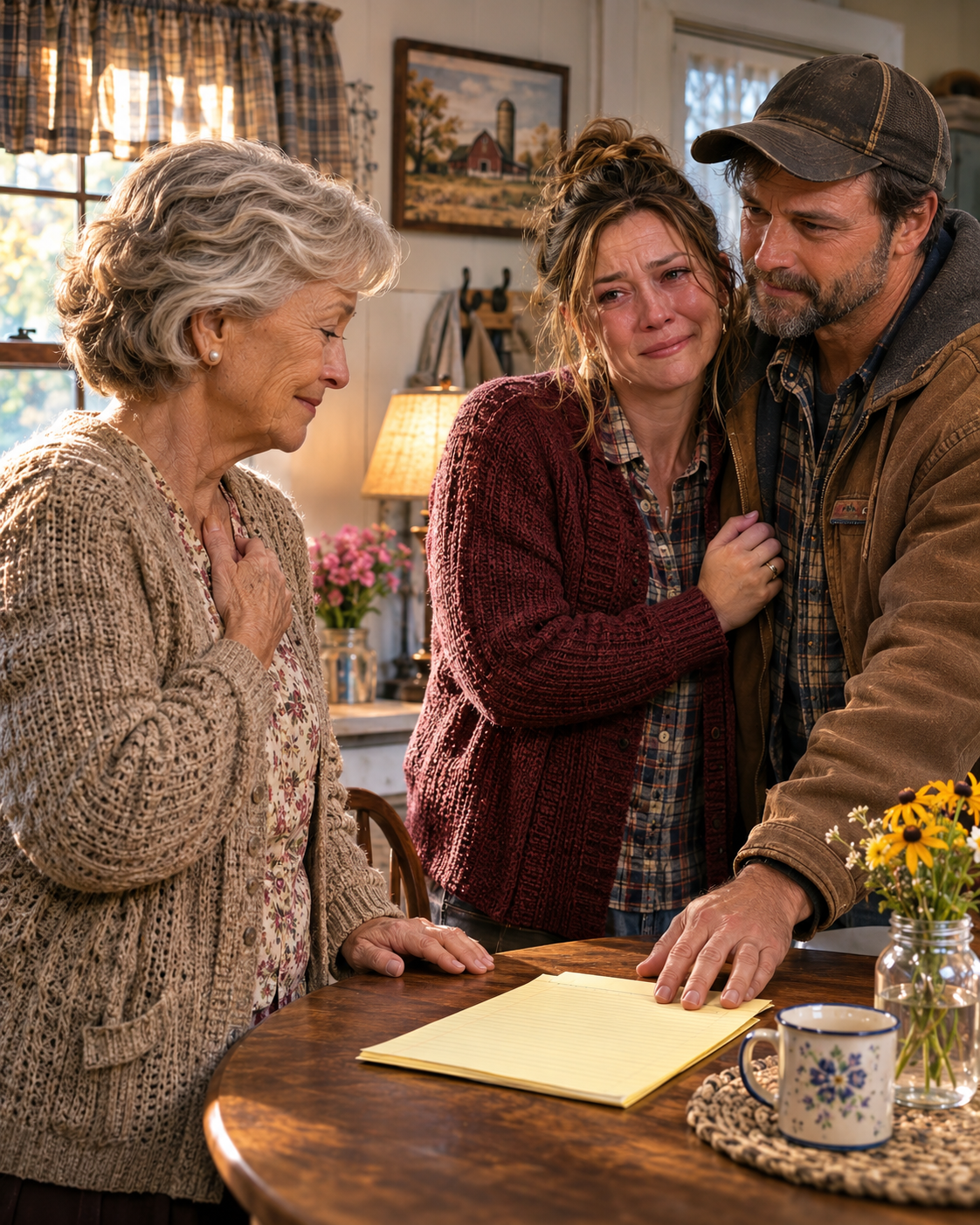
Michelle stood beside the refrigerator, twisting her wedding ring around her finger.
Neither of them sat down.
“What’s this?” I asked, looking at the columns of numbers covering the page.
Todd swallowed.
“It’s what we actually owe.”
I adjusted my glasses.
There were mortgage payments, two car loans, credit cards, medical bills, and something labeled personal loan.
At the bottom, underlined three times, was a number that made my stomach tighten.
$47,680.
I looked up.
“You’re almost fifty thousand dollars in debt?”
Michelle covered her mouth.
Todd nodded.
“And that’s not counting the mortgage.”
For a moment, the only sound in my kitchen was the refrigerator humming.
I’d known they were having financial difficulties. Michelle had mentioned rising grocery prices and expensive school supplies. Todd had complained about overtime being cut at the plant.
But I hadn’t imagined anything like this.
“How did it get so bad?” I asked.
Todd pulled out a chair.
He sat down slowly, rubbing both hands over his face.
“It started when I bought the truck. Then the furnace went out. We put that on a credit card. Then I borrowed money to pay off another card, and…”
His voice trailed away.
Michelle finally spoke.
“We’ve been trying to keep everything together, Mom.”
I looked at her.
“Then why didn’t you tell me?”
She stared at the floor.
“Because we were embarrassed.”
I turned back to Todd.
“And you thought charging your widowed mother-in-law eight hundred dollars a month would fix it?”
He didn’t answer.
I tapped the legal pad.
“Four days of babysitting, too. Was that part of your financial plan?”
Todd looked away.
And that was when I noticed something strange.
Michelle wasn’t looking at him with the same sadness I’d seen when they arrived.
She was looking at him with anger.
“Tell her the rest,” she said quietly.
Todd stiffened.
“Michelle—”
“Tell her.”
I set my glasses on the table.
“What rest?”
Michelle pulled out the chair beside me.
“Mom, I didn’t know about all of this until yesterday.”
I frowned.
“What do you mean? You just said you’ve been trying to keep everything together.”
“I knew we were struggling. I didn’t know how much he’d borrowed.”
Todd closed his eyes.
Michelle continued.
“Yesterday, I found a letter in the mailbox. It was from a collection agency. I opened it because it had both our names on it.”
She reached into her purse and pulled out a folded envelope.
I recognized the red lettering immediately.
FINAL NOTICE.
I had handled enough overdue accounts at the lumberyard to know those words weren’t something people should ignore.
Michelle slid the letter toward me.
“They’re threatening legal action.”
I read the amount.
$18,400.
Then I looked at the name of the creditor.
And my heart sank.
“That isn’t a bank,” I whispered.
Todd shook his head.
“No.”
“Then who is it?”
He rubbed his forehead.
“A private lender.”
Michelle gave a bitter laugh.
“That’s what he calls him.”
I looked between them.
“Who is he, Todd?”
Todd stared at the table for several seconds.
“His name is Russell Mercer.”
I knew the name.
Everyone in our county knew Russell Mercer.
He owned several rental properties, a used-car lot, and a large storage facility on the highway.
He was also the kind of man who always seemed to know when somebody was desperate enough to accept a bad deal.
My husband, Dale, had once refused to sell him a piece of farm equipment because Russell tried to change the agreed price after shaking hands.
Dale had come home furious.
“That man would charge his own mother interest on a glass of water,” he’d said.
I could almost hear my husband’s voice in the kitchen.
“Why would you borrow money from Russell Mercer?” I asked.
Todd didn’t look at me.
“Because nobody else would approve us.”
I stared at him.
“And what did you give him as security?”
Todd went completely still.
Michelle’s eyes filled with tears.
“That’s the part I found out this morning, Mom.”
I felt a cold sensation move through my chest.
“What did he give him?”
Todd finally looked up.
“The house.”
For several seconds, I couldn’t speak.
Their house.
The place where my grandchildren slept.
The place where Sadie had learned to walk.
The place where we’d celebrated birthdays, Christmas mornings, and Sunday dinners.
“You put your children’s home at risk?” I whispered.
Todd nodded.
Michelle began crying.
“He signed an agreement without telling me.”
I leaned back in my chair.
At sixty-seven, I’d lived long enough to understand that people sometimes made foolish decisions when they were frightened.
But there was a difference between making a mistake and hiding that mistake from the people who would suffer because of it.
“How long do you have?” I asked.
Todd stared at the yellow pad.
“Thirty days to resolve the default.”
Michelle wiped her cheeks.
“That’s why we came here.”
I looked at her.
And suddenly, I understood.
The $800 wasn’t simply about helping with household expenses.
They’d been counting on my Social Security check.
Every month.
And the four days of free babysitting meant Michelle could pick up more shifts at the clinic.
I looked at Todd.
“You weren’t offering me a home.”
He flinched.
“You were trying to turn me into a payment plan.”
Michelle began shaking her head.
“Mom, please—”
“No, honey. Let me finish.”
My voice was steady, although my hands were trembling beneath the table.
“I spent forty-three years married to your father. We never had much money, but we paid our bills. When things were difficult, we cut back. We didn’t expect somebody else to sacrifice their independence to protect our pride.”
Todd looked down.
I continued.
“Your father worked through harvest with a fever once because the farm needed him. He wore the same winter coat for eleven years. And do you know why?”
Michelle whispered, “Because he didn’t like spending money.”
“No.”
I looked directly at her.
“Because he wanted you to have choices he never had.”
That broke something in her.
She put her face in her hands and sobbed.
I wanted to reach for her.
Every mother knows that feeling.
Your child is hurting, and every instinct tells you to make the pain disappear.
But I also knew something I’d spent far too many years learning.
Sometimes, when you keep rescuing people from their choices, you prevent them from learning how to make better ones.
So I stayed in my chair.
After a long silence, Todd spoke.
“I know I was wrong, Judy.”
I nodded.
“Yes. You were.”
“I thought if you moved in, we’d have enough breathing room to get caught up.”
“And when you were caught up?”
He looked confused.
“What?”
“Would my rent have gone down? Would I have stopped babysitting four days a week? Would I have been allowed to use the upstairs bathroom without asking?”
Michelle stared at me.
Todd said nothing.
“Did either of you ever ask what I wanted?”
Neither answered.
I glanced around my little home.
The secondhand curtains I’d hemmed myself.
The yellow dish towels hanging from the oven handle.
The little vase of dried sunflowers on the windowsill.
Everything was modest.
Nothing matched.
But it was mine to arrange, mine to clean, mine to enjoy.
“I didn’t choose this place because I love strangers more than my family,” I said softly. “I chose it because I wanted to live the years I have left as a person, not an obligation.”
Michelle reached across the table and took my hand.
“I’m sorry, Mom.”
I squeezed her fingers.
“I know, sweetheart.”
Todd stood.
“I shouldn’t have come here expecting you to fix this.”
“No,” I said. “You shouldn’t have.”
He nodded and moved toward the door.
But before he reached it, I asked one more question.
“Todd, how much is the monthly payment on that loan?”
He hesitated.
“Six hundred and twenty dollars.”
I did the calculation in my head.
“And you wanted eight hundred from me.”
He looked ashamed.
“Yes.”
I nodded slowly.
“At least now I understand where the number came from.”
He stopped at the screen door.
“I really am sorry.”
I believed him.
But believing somebody is sorry doesn’t mean handing them the keys to your life.
Michelle hugged me before leaving.
She held on longer than usual.
“I don’t want to lose you, Mom.”
“You haven’t lost me.”
“Can I bring the kids over Sunday?”
I smiled.
“I’ll make chicken and dumplings.”
For the first time in nearly two weeks, she smiled back.
After they left, I washed the three coffee cups I’d put out, although none of us had taken more than a sip.
Then I sat on the porch swing and watched the last grain truck rumble down the street.
I should have felt relieved.
My daughter had apologized.
Todd had admitted the truth.
The grandchildren were coming Sunday.
But something still bothered me.
It was a small detail.
Something Todd had said while explaining the loan.
He’d told me no bank would approve them.
Yet the agreement with Russell Mercer had supposedly been signed only four months earlier.
I remembered Michelle telling me last spring that they’d refinanced their mortgage.
And I remembered her proudly saying their credit had finally improved.
Something didn’t fit.
The next morning, I drove to the grocery store for flour, butter, and chicken.
On my way out, I ran into an old acquaintance.
His name was Walter Price.
Walter had worked at the county courthouse for thirty-six years before retiring.
We’d known each other since our children were in elementary school.
He asked how I was settling into my new home.
I told him I liked it.
Then, almost without thinking, I asked, “Walter, do you know much about Russell Mercer?”
His smile disappeared.
“Why?”
I hesitated.
“Someone in my family borrowed money from him.”
Walter’s expression changed.
He took off his cap and looked around the parking lot.
“Judy, I need to ask you something.”
“What?”
“Did Russell know your husband?”
I frowned.
“Of course. Dale knew practically everybody around here.”
Walter stepped closer.
“No. I mean, did they ever have a disagreement?”
I remembered the farm equipment.
“The two of them didn’t get along.”
Walter nodded slowly.
“That’s what I was afraid of.”
A chill ran down my spine.
“Why?”
He glanced toward the courthouse across the street.
“Because about six months before Dale died, Russell came into the records office asking questions about property connected to your husband’s name.”
I stared at him.
“What property? Dale didn’t own the farmhouse.”
“I know.”
Walter lowered his voice.
“That’s what made it strange.”
I gripped my grocery bag.
“What exactly was Russell looking for?”
Walter hesitated.
Then he said something I would remember for the rest of my life.
“Judy, he wasn’t asking about the farmhouse. He was asking about a parcel of land Dale inherited from his father.”
I nearly dropped the bag.
“Dale never inherited any land.”
Walter’s face tightened.
“That’s what I thought, too. But I saw the old transfer record myself.”
I shook my head.
“There must be some mistake.”
“Maybe,” Walter said. “But there’s something else you need to know.”
He reached into his coat pocket and pulled out a folded piece of paper.
“I made a note of the parcel number because the inquiry seemed unusual.”
I looked at the paper.
It contained a legal description and a reference to land near the old railroad spur.
Land less than a mile from my little rental house.
“Why would Russell be interested in that?” I asked.
Walter looked at me for a long moment.
“Because the county approved a commercial development proposal near that railroad spur last month.”
My heart began pounding.
“And?”
“And if the parcel is the one I think it is, Judy, it sits right in the middle of the proposed access road.”
I stared at him.
The grocery store parking lot seemed suddenly very quiet.
Walter put his cap back on.
“Don’t sign anything Russell Mercer gives you. And don’t discuss this with Todd until you know exactly what you’re dealing with.”
I barely remember driving home.
I put the groceries away, sat at my kitchen table, and unfolded the paper again.
Dale had never told me about inherited land.
Not once in forty-three years.
We’d shared everything.
Or so I’d believed.
That afternoon, I went through the cardboard box containing his old documents.
His military discharge papers.
Our marriage certificate.
Insurance statements.
Receipts for tractor repairs.
A photograph of Michelle on her first day of school.
At the very bottom, beneath a stack of yellowed tax forms, I found an envelope.
It was sealed.
My name was written across the front in Dale’s familiar handwriting.
FOR JUDY — WHEN THE TIME IS RIGHT.
My hands began shaking.
I had never seen that envelope before.
I opened it carefully.
Inside was a handwritten letter and a small brass key.
The letter began with six words that brought tears to my eyes.
“My darling Judy, forgive me first.”
I pressed a hand over my mouth.
Then I read the next paragraph.
And everything I thought I knew about my husband’s final years began to change.
Dale had written:
“There’s something I’ve kept from you because I was afraid of what would happen if Russell Mercer found out you knew. The land my father left me was never meant to make us rich. It was meant to keep you safe when I couldn’t. But there’s one person you must never trust with the papers, no matter how much they claim to love you.”
I stopped breathing for a moment.
Below that sentence, Dale had written a name.
Todd.
I stared at the page.
My son-in-law.
The man who had just sat at my kitchen table begging forgiveness.
The man who had tried to take $800 from my Social Security every month.
The man whose mysterious lender was suddenly interested in land my husband had hidden from me.
And beneath Todd’s name, Dale had written one final warning:
“If Todd ever comes asking you for money, Judy, don’t give him a penny until you open the box this key belongs to. What you’ll find inside will explain why.”
I looked at the little brass key in my palm.
There was a number engraved on its side.
214.
I had no idea what it opened.
But I was about to discover that the $800 Todd wanted from me was only the beginning.
And that my husband had been protecting me from a secret far bigger than any of us could have imagined…………………………
Todd.
My own son-in-law.
The father of my grandchildren.
The man who had sat across from me less than twenty-four hours earlier, apologizing for trying to charge me eight hundred dollars a month to live in his basement.
I read Dale’s letter again.
Then a third time.
Every word felt heavier than the last.
“If Todd ever comes asking you for money, Judy, don’t give him a penny until you open the box this key belongs to.”
I wanted to believe there was an innocent explanation.
Maybe Dale had misunderstood something.
Maybe he’d been frightened by the cancer treatments.
Maybe the medication had confused him.
But my husband had never been a man who made accusations without good reason.
In forty-three years of marriage, I’d seen Dale angry only a handful of times.
He was patient with animals, gentle with children, and forgiving toward people who made honest mistakes.
But he had one rule he never broke.
“If somebody lies to you about money,” he used to say, “check what else they’ve been hiding.”
And now, nearly two years after burying him, I was beginning to understand why he’d said it so often.
I turned the brass key over.
The number 214 was stamped into the metal.
There was no company name.
No address.
Nothing to tell me what it opened.
I searched the envelope again.
A second sheet of paper had slipped beneath the lining.
It was folded so tightly that I almost missed it.
Across the top, Dale had written:
“Ask Walter about the old depot. He’ll know where to send you.”
My heart gave a strange little jump.
Walter Price.
The very man who had stopped me outside the grocery store that morning.
The man who had told me about the land near the railroad spur.
I stared at the note.
Was it a coincidence?
Or had Walter known more than he’d admitted?
I reached for my telephone.
Then I stopped.
Dale had specifically warned me not to trust Todd with the papers.
He hadn’t warned me about Michelle.
But something about the entire situation made me reluctant to involve anyone until I understood what was happening.
So I placed the letter inside my handbag, put the brass key in my coat pocket, and drove to Walter’s house.
He lived in a modest brick bungalow near the old Methodist church.
His wife, Evelyn, had died five years earlier, and since then he’d spent most of his time tending his garden and volunteering at the historical society.
When he opened the door, he looked surprised to see me.
“Judy? Everything all right?”
“I found something.”
His expression changed immediately.
“What kind of something?”
I held up the key.
The color drained from his face.
For several seconds, he didn’t speak.
Then he stepped aside.
“You’d better come in.”
I followed him into a living room filled with old photographs and neatly stacked newspapers.
He didn’t offer coffee.
He didn’t ask about the weather.
Instead, he closed the curtains.
That frightened me more than anything.
“Walter, what’s going on?”
He sat across from me.
“Where did you find that key?”
“In Dale’s papers.”
“Was there a letter?”
I nodded.
He looked down at his hands.
“Then he finally told you.”
I felt my chest tighten.
“Finally told me what?”
Walter sighed.
“Your husband made me promise something before he died.”
I stared at him.
“You knew about this?”
“Some of it.”
“Then why didn’t you tell me?”
“Because Dale asked me not to.”
I stood so quickly that my handbag fell from my lap.
“That man has been dead almost two years, Walter! I’ve been living in a farmhouse that wasn’t mine, worrying about where I’d go, counting every dollar of my Social Security, and you’re telling me you knew he left something behind?”
Walter didn’t defend himself.
He simply nodded.
“You’re right to be angry.”
I took a trembling breath.
“Then tell me the truth.”
He looked toward the window.
“The key belongs to a storage locker at the old railroad depot. Number 214.”
I sat down again.
“The depot hasn’t been used in years.”
“The freight offices haven’t. But the historical society rents the old records wing for document storage. Dale arranged for a private locker there.”
“Why?”
Walter hesitated.
“Because he didn’t trust the people who were trying to buy his father’s land.”
I frowned.
“What people?”
“Russell Mercer was one of them.”
My stomach dropped.
“And Todd?”
Walter looked me straight in the eyes.
“That’s what you need to find out for yourself.”
I wanted to demand more answers.
But something in his expression told me he was frightened.
Not for himself.
For me.
He rose, took his coat from the hallway hook, and said, “Come on. I’ll take you there.”
The old depot stood at the edge of town, where the railroad tracks curved past the grain elevator.
As a girl, I’d watched passenger trains stop there on summer afternoons.
By the time Michelle was born, most of the building had been abandoned.
Now the brick walls were faded, the windows were narrow, and weeds pushed through cracks in the loading platform.
Walter unlocked a side entrance.
Inside, the air smelled of old wood, dust, and paper.
We walked down a hallway lined with metal cabinets.
At the far end stood a row of numbered storage lockers.
My eyes found 214 immediately.
It was a narrow steel compartment, no bigger than a kitchen cupboard.
Walter stepped back.
“This part is yours, Judy.”
My fingers trembled as I inserted the key.
For a moment, it wouldn’t turn.
Then I pushed gently.
The lock clicked.
Inside sat a rectangular wooden box wrapped in an old blue towel.
I recognized that towel.
It had come from our farmhouse.
Dale used to keep it in his truck to wipe grease from his hands.
I lifted the box carefully.
It was heavier than I expected.
On the lid, my husband had carved two initials.
D.H.
Dale Henderson.
I ran my fingertips over the letters.
Suddenly, I was no longer sixty-seven years old.
I was twenty-three again, watching a shy farmhand stand outside my father’s house with a bunch of wildflowers in his hand.
Dale had never been wealthy.
But he’d always found ways to make ordinary things feel precious.
I opened the box.
Inside were three thick envelopes, a small leather notebook, several old photographs, and a folded document tied with string.
The first envelope was labeled:
“THE LAND.”
I opened it.
There was a deed.
An actual deed.
It listed Dale as the legal owner of 18.6 acres near the old railroad spur.
I read the description twice.
Then I looked at Walter.
“Eighteen acres?”
He nodded.
“His father bought it in the 1960s. It was mostly useless pasture back then.”
“Why didn’t Dale tell me?”
Walter’s expression softened.
“He planned to. Then he got sick.”
I looked back at the deed.
The land had been transferred into Dale’s name years before his diagnosis.
But attached to it was another document.
A recorded transfer-on-death designation.
I read the beneficiary’s name.
Judith Henderson.
Me.
I sat down on a nearby wooden bench.
The paper shook in my hands.
“Dale left this to me?”
Walter nodded.
“He wanted you to have something that couldn’t be taken away just because the farm changed hands.”
Tears blurred my vision.
All those nights I’d spent worrying about the future.
All those mornings I’d woken up in the farmhouse wondering whether I would have enough money to survive.
My husband had been trying to provide for me even after he was gone.
But why had he hidden it?
And why had Russell Mercer been asking about the property?
I opened the second envelope.
It was labeled:
“THE OFFER.”
Inside was a letter dated eight months before Dale died.
It came from a development company called Prairie Ridge Holdings.
The company offered $165,000 for the land.
I gasped.
“One hundred and sixty-five thousand dollars?”
Walter nodded.
“That was before the county approved the new access road.”
I looked up.
“What’s it worth now?”
He hesitated.
“I’ve heard figures considerably higher, but you’d need a proper appraisal.”
My mind raced.
Even the old offer was more money than Dale and I had ever had in savings.
I could have bought a small home outright.
I could have helped Michelle without surrendering my independence.
I could have stopped worrying about whether the Buick would survive another winter.
But Walter leaned forward.
“Don’t get ahead of yourself, Judy. Read the third envelope.”
I reached into the box.
The final envelope was thicker than the others.
Across the front, Dale had written:
“THE REASON I SAID NO.”
Inside were copies of bank records, several handwritten notes, and a photograph.
The photograph showed three men standing beside a pickup truck.
I recognized Dale immediately.
He looked thinner than I remembered, but he was smiling.
Beside him stood Russell Mercer.
And on Russell’s other side stood Todd.
I stared at the picture.
Todd had his arm around Russell’s shoulder.
They looked like old friends.
“What’s this?”
Walter leaned over.
“Dale took that photograph at the county fair about three years before he died.”
I frowned.
“Todd told us he barely knew Russell.”
Walter said nothing.
I turned the photograph over.
Dale had written a date.
And beneath it:
“First meeting about the land. Todd brought him.”
I felt sick.
Todd had introduced Russell Mercer to my husband.
Todd had known about the property.
Todd had known Russell wanted it.
Yet when he sat in my kitchen explaining his debts, he’d acted as though Russell were merely some lender he’d approached out of desperation.
I opened the leather notebook.
Dale had filled the pages with dates and short observations.
He’d always kept little notebooks in his shirt pocket.
Most contained feed prices, repair measurements, or lists of things to buy in town.
This one was different.
“May 12 — Todd asked whether I would consider selling the railroad parcel.”
“May 18 — Russell offered cash. Told him no.”
“June 2 — Todd said the land was wasted sitting empty.”
“June 14 — Russell raised offer. Asked whether Judy knew about the property.”
I stopped reading.
The next entry had been underlined.
“June 19 — Todd said family ought to share what it has. I told him Judy’s security comes first.”
I closed my eyes.
Family ought to share what it has.
The same idea Todd had used when he tried to charge me $800 a month.
I turned another page.
“July 3 — Todd came by without Michelle. Asked me to sign papers giving him authority to negotiate.”
My breath caught.
“July 4 — Refused. He got angry. Said Michelle deserved an inheritance while I was still alive.”
I pressed my hand against my chest.
Walter sat quietly beside me.
Then I found the entry that changed everything.
“August 11 — Russell says Todd has already promised him the parcel. Told Russell Todd owns nothing. Russell became furious.”
I looked up.
“Todd promised land that didn’t belong to him?”
Walter nodded slowly.
“That’s what Dale believed.”
I kept reading.
“August 16 — Todd begged me not to tell Michelle. Said he borrowed money against a future sale.”
My stomach twisted.
Todd had borrowed money.
Years before the debt he’d confessed to me.
And he’d been counting on selling my husband’s land to pay it back.
Suddenly, the $18,400 collection notice made a terrible kind of sense.
But another question bothered me.
“Why would Russell lend Todd money against land he didn’t own?”
Walter rubbed his chin.
“That’s what I’ve never understood.”
I turned the final pages.
Dale’s handwriting became shakier as his illness progressed.
Some entries were barely legible.
Then, near the back, I found a note written in dark blue ink.
“Russell offered to make Todd’s debt disappear if I signed. Told him I’d rather burn the papers.”
I swallowed hard.
Below that was another entry.
“Need to protect Judy. Walter knows where records are. Must tell her before it’s too late.”
There were no more entries.
I stared at the blank pages.
My husband had died before he could finish explaining.
For nearly two years, I’d believed he’d left me nothing except memories and a few boxes of belongings.
Now I was holding proof that he’d spent his final months trying to protect me from the very man who wanted to move me into his basement.
I began crying.
Not loudly.
Not dramatically.
Just the quiet tears of a woman who suddenly realized how much her husband had carried alone.
Walter placed a hand on my shoulder.
“Dale loved you, Judy.”
“I know.”
“He was afraid you’d sell the land out of kindness if you knew Todd was in trouble.”
I wiped my eyes.
“He knew me too well.”
Because that was exactly what I might have done.
If Michelle had come to me crying about losing her house, I would have tried to save her.
Even if it meant giving away the only security Dale had left me.
Walter helped me return the papers to the wooden box.
“Before you do anything,” he said, “you need an attorney to verify the ownership and review these documents.”
I nodded.
“And Judy?”
“Yes?”
“Don’t tell Todd what you found.”
I looked at him.
“Why not?”
“Because if he made promises to Russell years ago, we don’t know what he’s promised since.”
We locked the depot and walked outside.
The afternoon sun was sinking behind the grain elevator.
For a moment, I stood beside my Buick, holding the box against my chest.
I thought about Michelle.
My only daughter.
The little girl who used to fall asleep on Dale’s shoulder after supper.
The woman who now stood to lose her home because of debts her husband had hidden.
How much did she know?
Was she another victim of Todd’s lies?
Or had she known about the land all along?
I hated myself for even wondering.
Walter seemed to read my thoughts.
“Be careful who you accuse, Judy. Knowing somebody lied doesn’t tell you who else was involved.”
He was right.
I thanked him and drove home.
That evening, I placed the wooden box in the bottom drawer of my bedroom dresser.
Then I called an attorney in the next county, a woman named Eleanor Shaw whom Walter had recommended.
Her receptionist offered me an appointment for Monday morning.
I accepted.
I didn’t mention the land to Michelle.
Not yet.
Instead, I spent Saturday cleaning my little house.
I washed the windows.
I swept the porch.
I bought a small pumpkin for the front step.
And on Sunday morning, I got up early to prepare chicken and dumplings for my grandchildren.
I wanted one ordinary afternoon.
One day when I could simply be Grandma Judy.
At eleven-thirty, Michelle’s car pulled into the driveway.
Sadie jumped out before her mother had finished parking.
“Grandma!”
I opened my arms.
She ran straight into them.
Her older brother, eight-year-old Caleb, followed carrying a paper bag.
“We brought cookies!”
I kissed them both.
For the next hour, my little house was filled with laughter.
Sadie inspected every room.
Caleb discovered the porch swing.
Michelle helped me set the table.
Todd wasn’t with them.
I tried not to look relieved.
While the children played outside, Michelle stood beside me at the kitchen sink.
“Mom, can I ask you something?”
“Of course.”
She hesitated.
“Are you still angry with Todd?”
I dried my hands.
“I’m disappointed in him.”
She nodded.
“He knows he made mistakes.”
“Does he?”
Michelle looked at me.
“He’s trying, Mom.”
I studied her face.
There were dark circles beneath her eyes.
She looked exhausted.
“Michelle, sweetheart, how much do you really know about your husband’s debts?”
She stiffened.
“What do you mean?”
“Has he shown you every account? Every agreement? Every loan?”
She looked away.
“He showed me the legal pad.”
“That’s not what I asked.”
For a long moment, she didn’t speak.
Then she whispered, “I don’t know.”
I took her hand.
“Then you need to find out.”
Her eyes filled with tears.
“Mom, I’m scared.”
I pulled her into my arms.
“I know, honey.”
“What if we lose the house?”
I held her tightly.
“Then we’ll figure out what comes next.”
She drew back.
“Does that mean you’ll help us?”
I looked at her.
“I’ll help you understand your options. I’ll help with the children when I can. But I won’t hand over my retirement money to cover debts nobody will explain.”
She nodded slowly.
“I understand.”
I wanted to tell her about the land.
I wanted to show her Dale’s letter.
But something stopped me.
Instead, I asked a question.
“Michelle, did your father and Todd ever argue about money?”
She frowned.
“Sometimes.”
“Do you remember what about?”
She thought for a moment.
“Not really. Dad never talked about it.”
Then she paused.
“Actually, there was one argument.”
My heart began pounding.
“When?”
“About a year before Dad got sick.”
“What happened?”
Michelle looked toward the window.
“Todd came home furious after visiting the farm. He said Dad was being selfish.”
I felt a chill.
“Selfish how?”
“He said Dad was sitting on something valuable while we were struggling.”
I gripped the edge of the counter.
“Did Todd tell you what it was?”
She shook her head.
“He said it was a business opportunity. Something Dad wouldn’t agree to.”
I took a slow breath.
“Did you ever ask your father?”
“Once.”
“And what did he say?”
Michelle’s expression softened.
“He told me that sometimes the best thing a father can give his daughter is the freedom to make her own decisions.”
I turned away before she could see my tears.
That sounded exactly like Dale.
After lunch, the children played in the yard while Michelle helped me wash dishes.
At two o’clock, Todd arrived in his pickup.
He’d come to collect them.
I stepped onto the porch as he got out.
“Afternoon, Judy.”
“Afternoon.”
He glanced at the porch swing.
“Nice place you’ve got here.”
“Thank you.”
He shifted his weight.
“Listen, I wanted to tell you something.”
I waited.
“Russell agreed to give us a little more time.”
My stomach tightened.
“How much?”
“Another sixty days.”
“That’s generous.”
Todd nodded.
“Yeah. He’s actually been pretty understanding.”
I watched his face.
Then I asked casually, “Have you known Russell long?”
He looked surprised.
“Not really. Just through some people at work.”
I felt the blood drain from my cheeks.
Another lie.
I remembered the photograph.
Todd with his arm around Russell’s shoulder at the county fair.
I remembered Dale’s notebook.
Todd had introduced Russell to him years earlier.
But I kept my voice calm.
“Well, I hope things work out.”
Todd smiled.
“Thanks, Judy.”
He started toward the house.
Then he stopped.
“Oh, one more thing.”
I waited.
“Russell mentioned he might be interested in buying some property around here.”
I felt my heartbeat quicken.
“What property?”
Todd shrugged.
“Land near the railroad tracks. He thinks the new development could make it valuable.”
I said nothing.
He continued.
“Funny thing is, he said Dale might have owned some land out there years ago.”
The world seemed to narrow around me.
Todd watched my face carefully.
“Did Dale ever mention anything like that?”
I thought about the wooden box hidden in my dresser.
The deed.
The notebook.
The warning written in my husband’s handwriting.
Then I smiled.
“No, Todd. Dale never discussed any land with me.”
It wasn’t quite the answer he wanted.
But it was true about the years Dale was alive.
Todd studied me.
Then he nodded.
“Probably just a rumor.”
He went inside to help the children gather their things.
I stood on the porch, gripping the railing.
For the first time since Dale died, I was frightened of my own son-in-law.
Not because he’d shouted.
Not because he’d threatened me.
But because he’d looked directly into my eyes and lied so easily.
That evening, after everyone left, I checked the locks twice.
Then I took Dale’s box from the dresser and placed it beneath my bed.
I didn’t sleep much.
At eight-thirty Monday morning, I drove to Eleanor Shaw’s law office.
She was a woman in her early fifties with silver-framed glasses and a calm, practical manner.
I told her everything.
The basement offer.
The debt.
Russell Mercer.
Walter’s warning.
The land.
Dale’s notebook.
She listened without interrupting.
Then she examined the deed and the recorded transfer-on-death document.
After several minutes, she looked up.
“Mrs. Henderson, I need to verify the current title and whether the beneficiary transfer was properly recorded.”
I nodded.
“Of course.”
She studied the papers again.
“But I can tell you something right now.”
“What?”
“If these documents are valid and the title is clear, you may own property worth considerably more than you realize.”
My hands tightened around my handbag.
“How much more?”
She opened a folder containing a map of the proposed development.
Then she pointed to a narrow strip running through the center.
“Your parcel appears to be the only practical access route connecting the industrial expansion to the county highway.”
I stared at the map.
“What does that mean?”
“It means a developer might be willing to pay a substantial premium for it.”
She paused.
“But that’s not the part that concerns me.”
I looked up.
“What concerns you?”
She turned her computer screen toward me.
“I pulled the public property records before your appointment.”
On the screen was a document filed just three weeks earlier.
The heading read:
NOTICE OF CLAIMED INTEREST IN REAL PROPERTY.
I leaned closer.
“What is that?”
Eleanor’s face was serious.
“Someone has filed a claim asserting an interest in your husband’s land.”
My stomach dropped.
“Who?”
She pointed to the name at the bottom.
Prairie Ridge Holdings, LLC.
The same company that had offered Dale $165,000 years earlier.
I swallowed.
“Russell Mercer’s company?”
“We’ll need to confirm the ownership structure.”
Then she scrolled down.
“And there’s something else.”
Attached to the claim was a copy of an alleged agreement.
The document purported to give Prairie Ridge Holdings the right to purchase the land at a fixed price.
I stared at the signature.
It was supposed to be Dale’s.
But I knew my husband’s handwriting better than I knew my own.
That signature was wrong.
The D curved the wrong way.
The H was too narrow.
And Dale never signed his name with a flourish beneath it.
I pointed at the screen.
“He didn’t sign that.”
Eleanor looked at me.
“Are you certain?”
“Absolutely.”
She leaned back.
“Then we may be dealing with a forged document.”
My mouth went dry.
“Who filed it?”
Eleanor clicked another page.
“The submission was made through a representative of the company.”
She read the name silently.
Then her expression changed.
“Mrs. Henderson, do you recognize this person?”
She turned the screen toward me.
I looked.
And for a moment, I couldn’t breathe.
The name was not Russell Mercer.
It wasn’t even Todd.
It was:
Michelle Henderson Collins.
My daughter.
My only child.
The little girl Dale had worked his whole life to protect.
I shook my head.
“No. That can’t be right.”
Eleanor spoke carefully.
“Is Michelle Collins your daughter?”
“Yes.”
“Then I think we need to understand why her name appears on a filing that could affect your property rights.”
I stared at the screen.
My hands had gone numb.
Had Michelle known about the land all along?
Had she helped Todd?
Had her tears in my kitchen been real?
Or had the two of them been trying to manipulate me from the beginning?
Eleanor printed the document and handed it to me.
“Please don’t confront anyone until we’ve examined this properly.”
I nodded, although I barely heard her.
As I stood to leave, my phone began ringing.
Michelle.
I stared at her name.
For the first time in my life, I didn’t know whether I wanted to answer my own daughter’s call.
Then a text message appeared.
MOM, PLEASE CALL ME. I JUST FOUND SOMETHING IN TODD’S TRUCK. I THINK HE’S BEEN LYING TO BOTH OF US.
Before I could respond, another message arrived.
AND MOM… THERE’S A PAPER WITH YOUR SIGNATURE ON IT.
I felt my knees weaken.
Because I had never signed a single document concerning Dale’s land.
Not one.
And when Michelle sent me a photograph of that paper thirty seconds later, I saw something that made my blood run cold.
At the bottom was my name.
Judith Henderson.
Beside it was a date from six weeks earlier.
And underneath, in bold letters, were five words:
IRREVOCABLE AUTHORIZATION TO TRANSFER PROPERTY.
But the most terrifying detail wasn’t the forged signature.
It was the line identifying the person who had supposedly witnessed me signing it.
Walter Price.
The man who had led me to Dale’s secret box.
The man my husband had trusted.
The man who had warned me not to trust my own family.
I stared at the photograph until the words blurred.
Then my phone rang again.
This time, it wasn’t Michelle.
It was Walter.
And the moment I answered, he whispered:
“Judy, don’t go home. Somebody broke into the depot last night, and your husband’s storage locker is empty.”……………………..
Walter’s voice trembled through the telephone.
I stood in the parking lot outside Eleanor Shaw’s law office, holding my handbag so tightly that the leather strap dug into my fingers.
“What do you mean, empty?” I whispered.
“The lock was damaged. The door was hanging open when I arrived this morning.”
“But I took the box home Friday.”
There was silence.
Then Walter let out a long breath.
“Thank God.”
I closed my eyes.
For the first time that morning, I felt a tiny bit of relief.
“Whoever broke in,” Walter continued, “thought the papers were still there.”
I glanced toward my Buick.
“Do you think it was Russell?”
“I don’t know. But listen carefully. Don’t go anywhere alone until we understand what’s happening.”
I looked through the glass doors of Eleanor’s office.
Inside, my attorney was still examining the document that supposedly carried my signature.
“Walter, there’s something I need to ask you.”
“What?”
“Did you witness me signing a property transfer six weeks ago?”
His answer came immediately.
“Absolutely not.”
“Your name is on the paperwork.”
Another silence.
Then he said something that made my stomach turn.
“Judy, six weeks ago, I was in a hospital in Des Moines having knee surgery. I couldn’t even walk without a frame.”
I gripped the phone.
“Are you certain about the date?”
“September fourth?”
“Yes.”
“That’s the day they operated. Evelyn’s sister drove me there. I’ve got the discharge papers.”
I looked back at Eleanor’s office.
Someone had forged my signature.
Someone had forged Walter’s involvement.
And someone had broken into the old depot looking for the documents Dale had hidden before he died.
These weren’t coincidences anymore.
They were pieces of the same terrible puzzle.
“Walter, I’m going back inside to speak with my attorney.”
“Good. And Judy?”
“Yes?”
“Your husband didn’t hide those papers because he was afraid of losing money.”
I swallowed.
“Then why?”
Walter’s voice became very quiet.
“Because he was afraid of what somebody might do to get it.”
I ended the call and hurried back into Eleanor’s office.
She was standing beside the copier when I entered.
“Mrs. Henderson? Did you forget something?”
I handed her my phone.
“Look at this.”
She studied the photograph Michelle had sent.
Her expression hardened.
“Where did you get it?”
“My daughter found it in her husband’s truck.”
Eleanor enlarged the image.
For several seconds, she said nothing.
Then she pointed to a line near the bottom.
“Do you see this?”
I leaned closer.
It was a reference number.
The same number appeared on the property claim she’d printed earlier.
“Does that mean they’re connected?”
“It appears so.”
She returned my phone.
“Mrs. Henderson, I want you to understand something. A document like this doesn’t automatically transfer your property just because someone wrote your name on it. But if someone is attempting to use a forged authorization, we need to act immediately.”
“What do we do?”
“First, we preserve the evidence. Then we contact the appropriate authorities and take steps to challenge the filing.”
I nodded.
“And Walter says somebody broke into the depot.”
Eleanor stopped writing.
“When?”
“Last night.”
“Was anything taken?”
“No. I already had Dale’s box.”
She looked at me over her glasses.
“Then whoever went there may not know that.”
My heart began pounding.
“Do you think they’ll come looking for it?”
“I don’t know. But I don’t want you keeping those original documents in an unsecured house.”
She opened a drawer and removed a business card.
“I’m going to arrange secure storage for the originals after we make copies. In the meantime, I want you to stay somewhere you feel safe.”
I almost laughed.
Safe.
A week earlier, my biggest worry had been whether my little rental house would be warm enough in November.
Now I was sitting in an attorney’s office discussing forged documents, a break-in, and the possibility that my own family was involved.
“I have a daughter,” I said quietly.
Eleanor looked at me.
“Is she someone you trust?”
I opened my mouth.
Then closed it.
That was the cruelest part.
For sixty-seven years, I’d believed there were certain questions a mother should never have to ask.
Whether her child loved her.
Whether her child was telling the truth.
Whether her child might betray her for money.
And now I couldn’t answer any of them.
My phone rang again.
Michelle.
This time, I answered.
“Mom?”
Her voice was breathless.
“Where are you?”
“At my attorney’s office.”
“Thank God.”
“Michelle, what happened?”
She began crying.
“I found more papers.”
I sat down.
“What kind of papers?”
“Copies of Dad’s signature. Pages and pages of them. Todd had them in a folder under the back seat.”
I felt my blood run cold.
“Why would he have those?”
“I don’t know.”
“Where is Todd now?”
“At work. At least, that’s where he said he was.”
I closed my eyes.
“Michelle, listen to me. Don’t confront him. Take photographs of everything, and don’t remove anything if doing so would put you in danger.”
“Mom, I already took the folder.”
My stomach dropped.
“You what?”
“I panicked. I brought it into the house.”
“Does Todd know?”
“I don’t think so.”
Then I heard a sound in the background.
A vehicle door closing.
Michelle stopped breathing.
“Mom.”
“What?”
“His truck just pulled into the driveway.”
I stood up.
“Michelle, are the children with you?”
“No. They’re at school.”
“Good. Take your phone and leave the house if you can do so safely.”
Her breathing became uneven.
“He’s coming up the steps.”
“Michelle—”
The line went dead.
I stared at the screen.
For one terrible second, I couldn’t move.
Then I looked at Eleanor.
“My daughter may be in trouble.”
Eleanor picked up her office telephone.
“Tell me her address.”
I gave it to her.
She called the sheriff’s department and explained the situation.
I stood beside her desk, shaking.
All I could think about was Michelle at four years old, running across our farmhouse kitchen with a scraped knee.
How Dale had scooped her up.
How she’d buried her face in his shirt.
How he’d always said, “As long as I’m here, sweetheart, nobody gets to make you feel small.”
But Dale wasn’t here anymore.
And I had no idea what was happening inside my daughter’s house.
Twenty minutes passed.
Then thirty.
At last, my phone rang.
It was Michelle.
“Mom?”
I nearly collapsed with relief.
“Are you all right?”
“I’m at the neighbor’s house.”
“What happened?”
She took a shaky breath.
“Todd came home because he realized the folder was missing.”
My heart hammered.
“Did he hurt you?”
“No. But he was furious.”
“What did he say?”
“He kept asking whether I’d shown you anything.”
I closed my eyes.
“And what did you tell him?”
“That I hadn’t.”
“Michelle—”
“I know, Mom. I lied. But I was scared.”
Her voice broke.
“Then he said something I don’t understand.”
“What?”
“He said, ‘Your mother wasn’t supposed to find out until after the closing.’”
The room seemed to tilt.
“The closing?”
“That’s what he said.”
I looked at Eleanor.
She was watching me carefully.
“Michelle, did he say when?”
“Friday.”
I glanced at the calendar on Eleanor’s desk.
It was Monday.
Four days.
Someone intended to complete a transaction involving my husband’s land in four days.
A transaction I hadn’t agreed to.
A transaction involving documents bearing signatures that weren’t mine.
And Todd knew about it.
“Michelle, where’s the folder now?”
“With me.”
“Keep it safe. Eleanor will tell us how to get it to her.”
Then Michelle whispered something that broke my heart.
“Mom, I think my husband has been using me.”
I sat down.
“What do you mean?”
She began crying harder.
“Remember when Dad was sick? Todd kept bringing papers to the hospital. He said they were insurance forms and medical authorizations.”
I felt a terrible pressure in my chest.
“Yes.”
“He asked me to sign as a witness on some of them.”
I couldn’t speak.
Michelle continued.
“I didn’t read every page. I trusted him.”
I pressed my fingers against my forehead.
“And now?”
“Now I think he put my name on documents I never saw.”
Suddenly, the property claim made sense.
Michelle’s name had appeared as the representative.
But that didn’t necessarily mean she’d knowingly submitted it.
Someone could have used her information.
Or tricked her into signing paperwork she didn’t understand.
I wanted desperately to believe that was what had happened.
But I needed proof.
“Michelle, bring the folder to Eleanor’s office. The sheriff’s department has been contacted. We’ll make sure you’re safe.”
She agreed.
When I hung up, Eleanor looked at me.
“Mrs. Henderson, I need to ask you a difficult question.”
I nodded.
“Do you believe your daughter is telling the truth?”
I stared at the floor.
Then I answered as honestly as I could.
“I believe she’s frightened. And I believe she doesn’t understand everything her husband has done.”
Eleanor nodded.
“That’s a place to start.”
An hour later, Michelle arrived.
Her face was pale.
Her hair was pulled into a messy ponytail.
She carried a thick brown folder against her chest.
When she saw me, she burst into tears.
I stood and held her.
For a moment, she was my little girl again.
“I’m sorry, Mom.”
I stroked her hair.
“Let’s find out what happened before we decide what anyone needs to apologize for.”
We sat together while Eleanor examined the documents.
There were photocopies of Dale’s signature.
Copies of his driver’s license.
Old medical records.
Bank statements.
And several sheets of paper covered with handwriting exercises.
Someone had been practicing his signature.
Over and over.
I recognized the name.
Dale Henderson.
Dale Henderson.
Dale Henderson.
My husband had signed his name thousands of times during our marriage.
On checks.
On birthday cards.
On school permission slips.
On the little notes he used to leave beside my coffee cup.
Seeing his signature copied like that made me feel physically ill.
Then Eleanor pulled out a document with a blue paperclip.
She read it twice.
Her face changed.
“Mrs. Henderson, do you recognize this?”
It was a letter addressed to Russell Mercer.
The date was from the final month of Dale’s life.
At the bottom was a signature that looked almost like my husband’s.
But not quite.
Eleanor read the relevant section aloud.
The letter claimed Dale had agreed to sell the railroad property to Prairie Ridge Holdings for $165,000.
The same amount offered years earlier.
Then she pointed to a paragraph.
“The agreement states that the sale would be completed after the owner’s death, subject to transfer of title.”
I frowned.
“Why would Dale agree to that?”
Eleanor looked at me.
“That’s exactly what we need to investigate.”
Michelle leaned forward.
“There’s another page.”
She reached into the folder and handed Eleanor a handwritten note.
It was Todd’s handwriting.
I recognized it from the yellow legal pad.
Across the top, he’d written:
“Projected proceeds.”
Below that were several numbers.
Sale price: $165,000.
Russell’s outstanding advances: $47,680.
Fees and expenses: $12,320.
Remaining proceeds: $105,000.
I stared at the figures.
The same $47,680 Todd had shown me as family debt.
The same number he’d claimed came from car loans, credit cards, and medical bills.
I looked at Michelle.
“He lied about where the debt came from.”
She covered her mouth.
Eleanor continued examining the paper.
At the bottom was a handwritten calculation.
“$105,000 divided by 3 = $35,000.”
Beside it were three initials.
R.M.
T.C.
M.C.
Russell Mercer.
Todd Collins.
Michelle Collins.
My daughter stared at the paper.
“Why is my name there?”
Todd had apparently planned to divide the remaining proceeds among the three of them.
But the land wasn’t his.
It wasn’t Russell’s.
And it wasn’t Michelle’s.
It was mine.
The very property Dale had left to protect me.
I felt something inside me change.
Not anger exactly.
Something colder.
Something steadier.
For years, I’d been the woman who avoided arguments.
The woman who smiled when people were rude.
The woman who apologized even when she’d done nothing wrong.
But sitting there, looking at my dead husband’s forged signature, I realized kindness had been mistaken for weakness.
And I was finished allowing that.
“Eleanor,” I said quietly.
She looked up.
“Yes?”
“I want this stopped.”
She nodded.
“That’s what we’re going to work on.”
“And I want every document examined.”
“Of course.”
“And if someone forged my husband’s name, I want the truth brought into the open.”
Michelle reached for my hand.
“Mom, what about the house?”
I turned toward her.
“What house?”
“Our house. Russell still has that loan agreement. Todd says we’ll lose everything if the sale doesn’t happen.”
I looked at my daughter.
Her eyes were filled with terror.
I understood what she was asking.
She wanted me to save them.
To surrender the land.
To make the danger disappear.
The same way I’d always made things easier when she was growing up.
But this time, the price was too high.
“Michelle,” I said gently, “I love you and the children more than anything in this world.”
She nodded through her tears.
“But I won’t let someone steal from me to protect your husband’s lies.”
She looked down.
“I know.”
“If you lose the house, we’ll find another place for you and the children. But we’re not going to solve one wrong by committing another.”
For a long moment, she said nothing.
Then she squeezed my hand.
“Okay, Mom.”
Eleanor made several telephone calls.
She contacted the county recorder’s office about the disputed filing.
She arranged for the original documents from Dale’s box to be placed in secure storage.
And she prepared an emergency legal filing seeking to prevent any unauthorized transfer while the ownership dispute was investigated.
By late afternoon, I was exhausted.
Michelle offered to drive me home.
But Eleanor suggested I stay with a friend for the night until we knew more about the depot break-in.
Walter offered his guest room.
I almost accepted.
Then I remembered his name on the forged document.
He had an explanation.
A good one, perhaps.
But I wanted to verify it before placing my safety in his hands.
So I called my old friend Ruth Miller.
Ruth had been my neighbor for nearly twenty years.
She was seventy-one, widowed, and possessed the kind of stubborn common sense that could stop a runaway tractor.
When I explained that I needed somewhere to stay, she didn’t ask questions.
“Come on over,” she said. “I’ve got clean sheets and leftover meatloaf.”
I nearly cried.
Sometimes the people who save you don’t arrive carrying legal documents or promises of money.
Sometimes they simply offer you a warm bed and supper.
That evening, I sat at Ruth’s kitchen table while she poured tea.
I told her enough to explain why I was frightened.
She listened carefully.
Then she said, “Judy, do you remember what Dale told my husband when the bank threatened to take our farm?”
I shook my head.
“He said, ‘A person can lose a house and still keep their dignity. But once they sell their dignity to keep the house, they’ve lost both.’”
Tears filled my eyes.
“That sounds like him.”
Ruth smiled sadly.
“He was a good man.”
I nodded.
“The best.”
At nine o’clock, Michelle called.
She and the children were staying with a friend.
Todd had been questioned by a deputy about the documents, but no arrest had been made.
He’d denied forging anything.
He claimed Russell’s company had handled the paperwork.
Russell, meanwhile, insisted that the signatures were genuine.
Everyone was pointing at somebody else.
And the supposed closing was still scheduled for Friday.
I barely slept.
The next morning, Eleanor called with news.
“Judy, we obtained the filing history for the disputed agreement.”
I sat up in Ruth’s guest bed.
“What did you find?”
“The document was submitted electronically from an account registered to Prairie Ridge Holdings.”
“Russell’s company?”
“Yes.”
I exhaled.
“Then Russell did it.”
“Not necessarily. The account may have been used by someone else. But there’s something unusual.”
“What?”
“The document metadata indicates it was created much more recently than the date printed on it.”
My heart jumped.
“How recently?”
“Six weeks ago.”
The same period when someone had supposedly witnessed me signing the authorization.
The same period when Todd and Russell had apparently begun preparing their final move.
Eleanor continued.
“And there’s another detail.”
I waited.
“The file contains an internal reference to a property appraisal.”
“An appraisal?”
“Yes. A recent one.”
I frowned.
“How much?”
She paused.
“Judy, the land may be worth significantly more than the old $165,000 offer.”
My mouth went dry.
“How much more?”
“The appraisal estimates its market value at approximately $940,000, assuming the planned development proceeds.”
For several seconds, I couldn’t speak.
Nine hundred and forty thousand dollars.
I thought of Dale’s worn winter coat.
The farmhouse kitchen where we’d counted pennies.
The evenings I’d spent worrying about my Social Security check.
And Todd’s handwritten demand for $800 a month.
All while someone was trying to acquire property potentially worth almost a million dollars for a fraction of its estimated value.
I pressed a hand against my chest.
“Eleanor, are you sure?”
“It’s an estimate, not a guaranteed sale price. We’ll need an independent appraisal. But yes, that’s what the document says.”
I stared at the bedroom wall.
Then I asked the question that had been haunting me.
“Does Michelle know?”
“I don’t know.”
I thought about the initials on Todd’s calculation sheet.
M.C.
Thirty-five thousand dollars.
Had Todd promised Michelle a share?
Had she been told the money would save their home?
Or had he simply used her name to make the transaction look legitimate?
Before I could ask another question, Eleanor spoke again.
“There’s one more thing. We found a reference to an earlier agreement.”
My stomach tightened.
“What agreement?”
“A consulting contract between Prairie Ridge Holdings and someone named Thomas Collins.”
I frowned.
“Thomas?”
“Yes. Thomas Edward Collins.”
I closed my eyes.
Todd’s full name.
Thomas Edward Collins.
He’d always gone by Todd.
“What kind of consulting contract?”
Eleanor hesitated.
“It appears to promise him a substantial payment if he helps the company acquire the property.”
“How substantial?”
“Two hundred thousand dollars.”
I nearly dropped the phone.
Two hundred thousand.
Todd wasn’t merely trying to pay off debts.
He stood to receive a personal payment if Russell acquired my land.
A payment far larger than the amount he’d shown me on that yellow legal pad.
And suddenly, everything became clear.
The basement.
The $800.
The free babysitting.
The guilt.
The silence.
The apology.
The carefully presented debts.
Todd had wanted me close.
Dependent.
Financially strained.
And grateful for whatever help he offered.
If I had moved into that basement, he might have been able to persuade me to sign whatever paperwork he placed in front of me.
I remembered the tiny window.
The smell of damp cardboard.
The thirteen stairs.
Sadie’s innocent question.
“Grandma, are you going to sleep in the underneath?”
I began to cry.
Not because I was frightened anymore.
But because I’d come so close to giving away my freedom.
And because Dale, even from his grave, had somehow given me the strength to refuse.
That afternoon, I returned to Eleanor’s office.
She had arranged a meeting with a detective assigned to investigate the suspected forged documents.
His name was Daniel Reeves.
He was a quiet man with graying hair and the patient expression of someone who had spent years listening to people explain things they wished they’d never done.
He examined Dale’s notebook.
He studied the copies of the signatures.
He asked questions about Todd’s relationship with Russell.
Then he turned to Michelle.
“Mrs. Collins, did your husband ever ask you to sign papers relating to your father’s property?”
She nodded.
“Yes. But he told me they were hospital forms.”
“Did you read them?”
“Not carefully.”
“Did he ever mention that you might receive money from a sale?”
Michelle hesitated.
My heart stopped.
Then she whispered, “Yes.”
I turned toward her.
“Michelle?”
Tears spilled down her cheeks.
“He told me Dad had wanted us to have some money after he died.”
I stared at her.
“What money?”
“Thirty-five thousand dollars.”
The exact amount on Todd’s calculation sheet.
I felt as though someone had struck me.
“Why didn’t you tell me?”
She began sobbing.
“Because he said Dad had arranged it privately. He told me you already knew.”
I looked at her.
“Michelle, your father never told me any such thing.”
“I know that now.”
She wiped her face.
“He said it was supposed to be a surprise. He said Dad wanted us to pay off our debts and start fresh.”
I leaned back in my chair.
My daughter had believed she was receiving a final gift from her father.
Todd had used Dale’s memory to make the arrangement sound loving.
That hurt more than the money.
Detective Reeves asked another question.
“Mrs. Collins, did you ever see your husband sign your father’s name?”
Michelle shook her head.
“No.”
“Did you ever see Russell Mercer prepare any of these documents?”
“No.”
“Then we need to determine exactly who created them.”
He closed his notebook.
“We’ll investigate the available evidence. But I want everyone here to understand that an accusation is not proof. We’ll need to establish who knew what and when.”
I appreciated that.
Because I wanted justice.
Not revenge.
And I didn’t want an innocent person blamed simply because someone else had been clever enough to use their name.
By Thursday morning, Eleanor had obtained a temporary court order preventing the disputed property transfer from proceeding until the court could review the claim.
The Friday closing was stopped.
For the first time in days, I felt able to breathe.
I returned to my little rental house that afternoon.
The porch swing creaked in the breeze.
The pumpkin sat beside the front step.
Everything looked exactly as I’d left it.
I unlocked my door and stood in the kitchen.
My home.
My keys.
My choice.
No one could promise me that the land would make me wealthy.
No one could promise the legal fight would be easy.
But I had something I’d nearly forgotten during the chaos.
I had a place where I could close the door and decide what happened next.
I made myself a cup of tea.
Then I sat at the table and opened Dale’s letter one more time.
“My darling Judy, forgive me first.”
I traced his handwriting.
“Oh, Dale,” I whispered. “What else were you trying to tell me?”
That’s when I noticed something I’d missed.
The envelope had a second fold along the bottom.
A small strip of paper had been tucked into it.
I carefully pulled it free.
There were only three sentences.
“If Russell ever claims I signed away the land, ask Walter about the meeting at the hospital. He wasn’t the only person there. The other witness knows what really happened.”
My hands began trembling.
Another witness.
Someone who had been present during Dale’s final illness.
Someone who might know whether Todd or Russell had pressured him.
I called Walter immediately.
He answered on the second ring.
“Walter, who else was at the hospital meeting?”
He didn’t speak.
“Walter?”
He sighed.
“Judy, I hoped you wouldn’t have to find out this way.”
“Find out what?”
“The other person was a nurse.”
I frowned.
“A nurse?”
“Yes. She was taking care of Dale that afternoon.”
“What was her name?”
Walter hesitated.
Then he answered.
“Rebecca Lawson.”
I remembered Rebecca.
She was a gentle woman in her forties who’d cared for Dale during several hospital stays.
She used to bring him extra blankets because he was always cold.
She’d sat beside me on the night he was moved to hospice.
“What does Rebecca know?”
Walter’s voice dropped.
“She witnessed an argument between Dale and Todd.”
My heart pounded.
“What argument?”
“About the land.”
I closed my eyes.
“Why didn’t she tell me?”
“Because Dale asked her not to upset you while he was still fighting the cancer.”
I gripped the phone.
“Where is she now?”
“She moved to Cedar Falls last year. I can give you her number.”
I wrote it down.
Then I called her.
She answered after several rings.
“Hello?”
“Rebecca? This is Judy Henderson. Dale’s wife.”
There was a long silence.
Then her voice softened.
“Mrs. Henderson. Of course I remember you.”
“I need to ask you about something that happened at the hospital before Dale died.”
Her breathing changed.
“Is this about the papers?”
I felt my stomach tighten.
“Yes.”
Another silence.
Then she said, “I’ve been wondering when somebody would finally ask.”
I closed my eyes.
“Rebecca, what happened?”
She spoke slowly.
“Your husband asked me to come into his room because he was frightened.”
“Dale? Frightened?”
“Yes. Two men had been visiting him.”
I gripped the edge of the table.
“Todd and Russell?”
“Yes.”
My heart hammered.
“They brought documents. They wanted him to sign something.”
“Did he?”
“No.”
I let out a shaky breath.
“Are you sure?”
“Absolutely. I watched him push the papers away.”
Tears filled my eyes.
“What did he say?”
Rebecca paused.
Then she repeated words I could almost hear in Dale’s voice.
“He said, ‘My wife has stood beside me for forty-three years. I will not sell her future to pay for somebody else’s mistakes.’”
I began crying.
Rebecca waited.
Then she continued.
“But Mrs. Henderson, there’s something you need to know.”
I wiped my cheeks.
“What?”
“After your husband refused, Todd came back alone.”
I stopped breathing.
“When?”
“The following afternoon.”
“What happened?”
Rebecca’s voice became very quiet.
“He asked me to leave the room. Dale refused. He said I was to stay.”
I gripped the phone.
“And then?”
“Todd told your husband that if he didn’t cooperate, Michelle would lose her house.”
I closed my eyes.
Rebecca continued.
“Your husband asked how much Todd owed. Todd gave him a number. Dale said he would help Michelle directly if necessary, but he would never sign away the land.”
My throat tightened.
“What did Todd say?”
Rebecca hesitated.
“He said something awful.”
“What?”
“He told Dale that once he was gone, Judy would be easy to persuade.”
I stared at the wall.
Rebecca’s voice shook.
“And your husband said, ‘You don’t know my wife as well as you think you do.’”
I covered my mouth.
Dale had known.
He’d known exactly what Todd intended.
He’d known I might be pressured.
And he’d trusted that somewhere inside me was the strength to say no.
I cried so hard that Rebecca had to wait several minutes before continuing.
Then she said something that changed the entire conversation.
“Mrs. Henderson, I kept something from that day.”
I wiped my eyes.
“What?”
“Your husband asked me to keep a copy of the hospital visitor log and a written account of what I witnessed.”
My heart jumped.
“Do you still have them?”
“Yes.”
“Would you be willing to speak with my attorney?”
“Of course.”
I nearly collapsed with relief.
But then Rebecca added, “There’s something else.”
I waited.
“After Todd left, your husband asked me to bring him his telephone.”
I frowned.
“Why?”
“He made a call.”
“To whom?”
“I don’t know. But he told the person on the other end that he was changing his plans.”
My heart began pounding.
“What plans?”
Rebecca took a slow breath.
“He said, ‘I won’t let them use Michelle to get to Judy. If they want the land, they’ll have to deal with what I’ve already arranged.’”
I stared at the kitchen window.
“What had he arranged?”
Rebecca hesitated.
“I don’t know. But he asked me to witness one more document that evening.”
I gripped the phone.
“What document?”
“It wasn’t a sale agreement.”
“Then what was it?”
Rebecca spoke so softly I could barely hear her.
“It was a letter of instructions for an attorney.”
My heart raced.
“Which attorney?”
“Someone named Samuel Bennett.”
I had never heard that name.
Rebecca continued.
“Your husband told me the attorney was handling something important. Something he didn’t want Todd or Russell to discover.”
I sat completely still.
“Do you know where Samuel Bennett is?”
“I believe he practiced in Cedar Rapids. But Mrs. Henderson…”
“Yes?”
“There’s one more thing I remember.”
I closed my eyes.
“What?”
“Your husband said the land wasn’t the only thing he was leaving you.”
My breath caught.
“What else?”
Rebecca paused.
Then she said, “He told me that when the time came, you’d understand why he kept paying for something every month, even when money was tight.”
I stared at the wall.
Paying for something every month.
Dale had always handled certain bills himself.
I’d assumed they were farm expenses.
Fuel.
Equipment.
Insurance.
But suddenly, I remembered a small payment that appeared on our bank statements for years.
Every month.
Always the same amount.
$86.50.
The description had been abbreviated.
I’d never asked about it.
Dale had told me it was connected to his father’s estate.
I stood and hurried to the bedroom.
I pulled out the old bank statements from his box.
There it was.
Month after month.
Year after year.
$86.50.
And beside it, the same mysterious abbreviation.
BNT TRST.
My hands began shaking.
Bennett Trust.
I looked at the phone.
“Rebecca, I think I know what Dale was paying for.”
“What?”
I could barely speak.
“A trust.”
I hung up and called Eleanor.
She answered immediately.
“Judy?”
“Eleanor, I need you to find an attorney named Samuel Bennett.”
“Why?”
“Because my husband may have created a trust before he died.”
There was silence.
Then Eleanor asked, “Do you have any paperwork?”
“Not yet.”
“Do you know what assets were placed in it?”
“No.”
She took a breath.
“Then let’s not make assumptions. I’ll see what we can verify.”
I thanked her.
But before I could hang up, she spoke again.
“Judy, I was actually about to call you.”
My stomach tightened.
“Why?”
“We received a response to the court order.”
“From Russell?”
“Yes.”
“What did he say?”
Eleanor hesitated.
“He claims the disputed sale agreement is enforceable. But he also submitted something unexpected.”
I gripped the telephone.
“What?”
“A copy of a document he says your husband signed before his death.”
My heart hammered.
“Another forgery?”
“We don’t know yet.”
“What does it say?”
Eleanor’s voice became serious.
“It refers to a private settlement agreement involving your son-in-law.”
I stared at the wall.
“What settlement?”
“Judy, according to Russell’s filing, Todd received a payment years ago in exchange for giving up any future claim connected to the land.”
My mouth went dry.
“How much?”
Eleanor paused.
“Seventy-five thousand dollars.”
I nearly dropped the phone.
Todd had already received seventy-five thousand dollars?
Years before he’d tried to take $800 a month from my Social Security?
Years before he’d told Michelle they were drowning in debt?
I sank into a chair.
“Who paid him?”
Eleanor took a slow breath.
“That’s what makes this complicated.”
“What do you mean?”
“The document claims the payment came from an account controlled by Samuel Bennett.”
I closed my eyes.
The mysterious attorney.
The trust.
The monthly payments.
The hidden land.
Everything was connected.
But I still couldn’t see how.
“Eleanor, what are you telling me?”
She hesitated.
“Judy, I think your husband may have taken steps to protect you that neither Todd nor Russell fully understood.”
I stared at Dale’s photograph on the mantel.
“And?”
“And if the records are genuine, Todd may have accepted money under an agreement that could seriously undermine the story he’s been telling.”
My hands trembled.
“Can you find Samuel Bennett?”
“I’ve already started.”
Then she said something that made me sit upright.
“Actually, Judy, his office contacted us about an hour ago.”
I stopped breathing.
“What?”
“They said they’ve been waiting for you.”
My heart hammered.
“Waiting for me?”
“Yes.”
“Why?”
Eleanor paused.
“Because your husband left instructions that certain documents were to be released only if someone attempted to take the railroad property without your consent.”
I stared at the wall.
Nearly two years after Dale’s death, his plan was still unfolding.
“What documents?”
Eleanor’s voice became very quiet.
“Judy, Bennett’s office says there’s a sealed package addressed to you.”
I gripped the phone.
“And what’s inside?”
“They wouldn’t tell me over the telephone.”
I swallowed.
“Then when can we see it?”
“Tomorrow morning.”
I looked toward the photograph of Dale in his old work jacket.
His familiar smile.
His kind eyes.
The man who had spent his life making sure everyone else had enough before he thought of himself.
I whispered, “What did you do, Dale?”
Eleanor continued.
“There’s one more thing.”
My heart sank.
“What now?”
“The attorney’s office says the package contains instructions about the land, the trust, and a payment made to Todd.”
I closed my eyes.
“And?”
“They said your husband recorded a personal message to accompany the documents.”
Tears filled my eyes.
A message.
From Dale.
For me.
I hadn’t heard his voice in nearly two years.
I’d kept an old voicemail on my phone just so I could listen to him say, “Pick up some milk on your way home, sweetheart.”
And now there was another message.
One he’d recorded knowing he might never see me again.
I pressed a hand over my mouth.
“Eleanor, what does the message say?”
She paused.
Then answered, “I don’t know. But they told me Dale insisted you hear it before anyone explains the financial arrangements.”
I stared at the photograph.
For a long time, I couldn’t speak.
Then Eleanor added one final detail.
“Judy, the receptionist read me the note attached to the recording.”
I swallowed.
“What note?”
She took a breath.
“It says, ‘For my wife, Judy. If you’re hearing this, someone has finally tried to take what I left you. Before you forgive them, there’s something you need to know about the seventy-five thousand dollars.’”
My blood ran cold.
Because I suddenly remembered something.
Three years before Dale died, Todd and Michelle had made a large down payment on their house.
They’d told everyone Todd had received a bonus from work.
The amount?
Seventy-five thousand dollars.
I stared at the phone.
And for the first time, I began to wonder whether Michelle had been telling me the whole truth.
Because if that money had come from Dale’s secret arrangements, then my daughter had been living in a house partly paid for by the very man her husband had betrayed.
And there was still one question nobody had answered.
What exactly had Todd promised in exchange for that money?…………………………………….
And the moment I heard his voice, I understood why he had hidden the truth.
It was nine o’clock when Michelle and I arrived at Samuel Bennett’s office in Cedar Rapids.
Neither of us had slept much.
Michelle sat beside me in the waiting room, twisting a tissue between her fingers.
She hadn’t spoken to Todd since the detective began investigating the forged documents.
The children were staying with her friend, and she’d told me she was considering separating from him.
I hadn’t pushed her.
Some decisions are too important for a mother to make on her daughter’s behalf.
But I could see the fear in her eyes.
“Mom,” she whispered, “what if Dad really did give us that money?”
I looked at her.
“Then we’ll find out why.”
She swallowed.
“And what if Todd lied about everything?”
I took her hand.
“Then you’ll have to decide what kind of life you want after the truth comes out.”
Before she could answer, a receptionist appeared.
“Mrs. Henderson? Mr. Bennett is ready for you.”
We followed her down a quiet hallway into an office lined with bookshelves.
Samuel Bennett was an elderly man with white hair, a navy-blue suit, and the kind of gentle expression that reminded me of my husband’s old family doctor.
He stood when we entered.
“Judy Henderson.”
I nodded.
He came around his desk and offered his hand.
“I knew your husband for many years.”
My throat tightened.
“He never mentioned you.”
Samuel smiled sadly.
“That sounds like Dale. He didn’t believe in worrying people before there was something they needed to worry about.”
I sat down.
Michelle took the chair beside me.
On Samuel’s desk was a thick brown envelope.
My name was written across the front.
Dale’s handwriting.
I recognized it immediately.
Samuel noticed me staring.
“He prepared this during the final months of his illness.”
I reached toward it, then stopped.
“Before we open that,” I said, “I need to know something.”
“Of course.”
“Did my husband give Todd seventy-five thousand dollars?”
Samuel’s expression became serious.
“Yes.”
Michelle made a small sound beside me.
I turned toward her.
Her face had gone pale.
Samuel continued.
“But the circumstances were not what your son-in-law represented.”
I leaned forward.
“Then tell us.”
Samuel opened a folder.
“Several years ago, Todd approached your husband about selling the railroad property. He had already been discussing the land with Russell Mercer, despite having no ownership interest in it.”
I nodded.
“I found Dale’s notebook.”
“Then you know your husband refused.”
“Yes.”
Samuel folded his hands.
“What you may not know is that Todd had already borrowed money based on his expectation that the property would eventually be sold.”
Michelle covered her mouth.
Samuel looked at her gently.
“He told Russell that Dale would agree. When Dale refused, Todd found himself responsible for a debt he couldn’t repay.”
I felt my stomach tighten.
“How much?”
“At that time, approximately sixty-two thousand dollars, including fees and interest.”
I closed my eyes.
Todd had been gambling with somebody else’s property long before he tried to make me pay rent in his basement.
Samuel continued.
“Russell threatened to pursue collection. Todd told Dale that the financial consequences could cost Michelle and the children their home.”
Michelle began crying.
“I didn’t know.”
Samuel nodded.
“Your father believed you didn’t.”
I looked up sharply.
“He did?”
“Yes. He was very clear about that.”
Samuel took a document from the folder.
“Dale didn’t want his daughter and grandchildren to suffer for Todd’s decisions. But he also refused to sell the land or give Todd control over it.”
“So what did he do?” I asked.
“He arranged a settlement.”
Samuel placed the document in front of us.
It showed a payment of seventy-five thousand dollars.
But the money hadn’t been given to Todd as a gift.
It had been used to settle his obligations and prevent the threatened loss of the family home.
The agreement required Todd to acknowledge that he had no ownership interest in Dale’s land, no authority to negotiate its sale, and no right to represent himself as acting on Dale’s behalf.
It also required him to disclose the arrangement to Michelle.
I looked at my daughter.
She was staring at the paper.
“He never told me,” she whispered.
Samuel’s face softened.
“Your father wanted you to know. Todd promised that he would explain everything.”
I swallowed.
“And the down payment on their house?”
Samuel looked at another document.
“From what I understand, Todd later represented the financial relief from the settlement as money he’d received through work. Your father was deeply disappointed when he learned that.”
Michelle began shaking.
“All those years, I thought Todd had earned that money.”
I reached for her hand.
Samuel continued.
“Dale was angry, but he didn’t want to destroy your marriage. He hoped Todd would honor the agreement and become more responsible.”
I stared at the papers.
“And he didn’t.”
“No.”
Samuel paused.
“Instead, Todd apparently resumed dealing with Russell after your husband’s death.”
I looked down at the signature on the settlement.
Todd’s handwriting.
Clear.
Unmistakable.
He had signed away any claim to the land.
He had accepted the benefit of Dale’s help.
And years later, he’d tried to take the property anyway.
I thought of the yellow legal pad.
The $800 circled twice.
The four days of babysitting.
The basement room with its tiny window.
I finally understood something that had bothered me from the beginning.
Todd hadn’t merely wanted my Social Security.
He’d wanted control over my circumstances.
If I lived under his roof, he could make me feel dependent.
He could pressure me.
He could convince me that signing papers was the price of keeping peace in the family.
And if I’d agreed?
I might never have discovered the land until it was too late.
Samuel closed the folder.
“Judy, your husband anticipated that Todd might try something like this.”
I looked at him.
“How?”
“Because Todd made a remark during one of their final conversations.”
My heart tightened.
“What remark?”
Samuel hesitated.
“He told Dale that once he was gone, you wouldn’t know what to do with the property.”
I stared at him.
“And what did Dale say?”
Samuel smiled faintly.
“He said, ‘You’d be surprised what my wife knows how to do.’”
Tears filled my eyes.
I could hear Dale saying it.
That quiet confidence.
That gentle stubbornness.
He’d never been a man who raised his voice to prove his strength.
He simply did what needed doing.
Samuel reached toward the brown envelope.
“There’s something else.”
I wiped my cheeks.
“What?”
“Your husband established a trust to preserve certain records and provide legal assistance if the land was ever challenged.”
I thought of the bank statements.
“Eighty-six dollars and fifty cents every month?”
Samuel nodded.
“Those payments covered administrative and document-storage expenses under an arrangement he maintained for years. When his health declined, he funded the remaining obligations in advance.”
I shook my head.
“We were counting pennies, and he was paying to protect paperwork?”
Samuel leaned forward.
“He was protecting you, Judy.”
I looked at the envelope.
“Why didn’t he tell me?”
Samuel was quiet for a moment.
“Because he knew that if you learned Todd was in trouble, you might sacrifice the property to help Michelle.”
I closed my eyes.
He was right.
Of course he was right.
I would have sold the land.
I would have emptied our savings.
I would have done anything to keep my daughter from suffering.
Dale had known that about me.
He’d loved that about me.
But he’d also known that kindness without boundaries could leave a person with nothing.
Samuel opened the envelope.
Inside was a small digital recorder.
My breath caught.
“Is that…?”
“Yes.”
He placed it on the desk.
“Your husband recorded this shortly before he entered hospice.”
Michelle began crying quietly.
Samuel looked at me.
“Would you like to hear it now?”
I nodded.
But when he reached for the button, I stopped him.
“Wait.”
He looked up.
I took Michelle’s hand.
“Whatever he says, I want my daughter to hear it with me.”
Samuel nodded.
Then he pressed play.
For a moment, there was only a faint rustling sound.
Then a cough.
And then I heard the voice I had missed every single day for almost two years.
“Well, Judy girl…”
My heart broke.
That was what Dale used to call me when we were young.
Judy girl.
He hadn’t said it often during his final illness.
Hearing it again felt like someone opening a door to a room I’d thought was gone forever.
“If you’re listening to this, sweetheart, I suppose I’ve gone on ahead.”
I covered my mouth.
Michelle gripped my hand.
Dale continued.
“I don’t know how much time I’ve got left. The doctors have been honest with me, and I reckon it’s time I was honest with you.”
His voice was weak.
But unmistakably his.
“I’ve been thinking about that first winter we were married. Remember the old house with the frozen pipes? You wore two sweaters to bed, and I told you we’d have a better place someday.”
I laughed through my tears.
I remembered.
The roof leaked.
The furnace barely worked.
We’d eaten beans three nights a week.
But we’d been happy.
Dale continued.
“I never gave you the fancy house I promised. Never bought you the diamond ring you deserved. And I know you always told me you didn’t care about those things.”
His voice trembled.
“But I cared, Judy. I cared because you gave me everything you had, and I wanted to leave you something besides memories.”
I began sobbing.
Samuel quietly placed a box of tissues beside me.
Dale coughed again.
“That little piece of land my father left me isn’t much to look at. But someday, somebody might need it. And if they do, I want you to be the one who decides what happens to it.”
He paused.
Then his voice became firmer.
“Now, there’s something you need to know about Todd.”
Michelle stiffened beside me.
“I helped him once. Not because he deserved it, but because Michelle and those babies didn’t deserve to lose their home over his foolishness.”
I closed my eyes.
“But I made him sign papers promising he’d never come after that land again.”
There was another pause.
“And Judy, if he ever breaks that promise, don’t you dare blame yourself.”
Tears rolled down my cheeks.
“You spent your whole life making room for everybody else. You made room for me when I was a broke farmhand. You made room for my parents when they needed help. You made room for our daughter every time she needed somewhere to land.”
His voice cracked.
“But sweetheart, you’ve earned the right to have a little room for yourself.”
I looked at Michelle.
She was crying so hard she could barely breathe.
Dale continued.
“I don’t know where you’ll be living when you hear this. Maybe you’ll still be at the farm. Maybe you’ll find yourself a little place in town.”
I looked down at the keys resting in my handbag.
My little two-room rental.
My porch swing.
My own front door.
It was almost as though he’d seen the future.
“But wherever you are, Judy, I want you to remember something.”
The recording went quiet for several seconds.
Then Dale spoke the words that would change the rest of my life.
“A home isn’t something you owe people for loving you. And being a mother doesn’t mean you stop being a person.”
I pressed my hand against my heart.
“I love Michelle. I love those grandchildren. But I love you, too. And I don’t want you spending your last good years trying to prove you deserve a place at somebody else’s table.”
Michelle bent forward, crying into her hands.
Dale’s voice softened.
“So if anybody ever makes you feel like a burden, you go find yourself a place where you can breathe. Buy yourself some flowers. Sit outside when the weather’s nice. Eat pie for supper if you feel like it.”
I laughed through my tears.
That sounded exactly like him.
“And don’t worry about what people say. You worked hard enough for two lifetimes.”
He coughed.
Then came his final words.
“Judy girl, I couldn’t give you the world. But I hope I left you enough to choose your own little corner of it.”
A long silence followed.
Then, very softly:
“And if there’s anything waiting for me on the other side, I’ll be saving you a seat. But don’t you hurry. You’ve still got living to do.”
The recording ended.
Nobody spoke.
Samuel looked down at his desk.
Michelle cried silently.
And I sat there holding a tissue, feeling as though Dale had reached across two years of grief and taken my hand.
For so long, I’d measured my life by what I had lost.
My husband.
The farmhouse.
The familiar routines.
The feeling of being needed.
But Dale had left me something I hadn’t known how to give myself.
Permission to live.
Not merely survive.
Live.
After several minutes, Samuel spoke.
“Judy, there are some practical matters we need to discuss.”
I nodded.
He explained that the trust documents, Dale’s notebook, and Rebecca’s testimony could help establish what had happened.
The disputed signatures would need expert examination.
The property records would need to be corrected through the proper legal process.
And the suspected fraud would be investigated.
There were no guarantees.
No instant solutions.
No magical check waiting to solve everything.
But for the first time, I had something more valuable than a promise.
I had evidence.
And I had people willing to help me protect my rights.
When we left the office, Michelle walked beside me in silence.
We reached my Buick before she finally spoke.
“Mom?”
I turned.
She was crying again.
“I’m so sorry.”
I reached for her hand.
“Honey, we’ve both got things to learn from this.”
She shook her head.
“No. I mean I’m sorry for that day at the kitchen table.”
I waited.
“For letting Todd put that paper in front of you. For acting like you had to earn your place in our family. For making you feel like taking care of the grandchildren was something you owed us.”
My eyes filled.
“Michelle…”
She continued.
“I remember how Dad used to come home exhausted and still help me with my homework. I remember how you worked all day at the lumberyard and came home to cook supper and wash clothes.”
Her voice broke.
“And somehow, I grew up thinking that because you were always there for us, you were supposed to keep being there whenever we wanted.”
I squeezed her hand.
“Being there for family is a beautiful thing, sweetheart.”
She nodded.
“But it should be a choice.”
I smiled through my tears.
“Yes.”
She hugged me.
For a long time, we stood beside the Buick while cars passed along the street.
Then she whispered, “I don’t want your money, Mom.”
I held her tighter.
“I know.”
“I just want my mother back.”
I kissed her forehead.
“You never lost me.”
But the truth was, we’d both nearly lost something.
She’d nearly lost the mother she knew.
And I’d nearly lost the woman I still had the right to become.
The following weeks were difficult.
Todd moved out of the family house while Michelle considered her options.
She met with an attorney of her own to understand her financial responsibilities and protect the children.
The sheriff’s investigation continued.
Russell’s company denied wrongdoing.
Todd claimed he had misunderstood the earlier agreement and blamed Russell for preparing the disputed documents.
Russell blamed Todd.
Neither explanation accounted for the handwriting practice sheets, the inconsistent signatures, or the false witness information.
The evidence didn’t resolve itself overnight.
But it didn’t disappear, either.
Rebecca provided her written account of the hospital meeting.
Walter supplied hospital records showing he had been recovering from surgery on the date he supposedly witnessed my signature.
Samuel produced the settlement agreement Todd had signed years earlier.
And Eleanor continued challenging the property claim.
Eventually, the disputed filing was withdrawn after the court proceedings and document examinations exposed serious problems with its authenticity.
The criminal investigation took longer.
Russell and Todd both faced charges connected to the attempted fraudulent property transaction. The case proceeded through the courts, and Todd ultimately admitted his role in arranging false documents and attempting to obtain money from the proposed sale.
Russell contested the allegations against him, but the evidence eventually led to his conviction on fraud-related charges.
I didn’t attend every hearing.
I didn’t need to.
Justice wasn’t something I had to watch every minute to believe in.
What mattered was that my husband’s name was cleared.
The land remained mine.
And no one could use a forged signature to take it from me.
Todd’s actions also had consequences at home.
Michelle filed for divorce.
It wasn’t an easy decision.
She cried.
She questioned herself.
She worried about the children.
But one evening, sitting at my kitchen table, she said something I will never forget.
“Mom, I kept thinking that staying married meant keeping the family together. But the children were watching me accept things I would never want them to accept.”
I reached across the table.
“Then teach them something different.”
She nodded.
“I’m going to.”
I was proud of her.
Not because she was leaving her marriage.
But because she was beginning to make decisions based on the truth instead of fear.
As for the land, Eleanor arranged an independent appraisal.
The figure came back at approximately $910,000, subject to development approvals and market conditions.
I stared at the report for a long time.
Nearly a million dollars.
I thought of all the times Dale and I had argued about whether we could afford a new washing machine.
All the years he’d patched his work boots instead of buying new ones.
All the evenings I’d sat beside him at the kitchen table, adding up bills with a pencil.
He’d died without ever seeing what that little piece of land might become.
But I knew what he would have said if he’d seen the appraisal.
“Well, Judy girl, I reckon we can finally afford that washing machine.”
I laughed until I cried.
Several months later, a different development company approached Eleanor with an offer.
Unlike Russell’s company, they were willing to negotiate openly, provide independent legal review, and allow me time to consider my options.
I didn’t rush.
I had the property surveyed.
I reviewed the proposed access requirements.
I spoke with a tax professional.
And I made sure every document was explained before I signed anything.
Eventually, I agreed to sell part of the land while retaining a smaller parcel.
The transaction provided enough money, after expenses and taxes, to give me financial security for the rest of my life.
I didn’t become a different person overnight.
I didn’t buy a mansion.
I didn’t purchase a luxury car.
I didn’t start wearing expensive jewelry or treating people differently.
In fact, the first thing I bought was a new pair of comfortable walking shoes.
The second was a proper winter coat.
And the third was something I’d wanted for nearly forty years.
A little house of my own.
Not a rental.
Not a farmhouse tied to somebody else’s job.
Not a basement beneath my daughter’s kitchen.
A home.
It stood on a quiet street with maple trees along the sidewalk.
It had two bedrooms, a bright kitchen, and a small garden.
There were no stairs at the front entrance.
The windows were large enough to let the morning sun pour into every room.
And in the backyard stood an old apple tree.
The day I received the keys, I sat on the front porch for nearly an hour.
I didn’t cry.
I simply looked around.
At the grass.
The flowers.
The blue sky.
The little brass house number beside the door.
And I felt a peace I hadn’t known since Dale died.
Mr. Brandt, who had rented me that first little house near the grain elevator, came by to congratulate me.
He shook my hand.
“Well, Judy, looks like you’ve moved up in the world.”
I smiled.
“Maybe a little.”
He glanced at the porch.
“Bet you won’t miss that grain dust.”
I laughed.
“Actually, I think I will.”
Because that tiny rental had given me something no expensive home could replace.
It had taught me I could begin again.
I kept the two keys Mr. Brandt had given me.
The front door key.
The back door key.
I placed them in a small wooden frame beside Dale’s photograph.
Underneath, I wrote:
THE FIRST KEYS I CHOSE FOR MYSELF.
When Michelle saw them, she cried.
She understood.
A few months later, she and the children moved into a modest rental not far from my new house.
She returned to full-time work at the clinic and began rebuilding her finances.
I helped when I chose to.
Sometimes I picked the children up from school.
Sometimes I made supper for everyone.
Sometimes I watched Sadie and Caleb on Saturday afternoons so Michelle could rest.
But there was no schedule written on notebook paper.
No four-day requirement.
No demand that I earn my keep.
If I wanted a quiet afternoon, I took one.
If I wanted to visit Ruth, I went.
If I wanted to sit in my garden reading a book, nobody made me feel guilty.
And something wonderful happened.
The more freely I gave my time, the more I enjoyed giving it.
Because love feels different when it isn’t being collected like rent.
One Sunday afternoon, nearly a year after Todd first slid that paper across Michelle’s kitchen table, we gathered at my house for dinner.
Michelle brought a homemade apple pie.
Caleb carried a board game.
Sadie arrived holding a bouquet of dandelions.
“For your table, Grandma.”
I placed them in a little glass jar.
“They’re beautiful.”
She smiled.
Then she looked around my kitchen.
“Grandma?”
“Yes, sweetheart?”
“Is this your forever house?”
I paused.
Forever.
At sixty-eight, I knew better than to make promises about forever.
But I looked at the sunlight falling across the floor.
At Michelle laughing with Caleb.
At the flowers on the table.
At Dale’s photograph beside the window.
And I smiled.
“I think it’s my right-now house, sweetheart.”
Sadie frowned.
“What’s that?”
“It’s a house where I’m happy today.”
She considered this.
Then she nodded.
“That’s good.”
I laughed.
“Yes, it is.”
After dinner, Michelle helped me wash the dishes.
She dried a plate, placed it in the cupboard, and glanced toward the framed keys.
“Mom, can I ask you something?”
“Of course.”
“Do you ever wish you’d moved into our basement?”
I looked at her.
She wasn’t asking to hurt me.
She genuinely wanted to know.
I set down the dishcloth.
“No, honey.”
She nodded slowly.
“Not even before all the trouble started?”
I thought about the nights I’d spent alone on the porch swing.
The loneliness.
The fear.
The guilt.
The way I’d missed my grandchildren so badly that I’d wondered whether independence was worth it.
Then I answered.
“There were nights when I wished things had been easier.”
Michelle looked down.
“But I never wished I’d given up the right to choose.”
She wiped her eyes.
“I understand now.”
I touched her cheek.
“That’s all I ever wanted.”
That evening, after everyone left, I sat alone on the porch.
The sun was setting behind the maple trees.
A cool breeze moved through the branches.
Somewhere down the street, a dog barked.
I had a cup of tea beside me and a warm blanket over my knees.
For the first time in years, I wasn’t waiting for something.
Not for a phone call.
Not for a bill.
Not for somebody to tell me where I belonged.
I simply sat there.
And I thought about Dale.
I thought about the way he’d held my hand during thunderstorms.
The way he’d warmed my car on freezing mornings.
The way he’d always saved me the last piece of pie.
I thought about his final message.
“You’ve still got living to do.”
I smiled.
“I know, sweetheart.”
Then I reached into my coat pocket and pulled out something I’d kept since that Saturday afternoon.
A folded sheet of notebook paper.
Todd’s original offer.
$800.
Two circles around the number.
I’d carried it through every move.
Every appointment.
Every frightening discovery.
Not because I wanted to remember his cruelty.
But because I wanted to remember the moment I finally chose myself.
I unfolded it carefully.
The paper was creased and soft from being handled.
I looked at the number.
Eight hundred dollars.
Nearly half my Social Security.
Four days of babysitting.
A basement room with one tiny window.
And a lifetime of feeling as though I had to pay for the privilege of being loved.
I stood and walked inside.
At my kitchen table, I took out a pen.
Below Todd’s number, I wrote:
“Rent in my first little house: $550.”
Then:
“Freedom to come and go: Mine.”
“Time with my grandchildren: Given with love.”
“Right to say no: Mine.”
I paused.
Then I wrote one final line.
“Value of the years I have left: Not for sale.”
I folded the paper and placed it in the drawer beside Dale’s letter.
I thought that would be the end of it.
But two weeks later, something happened that brought the entire story full circle.
It was a Thursday afternoon.
I was watering the flowers near my front steps when a car pulled into the driveway.
A man stepped out.
He was older than I remembered.
His shoulders were rounded.
His face looked tired.
Todd.
I hadn’t seen him since the court proceedings.
He stood beside the car for a moment, uncertain whether to approach.
I set down the watering can.
“Hello, Todd.”
“Hello, Judy.”
He looked toward the house.
“Nice place.”
“Thank you.”
He swallowed.
“I won’t stay long.”
I waited.
He took a folded piece of paper from his pocket.
My heart tightened.
For one strange moment, I was back at Michelle’s kitchen table.
Another piece of paper.
Another number.
Another request.
But this time, Todd didn’t hand it to me.
He held it between trembling fingers.
“I’ve been going through some things,” he said.
I nodded.
“I know.”
“I’ve had a lot of time to think about what I did.”
I said nothing.
He looked down.
“I told myself I was doing it for Michelle and the kids.”
His voice cracked.
“But the truth is, I wanted money. I wanted people to think I was successful. And every time I made a bad decision, I found somebody else to blame.”
I watched him carefully.
He continued.
“When Dale refused to sell the land, I hated him for it.”
My chest tightened.
“I know.”
Todd nodded.
“I told myself he was selfish.”
He wiped his eyes.
“But he wasn’t. He was protecting you.”
For a moment, neither of us spoke.
Then Todd unfolded the paper.
It wasn’t a bill.
It wasn’t a demand.
It was a handwritten apology.
He held it out.
“I don’t expect you to forgive me.”
I took the paper.
He looked at me.
“And I don’t expect Michelle to take me back.”
I nodded.
“That’s her decision.”
“I know.”
He glanced toward the front door.
“Can I ask you something?”
“Yes.”
“Did Dale really leave you a recording?”
I felt tears rise unexpectedly.
“Yes.”
Todd swallowed.
“Did he say anything about me?”
I thought about the message.
About Dale’s quiet disappointment.
About the seventy-five thousand dollars.
About the warning he’d left for me.
Then I answered.
“He said he helped you because he loved Michelle and the children.”
Todd began crying.
I let him.
After a moment, he whispered, “I wish I’d thanked him.”
I looked toward the sky.
“So do I.”
He wiped his face.
Then he said, “I’m sorry, Judy.”
I nodded.
“I believe you’re sorry.”
He looked up hopefully.
But I continued.
“That doesn’t undo what happened.”
His expression fell.
“I know.”
“And it doesn’t mean things can go back to the way they were.”
He nodded again.
“I understand.”
I looked at the apology in my hand.
Then at the man who had once tried to turn my retirement into his financial rescue plan.
“Todd, I hope you become the kind of father your children deserve.”
His eyes filled.
“And I hope you learn that loving people means respecting what belongs to them. Their money. Their choices. Their peace.”
He lowered his head.
“I’ll try.”
I nodded.
“Then start there.”
He walked back to his car.
Before getting in, he turned.
“Judy?”
“Yes?”
“Thank you for listening.”
I watched him drive away.
I didn’t invite him inside.
I didn’t offer money.
I didn’t promise forgiveness on a timetable.
But I didn’t shout, either.
Because I’d finally learned that boundaries didn’t have to be cruel to be firm.
That evening, I called Michelle.
I told her Todd had stopped by.
She listened quietly.
Then she asked, “Did you forgive him?”
I thought for a moment.
“I hope one day I can let go of all the anger.”
She nodded.
“But that doesn’t mean I’ll ever let him make decisions for me again.”
Michelle was silent.
Then she said, “Dad would be proud of you.”
I looked at his photograph.
And smiled.
“I think he would.”
The following March marked three years since Dale died.
On the anniversary, I drove to the cemetery with a bouquet of yellow daisies.
They were his favorite flowers, though he’d always insisted flowers were a waste of money.
I sat beside his headstone for a long time.
I told him about the children.
About Michelle’s new job.
About my garden.
About the apple tree.
About the little house I’d finally bought.
I told him the land was secure.
That the people who had tried to take it had been held accountable.
And that I was doing exactly what he’d asked.
Living.
Before I left, I placed my hand against the cool stone.
“You were wrong about one thing, Dale.”
The wind moved gently through the trees.
“You said you never gave me the home you promised.”
I smiled through my tears.
“But you did.”
I thought about our first winter.
The frozen pipes.
The two sweaters.
The beans for supper.
The nights we’d fallen asleep holding hands because the house was so cold.
“You gave me a home for forty-three years. And when you couldn’t stay, you made sure I knew how to find one for myself.”
I kissed my fingertips and touched his name.
“Thank you, sweetheart.”
Then I stood and walked back to my car.
As I drove home, I passed the grain elevator.
The trucks were lined up along the road, just as they had been the evening I first moved into my little rental.
I slowed down.
For a moment, I could almost see myself sitting on that porch swing.
A lonely widow.
Sixty-seven years old.
Afraid of losing her daughter.
Afraid of being a burden.
Afraid that saying no would cost her the only family she had left.
I wished I could reach through time and tell that woman something.
I wished I could sit beside her and take her hand.
And say:
“Judy, you’re going to be all right.”
“Your daughter will find her way.”
“Your grandchildren will still love you.”
“And the little house you chose because it had its own front door will lead you somewhere you never imagined.”
But most of all, I wished I could tell her this:
“You don’t have to become smaller just because somebody else needs more room.”
I drove the rest of the way home with the windows down.
When I pulled into my driveway, Sadie and Caleb were waiting on the porch with Michelle.
They’d come to surprise me.
Sadie ran toward the car.
“Grandma! We made you something!”
She handed me a piece of construction paper covered in bright crayon drawings.
There was a yellow house.
A big apple tree.
Three smiling stick figures.
And a fourth figure with gray hair standing in the middle.
Above the drawing, in Caleb’s careful handwriting, were the words:
GRANDMA’S HOUSE — WHERE EVERYBODY IS LOVED.
I stared at the picture.
Then I hugged them so tightly they squealed.
Michelle stood beside us, smiling through her tears.
And in that moment, I understood the greatest gift Dale had left me.
It wasn’t the land.
It wasn’t the money.
It wasn’t even the house.
It was the reminder that I had never needed to purchase my place in my own family.
I belonged because I loved them.
And they belonged because I loved them.
Not because of what I could pay.
Not because of what I could provide.
Not because of how many days I babysat.
Just because we were family.
That night, after everyone had gone home, I hung the children’s drawing beside the framed keys from my first rental.
Then I stood back and looked at them.
Two little pieces of metal.
One colorful drawing.
And a lifetime of lessons.
I thought about that Saturday afternoon when Todd pushed the paper toward me.
Eight hundred dollars.
Two circles.
A basement.
Four days of work.
He’d believed he was offering me a place to live.
But he hadn’t understood what I was really looking for.
I didn’t need someone to give me a corner of their house.
I needed the freedom to decide where my life belonged.
And at sixty-eight years old, I had finally found it.
So if there’s one thing I hope people remember from my story, it’s this:
Getting older doesn’t mean your life becomes somebody else’s to manage.
You can love your children without financing their mistakes.
You can adore your grandchildren without becoming an unpaid employee.
You can forgive someone without handing them another opportunity to hurt you.
And you can start over at sixty-seven, seventy-seven, or ninety-seven, because as long as you’re still breathing, your story isn’t finished.
I still receive my Social Security check every month.
I still clip coupons out of habit.
I still save leftover soup in old butter containers.
And I still think twice before buying something I don’t need.
But now, when I sit at my kitchen table and look around my home, I remember something Dale said in his final recording.
“You’ve still got living to do.”
And I intend to do exactly that.
Because the day I refused to pay $800 to live in my daughter’s basement wasn’t the day I turned my back on my family.
It was the day I finally stopped turning my back on myself.
And the most beautiful part?
My grandchildren don’t come to my house because I’m obligated to watch them.
They come because they want to.
My daughter doesn’t call because she needs my Social Security money.
She calls because she misses her mother.
And every night, when I turn the key in my own front door, I remember the man who loved me enough to make sure I would never have to beg for a place in anyone else’s home.
Dale never made me rich while he was alive.
But he left me something far greater than wealth.
He left me the courage to know that my life was still worth living on my own terms.
And if he could see me now, standing on my porch with the sunset shining through the apple tree, I know exactly what he’d say.
He’d smile that crooked smile of his, tip his old farm cap, and whisper:
“That’s my Judy girl. I knew you’d find your way.”………………………………………
It was just after nine when the doorbell rang.
I was standing in the kitchen, waiting for my coffee to finish brewing.
Through the window, I saw a woman beside my porch railing.
She appeared to be in her early fifties, with dark hair streaked with silver and a long brown coat buttoned to her chin.
She wasn’t holding flowers.
She wasn’t carrying a package.
She held a faded manila envelope against her chest.
When I opened the door, she looked at me with an expression I couldn’t quite understand.
Relief.
Fear.
And something that looked remarkably like grief.
“Mrs. Henderson?”
“Yes?”
She swallowed.
“My name is Caroline Whitmore.”
I waited.
“I knew your husband.”
My fingers tightened around the door handle.
“Dale?”
She nodded.
“Yes.”
There was something about the way she said his name that made my stomach turn.
Not because it sounded romantic.
Because it sounded painful.
“I’m sorry to come without calling,” she continued. “But I’ve spent months trying to decide whether I should tell you what I know.”
I studied her.
“Tell me what?”
She glanced toward the street.
“May I come inside? It’s about something Dale did before he died.”
For a moment, I considered closing the door.
I’d spent enough of my life uncovering secrets.
I’d survived forged documents, family betrayal, and a legal battle over land I hadn’t even known I owned.
I wanted peace.
But then Caroline opened the envelope.
She pulled out a photograph.
And my breath caught.
It showed Dale standing beside a young woman outside a brick building.
He was wearing his old green work jacket.
The same jacket he’d worn during harvest for nearly fifteen years.
His arm rested gently around the woman’s shoulders.
And both of them were smiling.
I recognized the building immediately.
It was the old county hospital.
The photograph was dated eleven years earlier.
I looked at Caroline.
“Who is she?”
Her eyes filled with tears.
“That’s my daughter.”
I stared at the photograph.
“And why was my husband with her?”
Caroline took a shaky breath.
“Because your husband saved her life.”
I stood completely still.
Then I stepped aside.
“Come in.”
We sat at my kitchen table.
The same table where I’d read Dale’s letter.
The same table where I’d finally learned to stop sacrificing my future for other people’s mistakes.
I placed two cups of coffee between us.
Caroline wrapped her hands around hers but didn’t drink.
“Eleven years ago,” she began, “my daughter, Emily, was sixteen.”
I nodded.
“She was a wonderful girl. Smart. Kind. Always singing around the house.”
Her voice trembled.
“Then she became very sick.”
I leaned forward.
“What happened?”
“Her kidneys began failing. We spent months going from doctor to doctor, trying to understand what was wrong.”
I felt my chest tighten.
“Was she all right?”
Caroline looked at the photograph.
“Eventually. But there was a time when we thought we were going to lose her.”
I waited.
“Her father had left us years earlier. I was working two jobs, and we had almost nothing saved.”
She wiped her eyes.
“The medical bills were overwhelming. We were behind on rent. I was terrified.”
I knew that kind of fear.
The fear of opening another envelope.
The fear of hearing the telephone ring.
The fear that one unexpected expense could destroy everything you’d worked for.
Caroline continued.
“One afternoon, I was sitting outside the hospital crying when a man stopped beside me.”
My heart began pounding.
“Dale?”
She nodded.
“He asked whether I was all right.”
I smiled sadly.
That sounded exactly like my husband.
Dale had never been able to walk past somebody who was hurting.
“He sat beside me,” Caroline said. “And I told him everything.”
She looked at me.
“I didn’t know him. I didn’t know he was married. I didn’t even know his last name.”
“What did he say?”
“He told me that sometimes life gives us more than we can carry, and there’s no shame in letting somebody help.”
I closed my eyes.
I could hear him saying those words.
Caroline reached into the envelope.
“He came back the next day.”
She placed a receipt on the table.
“And he paid part of Emily’s medical expenses.”
I stared at the amount.
$4,800.
My mouth went dry.
“Four thousand eight hundred dollars?”
Caroline nodded.
“He told the hospital not to tell us who paid.”
I shook my head.
“Dale and I didn’t have that kind of money.”
“I know.”
I looked up.
“Then where did he get it?”
Caroline hesitated.
“That’s part of why I’m here.”
She pulled out another document.
It was a handwritten agreement.
I recognized Dale’s signature immediately.
He’d borrowed money against a small savings account.
A savings account I hadn’t known existed.
My stomach tightened.
“He took out a loan?”
Caroline nodded.
“To help Emily.”
I stared at the paper.
For a moment, I didn’t know what to feel.
Pride.
Sadness.
Confusion.
My husband had spent his life being generous.
But he’d also spent years telling me we needed to be careful with every dollar.
Why had he hidden this?
Caroline seemed to understand my silence.
“He told me he couldn’t bear the thought of a mother losing her child because she couldn’t afford help.”
I swallowed.
Then she added, “But that’s not the only reason.”
I looked up.
“What do you mean?”
Caroline lowered her eyes.
“He said he’d lost someone when he was young.”
My heart tightened.
“Who?”
She hesitated.
“A little boy.”
I stared at her.
“A little boy?”
Caroline nodded.
“He said the child had been very sick, and there hadn’t been enough money for the treatment he needed.”
I felt a strange coldness spread through my chest.
Dale had never told me about a little boy.
Not once.
We’d been married forty-three years.
We’d raised Michelle together.
I’d known about his parents, his brothers, his childhood on the farm.
But I’d never heard this story.
“Are you sure he said a boy?”
“Yes.”
I looked toward Dale’s photograph on the mantel.
“Did he tell you the child’s name?”
Caroline nodded slowly.
“Daniel.”
I stopped breathing.
Daniel.
The name hit me like a memory I’d buried beneath decades of ordinary life.
Years before Michelle was born, Dale and I had talked about baby names.
He’d wanted Daniel if we had a son.
I’d asked him why.
He’d simply said it was a good name.
I’d never questioned it.
Now I wondered whether there had been another reason.
Caroline continued.
“Your husband told me he’d spent years wishing somebody had helped that child.”
My hands began trembling.
“Did he say Daniel was his son?”
Caroline looked startled.
“No. He never said that.”
I exhaled slowly.
But the question had already entered my mind.
And once a question like that takes hold, it doesn’t easily leave.
Caroline reached for my hand.
“Mrs. Henderson, I didn’t come here to upset you.”
“Then why did you come?”
She looked down.
“Because Emily asked me to.”
I frowned.
“Your daughter?”
Caroline nodded.
“She’s twenty-seven now. She’s married. She has a little boy of her own.”
I smiled faintly.
“That’s wonderful.”
“It is.”
Caroline’s eyes filled.
“And every year on the anniversary of the day your husband helped her, she sends flowers to the hospital.”
I stared at her.
“Why?”
“Because she says she wouldn’t have the life she has now without him.”
My throat tightened.
Caroline opened the envelope one last time.
Inside was a folded letter.
“Emily wrote this for you.”
I took it carefully.
The handwriting was neat.
Across the top were the words:
“To the wife of the man who gave me a second chance.”
I unfolded the letter.
“Dear Mrs. Henderson,
You don’t know me, but I feel as though I’ve known your family for years.
When I was sixteen, I was frightened, sick, and convinced my future was over.
Your husband helped my mother when she had nowhere else to turn.
He never asked for recognition.
He never asked for repayment.
He only asked that if I recovered, I would do something kind for somebody else.
I’m writing because I want you to know his kindness didn’t end with me.
I became a nurse.
I’ve spent the last five years helping children whose families are frightened and overwhelmed.
Every time I comfort a mother, I remember what your husband did for mine.
And last month, my little boy asked me why I always tell him to help people.
I told him about a farmer named Dale.
I told him that sometimes the smallest kindness can change generations.
Thank you for sharing your husband with the world.
Love,
Emily.”
By the time I finished reading, tears were falling onto the paper.
For so long, I’d thought of Dale’s legacy as something he’d left behind.
The land.
The house.
The money.
The legal documents.
But here was proof that his greatest legacy had never been measured in dollars.
It was living inside people I’d never met.
I pressed the letter against my chest.
“Thank you for bringing this.”
Caroline smiled through her tears.
“There’s one more thing.”
I laughed softly.
“Everyone seems to have one more thing about my husband.”
She smiled.
Then her expression became serious.
“Emily wants to meet you.”
My heart warmed.
“I’d like that.”
“But before she comes, there’s something she believes you should know.”
I looked at Caroline.
“What?”
She took a small photograph from her purse.
It showed Emily holding a little boy, perhaps four years old, with curly brown hair and bright blue eyes.
I smiled.
“He’s beautiful.”
Caroline nodded.
“His name is Daniel.”
I looked up sharply.
“Daniel?”
“Yes.”
She swallowed.
“Emily named him after the child your husband told us about.”
I stared at the photograph.
Then Caroline said something that made my heart pound.
“Mrs. Henderson, Emily has spent years trying to learn who that little boy was.”
I shook my head.
“I don’t understand.”
“She wanted to know why his story meant so much to Dale.”
I looked at her.
“And did she find out?”
Caroline hesitated.
“Not completely.”
I felt my stomach tighten.
“What did she find?”
She opened her handbag and removed an old newspaper clipping.
The paper was yellowed and fragile.
Across the top was a headline from more than fifty years earlier.
LOCAL FAMILY MOURNS DEATH OF SIX-YEAR-OLD BOY.
Beneath the headline was a photograph.
A little boy standing beside a young man.
The young man was Dale.
I recognized him immediately.
He couldn’t have been more than seventeen.
He had the same gentle eyes.
The same crooked smile.
And the same way of resting his hand protectively on somebody’s shoulder.
But the boy beside him was a stranger.
I stared at the photograph.
“Who is that?”
Caroline pointed to the caption.
My eyes moved slowly across the faded print.
“Daniel Henderson, age six, pictured with his older brother, Dale Henderson.”
I stopped breathing.
His younger brother.
Not his son.
His brother.
A brother he’d never told me about.
I looked up at Caroline.
“Dale had a little brother?”
She nodded.
“That’s what the article says.”
I pressed a hand against my mouth.
I’d met Dale’s parents.
I’d known his two surviving brothers.
But nobody had ever mentioned Daniel.
Not once.
Caroline spoke gently.
“Sometimes families stop talking about the people they’ve lost because the pain becomes too much.”
I nodded slowly.
I knew that was true.
After Dale died, there were days I couldn’t bear to hear his name.
Not because I wanted to forget him.
But because remembering hurt.
Still, I couldn’t understand why he’d kept Daniel’s existence from me for forty-three years.
Caroline stood.
“I should go.”
I rose with her.
“Thank you.”
She hugged me.
It was an unexpected embrace.
But I held her tightly.
At the door, she paused.
“Mrs. Henderson, Emily will call you next week.”
I smiled.
“I’d like that.”
Then Caroline looked at me with a strange expression.
“There’s something else I should tell you.”
I felt a familiar chill.
“What?”
“When Emily found that newspaper clipping, she contacted the historical society.”
I nodded.
“They sent her copies of some old records.”
“What records?”
Caroline hesitated.
“Records concerning the accident that killed Daniel.”
I frowned.
“I thought you said he was sick.”
“That’s what your husband told me.”
My heart began pounding.
“But the newspaper article says something different.”
I looked down at the clipping.
I hadn’t read the entire story.
Only the headline and caption.
Caroline pointed to a paragraph near the bottom.
I read it slowly.
Daniel had been hospitalized after an accident involving farm equipment.
He’d survived the initial injuries.
But complications developed.
The family had struggled to pay for specialized care.
And after several weeks, the little boy died.
I felt tears fill my eyes.
“Oh, Dale.”
Caroline nodded.
“But there’s a detail Emily noticed.”
I looked up.
“What detail?”
“The article mentions the equipment belonged to a neighboring farm.”
I frowned.
“Whose farm?”
Caroline took a breath.
“The Mercer family.”
My heart stopped.
Mercer.
Russell Mercer.
The man who had tried to take my husband’s land.
The man who had worked with Todd to pressure Dale.
The man whose company had submitted documents bearing forged signatures.
I stared at Caroline.
“Are you telling me Russell’s family was involved in Daniel’s accident?”
She nodded slowly.
“That’s what the old report suggests.”
My hands began trembling.
For years, I’d believed Dale disliked Russell because of a dishonest business deal.
Then I’d learned Russell had tried to acquire our land.
But now there was something else.
Something much older.
Something rooted in a tragedy that had happened before I even met my husband.
I looked toward Dale’s photograph.
And suddenly, I remembered something he’d said during our marriage.
It had been after Russell tried to change the price of that farm equipment.
Dale had come home furious.
I’d asked him why he disliked Russell so much.
He’d stared out the kitchen window for a long time.
Then he’d said:
“Some people spend their whole lives taking from others, Judy. And some of us spend our whole lives trying to make sure they don’t get another chance.”
At the time, I thought he was talking about money.
Now I wasn’t so sure.
Caroline touched my arm.
“I’m sorry. I didn’t mean to bring you more pain.”
I shook my head.
“No. You brought me something important.”
She looked relieved.
After she left, I sat at the kitchen table with the old clipping.
I studied the photograph of Daniel.
His little smile.
His untidy hair.
The way he leaned toward his older brother.
Dale had been just a boy himself.
Seventeen.
And he’d carried that loss for the rest of his life.
I began to understand why he’d helped Emily.
Why he’d been so protective of Michelle.
Why he’d refused to let Russell Mercer control anything that belonged to our family.
But one question remained.
Had the accident truly been an accident?
Or was there something about Daniel’s death that Dale had never been able to forgive?
I didn’t want to spend the rest of my life chasing ghosts.
I’d worked too hard to find peace.
Yet I also knew that understanding my husband’s past might help me understand the man he’d become.
So the next morning, I called Walter Price.
When I mentioned Daniel’s name, he went completely silent.
“Walter?”
He sighed.
“Judy, where did you hear that name?”
I told him about Caroline.
The photograph.
The newspaper clipping.
The Mercer farm.
When I finished, Walter didn’t speak for a long time.
Then he said, “I wondered whether this day would ever come.”
My stomach tightened.
“You knew about Daniel?”
“Yes.”
“Why didn’t you tell me?”
“Because Dale made me promise I wouldn’t bring it up unless you asked.”
I closed my eyes.
Another promise.
Another secret.
“Walter, I’m tired of finding out my husband had an entire life nobody told me about.”
His voice softened.
“I understand.”
“Then please. Tell me what happened.”
Walter took a long breath.
“Daniel was six when he died. Dale was seventeen. Their father had been working on the Mercer farm that summer.”
I listened.
“One afternoon, Daniel followed Dale out to the fields. There was an accident involving a piece of machinery.”
I pressed a hand against my chest.
“Was Dale there?”
“Yes.”
My heart sank.
Walter continued.
“He tried to save his little brother. He was injured himself.”
I looked at the photograph.
The protective hand on Daniel’s shoulder.
The smile.
The love.
“What happened afterward?”
Walter hesitated.
“The Henderson family believed the equipment had been poorly maintained. There were arguments about who was responsible.”
“And Russell?”
“Russell was only a child then. His father owned the farm.”
I closed my eyes.
“So Russell didn’t cause the accident?”
“Not according to anything I know.”
I exhaled.
I was relieved.
I didn’t want another reason to hate somebody.
Walter continued.
“But there was a dispute over the medical expenses. Dale’s father believed the Mercer family should help. Russell’s father refused responsibility.”
My throat tightened.
“And Daniel died.”
“Yes.”
I sat in silence.
Then Walter said something that made me look up.
“Judy, the land Dale inherited wasn’t originally part of his father’s farm.”
I frowned.
“What?”
“It was part of a settlement reached years after Daniel’s death.”
My heart began pounding.
“A settlement?”
Walter nodded.
“The families eventually resolved their dispute. A parcel near the railroad spur was transferred to Dale’s father.”
I stared at the wall.
The land.
The eighteen acres.
The property Russell had spent years trying to acquire.
It wasn’t merely an inheritance.
It was connected to Daniel.
To a little boy who’d died before I ever knew his name.
Walter continued.
“Dale’s father left it to him because he knew how much Daniel’s death had affected him.”
I wiped my eyes.
“And Dale kept it all those years.”
“Yes.”
“Even when we needed money.”
“Yes.”
I looked at Dale’s photograph.
Suddenly, the land meant something entirely different.
It wasn’t just property.
It was a reminder of a brother he’d lost.
A promise he’d made to himself.
A piece of family history he’d never known how to explain.
And when Russell tried to take it through Todd, Dale must have felt as though the Mercer family was reaching into his life all over again.
I thanked Walter.
Then I sat alone for a long time.
That afternoon, I drove to the cemetery.
I walked past Dale’s grave to the older section, where his parents were buried.
I’d visited their headstones many times.
But I’d never noticed the small marker beside them.
It was partly hidden beneath an overgrown shrub.
I knelt and brushed away the leaves.
There was a name carved into the stone.
DANIEL HENDERSON
BELOVED SON AND BROTHER
1958–1964
Beneath the dates were six words.
FOREVER SIX, FOREVER IN OUR HEARTS.
I sat back on my heels.
And I cried.
For Daniel.
For Dale.
For the family that had carried a grief so heavy they couldn’t speak of it.
I thought about all the times my husband had quietly helped strangers.
All the times he’d given away money we could barely spare.
All the times he’d stopped beside someone in trouble.
Maybe he’d spent his entire life trying to save the little boy he couldn’t save at seventeen.
Maybe every act of kindness had been his way of keeping Daniel alive.
I placed a small yellow daisy on the headstone.
Then I whispered, “Your brother was a good man.”
The wind moved gently through the cemetery.
And for the first time, I felt as though I understood a part of Dale that had always been just beyond my reach.
I went home before sunset.
I made myself supper.
I watered the flowers.
And I placed Daniel’s photograph beside Dale’s on the mantel.
I thought that was enough.
I thought the story had finally found its resting place.
But at seven-fifteen that evening, my telephone rang.
It was Samuel Bennett.
“Judy?”
“Hello, Samuel.”
His voice was unusually serious.
“I received a call today from someone who says he knew your husband’s family.”
I sat down.
“Who?”
“An elderly man named Harold Mercer.”
My heart stopped.
Mercer.
“Is he related to Russell?”
“He’s Russell’s uncle.”
I gripped the telephone.
“What does he want?”
Samuel hesitated.
“He says he has something that belonged to Dale’s father.”
I closed my eyes.
“What something?”
“A letter.”
I stared at the wall.
“About the land?”
“About Daniel.”
My heart began pounding.
Samuel continued.
“Harold says the letter was written shortly after the accident. He claims it explains something that never appeared in the newspaper.”
I swallowed.
“What does it explain?”
There was a long silence.
Then Samuel said:
“Judy, according to Harold, Dale spent his entire life believing he was responsible for his little brother’s death.”
Tears filled my eyes.
“But he wasn’t?”
Samuel took a slow breath.
“Harold says he has proof that Dale was protecting someone else.”
I gripped the phone.
“Who?”
Samuel hesitated.
Then he answered.
“The person who was actually operating the machinery that day.”
I closed my eyes.
“And who was that?”
Samuel’s next words made the room spin.
“Judy, Harold says it was a little boy named Russell Mercer.”
I stared at Dale’s photograph.
The man who had spent his life protecting others.
The man who had refused to surrender his family’s land.
The man who had carried a secret for more than fifty years.
And suddenly, I realized that even after everything I’d discovered, there was one final truth my husband had taken to his grave.
Because the man who tried to steal my future might have been the same boy my husband had protected from losing his own……………………..
I sat at my kitchen table with Samuel Bennett’s words echoing in my ears.
“Harold says it was a little boy named Russell Mercer.”
Russell.
The same Russell Mercer who had worked with my son-in-law to acquire Dale’s land.
The same man whose company had submitted documents bearing forged signatures.
The same man who had spent years trying to take a piece of property connected to my husband’s dead brother.
I looked at the photograph of six-year-old Daniel standing beside seventeen-year-old Dale.
My husband’s hand rested protectively on the little boy’s shoulder.
For the first time, I wondered how much pain had been hidden behind that familiar smile.
“Samuel,” I whispered into the telephone, “are you telling me Dale knew Russell caused the accident?”
“We don’t know that yet, Judy.”
“But Harold does?”
“He claims he was there that afternoon.”
My stomach tightened.
“Then why has he waited more than fifty years to tell anyone?”
Samuel hesitated.
“That’s exactly what I asked him.”
“And?”
“He said he’s eighty-four years old, his health is failing, and he doesn’t want to take the truth to his grave.”
I closed my eyes.
Another dying man.
Another secret.
Another piece of my husband’s life that had been kept from me.
I thought I’d finally reached the end of Dale’s story.
But it seemed every answer opened another door.
“Where is Harold now?” I asked.
“At an assisted-living facility outside Cedar Rapids.”
“Can I speak with him?”
“He specifically asked to meet you.”
I stared at the photograph.
“Then arrange it.”
Samuel was quiet for a moment.
“Judy, I want you to be prepared. Whatever Harold tells you may change how you remember certain things.”
I looked toward Dale’s smiling face.
“Samuel, I’ve learned more about my husband since he died than I knew during some of the years we were married.”
My voice trembled.
“But nothing is going to change how much I loved him.”
The following morning, Michelle drove me to Cedar Rapids.
I hadn’t asked her to come.
She’d simply arrived at my house at eight o’clock with two travel mugs of coffee.
“You’re not doing this alone, Mom.”
I looked at her.
She was wearing the blue sweater I’d given her for Christmas.
Her hair was pulled back.
There were still shadows beneath her eyes from everything she’d endured with Todd.
But she looked stronger.
More certain of herself.
I smiled.
“Your father would have liked that.”
She took my hand.
“I know.”
The drive took nearly two hours.
We passed harvested fields, small farmhouses, and stretches of highway that reminded me of the roads Dale and I had traveled together for decades.
I remembered the way he used to point out crops.
How he’d tell me whether the corn looked healthy.
How he’d complain about farmers planting too early.
And how he’d always stop for pie at a little diner outside town.
I wondered how many times he’d driven these same roads while carrying a secret about his little brother.
A secret he never trusted himself to tell me.
At ten-fifteen, we arrived at Willow Creek Assisted Living.
Samuel was waiting in the lobby.
He greeted us warmly, then led us down a quiet hallway.
“Harold is expecting you.”
I nodded.
“How is he?”
“Physically weak. Mentally very clear, according to the staff.”
We stopped outside room 118.
Samuel knocked.
A thin voice answered.
“Come in.”
Harold Mercer sat beside a window in a wheelchair.
He was a small man with white hair, deeply lined cheeks, and trembling hands.
A folded blanket covered his knees.
When he saw me, his eyes filled with tears.
“Judith Henderson?”
I nodded.
He looked at my face for a long moment.
Then he whispered, “You look just like the photograph Dale kept in his wallet.”
My heart tightened.
“What photograph?”
“Your wedding picture.”
I felt tears rise.
Dale had carried that photograph for decades.
The corners had worn away.
The colors had faded.
But he’d refused to replace it.
Harold gestured toward the chairs.
“Please sit.”
Michelle sat beside me.
Samuel remained near the door.
Harold studied us quietly.
Then he said, “I owe your family an apology that should have been made fifty years ago.”
I took a slow breath.
“Then tell me what happened.”
He looked toward the window.
“It was August 1964. The hottest summer I can remember.”
His voice was thin but steady.
“My older brother, Charles, owned the farm beside the Henderson property. Your husband’s father worked for him during harvest.”
I nodded.
“Daniel used to follow Dale everywhere,” Harold continued. “That little boy worshipped his big brother.”
I looked down at the photograph in my lap.
Harold smiled sadly.
“Dale was seventeen. Strong as an ox. Always working. Always looking after somebody.”
I swallowed.
“That sounds like him.”
Harold nodded.
“Russell was seven that summer. He was Charles’s only son.”
My stomach tightened.
“He and Daniel played together?”
“Sometimes.”
Harold’s expression darkened.
“But Russell was a difficult child. Spoiled. Reckless. Always trying to prove he was older than he was.”
He paused.
“That afternoon, the boys were playing near a piece of farm machinery.”
I gripped Michelle’s hand.
“The machine was supposed to be shut down,” Harold said. “But someone had left the engine running.”
My chest tightened.
“Who?”
“Charles.”
Harold lowered his eyes.
“My brother.”
I felt a chill.
“Then what happened?”
“Russell climbed into the operator’s seat. He’d watched his father use the controls a hundred times.”
Harold swallowed.
“Daniel was standing nearby.”
I closed my eyes.
“Russell pulled a lever.”
The room went silent.
Harold’s voice broke.
“The machinery moved unexpectedly. Daniel was caught beside it.”
Michelle covered her mouth.
I could barely breathe.
Harold continued.
“Dale heard the shouting from the other side of the barn. He ran toward them.”
Tears filled the old man’s eyes.
“He pulled Daniel away from the machinery. He hurt his own arm trying to free him.”
I stared at the photograph.
My husband.
Seventeen years old.
Trying desperately to save his six-year-old brother.
Harold wiped his cheeks.
“Daniel was alive when they took him to the hospital. But his injuries were severe.”
I pressed a hand against my heart.
“And Russell?”
Harold looked down.
“He was terrified.”
I waited.
“He kept saying he’d killed Daniel.”
My stomach turned.
Harold continued.
“Charles grabbed him by the shoulders and told him never to say that again.”
I stared at him.
“What?”
“Charles said the machine had malfunctioned. He told everyone that Dale had been operating it.”
My breath caught.
“He blamed Dale?”
Harold nodded.
“Yes.”
Michelle gasped.
I felt as though the air had been pulled from the room.
“But Dale was trying to save Daniel.”
“I know.”
“Then why didn’t anyone tell the truth?”
Harold’s hands began shaking.
“Because Charles threatened us.”
I stared at him.
“Threatened you how?”
“He said if Russell was blamed, the family would lose everything. There could be lawsuits. Criminal questions. The farm could be ruined.”
I shook my head.
“So he let an innocent seventeen-year-old boy take the blame?”
Harold’s eyes filled.
“Yes.”
I felt anger rise in my chest.
Not the sharp anger I’d felt toward Todd.
Something older.
Deeper.
The kind of anger that comes when you realize someone you loved suffered for reasons that never should have existed.
“What did Dale say?” I asked.
Harold looked at me.
“At first, he told the truth.”
I leaned forward.
“He told the sheriff that Russell had climbed onto the machine.”
“Then why did people believe otherwise?”
Harold swallowed.
“Because Charles convinced Dale’s father that the investigation would destroy both families.”
I stared at him.
“How?”
“He promised to help with Daniel’s medical expenses. He promised to take care of the Henderson family.”
My voice trembled.
“And did he?”
Harold shook his head.
“No.”
The room seemed to tilt.
“Daniel died three weeks later.”
I closed my eyes.
Harold continued.
“Charles denied responsibility. He claimed Dale had been careless. And because the families were poor and frightened, nobody pursued the matter.”
I pressed a hand over my mouth.
“Then what happened to Dale?”
Harold looked at me with an expression I’ll never forget.
“He blamed himself.”
I shook my head.
“But he wasn’t responsible.”
“I know.”
“Then why?”
Harold’s voice cracked.
“Because he believed he should have been watching Daniel. He believed that if he’d been standing closer, if he’d heard the machine sooner, if he’d done one thing differently, his little brother might have lived.”
I began crying.
For forty-three years, I’d watched Dale carry burdens that didn’t belong to him.
He apologized when the weather ruined a harvest.
He felt guilty when we couldn’t afford something Michelle wanted.
He worried about neighbors who were struggling.
He gave away money we needed ourselves.
And now I understood.
He’d spent his entire adult life trying to make up for one terrible afternoon when he was seventeen.
An afternoon when he’d done everything he could.
And still lost someone he loved.
Harold reached toward a small wooden box on the table beside him.
“I’ve kept this for sixty-two years.”
He opened it.
Inside was a yellowed envelope.
Across the front, in faded blue ink, were the words:
“To Dale Henderson.”
My heart pounded.
“Who wrote it?”
Harold swallowed.
“Charles.”
I stared at him.
“Russell’s father?”
He nodded.
“Shortly before he died.”
Samuel stepped closer.
Harold continued.
“My brother wrote this letter when he became ill. He wanted to confess what happened.”
I felt my chest tighten.
“Did Dale ever see it?”
Harold shook his head.
“No.”
“Why not?”
The old man began crying.
“Because I was a coward.”
I stared at him.
He wiped his eyes.
“Charles gave it to me and asked me to deliver it. But Russell had taken over the family business by then. I was afraid of what would happen if the truth came out.”
I looked at the envelope.
“So you kept it.”
“Yes.”
“For all these years?”
“Yes.”
My voice shook.
“And Dale died never knowing?”
Harold looked down.
“Yes.”
For a moment, I wanted to stand up and leave.
I wanted to tell this man that his apology was fifty years too late.
That his fear had cost my husband a lifetime of peace.
That no letter could give Dale back the years he’d spent blaming himself.
But then I looked at Harold.
An eighty-four-year-old man trembling in a wheelchair.
A man who had carried his own shame for decades.
And I remembered something Dale once told me.
“Anger is a heavy thing to carry, Judy. Sometimes the person who hurt you doesn’t even know you’re still holding it.”
I took a slow breath.
“May I read the letter?”
Harold handed it to me.
My fingers trembled as I unfolded the paper.
The handwriting was uneven.
The ink had faded.
But the words were clear.
“Dear Dale,
There is something I should have told you many years ago.
You were not responsible for Daniel’s accident.
Russell was operating the machine.
I knew it.
Harold knew it.
And I allowed everyone to believe otherwise because I was afraid of losing my son and my farm.
I promised your father I would help with Daniel’s treatment, but I failed to keep that promise.
Your brother’s death was a tragedy, and my cowardice made it worse.
I cannot ask you to forgive me.
But I hope someday you will understand that the blame you have carried was never yours.
You tried to save Daniel.
You did not cause his death.
I am sorry.
Charles Mercer.”
I read the letter twice.
Then I pressed it against my chest.
I wanted Dale to hear those words.
I wanted to run home and tell him.
I wanted to watch his face when he finally understood he hadn’t failed his brother.
But Dale was gone.
And that was the cruelest part.
The truth had arrived too late for the person who needed it most.
Michelle put her arms around me.
I cried against her shoulder.
For Daniel.
For Dale.
For the years of guilt.
For all the things that should have been said while there was still time.
After several minutes, Harold spoke.
“There’s something else.”
I looked up.
He reached into the wooden box again.
This time, he removed a second envelope.
It was newer.
The paper was white.
The handwriting was familiar.
My heart stopped.
Dale.
My husband’s handwriting.
I stared at Harold.
“Where did you get that?”
He swallowed.
“Dale gave it to me about four years before he died.”
I couldn’t speak.
“He came to see me after Charles passed away,” Harold continued. “He asked whether I knew what had really happened to Daniel.”
My heart pounded.
“What did you tell him?”
Harold looked down.
“I told him the truth.”
I froze.
“You told him?”
“Yes.”
I stared at him.
“But you said Dale never knew.”
Harold’s eyes filled.
“He never saw Charles’s confession. But I told him Russell had been operating the machinery.”
I felt my breath catch.
“Dale knew?”
Harold nodded.
“He knew.”
I leaned back in my chair.
All those years.
All that guilt.
And sometime before his final illness, my husband had finally learned the truth.
“How did he react?” I whispered.
Harold looked toward the window.
“He cried.”
My eyes filled.
“He sat right where you’re sitting now, and he cried for nearly an hour.”
I covered my mouth.
“Then he asked me something.”
“What?”
Harold swallowed.
“He asked whether Russell knew.”
My stomach tightened.
“And did he?”
“Yes. Russell had always known.”
I stared at him.
“Then why did Russell spend years trying to take Dale’s land?”
Harold shook his head.
“Because Russell believed the property belonged to his family. He resented the settlement that transferred it to the Hendersons.”
I felt anger rise again.
“His family caused Daniel’s death.”
Harold nodded.
“And yet he thought Dale owed him something?”
“Yes.”
I looked at Michelle.
She shook her head in disbelief.
Harold continued.
“Russell grew up hearing his father complain about the land. Charles never admitted the truth publicly. Russell came to believe the Hendersons had taken advantage of his family.”
I stared at the old man.
“Even though he knew he was the one operating the machine?”
Harold nodded sadly.
“People can convince themselves of almost anything when the truth threatens the person they want to believe they are.”
I looked down at Dale’s envelope.
“What’s this?”
Harold’s voice softened.
“Your husband asked me to keep it until I was ready to tell the truth.”
I swallowed.
“Why?”
“He said he didn’t want you carrying his old pain.”
My hands began shaking.
I opened the envelope.
Inside was a single sheet of paper.
Dale had written only a few paragraphs.
“Dear Harold,
Thank you for finally telling me what happened to Daniel.
I spent most of my life believing I could have saved him if I’d been quicker.
Maybe I could have.
Maybe I couldn’t.
But I know now that I didn’t cause the accident.
For years, I hated Charles for blaming me.
And I hated Russell for the way he treated our family.
But I don’t want to spend whatever time I have left feeding that hatred.
Daniel was six years old.
He loved fishing, apple pie, and chasing butterflies.
He deserved to be remembered for those things, not for the worst day of our lives.
If you ever tell Judy about this, please tell her something for me.
I don’t want revenge.
I don’t want her to spend her remaining years fighting battles that began before she knew me.
I want her to be happy.
And I want her to know that the best years of my life began the day I married her.
Your friend,
Dale.”
I pressed the letter against my heart.
My husband had known.
He’d finally learned he wasn’t responsible.
And instead of spending his final years seeking revenge, he’d chosen to protect the life we built together.
I looked at Harold.
“Why didn’t he tell me?”
Harold wiped his eyes.
“He said you had already spent too many years worrying about everybody else.”
I smiled through my tears.
That sounded exactly like Dale.
Always trying to spare me pain.
Even when he was the one hurting.
Harold leaned forward.
“Judy, there’s something I need to ask.”
I looked at him.
“What?”
“Will you forgive me?”
The room became very quiet.
Michelle looked at me.
Samuel stood motionless beside the door.
I thought about the decades Harold had remained silent.
The truth he had hidden.
The years Dale had suffered.
Then I thought about my husband’s letter.
“I don’t want revenge.”
I took a slow breath.
“Harold, I can’t pretend your silence didn’t hurt my husband.”
He nodded.
“I know.”
“And I can’t give you the forgiveness Dale might have offered. That’s not mine to give.”
His eyes filled.
“But I can choose not to carry this anger for the rest of my life.”
He began crying.
I continued.
“I hope telling the truth gives you some peace.”
Harold reached for my hand.
“Thank you.”
I squeezed his fingers.
Then I stood.
Before leaving, I looked at the old man one last time.
“Harold, I want copies of everything you’ve shown me.”
He nodded.
“Of course.”
“And I want Daniel’s story preserved accurately.”
His eyes filled again.
“Yes.”
“Because he deserves to be remembered.”
Harold bowed his head.
“He does.”
We left Willow Creek shortly after noon.
For most of the drive home, Michelle and I said very little.
I held Dale’s letter in my lap.
Every few minutes, I unfolded it and read the final lines.
“The best years of my life began the day I married her.”
I smiled through my tears.
I’d spent so much time wondering whether my husband had hidden things because he didn’t trust me.
Now I understood that some of his silence had come from pain he didn’t know how to share.
That didn’t make every secret right.
But it helped me understand the man behind them.
About halfway home, Michelle pulled into a small roadside diner.
“Mom, let’s get something to eat.”
I looked at the sign.
Apple pie.
Fresh daily.
I laughed.
“Your father would have stopped here.”
Michelle smiled.
“Then we should, too.”
We ordered coffee and two slices of apple pie.
For a while, we simply sat together.
Then Michelle asked, “Mom, do you think Dad ever really forgave Russell?”
I thought about it.
“I think he stopped letting Russell decide what kind of man he would be.”
She looked at me.
“Is that the same thing?”
“Maybe not.”
I took a sip of coffee.
“But sometimes it’s enough.”
Michelle nodded slowly.
Then she looked down at her plate.
“Do you think I can ever forgive Todd?”
I studied my daughter.
“That’s something only you can decide.”
She sighed.
“I don’t know if I can.”
“You don’t have to decide today.”
She looked up.
“And forgiving him wouldn’t mean taking him back?”
I shook my head.
“No, sweetheart.”
I reached across the table.
“Forgiveness doesn’t require you to return to a situation that hurt you.”
Tears filled her eyes.
“Thank you, Mom.”
We finished our pie.
Then we drove home.
I thought that would be the end of Daniel’s story.
But three weeks later, Samuel called with unexpected news.
He’d been reviewing the old settlement records and the letters Harold provided.
He’d also spoken with the county historical society about preserving the documents.
“Judy,” he said, “there’s something you should know.”
I smiled faintly.
“Samuel, I’ve learned to be nervous whenever you say that.”
He chuckled.
“This time, it’s something good.”
I sat down.
“All right.”
“The historical society wants to create a small exhibit about Daniel and Dale.”
My heart warmed.
“An exhibit?”
“Yes. About the accident, the family’s history, and the importance of preserving accurate records.”
I looked toward Daniel’s photograph on my mantel.
“That sounds lovely.”
Samuel continued.
“They also asked whether you’d consider allowing copies of Dale’s letters to be included.”
I hesitated.
Those letters were precious.
They were the last pieces of my husband’s voice I’d been given.
But then I remembered what Dale had written.
“Daniel deserved to be remembered for the life he lived.”
I took a breath.
“Yes.”
Samuel sounded pleased.
“Wonderful.”
“But I have one condition.”
“What’s that?”
“I don’t want the exhibit to be about Russell Mercer.”
There was silence.
Then Samuel asked, “What would you like it to be about?”
I looked at the photograph.
“Two brothers.”
My voice trembled.
“One who lived six years. And one who spent the rest of his life trying to make those six years mean something.”
Samuel was quiet.
Then he said, “I think Dale would have liked that.”
I smiled.
“So do I.”
Over the next several months, the historical society gathered photographs, newspaper clippings, and family records.
Michelle helped me sort through old boxes.
Caleb and Sadie asked questions about their grandfather.
I told them stories.
Not about money.
Not about lawsuits.
Not about betrayal.
I told them how Dale could whistle like a meadowlark.
How he used to make pancakes shaped like animals.
How he’d once rescued a kitten from a drainage ditch during a thunderstorm.
And how he always believed that people deserved kindness, even when life hadn’t been kind to them.
One afternoon, Sadie pointed to Daniel’s photograph.
“Grandma, who’s that little boy?”
I sat beside her.
“That’s your grandpa’s little brother.”
She studied the picture.
“Did he grow up?”
My throat tightened.
“No, sweetheart. He died when he was very young.”
Sadie’s face fell.
“That’s sad.”
“Yes.”
She looked at Dale.
“Did Grandpa miss him?”
I nodded.
“Very much.”
Sadie thought for a moment.
Then she asked, “Is that why Grandpa always helped people?”
I smiled through my tears.
“I think it was part of the reason.”
She leaned against me.
“Then Daniel helped people, too.”
I looked at her.
“What do you mean?”
She pointed to the photograph.
“Because Grandpa remembered him.”
I stared at my granddaughter.
Four years old.
And she’d understood something adults had spent decades struggling to explain.
Love doesn’t always end when a life ends.
Sometimes it keeps moving.
Through memories.
Through kindness.
Through the people who come afterward.
I hugged her.
“Yes, sweetheart.”
My voice broke.
“Daniel helped people, too.”
The historical exhibit opened the following spring.
It was small.
Just one room in the old depot building.
The same building where Dale had hidden the wooden box that changed my life.
There were photographs of the Henderson family.
A copy of the old newspaper article.
A short explanation of Daniel’s accident, based on the available records and Harold’s testimony.
And a photograph of Dale standing beside his little brother.
Beneath it was a plaque.
DANIEL AND DALE HENDERSON
TWO BROTHERS, ONE ENDURING LEGACY
A reminder that compassion can outlive tragedy, and that truth matters even when it arrives late.
I stood in front of the plaque for a long time.
Michelle held my hand.
Caleb and Sadie stood beside us.
Ruth had come.
Walter had come.
Samuel had come.
Even Caroline and Emily traveled to attend.
Emily brought her little boy, Daniel.
When she introduced him to me, I knelt down.
He was a shy child with bright blue eyes.
“Hello, Daniel.”
He smiled.
“Hello.”
I took his small hand.
“Did your mommy tell you about Dale?”
He nodded.
“She said he was a hero.”
My eyes filled.
I smiled.
“He was a good man.”
The little boy looked at the photograph on the wall.
“Is that him?”
I nodded.
“Yes.”
He studied it.
Then he said something I’ll never forget.
“He looks happy.”
I looked at Dale’s smile.
At Daniel beside him.
At the photograph taken before tragedy changed their family.
“Yes,” I whispered.
“He does.”
After the ceremony, I walked outside alone.
The grain elevator stood in the distance.
Trucks rolled along the road.
The afternoon sun warmed the old brick walls.
I thought about the first day I’d stood outside that building holding a brass key marked 214.
I’d believed I was searching for answers about money.
But what I’d really found was the story of a man who had spent his life turning pain into kindness.
A man who’d carried guilt he didn’t deserve.
A man who’d helped strangers because he knew what helplessness felt like.
A man who’d loved his wife enough to make sure she had choices after he was gone.
I looked toward the sky.
“Oh, Dale.”
My voice trembled.
“You were always more than you let yourself believe.”
The wind moved gently through the trees.
I smiled.
Then I heard footsteps behind me.
It was Michelle.
“Mom?”
I turned.
She was holding an envelope.
“Someone left this for you at the front desk.”
My stomach tightened.
“Who?”
She shook her head.
“They didn’t say.”
I looked at the envelope.
There was no return address.
Only my name.
Judith Henderson.
The handwriting was unfamiliar.
I opened it carefully.
Inside was a single sheet of paper.
The message was short.
“Mrs. Henderson,
I attended the exhibit today, but I couldn’t bring myself to speak to you.
I heard what was said about Daniel.
I saw the photograph of Dale.
And for the first time in my life, I understood what my family’s silence cost yours.
I cannot undo what happened.
I cannot return the years.
But there is something I need to tell you before it’s too late.
The railroad property was not the only land connected to the original settlement.
There was another parcel.
And someone has been collecting money from it for decades.
Your husband never knew.
Neither did you.
But I do.
If you want the truth, ask Samuel Bennett to examine the old Mercer trust records.
And please, don’t tell Russell’s children until you’ve seen them.
— A member of the Mercer family.”
I stared at the letter.
My hands began shaking.
Another parcel.
Another secret.
Another piece of history that had somehow survived more than sixty years.
Michelle looked at me.
“Mom? What is it?”
I folded the paper slowly.
For a moment, I thought about throwing it away.
I’d spent so long fighting to understand the past.
I’d finally found peace.
Did I really want another mystery?
Then I looked through the depot window.
At Dale’s photograph.
At Daniel’s smile.
At the children laughing beside the exhibit.
And I realized something.
The truth wasn’t always comfortable.
Sometimes it arrived late.
Sometimes it hurt.
Sometimes it changed everything.
But hiding from it had never protected anyone in our family.
I looked at Michelle.
“There’s something we need to ask Samuel.”
She sighed.
“Another secret?”
I smiled sadly.
“Apparently.”
She took my hand.
“Then we’ll face it together.”
I nodded.
Because this time, I wasn’t the frightened widow sitting alone on a porch swing, wondering whether she deserved a place in her daughter’s home.
I was Judy Henderson.
I had my own house.
My own choices.
My own future.
And whatever waited inside those old Mercer trust records, I knew one thing for certain.
No one was ever going to make me pay for the right to live my own life again.
But when Samuel finally examined the records three days later, he called me with a discovery that left him almost speechless.
“Judy, the second parcel wasn’t transferred to Dale’s father.”
I gripped the telephone.
“Then who owns it?”
Samuel took a slow breath.
“According to the original trust documents, it was placed in the name of a child.”
My heart began pounding.
“What child?”
There was a long silence.
Then Samuel whispered:
“Judy, the beneficiary was Daniel Henderson.”
I stared at the wall.
“But Daniel died in 1964.”
“I know.”
“Then who has been receiving the money?”
Samuel’s voice became very quiet.
“That’s the problem. The payments have continued for more than sixty years, and the person collecting them has been using a name that shouldn’t exist on any active account.”
My blood ran cold.
“What name?”
Samuel hesitated.
Then he said:
“Daniel Henderson.”
And just like that, the past opened one more door.
PART 8 — THE DEAD BOY WHO HAD BEEN COLLECTING MONEY FOR SIXTY YEARS (FINAL PART)
I was sixty-eight years old when I learned that a little boy who had been dead for more than sixty years was still receiving money in his name. But the most shocking part wasn’t the money. It was the identity of the person collecting it. And when I finally discovered what my husband’s family had hidden, I realized that Dale had left me one final lesson about love, forgiveness, and the true meaning of wealth.
I sat at my kitchen table, gripping the telephone so tightly that my fingers hurt.
“Samuel, say that again.”
My attorney took a slow breath.
“The account is registered under the name Daniel Henderson.”
I stared at the photograph on my mantel.
A little boy with untidy hair and a shy smile.
Six years old.
Forever six.
“That’s impossible,” I whispered.
“I know how it sounds, Judy.”
“Daniel died in 1964.”
“Yes.”
“Then how can someone have been collecting money in his name?”
Samuel hesitated.
“That’s what we need to investigate.”
I looked toward the window.
The apple tree in my backyard was beginning to lose its leaves.
Everything outside looked peaceful.
Ordinary.
Yet my husband’s past had once again reached across the decades and placed another mystery in my hands.
“How much money are we talking about?” I asked.
Samuel shuffled some papers.
“The records indicate recurring payments connected to mineral rights and a long-term land lease.”
I frowned.
“Mineral rights?”
“Yes. The original parcel was divided decades ago. The surface property changed hands, but certain rights and lease payments remained connected to the old trust.”
I tried to follow.
“And Daniel was the beneficiary?”
“According to the trust documents, yes.”
“But he was already dead.”
Samuel paused.
“The trust appears to have been established shortly before the accident. The beneficiary information was never properly updated.”
I closed my eyes.
“How much has been paid?”
“That’s the part I want to verify before giving you a firm figure.”
“Samuel.”
“Yes?”
“Please don’t protect me from the truth.”
He sighed.
“The available statements suggest that more than three hundred thousand dollars may have passed through the account over the decades.”
I nearly dropped the telephone.
Three hundred thousand dollars.
Paid in the name of a child who had died before I was even married.
I thought about Dale.
The worn winter coat.
The patched boots.
The nights we counted pennies.
The little farmhouse where we raised Michelle.
All those years, money had been moving through an account connected to his dead brother.
And Dale had apparently never known.
“Who received it?” I whispered.
Samuel’s voice became serious.
“The payment instructions were changed several times. The most recent account appears to be controlled by a private trustee.”
My stomach tightened.
“Who?”
He hesitated.
“An entity associated with the Mercer family.”
I closed my eyes.
Of course.
The Mercers.
The family whose machinery had killed Daniel.
The family whose silence had allowed Dale to carry undeserved guilt.
The family whose descendant had tried to take my husband’s land.
And now, after everything, another financial trail led back to them.
“Samuel, I want the truth.”
“I know.”
“Every document. Every payment. Every signature.”
“We’ll examine what we can lawfully obtain.”
I took a breath.
“And if somebody stole money intended for Daniel?”
“Then we’ll determine who had the legal right to receive it and what remedies may still be available.”
I thanked him.
But before I hung up, he said something that made me pause.
“Judy, there’s one more thing.”
I almost laughed.
“Samuel, I’ve come to dread those words.”
He chuckled softly.
“This may be important. The trust contains a provision that appears to address what happens if Daniel died before receiving the funds.”
My heart jumped.
“What provision?”
“The money was supposed to pass to his surviving siblings.”
I stared at Dale’s photograph.
“To Dale?”
“Potentially to Dale and his other surviving brothers, depending on the terms and applicable law.”
I swallowed.
“And Dale is gone.”
“Yes.”
“Then what happens?”
Samuel took a slow breath.
“That’s what we’re going to find out.”
For the next three weeks, I tried to live normally.
I watered my flowers.
I went grocery shopping.
I attended church with Ruth.
I helped Sadie make a paper turkey for school.
I watched Caleb play soccer on a chilly Saturday afternoon.
But every evening, when the house grew quiet, I found myself looking at Daniel’s photograph.
A child who had lived only six years.
A child whose name had been used in financial records for decades.
A child whose death had shaped my husband’s entire life.
I wondered what Dale would have wanted me to do.
Fight?
Walk away?
Take the money?
Give it away?
I wished I could ask him.
But then I remembered his final recording.
“You’ve still got living to do.”
And I realized that whatever happened next, I couldn’t allow the past to consume the future he’d worked so hard to give me.
One Thursday afternoon, Samuel called again.
“Judy, we’ve made progress.”
I sat down immediately.
“What did you find?”
“We obtained additional historical trust records and payment statements.”
My heart began pounding.
“And?”
“The trust was established by Charles Mercer shortly before Daniel’s accident.”
I frowned.
“Charles?”
“Yes.”
“Russell’s father?”
“Correct.”
I stared at the wall.
“Why would Charles create a trust for Daniel?”
Samuel paused.
“According to the original documents, it was part of a compensation arrangement involving the Henderson family.”
I felt my stomach tighten.
“But Daniel hadn’t been injured yet.”
“That’s what made the dates confusing. We discovered that the original agreement concerned an earlier incident involving the same equipment.”
I sat completely still.
“An earlier incident?”
“Yes. Daniel had suffered a minor injury several months before the fatal accident. Dale’s father complained about unsafe conditions on the farm. Charles agreed to establish a small trust as part of a private settlement.”
I closed my eyes.
“So they knew the equipment was dangerous.”
“The documents suggest there had been safety concerns.”
I felt tears rise.
“And they kept using it.”
Samuel didn’t answer immediately.
“That’s something the historical records may help establish.”
I pressed a hand against my chest.
Daniel’s death suddenly felt even more heartbreaking.
There had been warnings.
There had been opportunities to make things safer.
And still, a little boy had died.
Samuel continued.
“After Daniel’s death, the trust should have been administered according to its successor-beneficiary provisions.”
“But it wasn’t.”
“Apparently not.”
“Why?”
“Someone continued submitting payment instructions using Daniel’s name.”
I gripped the telephone.
“Who?”
Samuel took a slow breath.
“The earliest records identify Charles Mercer as the person directing the payments.”
I closed my eyes.
“And after Charles died?”
“Russell assumed control of the relevant accounts.”
I stared at the wall.
For several seconds, I couldn’t speak.
Russell.
The man who had spent years claiming the Henderson family had taken something from his own.
The man who’d tried to acquire Dale’s land through questionable documents.
The man whose family had allowed an innocent boy to carry guilt for his brother’s death.
And now, the records suggested he’d been controlling payments connected to that same dead child.
“Samuel,” I whispered, “did Russell know the money was supposed to go to Dale?”
“We can’t yet establish what he knew. But the documents clearly identify the successor beneficiaries.”
I swallowed.
“Then what happens now?”
“We’ve asked the court for an accounting and instructions concerning the trust. We’ll also review whether any claims can still be brought after so much time.”
I nodded.
“All right.”
Then Samuel added something unexpected.
“Judy, Harold Mercer has asked to see you again.”
My stomach tightened.
“Harold?”
“Yes.”
“Why?”
“He says he knows why Charles kept the trust open.”
I looked toward Daniel’s photograph.
“And why didn’t he tell us before?”
Samuel hesitated.
“He says he didn’t know the full story until he found another document among his brother’s belongings.”
I sighed.
Another document.
Another hidden piece of the past.
But this time, I wasn’t frightened.
I was tired.
Tired of secrets.
Tired of people using silence to protect themselves.
Tired of discovering that the truth had been sitting inside envelopes and filing cabinets while innocent people suffered.
Still, I agreed to meet Harold.
Two days later, Michelle drove me back to Willow Creek.
Harold looked weaker than before.
His cheeks were hollow.
His hands trembled beneath the blanket covering his knees.
But when he saw me, he smiled.
“Judy.”
“Hello, Harold.”
He gestured toward the chair beside his bed.
“Thank you for coming.”
I sat down.
Michelle remained beside me.
Harold looked at her.
“You must be Dale’s daughter.”
She nodded.
“Michelle.”
His eyes filled.
“You have his eyes.”
Michelle smiled sadly.
“People tell me that.”
Harold reached toward a small box on his bedside table.
“I found something after our last conversation.”
He opened it.
Inside was a faded ledger and several letters.
“Charles kept these hidden in the attic of the old family house.”
I looked at him.
“What are they?”
“Records of the trust payments.”
My heart tightened.
Harold continued.
“After Daniel died, Charles knew the money should pass to the Henderson family.”
I nodded.
“But he couldn’t bring himself to admit what had happened.”
Harold looked down.
“He believed that if he transferred the money, people would ask questions about the accident.”
I felt anger rise.
“So he kept it.”
“Yes.”
Harold’s voice cracked.
“And when Russell became an adult, Charles taught him how to manage the accounts.”
I stared at him.
“Did Russell know?”
Harold nodded slowly.
“He knew Daniel was dead. He knew the account remained in Daniel’s name. And he knew the Henderson family wasn’t receiving the payments.”
I closed my eyes.
Michelle squeezed my hand.
Harold continued.
“Charles convinced himself he was protecting the family business.”
I looked at him.
“And Russell?”
Harold’s expression hardened.
“Russell convinced himself the money belonged to him.”
I shook my head.
“All those years.”
Harold nodded.
“Yes.”
Then he pulled out a letter.
“This is the part I wanted you to see.”
I unfolded it.
The letter was dated more than thirty years earlier.
It was written by Charles to Russell.
I read slowly.
“Russell,
The account connected to Daniel Henderson must eventually be settled.
I have allowed it to remain open because I was afraid of what the truth would cost our family.
But I am an old man now, and I know I was wrong.
The Hendersons suffered because of my decisions.
Dale suffered most of all.
If you have any decency, you will correct what I failed to correct.
Do not make my cowardice your inheritance.
Your father.”
I stared at the page.
My hands began shaking.
Charles had known.
He’d written the truth.
He’d even asked his son to make things right.
But Russell hadn’t.
Instead, he’d spent years trying to take more.
I looked at Harold.
“Why didn’t Charles deliver this himself?”
Harold wiped his eyes.
“He died before he could.”
I swallowed.
“And Russell kept the letter?”
“Yes.”
Harold looked ashamed.
“I found it among papers he had left in the old house years ago.”
I sat in silence.
Then I asked the question that had been growing inside me.
“Harold, did Dale ever know about the trust?”
He shook his head.
“Not as far as I know.”
I looked toward the window.
My husband had known about Daniel’s accident.
He’d eventually learned that he wasn’t responsible.
He’d even chosen not to seek revenge.
But he’d never known that money intended for his family had been diverted for decades.
I thought about the years we struggled.
The nights we worried about bills.
The times Dale worked through pain because we couldn’t afford for him to miss a paycheck.
And suddenly, I felt something I hadn’t expected.
Not greed.
Not excitement.
Grief.
Grief for the life we might have had.
The vacations we never took.
The repairs we postponed.
The medical appointments Dale delayed because he didn’t want to spend money.
The years we spent believing there was no other choice.
I looked at Harold.
“Do you know what hurts the most?”
He shook his head.
“It’s not the money.”
My voice broke.
“It’s knowing that Dale worked himself to exhaustion while people who had already hurt his family were benefiting from something meant to help them.”
Harold began crying.
“I’m sorry.”
I nodded.
“I know.”
He reached toward me.
“Judy, I don’t expect forgiveness.”
I looked at his trembling hand.
Then I took it.
“I’ve learned something these past few years, Harold.”
He looked up.
“What’s that?”
“Forgiveness doesn’t mean pretending something didn’t happen.”
He nodded.
“And it doesn’t mean giving people permission to do it again.”
Tears rolled down his cheeks.
“But it does mean I don’t have to spend the rest of my life carrying their shame.”
He squeezed my hand.
“Your husband was a good man.”
I smiled through my tears.
“Yes.”
Then I added quietly, “And he deserved better.”
Harold bowed his head.
“He did.”
That was the last time I saw Harold Mercer alive.
He passed away peacefully three weeks later.
Samuel called to tell me.
I sat beside my kitchen window for a long time afterward.
I didn’t feel joy.
I didn’t feel satisfaction.
I simply felt sad.
Another person gone.
Another life spent carrying secrets.
Another reminder that time doesn’t wait for people to find the courage to do what’s right.
But Harold had told the truth before he died.
And because of that, Daniel’s story would no longer be buried beneath silence.
The legal process continued for several months.
The trust records were examined.
Historical payments were reconstructed as far as the surviving documents allowed.
The court considered the successor-beneficiary provisions and the rights of Dale’s estate and other family members.
Some claims were too old to pursue.
Some records were incomplete.
And not every dollar could be recovered.
But the accounting established that substantial funds had been improperly directed over the years.
Eventually, a settlement was reached with the remaining responsible parties and the relevant trust interests.
After legal expenses and the allocation of proceeds among the rightful beneficiaries, Dale’s estate received a significant payment.
It wasn’t the entire amount that had passed through the account.
It couldn’t undo the past.
But it was enough to make me sit quietly for a long time when Samuel told me the final figure.
$186,000.
One hundred and eighty-six thousand dollars.
I stared at the settlement statement.
Then I looked at Dale’s photograph.
“Oh, sweetheart.”
My voice trembled.
“You worked so hard.”
I thought about the little farmhouse.
The patched winter coat.
The old Buick.
The years we made do with what we had.
And for a moment, I wished more than anything that Dale were sitting beside me.
Not because I wanted to spend the money.
But because I wanted him to know.
I wanted to tell him that his family had finally received something that should have been theirs.
I wanted to see him smile.
I wanted to hear him say, “Well, Judy girl, I reckon we can afford a decent vacation now.”
Instead, I sat alone.
And cried.
That evening, Michelle came over.
I showed her the settlement statement.
She stared at it.
“Mom.”
I nodded.
“I know.”
She looked at me.
“What are you going to do with it?”
I smiled faintly.
“I’ve been thinking about that.”
She waited.
I looked toward the photographs on my mantel.
Dale.
Daniel.
The two brothers whose lives had become connected to so much pain.
Then I said something that surprised even me.
“I want to use part of it to help people.”
Michelle smiled.
“Like Dad?”
I nodded.
“Like Dad.”
But I didn’t want to simply write checks without understanding where the money would go.
I’d learned too much about financial responsibility to do that.
So I spoke with Samuel.
I met with a financial adviser.
I made sure my own future was secure.
Then I established a small charitable fund in Dale and Daniel’s names.
Its purpose was simple.
To help local families facing unexpected medical expenses, especially when a child’s illness or injury placed them under financial strain.
I called it the Henderson Brothers Helping Hands Fund.
I didn’t want a grand building.
I didn’t want my name on a marble wall.
I wanted practical help.
A hospital bill paid.
A prescription covered.
Transportation to a medical appointment.
A family given enough breathing room to get through a difficult month.
The first time the fund helped someone, it was a young mother named Laura.
Her eight-year-old son had been hospitalized after a serious accident.
She’d missed work to stay beside him.
The bills were piling up.
She was terrified of losing her apartment.
When the hospital social worker contacted our fund, I asked only one question.
“How much would it take to help her get through the next few weeks?”
We arranged assistance through the fund’s review process.
A few days later, Laura sent a handwritten thank-you card.
I sat at my kitchen table and read it.
“Dear Mrs. Henderson,
I don’t know who your husband was, but I wish I could thank him.
Because of the help we received, I was able to stay beside my son while he recovered.
I didn’t have to choose between paying rent and being there when he woke up.
Thank you for giving us hope.”
I pressed the card against my chest.
And I cried.
Because I finally understood what Dale had been doing all those years.
He hadn’t been trying to replace Daniel.
He hadn’t been trying to erase the past.
He’d been taking the pain of losing his brother and turning it into something that could help another family.
And now, even after his death, that kindness was still moving forward.
A few months later, Emily visited with her little boy, Daniel.
We sat in my backyard beneath the apple tree.
The children played on the grass.
Michelle brought lemonade.
Ruth arrived with a plate of cookies.
For a while, it felt like an ordinary family gathering.
Then Emily looked at me.
“Mrs. Henderson, can I ask you something?”
“Of course.”
“Do you ever feel angry that your husband kept so much from you?”
I thought about the question.
For a long moment, I didn’t answer.
Then I nodded.
“Sometimes.”
She looked surprised.
I smiled.
“Love doesn’t mean you never feel disappointed.”
I glanced toward the house.
“Dale was a wonderful husband. But he was also a man who thought he had to carry every burden alone.”
I paused.
“I wish he’d trusted me with more of his pain.”
Emily nodded.
“But I also understand that he was trying to protect me in the only way he knew.”
I looked at the children laughing beneath the tree.
“And if there’s one thing I’ve learned, it’s that loving someone doesn’t mean pretending they were perfect.”
Emily smiled.
“It means loving the whole person.”
I nodded.
“Exactly.”
That afternoon, Caleb asked whether we could visit the historical exhibit again.
He wanted to show his friend the photograph of his grandfather and great-great-uncle Daniel.
I agreed.
The following Saturday, we drove to the old depot.
The exhibit had grown.
There were new photographs.
Copies of the historical letters.
A display about farm safety.
And a section describing how the Henderson Brothers Helping Hands Fund was helping families in the community.
I stood in front of Dale’s photograph.
For the first time, I didn’t feel only sadness.
I felt pride.
Not the pride that comes from money.
Not the pride that comes from winning a legal battle.
But the quiet pride of knowing that a good person’s life can continue making a difference long after they’re gone.
Caleb stood beside me.
“Grandma?”
“Yes, sweetheart?”
“Was Grandpa rich?”
I smiled.
“No, honey. Not when he was alive.”
Caleb frowned.
“But he left you all that land.”
“Yes.”
“And now you have money.”
“Yes.”
He thought for a moment.
“Then why didn’t Grandpa buy a big house?”
I looked at the photograph.
“Because sometimes people don’t know what something will be worth someday.”
Caleb nodded.
Then he asked, “Do you wish he had?”
I thought about our little farmhouse.
The kitchen where we’d eaten supper.
The old couch where Michelle had fallen asleep.
The bedroom where Dale used to hold my hand when thunderstorms rolled across the fields.
I smiled.
“No.”
Caleb looked confused.
“Why not?”
“Because we had something more important than a big house.”
“What?”
I put my arm around him.
“We had a home where people loved each other.”
He considered that.
Then he smiled.
“Like your house now?”
I kissed his forehead.
“Exactly like my house now.”
That evening, after everyone left, I sat alone on my porch.
The sun was setting.
The apple tree moved gently in the breeze.
I had a cup of tea beside me.
And on my lap rested a small wooden box.
Dale’s box.
The one he’d hidden in locker 214.
The box that had started everything.
I opened it carefully.
Inside were the letters.
The photographs.
The old deed.
The notebook.
The brass key.
And the recording of Dale’s final message.
I picked up the recorder.
For a moment, I hesitated.
I’d listened to his voice so many times.
Sometimes when I missed him.
Sometimes when I felt frightened.
Sometimes simply because I wanted to remember what it sounded like when he said my name.
I pressed play.
“Well, Judy girl…”
My eyes filled immediately.
I listened to the entire message.
The memories.
The promises.
The gentle jokes.
The love.
And when he reached the final words, I closed my eyes.
“You’ve still got living to do.”
I smiled through my tears.
“I know, sweetheart.”
Then I did something I’d never done before.
I recorded a message of my own.
Not because I believed Dale could hear it.
Not because I expected anyone to find it.
But because there were things I needed to say.
I pressed the button.
“Hello, Dale.”
My voice trembled.
“It’s Judy.”
I laughed softly.
“As if you wouldn’t know.”
I took a breath.
“I’ve been meaning to tell you something.”
The porch was quiet.
The evening birds were settling in the trees.
I continued.
“You were right about the little house.”
I smiled.
“I found my own front door. My own keys. My own place to sit and watch the world go by.”
I paused.
“And you were right about Michelle. She found her way.”
Tears filled my eyes.
“The grandchildren are growing so fast. Caleb asks a thousand questions. Sadie still brings me flowers from the yard.”
I laughed.
“And Dale, you wouldn’t believe what happened with that land.”
I looked toward the sky.
“We protected it. Then I sold part of it. And I used some of what you left to help other families.”
My voice broke.
“I found out about Daniel.”
I stopped for a moment.
“I’m sorry you carried that pain for so long.”
Tears rolled down my cheeks.
“I wish you’d told me.”
I wiped my face.
“But I understand a little better now.”
I took a shaky breath.
“And sweetheart, I want you to know something.”
I looked toward the apple tree.
“You didn’t fail your brother.”
My voice cracked.
“You tried to save him. And when you couldn’t, you spent the rest of your life helping people who needed someone.”
I pressed a hand against my heart.
“Daniel would have been proud of you.”
I sat quietly for a moment.
Then I continued.
“And I’m proud of you, too.”
I smiled through my tears.
“Not because of the land. Not because of the money. Not because you left me a house.”
I paused.
“But because you showed me what kindness looks like when nobody is watching.”
My voice softened.
“And because you loved me enough to want me to keep living.”
I looked at the porch steps.
The flowers.
The little brass house number beside the door.
Then I said the words I’d been holding inside for nearly three years.
“I’m happy, Dale.”
I began crying.
“Not every minute. Not every day. I still miss you more than I can explain.”
I took a breath.
“But I’m happy.”
I smiled.
“And I think you’d like that.”
I pressed stop.
Then I placed the recorder back inside the box.
For a long time, I sat in silence.
I thought about the woman I’d been when this story began.
Sixty-seven years old.
Recently widowed.
Facing the loss of the farmhouse.
Afraid of becoming a burden.
Afraid of disappointing her only daughter.
Afraid that independence would mean loneliness.
I remembered Todd sliding that sheet of notebook paper across the kitchen table.
Eight hundred dollars.
Two circles.
Four days of babysitting.
A basement room with one tiny window.
I remembered the way I’d smiled politely.
The way I’d thanked them.
The way I’d gone home wondering whether I had the right to say no.
And I thought about everything that had happened because I did.
The little rental near the grain elevator.
The porch swing.
The brass keys.
Dale’s secret box.
The land.
The forged documents.
The family betrayal.
The hidden letters.
Daniel’s story.
The trust.
The people we’d helped.
The home I’d finally chosen for myself.
It had been a long road.
A painful road.
But it had led me somewhere I never expected.
Back to myself.
The following Sunday, Michelle and the children came for dinner.
We had roast chicken, mashed potatoes, green beans, and apple pie.
Afterward, Sadie helped me clear the table.
She was growing taller.
Her hair was tied with a yellow ribbon.
She looked up at me.
“Grandma?”
“Yes, sweetheart?”
“Can I ask you something?”
“Of course.”
She hesitated.
“When I grow up, can I have a house like yours?”
I smiled.
“Of course you can.”
She looked around.
“With flowers?”
“Yes.”
“And an apple tree?”
“If you want one.”
“And a porch swing?”
I laughed.
“Absolutely.”
She smiled.
Then she asked something that brought tears to my eyes.
“Grandma, how do you know when a house is really yours?”
I looked at her.
For a moment, I thought about deeds.
Mortgages.
Keys.
Property lines.
All the things adults use to prove ownership.
Then I knelt beside her.
“Sweetheart, a house is yours when you can close the door and feel safe.”
She nodded seriously.
“And when you can open it because you want to welcome someone, not because you’re afraid they’ll stop loving you if you don’t.”
She thought about that.
Then she wrapped her arms around my neck.
“I always want to come to your house, Grandma.”
I hugged her tightly.
“And I always love having you here.”
She smiled.
“Even when I make a mess?”
I laughed.
“Even then.”
That night, after everyone left, I stood in the hallway looking at the framed drawing Caleb and Sadie had made.
GRANDMA’S HOUSE — WHERE EVERYBODY IS LOVED.
Beside it hung the two keys from my first rental.
And below them, I’d placed a small photograph of Dale and Daniel.
Three reminders.
One of freedom.
One of family.
One of love that survives loss.
I thought about the $800 Todd had demanded.
At the time, it had seemed like the most important number in my life.
Nearly half my monthly income.
The price of a basement room.
The cost of remaining close to my grandchildren.
But now, after everything, I understood something.
The most expensive thing I could have given away that day wasn’t eight hundred dollars.
It was my dignity.
My independence.
My right to decide how I spent the years I had left.
And once I understood that, no amount of money could persuade me to surrender it.
I still live in my little house.
I still clip coupons.
I still save leftovers.
I still buy flowers when I feel like it.
Sometimes I spend an entire afternoon reading.
Sometimes I bake cookies for the grandchildren.
Sometimes I drive out to the cemetery and tell Dale what’s happening in the world.
And sometimes I sit on my porch swing and do absolutely nothing.
Because I’ve learned that rest doesn’t have to be earned.
Love doesn’t have to be purchased.
And being needed isn’t the same as being valued.
I have money now.
Enough to live comfortably.
Enough to help others.
Enough to stop worrying about every unexpected bill.
But the money isn’t what makes me feel rich.
What makes me feel rich is hearing Sadie laugh in my kitchen.
Seeing Michelle smile without fear.
Watching Caleb grow into a kind young man.
Knowing that somewhere, a frightened mother is receiving help because of a fund named after two brothers.
And remembering that the man I loved spent his life proving that compassion could survive even the deepest pain.
A few days before my seventieth birthday, I found myself standing outside the old grain elevator again.
Mr. Brandt had invited me to visit.
The little rental house was still there.
White siding.
One front step.
A porch swing.
The same tiny kitchen where I’d opened Dale’s letter.
The same place where I’d first learned that saying no could be the beginning of something beautiful.
A young widow had recently moved in.
She was raising a little boy on her own.
Mr. Brandt introduced us.
Her name was Anna.
She looked tired.
Worried.
The way I’d looked when I first arrived.
She told me she was trying to start over after a difficult marriage.
I listened.
Then I smiled.
“Well, Anna, I think you’ve found a good place to begin.”
She looked at the house.
“It’s small.”
I nodded.
“Yes.”
She sighed.
“But it’s all I can afford.”
I looked at the front door.
The porch swing.
The little window above the kitchen sink.
Then I said something I wished somebody had told me years earlier.
“Don’t measure the beginning of your new life by the size of the house.”
She looked at me.
“Measure it by how freely you can breathe inside.”
Her eyes filled with tears.
I reached into my handbag.
I took out a small envelope.
Inside was a gift card to the local grocery store.
Nothing extravagant.
Just enough to help with a few weeks of groceries.
I handed it to her.
She stared at it.
“Oh, I can’t—”
“Yes, you can.”
She looked embarrassed.
“I don’t know how I’ll pay you back.”
I smiled.
“You don’t have to.”
She began crying.
I touched her arm.
“Just remember how this feels. And someday, when you’re able, help somebody else.”
She hugged me.
And for one beautiful moment, I felt Dale standing beside us.
Not as a ghost.
Not as a memory that hurt.
But as a kindness still moving through the world.
When I drove home that afternoon, I passed the cemetery.
I stopped for a few minutes.
I placed yellow daisies on Dale’s grave.
Then I walked to Daniel’s small headstone and placed a flower there, too.
I stood between the two brothers.
One who lived six years.
One who lived long enough to change hundreds of lives.
And I whispered:
“Your story mattered.”
The wind moved softly through the grass.
I looked at Dale’s name.
“And so did ours.”
Then I smiled.
Because after everything, I finally understood the ending my husband had wanted for me.
Not a life spent mourning what was gone.
Not a life spent paying for somebody else’s mistakes.
Not a life spent waiting for permission to be happy.
But a life filled with choices.
A life with boundaries.
A life where kindness was given freely.
A life where love didn’t require sacrifice of the self.
I returned to my car.
Before opening the door, I looked back one last time.
“Thank you, Dale.”
My voice trembled.
“For loving me.”
I paused.
“And for teaching me that I was worth loving, too.”
Then I drove home.
I pulled into my driveway.
Walked up the porch steps.
Took out my keys.
And opened my own front door.
Inside, the house was warm.
The afternoon sunlight stretched across the kitchen floor.
There was a fresh apple pie cooling on the counter.
And beside Dale’s photograph sat a little jar of dandelions Sadie had picked that morning.
I smiled.
I was seventy years old.
I had buried the love of my life.
I’d lost a home.
I’d faced betrayal.
I’d discovered secrets that had been hidden for generations.
I’d fought to protect what was mine.
And I’d learned to forgive without surrendering my boundaries.
But the greatest lesson of all was something no lawyer, no bank account, and no inheritance could ever have taught me.
You are never too old to begin again.
You are never too old to choose peace.
And you are never obligated to give away your dignity just to prove that you love your family.
I thought about that first Saturday afternoon.
Todd’s notebook paper.
The number $800.
The two circles drawn around it.
The expectation that I’d pay nearly half my income and work four days a week to deserve a basement room.
Then I looked around my beautiful little home.
And I laughed softly.
Because the man who’d tried to charge me for a place in his basement had unknowingly taught me the most valuable lesson of my life.
I didn’t need to rent a place in someone else’s world.
I needed to build a life where I belonged to myself.
And I did.
Not because I became wealthy.
Not because I won a legal battle.
Not because my husband left me land.
But because one ordinary Saturday afternoon, when someone tried to put a price on my worth, I smiled politely, thanked them, and chose a different door.
A door that led to freedom.
A door that led to healing.
A door that led to the life I still had waiting for me.
And every time I turn the key in that door, I hear Dale’s voice in my heart.
“That’s my Judy girl. You’ve still got living to do.”
I smile.
And I answer him the same way every time.
“I know, sweetheart. And I’m finally living it.”
THE END — THE FINAL CHAPTER OF JUDY HENDERSON’S STORY.