Then he sat across from me and placed Grandma’s check between us.
He did not smile.
“Mr. Harper, this check appears to be valid.”
For a second, I thought I had misheard him.
“What?”
He slid the paper slightly closer.
“The account exists. The signature matches the signature card we have on file. The check number is consistent. The funds are sufficient.”
My mouth went dry.
“Six million dollars?”
“Yes.”
I looked at the amount again.
The number had not changed.
Six zeroes.
Grandma’s trembling signature.
A bank seal I had assumed was decorative.
Edward continued.
“That does not mean we simply put six million dollars into your available balance this morning.”
“Why not?”
“Because an item of this size triggers enhanced verification, fraud controls, source-of-funds review, and internal approval. You are not being accused of anything. This is normal for an extraordinary transaction.”
That made sense.
My literature-teacher brain had not caught up with the fact that my grandmother had apparently written a real check worth more than everything I expected to earn in my lifetime.
“How long?”
“Potentially several business days before full availability, depending on verification.”
I nodded.
Then realized something.
“She gave checks to everyone.”
Edward’s eyes narrowed slightly.
“How many?”
“My parents. My brother Eric. My sister Olivia. Aunt Diane. Uncle Martin. Me.”
He did not react dramatically.
Bank managers probably learn not to.
“Were the amounts the same?”
“Six million each.”
He took a slow breath.
That was the closest thing to shock I saw.
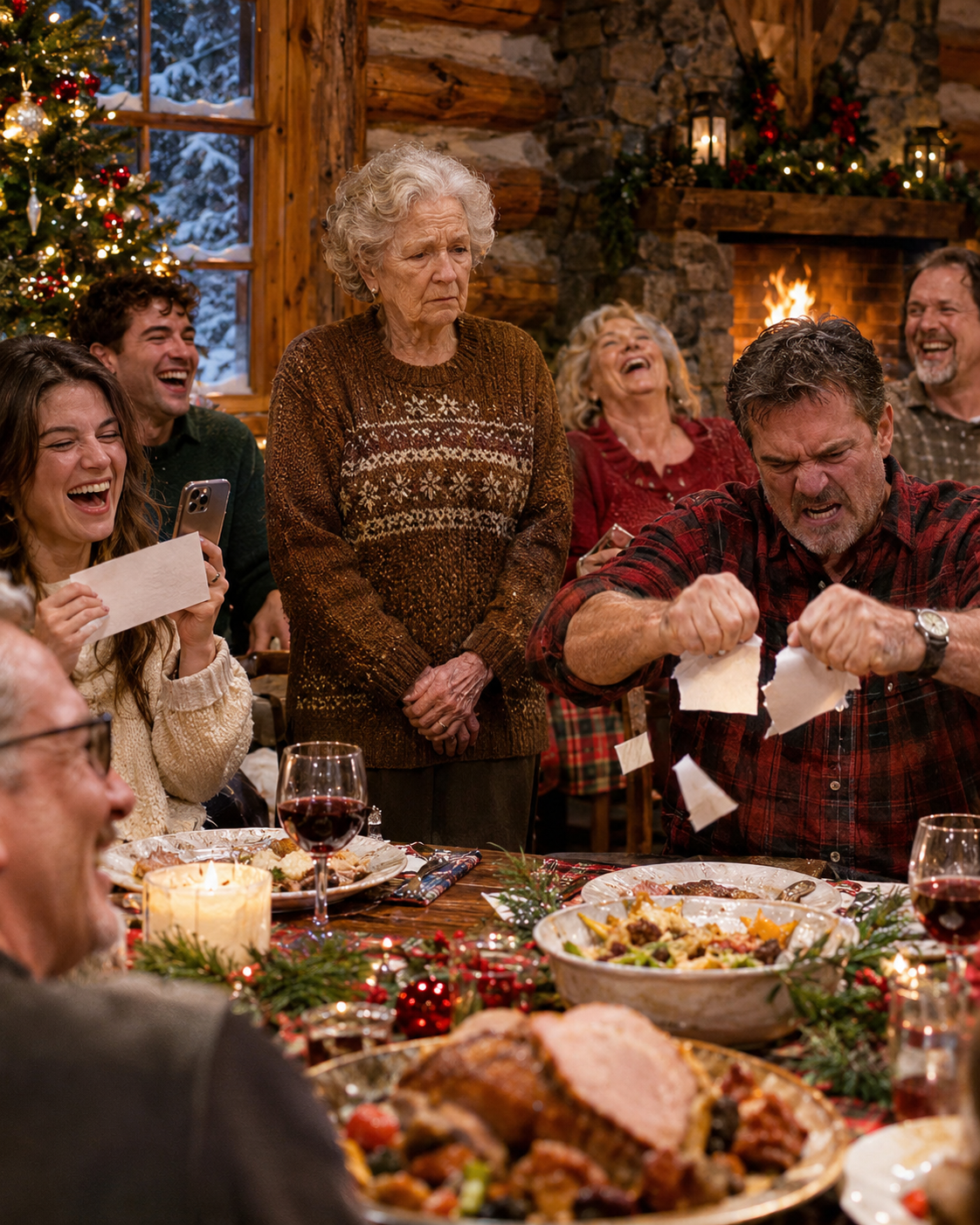
I thought about Dad tearing his into four pieces.
Eric waving his like a fan.
Olivia posting a photo.
Aunt Diane treating hers like counterfeit money.
My stomach twisted.
“Can you tell me if theirs are real too?”
“No.”
Privacy.
Of course.
He could only discuss the item I presented.
“Can you tell me whether Grandma actually has that kind of money?”
“I can tell you the account tied to this check is sufficient for this item.”
Careful.
Professional.
No gossip about customer wealth.
Good.
Then Edward asked the question that mattered.
“Are you certain your grandmother intended this as a gift?”
“Yes.”
“Did she place any conditions on it?”
“No.”
“Did she seem confused?”
I pictured Evelyn’s eyes at the Christmas table.
Steady.
Watchful.
“No.”
“Was anyone pressuring her?”
“No.”
“Did she ask you to deposit it immediately?”
“No.”
That answer made him pause.
He folded his hands.
“Then my recommendation is simple.”
“Deposit it?”
“Call your grandmother first.”
I blinked.
He continued.
“This is not legal advice. It is practical advice. A transfer this large changes lives. Before you rely on it, confirm directly that she intended the amount and understands the transaction.”
He was right.
I felt foolish for not calling before driving to the bank.
I had been thinking about proving Dad wrong.
That was not the same as understanding what Grandma had done.
Edward slid a deposit acknowledgment toward me.
The bank could accept the check for processing while verification continued.
I signed.
Not because I planned to spend anything.
Because leaving a six-million-dollar paper check in my apartment suddenly felt insane.
Edward made a copy.
Then had another officer witness the item.
Two signatures.
Two scans.
Procedures.
For the first time, the number felt real.
When I left his office, Tiffany the teller avoided staring at me.
I appreciated that.
Outside, Boulder looked exactly the same.
Traffic.
Snow piled near the curb.
A delivery truck.
A student jogging with headphones.
Nothing in the world announced that I might suddenly be wealthy.
I sat in my car without starting it.
Then called Grandma.
No answer.
I called again.
Still nothing.
My chest tightened.
Her cough.
The way she had steadied herself against the wall.
I tried a third time.
Voicemail.
“Grandma, it’s Daniel. I went to the bank. Please call me.”
Then I added:
“I’m not touching anything until we talk.”
That felt important.
Not because Edward told me to.
Because the money was hers before it became mine.
The bank could verify paper.
Only Evelyn could explain intent.
I called her neighbor, Mrs. Alvarez, whose number I still had from helping with a snowstorm two winters earlier.
She answered on the second ring.
“Daniel?”
“Have you seen Grandma today?”
“She was up early. Why?”
“She isn’t answering.”
“Hold on.”
I heard a door open.
Wind.
Then muffled footsteps.
Three minutes later, Mrs. Alvarez came back.
“She’s here. She was in the greenhouse. Left her phone inside.”
I laughed from relief so hard my eyes watered.
Then Evelyn’s voice came through.
“Daniel?”
“Grandma.”
“Well, you sound dramatic.”
“You gave me six million dollars.”
A pause.
Then:
“Yes.”
Not confusion.
Not surprise.
Just yes.
“Grandma, the bank says it’s real.”
“I should hope so.”
I gripped the steering wheel.
“Where did you get forty-two million dollars?”
She laughed.
That sound was almost worse than Edward’s serious face.
“Oh, dear.”
“What?”
“You all really never asked me anything, did you?”
And there it was.
The first answer.
Not about money.
About us.
Edward called me again late that afternoon.
Not because anything was wrong.
Because a transaction of that size triggered a second-level review and he wanted to make sure I understood the availability schedule.
“Mr. Harper, the check has been accepted for collection. That is not the same as final settlement.”
“I understand.”
“Do you?”
Probably not fully.
He explained the difference between a deposit receipt and money I should already consider spendable.
The issuing account had to be verified.
The item had to survive fraud screening.
Large transfers could generate holds even when genuine.
If anything unusual appeared, the bank could request additional documentation.
I appreciated the caution.
Six million dollars had become real enough to make patience feel like discipline.
I asked whether I should tell Grandma the bank might call her.
“Yes.”
That mattered too.
A large gift does not eliminate the giver’s role in verification.
I called Evelyn after our first conversation.
“Grandma, the bank may contact you.”
“Good.”
“You sound too relaxed.”
“I already warned mine.”
Of course she had.
She had not casually written giant checks at the kitchen table without preparation.
That assumption had been ours.
She had spoken with Sarah.
Spoken with the bank.
Set aside the funds.
Created records.
The Christmas surprise had been emotional.
Not financially improvised.
That difference humbled me.
I had thought I was being careful because I did not laugh.
In reality, Evelyn had been far more prepared than any of us.
The bank also asked whether I wanted private-banking services.
I declined for the moment.
Not because private banking was bad.
Because I did not want a sales conversation inside a verification process.
Edward respected that.
He gave me names for independent tax and financial professionals outside his bank too.
That impressed me more.
A week earlier, I would have treated six million as one number.
Now it had categories.
Tax reporting.
Investment risk.
Liquidity.
Insurance.
Estate planning.
Security.
Privacy.
Every category represented a way to make a bad decision quickly.
So I made none.
No car.
No house.
No gifts.
No announcement.
I kept teaching.
On the first day back, one student asked why I looked distracted.
“I had an unusual Christmas.”
That was all.
I liked that the classroom still needed the same things from me.
Attendance.
Discussion.
Feedback.
No one cared what sat in review at the bank.
Ordinary responsibility became stabilizing.
The money was huge.
My Tuesday class still started at nine.
That first weekend after the deposit, I also realized how vulnerable information had become.
Edward warned me about scams.
Large deposits can attract attention if someone talks.
I had told no one outside family and the bank.
Good.
He suggested credit monitoring, stronger account security, and limits on how much information I shared over the phone.
I updated passwords.
Added verbal verification instructions.
Opened a separate account structure after consulting an adviser.
Not because I expected criminals around every corner.
Because six million dollars changes the cost of carelessness.
At school, I told no colleagues.
Not even my department chair.
I did not want money changing how people saw ordinary decisions.
If I bought lunch, was I showing off?
If I declined a fundraiser, was I selfish?
I wanted time before other people’s interpretations arrived.
That privacy became useful.
I could decide what the money meant to me before the world tried to decide for me.
Grandma approved.
“People cannot gossip about numbers they do not know.”
“They know six million.”
“Family knows. That is already too many.”
She was not wrong.
By February, one cousin who had not attended Christmas called asking whether the story was true.
I asked who told him.
Three names later, I stopped.
Information travels.
I learned to answer simply:
Grandma made a gift. I’m not discussing details.
No lies.
No balance screenshots.
No proof.
Wealth can turn privacy into discipline.
That was one of the earliest costs of the gift nobody mentioned at Christmas.
I also made one decision that day that saved me later.
I wrote down exactly what Edward had said.
Not because I distrusted him.
Because huge numbers distort memory.
Valid check.
Funds sufficient.
Enhanced verification.
No guarantee of immediate availability.
Call Evelyn.
Those notes prevented me from later turning the bank meeting into mythology.
The manager’s face had not “gone pale because Grandma was richer than the bank.”
He had become serious because the transaction was extraordinary.
Details matter.
Family stories already had enough exaggeration.
I wanted one clean record of the first moment reality changed.
A month later, I asked Edward whether he remembered the check. Of course he did. Transactions that large are not daily events at a neighborhood branch. But what he remembered most was not the amount. “You kept asking whether your grandmother understood what she had done.” That surprised me. I had felt greedy just for standing there. He had seen caution. Perspective depends on which detail you notice. That conversation helped me stop being ashamed of having accepted the gift at all. Accepting something freely given is not the same as taking.
I never spent from the deposited funds during the verification window. That choice gave me psychological distance from the number. Until settlement completed, I treated it as information, not wealth. When the bank finally released the full balance, there was no fireworks moment. Just a status change on a screen. I stared for a minute, closed the app, and went to grade essays. That ordinary response reassured me more than any celebration could have.
The check cleared fully several days later. Edward called once more, congratulated me, and reminded me to move slowly. I thanked him for treating the transaction like a financial event instead of a spectacle. He said, “That is the job.” I liked that answer.
“Come back next weekend.”
“Grandma, I have work.”
“You have accumulated personal days.”
“How do you know that?”
“You complain every Christmas.”
I smiled.
Even with six million dollars moving through the banking system, she was still Evelyn.
I drove to Sheridan three days later.
Before I left, Edward called.
Verification had progressed.
The check had cleared the drawer bank’s initial review.
Funds were still subject to final availability procedures, but there was no indication the instrument was fraudulent.
He repeated:
“Do not make major commitments until everything is fully settled.”
I promised.
At the cabin, Grandma had stew waiting.
No lawyer.
No financial adviser.
No dramatic folder.
Just soup.
I wanted answers immediately.
She made me eat first.
Then we sat near the fireplace.
“Grandma.”
“I know.”
“Forty-two million dollars.”
“More.”
I stared.
She sipped tea.
“How much more?”
“Enough that those checks did not empty anything important.”
That answer was almost annoying.
Then she explained.
Grandpa Walter had never been only the quiet man who fixed tractors and disappeared into his workshop.
He had bought land.
Not glamorous land.
Ranch parcels.
Mineral rights.
Timber acreage.
A few commercial properties.
Mostly in the 1970s and 1980s, when prices were low.
He and Evelyn also invested steadily.
Never sold much.
Never upgraded the cabin because they liked it.
Never bought luxury cars.
Never discussed numbers with family because, as Grandma put it:
“Everyone became strange the minute money entered a sentence.”
After Grandpa died, she inherited the remaining interests.
A major energy company later bought several mineral-right packages.
A commercial parcel near a growing corridor sold for far more than either of them expected.
Investments had compounded.
Tax planning reduced some immediate damage.
An accountant and estate attorney helped restructure assets.
The result was a fortune hidden in plain sight.
“Why did you ask Daniel for roof money?” I asked.
That was Aunt Diane’s accusation.
Grandma frowned.
“I did not ask your father for roof money.”
“Aunt Diane said you did.”
“I said the roof needed work. Your father said he would find someone. He never did.”
I looked down.
That sounded more like Dad than I wanted to admit.
“Why not pay for it?”
“I did.”
She pointed upward.
“The contractor comes in spring.”
Of course.
Everyone had interpreted ordinary conversation through the assumption that Grandma was poor.
I had too.
The difference was I stayed.
That did not make me virtuous.
It made me available enough to notice she was tired.
“Why the checks now?”
Her expression changed.
Not sad exactly.
Resolved.
“I am eighty-six.”
“Eighty-seven in March.”
“If I get there.”
My stomach dropped.
“What does that mean?”
She coughed.
Longer than I liked.
Then she said:
“I have pulmonary fibrosis.”
The room went quiet.
I had heard the term.
Not enough to understand.
“How serious?”
“Serious enough.”
“How long have you known?”
“Seven months.”
“Why didn’t you tell us?”
She looked at me with that same steady Christmas gaze.
“When would I have told you?”
That hurt because it was partly fair.
I called.
Not enough.
Visited.
Not enough.
Everyone else even less.
She continued.
“I did not want the last year of my life to become a waiting room where people counted my breaths against an inheritance.”
“So you gave it away.”
“Some.”
“Six million each.”
“Yes.”
“To everyone.”
“Yes.”
“Even Dad after he tore it up?”
She smiled faintly.
“I wrote the check.”
Not the same as replacing it.
Important.
“What did you want us to do?”
“Whatever we chose.”
“Then why give it at Christmas?”
“Because everyone was there.”
“That’s it?”
“No.”
She looked toward the window.
“I wanted to see what money revealed while I was still alive.”
I stiffened.
That sounded too much like a test.
She saw it.
“Not a contest, Daniel.”
“Then what?”
“Information.”
She explained.
She had spent years hearing family opinions about her life.
Sell the cabin.
Move to assisted living.
Stop growing vegetables.
Get rid of Grandpa’s tools.
Accept help.
No one asked what she wanted.
She feared that after death, the estate would become the same thing.
People telling one another what Evelyn meant.
So she wanted major gifts completed while she could answer questions.
Not from beyond a will.
Living gifts.
Transparent accounting.
Proper taxes.
Professional records.
The checks were not her only plan.
They were the first visible part.
“Did you expect everyone to laugh?”
“No.”
That answer came quietly.
For the first time, hurt entered her face.
“I expected confusion.”
My chest tightened.
She looked at the fire.
“I did not expect your father to tear it before asking one question.”
I reached for her hand.
She let me hold it.
“I’m sorry.”
“You didn’t tear yours.”
“That doesn’t make me better.”
“No.”
Good.
Grandma refused to turn my caution into sainthood.
Then she said:
“You deposited it?”
“It’s processing.”
“Good.”
“Why good?”
“Because a gift is only useful if the recipient receives it.”
The sentence stayed with me.
Not because of money.
Because she said it like she had learned that lesson somewhere painful.
I asked whether she wanted help telling the family.
“No.”
“Grandma.”
“They will discover what they did.”
“How?”
She smiled.
“Banking is educational.”
Grandma showed me one old metal filing box after dinner.
Nothing glamorous.
Receipts.
Mineral leases.
Tax notices.
Handwritten letters from Grandpa.
A faded map with red pencil marks.
One parcel had been purchased because Walter wanted hunting access.
Another because Evelyn believed a road extension would raise value.
One mineral-right interest had produced almost nothing for twenty years.
Then drilling technology changed.
Revenue grew.
The fortune was not a secret vault.
It was a collection of boring decisions held long enough to become large.
That changed how I thought about wealth immediately.
No single genius move.
No casino moment.
No hidden criminal empire.
Patience.
Land.
Markets.
Luck.
Tax planning.
And the privilege of owning assets early enough for time to work.
Grandma refused to romanticize it.
“We were lucky.”
“You were smart too.”
“Both.”
That answer mattered.
Family stories prefer one cause.
Hard work.
Luck.
Talent.
Privilege.
Usually several coexist.
She also showed me a letter from an energy company offering a buyout years before.
Walter wanted to accept.
Evelyn refused.
Later, the rights became worth far more.
“Grandpa listened?”
“Eventually.”
I laughed.
“Was he mad?”
“For six months.”
Real marriage.
Not genius partnership.
They argued.
Compromised.
Missed opportunities.
Made others.
Grandma’s fortune felt more believable the more ordinary the record became.
She also admitted they had made mistakes.
A retail partnership failed.
One parcel lost money.
An investment in a regional airline disappeared.
“We were not wizards.”
Good.
I needed to hear that before six million made me afraid of every decision.
If Evelyn and Walter could lose money and still build wealth, I did not need perfection.
I needed process.
That night she gave me the name of her accountant.
Not so I could use him automatically.
“So you can ask him what questions to ask somebody else.”
Grandma understood independence better than the rest of us.
Advice should increase choice.
Not replace it.
Grandma’s hidden wealth also altered how I saw the cabin itself.
I had always thought the worn cabinets meant she could not afford new ones.
Wrong.
She liked them.
The old truck?
She trusted it.
The greenhouse?
She preferred vegetables she grew herself.
Frugality was preference, not deprivation.
That distinction embarrassed me.
How often had I looked at older relatives and converted simplicity into need?
Grandma showed me receipts for things she spent freely on.
Medical care.
Land maintenance.
Books.
Donations.
She was not afraid of spending.
She disliked spending for display.
That value was hers.
Not a universal rule.
Later, when I bought a nicer home, I worried she would judge me.
Then remembered she had never asked me to copy her.
Wealth does not come with one correct aesthetic.
A person can live in a cabin with forty million dollars.
Another can buy a beautiful house with far less.
Meaning comes from choice.
Not price.
Grandma also revealed she had quietly paid for several local students’ community-college tuition over the years.
No plaques.
No public foundation then.
She liked direct giving.
I preferred structured grants.
Different methods.
Same general value.
Honoring someone does not require reproducing their exact style.
That lesson saved me from turning Evelyn into a saintly blueprint.
She was a person with preferences.
I was allowed to have mine.
Grandma also told me Walter had once considered selling the cabin when maintenance became difficult.
She refused.
Then, years later, she considered selling it herself.
Changed her mind.
That surprised me.
I had thought the cabin represented unwavering devotion.
No.
She had doubts.
Ownership is not a sacred vow.
People reassess.
That helped me later when the trust needed major repairs.
Preservation was a choice renewed through structure.
Not proof that Evelyn had never questioned the place.
Grandma also admitted she had considered telling the family about the fortune years earlier. Walter talked her out of it. “He said people should know us before they know the balance sheet.” She still agreed with him, mostly. But she had learned another side too: secrecy can create assumptions that become their own distortions. By the end of her life, she wanted enough transparency to reduce mystery without turning wealth into identity. The Christmas checks were her imperfect attempt at that balance.
Evelyn also told me she had worried the family would suddenly become attentive only because of money. She hated herself for suspecting that. Then she admitted suspicion was not the same as certainty. “Watch what people do after the excitement fades,” she said. Good advice. Some relatives did fade again. Others changed. She allowed behavior over time to answer instead of deciding everyone’s motives immediately.
Before I left Sheridan, Grandma made me promise not to tell people she had been “secretly poor” or “secretly rich.” Both labels annoyed her. “I was simply private,” she said. That distinction stayed with me.
Not hello.
Not how are you.
“Did you take that check to the bank?”
I closed my classroom door.
“Yes.”
Silence.
Then:
“And?”
“It’s real.”
Another silence.
Longer.
“Don’t screw with me, Daniel.”
“I’m not.”
“You deposited six million dollars?”
“It’s still clearing through bank procedures, but yes.”
He said nothing.
Then hung up.
Eric called three minutes later.
“Dad says you’re lying.”
“I’m not.”
“What bank?”
“Not relevant.”
“Send a screenshot.”
“No.”
“Why?”
“Because I don’t send bank screenshots to prove things.”
“You always were weird.”
Fine.
Olivia texted:
PLEASE tell me Grandma’s check was actually real.
I wrote:
Yes.
Typing dots appeared.
Stopped.
Appeared again.
Then:
I threw mine away.
That sentence carried a different weight now.
Aunt Diane called next.
Then Uncle Martin.
By noon, everyone knew.
Dad found the four pieces of his check.
Apparently Mom had swept them into a drawer instead of throwing them away.
He taped them together.
That image should not have been funny.
It was.
He drove to his bank.
The teller could not accept a damaged item without review.
That did not mean the money vanished forever.
But a torn check creates practical problems.
His bank contacted the issuing bank.
Verification.
Possible replacement request.
Drawer authorization.
Nothing instant.
Dad called Grandma.
I learned later how it went.
“You need to write me another check.”
Not:
Mom, is this real?
Not:
Why did you do this?
Another check.
Grandma said:
“No.”
Dad exploded.
“But you intended to give me six million.”
“Yes.”
“Then replace it.”
“I may.”
“What do you mean may?”
“I mean I will decide.”
That was her right.
A check is an order to pay.
Tearing it does not necessarily erase every underlying intention or obligation.
But this was a gift.
Not a debt Dad could enforce simply because the first paper existed.
Grandma’s lawyer later confirmed she remained free to stop, replace, or decline further gifting depending on circumstances and applicable law.
The family hated that.
They wanted Christmas to become a contract.
It was not.
Eric had folded his check into a pocket.
Then washed the pants.
The paper survived badly.
Olivia found hers in the trash after digging through a bag outside her apartment.
Aunt Diane had hers.
So did Uncle Martin.
Mom’s was intact in her purse.
Everyone suddenly became careful with paper they had mocked.
That afternoon, the family group chat exploded.
Dad:
Nobody deposits anything until we figure out what Mom is doing.
I stared.
Then replied:
Mine is already deposited.
Dad:
You had no right.
That sentence stopped me.
No right?
Grandma wrote the check to me.
I had every right to present it.
But arguing in a group chat would accomplish nothing.
I muted it.
Eric called again.
“Did Grandma tell you where the money came from?”
“Yes.”
“What did she say?”
“Ask her.”
“She won’t answer.”
“Then wait.”
“You think you’re special because you stayed after Christmas.”
“No.”
He laughed bitterly.
“You always do this.”
“Do what?”
“Act calm so everyone else looks crazy.”
That one hit.
Because maybe I did.
Teaching teenagers and dealing with family had taught me that calm can become a weapon if you use it to imply moral superiority.
I did not want that.
So I said:
“I’m not calm. I’m scared Grandma is sick.”
Silence.
“What?”
I regretted saying it immediately.
Not my medical news to disclose.
“Call her.”
“Daniel.”
“Call her.”
Then I hung up.
I called Grandma next.
Told her I had slipped.
She was quiet.
Then:
“It’s time anyway.”
Within an hour, she told everyone herself.
Pulmonary fibrosis.
Progressive.
Treatment focused on slowing decline and managing symptoms.
No miracle cure promised.
Suddenly, the six-million-dollar checks were not the biggest thing in the family.
At least they should not have been.
Dad still asked about replacement paperwork in the same call.
That was when I understood the real fight had not even started.
When the family learned about the illness, the group chat changed tone for about six hours.
Then money returned.
Dad asked whether the illness affected the checks.
Eric asked whether there would be taxes.
Olivia asked if Grandma had written a will.
Aunt Diane asked who had medical power of attorney.
I stared at the messages.
Then muted them again.
Not because the questions were illegitimate.
Timing mattered.
The difference between concern and entitlement is often not the topic.
It is when and how you ask.
Dad eventually called me privately.
“Do you think Mom knew she was dying when she wrote them?”
“Yes.”
“Then this is part of the estate.”
“Not exactly.”
“Daniel.”
“I’m not her lawyer.”
That phrase saved me repeatedly.
I refused to become the family translator of law simply because Grandma trusted me.
Dad disliked that.
Good.
He needed to ask Sarah.
Eric did too.
When people cannot use one family member as an unofficial expert, they either seek real advice or stop arguing.
Both outcomes are better.
Olivia’s check created another practical issue.
Her social-media photo showed enough of the check that someone online tried to enhance the image.
Routing information was partially visible.
She panicked.
Called the bank.
The bank recommended closing the exposed check number through stop payment and replacing the instrument.
That became an accidental lesson in financial privacy.
Grandma was furious.
Not cruelly.
“Never post negotiable instruments.”
Olivia cried.
“I didn’t know it was real.”
“That is why you do not post things before knowing what they are.”
Fair.
The bank handled it.
No money lost.
Still, the incident showed why large gifts require more than emotion.
Information security matters.
Olivia deleted the post.
Changed privacy settings.
Filed a report when a stranger messaged asking about the “lottery.”
No crime followed.
Just caution.
For weeks, our family treated every unknown phone call like a scam.
Some probably were.
Sudden wealth increases attention.
Grandma had lived quietly partly to avoid that.
We finally understood why.
The damaged-check crisis created one awkward banking lesson for Dad.
He thought taping the pieces together should make the instrument usable.
The bank employee explained that physical integrity, endorsement space, machine processing, and fraud concerns all mattered.
Dad came home furious at “bureaucracy.”
Then Sarah asked:
“If a stranger handed you a six-million-dollar check taped into four pieces, would you want the bank to accept it without review?”
He stopped.
Point made.
Systems feel annoying when they slow us down.
Protective when they slow someone else down.
That contradiction became a family joke too.
Dad complained about holds until he imagined fraud against himself.
Then suddenly procedures seemed wise.
The replacement process also required identity verification that annoyed Eric.
He had moved recently.
Address mismatch.
More review.
He complained.
Then remembered Olivia’s social-media exposure.
Fine.
Security has friction.
We all became better at tolerating it.
The Christmas checks had made everyone briefly believe money should move instantly because emotion was intense.
Banks did not care about our emotional urgency.
That was healthy.
Procedures kept the family from converting panic into bad transfers.
Even Grandma appreciated delay.
It gave her time to decide replacements from intention rather than pressure.
Olivia’s social-media mistake also changed how the family handled privacy afterward.
No posting checks.
Medical news.
Estate papers.
Hospital rooms.
Nothing without permission.
Simple rule.
At first Olivia felt singled out.
Then she became the strongest defender of it.
Years later, when a cousin tried to post Grandma’s hospital photo, Olivia stopped him.
People can become good guardians of the boundary they once crossed.
That gave me hope in other family conflicts too.
Eric eventually had his water-damaged original check returned after replacement processing. The bank marked it void. He kept it in a plastic sleeve for a year, then threw it away himself. “I don’t need the souvenir.” That choice impressed me. He had spent months obsessing over the piece of paper. Letting it go showed the money had finally become real enough that the ruined object no longer felt magical.
Dad’s anger about the damaged check softened once he understood the replacement was a choice Evelyn retained. He still hated feeling dependent on her decision. That discomfort was useful. For years, he had made family members feel dependent on his decisions. He later admitted the parallel. Not in a grand speech. Just one quiet sentence: “I see why people hate being managed.” I remembered it.
Olivia later admitted the online post embarrassed her more than the damaged check. Money could be replaced. A public mistake lingered. She became careful about posting other people’s moments after that.
She had represented Evelyn for almost eleven years.
Estate planning.
Property sales.
Trusts.
Tax coordination.
Sarah agreed to a family meeting only because Grandma requested it.
Not because Dad demanded it.
We gathered by video.
Grandma at the cabin.
Sarah in her office.
The rest of us scattered across four states.
I stayed quiet.
Sarah began with boundaries.
“I represent Evelyn Harper. I do not represent any beneficiary or family member.”
Dad interrupted.
“We understand.”
Sarah held up a hand.
“I need everyone to actually understand.”
Good.
She explained that Evelyn had made significant lifetime gifts.
The checks were real.
The funds supporting those checks existed.
Tax reporting would be handled appropriately by Evelyn’s team, including gift-tax filings where required.
Receiving a gift generally did not mean each recipient personally owed federal income tax simply because a gift was received, though everyone should obtain their own tax advice.
Eric whispered:
“So it’s really six million.”
Sarah ignored him.
Then Dad asked:
“Can Mom replace mine?”
“Evelyn can decide whether to issue another instrument.”
“But she already gave it.”
“She attempted a gift by check. Whether a completed gift occurred can involve delivery, acceptance, negotiation, and applicable law. I am not giving you individual legal advice.”
Dad hated uncertainty.
“I tore it because I thought it was fake.”
Grandma spoke.
“You tore it because you did not ask me.”
Silence.
Sarah continued.
Olivia asked about her stained check.
Aunt Diane asked how long checks remained valid.
Mom asked whether depositing hers would affect Grandma’s care.
Good question.
Grandma answered.
“No.”
That was the first question that made her smile.
Sarah confirmed Evelyn had retained substantial assets and dedicated reserves for medical care, home support, taxes, property maintenance, and estate administration.
The gifts were not impoverishing her.
No one was draining the cabin to hand out money.
Dad asked for the total estate value.
Sarah said:
“That is not information Evelyn has authorized me to disclose.”
He argued.
Grandma ended it.
“Roberto, stop.”
We had never called Dad Roberto at home.
Grandma did when serious.
He stopped.
Then Evelyn explained why she gave while alive.
“I am tired of being interpreted.”
No one spoke.
“When Walter died, everybody told me what he would have wanted. Half of you were wrong.”
Aunt Diane looked offended.
Grandma continued.
“I do not want to be dead while you explain me to one another.”
The checks were not a loyalty prize.
Not a test where the people who believed got money and the people who laughed lost.
That was important.
She had intended equal gifts.
But destruction, loss, and failure to deposit could require practical decisions.
She would consider replacement requests individually after consulting Sarah and the bank.
Not immediately.
No one liked that.
Good.
Sometimes delay protects decisions from panic.
Grandma also made one thing clear.
“I gave you money. I did not sell you the right to manage me.”
That sentence changed the meeting.
Dad had already suggested moving her to Colorado.
Aunt Diane wanted her near Chicago.
Mom had researched private nursing care.
All within forty-eight hours of learning she was rich and ill.
Maybe concern.
Maybe control.
Probably both.
Grandma said she intended to remain in the cabin as long as medically safe.
Home health if needed.
Local pulmonary specialist plus regional specialty care.
A plan already existed.
Sarah had copies.
So did Grandma’s healthcare proxy.
Not Dad.
Dad hated that.
“Who is your proxy?”
Grandma said:
“None of your business unless it becomes necessary.”
Legally, perhaps the identity could be shared if Grandma wanted.
Emotionally, she was making a point.
Money had arrived and everyone immediately behaved as though proximity to wealth created authority.
It did not.
At the end, Sarah asked if anyone had questions unrelated to replacement checks.
No one spoke at first.
Then Mom asked:
“Evelyn, are you scared?”
Grandma went quiet.
“Yes.”
That was the first honest family question in the entire meeting.
For the next twenty minutes, nobody mentioned money.
We asked about breathing.
Medication.
Appointments.
What help she wanted.
The conversation became human again.
Afterward, Grandma called me.
“That was better.”
“Yes.”
“Still exhausting.”
“Yes.”
She coughed.
Then:
“Daniel, the money is not the story.”
I looked at my pending bank balance on the screen.
Six million dollars suggested otherwise.
But I knew what she meant.
The money was only making the story visible.
After the family video meeting, Grandma called Sarah back privately.
I knew because Sarah later told me only after Evelyn authorized it.
Grandma had one concern.
“Did I make them worse?”
That question broke my heart.
She had wanted clarity.
Instead, the checks created panic.
Sarah told her the truth.
“Money didn’t invent the family dynamics. It accelerated them.”
Exactly.
Dad’s need for control existed before.
Diane’s need to manage care existed before.
Olivia’s need to perform online existed before.
My need to become the calm fixer existed before.
The checks did not create us.
They revealed us.
Grandma worried she had been manipulative by giving such enormous gifts without warning.
Maybe partly.
Even good intentions can create chaos.
She later admitted that to us.
“I should have prepared you better.”
Dad almost said:
Yes.
Then stopped.
Good instinct.
Grandma continued.
“But your reactions were still yours.”
Also true.
That balance mattered.
No saintly giver.
No helpless recipients.
Adult choices on all sides.
She also created written guidance after the meeting.
Not instructions on spending.
Contact information.
Bank numbers.
Tax advisers.
Fraud warnings.
How to verify future communications claiming to be from her team.
Smart.
The family received packets.
Dad joked that Christmas came with a compliance manual.
Grandma replied:
“Because you tore the first document.”
He deserved that.
The packets reduced confusion.
Especially about taxes.
Grandma’s accountant explained she would be responsible for gift-tax reporting under federal rules, using available exclusions and lifetime exemption structures as applicable, and potentially tax due depending on her overall estate and prior gifts.
Recipients should still consult their own professionals.
No viral myth that everyone simply loses half the check overnight.
Real planning.
Real paperwork.
That realism strangely calmed everyone.
Huge numbers become less frightening when they enter procedures.
By the end of January, every family member had an adviser.
The checks had moved from spectacle to administration.
That was healthier.
Grandma’s “I do not want to be interpreted” line stayed with all of us.
After that meeting, Olivia asked if she could record Grandma explaining a few estate decisions.
Evelyn refused at first.
“I am not making a documentary.”
Later, she agreed to short audio notes about personal items and the cabin.
Not legal instructions.
Context.
Why the quilt collection mattered.
Why Walter’s tools belonged with Dad.
Why she wanted the cabin protected.
Those recordings reduced future myth-making.
But they also showed how much interpretation remains even when someone explains.
Grandma said the cabin should remain a gathering place.
What counts as gathering?
How many weekends?
Who pays?
Legal structure still mattered.
Feelings alone cannot administer property.
That balance between personal explanation and formal documents became one of the strongest parts of her plan.
When I later did my own estate planning, I copied the principle.
Clear legal instruments.
Separate personal letter.
No emotional riddles hidden in the will.
No “if they really loved me, they’ll understand.”
Ambiguity is not mystery.
It is work left for grieving people.
Grandma had seen enough family history to know better.
The family packets Sarah distributed included one page titled Questions You Should Ask Your Own Adviser.
That page became more useful than any prediction.
How should this gift be titled?
What tax reporting applies?
How much should remain liquid?
What insurance changes matter?
What estate plan updates are needed?
No answers.
Questions.
Grandma liked that.
“Good advice teaches you what to ask.”
That sentence became part of how I taught students too.
Education is not always giving conclusions.
Sometimes it is giving better questions.
Sarah once told me privately that Evelyn’s greatest concern was not taxes or investment returns. It was family members changing their lives too quickly. Sudden wealth can destabilize routines, marriages, work, and judgment. That was why she encouraged advisers, waiting periods, and written plans. Grandma had thought beyond whether the checks cleared. She worried about what clearing would do to us. That kind of care felt more significant than the amount itself.
The family meeting with Sarah also established a rule that nobody would pressure Evelyn privately after a group decision. If someone had a question about the gifts, ask Sarah or Evelyn openly. No side campaigns. No sending Mom to persuade her. No using me as intermediary. That rule reduced manipulation and, unexpectedly, made conversations shorter. Hidden lobbying consumes enormous energy.
After the meeting, Sarah sent written notes so nobody could later claim a different version. That one step prevented weeks of arguments. Memory bends quickly when money is involved. Written summaries helped.
Not because he was the most concerned.
Because he lived closest.
He drove four hours through light snow and pulled into Grandma’s driveway after dark.
I was already there.
Grandma had asked me to come for a pulmonary appointment.
Eric stepped inside carrying a duffel bag and a plastic grocery sack.
No gift.
No flowers.
But he had brought the cough drops Grandma liked.
Progress.
He hugged her awkwardly.
She held him longer than he expected.
Then he started crying.
That surprised both of us.
“I’m sorry I laughed.”
Grandma patted his back.
“You did.”
“I thought it was fake.”
“Yes.”
“I didn’t think you had that kind of money.”
“Yes.”
He pulled away.
“Are you mad?”
Grandma considered.
“I was hurt.”
Different.
Anger can sound temporary.
Hurt makes people listen.
Eric sat beside her.
“I washed the check.”
“I heard.”
He laughed through tears.
“Dad told everyone.”
“Your father has always loved broadcasting other people’s mistakes.”
Accurate.
Olivia arrived the next morning.
She had recovered her check from the trash, but it was creased and stained.
She carried it inside a plastic sleeve like museum paper.
“Grandma.”
Evelyn looked at the sleeve.
Then Olivia.
“I see you have become respectful of stationery.”
Olivia burst into tears.
That was Grandma.
Sharp enough to make you laugh while ashamed.
Olivia apologized for posting the photo.
She had deleted it.
The screenshot still existed online because someone saved it.
That embarrassed her.
Grandma did not lecture.
“Next time, decide whether something belongs to the internet before you offer it.”
Olivia nodded.
Then:
“Can you replace it if the bank rejects this one?”
There it was.
The question none of us could avoid.
Grandma looked at her.
“Maybe.”
Olivia stiffened.
“I said I’m sorry.”
“I know.”
“Then why maybe?”
“Because apology and financial decision are separate.”
I looked at Grandma.
She had learned that distinction long before us.
Maybe through Grandpa.
Maybe business.
Maybe life.
Eric said:
“So you are testing us.”
“No.”
“Then why not just replace them?”
Grandma coughed into a handkerchief.
Long enough that we stopped talking.
When she recovered, she said:
“Because I am sick, and all of you suddenly want every decision completed immediately.”
Silence.
“I will not spend what time I have left processing panic at your speed.”
That shut us up.
The checks had created urgency.
Her illness created a different urgency.
We had confused them.
Olivia sat on the floor near the fireplace.
“What do you want us to do?”
“Today?”
“Yes.”
“Carry the winter vegetables upstairs from the cellar.”
Olivia laughed.
Grandma did not.
“I’m serious.”
So we worked.
Potatoes.
Onions.
Jars.
Boxes.
Eric fixed a loose porch rail.
I organized medications with Grandma’s permission.
Olivia cleaned the greenhouse glass.
No one mentioned six million dollars for almost six hours.
That was probably the most useful family meeting we had ever had.
That evening, Dad called.
He wanted to know who was there.
Grandma told him.
He said:
“I’m coming.”
Grandma asked:
“To see me or to discuss the check?”
Dad went quiet.
Then:
“Both.”
Honest.
Good.
He arrived the next afternoon with Mom.
Dad walked in holding the taped pieces.
I wanted to laugh.
Did not.
Grandma looked at them.
Then at him.
“You saved it.”
“Of course.”
“You tore it.”
“I was an idiot.”
There.
Dad almost never used that word about himself.
He sat down.
“Mom, I’m sorry.”
Grandma nodded.
Then waited.
Dad continued.
“I made your gift into a joke because I had already decided what your life looked like.”
That sentence surprised me.
Mom had probably helped.
Maybe therapy by telephone with Sarah.
Did not matter.
It was accurate.
Dad held out the taped check.
“Can we fix this?”
Grandma did not take it.
“We can discuss it with the bank.”
Not yes.
Not no.
Process.
Dad nodded.
That was the first time he accepted process without turning it into rejection.
Aunt Diane and Uncle Martin came two days later.
Suddenly the little cabin held too many coats.
Too many shoes.
Too many opinions.
Grandma grew tired.
I saw it before anyone else.
Maybe because I was watching her instead of the checks.
I stood.
“Everyone out for an hour.”
Dad frowned.
“This is Mom’s house.”
Grandma said:
“Listen to Daniel.”
Dad looked offended.
Then obeyed.
We all went to the diner in Sheridan.
Seven adults sitting in a booth arguing about soup.
No money.
No estate.
Just waiting while Grandma slept.
That hour taught us something.
Being present does not mean being constantly in the room.
Sometimes care means leaving.
Dad’s visit to the cabin after the replacement discussion lasted three days.
The first day, he followed Grandma everywhere.
Kitchen.
Greenhouse.
Porch.
She tolerated it for six hours.
Then:
“Roberto, sit down or leave.”
He sat.
Dad had always expressed love through action.
Fix.
Drive.
Call.
Arrange.
Doing nothing beside someone felt impossible.
Grandma made him practice.
They sat by the window.
For almost an hour.
No repairs.
No money.
Just weather.
Later Dad told me:
“I didn’t know what to say.”
“You didn’t need to.”
He looked annoyed.
Then thoughtful.
Our family had spent years using usefulness to avoid vulnerability.
I fixed things.
Dad organized.
Mom cooked.
Diane advised.
Eric joked.
Olivia documented.
Grandma’s illness removed some of those defenses.
There were hours when nothing could be fixed.
That forced presence.
Eric struggled too.
He came one weekend and asked me what project needed doing.
“Nothing.”
“There has to be something.”
“Sit with her.”
He looked terrified.
He sat.
Grandma asked about his job.
Then his divorce.
A subject he had avoided for two years.
By dinner, he had told her more than he ever told us.
Money did not create that conversation.
Illness created the urgency.
But the gift had brought him back to the cabin long enough for it to happen.
That distinction kept returning.
The checks were not the story.
They changed the traffic around the story.
People came.
Stayed.
Asked.
Sometimes for the wrong reasons.
Then other things became possible.
The diner hour while Grandma slept became unexpectedly important.
Dad ordered pie.
Eric coffee.
Olivia nothing.
Nobody knew what to say.
Finally Aunt Diane said:
“I feel disgusting.”
Dad looked at her.
“About the check?”
“About wanting to know if Mom replaced it while she can barely breathe.”
There.
Everyone had thought it.
Diane said it.
That honesty helped.
Eric admitted he had checked the bank balance twice that morning.
Olivia admitted she had searched online for gift-tax rules before searching pulmonary fibrosis.
Dad looked ashamed.
Then I admitted I had done the opposite version.
I researched pulmonary fibrosis obsessively because focusing on illness made me feel morally superior to everyone focused on money.
Dad looked at me.
“Really?”
“Yes.”
Good.
No hero.
We all had anxiety.
It chose different disguises.
Money research.
Medical research.
Control.
Jokes.
Silence.
Once we named that, shame loosened.
We could care about both.
Grandma’s health.
The financial reality.
Human beings can hold more than one concern.
The issue was which one we allowed to dominate the person in front of us.
When we returned to the cabin, Grandma was awake.
She asked:
“Did you solve the world?”
Dad said:
“No.”
“Good. Less work tomorrow.”
She understood us better than we did.
During one quiet afternoon, Eric admitted he had almost skipped Christmas completely.
Work deadline.
Snow.
Long drive.
He came because Grandma had sounded unusually firm on the phone.
“If I hadn’t gone, would she have mailed the check?”
We never knew.
That question haunted him.
Not because of money.
Because he might have missed one of the last healthy Christmases with her.
He stopped skipping family events automatically after that.
Not all.
Enough.
Priorities became more deliberate.
Olivia apologized one more time for laughing at Christmas while Grandma was still alive. Evelyn stopped her. “You already apologized.” Olivia said she still felt bad. Grandma answered, “Feeling bad forever is not repair.” That sentence changed Olivia. She stopped using shame as proof she had learned. Instead, she changed behavior. Less posting. More asking. More private time with Grandma. Guilt became useful only when it moved.
When Dad finally sat quietly beside Evelyn, he noticed details he had missed for years. The way she rubbed her thumb when anxious. How she watched birds through the window. How often she paused before standing. He told me later he had known his mother’s opinions better than her habits. That difference haunted him. It also made his later visits more attentive and less managerial.
Grandma slept deeply after everyone left the cabin that evening. I checked on her once, then stopped myself from hovering. Care includes trusting someone to rest without being watched constantly.
Not for a dramatic will reading.
For paperwork.
Grandma wanted to review replacement procedures for the damaged checks.
Her bank had its own requirements.
The original checks had been issued from a high-balance private account, not cashier’s checks.
That meant Evelyn could stop payment and issue replacements if she chose.
But the bank wanted written confirmation for the torn and badly damaged items, especially because of the amounts.
Olivia’s check could probably still be processed if the bank accepted the physical instrument after review.
Eric’s water-damaged check was less certain.
Dad’s taped check was almost comic.
Grandma decided not to make anyone play paper roulette.
She placed stop payments on the damaged checks.
Then told Sarah to prepare replacement documentation.
Dad smiled too soon.
Grandma raised a finger.
“After we talk.”
His smile disappeared.
“What is there to talk about?”
“Why you believe replacement is something I owe you.”
Dad opened his mouth.
Closed it.
Sarah looked at her notes.
Professional silence.
Grandma continued.
“I intended equal gifts at Christmas. That remains my intention.”
Everyone relaxed slightly.
Then:
“But I want you to understand something before I rewrite anything.”
She looked at Dad first.
“When I told you the roof leaked, you said you were too busy.”
Dad looked down.
“At Thanksgiving, I told you I was short of breath.”
“I thought it was the altitude.”
“You did not ask again.”
Then Eric.
“When I called because the truck would not start, you sent me a number for a mechanic.”
Eric winced.
“I live four hours away.”
“I know.”
Then Olivia.
“You post pictures of this cabin every Christmas. You have not stayed overnight in six years.”
Olivia cried quietly.
Grandma turned to Aunt Diane.
“You tell everyone I am stubborn because I refuse assisted living.”
Diane started:
“I worry—”
“I never asked you not to worry. I asked you to stop describing my choices as confusion.”
Diane fell silent.
Then Grandma looked at me.
My stomach tightened.
“You call.”
I waited.
“You visit more than they do.”
Still waiting.
“You also assume helping me with chores means you understand what I want.”
There.
Fair.
I had started interpreting my closeness as expertise.
Same family habit in a nicer coat.
I nodded.
“You’re right.”
Grandma leaned back.
“This is why I gave money while alive. Not to reward the good child. Not to punish the careless one. I wanted all of you to have something significant before my death so the estate itself would carry less hunger.”
Dad said:
“Then replace the checks.”
Grandma almost laughed.
“Roberto, you can hear a whole speech and still land on the money.”
Mom covered her mouth.
Even Dad laughed eventually.
That broke the tension.
Sarah explained the replacement process.
New checks would be written.
Old check numbers voided.
Recipients would sign acknowledgment that the replacement superseded the damaged instrument.
Clear records.
No duplicate negotiation.
No confusion.
Dad asked whether the six million was “his” before he received the new check.
Sarah said:
“Do not make me answer a law-school exam in your mother’s living room.”
Grandma laughed so hard she coughed.
Then needed oxygen.
The laughter stopped immediately.
That was our new reality.
Joy and fear in the same minute.
When her breathing settled, she said:
“Write the replacements.”
Sarah did.
Not that day physically.
The bank prepared them over the next several business days.
Verification.
Controls.
Documentation.
No one walked out with a fresh six-million-dollar note after a five-minute conversation.
That mattered.
The replacements eventually arrived by secure delivery and were deposited through each recipient’s bank with enhanced review.
Dad received his money.
So did Eric.
Olivia.
Mom.
Aunt Diane.
Uncle Martin.
The equal-gift intention survived our bad Christmas behavior.
Some relatives later said Grandma should have withheld money as a lesson.
She refused.
“I am not buying better children with six million dollars.”
Exactly.
Consequences came elsewhere.
Embarrassment.
Changed trust.
Medical reality.
The need to face what we had ignored.
Money was not the punishment.
And keeping it was not forgiveness.
That distinction made her decision stronger.
When the replacement checks finally arrived, the bank required each recipient to acknowledge the prior item had been stopped.
Dad complained about the form.
Grandma watched him sign.
“Read it.”
“I know what it says.”
She raised an eyebrow.
The entire family laughed.
Dad read it.
Every line.
Then signed.
That became another family joke.
Do not tear the check.
Read before signing.
Verify before laughing.
Grandma had accidentally created a financial-literacy curriculum for adults.
Eric’s adviser also encouraged him to wait before making any large purchase.
He hated that.
“I’ve already waited my whole life.”
“For what?”
“To have money.”
Interesting.
He had lived as though wealth would one day unlock the person he wanted to become.
Now he had it.
No transformation arrived automatically.
He still had the same job stress.
Same divorce grief.
Same sleep problems.
Money removed some constraints.
Not identity.
Olivia discovered the same.
She bought the condo.
Still felt lonely.
Dad bought the house.
Still missed Grandma.
Mom invested.
Still worried.
The six million became less magical each month.
Good.
Magic makes people careless.
Resources deserve reality.
Grandma encouraged each of us to spend some amount on joy.
Not all reinvestment.
Not all charity.
Dad bought an old convertible.
Eric took a hiking trip.
Olivia bought a camera she had wanted for years.
Mom renovated a kitchen.
I traveled to Ireland for two weeks the next summer.
No guilt.
Grandma said:
“If money never makes life easier or richer in experience, you are just storing numbers.”
She also said:
“If it makes you stupid, hire help.”
Classic Evelyn.
We did both.
Enjoyed some.
Planned most.
The replacement checks stopped feeling like second chances.
They became what she intended from the start.
Gifts.
After the replacement checks cleared, the family compared investment plans for about one week.
Then Grandma shut it down.
At dinner, Eric started:
“My adviser says—”
Grandma raised her hand.
“No portfolio contests.”
He laughed.
She was serious.
Comparing returns would turn the gifts into another family ranking.
Who was smartest?
Who grew six million fastest?
Who wasted it?
Grandma refused.
That was wise.
Money outcomes depend on goals, risk, timing, taxes, luck, and behavior.
A higher return is not automatically a better life.
Dad wanted income and capital preservation.
Eric wanted growth.
Olivia had a longer horizon.
Mom wanted certainty.
I wanted flexibility.
Different goals.
Different allocations.
We stopped comparing.
That boundary saved us years of smugness and shame.
When Martin’s restaurant investment failed, nobody was allowed to use it as evidence he had “wasted Grandma’s gift.”
He made a bad investment.
Not a moral failure.
He still had resources.
He adjusted.
That language mattered.
Wealth can make every mistake look larger than the person.
Grandma had given money to adults.
Not an exam.
Dad deposited the replacement check only after calling Grandma from the bank parking lot.
“Last chance to change your mind.”
Grandma said:
“Deposit it before you tear this one too.”
He laughed.
Then:
“Thank you.”
Two words.
No speech.
Grandma replied:
“Use it like an adult.”
That was their entire exchange.
Sometimes closure is not elegant.
It is enough.
Dad later told me that call mattered more than seeing the balance clear.
Dad’s financial adviser eventually told him the convertible he wanted was a terrible value. Dad bought it anyway with a tiny fraction of the gift. He drove it for years. That decision became a family lesson too. Responsible wealth management does not require every purchase to maximize value. Sometimes enjoyment is the point, provided the larger plan remains sound. Even I had to learn that.
Eric used part of his gift to establish a simple emergency fund for his children rather than handing them large sums immediately. He said he had learned from Christmas that receiving money without context can make people stupid fast. His words. The children rolled their eyes. Still, he paired money with conversation, not control. That was one place the family genuinely improved.
Dad deposited the replacement without another speech. He called Grandma only after the funds cleared. “It worked.” She answered, “Banks usually do when you don’t tear things.” He laughed.
Not overnight.
Not like a movie.
Small losses.
Longer recovery after walking to the greenhouse.
Oxygen at night.
Then oxygen during the day.
Appointments in Billings and Denver.
Pulmonary rehabilitation.
Medication changes.
No miracle.
Family money suddenly became useful in practical ways.
Home modifications.
A bathroom rail.
Better heating controls.
A stair lift she refused for three months and then requested herself.
That detail mattered.
Dad had wanted to install one immediately.
Grandma said no.
Three months later:
“Call the company.”
Same device.
Different consent.
We learned.
Home health came twice a week.
Then more.
A respiratory therapist visited.
Meals became easier.
The cabin remained hers.
Not a hospital disguised as a home.
Dad spent part of his six million on a new house.
That caused gossip.
Aunt Diane said it looked terrible.
Not her money.
Eric paid off debt and invested most of his gift after hiring an adviser.
Olivia bought a condo and quietly funded a local arts program.
Mom did almost nothing for six months because she was afraid to spend.
Aunt Diane wanted to give half to her children immediately.
Sarah told everyone to get their own tax and financial advice rather than copying one another.
Good.
My money finished clearing.
Six million in an account I did not recognize as mine psychologically.
I hired a fee-only financial planner and tax attorney.
Paid off my modest mortgage.
Created emergency reserves.
Diversified.
Kept teaching.
That confused everyone.
“Why are you still working?” Eric asked.
“Because I like teaching.”
“You have six million dollars.”
“And?”
Money did not automatically answer identity questions.
I took a reduced course load eventually.
Not retirement.
Choice.
I traveled to Grandma more often.
Could afford flights when driving was unsafe.
Could pay for substitute coverage when needed.
But I made one rule for myself.
I would not call those visits repayment.
Grandma did not buy my presence.
That mattered deeply.
Dad struggled with the same issue.
He began showing up constantly.
Too constantly.
Grandma finally told him:
“Go home.”
He looked wounded.
“I’m helping.”
“You are hovering.”
“I lost years.”
“You cannot recover them by sitting in my kitchen every day.”
That sentence broke him.
He cried on the porch.
I sat beside him.
No lecture.
He said:
“I thought there was time.”
Yes.
We all had.
That was the real family mistake.
Not laughing at the check.
Believing ordinary time was unlimited.
Dad returned home for two weeks.
Then came back for a planned weekend.
Better.
Aunt Diane apologized for pushing assisted living.
Grandma accepted.
Then asked Diane to research one facility anyway.
Not because Diane had been right.
Because Grandma wanted information in case home care stopped being safe.
The difference was ownership.
Grandma chose when the question became relevant.
Olivia started recording Grandma’s stories with permission.
Not for social media.
For family.
She labeled each file.
Walter.
Cabin.
Childhood.
Recipes.
Bad dates.
Money.
One recording began:
“Everybody thinks Walter was a financial genius. Mostly he was patient and cheap.”
Grandma laughed.
Those recordings became more valuable than any check.
Eric repaired the greenhouse heater.
Dad fixed the porch steps.
Mom cooked.
I read aloud.
Aunt Diane reorganized medications until the nurse told her to stop reorganizing things.
We became useful in smaller ways.
No one earned more money for it.
Good.
The gifts had already been equal.
Care did not become a competition.
Home healthcare created its own family tensions.
Dad thought the nurses came too often.
Diane thought not enough.
Mom wanted meal delivery.
Grandma hated the meals.
I wanted everyone to stop arguing in front of her.
Then the nurse asked the obvious question.
“What does Evelyn want?”
Silence.
We had done it again.
Turned care into a debate among helpers.
Grandma said:
“Three nursing visits a week. I choose my own lunch.”
Done.
Not every issue required consensus.
Her capacity remained intact.
That mattered.
Illness does not erase autonomy.
We learned to distinguish assistance from substitution.
Later, when her breathing worsened, some decisions shifted.
But only when needs changed.
Grandma also kept control of finances.
Professional bill pay assistance for convenience.
No child added casually as joint owner.
No family member with unrestricted power.
Sarah had designed durable powers carefully.
That prevented money from turning care into financial access.
We all resented the distance a little.
Then appreciated it.
No one had to wonder whether Dad was moving funds.
Or I was.
Or Diane.
Professional structures protected us from suspicion.
That was worth the cost.
Grandma once told me:
“Families are kinder when fewer of them can steal from each other.”
I laughed.
Then realized she was serious.
Not because she thought we were thieves.
Because temptation plus ambiguity damages relationships.
Good planning removes opportunities for suspicion.
The same logic applied to the cabin trust later.
She understood systems because she had watched people for eighty-seven years.
Money gave her reason to formalize what experience already taught her.
Grandma’s home-care team also taught us a practical lesson about dignity.
The first aide arrived cheerful and overly familiar.
Called Evelyn “sweetie.”
Grandma hated it.
After one visit, she said:
“I am old, not four.”
We laughed.
Then changed agencies.
Some relatives thought she was being difficult.
No.
She was choosing how she wanted to be addressed in her own home.
Later, she liked another aide named Rosa.
Rosa asked before moving anything.
Explained what she was doing.
Talked about gardening.
Not illness every minute.
Grandma trusted her.
The family learned from Rosa too.
Care is not only tasks.
Tone.
Permission.
Normal conversation.
When relatives visited, we began asking:
Do you want help getting up?
Instead of grabbing her arm.
Small.
Huge.
Illness can make a person’s body feel publicly managed.
We tried to give control back wherever possible.
That skill outlasted Grandma.
Years later, when Dad needed help after surgery, we asked more than we would have before.
Her illness changed how the whole family cared.
Rosa, the home-health aide Grandma liked, attended the funeral.
She sat near the back.
Afterward she gave Mom a small envelope.
Inside was a recipe Grandma had dictated for apple pie.
Not a legal gift.
Not valuable.
Mom cried harder over that than over any trust notice.
Care relationships create their own archives.
The family had focused so much on formal inheritance that we almost missed the people who held pieces of Evelyn’s final months.
Rosa became one of them.
As Grandma’s care needs increased, we created a shared calendar for visits. Not to maximize coverage. To prevent crowding. Two relatives at a time unless she requested more. She loved the rule. “Finally, scheduling that keeps people away.” The calendar also stopped relatives from treating presence like a competition. You signed up because you wanted to help. Not because someone else had more days.
Grandma’s care plan was reviewed every few months because what worked in spring did not work in autumn. We learned that respecting someone’s prior choice does not mean freezing it forever. She could say no to help in March and yes in August without contradiction. Autonomy includes changing your mind. That principle later helped every one of us with aging relatives.
Rosa eventually learned every family member’s name and still addressed Grandma first when entering the room. That small habit modeled respect better than any lecture we gave one another.
Her birthday week.
Eighty-seven.
She had made it.
We celebrated with apple pie because she hated frosted cake.
Only immediate family.
No giant party.
No banker.
No attorney.
No check jokes.
After dinner, she handed me a small notebook.
Not money.
Grandpa’s.
Brown leather.
Pages full of dates, land descriptions, repair notes, crop prices, stock purchases, and comments in pencil.
Walter’s financial life looked boring.
That was the secret.
No hidden treasure map.
No gambling windfall.
Decades.
Patience.
Reinvested income.
Land nobody cared about until companies did.
Grandma said:
“Everyone wants to know where the money came from.”
I turned the pages.
“Here?”
“Mostly.”
One line from 1983:
Do not sell west parcel. Evelyn thinks road will come.
Grandma smiled.
“I was right.”
Another:
Bought shares after market drop. Evelyn says stop checking every day.
She laughed.
“I was right again.”
The fortune had not belonged only to Grandpa.
The family mythology already wanted to make him the genius and Evelyn the widow who inherited.
Wrong.
She had made decisions too.
Negotiated leases.
Tracked taxes.
Pushed diversification.
Kept records.
“Why didn’t anyone know?”
“Because nobody asked what I did.”
That sentence hurt.
The family had mistaken quiet for simplicity.
Old woman in cabin.
Needs roof.
Probably modest savings.
Wrong.
Grandma did not mind living modestly.
She minded being underestimated.
Those are different.
I asked why she gave me the notebook.
“Because you teach.”
“That makes no sense.”
“You know how to read boring things and find the story.”
Fair.
She did not want me to manage the family wealth.
Did not appoint me financial patriarch.
Thank God.
She wanted me to preserve context.
So later I digitized the notebook.
Every page.
Stored originals safely.
Shared copies with family after Grandma approved.
No one could later say:
Grandpa did everything.
The records showed Evelyn’s hand everywhere.
That week, she also showed me the rest of her planning.
Not exact totals.
Structure.
A revocable trust.
Separate charitable fund.
Specific gifts.
Cabin disposition.
Healthcare directives.
Professional trustee for some assets.
Sarah as attorney.
No single relative controlling everything.
Smart.
Dad would not become executor with unilateral power.
Neither would I.
Professional administration reduced family pressure.
Grandma said:
“I love all of you too much to make one of you police the others.”
I laughed.
That may have been the wisest estate-planning sentence I ever heard.
She asked what I planned to do with my six million.
“I don’t know fully.”
“Good.”
“Why good?”
“People who know immediately usually want something shiny.”
I told her about paying off my mortgage.
Keeping teaching.
Investing.
Maybe funding literacy programs.
She nodded.
“Do it because you want to. Not because you think generosity proves you deserved the money.”
Another sentence that stayed.
I had felt pressure.
Everyone knew I had believed her.
That made me the “good grandson” in the family story.
I hated it.
Because it tempted me to perform virtue.
Give more.
Spend less.
Stay modest.
Prove Grandma chose wisely.
But she had not chosen me over them.
She gave us equal amounts.
I did not need to be morally superior to keep mine.
That freed me.
On her birthday night, we sat by the fire.
She wore oxygen.
The notebook lay between us.
“I’m scared,” I admitted.
“Of me dying?”
“Yes.”
“Good.”
I stared.
She smiled.
“Means you’re paying attention.”
Then softer:
“Just don’t let fear turn the rest of my life into a funeral rehearsal.”
I promised.
Hard promise.
We failed sometimes.
Still tried.
The next morning, Grandma asked me to drive her to the hardware store.
She wanted greenhouse hooks.
Eighty-seven.
Pulmonary fibrosis.
Tens of millions still under management.
And we spent forty minutes debating hooks.
That was life.
The money had become background.
Exactly where she wanted it.
The notebook also contained dozens of entries where Grandma disagreed with Grandpa.
Evelyn says too risky.
Walter wants to sell.
Evelyn says hold.
Walter says roof first.
Evelyn says taxes first.
Their marriage was not financially unified by instinct.
It was negotiated.
That helped me understand why she resisted our family’s assumption that love should erase disagreement.
She loved Walter.
Still said no.
He loved her.
Still argued.
They built wealth partly because neither person automatically surrendered judgment.
That became another lesson I did not expect from old accounting notes.
Grandma asked whether I wanted the original notebook immediately.
“No.”
She smiled.
“Why not?”
“Because you’re still using it.”
Correct answer.
Inheritance thinking can start stealing objects before a person dies.
Who gets the ring?
The tools?
The cabin?
The notebook?
We stopped doing that after one ugly afternoon when Diane asked about quilts while Grandma was sitting three feet away.
Evelyn said:
“I am not a garage sale.”
Diane apologized.
From then on, personal-property questions waited unless Grandma initiated.
That restored dignity.
It also made later distributions easier because many items had stories attached.
Grandma recorded some.
Not all.
The family learned to accept mystery.
Not every object required provenance.
Sometimes a bowl was just a bowl.
That may sound small.
After months of turning everything into legacy, it was refreshing.
The hardware-store trip became one of my favorite memories because Grandma refused to make illness solemn.
She wore portable oxygen.
Complained about the price of hooks.
Argued with a clerk about whether stainless steel was necessary.
Then bought the more expensive kind.
On the way home, she asked me to stop for ice cream.
“Doctor approved?”
“No.”
I laughed.
We ate in the car.
She got vanilla.
I got coffee.
Six million dollars had cleared by then.
The purchase that day cost under five dollars.
That contrast mattered.
Money changes what is possible.
It does not automatically change what feels good.
A drive.
Ice cream.
Hardware.
Time.
I later caught myself telling that story in a speech for the reading fund.
Then removed the six-million-dollar detail.
The story did not need it.
Grandma’s value was not made more touching because she was secretly wealthy.
That became important.
I stopped using wealth as the twist in every memory.
She had been worth knowing before the reveal.
Walter’s notebook eventually went into archival storage when the leather began cracking.
I kept a high-quality facsimile.
At first that felt wrong.
The original had texture.
Smell.
History.
Then I realized preservation sometimes means less handling.
Love does not require touching fragile things until they fall apart.
Another lesson from the historical nonprofit.
Care can include distance.
The notebook showed Evelyn and Walter had once gone five years without buying a single individual stock because they did not understand the market well enough then. That restraint impressed me. Not acting can be a decision. The same principle helped me with six million dollars. I did not need immediate brilliance. Waiting while learning was itself responsible.
The notebook eventually showed me another pattern: Evelyn and Walter rarely made large decisions on the same day they received major news. They waited. Sometimes a week. Sometimes months. I adopted a version of that rule. No huge family gifts, investments, or property choices during emotional spikes. Waiting became a form of wisdom I could actually practice.
I scanned Walter’s notebook in high resolution and stored copies in three places. For once, my tendency to overprepare was useful. Grandma approved. “See? Your fussing has a purpose sometimes.”
Not Dad.
Not Eric.
Mom.
She had kept her check intact.
Never posted it.
Never tore it.
Still laughed.
Why?
We sat in Grandma’s kitchen one afternoon while Evelyn slept.
Mom washed mugs.
I dried.
She said:
“I thought if it was real, then I had misunderstood your grandmother for thirty years.”
I waited.
“What did you misunderstand?”
“Everything.”
Mom had married Dad at twenty-four.
She entered the Harper family believing Evelyn and Walter were frugal because they had to be.
Small cabin.
Old truck.
Homegrown food.
No luxury vacations.
Whenever Mom suggested expensive gifts, Evelyn said no.
Whenever the family worried about repairs, Evelyn said she would handle it.
Mom translated that as limited means.
Then built resentment.
“She never let us help properly.”
“Did she ask?”
Mom stopped washing.
“No.”
“So what were you angry about?”
Mom laughed sadly.
“That she made me feel like I should offer.”
Interesting.
Grandma’s independence had become Mom’s guilt.
Instead of asking directly, Mom created a story.
Poor Evelyn.
Too proud.
Needs us but won’t say it.
That story made Mom feel generous for worrying.
Then Christmas destroyed it.
If Evelyn had been financially secure all along, Mom’s guilt had been built on assumption.
Worse, Grandma’s real needs were not money.
Company.
Attention.
Someone to ask about the cough.
Mom had offered the wrong kind of concern because financial concern was easier.
“I laughed,” she said, “because believing the check was fake let me keep the old story.”
That was one of the most honest things anyone said.
Mom cried.
I did not reassure her immediately.
She needed the truth to sit.
Then I said:
“We all had stories.”
Mine too.
I thought I was the attentive grandson because I stayed and fixed things.
Grandma later told me I had a habit of fixing before asking.
Same pattern.
Different style.
Mom asked whether Grandma forgave her.
“Ask Grandma.”
“I’m scared.”
“Still ask.”
She did that evening.
Grandma said:
“I forgave you before you knew you needed it.”
Mom cried harder.
Then Evelyn added:
“That does not mean I want you reorganizing my kitchen.”
We all laughed.
Forgiveness did not create unlimited access.
Important.
Mom changed after that.
Not dramatically.
She called Grandma every Sunday.
Not every day.
Asked what she wanted before mailing things.
Sometimes Grandma said nothing.
Then Mom sent nothing.
That was harder for her than shopping.
She learned to let love exist without proof.
When Grandma’s breathing worsened, Mom spent one week at the cabin.
She cooked badly.
Evelyn criticized every soup.
They argued.
Real relationship.
Not saintly caregiving.
On the last night, Mom told Grandma:
“I wish I had known.”
Evelyn answered:
“You could have asked.”
That sentence was not cruel.
It was true.
Mom carried it for years.
So did I.
Mom’s weekly calls with Grandma developed their own rhythm.
Weather.
Recipes.
Doctors.
Neighbors.
Never long.
Fifteen minutes usually.
Grandma would say:
“That is enough.”
Mom learned not to take that personally.
Boundaries around time can feel like rejection when a relationship is fragile.
They were not.
Grandma tired easily.
Mom adapted.
Eventually, she became the family member best at ending visits before exhaustion.
That may be why Evelyn chose her as healthcare proxy.
Not because Mom had always listened.
Because she had learned to.
People can earn trust later.
That was hopeful.
Mom told me once:
“I wish she had chosen me sooner.”
“Would you have been ready?”
She thought.
“No.”
Exactly.
Timing matters in relationships.
Being capable now does not rewrite being incapable before.
It allows a different future.
When Grandma was hospitalized briefly that summer, Mom handled communication beautifully.
One daily update.
No speculation.
No posting.
No family panic.
Dad followed her lead.
That was new.
The family system had shifted.
Not because six million made us mature.
Because months of mistakes forced practice.
Mom’s apology to Grandma changed their relationship, but not into instant closeness.
They still irritated each other.
Mom fussed.
Grandma resisted.
Mom liked plans.
Grandma changed her mind.
One Sunday call ended with both of them annoyed about a recipe.
That made me happy.
Real reconciliation allows ordinary conflict.
If everyone stays permanently tender after a rupture, nobody is living naturally.
Mom learned that disagreement did not mean the relationship was fragile.
Grandma could say:
“Stop calling.”
And call the next week.
No crisis.
That skill later helped Mom with us.
After Evelyn died, Mom stopped interpreting every family boundary as rejection.
She became better at asking:
Is this about me?
Often no.
Sometimes yes.
Either answer manageable.
That was a quiet legacy no check could measure.
Mom later told me being healthcare proxy had changed her understanding of love more than the six million dollars.
She had always thought helping meant doing.
The proxy role taught her that sometimes helping meant carrying out a choice she personally disliked.
That was harder.
More respectful.
She became the person relatives later trusted in medical crises because she had learned not to confuse her fear with the patient’s wishes.
Mom eventually spent part of her gift on something Evelyn would have teased her about: a beautifully renovated kitchen. Mom worried the choice looked shallow. I reminded her Grandma had given money without conditions. Mom laughed. “So now you’re defending expensive cabinets?” Yes. Freedom means allowing people to enjoy different things without turning taste into character judgment.
Mom’s renovated kitchen became the place where family holidays moved after Evelyn died. That gave her spending a second meaning she had not planned. People gathered there. Cooked. Argued. Stayed late. The expense had been personal enjoyment first. Community benefit came later. Not every good outcome needs to be the reason for the original choice.
Mom’s Sunday calls continued even when Grandma was too tired to talk. On those days, she asked
Not because Grandma’s money had suddenly made repairs possible.
Because winter had been hard.
Gutters.
Porch.
Greenhouse framing.
A section of roof flashing.
Dad suggested hiring a full crew.
Grandma said yes to the roof.
No to the porch.
“I want you people to do something useful with your hands.”
So one weekend, we all came.
Not as penance.
That was Grandma’s rule.
“If anybody starts calling this repayment, go home.”
Dad brought tools.
Eric brought lumber.
Olivia brought lunch and a camera, which Grandma immediately banned from work.
“Photos later.”
Aunt Diane arrived in expensive boots unsuited to mud.
We mocked her.
She deserved it.
Uncle Martin knew enough carpentry to be dangerous.
I supervised nothing.
Important.
Dad did.
He actually knew what he was doing.
For years, family narratives had flattened us.
Dad controlling.
Daniel calm.
Eric careless.
Olivia shallow.
Diane bossy.
Real people are more useful than labels.
Dad could build.
Eric was patient with measurements.
Olivia noticed Grandma needed a chair before anyone else.
Diane organized materials efficiently.
Martin made terrible jokes and excellent coffee.
Mom kept Grandma inside when dust got bad.
We worked.
At lunch, Grandpa Walter stories surfaced.
Then money stories.
Dad admitted he had once borrowed five thousand dollars from his parents for a business.
Paid it back.
Eric looked shocked.
“You borrowed from Grandma?”
“Everybody borrows from somebody once.”
Grandma called from the doorway:
“Twice.”
Dad laughed.
“Fine. Twice.”
The fortune had already moved through the family in smaller ways long before the six-million checks.
Education.
Business loans.
Medical help.
Quiet gifts.
Nobody had tracked it because amounts felt normal then.
Large money makes people pretend generosity began at the dramatic moment.
It rarely does.
By late afternoon, the porch rail stood straight.
No miracle reconciliation.
Dad and Eric argued about screws.
Diane twisted an ankle lightly.
Olivia got splinters.
Grandma sat wrapped in a blanket and supervised more than she admitted.
She looked happy.
That evening, after everyone left, I asked:
“Was that what you wanted?”
“Mostly.”
“What was missing?”
“Walter.”
Of course.
Money could buy labor.
Not him.
She looked at the repaired porch.
“He would have complained about your father’s angle.”
“Dad’s angle was fine.”
“Walter would still complain.”
We laughed.
Then Grandma grew quiet.
“I wanted all of you here without a funeral.”
There.
That was the point.
Families gather reliably for funerals.
She wanted a living gathering.
Not a pre-funeral.
A workday.
Ordinary.
We had almost missed it.
The six-million-dollar checks forced us back into orbit.
But once there, the money mattered less.
That was probably what Evelyn hoped.
Not a test.
A disruption.
Enough to make us look again.
The cabin workday became an annual tradition while Grandma was alive.
Only two years in total.
Still enough to matter.
The second year, she could not sit outside long.
We worked anyway.
Smaller tasks.
Paint.
Fence repair.
Greenhouse shelves.
Nobody called it repayment.
Grandma enforced that.
When Eric joked:
“Six-million-dollar volunteer program.”
She pointed toward the road.
“You can leave.”
He apologized.
Immediately.
Humor can minimize without intending to.
We learned.
That day, Grandma asked Olivia to take photographs.
Permission.
Specific.
Olivia documented hands.
Tools.
Mud.
Grandma’s blanket.
No posed wealth.
No checks.
After Evelyn died, those photographs became some of the family’s favorites.
One showed Dad kneeling beside the porch while Grandma pointed at something off-camera.
His face looked twelve.
Mother correcting son.
Money disappeared from the image.
Relationship remained.
Olivia later printed a book for each of us.
No public sale.
No social campaign.
Private.
That restraint was part of her growth too.
The annual cabin workdays after Grandma died continued under the trust.
Attendance optional.
Important.
No guilt if someone skipped.
That kept the tradition from becoming obligation.
Some years I went.
Some not.
Dad attended almost every year until his knees made it harder.
Olivia brought younger relatives.
Eric handled tools.
The nonprofit staff taught preservation methods we initially mocked and later appreciated.
We learned why old wood matters.
Why replacing original windows can change historic character.
Why maintenance planning beats emergency repair.
Those lessons resembled family repair more than I expected.
Small upkeep.
Clear rules.
Do not wait until everything rots.
Maybe too neat a metaphor.
Still.
The cabin survived because care became routine instead of crisis.
Families could use the same principle.
The second annual workday after Grandma died included several teenagers who barely remembered her.
That initially bothered me.
Then one of them asked why the greenhouse mattered.
We told the hair-dryer frozen-pipe story.
The room laughed.
Memory had moved to another generation.
Not perfectly.
Not completely.
Enough.
Family history survives through selected stories, not total preservation.
That made me less anxious about forgetting details.
The cabin workdays also repaired relationships among siblings who had drifted for reasons unrelated to Evelyn. Eric and Olivia started calling each other more. Diane and Mom stopped using me as a messenger. Dad and Martin resumed an old card game. The gathering created opportunities. It did not guarantee connection. People still had to use them. Some did.
The workdays taught younger relatives that family contribution can be labor, not only money. Some could not afford maintenance assessments beyond what the trust covered. They could paint, clean, haul, document, or plan. No one ranked forms of contribution. That prevented wealth differences created by Evelyn’s generation from becoming a new hierarchy among ours.
The repaired porch weathered the next winter well. Dad inspected it in spring and looked absurdly proud. Grandma told him one board was crooked. It was not. She just enjoyed keeping him humble.
Not an ambulance drama.
A worsening infection on top of fragile lungs.
She called me herself.
“I’m going in.”
I flew to Wyoming.
Dad arrived same day.
Mom the next.
The hospital allowed limited visitors.
Good.
Otherwise twenty relatives would have crowded the room.
Grandma hated being fussed over.
Oxygen.
Antibiotics.
Steroids.
Monitoring.
Doctors were careful.
No promises.
She improved slightly.
Then plateaued.
Sarah visited once because Grandma asked.
That sent the family into instant suspicion.
Estate papers?
Will changes?
Replacement checks?
Grandma found out and became furious.
“She came because I needed to update a healthcare directive.”
Dad looked ashamed.
Money had trained our suspicion.
We were still learning.
Grandma asked each person to visit alone.
Not groups.
Dad first.
He came out after forty minutes crying.
Mom next.
Then Eric.
Olivia.
Diane.
Martin.
Me last.
I sat beside the bed.
Grandma looked tiny.
Smaller than Christmas.
Smaller than the cabin chair.
Still herself.
“Did everybody behave?”
“Mostly.”
“Liar.”
I laughed.
She reached for my hand.
“Daniel.”
“Yes.”
“You are not responsible for making them understand me after I die.”
That sentence hit harder than anything about money.
“But the notebook—”
“Preserve it. Do not use it like scripture.”
I nodded.
“People will argue.”
“Yes.”
“Dad will say things.”
“Yes.”
“Diane definitely will.”
Grandma smiled.
“Let them.”
I hated that.
Truth mattered.
She squeezed my hand weakly.
“Truth does not require you to attend every argument.”
That was one of her final lessons.
Then she asked about my students.
Not money.
Not estate.
Students.
I told her about a senior named Maya who hated poetry until we read Mary Oliver.
Grandma said:
“Good teachers are sneaky.”
I laughed.
We talked until she tired.
Before I left, she said:
“Come tomorrow.”
I did.
She was worse.
The doctors discussed goals of care.
Not with the family first.
With Grandma.
She was capable.
She chose comfort-focused treatment if respiratory failure progressed beyond what she considered acceptable.
Her directive supported it.
Her healthcare proxy—Mom, surprisingly—was there to speak only if needed.
Dad was not proxy.
Neither was I.
Grandma had chosen Mom because Mom could listen when she slowed down enough.
That decision mattered to Mom deeply.
Two days later, Grandma decided not to escalate to invasive ventilation.
Medical team documented.
Family understood.
Some disagreed privately.
No one overrode her.
That was progress.
She died early the next morning.
Mom with her.
Dad nearby.
I was asleep in a chair down the hall.
No final speech.
No reading of names.
No hidden envelope.
Just death.
Quiet.
Ordinary in the way death can be after months of anticipation.
For several hours, no one mentioned money.
Thank God.
We cried.
Called relatives.
Arranged the funeral.
Returned to the cabin.
Her mug still near the sink.
Oxygen tubing coiled by the chair.
The repaired porch.
Greenhouse hooks she had made me drive into town to buy.
That was grief.
Not account balances.
At the funeral, the church filled.
People I had never met told stories.
Evelyn lending tools.
Delivering soup.
Buying school books anonymously.
Negotiating hard at land meetings.
Swearing at a broken tractor.
A whole woman beyond our family.
I realized we had spent months learning the person our assumptions had hidden.
Too late.
Not entirely.
We had gotten a year.
The checks had not bought that year.
They had forced us to pay attention during it.
During the hospital stay, Dad asked the doctor one question that showed how much he had changed.
“What does she want if her breathing gets worse?”
Not:
What can you do?
Not:
Do everything.
What does she want?
The doctor reviewed Evelyn’s directive.
Comfort.
Noninvasive support within limits.
No prolonged invasive ventilation if recovery was unlikely to return her to the quality of life she defined.
Dad cried.
Then nodded.
He did not try to override.
That mattered.
Months earlier, he had wanted to control a replacement check.
Now he could let his mother control the conditions of her dying.
Harder.
More important.
The family also stopped discussing estate documents in the hospital after Sarah’s visit.
I enforced nothing.
Dad did.
When Martin whispered:
“Do you think the cabin—”
Dad interrupted.
“Not here.”
Good.
Grief does not automatically improve people.
Practice had.
We had spent months learning to separate Evelyn the person from Evelyn the estate.
At the end, we mostly managed it.
In Grandma’s final days, one nurse did something I will never forget.
She asked the family to leave the room for ten minutes.
Dad bristled.
Then obeyed.
The nurse wanted to ask Evelyn privately whether she felt pressured about treatment decisions.
Standard.
Necessary.
When we returned, Grandma looked pleased.
“Someone finally checked whether you people were bullying me.”
Dad groaned.
The nurse smiled.
Safeguards matter even in loving families.
Especially then.
Everyone assumes love prevents coercion.
Love can create pressure too.
Please stay.
Try one more treatment.
Do it for us.
Those are loving sentences that can still override a patient if repeated hard enough.
The nurse protected Evelyn’s voice.
I was grateful.
That experience shaped how I later thought about elder care and consent.
Family presence is valuable.
Private professional assessment is valuable too.
Both can coexist.
After Grandma died, I had one month where I could not read anything serious.
Literature teacher.
Books everywhere.
Nothing held.
Grief disrupted the very thing that usually steadied me.
I worried something was wrong.
Then, gradually, reading returned.
First essays.
Then a novel.
Then poetry.
No dramatic breakthrough.
Grief changes attention.
It does not follow intellectual discipline.
That period made me gentler with students who carried invisible losses.
At the funeral, one local librarian told me Evelyn had funded a reading room years earlier under another donor name. I had never known. That story influenced my later fund, but I resisted turning it into evidence Grandma had secretly wanted me to become a philanthropist. She did not leave that instruction. I chose it. Keeping that distinction preserved both her freedom and mine.
At the hospital, I once caught myself hoping for one perfect final conversation. A quote I could carry forever. Grandma gave me no such gift. She complained about the temperature. Asked about students. Slept. That was better. Final days are not obligated to produce literature just because the dying person matters. Presence was enough.
Grandma’s last lucid evening was not profound. She asked for tea, complained it was weak, and told Mom the hospital socks were ugly. We laughed. Ordinary personality survived illness longer than grandeur.
Sarah did not gather us around a mahogany table and reveal secrets.
She administered the estate properly.
Not theatrically.
Beneficiaries received notices.
Trust terms followed.
Assets valued.
Taxes reviewed.
Debts and expenses handled.
Professional trustee involved.
The cabin had the biggest emotional surprise.
Grandma did not leave it to me.
Everyone assumed she would.
I had stayed most.
Fixed things.
Held the notebook.
The family story had already decided.
Wrong.
The cabin went into a family conservation trust with a local historical nonprofit holding a preservation interest and a professional manager overseeing use.
Why?
Grandma left a letter.
Not legally controlling beyond the documents.
Explanatory.
The cabin was never meant to become one person’s prize.
Family members could schedule limited use under rules.
Maintenance funded separately.
No one could sell individually.
No one could convert it into a luxury rental.
No one could claim ownership because they visited most.
I loved it.
Dad hated it for about a week.
Then admitted it was smart.
Grandma had prevented the cabin from becoming the next six-million-dollar check.
The largest remaining financial gifts did not go to any of us.
A substantial charitable trust supported rural libraries, respiratory-care access, local scholarships, and land conservation.
That surprised the family.
Not because Grandma had never cared about those things.
Because we had not asked enough to know.
There were additional family bequests.
Smaller than the Christmas gifts.
Education trusts for younger descendants.
Specific personal items.
Mom received jewelry.
Dad got Grandpa’s tool chest.
Eric received fishing gear.
Olivia got photo albums and cameras.
Aunt Diane got a quilt collection.
Uncle Martin got a vintage truck project that immediately became his entire personality.
I received the leather notebook and Grandma’s library.
Books.
Hundreds.
That inheritance made me cry harder than the six million.
Sarah handed me Evelyn’s letter.
Daniel,
You already have enough money. Keep the books in motion.
That was it.
Classic Grandma.
I donated some to my school.
Kept others.
Created a rotating collection in her name.
Books should move.
Money too, perhaps.
But by choice.
Dad asked whether there was “anything else.”
Sarah said the estate documents were complete.
No secret final jackpot.
No hidden revenge clause.
No disinheritance for torn checks.
No bonus for me because I deposited mine.
Grandma’s final plan matched what she said while alive.
She did not use death to punish us.
That mattered.
Family members still argued.
Cabin weekends.
Trust rules.
Charitable percentages.
Tax consequences.
Normal.
But professional administration prevented one person from dominating.
Dad could not order everyone.
I could not become interpreter-in-chief.
Sarah could point to documents.
The trustee could enforce rules.
Boring systems protected family relationships.
At the first anniversary of Grandma’s death, we gathered at the cabin.
Not everyone.
Enough.
We read part of her letter aloud.
Then stopped.
Dad said:
“She’d hate us making this solemn.”
True.
So we cooked.
Burned potatoes.
Argued about thermostat settings.
Olivia took photos after asking.
The cabin remained alive.
That was the biggest inheritance.
The professional trustee held the first cabin-use meeting six months after probate opened.
Nobody enjoyed it.
Rules.
Calendars.
Maintenance contributions.
Insurance.
Guest limits.
Preservation restrictions.
Dad called it bureaucracy.
Sarah said:
“Exactly.”
Bureaucracy was the point.
Without rules, the cabin would become emotional territory.
Who gets Christmas?
Who stayed most?
Who paid for repairs?
Who is more family?
Rules transformed moral claims into scheduling questions.
Much easier.
We created a rotating holiday system.
No permanent Christmas owner.
One family could trade.
No one could reserve every summer weekend.
Maintenance came from a trust plus usage assessments.
Clear.
Dad eventually appreciated it after he did not have to chase Eric for roof money.
The cabin trust protected not only property.
It protected us from each other’s worst assumptions.
Grandma had understood that.
Her final plan was not sentimental.
It was structural.
Love with governance.
That phrase would have made her laugh.
Still accurate.
The cabin trust’s rules also prevented a fight over renovations.
Eric wanted a modern kitchen.
Olivia wanted historic preservation.
Dad wanted better insulation.
The nonprofit had standards.
Professional manager gathered estimates.
Compromise.
Insulation improved where hidden.
Kitchen repaired, not gutted.
Modern safety upgrades added discreetly.
Nobody got everything.
The cabin remained usable.
That process annoyed everyone.
Therefore it was probably fair.
Without governance, whoever had more money or louder opinions might have won.
Grandma had deliberately removed that possibility.
Her wealth gave her the ability to create neutral structures.
She used it.
That was a form of generosity beyond cash.
She protected us from future versions of ourselves.
The professional trustee once denied Dad’s request for an extra cabin weekend because the schedule was full.
Dad called me, furious.
Old family pattern invited me to intervene.
I did not.
“Talk to the trustee.”
“You’re on the advisory committee.”
“Advisory.”
He groaned.
Then followed the appeal process.
Lost.
Survived.
Independent governance only works if family members stop asking insiders for exceptions.
That lesson protected the trust.
The cabin trust documents included a simple clause allowing sale only under limited circumstances if preservation became impractical. That surprised relatives who assumed Grandma wanted the property kept forever at any cost. No. Even her sentimental plan contained an exit. Good planning accepts that future conditions change. Love does not require permanent impracticality.
The estate administration took longer than impatient relatives expected. Property valuations, tax filings, trust funding, account transfers, creditor periods. Months. Some items longer. That pace frustrated everyone until Sarah reminded us that careful administration protects beneficiaries too. Again, procedure slowed emotion. Again, that turned out to be useful.
The first year of cabin scheduling was messy. Two bookings overlapped. One family forgot cleanup rules. Nothing catastrophic. Systems improve through use. The trust adjusted procedures and kept going.
Dad’s original was void.
Eric’s water-damaged one void.
Olivia’s damaged one void.
Replacement instruments had been issued and successfully negotiated after review.
Months later, Dad found one taped corner of his original check stuck inside a cookbook.
He brought it to the cabin trust meeting and held it up.
“Worth six million once.”
Sarah corrected him.
“It represented an attempted gift of six million.”
Dad rolled his eyes.
Lawyers.
But the distinction mattered.
Paper is not value by itself.
Intent, authority, payment, and process matter.
Dad eventually framed the torn corner.
Not proudly.
As a reminder.
I told him that was dramatic.
He said:
“Runs in the family.”
Fair.
The replacement checks also created tax questions everyone handled differently.
Some hired advisers.
Some made poor investments.
Uncle Martin put money into a restaurant that failed within two years.
Not all of it.
Enough to hurt.
He was embarrassed.
The family tried to rescue him.
He refused at first.
Then accepted professional restructuring advice, not cash from us.
Good.
Eric bought a rental property too quickly.
Tenant problems taught him humility.
Olivia’s condo appreciated.
Mom barely touched her gift and worried inflation would eat it.
Dad became fascinated with municipal bonds.
Six million dollars did not make us equally wise.
It magnified habits.
Grandma had said money reveals.
She was right.
I made mistakes too.
My first charitable pledge was too large.
Not financially dangerous.
Emotionally motivated.
I wanted to prove I would use Grandma’s gift well.
My adviser asked:
“Would you make this pledge if nobody knew where the money came from?”
I stopped.
Probably smaller.
So I reduced it.
That embarrassed me.
Good.
Generosity can become performance just like luxury spending can.
I did not owe the world proof I deserved six million dollars.
I owed myself responsible choices.
That was enough.
Dad’s torn check also became part of how we talked about impulsiveness.
He had destroyed a potentially valuable instrument in seconds because he was certain he understood the situation.
That pattern appeared elsewhere.
He dismissed medical advice quickly.
Rejected investment options before reading.
Judged relatives before asking questions.
The check became a shorthand.
“Don’t tear the check.”
Meaning:
Ask first.
Verify.
Do not let certainty outrun information.
Dad hated the phrase.
Then started using it himself.
One Thanksgiving, Eric dismissed a contract clause.
Dad said:
“Don’t tear the check.”
Everyone laughed.
Grandma would have loved that.
Maybe.
I stopped speaking for her so often.
That was another lesson.
Dead people become convenient authority.
Grandma said this.
Grandpa would want that.
Sometimes we knew.
Often we guessed.
After Sarah corrected me once, I became more careful.
Quote documents when relevant.
Otherwise own your opinion.
That made family arguments cleaner.
No one could hide behind Evelyn forever.
Her gifts had been made.
Her estate settled.
Our choices were ours.
The torn-check joke eventually spread beyond immediate family.
Cousins heard.
Then younger relatives.
One nephew asked Dad:
“Did you really tear six million dollars?”
Dad said:
“Yes.”
“Why?”
“I was certain I was right.”
That answer pleased me.
Not:
Because it looked fake.
Not:
Because Grandma was weird.
He owned the core mistake.
Certainty.
We turned the story into a family caution without turning Dad into permanent comic relief.
Important.
People change less when their worst moment becomes everyone’s favorite entertainment.
Dad was allowed to laugh too.
Sometimes he told the story himself.
Better.
Ownership over embarrassment can reduce shame.
The story also evolved.
Someone claimed Dad burned the check.
No.
Someone claimed the bank refused replacement for a year.
No.
Someone claimed I became a millionaire overnight at the teller window.
Definitely no.
I corrected major errors.
Let small exaggerations pass.
Family stories are not affidavits.
Still, truth matters when distortion changes meaning.
Grandma did not punish anyone by withholding money.
That part I always corrected.
Her generosity remained equal.
The lesson came from behavior, not financial revenge.
Dad’s “don’t tear the check” phrase eventually escaped money conversations.
A cousin almost quit a job after one angry meeting.
Dad said:
“Don’t tear the check.”
Meaning:
Sleep on it.
Verify.
Do not let one emotion decide something large.
The phrase became useful.
I used it with students too, without explaining origin.
A senior wanted to reject a college offer because one email sounded rude.
“Don’t make the permanent decision from the temporary emotion.”
Grandma would have liked that better than the literal phrase.
Maybe.
Again, I stopped claiming certainty about her.
What I knew was the family had transformed one humiliating mistake into practical caution.
That was a healthier use of memory than endless teasing.
Dad eventually replaced the empty frame that held the check corner with a photograph of Evelyn laughing on the porch.
Better use of the frame.
The family noticed.
Nobody commented at first.
Then Olivia said:
“Upgrade.”
Dad nodded.
The torn check had taught its lesson.
The person deserved the space more than the mistake.
The torn-check story also taught younger relatives that apologizing for impulsiveness should include changing the speed of decisions. Dad began saying, “I need a night,” before some large choices. That sentence would have been impossible when I was a child. Age had not made him automatically wiser. Consequences plus practice had.
Years later, Dad admitted he had initially framed the torn check because he wanted to punish himself. Burning the corner finally ended that. “I didn’t need a shrine to being stupid,” he said. Exactly. Accountability should guide future behavior, not require permanent self-contempt. I think Evelyn would have agreed. This time, I was comfortable saying only think.
The family eventually stopped asking to see Dad’s framed check corner. Once the story no longer needed a prop, the prop lost power. That was healthy.
That surprised people.
They expected a foundation immediately.
Six million dollars.
Literature teacher.
Grandmother who loved books.
Obvious.
Too obvious.
I wanted distance.
Grandma had warned me not to use generosity as proof.
So I waited until the emotional need to demonstrate goodness faded.
Then I started small.
Not a giant private foundation.
A donor-advised fund through a community foundation, paired with direct annual gifts.
Lower administrative burden.
Professional oversight.
More flexible.
I consulted tax counsel.
No heroic check presentation.
No building named after me.
The fund supported rural literacy, classroom libraries, and adult reading programs.
I called it the Evelyn Harper Reading Fund.
Dad wanted Walter included.
Fair question.
The notebook showed both of them valued education.
So one program became the Evelyn and Walter Harper Rural Library Grant.
No family fight.
Ask.
Discuss.
Decide.
Olivia designed the logo.
Eric helped review grant budgets.
Mom volunteered at one event.
Dad donated separately.
Not because I required family participation.
Because they wanted in.
Important.
The six-million-dollar gift had become something we could use without making every use a family referendum.
My fund was mine to govern within its structure.
Dad’s money was his.
Eric’s his.
Mom’s hers.
That separation reduced comparison.
Aunt Diane created a scholarship at a nursing program.
Martin funded a vocational workshop.
Olivia supported arts education.
Eric mostly invested and gave quietly.
Dad gave to a veterans’ organization.
Nobody had the morally correct use.
Grandma would have hated that competition.
I still taught.
Eventually part time.
Then became department chair.
Money gave me freedom to decline extra work that existed only because teachers are expected to martyr themselves.
That was another form of responsible use.
I funded classroom supplies anonymously for a while.
Then the principal figured it out.
Asked me to stop bypassing district processes.
Fair.
Money does not erase institutional rules.
I learned.
The reading fund built procedures.
Applications.
Budgets.
Reporting.
Boring again.
Good.
One rural library used a grant to reopen two evenings per week.
I visited quietly.
No ceremony.
A little boy sat in the corner reading about dinosaurs.
That moment moved me.
Not because Grandma’s money had become noble.
Because a resource moved where it was useful.
That was enough.
I told Dad about the library.
He said:
“Mom would be proud.”
I almost corrected him.
We cannot know.
Then I let it pass.
Sometimes affection is allowed to speak loosely.
Not every sentence needs estate-law precision.
Balance.
Years after Christmas, the fund had given away far less than six million.
That was intentional.
I wanted it sustainable.
My own future mattered.
I traveled.
Bought a better home eventually.
Helped students in defined ways.
Enjoyed dinners without guilt.
Wealth did not require permanent austerity.
Grandma had lived simply because she liked simplicity.
Imitating her cabin would not honor her if it made me miserable.
That was a hard lesson.
Honor is not duplication.
It is taking values seriously while still living your own life.
The reading fund’s first annual report bored almost everyone.
Perfect.
Pages of grants.
Outcomes.
Budgets.
No heroic portraits.
I loved it.
Grandma’s money had entered systems that could continue without my personality.
That mattered.
I appointed independent advisers.
Avoided making family members automatic board members.
Eric asked why.
“Because blood is not a qualification.”
He laughed.
Fair.
Olivia occasionally helped with design.
Paid market rates when work was professional.
No hidden family favors.
Clear.
The fund also taught me to say no.
Applications outnumbered money.
Every no felt awful.
Then I realized resources require selection.
Generosity does not mean unlimited approval.
That lesson mirrored family boundaries.
A thoughtful no can be more responsible than a guilt-driven yes.
Grandma had understood that long before me.
The reading fund eventually partnered with the charitable trust Evelyn created.
Separate entities.
Different governance.
Shared goals.
That required conflict-of-interest review and formal agreements.
Boring.
Exactly right.
I did not move money casually because “it was all Grandma’s anyway.”
Once assets enter different legal structures, purpose matters.
That principle echoed the Christmas checks.
Family origin does not erase ownership boundaries.
I came to respect legal form more over time.
Not because paperwork is sacred.
Because clarity protects intent when people are emotional, busy, or gone.
Grandma’s life taught me that in every direction.
The reading fund occasionally rejected applications from towns connected to our family.
Conflict concerns.
That frustrated relatives.
But if the fund became a way to favor friends and cousins, it would lose credibility.
Professional standards protected the charitable work from becoming another Harper family resource pool.
Again, structure.
Again, boring.
Again, useful.
The reading fund’s most successful grants were often small. Five thousand for books. Eight thousand for evening hours. Twelve thousand for a mobile-library route. Those numbers felt tiny beside six million. Their effect was concrete. That helped me stop equating scale with importance. A large gift can change a balance sheet. A smaller one can change a Tuesday evening in a town.
My charitable giving stayed private enough that students rarely knew about it. That protected the classroom. I did not want a struggling student wondering whether every request for help might become a personal grant from Mr. Harper. Institutional channels kept roles clean. Generosity can blur professional boundaries if emotion outruns structure.
I never named a building after Grandma. The fund name was enough. She had spent a lifetime avoiding display. I wanted the work visible, not my gratitude.
Not about the will.
About my check.
Strange.
He believed because I deposited mine first, I had an “advantage.”
We all received the same amount eventually.
Still, he felt I knew earlier.
Information advantage became emotional advantage.
He accused me of keeping Grandma’s wealth secret for days.
I reminded him:
“I learned at the bank.”
“You learned where it came from before us.”
“For three days.”
“You should have told us.”
“Grandma asked me to come talk.”
He hated that she had confided in me first.
That was the real issue.
Not money.
Proximity.
Dad had spent years believing he was the center of the Harper family.
Then his mother’s last year showed him he was one adult among many.
That loss of authority hurt.
We stopped speaking for two months.
Not three years.
Progress, perhaps.
Then Dad mailed me something.
The framed corner of the torn check.
I called.
“What is this?”
“Temporary loan.”
“Why?”
“So you can stop acting like you were the only one who learned anything.”
I laughed.
First contact.
Then he said:
“I was jealous.”
There.
Of me.
Not six million.
Of closeness with his mother.
That was harder to admit.
“I thought you got the version of her I was supposed to have.”
“She was your mother.”
“Exactly.”
We talked for two hours.
Dad remembered childhood.
Evelyn working accounts at night.
Walter repairing equipment.
Money arguments behind closed doors.
Dad had known they owned land.
He never understood scale.
Later, when he became successful himself, he stopped asking.
Assumed his parents were simply comfortable.
Then Evelyn needed nothing financially from him, which he interpreted as not needing him at all.
That explained some distance.
Not excuse.
Reason.
Dad apologized again for tearing the check.
I asked:
“Still about the money?”
“No.”
“For not listening long enough to see Mom’s face.”
That mattered.
We rebuilt slowly.
Calls once a week.
Then less formal.
He visited my school once.
Sat in the back of a class.
Hated poetry.
Told students openly.
They liked him.
I visited his new house.
Too large.
He knew I thought so.
Did not care.
Healthy.
We stopped comparing how we spent Grandma’s gift.
No running totals.
No moral score.
Dad’s veterans’ donations were his.
My literacy fund mine.
Eric’s investments his.
Money became individual again.
That saved the family.
At one Christmas, Dad brought the framed check corner back.
He hung it beside Grandma’s photograph at the cabin.
The trust manager complained about adding wall fixtures without approval.
We all laughed.
Even family history required a facilities request now.
Grandma’s systems continued teaching us from beyond the grave.
Not because she controlled everything.
Because she had designed structures that forced us to ask each other instead of assume.
That was the inheritance Dad and I finally agreed mattered most.
Dad and I eventually took a road trip to Sheridan alone.
First time since I was a teenager.
No family meeting.
No holiday.
Just us.
We argued about music.
He hated audiobooks.
I hated talk radio.
Compromise failed.
We drove in silence for an hour.
At a diner, Dad asked:
“Do you think Mom liked you best?”
There it was.
Childish and honest.
“No.”
“You don’t?”
“No. I think she trusted me with some things because I happened to show up differently near the end.”
He stared at coffee.
“I hate that I didn’t.”
“I know.”
That answer could have sounded cruel.
He took it.
Then:
“I loved her.”
“I know.”
People often need those two facts held together.
You failed someone.
You loved them.
One does not cancel the other.
Dad cried quietly.
Then complained the coffee was terrible.
Our family signature move.
Vulnerability followed by complaint.
We arrived at the cabin lighter.
Dad’s new house became a running joke because he bought far more square footage than he needed.
He loved it.
That was enough.
At first I silently judged.
Grandma lived in a cabin with enormous wealth.
Dad bought a large house.
Therefore Dad had learned nothing?
Wrong.
Grandma’s preference was not a moral law.
Dad invited family.
Hosted holidays.
Built a workshop.
Enjoyed the view.
The house made him happy.
He could afford it.
No debt crisis.
Fine.
I apologized once for being smug about it.
He laughed.
“You’re a teacher. Smug is in the pension plan.”
Fair.
The gift taught us not only to set boundaries.
Also to stop moralizing every dollar someone else spent.
That improved our relationship more than I expected.
Dad and I never became best friends.
Important.
Repair did not transform us into matching personalities.
He remained impatient.
I remained overly analytical.
We annoyed each other.
Called anyway.
Visited.
Argued.
Recovered faster.
That was enough.
Healthy repair often looks less dramatic than reconciliation stories promise.
The relationship simply becomes usable again.
Dad once asked whether I still resented him for laughing at Grandma. Yes, a little. Forgiveness did not erase irritation when I watched the old video. He accepted that. We had finally stopped treating forgiveness as total emotional cleanup. A relationship can be repaired while some feelings remain. That honesty made our bond more durable.
Dad and I eventually stopped discussing the six million altogether. Months would pass. Then years. That silence was different from avoidance. The money simply became uninteresting compared with health, work, travel, and family news. A subject stops controlling a relationship when nobody needs to bring it up to understand where they stand.
Dad’s weekly calls with me gradually became random calls instead. That felt like progress. Relationships become natural when maintenance stops feeling scheduled.
Different roof.
Stronger porch.
Updated heating.
Same fireplace.
Same view.
The family trust had survived.
That was an achievement.
People scheduled weekends.
Argued about dates.
Paid maintenance assessments.
Followed rules.
Mostly.
The historical nonprofit held us to preservation standards everyone complained about until we saw neighboring cabins replaced by giant vacation homes.
Then Grandma looked smarter again.
We gathered one December.
Not everyone.
Enough.
Dad.
Mom.
Eric.
Olivia.
Aunt Diane.
Uncle Martin.
Their children.
Mine did not exist; I never married, though I had a long-term partner named Leah by then.
Life had gone directions nobody predicted.
The six-million-dollar gift still existed in traces.
Dad’s house.
Mom’s investments.
Eric’s properties.
Olivia’s art nonprofit.
My reading fund.
Diane’s scholarships.
Martin’s smaller remaining portfolio after several expensive lessons.
No one was exactly who they had been at Christmas.
We found an old video on Olivia’s phone backup.
The clip she posted that night.
Grandma gave us fake checks for Christmas. This is iconic.
Olivia groaned.
“Delete it.”
Dad said:
“No.”
We watched.
Young Olivia laughing.
Eric waving paper.
Dad in the background tearing his check.
Grandma barely visible behind them.
Small.
Still.
Watching.
The room went quiet.
Not because of the money.
Because we could finally see what we missed.
Her face.
That was the real horror of the video.
She had been standing there while everyone performed certainty around her.
Nobody asked.
I had not laughed.
True.
I also had not stood up and asked:
Grandma, what is this?
I tucked mine away.
Better than tearing.
Still passive.
We all had missed part of the moment.
Olivia paused the video.
“Look at her.”
Mom cried.
Dad left the room for several minutes.
When he returned, he carried the framed check corner.
He set it beside the laptop.
Two artifacts.
One from certainty.
One from regret.
Eric said:
“Should we finally throw that thing away?”
Dad looked at it.
Then at us.
“Yes.”
That surprised everyone.
He removed the corner from the frame.
Tore it once more.
This time gently.
Then dropped it into the fire.
No money attached.
No legal meaning.
Just paper.
The flame took it quickly.
Grandma’s check had already done its work.
We did not need the relic.
Later that night, I walked outside.
Snow had begun.
The greenhouse lights glowed faintly.
Leah joined me.
She had heard the family story too many times.
“Thinking about Evelyn?”
“Yes.”
“Or six million dollars?”
“Same story for a while.”
“And now?”
I looked at the cabin.
“Not anymore.”
That was true.
The money had become background.
Important.
Life-changing.
Still background.
What I remembered most was the week after Christmas.
Shoveling snow.
Frozen pipe.
Apple pie.
Grandma telling me she knew the sound of my engine.
She had stood on the porch every winter listening for people she loved.
That sentence mattered more than the bank manager’s pale face.
More than Dad’s torn check.
More than every investment statement afterward.
I used to think the great revelation was that Evelyn Harper had been secretly wealthy.
It was not.
The revelation was that we had known almost nothing about her because we thought familiarity counted as attention.
We knew the cabin.
Not the mineral rights.
Knew her sweater.
Not her pulmonary diagnosis.
Knew she was stubborn.
Not what she wanted from care.
Knew she was frugal.
Not that she had negotiated investments for fifty years.
Knew she loved us.
Not how lonely Christmas had become after Walter died.
Money exposed our ignorance because money was impossible to ignore.
Illness did the rest.
We were lucky.
Not because of six million dollars.
Because Evelyn gave us time to correct some of it while she was alive.
Not enough.
Never enough.
But some.
The next morning, everyone left in stages.
Cars down the snowy drive.
Cabin quiet again.
I stayed one extra day.
Old habit.
Not because that made me the good grandson.
Because I wanted to.
I washed dishes.
Restacked wood.
Checked the greenhouse.
Then sat in Grandma’s chair.
The trust rules said no personal claim to furniture.
Fine.
I did not need ownership.
I opened Walter’s notebook on my lap.
One page held a line from 1991.
Evelyn says family will argue about this place someday. Probably right.
I laughed so loudly the empty cabin echoed.
She had been right again.
Then I closed the notebook.
Locked the cabin.
Stepped onto the porch.
For one second, I could almost imagine Evelyn inside listening for an engine.
Not haunting.
Memory.
I drove away slowly.
No check in my pocket.
No bank meeting waiting.
No family argument to solve.
Just snow.
Road.
A life made larger by money, yes.
But made meaningful by what the money forced us to notice before it was too late.
The final cabin visit of that tenth year ended with everyone checking the schedule for next Christmas.
No assumption.
No permanent ownership.
The trust calendar decided.
Olivia had priority the next year.
Dad complained.
She offered to trade for his spring week.
Negotiation.
Civil.
Grandma’s plan working exactly as intended.
Before I drove away, I checked the greenhouse one last time.
A volunteer from the historical nonprofit had started seedlings for a local school project.
I laughed.
Grandma’s greenhouse full of children’s plants.
She would either love it or complain they were watering wrong.
Probably both.
The property had continued.
Not frozen.
Preservation did not mean museum.
Family memory worked the same way.
We kept enough.
Changed enough.
Let go of enough.
That balance became the real inheritance.
Before leaving the cabin that tenth year, I found one of Grandma’s old grocery lists tucked inside a cookbook.
Milk.
Flour.
Apples.
Tea.
Nothing profound.
I almost kept it.
Then put it back.
Not every scrap needs preservation.
Grief can turn trash into relic.
Sometimes letting an ordinary object remain ordinary is another form of acceptance.
The books, notebook, recordings, photographs, trust documents—enough.
We did not need every list.
That choice felt peaceful.
Grandma had spent her last year fighting to remain a person rather than a symbol.
Turning every object she touched into sacred evidence would have repeated the mistake differently.
I closed the cookbook.
Left the list where it was.
Then locked the cabin and drove away.
On the drive away that final morning, I passed the hardware store where Grandma had argued about stainless-steel hooks.
I almost stopped.
Did not.
Some places can remain ordinary too.
Not every location needs a memorial.
I kept driving.
Snow lifted.
Road opened.
The cabin disappeared behind me.
Memory came along without requiring me to turn around.
Long after the check itself stopped mattering, I kept one habit from that week: when someone older in the family repeated a story I thought I already knew, I listened anyway. Familiarity had fooled us once. I no longer assumed knowing a person meant there was nothing left to ask. That may have been the most valuable thing Evelyn left me.
If I had to reduce Evelyn’s final year to one lesson, I would not choose money, investing, or estate planning. I would choose attention. Ask before assuming. Listen before interpreting. Verify before laughing. And when someone you love is still alive, do not wait for inheritance, illness, or regret to make them interesting. That lesson cost nothing. We almost learned it too late.
Years later, the six-million-dollar number still sounded enormous when someone mentioned it. Emotionally, though, it had shrunk. Evelyn had grown larger. That reversal was the ending I wanted most.
One winter evening, years after the family had stopped talking about the checks, I visited the cabin alone.
Snow pressed against the windows the same way it had that Christmas.
I made tea.
Sat in Evelyn’s old chair.
Opened one of the books she left me.
For a while, I heard nothing except the fire and the heating system.
Then a car passed on the road.
My first thought was absurdly immediate.
Grandma would know that engine.
I smiled.
That was what remained.
Not the number.
Not the bank hold.
Not the arguments.
Attention.
She had spent years listening for people to come home.
We had spent years assuming she would always be there when we finally arrived.
The six-million-dollar checks forced everyone to notice the cost of that assumption.
Some people changed quickly.
Some slowly.
Some only in small ways.
None of us became perfect.
Dad still jumped to conclusions sometimes.
Eric still made risky investments.
Olivia still loved posting pictures.
Mom still worried too much.
I still had a tendency to become the calm expert before anyone asked me to.
We caught ourselves more often.
That was enough.
Before leaving the cabin, I wrote one sentence in a notebook I kept for myself.
Ask before the person becomes a memory.
Then I closed it.
I did not need to make the sentence profound.
Evelyn had already made the point through an entire life.
I locked the door.
Walked to the car.
Started the engine.
For one second, I imagined her standing behind the window, listening.
Then I drove home.
And this time, I understood why listening mattered before certainty.
THE END
The End