PART 2 — THE DAY MY HUSBAND DISCOVERED WHO REALLY OWNED THE FARM
Alden stood beneath our kitchen light, staring at the paper in his hand.
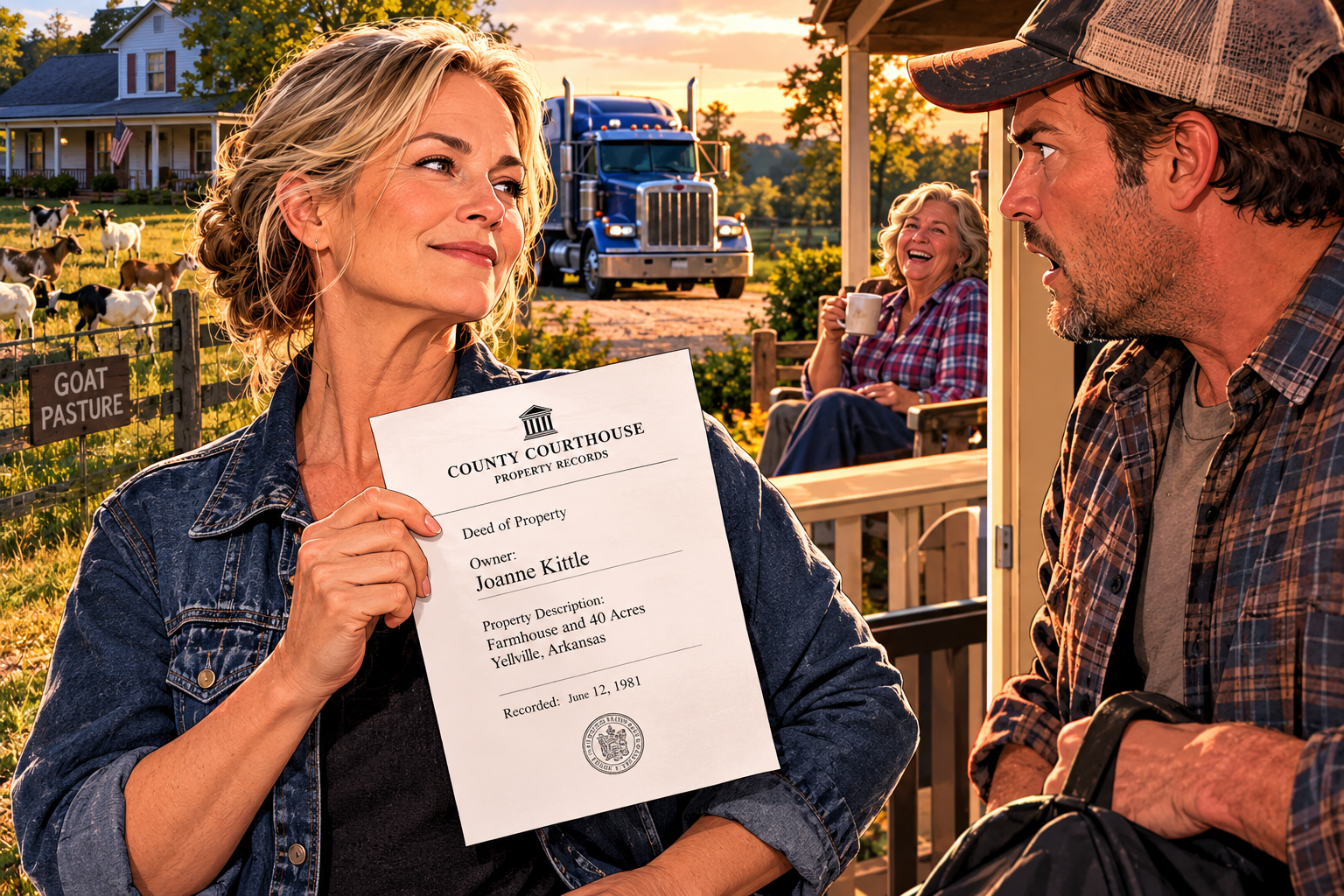
“This lease is made between Joanne Kittle, sole owner of forty acres in Marion County, Arkansas, and Miriam Yoder…”
He stopped reading.
His face changed.
“What in the devil is this?”
I folded my hands on the kitchen table.
“That’s a pasture lease, honey.”
“I can see that, Joanne. Why is my name not on it?”
“Because your name isn’t on the deed.”
For the first time in forty-five years, my husband had absolutely nothing to say.
Then he laughed.
Not a happy laugh.
The kind a man makes when he thinks a woman has told a joke she doesn’t understand herself.
“You’re renting out my pasture?”
“Mine,” I corrected gently.
He slapped the paper onto the table.
“Don’t start getting clever with me.”
Outside, something jingled against the fence.
Alden turned toward the window.
His eyes narrowed.
“What’s that noise?”
“Goats.”
He stared at me.
“What?”
“Miriam brought over twenty-six goats this afternoon. They’re settling in nicely.”
He marched toward the window.
I followed slowly.
Alden pulled the curtain aside.
Under the yellow light from the barn, twenty-six goats wandered across the front pasture.
One was standing on the little wooden ramp beside his precious zero-turn mower.
Another was chewing something near the fence.
Alden’s mouth fell open.
“JOANNE!”
I hadn’t heard him shout my name like that since the Christmas I bought the wrong brand of coffee.
“Those animals are eating my grass!”
“That’s generally what goats do.”
He spun around.
“Get them out!”
“I’m afraid I can’t.”
“Why not?”
“Because Miriam signed a five-year lease.”
He blinked.
“Five YEARS?”
“With annual rent, payable directly to me.”
“How much?”
I told him.
His expression changed again.
That was when I knew something interesting.
Alden hadn’t thought our pasture was worthless.
He’d simply never wanted me to discover what it was worth.
He grabbed his truck keys.
“I’m going over there.”
“Before you do, honey, you should probably read page two.”
He stopped.
“What’s on page two?”
“That’s where it explains the fence improvements and the payment schedule.”
He snatched the papers off the table.
I watched his eyes move down the page.
Then he looked up.
“You let them put up a permanent fence?”
“On my land.”
“And you get paid for that?”
“Not for the fence. The rent is for the grazing rights. Miriam’s family pays for the improvements.”
He looked toward the pasture again.
For three years, he’d told those people no.
For three years, he’d acted like the grass belonged to him.
And for three years, I’d let him.
But tonight something was different.
I wasn’t frightened of his anger anymore.
Alden threw the papers down.
“You’ve lost your mind.”
“Maybe,” I said. “But I found my pension.”
That stopped him.
His eyes moved toward the checkbook beside my coffee cup.
“What are you talking about?”
“My pension, Alden. The one you redirected into an account I didn’t recognize.”
His face went still.
For a moment, even the clock above the stove sounded loud.
“That was household money.”
“It was my retirement income.”
“I’ve been managing our finances for decades.”
“Yes. I noticed.”
He pulled out a chair.
Then pushed it back.
“Don’t tell me you’ve been down to the bank.”
“I have.”
“You had no business doing that without talking to me.”
I looked at him for a long moment.
Then I asked the question I’d been holding inside for years.
“Did you talk to me before you closed our joint account?”
He said nothing.
“Did you ask me before you changed where my pension went?”
His jaw tightened.
“Joanne, you’re making a mountain out of—”
“Did you?”
He looked away.
And there it was.
Forty-five years of marriage, reduced to one question my husband couldn’t answer.
I walked to the stove and turned off the burner.
There wasn’t any chicken and dumplings.
There wasn’t even a pot.
Alden noticed.
“Where’s supper?”
I smiled.
“Remember what you told me before you left?”
He frowned.
“What?”
“Whoever brings home the paycheck calls the shots.”
He stared at me.
“Well, honey,” I continued, “my pension came home this month. And the pasture brought in its first rent payment.”
I let that settle.
“So tonight, I’m calling the shots.”
Across the road, Miriam Yoder’s porch light flickered on.
I could see her standing by the railing.
She raised her glass of tea toward our kitchen.
I nearly laughed.
Alden didn’t.
Instead, he leaned closer.
“You think this is funny?”
“No. I think it’s forty-five years overdue.”
His eyes hardened.
“You’d better remember who paid the bills around here.”
I stood up.
“I remember exactly who paid them. That’s why I spent the last two weeks going through every statement I could find.”
Something flickered across his face.
Not anger this time.
Something closer to fear.
“What statements?”
“The mortgage records. The insurance. The property taxes. The retirement deposits.”
He swallowed.
“Why would you be looking at those?”
“Because I wanted to understand where our money went.”
He glanced toward the hallway.
Then back at me.
“You need to stop digging through things you don’t understand.”
I reached into my apron pocket.
There was another folded piece of paper inside.
I hadn’t planned to show him that one tonight.
But the way he said don’t understand reminded me of the six weeks I’d heated bathwater on the stove.
So I laid the paper on the table.
“This came from the county records office yesterday.”
Alden didn’t touch it.
“What’s that?”
“A copy of a document filed three years ago.”
His face lost its color.
I slid it closer.
“It concerns my father’s property.”
He stared at the heading.
Then he whispered something I’d never heard from him before.
“Joanne, let me explain.”
I looked at my husband.
The same man who’d laughed while waving his paycheck in my face.
The same man who’d called my inheritance his place.
Now he looked like he’d seen a ghost.
And I hadn’t even told him the worst part.
Because the document on that table wasn’t a pasture lease.
It was paperwork for a loan.
A loan I had never signed.
And listed as collateral, in black and white, was the farmhouse my daddy had left me.
END OF PART 2 — CONTINUE IN PART 3: THE SIGNATURE THAT WASN’T MINE
PART 3 — THE SIGNATURE THAT WASN’T MINE
Alden stood frozen in our kitchen, staring at the loan document like it might disappear if he waited long enough.
“Joanne,” he said quietly, “you don’t understand what you’re looking at.”
I pulled out the chair across from him.
“Then explain it to me.”
He rubbed his forehead.
“It’s complicated.”
“Forty-five years of marriage, Alden. I’ve got time.”
He didn’t smile.
I pointed to the bottom of the document.
“That’s supposed to be my signature.”
He glanced down.
“Yes.”
“But I didn’t sign it.”
He swallowed.
“You must have forgotten.”
I almost laughed.
I carried mail for thirty-one years.
I could remember which families wanted their packages left behind the porch swing and which ones had dogs that bit.
I remembered birthdays, anniversaries, and the exact day my daddy died.
And Alden thought I’d forgotten signing a loan against my own farmhouse?
“How much?” I asked.
He stared at the floor.
“How much money did you borrow against my land?”
“Joanne—”
“How much?”
His voice dropped.
“Eighty-five thousand.”
For a moment, the room seemed to tilt.
Eighty-five thousand dollars.
Against the house my father had built with his own hands.
I looked toward the window.
Beyond the pasture fence stood the old red barn where Daddy had taught me to milk our first cow.
Every board on that property held a memory.
And my husband had treated it like a bank account.
“What did you do with eighty-five thousand dollars?”
Alden shifted in his chair.
“Business expenses.”
“What business?”
“The trucking company.”
I narrowed my eyes.
“You don’t own the trucking company.”
He looked away.
That was answer enough.
I reached for the folder beside my chair.
Inside were copies of bank statements I’d spent three afternoons collecting.
“That’s interesting,” I said. “Because I called your employer yesterday.”
His head snapped up.
“You did WHAT?”
“I asked whether they were having financial trouble.”
“You had no right!”
“They told me they weren’t.”
He pushed away from the table.
“You’ve been snooping behind my back!”
I stood too.
“No, Alden. I’ve been learning what you did behind mine.”
For the first time, he had no clever answer.
Outside, a goat bleated.
It sounded almost like laughter.
Alden walked to the sink and stared into the dark window.
“You’re going to ruin everything.”
I felt something cold settle in my stomach.
“Everything?”
He didn’t turn.
“What exactly is everything?”
Silence.
Then he said, “You wouldn’t understand.”
I walked into our bedroom and returned carrying a small cardboard box.
His eyes followed it.
“What’s that?”
“Something I found in the filing cabinet.”
I placed it on the table.
Inside were envelopes, receipts, and a photograph.
Alden went pale.
“Where did you get that?”
“Behind your old tax folders.”
He reached for the photograph.
I moved it away.
It showed Alden standing beside a woman I’d never seen before.
They were smiling in front of a little brick house.
On the back, someone had written:
Our new beginning. June 2023.
My hands had trembled when I first read those words.
Now they were steady.
“Who is she?”
Alden closed his eyes.
“Joanne, please.”
“Who is she?”
“Her name is Denise.”
I nodded slowly.
“And the house?”
He said nothing.
I took out another document.
A property-tax notice.
The address matched the house in the photograph.
The owner’s name was Denise Mercer.
And the mailing address for the notices was a post-office box in Harrison.
I knew that box number.
I’d seen it on one of Alden’s statements.
“Did my money buy her house?”
Alden turned around.
“It wasn’t like that.”
“Then tell me what it was like.”
He sank into the chair.
Suddenly, he looked older than seventy.
“I was going to pay it back.”
I stared at him.
“Pay what back?”
“The loan.”
“With what money?”
He rubbed his hands together.
“I had a plan.”
“Was the plan to take my pension too?”
He didn’t answer.
That silence hurt worse than any confession.
For years, I’d defended him.
When my sister said Alden was controlling, I told her he was just old-fashioned.
When friends asked why I still drove the same truck, I said we were saving for retirement.
When he bought expensive things while I went without, I convinced myself marriage meant sacrifice.
But sitting in that kitchen, I finally understood.
I’d been sacrificing.
He’d been spending.
And he’d expected me never to notice.
I picked up the photograph.
“Does Denise know you’re married?”
He stared at me.
“Joanne, don’t go making trouble.”
I felt a strange little smile form.
“That’s not an answer.”
“She’s not part of this.”
“Her name is on a house connected to eighty-five thousand dollars borrowed against my property. I’d say she’s very much part of this.”
He slammed his hand on the table.
“Enough!”
For forty-five years, that sound would have ended the conversation.
I would have apologized.
I would have made him supper.
I would have spent the night wondering what I’d done wrong.
Not tonight.
I reached into my pocket and placed my phone beside the documents.
“Before you shout again, there’s something you should know.”
He glared at me.
“What now?”
“I’ve already spoken to an attorney.”
His expression changed immediately.
“You went to a LAWYER?”
“Yesterday morning.”
“Without telling me?”
I looked at him.
“You took out an eighty-five-thousand-dollar loan without telling me.”
He opened his mouth.
Then closed it.
“My attorney says the signature needs to be examined. She also told me not to move or destroy any of these records.”
Alden looked at the box.
“You’re making a mistake.”
“Maybe. But it’s finally my mistake to make.”
He leaned forward.
“Joanne, if you take this any further, they’re going to start asking questions.”
I met his eyes.
“Good.”
“You don’t understand. Other people are involved.”
“Who?”
He shook his head.
“Just leave it alone.”
I could hear the fear in his voice now.
Real fear.
Not the anger he’d used to keep me quiet.
And that’s when someone knocked on our kitchen door.
Three sharp knocks.
Alden jumped.
I looked at the clock.
Nine forty-seven.
Nobody visited our farmhouse that late without calling first.
I walked to the door.
Through the glass stood Miriam Yoder.
She wasn’t laughing anymore.
Her face was pale.
And she was holding a large brown envelope.
“Joanne,” she whispered when I opened the door, “I’m sorry to come over this late.”
“What’s wrong?”
She glanced over my shoulder at Alden.
Then she leaned closer.
“My husband was clearing brush along your back fence this afternoon. He found something buried beside the old equipment shed.”
My stomach tightened.
“What kind of something?”
Miriam held out the envelope.
“Documents. Wrapped in plastic.”
Behind me, Alden made a strange choking sound.
I turned.
He was gripping the back of his chair so tightly his knuckles had turned white.
“Don’t open that,” he said.
Miriam looked at him.
Then at me.
I slowly unfolded the envelope.
Inside was an old handwritten agreement, several photographs, and a receipt bearing my father’s name.
But what caught my attention was a single sentence written across the top of the first page.
If anything happens to me, Joanne must know the truth about Alden.
I recognized the handwriting immediately.
It belonged to my daddy.
And the date beside his signature was March 18, 1981.
Six weeks before he died.
I raised my eyes to my husband.
“Alden,” I whispered, “what did my father know about you?”
For the first time in our marriage, he looked genuinely terrified.
Then he said five words that made Miriam gasp.
“Your daddy wasn’t supposed to find out.”
END OF PART 3 — CONTINUE IN PART 4: THE SECRET MY FATHER TOOK TO HIS GRAVE
PART 4 — THE SECRET MY FATHER TOOK TO HIS GRAVE
Alden stood in our kitchen, staring at the envelope in my hands.
“Your daddy wasn’t supposed to find out.”
Those words hung in the air like smoke.
Miriam looked from him to me.
“Joanne,” she whispered, “what does he mean?”
I couldn’t answer.
My father had been dead for forty-five years.
And somehow, my husband was still frightened of him.
I unfolded the first handwritten page.
Daddy’s handwriting was shaky but unmistakable.
My dearest Joanne, if you’re reading this, then something has happened that I prayed would never come to pass.
My throat tightened.
I hadn’t seen a letter from my father since the week before my wedding.
I continued reading.
I have discovered something about Alden that troubles me deeply. I confronted him yesterday, and he begged me not to tell you.
I looked up.
Alden shook his head.
“Joanne, that was a long time ago.”
“Then you should remember it clearly.”
He took one step toward me.
“Give me that letter.”
I stepped back.
Miriam immediately moved beside me.
“That’s her father’s handwriting, Alden. Leave her alone.”
He stopped.
I unfolded the second page.
Three months ago, Alden came to me asking for money. He said he had a business opportunity and needed fifteen thousand dollars.
I blinked.
Fifteen thousand dollars.
In 1981, that was more money than I’d ever held in my life.
I refused. I told him that any man planning to marry my daughter should learn to stand on his own feet.
Alden lowered his head.
Two weeks later, I discovered that someone had attempted to use my property records to secure a loan without my permission.
My hands began trembling.
I looked at my husband.
“You tried to borrow against Daddy’s farm before we were even married?”
He said nothing.
I kept reading.
When I confronted Alden, he admitted he’d been speaking to a lender about the farm. He claimed it was only an idea and nothing had been signed. I warned him never to involve my property again.
Miriam covered her mouth.
“Oh, Joanne.”
The letter continued.
I do not know whether you should marry him. That choice belongs to you. But I have decided to leave the farmhouse and every acre solely in your name. No husband should ever be able to take from you what your mother and I worked our lives to build.
Tears blurred the words.
For years, I’d thought Daddy left me the farm simply because I was his only child.
Now I understood.
He’d been protecting me.
Even before I knew I needed protection.
Alden finally spoke.
“Your father never liked me.”
I raised my eyes.
“He knew you were trying to use his property.”
“He misunderstood everything!”
“Then explain it.”
Alden dragged a chair away from the table and sat down heavily.
“I was young. I wanted to start my own trucking business.”
“With Daddy’s land?”
“I thought once we were married, we’d build something together.”
I stared at him.
“And when he said no?”
Alden didn’t answer.
I looked down at the remaining papers.
There were three photographs.
One showed Daddy standing beside his old pickup.
Another showed him talking to a man outside the county courthouse.
The third photograph made my breath catch.
Daddy was standing beside Alden.
And Alden was holding an envelope.
On the back, my father had written:
March 19, 1981. Alden returned the papers after our argument.
I turned the photograph over again.
“What papers?”
Alden looked toward the door.
“Nothing important.”
I reached into the envelope.
At the bottom was a yellowed receipt.
It was for a payment of two thousand dollars.
The recipient was listed as Alden Kittle.
And beneath the amount, Daddy had written:
Final repayment. No further business dealings.
I looked at my husband.
“Daddy gave you two thousand dollars?”
Alden rubbed his forehead.
“He helped me out once.”
“You told me he never gave you a dime.”
“Joanne, I don’t remember every little thing from forty-five years ago.”
“Apparently, Daddy did.”
Miriam gently touched my arm.
“There’s something else.”
I looked at her.
“My husband found the papers inside an old metal box. Most of it was rusted through. But there was another envelope wrapped separately.”
She reached into her coat.
And handed me a smaller packet.
My name was written across it.
Not in Daddy’s handwriting.
In my mother’s.
I stared at those letters.
My mother died when I was nineteen.
For nearly fifty years, I’d kept her favorite blue dress hanging in the back of my closet.
I still remembered the smell of her lavender soap.
And now, somehow, she was speaking to me again.
I opened the envelope carefully.
Inside was one sheet of paper.
Joanne, sweetheart, your father worries too much about Alden. I hope he’s wrong. But if he isn’t, promise me something. Never surrender your independence just to keep a man happy. Love should never require you to disappear.
I pressed the paper against my chest.
For a long time, nobody spoke.
Then Alden broke the silence.
“Well, that’s enough of this nonsense.”
I looked at him.
He stood and reached for his duffel bag.
“I’m going to bed. We can talk about this when you’ve calmed down.”
Something inside me changed.
For forty-five years, I’d watched him end every difficult conversation by walking away.
But tonight, I wasn’t finished.
“No, Alden.”
He stopped.
“What?”
“You’re not sleeping in my bedroom tonight.”
He laughed.
“Your bedroom?”
“Yes.”
“Joanne, don’t be ridiculous.”
I walked to the kitchen counter and picked up a small envelope.
“I spoke to my attorney about our living arrangements, too. She explained that I can’t simply throw you out without following the law.”
His smile returned.
“Exactly.”
“So I’m not throwing you out. But I’m sleeping in the guest room tonight, with the door locked, and tomorrow we’ll discuss a formal separation.”
His smile disappeared.
“You’d end forty-five years over some old papers?”
I looked at him.
“No. I’m considering ending forty-five years because you lied to me for most of them.”
He stared at me.
Then he said something I never expected.
“You think you can survive without me?”
I took a slow breath.
“Alden, I survived thirty-one years delivering mail through ice storms, flooded roads, and summer heat. I think I can manage my own breakfast.”
Miriam let out a tiny laugh.
Alden grabbed his bag.
“Fine. You’ll come crawling back.”
He stormed down the hallway.
A moment later, the bedroom door slammed.
I stood quietly until my hands stopped shaking.
Miriam pulled out a chair.
“Joanne, are you all right?”
I looked at the letters spread across the table.
“No,” I admitted. “But I think I will be.”
She squeezed my hand.
Then her expression turned serious.
“There’s something I didn’t tell you about finding that box.”
I looked up.
“What?”
“My husband wasn’t digging near the shed by accident.”
I frowned.
“He wasn’t?”
Miriam shook her head.
“A man came by our place yesterday asking questions about your property.”
A cold feeling moved through my chest.
“What man?”
“He said he worked for a company in Harrison. He wanted to know whether Alden still lived here.”
“Why?”
“He wouldn’t say.”
I remembered the eighty-five-thousand-dollar loan.
The forged signature.
The house in Denise Mercer’s name.
“Did he leave a name?”
Miriam reached into her pocket.
She placed a business card on my table.
I picked it up.
HARRISON COUNTY FINANCIAL RECOVERY SERVICES
Beneath the company name was a phone number.
And written across the back were four words:
Regarding the Kittle property.
I swallowed.
“Did he say anything else?”
Miriam nodded.
“He said somebody had stopped making payments.”
My stomach dropped.
I turned the card over.
Then I noticed the handwritten date in the corner.
November 18.
Eight days away.
“What happens November eighteenth?”
Miriam hesitated.
“He said you needed to call before then.”
I looked toward the hallway where Alden had disappeared.
Suddenly, his fear made terrible sense.
He hadn’t just borrowed against my farmhouse.
He might have stopped paying back the money.
I picked up my phone and called the number on the card.
A recorded message said the office was closed.
Then it gave an option to leave a voicemail.
I stated my name and asked for a return call.
Before hanging up, I heard the recording mention a reference number.
I compared it with the number on the loan document.
They matched.
I slowly lowered the phone.
Miriam watched my face.
“Joanne?”
I looked at the photograph of Daddy standing beside Alden.
Then at the note my mother had written.
And finally at the document with the signature that wasn’t mine.
“I’m not losing this farm,” I whispered.
Miriam straightened.
“Then we’re going to find out exactly what’s happening.”
But before I could answer, my phone buzzed.
A text message appeared from an unfamiliar number.
Mrs. Kittle, this is Denise Mercer. I know what Alden did. We need to talk before he discovers I contacted you.
I stared at the screen.
Then another message arrived.
And please don’t believe everything he told you about the eighty-five thousand dollars.
I felt my heartbeat quicken.
A third message appeared.
Because the money wasn’t all for my house.
END OF PART 4 — CONTINUE IN PART 5: THE OTHER WOMAN KNEW WHERE MY MONEY WENT
PART 5 — THE OTHER WOMAN KNEW WHERE MY MONEY WENT
I sat at my kitchen table staring at Denise Mercer’s message.
Because the money wasn’t all for my house.
For a moment, I forgot how to breathe.
Miriam leaned over my shoulder.
“What does she mean?”
“I don’t know.”
My phone buzzed again.
Can you meet me tomorrow morning? Nine o’clock. The diner outside Harrison. Please come alone.
I looked toward the hallway.
Alden’s bedroom door was closed.
For forty-five years, that man had made decisions about my money, my home, and practically every hour of my life.
Now a woman I’d never met was asking me to keep a secret from him.
I typed back.
I’ll be there.
Miriam frowned.
“You’re not going alone, Joanne.”
“She specifically asked me to.”
“Then I’ll drive separately and sit at another table.”
I almost smiled.
“Miriam, you’re getting pretty good at this.”
She folded her arms.
“I’ve raised seven children and handled a hundred stubborn goats. Your husband doesn’t scare me.”
That made me laugh for the first time all evening.
But when Miriam went home, the laughter disappeared.
I sat alone looking at Daddy’s letter.
Then I opened my banking app.
My new pension account showed the money safely deposited.
For the first time in years, I could see exactly what belonged to me.
It should have felt wonderful.
Instead, I kept thinking about eighty-five thousand dollars.
And a woman named Denise.
The next morning, I woke before sunrise.
Alden was already in the kitchen.
He was drinking coffee from the chipped blue mug I’d bought him on our twentieth anniversary.
He didn’t look at me.
“Where are you going dressed like that?”
I glanced down at my clean jeans and flowered blouse.
“Into town.”
“For what?”
“Personal business.”
He lowered his mug.
“Since when do you have personal business?”
I looked straight at him.
“Since I remembered I’m a person.”
His expression darkened.
“Don’t get smart with me.”
I picked up my purse.
“There’s bread on the counter if you’re hungry.”
He stared.
“You’re not fixing breakfast?”
“No.”
He gave a bitter laugh.
“Your new attitude won’t last a week.”
I opened the door.
“Then I suppose you’d better enjoy the week.”
I drove away before he could answer.
The diner sat beside Highway 65, with a faded red sign and windows covered in advertisements for homemade pie.
I arrived ten minutes early.
Miriam’s pickup was parked across the lot.
She lifted her coffee cup when she saw me.
I walked inside.
A woman sat alone in the back booth.
She looked about fifty-five, with short brown hair and nervous hands.
When I approached, she stood immediately.
“Mrs. Kittle?”
“Joanne.”
“I’m Denise.”
We studied each other.
For three years, I’d imagined the kind of woman who might be involved with my husband.
Beautiful.
Confident.
Someone who enjoyed taking what belonged to another person.
But Denise looked exhausted.
There were dark circles beneath her eyes.
And she was twisting a tissue between her fingers.
“Thank you for coming,” she whispered.
I sat down.
“Tell me why you contacted me.”
She looked toward the entrance.
“Is Alden here?”
“No.”
She released a shaky breath.
“Good.”
The waitress brought coffee.
Neither of us touched it.
Denise opened her handbag.
“I need to tell you something, and I need you to let me finish.”
I nodded.
She placed a photograph on the table.
It was the same brick house I’d seen in Alden’s filing cabinet.
“That’s my home,” she said.
“I know.”
She swallowed.
“Alden told me he was divorced.”
I felt something twist in my stomach.
“He told you that?”
“Yes. He said his marriage ended years ago, but you still lived on the old family property.”
I stared at her.
“And you believed him?”
“I did.”
She lowered her eyes.
“I was wrong.”
For several seconds, I couldn’t speak.
Then I asked, “Were you two having an affair?”
Denise nodded.
“Until six months ago.”
I looked out the window.
Cars passed along the highway.
People hurried into the diner carrying newspapers and talking about ordinary things.
Meanwhile, forty-five years of my life were falling apart over a cup of untouched coffee.
“Why did it end?” I asked.
Denise wiped her eyes.
“Because I found out he was lying.”
“About being married?”
“About that. And about the money.”
She opened a folder.
Inside were copies of checks and loan documents.
“Alden helped me make the down payment on my house. He told me it was money he’d saved from his trucking career.”
“How much?”
“Twenty thousand dollars.”
I felt my fingers tighten around my cup.
“And the rest?”
Denise pushed a bank statement toward me.
“That’s what I came to show you.”
I looked down.
There were several large transfers from an account linked to Alden.
One for twenty thousand.
Another for fifteen thousand.
Then thirty thousand.
And finally twenty thousand.
Eighty-five thousand dollars.
But only the first transfer went toward Denise’s house.
The others went somewhere entirely different.
I pointed at the second transaction.
“What’s this?”
Denise leaned closer.
“A company called Ozark Ridge Holdings.”
“I’ve never heard of it.”
“Neither had I. Not until I started asking questions.”
I looked at the third transfer.
Thirty thousand dollars.
The recipient was listed as Kittle Transport Ventures.
My heart began pounding.
“Alden told me he wanted to start a trucking company years ago.”
Denise nodded.
“He told me the same thing.”
“But he never did.”
“That’s what you think.”
I looked up.
Denise slid another sheet across the table.
It was a business registration.
And there, printed clearly beneath the company name, was Alden’s signature.
But another name appeared beside his.
Marvin Kittle.
I stared at it.
Marvin.
Alden’s younger brother.
The same brother who had told me every Christmas that I was lucky to have a hardworking husband.
The same brother who always laughed when Alden joked about women not understanding finances.
“Marvin?” I whispered.
Denise nodded.
“They started the company together.”
I shook my head.
“Marvin told me he retired from construction.”
“He may have. But his name is on the business documents.”
I looked at the date.
Three years ago.
The same year the loan against my farm had been recorded.
“What happened to the company?”
Denise hesitated.
“That’s the problem.”
“What problem?”
She lowered her voice.
“There were debts.”
“How much?”
“I don’t know the full amount.”
My stomach sank.
“More than eighty-five thousand?”
She nodded slowly.
“Possibly much more.”
I stared at her.
Denise continued.
“Alden told me everything was going well. Then six months ago, he started asking me for money.”
“From you?”
“Yes. He wanted me to refinance my house.”
I leaned back.
“Did you?”
“No.”
“Why not?”
“Because I found documents in his truck that didn’t make sense.”
She pulled out another envelope.
“That’s when I learned he was still married.”
I opened it.
Inside was a copy of a letter addressed to Alden.
The heading read:
NOTICE OF DEFAULT — KITTLE TRANSPORT VENTURES
My hands went cold.
Denise spoke quietly.
“According to that notice, the company had missed several payments.”
I read the letter twice.
The outstanding balance was listed at more than one hundred and forty thousand dollars.
I looked up.
“Does this mean they can take my farm?”
“I don’t know, Joanne. That’s why you need to show everything to your lawyer.”
I folded the paper carefully.
“I already have one.”
“Good.”
She reached across the table.
“I know you have every reason to hate me.”
I looked at her hand.
Then at her face.
“I don’t know what I feel right now.”
She nodded.
“That’s fair.”
“But I do know something.”
“What?”
“Alden lied to both of us.”
Denise began crying.
Quietly at first.
Then she covered her face.
“I’m so sorry.”
I didn’t reach for her hand.
I wasn’t ready for that.
But I didn’t yell, either.
I’d spent enough years listening to Alden decide which woman deserved blame.
I wasn’t about to let him do it again.
After a moment, Denise wiped her cheeks.
“There’s one more thing.”
I waited.
“Marvin came to see me last week.”
“What did he want?”
“He asked whether I still had copies of the company records.”
“And?”
“I told him I did.”
She looked toward the window.
“He offered me five thousand dollars to destroy them.”
I stared at her.
“Five thousand?”
She nodded.
“He said the papers could ruin Alden’s life.”
I felt anger rise through my chest.
“Did you take it?”
“No.”
“Why?”
Denise’s voice became firm.
“Because I’m tired of being lied to.”
For the first time, I believed she understood something about my life.
I gathered the documents.
“May I give these copies to my attorney?”
“Please.”
I stood.
Denise caught my sleeve gently.
“Joanne?”
I turned.
“Be careful.”
“Of Alden?”
She shook her head.
“Of Marvin.”
Something in her expression frightened me.
“Why?”
She leaned closer.
“Because when I refused to destroy the records, he told me something.”
“What?”
“He said Alden was only the man signing the papers.”
I frowned.
“What does that mean?”
Denise looked directly into my eyes.
“He said someone else had been making the decisions.”
I stared at her.
“Who?”
Before she could answer, the diner’s front door opened.
Denise went completely still.
I followed her gaze.
Standing beside the entrance was a tall man wearing a brown work jacket.
He scanned the diner.
Then his eyes landed on our table.
I recognized him immediately.
Marvin Kittle.
My brother-in-law.
He started walking toward us.
Denise grabbed my wrist.
“Joanne,” she whispered, “don’t give him those documents.”
I slipped the folder inside my purse.
Marvin stopped beside our booth.
He looked at Denise.
Then at me.
And smiled.
“Well, now. Isn’t this an interesting little family reunion?”
I stood slowly.
“Hello, Marvin.”
His smile faded when he saw my expression.
“Joanne, there’s something you need to understand.”
I folded my arms.
“I’m listening.”
He glanced at Denise.
Then leaned closer.
“That loan against your farm wasn’t Alden’s idea.”
My heart skipped.
“Then whose idea was it?”
Marvin stared at me for a long moment.
And when he finally answered, I felt the floor disappear beneath my feet.
“You need to ask Alden’s sister, Patricia. She’s the one who arranged everything.”
END OF PART 5 — CONTINUE IN PART 6: THE SISTER-IN-LAW WHO PLANNED MY RUIN
PART 6 — THE SISTER-IN-LAW WHO PLANNED MY RUIN
Marvin Kittle stood beside our booth, looking at me like he’d just revealed some terrible family secret.
“Patricia arranged everything,” he repeated.
I stared at him.
Patricia.
Alden’s older sister.
The woman who brought sweet potato casserole to every Thanksgiving dinner.
The woman who called me twice a month to remind me how lucky I was to have her brother.
The same woman who once told me, “Joanne, a good wife doesn’t question her husband’s decisions.”
I slowly set my purse on the table.
“Explain yourself, Marvin.”
He glanced toward the diner entrance.
“Not here.”
I folded my arms.
“You’ve got about thirty seconds before I call my attorney.”
His expression tightened.
“Joanne, you’re making this bigger than it needs to be.”
I almost laughed.
“There’s an eighty-five-thousand-dollar loan against my farmhouse, a business drowning in debt, and a signature I never wrote. How much bigger does it need to get?”
Denise sat silently beside us.
Marvin lowered his voice.
“Patricia knew somebody who could arrange the financing.”
“Financing using my property?”
He nodded reluctantly.
“She said Alden could handle the payments.”
“And my signature?”
He looked away.
“That’s something you’ll have to ask her.”
I reached for my phone.
Marvin immediately raised his hands.
“Now, don’t go calling anybody.”
“Why not?”
“Because once lawyers start digging, the whole family gets dragged into it.”
I stared at him.
“The whole family?”
He swallowed.
That’s when I understood.
This wasn’t simply Alden making one terrible decision.
His own brother and sister had been helping him.
And every one of them expected me to remain the foolish little wife who never asked questions.
I picked up my purse.
“Denise, thank you for meeting me.”
Marvin stepped aside.
“Where are you going?”
“To see Patricia.”
He shook his head.
“That’s a bad idea.”
I looked him directly in the eyes.
“Marvin, I’ve spent forty-five years listening to your family’s ideas. Look where that got me.”
I walked past him.
Outside, Miriam was waiting beside her pickup.
She took one look at my face.
“Well?”
I opened my truck door.
“We’re going to Patricia’s.”
Miriam raised her eyebrows.
“Lord have mercy. Should I bring a witness?”
“You are the witness.”
She climbed into her truck.
And for the first time that morning, I smiled.
Patricia lived in a beautiful two-story house outside Harrison.
White columns.
Perfect flower beds.
A circular driveway lined with expensive landscaping.
Every Christmas, she’d brag about how well she’d managed her investments.
Now I wondered whose money had helped build that life.
When I pulled into her driveway, she was standing on the porch.
Almost as though she’d been expecting me.
“Joanne!” she called brightly.
“What a surprise!”
I stepped out of my truck.
“Hello, Patricia.”
She looked at Miriam’s pickup pulling in behind me.
Her smile weakened.
“What’s going on?”
“I have a few questions.”
Patricia laughed nervously.
“About what?”
I held up the loan document.
“About my farmhouse.”
Her face changed.
Only for a second.
But I saw it.
She opened the screen door.
“Come inside. We shouldn’t discuss family matters where the neighbors can hear.”
I remained on the porch.
“That’s interesting, Patricia.”
“What is?”
“For forty-five years, you’ve been perfectly comfortable discussing my marriage in front of other people.”
Her cheeks flushed.
“Joanne, there’s no need to be unpleasant.”
“Then let’s make this pleasant. Did you arrange a loan using my property?”
She stared at me.
“Who told you that?”
“Did you?”
She looked past me toward Miriam.
Then she sighed.
“Alden needed help.”
“That wasn’t my question.”
Patricia folded her arms.
“Yes. I introduced him to a lender.”
I felt my heartbeat quicken.
“Did you know my signature was on the paperwork?”
She hesitated.
“Of course.”
“Did you see me sign it?”
Silence.
“Patricia?”
She looked down.
“No.”
There it was.
One simple word.
And suddenly, forty-five years of family dinners felt like a bad joke.
I took a slow breath.
“You knew.”
Patricia’s eyes hardened.
“I knew Alden was trying to protect his financial future.”
“By risking mine?”
“Joanne, you never understood business.”
I almost smiled.
There it was again.
The same excuse.
Different mouth.
“You know what I understand, Patricia?”
She said nothing.
“I understand that my father left me forty acres. I understand someone put my name on loan documents without my permission. And I understand you’ve just admitted you helped arrange it.”
Patricia stepped forward.
“Be careful what you’re accusing me of.”
“I haven’t accused you of anything yet.”
I held up my phone.
“But my attorney will have questions.”
Her expression changed immediately.
“Joanne, please.”
I lowered the phone.
“Now you want to say please?”
She pressed a hand against her forehead.
“You don’t know what happened.”
“Then tell me.”
For a moment, I thought she might finally confess everything.
Instead, she looked toward the house.
“My husband doesn’t know about any of this.”
I stared at her.
“Your husband?”
She nodded.
“I used some of our savings to help Alden and Marvin.”
“How much?”
“Twenty-five thousand.”
Miriam made a soft sound behind me.
I looked at Patricia.
“And where did that money go?”
She shook her head.
“I don’t know anymore.”
“Patricia.”
Her eyes filled with tears.
“The business was supposed to make us all rich.”
I felt something cold move through my stomach.
“All of you?”
She looked away.
“Marvin had contacts. Alden knew trucking. I knew someone willing to lend money.”
“And what was my part?”
She didn’t answer.
I stepped closer.
“What was my part, Patricia?”
Her voice dropped to a whisper.
“Your property was the security.”
I closed my eyes.
My father’s farm.
My mother’s roses.
The old barn.
The kitchen where I’d raised three children.
All of it had been reduced to numbers on a balance sheet.
I opened my eyes again.
“And you never thought to ask me?”
Patricia looked almost offended.
“Alden said you’d never agree.”
I nodded slowly.
“He was right.”
She stared at me.
I continued.
“Because I would never have gambled my father’s home on a business I knew nothing about.”
Patricia began crying.
“Joanne, we didn’t think anything would go wrong.”
“But it did.”
She wiped her eyes.
“The company lost two major contracts. The trucks needed repairs. Insurance went up. Everything fell apart.”
“And now someone wants repayment.”
She nodded.
I reached into my purse and removed the default notice.
“How much do they owe?”
Patricia looked at the paper.
Then covered her mouth.
“Oh, Lord.”
“What?”
She shook her head.
“That’s not the latest amount.”
I froze.
“What do you mean?”
She looked toward Miriam.
Then back at me.
“The debt has grown.”
“How much?”
Patricia began shaking.
“Last month, the lender sent another notice.”
“How much, Patricia?”
She whispered the number.
“Two hundred and twelve thousand dollars.”
For several seconds, the world seemed silent.
Two hundred and twelve thousand.
I thought about the forty-acre farm my daddy worked his entire life to buy.
And I realized something horrifying.
If the lender successfully enforced the claim against my property, the consequences could threaten everything he’d left me.
I gripped the porch railing.
Miriam stepped beside me.
“Joanne, sit down.”
But I shook my head.
“No.”
Patricia was crying openly now.
“We’re trying to fix it.”
I looked at her.
“How?”
She hesitated.
Then said, “Alden has been talking to someone about selling part of the land.”
My breath caught.
“What land?”
She didn’t answer.
I stepped closer.
“Patricia, what land?”
“Your back twenty acres.”
I felt the blood drain from my face.
“My father is buried near the edge of that property.”
“I know.”
“And Alden thinks he can sell it?”
“He said he could convince you.”
I stared at her.
Then I began laughing.
Not because anything was funny.
But because I finally understood why Alden had suddenly started talking about retirement.
Why he’d asked whether I still wanted to keep the old barn.
Why he’d suggested that maintaining forty acres was too much work for a woman my age.
He hadn’t been planning our future.
He’d been preparing me to surrender my land.
I took out my phone.
Patricia’s eyes widened.
“Who are you calling?”
“My attorney.”
“Joanne, please don’t!”
I looked at her.
“Patricia, my father worked every day of his life so I would always have a place to come home to. Your family doesn’t get to sell that place to cover its secrets.”
I dialed.
My attorney, Rebecca Collins, answered on the third ring.
“Joanne? Is everything all right?”
“No,” I said. “But I’ve found something important.”
I explained what Patricia had admitted.
Rebecca listened without interrupting.
Then she asked a question that made my stomach tighten.
“Joanne, did anyone from the lender ever contact you directly?”
“No.”
“Did you receive any certified letters?”
“Not that I remember.”
“Did Alden control the household mail?”
I stopped breathing for a moment.
Alden had always collected the mail whenever he was home.
And when he was traveling, he’d frequently asked me to leave his business envelopes unopened.
“Yes,” I whispered.
Rebecca’s voice became serious.
“I want you in my office this afternoon. Bring every document you’ve found. We need to verify what was filed, identify the lender, and address the disputed signature immediately.”
“I’ll be there.”
“And Joanne?”
“Yes?”
“Don’t sign anything Alden or his relatives bring you.”
I looked straight at Patricia.
“I won’t.”
After the call ended, Patricia sank into a porch chair.
“You’ve ruined everything.”
I stared at her.
“No, Patricia. I just stopped pretending everything was fine.”
Miriam and I walked back toward our trucks.
But just as I reached my door, Patricia called after me.
“Joanne!”
I turned.
She stood trembling on the porch.
“There’s something else you need to know.”
I waited.
She looked almost frightened to say it.
“That lender isn’t a bank.”
My heart skipped.
“What?”
“It’s a private investment company.”
“So?”
Patricia swallowed.
“The owner is someone Alden has known for years.”
I frowned.
“Who?”
She shook her head.
“I only met him once.”
“What’s his name?”
Her voice was barely audible.
“Richard Bellamy.”
I stared at her.
That name meant nothing to me.
Until she added one more sentence.
“He used to work with your father.”
The air left my lungs.
My father?
The same father who had warned me about Alden before our wedding?
I slowly opened my truck door.
Then I remembered the photograph inside Daddy’s old metal box.
The one showing him speaking to a stranger outside the courthouse.
I grabbed my purse and pulled out the photograph.
I hadn’t paid much attention to the other man.
But now I studied his face.
Tall.
Dark hair.
A narrow chin.
And a distinctive scar above his eyebrow.
I held the picture toward Patricia.
“Is this Richard Bellamy?”
She looked.
And immediately stepped backward.
“Where did you get that?”
“Answer me.”
Patricia nodded.
“Yes.”
My hands began trembling.
Because on the back of that photograph, Daddy had written something I’d barely noticed the night before.
A date.
And beneath it, three words.
DO NOT TRUST.
I stared at those words.
Then at Patricia.
And suddenly, the truth felt far more dangerous than an unpaid loan.
Because the man threatening my farmhouse wasn’t some stranger.
He was someone my father had warned me about forty-five years ago.
And somehow, Alden had brought him back into our lives.
END OF PART 6 — CONTINUE IN PART 7: THE MAN MY FATHER WARNED ME ABOUT
PART 7 — THE MAN MY FATHER WARNED ME ABOUT
I sat in my truck outside Patricia’s house, staring at the old photograph.
Richard Bellamy.
The name meant nothing to me, but the words my father had written on the back made my hands tremble.
DO NOT TRUST.
Miriam tapped gently on my window.
“Joanne, honey, are you all right?”
I rolled it down.
“My daddy knew the man who’s trying to collect on Alden’s loan.”
Miriam’s expression changed.
“How long ago?”
“Forty-five years.”
She looked at the photograph.
“Then there’s something you need to find out before anybody gets another dollar.”
“What?”
“Why your father warned you about him.”
I nodded.
But I already knew where I needed to go.
Rebecca Collins’s law office was on the second floor of an old brick building in Harrison.
By the time we arrived, I had three folders, two envelopes, and enough questions to fill a church bulletin.
Rebecca greeted us at the door.
She was a serious woman in her early forties, with sharp eyes and a voice that never wasted words.
“Joanne, come in.”
I placed everything on her desk.
“The loan documents, the company records, the notices, and these letters from my father.”
Rebecca looked at the stack.
“That’s quite a collection.”
“It’s forty-five years of things nobody thought I’d ever find.”
She gave me a small smile.
Then she began reading.
For nearly twenty minutes, the only sounds were turning pages and the old ceiling fan.
Finally, Rebecca removed her glasses.
“Joanne, I need you to understand something important.”
My stomach tightened.
“Am I going to lose my farm?”
“Not simply because your husband borrowed money. The validity of the mortgage or other security documents matters, especially if your signature was forged.”
I gripped my purse.
“So there’s hope?”
“There’s absolutely a reason to challenge this. But I need to verify the recorded documents and the lender’s claims before I can tell you exactly where things stand.”
She pointed at the signature.
“Did you ever sign a power of attorney giving Alden authority over your property?”
“No.”
“Did you appear before a notary for this loan?”
“No.”
“Did you agree to pledge your land?”
“Never.”
Rebecca nodded.
“Then we’re going to investigate every step of this transaction.”
She turned another page.
Then stopped.
Her expression changed.
“What is it?” I asked.
She leaned closer to the document.
“Richard Bellamy.”
I straightened.
“You know him?”
“I know of him.”
“Is he a lawyer?”
“Not that I’m aware of. He operates through several private lending and investment businesses.”
She tapped the paperwork.
“But this document identifies a company as the lender. We need to establish who actually controls it.”
I placed Daddy’s photograph on her desk.
Rebecca studied it.
“Where did you get this?”
“My neighbors found it in an old box near our equipment shed.”
She turned it over.
Her eyes settled on the warning.
“Your father wrote this?”
“Yes.”
Rebecca looked at me.
“Do you know why?”
I shook my head.
“Not yet.”
She placed the photograph beside the loan.
“Then let’s find out.”
She reached for her telephone.
While Rebecca spoke to someone at the county records office, Miriam quietly squeezed my hand.
I looked at the photograph again.
Daddy was only fifty-six when he died.
A heart attack.
At least, that’s what the doctor told us.
He’d been working too hard that spring, trying to repair fences and prepare the fields before my wedding.
I remembered how tired he looked during those last weeks.
I remembered how he kept asking whether I was certain about marrying Alden.
And I remembered something else.
The night before he died, Daddy had knocked on my bedroom door.
“Joanne, sweetheart, there’s something we need to talk about.”
But I was busy sewing lace onto my wedding dress.
“Tomorrow, Daddy.”
He’d smiled sadly.
“All right, baby girl. Tomorrow.”
Tomorrow never came.
I pressed my fingers against my eyes.
For forty-five years, I’d wondered what he’d wanted to tell me.
Now I feared I was finally discovering the answer.
Rebecca finished her call.
“I’ve arranged to review the original recorded instruments and related filings.”
She looked at me.
“Meanwhile, I want you to tell me everything you remember about your father’s relationship with Bellamy.”
I took a deep breath.
“Daddy bought feed and equipment from several local businessmen. I don’t remember Bellamy’s name, but I remember an argument one spring.”
“What kind of argument?”
I closed my eyes.
“I was twenty-two. Daddy came home from town furious. He said a man had tried to cheat him out of something.”
“Do you remember what?”
“Some land.”
Rebecca leaned forward.
“Your farm?”
“I think so.”
I looked at Miriam.
“Daddy used to say the back twenty acres were the most valuable part of the property, even though the ground was rocky.”
Miriam frowned.
“Why would he say that?”
“I never knew.”
Rebecca wrote something down.
“Do you have the original property records?”
“Somewhere in the house.”
“Bring them to me.”
Then she looked at the photograph.
“And don’t confront Bellamy yourself.”
I promised I wouldn’t.
But as Miriam and I left the office, a terrible thought followed me down the stairs.
What if Alden knew exactly why that land mattered?
When I got home, his truck was gone.
There was a note on the kitchen counter.
Gone to see Marvin. Don’t do anything stupid.
I read it twice.
Then I laughed.
For forty-five years, he’d decided what counted as stupid.
Apparently, protecting my own farmhouse qualified.
I folded the note and tucked it into my folder.
Then I went upstairs.
Daddy’s old cedar trunk sat beneath the guest bedroom window.
It hadn’t been opened in years.
I knelt beside it and lifted the heavy lid.
Inside were photographs, Christmas cards, my mother’s wedding gloves, and a faded blue ledger.
I remembered that ledger.
Daddy recorded everything in it.
Fence repairs.
Seed purchases.
Hay sales.
Even the cost of replacing a broken shovel.
I carried it downstairs.
At the kitchen table, I opened the pages.
Most were ordinary farm expenses.
Then I reached March 1981.
And my heart began pounding.
Daddy had written:
March 12 — Bellamy returned. Offered $40,000 for back acreage. Refused.
Below that:
March 16 — Alden asked why I wouldn’t sell. Told him it wasn’t his concern.
Then:
March 18 — Bellamy and Alden together at courthouse. Something is wrong.
I stared at the words.
Alden and Bellamy.
Together.
Before my wedding.
Before Daddy died.
Before I inherited the farm.
I turned the page.
There was one final entry.
March 21 — Found out why they want the land. Must tell Joanne immediately.
My breath caught.
Beneath those words, Daddy had drawn a small arrow.
It pointed toward a folded paper tucked inside the ledger.
I opened it carefully.
It was an old geological survey map.
Across the back twenty acres, someone had circled a section in red pencil.
Beside the circle were three words.
MINERAL RIGHTS RESERVED.
I blinked.
Mineral rights?
Our farm was mostly grass, woods, and rocky ground.
Daddy had never mentioned anything valuable beneath it.
I studied the map again.
Then noticed a handwritten note along the bottom.
Potential limestone deposit. Commercial interest. Do not sell surface or subsurface rights without independent review.
I sat back slowly.
Suddenly, the pieces began fitting together.
Bellamy wanted the land in 1981.
Alden had questioned Daddy about selling it.
Forty-five years later, Bellamy was connected to a loan that supposedly placed my farm at risk.
And Alden had been trying to convince me to sell the back twenty acres.
I grabbed my phone and called Rebecca.
She answered immediately.
“Joanne?”
“I found Daddy’s ledger.”
“What does it say?”
I explained the entries and the survey map.
Rebecca went quiet.
Then she asked, “Does your deed mention mineral rights?”
“I don’t know.”
“Bring the map and ledger tomorrow. We need to examine the mineral title separately from the surface ownership.”
“Rebecca, do you think they’re trying to get the land because of what’s underneath it?”
“It’s possible. But don’t assume the survey proves there’s a valuable deposit. We need an independent assessment.”
I nodded.
Then something occurred to me.
“Rebecca?”
“Yes?”
“If Bellamy wanted those twenty acres forty-five years ago, why would he still want them now?”
She hesitated.
“That’s exactly what we need to investigate.”
After we hung up, I sat quietly at the kitchen table.
Outside, Miriam’s goats moved through the pasture.
The evening sun painted Daddy’s barn gold.
I thought about all the years I’d felt powerless.
All the years Alden told me I didn’t understand money.
And now I was holding a ledger that might explain everything.
Then I heard tires crunching on the gravel.
Alden’s pickup.
He came through the kitchen door carrying his jacket.
His expression was unusually calm.
“Joanne,” he said, “we need to talk.”
I closed the ledger.
“About what?”
He sat across from me.
“I’ve been thinking. Maybe I’ve been too hard on you.”
I stared at him.
In forty-five years, he’d never said anything close to that.
He continued.
“We’ve both made mistakes.”
I said nothing.
“And I think it’s time we worked together.”
“On what?”
He reached into his jacket pocket.
And pulled out an envelope.
Inside was a neatly typed document.
He placed it in front of me.
“A simple agreement. It’ll help us clear up the debt.”
I looked at the heading.
OPTION TO PURCHASE REAL PROPERTY.
My stomach tightened.
“Who wants to purchase it?”
Alden smiled.
“An investor.”
“What investor?”
“Someone interested in the back twenty acres.”
I looked at him.
“Richard Bellamy?”
His smile vanished.
“Where did you hear that name?”
I slowly opened Daddy’s ledger.
Then turned it toward him.
Alden read the March 1981 entries.
The color drained from his face.
“Where did you find that?”
“In Daddy’s trunk.”
He reached toward the ledger.
I pulled it back.
“Don’t.”
His eyes hardened.
“Joanne, you don’t understand what you’re dealing with.”
I stared at him.
“Then explain why Bellamy has wanted my land since 1981.”
Alden stood suddenly.
“Put that book away.”
“No.”
“Joanne!”
I stood too.
“No more shouting. No more secrets. Tell me why your friend wants Daddy’s land.”
He looked toward the window.
Then lowered his voice.
“Because your father refused an offer that could have made him rich.”
I swallowed.
“And now?”
Alden’s expression became desperate.
“Now there’s a chance to fix everything.”
“By selling my property?”
“By saving us!”
I looked down at the unsigned agreement.
Then back at my husband.
For one brief moment, I saw the young man I’d married.
The man who’d promised to build a life with me.
But the man standing in front of me now wasn’t asking for trust.
He was demanding another sacrifice.
I pushed the document back across the table.
“No.”
Alden stared.
“What?”
“I said no.”
His face tightened.
“You’re making the biggest mistake of your life.”
I shook my head.
“No, Alden. I made that mistake in 1981.”
He went completely still.
Then his phone rang.
He looked at the screen.
And something about his expression frightened me.
He stepped into the hallway to answer.
But he didn’t close the door.
I heard him whisper:
“She found the ledger.”
A pause.
Then:
“No. She hasn’t signed anything.”
Another pause.
Alden’s voice dropped even lower.
“Bellamy, listen to me. If she finds out what happened the night her father died, we’re finished.”
My blood turned cold.
I gripped the edge of the table.
The night Daddy died?
Alden had always told me he’d been driving through Missouri that evening.
He said he’d heard the news the following morning.
But now he was talking as though he knew something he’d never told me.
I took one silent step toward the hallway.
And heard Bellamy’s voice through the phone.
Loud enough that I caught every word.
“Then make sure she never finds that missing hospital report.”
I stopped breathing.
Because Daddy hadn’t died in a hospital.
At least, that’s what I’d always been told.
He’d supposedly collapsed alone in the barn.
And suddenly, after forty-five years, I had a question more frightening than anything about the money.
What really happened to my father on the night he died?
END OF PART 7 — CONTINUE IN PART 8: THE HOSPITAL REPORT MY HUSBAND HID FOR FORTY-FIVE YEARS
PART 8 — THE HOSPITAL REPORT MY HUSBAND HID FOR FORTY-FIVE YEARS
I stood in the hallway, listening to my husband whisper into his phone.
“If she finds out what happened the night her father died, we’re finished.”
Those words hit me harder than anything Alden had said in forty-five years.
My father.
The man who taught me to drive a tractor.
The man who held my hand when Mama died.
The man who promised I’d always have a home.
What had Alden done?
I backed quietly into the kitchen before he could see me.
My hands were shaking so badly I could barely close Daddy’s ledger.
A moment later, Alden returned.
He smiled.
A strange, nervous smile.
“Everything all right, Joanne?”
I looked at him.
“Who was that?”
“Just somebody from work.”
I nodded.
Another lie.
I wondered how many he’d told me.
Hundreds?
Thousands?
Or had our entire marriage been built on them?
“I’m tired,” I said.
“I’m going to bed.”
He studied my face.
“What about the agreement?”
“I’ll think about it.”
That seemed to satisfy him.
“Good. That’s all I’m asking.”
I picked up Daddy’s ledger.
Alden watched it carefully.
“Where are you taking that?”
“Somewhere safe.”
He frowned.
“Don’t start hiding things from me.”
I stopped at the doorway.
Then looked back.
“Funny how that bothers you.”
I went upstairs without another word.
But I didn’t sleep.
At two in the morning, I sat on the edge of the guest bed with my phone in my hands.
I wanted to call Rebecca.
I wanted to call Miriam.
I wanted to scream.
Instead, I opened an old photograph of Daddy.
He was standing beside his tractor, smiling beneath his favorite straw hat.
I remembered the last words he’d ever said to me.
“Tomorrow, baby girl.”
Forty-five years.
Forty-five years of believing he’d died alone.
And now there was a hospital report nobody wanted me to find.
At seven the next morning, I called Rebecca.
“Joanne?” she answered. “What’s happened?”
I told her everything.
The phone call.
Bellamy’s warning.
The missing hospital report.
For a moment, she said nothing.
Then her voice became very serious.
“Joanne, I want you to write down exactly what you heard.”
“Do you think Alden hurt my father?”
“We don’t know that. But we have enough reason to investigate what really happened.”
I swallowed.
“What should I do?”
“Bring the ledger to my office. I’ll help you request the old records and determine whether there’s anything authorities should examine.”
I looked toward the stairs.
Alden was still asleep.
“I’ll be there.”
“And Joanne?”
“Yes?”
“Don’t confront him about that phone call. Not yet.”
I promised.
Then I called Miriam.
She answered before the second ring.
“Something wrong, honey?”
“Miriam, I need another favor.”
“Name it.”
“Can you come with me to Harrison?”
She didn’t hesitate.
“I’ll get my keys.”
By nine o’clock, we were sitting in Rebecca’s office.
I told the story again.
This time, Rebecca wrote down every word.
Then she began making telephone calls.
The county clerk.
The hospital records department.
The state vital-records office.
She explained that records from 1981 might be incomplete and that access could require proof of my relationship to Daddy.
I handed her his death certificate.
I’d brought it from the cedar trunk.
Rebecca studied it carefully.
“Joanne, look at this.”
She pointed to a line near the bottom.
Place of death: Marion County Memorial Hospital.
My mouth fell open.
“No.”
Rebecca looked at me.
“What?”
“Alden told me Daddy died in the barn.”
Miriam leaned closer.
“Joanne, honey…”
I shook my head.
“He said a neighbor found Daddy beside the tractor. He told me the ambulance came, but it was already too late.”
Rebecca pointed to the certificate again.
“This says he died at the hospital.”
I stared at the paper.
It was such a small detail.
One line on an old document.
But it changed everything I’d believed about the worst day of my life.
“Why would Alden lie about that?”
Rebecca folded her hands.
“I can’t tell you. But we need to find out.”
She made another call.
Then another.
Finally, someone agreed to check whether archived emergency-department records from that period still existed.
While we waited, Miriam bought us coffee.
I couldn’t drink mine.
My mind kept returning to Daddy’s last day.
He’d seemed upset that morning.
He’d walked through the kitchen carrying a brown envelope.
When I asked what was wrong, he’d said, “Just some business I need to settle.”
Then he’d kissed my forehead.
That was the last time I saw him alive.
That evening, Alden came to our house.
He told me Daddy had collapsed.
I remembered screaming.
I remembered dropping a glass.
But I couldn’t remember Alden ever saying he’d been at the hospital.
Not once.
Rebecca’s phone rang just before noon.
She answered.
Listened.
Then looked at me.
“Joanne, they’ve located an archived admission register.”
My heart began pounding.
“Does it mention Daddy?”
“Yes.”
She listened again.
Then wrote something down.
When she finished the call, her expression was troubled.
“What is it?” I whispered.
Rebecca looked at her notes.
“Your father was brought to the hospital alive.”
I covered my mouth.
“He was?”
She nodded.
“According to the register, he arrived at 7:42 p.m.”
I stared at her.
“And when did he die?”
“At 10:16 that night.”
For years, I’d imagined Daddy dying alone in the barn.
Now I knew he’d lived for more than two hours afterward.
Two hours.
Two hours when I might have held his hand.
Two hours when I might have told him I loved him.
Two hours someone had kept from me.
Tears began running down my face.
“Why didn’t anyone call me?”
Rebecca’s voice softened.
“We’ll try to find out.”
I wiped my eyes.
“Was Alden there?”
She glanced down.
“The register names a person who accompanied him.”
My stomach tightened.
“Who?”
Rebecca hesitated.
“Richard Bellamy.”
I felt the room spin.
Bellamy.
The man Daddy had warned me about.
The man trying to buy our land.
The man now connected to the loan against my farmhouse.
He’d been there the night my father died.
I looked at Rebecca.
“Was Alden there too?”
“The register doesn’t say.”
Miriam put her arm around me.
But I barely felt it.
I was thinking about Daddy lying in a hospital bed.
Wondering where his daughter was.
And I hadn’t even known he was there.
Rebecca gently pushed a tissue box toward me.
“Joanne, we still need the medical notes. They may explain what happened.”
I nodded.
“I want every record they can find.”
“We’ll request what is available.”
Then she looked at the ledger.
“And we’re going to preserve all of this carefully.”
That afternoon, I drove home with my father’s death certificate sitting on the passenger seat.
Miriam followed behind me.
When we reached the farmhouse, Alden’s pickup was in the driveway.
So was another vehicle.
A black sedan.
I recognized it immediately.
Patricia’s car.
I stopped beside the barn.
Miriam climbed out of her truck.
“Want me to come inside?”
I shook my head.
“Stay close.”
She nodded.
“I’ll be right across the road.”
I entered through the kitchen.
Alden and Patricia were sitting at the table.
They stopped talking the moment they saw me.
Patricia smiled.
“Joanne, sweetheart.”
I almost laughed.
That woman hadn’t called me sweetheart in twenty years.
“What are you doing here?”
She folded her hands.
“We’re worried about you.”
“How thoughtful.”
Alden frowned.
“There’s no need for sarcasm.”
Patricia pushed a plate toward me.
“I brought some banana bread.”
I looked at it.
Then at her.
“Did you also bring another document for me to sign?”
Her smile disappeared.
Alden leaned forward.
“Joanne, listen. We’ve been discussing a way to settle everything.”
I placed my purse on the counter.
“Have you?”
“Yes. If you’ll agree to sell the back acreage, we can pay off the debt and move on.”
I stared at him.
“Move on?”
He nodded.
“Put all this unpleasantness behind us.”
I thought about Daddy’s hospital admission.
About the two hours he’d spent alive while I was kept in the dark.
And suddenly, I couldn’t pretend anymore.
“Where were you on April twenty-seventh, 1981?”
Alden went still.
Patricia’s face changed.
“What kind of question is that?” he asked.
“The night Daddy died.”
He cleared his throat.
“I already told you. I was driving.”
“Where?”
“Missouri.”
“What town?”
He frowned.
“Joanne, that was forty-five years ago.”
“Then maybe Patricia remembers.”
I looked at her.
She stared at the table.
“Patricia?”
She swallowed.
“I don’t know anything about that night.”
I took Daddy’s death certificate from my purse.
And laid it on the table.
Alden looked down.
His expression changed.
I pointed to the line.
“Daddy died at the hospital.”
He said nothing.
“You told me he died in the barn.”
Alden rubbed his forehead.
“That’s where they found him.”
“He lived for two more hours.”
Patricia gasped.
I looked at my husband.
“Two hours, Alden. Why didn’t you tell me?”
His face was pale.
“Joanne, you’re getting confused.”
“No. For the first time in my life, I’m getting the facts.”
Patricia stood suddenly.
“I think I should go.”
I turned toward her.
“Sit down.”
She froze.
I had never spoken to her like that before.
Neither had anyone else, judging by her expression.
I took a breath.
“Richard Bellamy was at the hospital with Daddy.”
Alden’s eyes widened.
Patricia slowly sat back down.
I looked between them.
“Would either of you like to explain why?”
Silence.
Then Alden said something I hadn’t expected.
“Bellamy was trying to help.”
“Help with what?”
He looked away.
“Your father had been under a lot of pressure.”
“Because someone wanted his land?”
Alden didn’t answer.
Patricia began twisting her wedding ring.
I turned toward her.
“Patricia, what do you know?”
Her eyes filled with tears.
“Alden, tell her.”
My husband snapped his head toward her.
“Be quiet.”
She shook her head.
“No. I’m tired of this.”
Alden stood.
“Patricia!”
She looked directly at me.
“Joanne, your father didn’t collapse alone.”
My heart stopped.
“What?”
She began crying.
“Someone was with him when it happened.”
“Who?”
Patricia looked at Alden.
Then whispered:
“Your husband.”
I stared at him.
Alden’s face had turned gray.
For forty-five years, he’d told me he was hundreds of miles away.
Now his own sister was saying he’d been there.
I gripped the kitchen counter.
“Alden?”
He didn’t speak.
“Look at me.”
Slowly, he raised his eyes.
“Were you there when Daddy collapsed?”
His lips trembled.
Then he whispered:
“Yes.”
The room went completely silent.
I could hear the ticking clock.
A goat bleating in the distance.
My own heartbeat.
“Why did you lie?”
Alden sank into his chair.
“Because I was afraid you’d blame me.”
I felt tears burning my eyes.
“Blame you for what?”
He covered his face.
Patricia began sobbing.
Finally, Alden looked up.
And spoke the words that shattered the last piece of the life I’d believed in.
“Your father collapsed during an argument with me and Bellamy.”
I stared at him.
“What argument?”
He swallowed.
“About the farm.”
I stepped closer.
“What happened that night?”
Alden shook his head.
“I never meant for anything to happen.”
My blood ran cold.
“What did you do?”
Before he could answer, Patricia reached into her handbag.
She pulled out a small, yellowed envelope.
Her hands were shaking.
“I’ve kept this since 1981,” she whispered.
Alden sprang from his chair.
“Patricia, DON’T!”
But she had already placed it in my hands.
Inside was a photograph.
And a handwritten statement.
I unfolded the paper.
The first sentence made my knees go weak.
“I witnessed what happened inside the Kittle barn on the evening of April 27, 1981.”
Beneath those words was a signature.
A signature I recognized immediately.
It belonged to the woman who had been Daddy’s closest friend for more than thirty years.
And according to everyone in town, she’d died without ever telling a soul what she’d seen.
END OF PART 8 — CONTINUE IN PART 9: THE DEAD WOMAN’S LETTER THAT EXPOSED EVERYTHING
PART 9 — THE DEAD WOMAN’S LETTER THAT EXPOSED EVERYTHING
I stood in my kitchen holding a letter written by a woman who’d been dead for nearly twenty years.
Her name was Eleanor Watkins.
She’d been my father’s closest friend since childhood.
She brought peach cobbler to our house every Sunday.
She held me when my mother died.
And she was one of the last people to see Daddy alive.
I stared at her signature.
“Eleanor wrote this?”
Patricia nodded, tears running down her cheeks.
“She gave it to me in 1981.”
My hands began trembling.
“Why would she give it to you?”
Patricia looked at Alden.
“Because she was afraid of what your husband might do if she gave it directly to you.”
Alden slammed his fist against the table.
“That’s a lie!”
I didn’t even flinch.
“Sit down, Alden.”
He stared at me.
I looked straight into his eyes.
“For forty-five years, you’ve been telling me what to do. Tonight, you’re going to listen.”
He slowly lowered himself into the chair.
I unfolded Eleanor’s letter.
The paper was yellow and fragile.
But the handwriting was clear.
April 28, 1981.
To whoever must someday know the truth.
Yesterday evening, I went to the Kittle farm to deliver a casserole. I heard shouting from the barn before I reached the driveway.
My throat tightened.
I recognized three voices. Harold Kittle, his daughter’s fiancé Alden, and Richard Bellamy.
I looked up.
Harold.
Daddy’s name.
Seeing it written there made everything feel painfully real.
I continued reading.
Harold was telling the two men to leave his property. He said they had no right to pressure him into selling his land.
Alden covered his face.
Bellamy kept insisting the back acreage was worth more than Harold understood. Alden said the money could change everyone’s lives.
I swallowed.
Then Harold shouted, “You are not marrying my daughter for her inheritance!”
My breath caught.
I lowered the letter.
“Is that what Daddy believed?”
Alden shook his head.
“He was angry. He didn’t mean it.”
I stared at him.
“You knew he thought you wanted my land?”
Alden said nothing.
I returned to the letter.
Harold ordered them out of the barn. Alden grabbed his arm. Harold pulled away, stumbled against the workbench, and fell.
My heart began pounding.
I ran inside. Harold was conscious but struggling to breathe. I told Alden to call an ambulance immediately.
I stopped.
My eyes blurred.
Daddy had been alive.
He’d been frightened.
And he’d needed help.
I wiped my tears and kept reading.
Bellamy wanted to leave before anyone arrived. He said they couldn’t afford questions about the property agreement.
Miriam’s words from the diner echoed in my mind.
Someone else had been making the decisions.
I refused to let them move Harold. I stayed beside him until the ambulance came.
The final paragraph was written more shakily.
I cannot say whether the fall caused his death. I only know what I witnessed. I am writing this because Harold’s daughter deserves the truth.
I lowered the letter.
For a long moment, nobody spoke.
Then I looked at Alden.
“You grabbed my father?”
He nodded without looking up.
“Yes.”
“Did you push him?”
“No.”
His voice cracked.
“I grabbed his arm. He pulled away. He fell.”
I stared at the man I’d married.
“Why didn’t you tell me?”
Alden began crying.
It was the first time I’d seen him cry since his mother’s funeral.
“Because I thought you’d leave me.”
I felt something break inside my chest.
“So you let me marry you without knowing?”
He covered his eyes.
“I loved you, Joanne.”
I shook my head.
“Love doesn’t steal someone’s right to know the truth.”
Patricia began sobbing.
“I wanted to tell you.”
I turned toward her.
“Then why didn’t you?”
She looked down.
“Alden begged me not to. He said Eleanor had misunderstood.”
“And you believed him?”
“I wanted to.”
I stared at her.
“You kept this letter for forty-five years.”
She nodded.
“Yes.”
“While I visited Daddy’s grave and blamed myself for not being there?”
Patricia couldn’t answer.
I folded the letter carefully.
Then placed it inside my purse.
Alden reached toward me.
“Joanne, please. Don’t let something that happened so long ago destroy everything we’ve built.”
I stepped backward.
“Everything we’ve built?”
I looked around my kitchen.
The same yellow curtains I’d sewn.
The same cabinets I’d painted.
The same farmhouse Daddy left me.
Then I looked at the loan documents on the table.
“You spent forty-five years benefiting from a secret about my father. And when that wasn’t enough, you tried to use his land to pay your debts.”
Alden shook his head.
“I was going to fix everything.”
“No. You were going to hide everything.”
His face crumpled.
I turned to Patricia.
“Did Eleanor ever tell anyone else?”
She hesitated.
“She spoke to the sheriff back then.”
My heart jumped.
“What?”
Patricia nodded.
“She gave a statement.”
I stared at her.
“Then why didn’t anyone tell me?”
“I don’t know.”
I looked at Alden.
He was staring at his hands.
Something about his expression told me he knew more.
“Alden?”
He didn’t answer.
“Did you know Eleanor went to the sheriff?”
He whispered, “Yes.”
“And?”
“The sheriff said there wasn’t enough evidence to charge anyone.”
I felt my stomach tighten.
“So there was an investigation?”
“A brief one.”
“And you never told me?”
He looked up.
“I was trying to protect you.”
I nearly laughed.
“From what? The truth?”
Before he could answer, I picked up my phone.
Rebecca answered after two rings.
“Joanne?”
“I found a witness statement about Daddy’s death.”
Her voice sharpened.
“Tell me exactly what you have.”
I explained Eleanor’s letter.
The barn.
The argument.
The fall.
And the fact that she’d supposedly spoken to the sheriff.
Rebecca listened carefully.
Then she said, “Preserve the original letter. Don’t write on it or let anyone else handle it unnecessarily.”
“Can we find the old investigation?”
“We can request whatever records still exist. And if the statement raises concerns, we can bring it to the appropriate authorities.”
I looked at Alden.
He was watching me with frightened eyes.
“Rebecca, I want the truth.”
“I know, Joanne.”
After I hung up, Patricia stood.
“I should go.”
I looked at her.
“Before you leave, answer one more question.”
She stopped.
“Did you know Alden was planning to sell my land?”
Her face turned pale.
“I knew he wanted you to sign the agreement.”
“And did you know Bellamy was involved?”
She nodded.
“Yes.”
I took a slow breath.
“Then you haven’t just been hiding what happened in 1981. You’ve been helping them again.”
Patricia began crying harder.
“Joanne, I was afraid.”
“Of what?”
She whispered, “Losing everything.”
I looked at her.
“So was I.”
For the first time, Patricia seemed to understand.
I opened the kitchen door.
“You need to leave.”
She hesitated.
Then walked outside without another word.
Alden remained at the table.
He looked smaller somehow.
Older.
Defeated.
“Joanne,” he whispered, “what happens to us now?”
I looked at him for a long time.
Then I said something I’d never imagined saying to my husband.
“I don’t know if there’s an us anymore.”
He began crying again.
But I couldn’t comfort him.
Not this time.
I took my father’s ledger and Eleanor’s letter upstairs.
Then I locked the guest bedroom door.
I sat on the bed until the house went quiet.
And finally, after forty-five years, I allowed myself to feel something I’d buried beneath marriage, duty, and fear.
Anger.
Not the loud kind.
The quiet kind that makes a woman stop apologizing for wanting her own life back.
The next morning, Miriam knocked on my door before breakfast.
She was holding a newspaper.
“Joanne, you need to see this.”
I opened the door.
“What happened?”
She handed me the business section.
A small advertisement had been circled in red.
OZARK RIDGE HOLDINGS ANNOUNCES PROPOSED LAND DEVELOPMENT PROJECT IN MARION COUNTY.
I read the article.
It described a potential commercial quarry operation.
A large investment.
New roads.
Industrial equipment.
And negotiations for several privately owned parcels.
Then I saw the name of the company’s principal investor.
Richard Bellamy.
My hands began trembling.
Miriam pointed toward the bottom.
“Read that part.”
I looked down.
The article mentioned a twenty-acre parcel believed to be essential for access to the proposed development.
Twenty acres.
My back pasture.
The land Daddy refused to sell.
The land Alden wanted me to sign away.
Suddenly, I understood why they were desperate.
This was never just about paying off a loan.
They wanted control of my property for something much bigger.
I called Rebecca immediately.
She answered.
“Joanne?”
“I think I know why Bellamy wants the farm.”
I explained the article.
She listened.
Then said, “Bring it in. We need to verify the project and whether any agreements have already been made.”
My stomach tightened.
“What agreements?”
“Sometimes developers secure options before a project becomes public.”
I looked at the unsigned purchase agreement Alden had left on the kitchen table.
“And if they can’t get my signature?”
“Then they may have to negotiate with you, provided nobody else has a valid legal right to transfer the land.”
I stared through the window.
At Daddy’s barn.
At the pasture.
At the goats grazing peacefully.
For forty-five years, Alden called this place his.
Now I understood why.
But something else occurred to me.
If Bellamy had wanted this property since 1981, why had he waited so long?
The answer came that afternoon.
Rebecca called just after two.
“Joanne, I found something.”
I sat down.
“What?”
“An old county filing involving your father and Richard Bellamy.”
My heart began pounding.
“What kind of filing?”
“A disputed land purchase agreement from March 1981.”
I closed my eyes.
“Before Daddy died?”
“Yes.”
“What does it say?”
Rebecca hesitated.
“According to the record, Bellamy claimed your father had agreed to sell the back twenty acres.”
I gripped the phone.
“But Daddy refused!”
“That’s what the ledger suggests. The recorded dispute was never resolved through a completed sale.”
I swallowed.
“Then why does it matter now?”
Rebecca’s voice became serious.
“Because Bellamy’s company is referring to that old agreement in its current dealings.”
I felt cold all over.
“Can he use it to take my property?”
“Not automatically. Its validity and any possible legal effect would need careful examination.”
I stared at the wall.
Then Rebecca said something that made my heart stop.
“Joanne, there’s another document.”
“What document?”
“A letter your father sent to his attorney three days before he died.”
I could barely speak.
“What did he say?”
Rebecca took a breath.
“He claimed someone had forged his signature on the original land agreement.”
My eyes filled with tears.
Daddy.
He’d been fighting the same kind of deception I was fighting now.
I whispered, “Who did he accuse?”
Rebecca paused.
Then answered.
“Alden Kittle.”
I covered my mouth.
But Rebecca wasn’t finished.
“Joanne, your father also wrote that he had evidence. He said he’d hidden it somewhere Alden would never think to look.”
My heart pounded.
“Where?”
Rebecca read the final sentence.
“If anything happens to me, tell Joanne to remember where I taught her to count the stars.”
I froze.
Because I knew exactly what Daddy meant.
When I was a little girl, we’d climb into the hayloft above the barn.
He’d point through the open roof vent and teach me the constellations.
And beneath the old wooden floor, he kept a small locked compartment.
A hiding place he’d once told me was just for our most precious treasures.
I looked toward the barn.
For forty-five years, nobody had opened that compartment.
And suddenly, I knew where Daddy’s missing evidence might be.
END OF PART 9 — CONTINUE IN PART 10: THE SECRET HIDDEN BENEATH MY FATHER’S BARN
PART 10 — THE SECRET HIDDEN BENEATH MY FATHER’S BARN
I stood at the kitchen window staring at the old red barn.
For forty-five years, I’d walked past that building without knowing it held the answer to my father’s final warning.
Remember where I taught her to count the stars.
Daddy’s words echoed in my head.
I was eight years old the first time he took me into the hayloft.
He’d spread an old quilt across the wooden floor and pointed through the open roof vent.
“See those seven bright stars, baby girl? That’s the Big Dipper.”
I’d laughed and asked whether someone had spilled diamonds across heaven.
He’d kissed my forehead.
“Maybe they did, sweetheart.”
Now I was sixty-eight years old.
And I was about to find out what else Daddy had hidden beneath those boards.
I called Miriam.
“Can you come over?”
She heard something in my voice.
“What’s happened?”
“I found Daddy’s hiding place.”
Ten minutes later, Miriam crossed the road carrying a flashlight and a small toolbox.
I met her beside the barn.
Neither of us spoke as we climbed the narrow wooden ladder.
The hayloft smelled of dust, dried grass, and old memories.
Sunlight spilled through gaps in the siding.
I walked toward the far corner.
There, beneath a faded horseshoe nailed to the wall, was the loose floorboard Daddy had once shown me.
I knelt.
My fingers traced the wood.
“Right here,” I whispered.
Miriam handed me a screwdriver.
I carefully lifted the board.
Underneath was a small metal compartment.
And inside it sat a green tin box.
My father’s old fishing-tackle box.
I recognized the scratch across its lid.
My hands started shaking.
“That’s Daddy’s.”
Miriam crouched beside me.
“Open it, Joanne.”
I lifted the lid.
Inside were several photographs, a sealed envelope, and a small cassette tape.
The envelope had my name written across the front.
I stared at it.
Then slowly opened it.
My precious Joanne,
If you’re reading this, then the truth I tried to tell you has finally found its way home.
Tears filled my eyes.
Richard Bellamy has been trying to obtain our back acreage. He claims it holds something valuable, but he refuses to tell me everything he knows.
I discovered that a purchase agreement was prepared using my name without my permission.
And the person who helped him was Alden.
I stopped reading.
Miriam gently touched my shoulder.
“Take your time.”
I swallowed and continued.
I confronted Alden. He promised me he would stay away from Bellamy, but yesterday I saw them together again.
I fear they are planning something involving the property after my death.
A tear dropped onto the paper.
Daddy had known.
He’d been trying to protect me.
The letter continued.
I’ve kept copies of the papers and recorded a conversation because I don’t want this to become one man’s word against another’s.
I hope you never need them.
But if you do, take them to someone you trust.
At the bottom was his signature.
Love always, Daddy.
I pressed the letter against my chest.
For several moments, I couldn’t speak.
Miriam quietly wiped her eyes.
Then she pointed at the cassette.
“Joanne, I think that’s what your father meant.”
I picked it up.
A small label was attached.
MARCH 24, 1981 — BELLAMY / ALDEN
My heart began pounding.
A recording.
Daddy had recorded them.
I placed everything back inside the box.
“We need to call Rebecca.”
But before I could stand, I heard an engine outside.
A pickup pulling into the driveway.
Then another.
Miriam looked through the barn window.
Her expression changed.
“Joanne.”
“What?”
“It’s Alden.”
I joined her at the window.
My husband climbed out of his truck.
Marvin stepped out of the second pickup.
And standing between them was a tall, silver-haired man in an expensive dark jacket.
He had a narrow chin.
And a scar above his eyebrow.
Richard Bellamy.
The man Daddy had warned me about.
Forty-five years later, he was standing in my driveway.
Miriam grabbed my arm.
“Stay quiet.”
Below us, Alden looked toward the farmhouse.
“Joanne!” he shouted.
I didn’t answer.
Bellamy walked toward the barn.
My stomach tightened.
“Where is she?” he asked.
His voice carried through the open doorway.
Alden shook his head.
“Her truck’s here.”
Marvin looked toward the hayloft.
For one terrifying moment, I thought he’d seen us.
Then he turned away.
Bellamy spoke again.
“We need that agreement signed today.”
Alden sounded nervous.
“She won’t do it.”
“Then convince her.”
“I’ve tried!”
Bellamy’s voice hardened.
“You told me you could control your wife.”
I felt something cold settle inside me.
Control.
There it was.
The word they’d built their entire plan around.
Bellamy continued.
“We’ve got investors waiting. If we can’t secure access to that land, the whole project could collapse.”
Marvin muttered something.
Bellamy snapped at him.
“You knew the risks.”
I looked down at Daddy’s box.
They didn’t know I’d found it.
And I wasn’t about to tell them.
Miriam leaned close.
“We should call somebody.”
I nodded.
I took out my phone and sent Rebecca a message.
I found Daddy’s evidence. Alden, Marvin, and Bellamy are here. I’m in the barn with Miriam.
Her reply came almost immediately.
Do not confront them. Keep the documents secure. If you feel threatened, call the sheriff.
I slipped the cassette into my purse.
Then handed the tin box to Miriam.
“Take this.”
She shook her head.
“I’m not leaving you.”
“We’re leaving together.”
We waited until the men walked toward the house.
Then quietly climbed down the ladder.
We slipped through the rear barn door and crossed behind the equipment shed.
Miriam’s truck was parked across the road.
We reached it without being seen.
Only after she started the engine did I begin breathing normally.
“Where are we going?” she asked.
“Rebecca’s office.”
She nodded.
“And Joanne?”
“Yes?”
“I think your daddy just saved you again.”
I looked down at the cassette in my hand.
For the first time in forty-five years, I felt as though Daddy was sitting beside me.
At Rebecca’s office, she examined the box carefully.
She photographed the contents and arranged for the recording to be copied without damaging the original.
Then she brought out an old cassette player.
“I borrowed this from my father,” she said.
My hands trembled.
“Are you ready?” she asked.
I nodded.
Rebecca pressed play.
At first, there was only static.
Then Daddy’s voice filled the room.
I gasped.
Forty-five years.
Forty-five years since I’d heard that voice.
“Richard, I’m telling you for the last time. My land isn’t for sale.”
I covered my mouth.
Bellamy answered.
“Harold, you’re making a mistake.”
Daddy’s voice was firm.
“The only mistake I made was trusting you.”
Then Alden spoke.
“We’re talking about a fortune here, Harold.”
My stomach twisted.
Daddy replied sharply.
“That fortune belongs to my daughter, if it belongs to anyone.”
Bellamy laughed.
“Your daughter doesn’t even know what’s underneath that property.”
“Then she’ll learn when she’s ready.”
There was a long silence.
Then Bellamy said something that made Rebecca lean forward.
“We’ve already got commitments from the investors.”
Daddy answered.
“That’s your problem.”
Alden interrupted.
“Harold, you can’t just walk away.”
“I can. And I’m going to.”
Then came the sound of papers rustling.
Daddy spoke again.
“And tomorrow morning, I’m taking these forged signatures to the sheriff.”
My heart stopped.
The recording continued.
Bellamy’s voice changed.
“Harold, let’s not do anything foolish.”
Daddy answered.
“Foolish was thinking I’d let you steal my daughter’s inheritance.”
Then the tape clicked.
And stopped.
I stared at the cassette player.
My father’s voice.
His warning.
His determination.
All preserved inside a little piece of plastic.
Rebecca sat silently for several seconds.
Then she spoke.
“Joanne, this could be important evidence concerning the disputed property transaction.”
I wiped my tears.
“Does it prove Alden forged the papers?”
“Not by itself. But it may help establish what your father believed and what those men were discussing. We should have the recording authenticated.”
I nodded.
“And Eleanor’s letter?”
“We’ll preserve that too. Together, these records give us several leads worth investigating.”
Miriam squeezed my hand.
I took a deep breath.
“There’s something else.”
Rebecca looked up.
“What?”
“Bellamy said investors are waiting for access to my land.”
Her expression became serious.
“Then we need to act quickly to protect your interests.”
She opened a fresh legal pad.
“Joanne, I want you to understand that you may have more negotiating power than Alden wants you to believe.”
I stared at her.
“What do you mean?”
“If your property is essential to the proposed development, Bellamy may need a valid agreement from you. But we must verify exactly what rights you own.”
I looked at the old survey map.
“And if I refuse?”
“Then he cannot simply rely on your husband’s wishes to sell land your husband doesn’t own. Any claimed lien or other rights would have to be examined separately.”
I sat back.
For the first time, I saw the situation differently.
They weren’t just trying to take my farm.
They needed something from me.
My signature.
My consent.
The very things Alden had spent decades convincing me didn’t matter.
I looked at Rebecca.
“Then I have a question.”
“Go ahead.”
“Can we find out what the land is actually worth?”
She smiled slightly.
“I was hoping you’d ask.”
That afternoon, Rebecca arranged to contact an independent land appraiser and a specialist familiar with mineral rights.
I drove home just before sunset.
Alden’s truck was gone.
So were Marvin and Bellamy.
On the kitchen table was another note.
Joanne, we need to settle this before Friday. Don’t make things harder.
I crumpled it.
Then smoothed it out again.
Rebecca had told me to save everything.
Even the threats that pretended to be advice.
Two days later, the independent specialist called Rebecca with preliminary findings.
She invited me to her office.
When I arrived, she had several maps spread across her desk.
“Joanne,” she said, “the back acreage may be more significant to the proposed quarry development than we first understood.”
I sat down.
“Because of the limestone?”
“Partly. But the biggest issue may be access.”
She pointed to a narrow strip running along the edge of my property.
“This is the most practical route from the proposed extraction area to the county road, according to the preliminary project plans.”
I stared at the map.
“So they need my land to move equipment?”
“Potentially, yes.”
“And without it?”
“They may need a substantially more expensive alternative.”
I leaned back.
All those years Alden laughed about my little farm.
All those years he told me I was lucky he’d stayed and managed it.
Now powerful businessmen were desperate for access to twenty acres my father had protected.
Rebecca looked at me.
“Joanne, there’s another reason I asked you to come.”
She pulled out a recently obtained corporate filing.
“The company developing the quarry has several investors.”
I scanned the names.
Most meant nothing to me.
Then I saw one that did.
PATRICIA KITTLE.
I stared.
“Alden’s sister?”
Rebecca nodded.
“Her name appears in the ownership records.”
My hands tightened.
Patricia hadn’t just arranged the loan.
She apparently had an ownership interest in the business pursuing my land.
I looked at Rebecca.
“How much does she own?”
“We’re still confirming the ownership structure.”
I shook my head slowly.
Then Rebecca turned another page.
“And there’s something else.”
She pointed to a second name.
ALDEN KITTLE.
My husband.
The man who claimed he was only trying to save us from debt.
The man who told me selling the acreage was our only choice.
He had an ownership interest in the very company trying to obtain it.
I stared at the document.
For forty-five years, Alden had told me whoever brought home the paycheck called the shots.
But now I knew something he hadn’t expected.
The most important asset in his entire business plan didn’t belong to him.
It belonged to me.
Rebecca watched my expression.
“Joanne, what would you like to do?”
I looked down at Daddy’s letter.
Then at the map.
Then at my husband’s name.
And I smiled.
“First, I want to protect every inch of my father’s farm.”
Rebecca nodded.
“And after that?”
I folded my hands.
“After that, I want Alden to explain to a judge why my signature appears on papers I never signed.”
But as I stood to leave, Rebecca’s phone rang.
She answered.
Listened.
Then her expression changed.
“Are you certain?”
I stopped.
Rebecca reached for a pen.
“Send me the documents immediately.”
She hung up and looked at me.
“Joanne, that was the investigator reviewing the loan records.”
My heart began pounding.
“What did they find?”
Rebecca took a slow breath.
“The notary who supposedly witnessed your signature has come forward.”
I stared at her.
“Does she remember me?”
Rebecca shook her head.
“She says you were never in her office.”
I gripped the edge of the desk.
“Then how did my signature get there?”
Rebecca’s voice became quiet.
“According to her, someone brought the documents already signed and pressured her to notarize them improperly.”
I swallowed.
“Who?”
Rebecca looked straight into my eyes.
“Patricia Kittle.”
I stood frozen.
Then Rebecca added one final sentence.
“And Joanne, the notary says Patricia wasn’t acting alone. She’s willing to identify the second person.”
END OF PART 10 — CONTINUE IN PART 11: THE WITNESS WHO COULD DESTROY THEIR ENTIRE PLAN
PART 11 — (END) THE WITNESS WHO COULD DESTROY THEIR ENTIRE PLAN………….My husband took my name off our bank account, then waved his paycheck
I stood in Rebecca Collins’s office, staring at the telephone.
“The notary knows who helped Patricia?”
Rebecca nodded.
“She says she can identify the second person.”
My heart began pounding.
“Was it Alden?”
Rebecca hesitated.
“That’s what we’re about to find out.”
She reached for a folder on her desk.
“The notary’s name is Linda Haskins. She’s agreed to give a formal statement about the documents.”
I sat down slowly.
For forty-five years, my husband had called me foolish whenever I questioned his decisions.
Now the people who had helped him were finally beginning to talk.
“Can I meet her?” I asked.
“Yes. She’s coming here this afternoon.”
I looked out the window.
Alden’s pickup wasn’t in the parking lot.
For once, I was grateful he had no idea where I was.
At three o’clock, a woman in her sixties entered Rebecca’s office.
She wore a gray cardigan and carried a worn leather handbag.
Her hands trembled as she sat across from me.
“Mrs. Kittle,” she whispered, “I’m very sorry.”
I studied her face.
“Do I know you?”
She shook her head.
“No, ma’am.”
“Then why does your notary seal appear beside my signature?”
Linda’s eyes filled with tears.
“Because I made a terrible mistake.”
Rebecca leaned forward.
“Linda, tell Joanne what you told me.”
Linda opened her handbag and removed a small notebook.
“Three years ago, Patricia Kittle came to my office with a stack of loan documents.”
I held my breath.
“She said her sister-in-law had signed everything at home because she couldn’t travel.”
I stared at her.
“And you believed that?”
Linda lowered her head.
“I shouldn’t have. I knew I needed to verify the signer’s identity and personal appearance. I allowed myself to be pressured.”
“By Patricia?”
Linda nodded.
“And someone else.”
My fingers tightened around my purse.
“Who?”
She looked directly at me.
“Your husband.”
The room went silent.
Alden.
Of course.
But hearing it from someone else still felt like being struck.
Linda continued.
“He stood beside Patricia and told me you were ill. He said the paperwork needed to be completed immediately.”
I swallowed.
“Did he sign my name?”
“I didn’t see who wrote the signature.”
She opened her notebook.
“But I remember something Patricia said.”
Rebecca nodded.
“Go ahead.”
Linda looked down.
“She said, ‘Joanne signs whatever Alden puts in front of her. This is only a formality.’”
I closed my eyes.
Forty-five years.
That’s what they thought of me.
A woman who signed whatever her husband demanded.
A woman whose name belonged to everyone except herself.
Linda began crying.
“I’ve regretted it ever since.”
I looked at her.
“Did you ever try to tell me?”
She shook her head.
“No.”
“Then why are you telling the truth now?”
Linda wiped her cheeks.
“Because Patricia called me last week.”
My stomach tightened.
“What did she want?”
“She told me to say you had personally appeared before me.”
Rebecca’s expression hardened.
Linda continued.
“She said if the loan was challenged, everyone involved could lose everything.”
I stared at her.
“And what did you say?”
“I told her I wouldn’t lie again.”
For the first time that afternoon, I felt something besides anger.
Hope.
Rebecca placed a document on the table.
“Linda has agreed to provide a sworn statement. We’ll also preserve her records and determine what steps are appropriate concerning the improper notarization.”
I nodded.
“Will that save my farmhouse?”
“It strengthens the challenge to the disputed documents, Joanne. But we still need the court and the relevant parties to address their legal effect.”
I took a deep breath.
“Then let’s do it properly.”
Rebecca smiled faintly.
“That’s the plan.”
But Linda wasn’t finished.
She reached into her handbag again.
“There’s something else.”
She placed a folded paper on the desk.
Rebecca opened it.
Her expression changed.
“What is this?”
“A copy I kept after Patricia and Alden left.”
I leaned forward.
It was a handwritten instruction sheet.
At the top were the words:
KITTLE PROPERTY — SIGNATURES REQUIRED
Underneath were several notes.
My name.
The loan amount.
The property description.
And one sentence circled in red.
Joanne must not be contacted directly.
I stared at it.
My hands became cold.
Rebecca studied the handwriting.
“Do you know who wrote this?”
Linda nodded.
“Richard Bellamy.”
I looked up sharply.
“How can you be sure?”
“Because he delivered the original loan package to my office the previous week. I watched him write notes on it.”
Rebecca carefully placed the document in a protective sleeve.
“This may be important.”
I looked at Linda.
“Did Bellamy know I hadn’t signed anything?”
She hesitated.
“I can’t know what was in his mind. But he specifically told me all communication should go through Alden.”
I sat back.
There it was again.
Bellamy.
Alden.
Patricia.
All connected by my father’s land.
And all depending on me never discovering the truth.
After Linda left, Rebecca began organizing the evidence.
“We have the disputed mortgage documents, Linda’s account, her retained instructions, your father’s old records, and the recent purchase proposal.”
I nodded.
“Is it enough?”
“It’s enough for us to take meaningful legal action. But we’ll need to authenticate what we can and present the facts carefully.”
She looked at me.
“Joanne, are you prepared for Alden to fight this?”
I thought about the water heater.
The mower.
The pension.
The forged signature.
And the forty-five years I’d spent asking permission inside my own home.
“Rebecca, I’ve been fighting quietly for years. I’m just not doing it quietly anymore.”
She nodded.
“Then we’re going to seek the appropriate court protection while we challenge the lien and disputed transactions.”
I signed the legal paperwork authorizing her to proceed.
This time, nobody told me where to put my signature.
Nobody stood over my shoulder.
Nobody called me foolish.
I read every page before signing.
Just like I’d read every piece of mail on my rural route.
When I stepped outside, Miriam was waiting beside my truck.
“Well?”
I climbed into the passenger seat.
“Linda told the truth.”
Miriam smiled.
“Good.”
“And she named Alden.”
Miriam’s smile disappeared.
“Oh, Joanne.”
I looked toward the distant Ozark hills.
“He’s been doing this so long, Miriam. I don’t think he ever believed anybody would say no.”
She started the truck.
“Then he married the wrong woman.”
I laughed.
A real laugh this time.
We stopped at a small café before heading home.
For the first time in weeks, I ordered whatever I wanted.
Chicken salad.
A slice of coconut cream pie.
And fresh coffee.
I paid with my own debit card.
Such a little thing.
But it felt wonderful.
When we reached the farm, Alden was standing on the porch.
His arms were folded.
Marvin’s pickup was parked beside the barn.
Miriam slowed.
“Want me to stay?”
“Please.”
We walked toward the house together.
Alden looked at Miriam.
“This is family business.”
She smiled politely.
“Then it’s a good thing Joanne invited me.”
His face tightened.
“Joanne, where have you been?”
“Seeing my attorney.”
He stared.
“Again?”
“Yes.”
Marvin stepped out of the kitchen.
“Joanne, you need to stop making trouble.”
I looked at him.
“Funny. Your family keeps saying that whenever I learn something true.”
Alden pointed toward the house.
“We need to talk privately.”
“No.”
He blinked.
“What?”
“Whatever you need to say, you can say in front of Miriam.”
His jaw tightened.
Then Marvin spoke.
“Bellamy has offered a settlement.”
I felt my stomach turn.
“What settlement?”
Alden pulled a document from his jacket.
“If you sign the purchase agreement for the back twenty acres, they’ll clear the loan and give you twenty-five thousand dollars.”
I stared at him.
“Twenty-five thousand?”
He nodded quickly.
“Cash. You can buy yourself a new truck, fix the house, whatever you want.”
Miriam made a strangled sound.
I looked at my husband.
“You want me to sell half my father’s land for twenty-five thousand dollars?”
“And wipe out the debt,” Marvin added.
I shook my head.
“A debt I never agreed to.”
Alden’s voice hardened.
“Joanne, stop being stubborn.”
I looked at the paper.
Then I smiled.
“Do you know what I learned today?”
He frowned.
“What?”
“The woman who notarized those loan papers remembers exactly who brought them to her.”
Alden went pale.
Marvin took a step backward.
I continued.
“She says I was never there.”
Silence.
“She says Patricia and Alden brought the documents.”
Alden opened his mouth.
Nothing came out.
“And she kept a copy of Bellamy’s instructions.”
Marvin looked toward his truck.
I watched both men carefully.
For the first time, they weren’t angry.
They were frightened.
Alden finally whispered, “Joanne, what have you done?”
I folded my arms.
“I told the truth.”
His face twisted.
“You’ve destroyed this family.”
I stared at him.
“No, Alden. You destroyed the trust. I’m just refusing to help you hide it.”
He dropped the purchase agreement onto the porch steps.
Then turned away.
Marvin hurried after him.
I watched them leave.
Miriam stood beside me.
“Joanne?”
“Yes?”
“Did you see how quickly they stopped talking about the money?”
I nodded.
“Because now they’re worried about something else.”
“What?”
“Being held responsible.”
That evening, I sat at the kitchen table reviewing the documents Rebecca had given me.
Outside, the goats moved quietly across the pasture.
The house was peaceful.
Almost too peaceful.
Then my phone rang.
Unknown number.
I answered cautiously.
“Hello?”
A man’s voice spoke.
“Mrs. Kittle?”
“Yes.”
“My name is Daniel Bellamy.”
I sat up.
“Bellamy?”
“Richard Bellamy is my father.”
My stomach tightened.
“What do you want?”
He hesitated.
“I need to speak with you about the land development project.”
“Then speak to my attorney.”
“I understand. But there’s something she needs to see.”
I gripped the phone.
“What?”
“My father’s private records.”
I froze.
Daniel continued.
“I’ve worked for his company for fifteen years. I recently discovered documents that suggest the whole project was built around acquiring your property.”
I swallowed.
“That’s hardly a surprise.”
“No, Mrs. Kittle. You don’t understand.”
His voice became tense.
“The investor reports contain information about the back acreage that was deliberately kept from you.”
I looked toward Daddy’s old ledger.
“What information?”
Daniel took a breath.
“An independent appraisal of the development access rights.”
My heart began pounding.
“How much?”
There was a pause.
Then Daniel answered.
“The company estimated that securing your twenty-acre corridor could be worth several million dollars to the overall project.”
I stared at the wall.
Several million.
I could barely comprehend it.
But Daniel wasn’t finished.
“That doesn’t mean your property would sell for that amount,” he explained. “It’s the projected value to the development, subject to a lot of assumptions.”
I nodded, even though he couldn’t see me.
“Then why are you calling?”
“Because my father told the other investors he’d already secured control of your land.”
My blood ran cold.
“What?”
“He represented the property as effectively under contract.”
“But I never signed anything!”
“I know.”
I stood slowly.
“How?”
Daniel’s voice dropped.
“Because I’ve seen the documents he submitted.”
I gripped the kitchen chair.
“And?”
“They include an agreement dated last month.”
My heart stopped.
“Last month?”
“Yes.”
I stared at the unsigned purchase proposal Alden had left on the table.
“Daniel, are you saying someone forged another signature?”
“I’m saying the agreement bears your name, and I need your attorney to examine it.”
I closed my eyes.
Another document.
Another attempt to take what belonged to me.
Daniel continued.
“There’s more.”
I swallowed.
“What?”
“My father is holding a meeting with the investors tomorrow morning.”
“So?”
“He’s planning to announce that the property acquisition is complete.”
My pulse quickened.
“But it isn’t.”
“I know. That’s why I called.”
I looked out the window.
Across the road, Miriam’s porch light glowed.
Beyond it, the hills stretched into darkness.
For forty-five years, Alden and his family had treated me like a woman whose signature didn’t matter.
Now a powerful businessman was apparently telling investors he owned rights I had never agreed to sell.
I took a breath.
“Daniel, I’m going to give you Rebecca Collins’s office number. Send anything you have directly to her, and don’t alter the originals.”
“I will.”
“And Daniel?”
“Yes, ma’am?”
“Why are you helping me?”
He was quiet for a long moment.
Then he said something I never expected.
“Because my grandfather once told me a story about a farmer named Harold Kittle.”
My heart skipped.
“My father?”
“Yes.”
“What story?”
Daniel’s voice softened.
“He said Harold was the only man in Marion County brave enough to stand up to Richard Bellamy.”
Tears filled my eyes.
“Your grandfather knew Daddy?”
“Very well.”
I pressed a hand against my chest.
Then Daniel added one final sentence.
“And Mrs. Kittle, there’s something else you should know.”
I waited.
“My grandfather left a written account of the dispute. It describes a meeting that took place the morning after your father’s death.”
My throat tightened.
“What meeting?”
Daniel hesitated.
Then answered.
“The meeting where Richard Bellamy and Alden Kittle discussed how to make sure your father’s warning never reached you.”
I stood frozen.
Because suddenly I realized something.
The conspiracy hadn’t ended when Daddy died.
According to Daniel, it had continued the very next morning.
And this time, there might be a second witness whose words Alden couldn’t explain away.
END OF PART 11 — CONTINUE IN PART 12: THE MORNING AFTER MY FATHER DIED
PART 12 — THE MORNING AFTER MY FATHER DIED
I stood beside my kitchen window, holding the phone so tightly my fingers hurt.
Daniel Bellamy had just told me his grandfather knew what happened the morning after Daddy died.
Forty-five years.
For forty-five years, I’d believed my father’s death was the end of the story.
Now I was beginning to understand it had been the beginning of something much uglier.
“Daniel,” I whispered, “what did your grandfather write?”
He hesitated.
“Mrs. Kittle, I’d rather send the documents directly to your attorney.”
“Please. Just tell me.”
There was a long silence.
Then he spoke.
“My grandfather worked as an accountant for my father’s early business ventures. He kept private notes because he didn’t trust the way Richard handled money.”
I swallowed.
“And?”
“The morning after Harold Kittle died, my father met with Alden at the old office on Main Street.”
My heart pounded.
“What did they discuss?”
“Your father’s papers.”
I closed my eyes.
Daniel continued.
“According to my grandfather, Richard wanted to know whether Harold had left any evidence of the forged purchase agreement.”
I looked toward Daddy’s ledger.
“And Alden?”
“He told Richard that Harold had been keeping records. But he didn’t know where.”
I slowly sat down.
For forty-five years, Daddy’s tin box had remained hidden beneath the hayloft.
Alden had never found it.
And now I understood why.
Daddy had known the one place his future son-in-law would never think to search.
A place associated with memories Alden had never bothered to share.
“There’s something else,” Daniel said.
I took a breath.
“What?”
“My grandfather wrote down a sentence Alden said during that meeting.”
I waited.
Daniel’s voice became quiet.
“He said, ‘Once Joanne marries me, nobody will question who manages that farm.’”
The words struck me like a slap.
I remembered my wedding.
The white dress.
The church bells.
The little bouquet of daisies.
Daddy’s empty chair in the front pew.
I’d thought Alden was the one person helping me survive my grief.
Now I wondered whether my grief had simply made his plans easier.
“Mrs. Kittle?”
I wiped my cheeks.
“I’m here.”
“I’m sorry.”
I stared at the faded curtains above my sink.
“Daniel, I need those documents.”
“I’ll send them to Rebecca this morning.”
“And the investor meeting?”
“It starts at ten.”
I looked at the clock.
Eight fifteen.
“Will your father be there?”
“Yes.”
“Will Alden?”
Daniel hesitated.
“He’s on the attendee list.”
My stomach tightened.
“And Patricia?”
“Her name is there too.”
I gave a small, humorless laugh.
Of course.
The whole family.
Everyone except the woman who actually owned the land.
I called Rebecca immediately.
She listened as I explained Daniel’s account.
Then she said, “Come to my office. We’re going to review whatever he provides and notify the company that your ownership and the disputed documents cannot be treated as settled.”
“Can we stop the meeting?”
“We can’t necessarily stop people from meeting. But we can formally dispute the claimed acquisition and take appropriate legal steps.”
I nodded.
“I’ll be there.”
Before leaving, I looked around my kitchen.
For years, I’d prepared Alden’s meals in this room.
Washed his shirts.
Balanced groceries around whatever money he allowed me.
Now I was preparing to challenge him in front of the people he’d hoped to impress.
I took Daddy’s photograph from the mantel.
“Wish me luck,” I whispered.
Then I slipped it into my purse.
At Rebecca’s office, Miriam was already waiting.
She’d brought biscuits wrapped in a dish towel.
“You need breakfast,” she insisted.
“I’m not hungry.”
“Eat one anyway. Nobody should face a family of fools on an empty stomach.”
I laughed despite myself.
Then Rebecca entered carrying a folder.
“Daniel sent the documents.”
My heart began racing.
She placed them on the desk.
Inside was a photocopy of an old handwritten journal.
The first page was dated April 28, 1981.
Rebecca read aloud.
“Richard arrived before eight. Alden followed shortly afterward. Both appeared agitated. They discussed Harold Kittle’s death and whether documents from the property dispute remained in his possession.”
I gripped Miriam’s hand.
Rebecca continued.
“Richard wanted the land agreement pursued immediately. Alden suggested waiting until after his marriage to Joanne.”
My eyes burned.
Rebecca turned the page.
“I told them that exploiting a grieving daughter was wrong. Richard told me to mind the accounts.”
I bowed my head.
A stranger had objected.
While the man I loved had said nothing.
Rebecca stopped reading.
“Joanne, these notes may help explain the history, but we’ll need to verify their authenticity and what the writer personally witnessed.”
“I understand.”
She turned another page.
Then her eyes narrowed.
“Interesting.”
“What?”
“The grandfather wrote that he kept a copy of an invoice for the disputed property paperwork.”
I leaned closer.
“Does it say who paid for it?”
Rebecca nodded.
“An account controlled by Richard Bellamy.”
I sat back.
The same man.
The same plan.
Forty-five years apart.
Miriam whispered, “Good heavens.”
Then Rebecca’s phone rang.
It was Daniel.
She placed him on speaker.
“Rebecca, the investors just received your notice,” he said.
“What’s happening?”
“My father is furious.”
I felt a strange satisfaction.
Daniel continued.
“He says Joanne is trying to sabotage the project.”
Rebecca’s voice remained calm.
“Your father is free to describe his position. But disputed signatures and ownership claims must be addressed.”
There was a pause.
Then Daniel said, “He’s calling an emergency meeting.”
I looked at Rebecca.
“Can we attend?”
Rebecca considered the question.
“If Daniel can arrange a voluntary meeting with the relevant parties, we may be able to put your position directly to them.”
Daniel answered immediately.
“I can arrange it.”
An hour later, I walked into a conference room at the Harrison business center.
I’d never seen such a fancy table.
Polished wood.
Leather chairs.
Bottled water lined up beside folders.
At the far end sat Richard Bellamy.
He looked older than in Daddy’s photograph.
His hair was silver.
But the scar above his eyebrow was unmistakable.
Beside him sat Alden.
Patricia.
Marvin.
And several investors I didn’t recognize.
When Alden saw me, his mouth fell open.
“Joanne?”
I walked toward an empty chair.
“Hello, honey.”
He looked at Rebecca.
“What is this?”
Rebecca placed her folder on the table.
“A discussion regarding Ms. Kittle’s property and the disputed documents.”
Bellamy stood.
“This is a private business meeting.”
Daniel stepped forward.
“I invited her.”
His father glared at him.
“You had no right.”
Daniel met his eyes.
“If we’re telling investors we control someone’s land, I think the owner deserves to speak.”
Silence settled over the room.
I sat down.
For the first time in my life, I was sitting at a business table where Alden had expected me to remain invisible.
Bellamy smiled coldly.
“Mrs. Kittle, I understand you’re upset.”
I looked at him.
“My name is Joanne.”
“Very well. Joanne. This is a complicated transaction.”
I nodded.
“So I’ve been told.”
He gestured toward a folder.
“Your husband negotiated an agreement intended to benefit both of you.”
I looked at Alden.
“He negotiated with property he doesn’t own.”
Alden shifted in his chair.
Bellamy cleared his throat.
“The documents indicate otherwise.”
Rebecca calmly placed copies of the recorded deed on the table.
“The property is titled solely to Joanne Kittle. The purported loan and subsequent agreement are disputed.”
One investor leaned forward.
“Disputed how?”
Rebecca answered.
“My client denies signing or authorizing them. We have a witness who states that the notarization did not occur as represented.”
The room went quiet.
Patricia stared at her hands.
Marvin looked toward the door.
Bellamy’s expression hardened.
“Those are serious allegations.”
“Yes,” Rebecca said. “They are.”
An investor opened his folder.
“Richard, you told us the acquisition was complete.”
I looked across the table.
Bellamy didn’t answer immediately.
Then he said, “There are administrative matters still being resolved.”
I leaned forward.
“Mr. Bellamy, my father’s farm is not an administrative matter.”
Every face turned toward me.
I continued.
“My daddy refused to sell you his land in 1981. And I am refusing to sign away my property now.”
Alden whispered, “Joanne, don’t.”
I looked at him.
“Why? Because somebody might finally hear what I have to say?”
He lowered his eyes.
Bellamy placed both hands on the table.
“Mrs. Kittle, perhaps we can discuss a reasonable offer.”
I smiled.
“You had forty-five years to learn what reasonable means.”
One investor closed his folder.
Another began making notes.
Daniel stood beside the window, watching his father.
Then I said something that changed the room.
“My attorney also has a recording of my father discussing your earlier attempt to obtain this property.”
Bellamy went completely still.
His scar seemed to whiten.
“What recording?”
I looked directly at him.
“The one Daddy made before he died.”
Alden turned pale.
Patricia covered her mouth.
Bellamy slowly sat down.
For the first time, the powerful businessman who’d frightened my family for decades looked uncertain.
Rebecca closed her folder.
“Joanne has preserved evidence that will be provided through the proper legal channels. We expect all parties to retain their records as well.”
An investor rose.
“Until this is resolved, I want our involvement reviewed.”
Another nodded.
“So do I.”
Bellamy glared at his son.
Daniel didn’t move.
The meeting ended without any agreement.
Outside, Alden hurried after me.
“Joanne!”
I stopped beside my truck.
He looked desperate.
“You don’t understand what you’ve done.”
I turned.
“Then tell me.”
“Those investors may walk away.”
“And?”
“The business could collapse.”
I studied him.
“Was the business ever mine?”
He shook his head.
“No, but—”
“Was the debt mine?”
He hesitated.
“The paperwork—”
“Did I agree to any of it?”
Silence.
I stepped closer.
“For forty-five years, Alden, you told me whoever brought home the paycheck called the shots.”
His eyes filled with tears.
I continued.
“Well, I brought my own pension home. I own the farm. And I finally know what you did.”
He whispered, “Please don’t leave me.”
For a moment, I saw the man I’d loved.
The young truck driver who once brought me wildflowers.
The man who held me at Daddy’s funeral.
But I couldn’t forget what he’d hidden.
“I already lost you, Alden,” I said quietly. “I just didn’t know it.”
I climbed into my truck.
But before I could start the engine, Rebecca knocked on my window.
Her expression was serious.
“Joanne, we just received an urgent message from the county records investigator.”
I rolled down the window.
“What happened?”
She held up her phone.
“Someone attempted to file another document concerning your back acreage this morning.”
My stomach dropped.
“Another document?”
She nodded.
“A deed claiming you transferred the property last week.”
I stared at her.
“But I didn’t!”
“I know.”
I gripped the steering wheel.
“Who submitted it?”
Rebecca looked toward the conference building.
Then answered.
“The filing names Alden as the person who delivered it.”
I turned slowly.
My husband was still standing in the parking lot.
Watching us.
And suddenly I understood.
Even after everything we’d uncovered, he hadn’t stopped trying.
But this time, he was too late.
Because Rebecca had already taken steps to challenge the filings.
And tomorrow, the fight for Daddy’s farm would move from a conference room to a courtroom.
END OF PART 12 — CONTINUE IN PART 13: THE DAY MY HUSBAND FACED THE JUDGE
PART 13 — THE DAY MY HUSBAND FACED THE JUDGE
I woke before sunrise on the morning of the hearing.
For the first time in forty-five years, I wasn’t preparing breakfast for Alden.
I was preparing to defend the home my father had left me.
I wore my best navy-blue dress.
The one I’d bought for my retirement ceremony.
I fastened Mama’s pearl earrings.
Then I stood before the bedroom mirror.
The woman looking back at me had gray hair, tired eyes, and wrinkles earned through decades of work.
But she wasn’t frightened anymore.
Downstairs, Alden sat at the kitchen table.
He looked as though he hadn’t slept.
“Joanne,” he whispered, “please don’t do this.”
I picked up my purse.
“Good morning, Alden.”
He stood.
“Rebecca’s making this worse than it needs to be.”
I stopped.
“Rebecca didn’t forge my signature.”
He flinched.
“Joanne—”
“Rebecca didn’t redirect my pension. She didn’t hide the truth about Daddy. And she didn’t try to sell land she didn’t own.”
Alden lowered his head.
I looked at him.
“You had forty-five years to be honest with me.”
His eyes filled with tears.
“I know.”
I waited.
But he didn’t apologize.
Not really.
He only whispered, “I can’t lose everything.”
I took a slow breath.
“Neither could Daddy.”
Then I walked out.
Miriam was waiting beside her pickup.
She wore a green Sunday dress and carried a paper bag.
“What’s that?” I asked.
“Biscuits.”
I laughed.
“Miriam, I can’t eat.”
“Then I’ll eat yours.”
We drove to the courthouse together.
Rebecca met us near the entrance.
“Joanne, today’s hearing concerns temporary protection of the property while the disputed documents are examined,” she explained. “It won’t resolve every issue.”
I nodded.
“I understand.”
“But the evidence you’ve gathered matters.”
I looked at the folder in her hands.
Daddy’s letter.
Eleanor’s statement.
The cassette.
Linda’s account.
The business filings.
Everything Alden believed I’d never discover.
Rebecca smiled.
“Ready?”
I looked toward the courthouse doors.
“As I’ll ever be.”
Inside, Alden sat beside his attorney.
Patricia was behind him.
Marvin sat two rows back.
Richard Bellamy occupied a seat near the aisle.
None of them looked at me.
I sat beside Rebecca.
When the judge entered, everyone stood.
My heart was pounding.
But I kept my eyes forward.
Rebecca presented the property deed.
Then the loan documents.
Then the subsequent agreement and attempted deed filing.
She explained that I denied signing or authorizing the disputed transactions.
Alden’s attorney argued that the financial arrangements had been made for the benefit of the marriage.
The judge listened carefully.
Then she asked a question.
“Is there evidence that Mrs. Kittle personally executed the documents?”
Alden’s attorney hesitated.
“The documents bear her signature.”
Rebecca stood.
“We have a sworn statement from the notary indicating that Mrs. Kittle did not appear before her.”
The judge looked down at the papers.
“That is a serious concern.”
I felt Miriam squeeze my hand.
Rebecca continued.
“We also have records raising questions about who prepared and presented the documents.”
The judge examined the exhibits.
Then addressed Alden’s attorney.
“Does your client contend that Mrs. Kittle authorized these signatures?”
There was a long pause.
Then Alden’s attorney said, “Your Honor, my client disputes some of the allegations, but he is not presently offering testimony that he personally witnessed Mrs. Kittle sign.”
I watched Alden lower his head.
For decades, he’d demanded answers from me.
Now he couldn’t provide one.
Rebecca requested temporary restrictions to prevent further transfers or encumbrances while the case proceeded.
The judge reviewed the competing arguments.
Then she spoke.
“Given the disputed execution of these documents and the potential harm associated with further property transactions, I am granting temporary relief pending additional proceedings.”
I stopped breathing.
Rebecca turned toward me.
Her eyes softened.
“Joanne, the court has ordered protections against further disposition of the disputed property while this matter is litigated.”
I covered my mouth.
The farm.
For now, Daddy’s farm was protected.
It wasn’t the final victory.
But it was the first time a person with authority had listened to me instead of Alden.
And believed my concerns deserved to be heard.
Across the courtroom, Patricia began crying.
Marvin stared at the floor.
Bellamy whispered something angrily to his attorney.
And Alden?
He looked at me.
Not with anger.
Not with contempt.
With disbelief.
As though he’d never imagined I could stand in a courtroom and speak for myself.
But the hearing wasn’t finished.
Rebecca raised another matter.
“Your Honor, we have also received notice of a newly submitted deed purporting to transfer this same property.”
The judge’s expression sharpened.
“After the dispute had arisen?”
“Yes.”
Alden shifted in his seat.
The judge requested further information about the attempted filing.
Rebecca provided the available records.
Then the judge looked toward both attorneys.
“All relevant documents must be preserved. Any questions concerning fraudulent execution or related misconduct may be referred to the appropriate authorities.”
Alden closed his eyes.
Patricia began trembling.
For the first time, their secrets were no longer just family secrets.
They were matters being examined in a court of law.
When the hearing ended, Rebecca guided me outside.
Miriam hugged me so tightly I almost dropped my purse.
“You did it!”
I shook my head.
“Not yet.”
Rebecca smiled.
“But you’ve taken an important step.”
I looked up at the courthouse.
Daddy had stood near this same square forty-five years earlier, trying to protect his land.
Now his daughter had come back to finish what he started.
I whispered, “We’re not done, Daddy.”
Three weeks later, the situation changed again.
The investigator reviewing the property documents identified inconsistencies in the signatures and transaction records.
Additional financial records were requested.
Daniel Bellamy cooperated with the inquiries and provided company files through the proper channels.
The investors suspended the quarry development pending clarification of the land rights.
And Richard Bellamy’s carefully built business plan began to unravel.
But the biggest surprise came from Alden.
One evening, he asked to speak to me with Rebecca present.
We met at her office.
He looked exhausted.
His shoulders sagged.
His hands trembled as he sat down.
“Joanne,” he said, “I have something to confess.”
Rebecca placed her pen on the table.
I waited.
Alden looked at me.
“I knew the signature wasn’t yours.”
I felt my chest tighten.
He continued.
“Patricia arranged the paperwork. Bellamy said it was temporary. I told myself we’d pay the loan before anybody noticed.”
I stared at him.
“And when you couldn’t?”
He swallowed.
“I kept borrowing.”
“Using my pension?”
He nodded.
“Some of it.”
I looked away.
It hurt to hear.
Even after everything.
Then I asked the question that mattered most.
“Why did you marry me, Alden?”
His face crumpled.
For a long time, he couldn’t speak.
Finally, he whispered, “I loved you.”
I shook my head.
“Did you?”
“Yes.”
“Then why did Daddy think you wanted his land?”
Alden looked down.
“Because when I was young, I wanted both.”
The room went silent.
He continued.
“I wanted you. And I wanted the farm. I thought if I had the land, I’d finally be somebody.”
Tears filled my eyes.
“And when Daddy said no?”
“I was angry.”
“What happened in the barn?”
Alden wiped his face.
“We argued. I grabbed his arm when he tried to walk away. He pulled free and fell.”
He looked directly at me.
“I didn’t mean for him to get hurt.”
I swallowed.
“Then why didn’t you call me when he was taken to the hospital?”
His voice broke.
“Because I was afraid he’d tell you what we’d been doing.”
I closed my eyes.
There it was.
The answer that had waited forty-five years.
Daddy hadn’t died because I failed him.
But someone had kept me from him when he needed me.
Alden began sobbing.
“I’m sorry, Joanne.”
I opened my eyes.
For decades, I’d waited for those words.
Now they sounded terribly small.
I looked at him.
“I’m glad you finally told the truth.”
He reached across the table.
“Can you forgive me?”
I looked at his hand.
Then gently moved mine away.
“I don’t know.”
His face fell.
“But whether I forgive you or not,” I continued, “I’m not going back to the life we had.”
He began crying harder.
I stood.
“Rebecca will communicate with your attorney about the property, the finances, and our separation.”
Alden whispered, “You’re really leaving me?”
I looked at him.
“No, Alden. I’m leaving the life where I had to ask permission to be myself.”
Then I walked out.
That night, I returned to the farmhouse.
Miriam had left a casserole on my porch.
The goats were grazing beneath the sunset.
Daddy’s barn glowed red against the hills.
I sat at the kitchen table and opened my father’s letter one more time.
No husband should ever be able to take from you what your mother and I worked our lives to build.
I pressed the page against my heart.
Then my phone rang.
Rebecca.
“Joanne, I have news.”
I sat up.
“What news?”
“The lender’s attorneys have contacted us. They’re discussing a release of the disputed claim against your property as part of a broader resolution.”
My breath caught.
“Does that mean the farm is safe?”
“It means we’re closer. Nothing is final until the documents are signed, verified, and properly recorded.”
I closed my eyes.
“Thank you.”
“There’s one more thing.”
I waited.
“Bellamy’s company has asked whether you’d consider negotiating access to the back acreage under an entirely new agreement.”
I stared toward the window.
“They still want my land?”
“They want to know whether you’re willing to talk.”
I was silent.
Then I remembered Daddy’s words.
That choice belongs to you.
For forty-five years, I’d forgotten what those words meant.
Now I knew.
I took a slow breath.
“Rebecca, tell them something for me.”
“What?”
“Tell them my farm is not for sale.”
Rebecca paused.
Then laughed softly.
“I’ll tell them.”
I smiled.
“And tell them one more thing.”
“Go ahead.”
“If they want to discuss anything else, they can make a written proposal to my attorney. But I won’t promise them a single inch.”
Rebecca chuckled.
“Understood.”
I hung up.
Then I sat in Daddy’s kitchen listening to the evening crickets.
The fight wasn’t over.
The loan still needed to be fully resolved.
The financial claims still needed examination.
And the truth about Daddy’s final hours was now in the hands of people who could investigate it.
But something had already changed forever.
Alden no longer controlled my decisions.
And no matter what happened next, he never would again.
Then, just before bedtime, I received one last message from Rebecca.
Joanne, the court has scheduled the next proceedings. But Daniel Bellamy has also delivered a sealed packet from his grandfather’s estate. It was specifically addressed to Harold Kittle’s daughter.
I stared at the screen.
A packet.
For me.
From a man who’d been present when Alden and Bellamy discussed Daddy’s property.
Rebecca added:
The envelope contains a letter written decades ago. Daniel says it may explain why your father considered the farm too important to sell.
I looked toward the dark pasture.
Daddy had spent his life protecting those forty acres.
And now someone was telling me there was still one last secret.
One secret that might change everything.
END OF PART 13 — CONTINUE IN PART 14: THE FINAL PROMISE — MY FATHER’S FARM, MY FREEDOM
PART 14 — THE FINAL PROMISE: MY FATHER’S FARM, MY FREEDOM
The envelope arrived on a rainy Thursday morning.
It was yellowed with age.
My name was written across the front in careful blue ink.
For Joanne Kittle, daughter of Harold Kittle.
I sat at my kitchen table, staring at those words.
Forty-five years ago, I’d buried my father.
I’d buried my questions with him.
And I’d spent nearly half a century believing the man I married was the one person I could trust.
Now, sitting in the house Daddy built, I was finally ready to hear the last truth.
Rebecca had brought the envelope herself.
Miriam sat beside me.
Neither woman spoke as I opened it.
Inside was a letter written by Daniel Bellamy’s grandfather.
Dear Joanne,
If this letter ever reaches you, I hope it finds you living a peaceful life on your father’s farm.
My eyes filled with tears.
Harold Kittle was an honest man. He worked hard, kept his promises, and loved his daughter more than anything in this world.
I swallowed.
When Richard first approached him about buying the back acreage, Harold asked me to review the financial proposal.
I discovered the land was important to a proposed commercial development. But the offer being presented to Harold was far below what the investors believed access to the property might be worth.
I looked at Rebecca.
She nodded for me to continue.
Harold was furious.
Not because he wanted to become wealthy.
But because he realized someone was trying to take advantage of him.
The letter continued.
He told me something I never forgot.
“I don’t care how much money they wave in my face. That farm is my daughter’s security. When I’m gone, she’ll always have a place that belongs to her.”
I began crying.
Miriam wrapped an arm around my shoulders.
I kept reading.
Harold knew the back acreage might someday become valuable. But he also knew that money could disappear.
Land, properly protected, could provide a home for generations.
He asked me to preserve copies of the documents and tell the truth if anyone ever challenged his wishes.
At the bottom, the old accountant had written:
Your father did not leave you a fortune to spend.
He left you a choice.
I lowered the letter.
For a long time, nobody spoke.
Then Rebecca gently said, “Joanne, there’s something important about that last sentence.”
I wiped my face.
“What?”
“Your father wanted you to decide what happened to this property.”
I looked toward the window.
The rain was falling softly across the pasture.
Miriam’s goats huddled beneath the shelter near the fence.
The barn stood strong against the gray sky.
All those years, I’d thought Daddy simply left me a house.
But he left me something much greater.
The right to choose.
The right to say no.
The right to live without begging someone else’s permission.
I folded the letter.
Then I smiled through my tears.
“Then I think it’s time I honored that.”
Over the following months, life changed in ways I never imagined.
The disputed property documents were examined.
The notary’s statement and supporting records were reviewed.
The lender eventually agreed to release its challenged claim against my land under a documented settlement that did not require me to sell the farm.
Rebecca made sure the release was properly recorded.
When she handed me the certified copy, I read every word.
Twice.
Old habits.
She smiled.
“Joanne, the disputed lien has been released. The land remains in your name.”
I stared at the document.
“All forty acres?”
“All forty.”
My hands began trembling.
For a moment, I couldn’t speak.
Then I covered my face and cried.
Not because I was afraid.
Not because someone had hurt me.
But because after months of fighting, I could finally breathe.
Daddy’s farm was safe.
Alden’s business collapsed.
The investors withdrew from the proposed arrangement with Bellamy’s company.
Investigators reviewed the false documents, the financial transactions, and the circumstances surrounding the old property dispute.
The historical questions about Daddy’s death were harder.
Some records were gone.
Some witnesses had passed away.
And there were things no investigation could fully recover after forty-five years.
But I finally knew Daddy hadn’t abandoned me.
He had spent his last days trying to protect me.
That knowledge healed something no amount of money ever could.
Alden and I divorced.
It was not quick.
It was not painless.
Forty-five years of marriage cannot be folded into a neat little folder and put away.
There were arguments about money.
Hard conversations about retirement.
And evenings when I sat alone, remembering the boy who’d once promised me forever.
But I didn’t change my mind.
Through the divorce and financial proceedings, Rebecca helped me address the disputed transactions and protect my separate property.
I kept my farmhouse.
I kept my land.
And I kept control of my own pension.
Alden moved into a small rented apartment near Harrison.
One afternoon, several months after the divorce was finalized, he came to the farmhouse.
He didn’t drive up in his big rig.
He came in an old pickup that rattled when he turned off the engine.
I was hanging sheets on the clothesline.
He stood beside the fence, holding his hat.
“Joanne?”
I turned.
“Hello, Alden.”
He looked across the pasture.
The goats were grazing peacefully.
The new fence ran straight along Daddy’s old posts.
“You’ve done a lot with the place.”
I nodded.
“Yes.”
He shifted his weight.
“I heard you fixed the water heater.”
I almost laughed.
“I did.”
“And the roof?”
“Last month.”
He looked at the farmhouse.
Then he said something that surprised me.
“It looks better than it has in years.”
I smiled.
“Thank you.”
There was a long silence.
Then Alden looked at me.
“Are you happy?”
I thought about it.
Really thought.
I wasn’t happy every minute.
Some nights were lonely.
Some mornings I still woke expecting to hear his boots on the kitchen floor.
And sometimes I missed the man I thought I’d married.
But I no longer woke wondering whether I was allowed to spend my own money.
I no longer felt frightened when the mail arrived.
I no longer needed permission to make decisions about my own home.
So I answered truthfully.
“Yes, Alden. I am.”
His eyes filled with tears.
He looked away.
“I never thought you’d actually leave.”
I nodded.
“I know.”
He swallowed.
“I thought you’d always need me.”
I looked toward the barn.
Then back at him.
“That’s the difference between us, Alden.”
He frowned.
“What?”
“I wanted you in my life. You wanted me to believe I couldn’t have a life without you.”
He lowered his head.
For a moment, I thought he might argue.
Instead, he whispered, “I’m sorry.”
I believed he meant it.
At least in that moment.
But forgiveness didn’t mean returning.
And an apology couldn’t restore the years we’d lost.
I stepped closer to the fence.
“I hope you find some peace, Alden.”
He looked at me.
“Do you think you’ll ever forgive me?”
I took a slow breath.
“Maybe I already have, in some ways. But forgiveness doesn’t give you the right to make decisions for me again.”
He nodded.
Then he turned toward his pickup.
Before climbing inside, he looked back.
“Your daddy was a good man, Joanne.”
My throat tightened.
“Yes,” I whispered. “He was.”
Alden drove away.
And for the first time, I didn’t watch until his truck disappeared.
I simply returned to hanging my sheets.
Because my life no longer stopped whenever he left.
That autumn, Miriam and I planted roses beside the front porch.
Pink ones.
Mama’s favorite.
We repaired the old barn doors.
Painted the kitchen cabinets a soft cream color.
And replaced the ancient curtains with bright yellow ones.
I bought myself a new rocking chair.
Not because I needed one.
Because I wanted one.
Then I did something that made Miriam laugh until she cried.
I sold Alden’s beloved zero-turn mower.
After the divorce, the mower had been assigned to me as part of the property settlement.
For years, that machine had been a symbol of everything I wasn’t allowed to have.
I’d heated water on a stove while Alden rode around on it like a king.
Now it sat in my barn, taking up space.
A young farmer offered me a fair price.
I accepted.
When Miriam saw the empty corner of the barn, she raised her eyebrows.
“Where’s the royal chariot?”
I grinned.
“Gone.”
“What did you do with the money?”
I pointed toward the house.
“Come see.”
Inside the kitchen stood a brand-new refrigerator.
And beside it, a beautiful little dining table.
Not expensive.
Not fancy.
But exactly what I wanted.
Miriam burst out laughing.
“Joanne Kittle, you are something else.”
I smiled.
“That’s what I’m beginning to think.”
Winter came.
Then spring.
The Yoders renewed their pasture lease.
Their goats grew healthy on the fresh grass.
And every month, the rent went directly into my account.
My pension arrived on schedule.
I checked it myself.
Every third of the month.
I still read the statements twice.
But now the numbers made me smile.
One Saturday, my granddaughter Emma visited.
She was twenty-three.
The same age I’d been when I married Alden.
We sat on the porch drinking sweet tea.
She looked toward the pasture.
“Grandma, is it true Grandpa tried to sell your farm?”
I nodded.
“Yes, sweetheart.”
She was quiet for a moment.
Then she asked, “Were you scared?”
I smiled sadly.
“Terrified.”
“Then how did you do it?”
I looked toward Daddy’s barn.
And remembered the morning I’d driven to the courthouse with shaking hands.
The first phone call to the pension office.
The first time I told Alden no.
The first night I slept behind a locked door.
And the day I heard my father’s voice on an old cassette.
“I wasn’t brave all at once, Emma.”
She frowned.
“What do you mean?”
“I was brave for five minutes. Then another five. Then another.”
She smiled.
I took her hand.
“Sometimes that’s all courage is. Doing the next right thing even when your knees are shaking.”
Emma leaned against my shoulder.
“I’m proud of you, Grandma.”
I kissed her forehead.
“Your great-grandfather would have liked you.”
She looked toward the barn.
“Tell me about him.”
So I did.
I told her about the man who worked his hands raw to buy forty acres.
The man who taught me to count the stars.
The man who believed his daughter deserved a future nobody could take away.
Then I took Emma into the barn.
We climbed the old wooden ladder.
The hayloft was clean now.
I’d repaired the boards and laid Daddy’s old quilt beneath the roof vent.
We sat together as the afternoon light faded.
When the first stars appeared, I pointed upward.
“See those seven?”
Emma smiled.
“The Big Dipper?”
I laughed.
“That’s right.”
For a moment, I could almost hear Daddy’s voice.
Maybe somebody spilled diamonds across heaven, baby girl.
I looked down at the floorboard where his tin box had rested for forty-five years.
The compartment was empty now.
The letters and recording were preserved safely.
But Daddy’s greatest gift had never been inside that box.
It was all around us.
The farm.
The house.
The freedom to choose our own lives.
Emma took my hand.
“Grandma?”
“Yes, sweetheart?”
“Do you regret marrying Grandpa?”
I was quiet for a long moment.
Then I answered.
“I regret the years I spent believing I wasn’t allowed to stand up for myself.”
She nodded.
“But I don’t regret learning that I could.”
We sat beneath the stars until the night grew cool.
And when we climbed down, I locked the barn door with Daddy’s old brass key.
The following morning, I woke to sunshine pouring through my bedroom window.
Coffee brewed in the kitchen.
Birds sang in the orchard.
And somewhere across the road, Miriam was hollering at a stubborn goat.
I laughed.
Then I walked outside with my coffee.
The farmhouse stood behind me.
Forty acres stretched toward the hills.
Every inch still carried Daddy’s memory.
And every inch still belonged to me.
I thought about the night Alden waved his paycheck in my face.
“Whoever brings this home calls the shots,” he’d said.
He’d laughed.
He’d thought the money made him powerful.
He’d thought my silence made me weak.
He’d thought forty-five years of marriage meant I’d never learn to live without him.
But he had forgotten something.
My father didn’t raise a helpless daughter.
He raised a woman who had simply forgotten her own strength.
And when I finally remembered, everything changed.
I lifted my coffee cup toward the barn.
“Thank you, Daddy.”
The wind moved gently through the pasture.
The sun rose higher over the Ozark hills.
And I smiled.
Because at sixty-eight years old, I wasn’t starting over with nothing.
I was starting over with everything that mattered.
My home.
My dignity.
My freedom.
And a future that belonged to me.
Alden once told me whoever brought home the paycheck called the shots.
He was wrong.
The person who earns the money deserves a voice. The person who owns the land deserves a choice. And no marriage gives anyone the right to steal either one.
For forty-five years, I was afraid of losing my husband.
But the day I finally stood up to him, I discovered the one person I could never afford to lose was myself.
And this time, I wasn’t letting her go.
THE END.