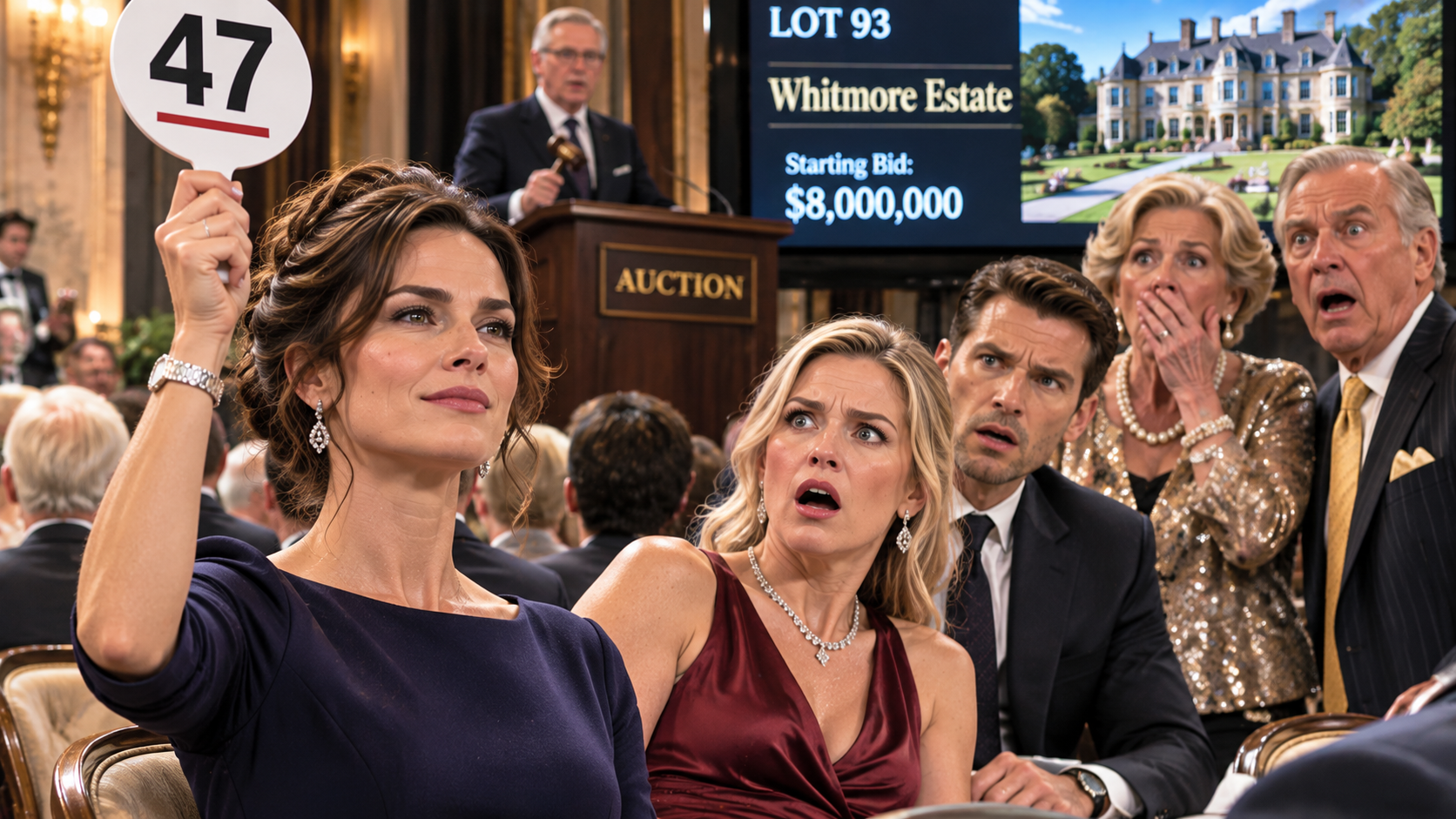
Uncle Gerald stood between me and the office door, staring at the old letter in my hand as though it were a loaded weapon.
“Give me that letter, Stella.”
I didn’t move.
“Why?”
His expression hardened.
“Because you have no idea what you’re holding.”
I looked down at my grandfather’s handwriting.
“Then explain it to me.”
Gerald glanced toward the hallway.
“Not here.”
“Here is fine.”
He took another step forward.
For the first time in my life, I saw something beneath my uncle’s expensive suits and arrogant smile.
Panic.
Real, unmistakable panic.
“Your father made mistakes,” he said quietly. “Terrible mistakes. There are things you don’t understand about him.”
My chest tightened.
“My father was a good man.”
“I’m not saying he wasn’t.”
“Then what are you saying?”
Gerald rubbed his forehead.
“I’m saying that digging into the past won’t bring him back.”
Those words hit harder than I expected.
For seven years, my uncle had barely mentioned my parents.
Now he was standing in front of me, using my father’s death as a reason to keep me silent.
I carefully folded the letter.
“What is the blue ledger?”
Gerald went completely still.
He didn’t blink.
He didn’t breathe.
Then he gave a short, unnatural laugh.
“I don’t know what you’re talking about.”
“Interesting.”
“What?”
“Because I never said what the ledger contained. I only asked what it was.”
He swallowed.
My phone was still connected to Lawrence.
I lifted it.
“Lawrence, are you there?”
“Yes, Stella.”
Gerald’s eyes widened.
“You’re on the phone with Brennan?”
“He’s been listening.”
A long silence followed.
Then Lawrence spoke.
“Mr. Whitmore, I suggest you step away from my client.”
Gerald’s jaw tightened.
“This is a private family matter.”
“Not if you’re attempting to intimidate her over documents relevant to a potential legal claim.”
Gerald looked at me again.
Something in his expression changed.
The panic disappeared beneath a cold, calculating stare.
“You think you’re clever, Stella.”
“I think you should leave.”
He leaned closer.
“You bought a house today. Don’t confuse that with winning.”
I held his gaze.
“Then why are you so frightened?”
His face flushed.
For one second, I thought he might grab the letter.
Instead, he straightened his jacket.
“You’ll regret opening doors that should have remained closed.”
Then he walked out.
I waited until his footsteps disappeared before speaking.
“Lawrence?”
“I’m here.”
“What just happened?”
He exhaled slowly.
“Stella, I need you to come to my office before you go anywhere near Whitmore Estate.”
“Why?”
“Because your grandfather’s letter confirms something I’ve been investigating for months.”
I looked at the envelope.
“Months?”
“Yes.”
“Lawrence, why didn’t you tell me?”
“Because I didn’t have enough evidence. And because I needed to know whether the estate documents would be released to the successful buyer.”
My stomach tightened.
“You knew about the letter?”
“I knew there might be sealed records. I didn’t know exactly what they contained.”
I closed my eyes.
Suddenly, buying Whitmore Estate felt less like a victory and more like stepping into a room filled with locked doors.
And Gerald had just warned me not to open any of them.
“Tell me what you know,” I said.
Lawrence hesitated.
“Not over the phone.”
“Why does everyone keep saying that?”
“Because, Stella, we’re not talking about a simple inheritance dispute.”
His voice dropped.
“We may be talking about fraud.”
I stared at the wall.
“Fraud?”
“Possibly committed against your father.”
For a moment, I couldn’t speak.
Then I heard Vanessa shouting outside the office.
“This isn’t fair! She tricked us!”
Her voice was getting closer.
Lawrence continued.
“Complete the auction paperwork. Then come straight to me. Don’t discuss that letter with anyone.”
“What about Gerald?”
“Especially Gerald.”
The call ended.
I stood alone in the quiet office, holding a letter written by a man who had died before I was old enough to understand what his name meant.
And for the first time, I wondered whether my father had spent his entire life protecting me from a truth that could have changed everything.
When I stepped back into the hallway, Vanessa was waiting.
Her makeup had smudged beneath her eyes.
Patricia stood beside her, clutching her handbag.
Derek leaned against the wall, looking irritated.
Vanessa crossed her arms.
“Well?”
I stopped.
“Well, what?”
“Did they tell you that you can’t afford it?”
“No.”
She stared.
“Then what took so long?”
“Paperwork.”
Patricia’s eyes moved toward the envelope in my hand.
“What’s that?”
“Something for the new owner.”
Her expression changed.
“From whom?”
I smiled politely.
“The auction house.”
She took a small step toward me.
“Stella, sweetheart, you know this property has been connected to our family for generations. There may be things you don’t understand.”
I almost laughed.
It was remarkable how quickly people who had spent years calling me stupid suddenly became concerned about my understanding.
“Then I’m sure I’ll learn.”
Patricia looked at Gerald, who had just emerged from another hallway.
He gave her a sharp shake of his head.
She immediately stopped speaking.
I noticed.
And Gerald noticed that I noticed.
Vanessa stamped her foot.
“Dad, do something!”
Gerald didn’t look at her.
“We’re leaving.”
“What?”
“Now.”
“But the house—”
“Vanessa.”
His voice was so cold that she fell silent.
They walked toward the exit.
Derek followed.
But Patricia lingered.
She turned to me and whispered something I would remember long afterward.
“Your father was always too trusting, Stella. Please don’t make the same mistake.”
Then she hurried after Gerald.
I watched them disappear through the glass doors.
For years, I had thought my relatives were united by wealth and arrogance.
Now I wondered whether they were united by something else.
A secret.
And the fear that I might uncover it.
Two hours later, I sat across from Lawrence Brennan in his office overlooking the city.
He had removed his jacket and spread several folders across the conference table.
There was no congratulatory champagne.
No celebration.
Only documents.
“Before we begin,” he said, “I need you to understand something.”
I nodded.
“Nothing I’m about to show you proves wrongdoing by itself. Some of these are copies of incomplete records. We need to verify the originals.”
“Understood.”
He opened the first folder.
Inside was a photograph.
Three men stood in front of Whitmore Estate.
One was my grandfather.
One was Gerald, looking much younger.
And the third was my father.
I touched the picture.
“Dad.”
He looked happy.
Younger than I remembered.
His arm was resting around my grandfather’s shoulders.
“When was this taken?”
“1997.”
A year before the letter.
Lawrence placed another document beside it.
“This is a copy of a preliminary agreement prepared during the reorganization of the Whitmore family holdings.”
I looked at the paper.
The terminology was complicated, but one line stood out.
My father’s name.
Daniel Bennett.
Beneath it were the words:
PROPOSED BENEFICIAL INTEREST — FORTY PERCENT.
I looked up.
“Forty percent of what?”
“An investment holding company that once controlled several properties, including Whitmore Estate.”
My mouth went dry.
“You’re saying Dad owned forty percent?”
“I’m saying this document indicates that he was supposed to receive that interest. We haven’t established whether the agreement was executed or whether the interest was later transferred.”
I looked back down.
My father had spent most of his life working as an accountant for a modest manufacturing company.
He drove an old sedan.
He worried about bills.
He clipped grocery coupons.
And now I was staring at a document suggesting he might once have been entitled to a substantial family asset.
“Why didn’t he have it?”
Lawrence opened another folder.
“That’s the question.”
He slid a page toward me.
“This is a summary from the company’s historical records. In 1999, your father’s proposed interest disappeared from the subsequent ownership schedule.”
“Disappeared?”
“The later records show a different allocation.”
“To whom?”
Lawrence looked at me.
“Gerald.”
I stared at him.
“Uncle Gerald?”
“Yes.”
My pulse quickened.
“How?”
“There’s a reference to a waiver signed by your father.”
I frowned.
“A waiver?”
“Supposedly, Daniel voluntarily relinquished any claim in exchange for a payment.”
“How much?”
“Two hundred and fifty thousand dollars.”
I sat back.
That wasn’t a small amount.
But it was nowhere near what forty percent of the holdings might eventually have been worth.
“Did Dad receive it?”
“We haven’t found a reliable record of payment.”
I looked at him.
“Maybe he signed it anyway.”
“That’s possible.”
“Then why do you think something is wrong?”
Lawrence reached for a third document.
“Because I found this.”
He placed a photocopy in front of me.
At the bottom was a signature.
Daniel Bennett.
I stared.
Something about it bothered me immediately.
The letters looked familiar.
But not quite right.
My father had taught me to sign my name when I was eight.
He always made the capital B with a long, looping stroke.
He used to joke that a signature should have a little personality.
This one didn’t.
It was stiff.
Careful.
Almost like someone trying too hard.
“That doesn’t look right,” I whispered.
Lawrence watched me.
“Tell me why.”
I explained.
He made a note.
“A handwriting expert will need original or sufficiently reliable comparison samples before we can draw any conclusion.”
I nodded.
But my hands had started trembling.
“Lawrence, are you saying Gerald forged Dad’s signature?”
“I’m saying it’s a possibility worth investigating. Nothing more at this stage.”
I looked at my father’s name again.
Then I remembered something.
The last Christmas before the accident.
I was nineteen.
Dad had been unusually quiet throughout dinner.
Later, I found him sitting alone at the kitchen table.
There were papers spread in front of him.
When I asked what was wrong, he smiled.
“Just an old family matter, sweetheart.”
I offered to help.
He shook his head.
“Some things take longer to put right than they should.”
At the time, I assumed he was talking about money.
Now I wasn’t sure.
I looked at Lawrence.
“Why didn’t Dad ever tell me?”
“Perhaps he didn’t know the full picture. Perhaps he wanted to resolve it first.”
“Or perhaps he was afraid.”
Lawrence didn’t answer.
That silence frightened me more than anything else.
I unfolded my grandfather’s letter.
“The blue ledger. What is it?”
Lawrence leaned forward.
“Your grandfather was known for keeping handwritten transaction records.”
“Even when the company had accountants?”
“Especially then. According to a former employee, he maintained a personal ledger containing payments, ownership agreements, and private advances between family members.”
“Blue?”
“Apparently bound in blue leather.”
I pictured the old shelves inside Whitmore Estate.
Dusty books.
Locked cabinets.
The library where my father used to sit reading while the adults argued over money.
“Where is it?”
“We don’t know.”
“But you think it’s in the house?”
“I think your grandfather’s letter gives us a reason to search the estate carefully, with a proper inventory and preservation process.”
I looked at the documents.
“If the ledger proves Dad was cheated, what happens?”
“That depends on what it contains, which agreements were valid, and whether any legal claims remain available. Some could be barred by time. Others might involve conduct discovered much later.”
I nodded slowly.
I wasn’t thinking about money anymore.
I was thinking about my father.
About the way he worked late and still came home smiling.
About how he apologized when he couldn’t afford the bicycle I wanted for my sixteenth birthday.
About the night he told me that being honest mattered more than being rich.
What if he’d spent years fighting to prove that someone in his own family had betrayed him?
What if he’d died before he could finish?
“There’s something else,” Lawrence said.
I looked up.
He seemed reluctant.
“What?”
“After your parents’ accident, Gerald contacted the attorney who was handling their affairs.”
I frowned.
“Why?”
“He asked about your father’s personal files.”
My stomach dropped.
“What files?”
“We don’t know exactly. But there is correspondence showing that he requested access to documents stored with your father’s belongings.”
“Did he get them?”
“Apparently not. The attorney declined without authorization.”
I felt cold.
Gerald had told me at the funeral that he couldn’t help with the expenses.
He barely called afterward.
But he had somehow found time to ask about my father’s paperwork.
“Did anyone tell me?”
“You were nineteen. The old correspondence suggests the attorney intended to discuss it with you, but the follow-up isn’t documented.”
I leaned back.
Suddenly, memories began rearranging themselves.
The coldness.
The distance.
The strange way Gerald sometimes stared at me during family gatherings.
It wasn’t simply contempt.
Perhaps he’d been watching for signs that I knew something.
Lawrence closed the folder.
“Stella, I want you to be careful.”
“With Gerald?”
“With everyone who may have an interest in these records.”
I thought of Patricia’s warning.
Your father was always too trusting.
I nodded.
“What’s our next step?”
“We secure the property, preserve any relevant records, and review the title and company histories.”
“When can I go inside?”
“According to the auction terms, possession is scheduled after closing. I’ve requested a supervised inspection in the meantime.”
I looked at the photograph of my father.
I had waited seven years to feel that I had accomplished something he would be proud of.
Now I had a different purpose.
I wanted to know what had happened to him.
And I wasn’t going to stop just because Gerald told me to.
That evening, I returned to my apartment.
The same small studio where I had lived for years.
I made tea.
Sat at my kitchen table.
And opened the battered wooden memory box I kept beneath my bed.
Inside were photographs, birthday cards, and a few belongings from my parents.
I hadn’t gone through everything since the funeral.
Some memories still hurt too much.
Near the bottom, I found my father’s old appointment diary.
The cover was worn at the corners.
I turned the pages carefully.
Most entries were ordinary.
Meetings.
Dentist appointments.
Bills to pay.
Then I reached November 1999.
One entry was circled twice in blue ink.
“Whitmore — G. — agreement.”
Below it, Dad had written:
“Ask Father about original records.”
I stopped breathing for a second.
Original records.
I turned another page.
There was a second note.
“Library. Behind east wall shelves?”
My heart began pounding.
I stared at the words.
The library.
Whitmore Estate had a library on the eastern side of the main house.
I remembered it clearly.
Tall windows.
Dark wooden shelves.
A marble fireplace.
And a heavy walnut cabinet that my grandfather always kept locked.
I reached for my phone.
Before I could dial Lawrence, a notification appeared.
A message from an unknown number.
I opened it.
There were only two sentences.
“Congratulations on buying Whitmore Estate, Stella.”
“Your father searched for the blue ledger too.”
I sat completely still.
Another message arrived.
“He found it.”
My fingers froze above the screen.
Then a third message appeared.
“And three days later, he told someone he was afraid for his life.”
I stared at the words.
My throat tightened.
I typed:
“Who is this?”
The response came almost immediately.
“Someone who worked for your grandfather.”
I swallowed.
“What do you want?”
A pause.
Then:
“To make sure you don’t make the same mistake your father made.”
I stood, suddenly aware of how quiet my apartment had become.
“What mistake?”
The typing indicator appeared.
Disappeared.
Appeared again.
Then the reply came.
“He trusted Gerald.”
I immediately called Lawrence.
He answered on the second ring.
“Stella?”
“Someone just contacted me.”
I explained everything.
His tone changed.
“Don’t delete those messages. Take screenshots and send them to me.”
“Do you think they’re telling the truth?”
“I don’t know. The sender could be helpful, mistaken, or trying to manipulate you. We need to establish who they are.”
I looked toward my window.
“Lawrence, what if Dad really found something?”
“Then we’ll look for evidence of it.”
“And what if Gerald knows where it is?”
Lawrence went silent.
Then he said, “Don’t confront him.”
Before I could respond, another message appeared.
This one included a photograph.
I opened it.
It showed the inside of Whitmore Estate.
An old wooden bookshelf.
Part of a marble fireplace.
And a narrow space behind one of the shelves.
Something blue was visible inside.
My heartbeat thundered.
Underneath the photograph was a message.
“The ledger isn’t where Gerald thinks it is.”
I looked closer.
There was a handwritten note taped to the shelf.
Just four words.
“FOR DANIEL’S DAUGHTER ONLY.”
My eyes filled with tears.
Daniel’s daughter.
Me.
I whispered my father’s name.
Then another message arrived.
“Someone is going to try to enter the estate tonight.”
“Make sure the auction house knows before it’s too late.”
I forwarded everything to Lawrence.
He immediately contacted the auction house and its property-security team.
Within minutes, he called me back.
“Stella, they are sending someone to verify the building is secure.”
“Did they find anything?”
“Not yet.”
I walked back and forth across my apartment, unable to sit still.
Twenty minutes passed.
Then thirty.
Finally, Lawrence called again.
“Stella, there’s been an incident.”
I gripped the phone.
“What happened?”
“The security team found the side entrance unlocked. Someone had apparently entered the house.”
My chest tightened.
“Did they catch anyone?”
“No. But they discovered something unusual in the library.”
“What?”
“A cabinet had been moved away from the wall.”
I stopped pacing.
“And behind it?”
Lawrence hesitated.
“An empty compartment.”
I stared at the diary in my hand.
“Empty?”
“Yes.”
The ledger was gone.
Or perhaps it had never been there.
I looked at the photograph sent by the stranger.
“Lawrence, the picture showed something blue.”
“I know.”
“Then someone got there first.”
“Possibly.”
I sat down slowly.
Every instinct told me Gerald was involved.
But I had no proof.
Only a suspicious old document.
A frightening letter.
And messages from someone who refused to give their name.
Then Lawrence said something that made my blood run cold.
“There’s one more thing.”
“What?”
“The security team found a torn piece of paper inside the compartment.”
I held my breath.
“What did it say?”
His voice lowered.
“It was part of a handwritten note.”
“And?”
“Stella, the note had your name on it.”
My heart stopped for an instant.
“Mine?”
“Yes.”
I whispered, “What did it say?”
Lawrence read the surviving words aloud.
“If Stella ever discovers the truth, tell her that Gerald was not acting alone.”
I couldn’t speak.
My hand tightened around the phone.
Then he continued.
“There was another name written underneath.”
I closed my eyes.
“Whose name?”
Lawrence hesitated.
“Patricia.”
A chill traveled down my spine.
Aunt Patricia.
The woman who had smiled at me after my parents’ funeral.
The woman who had suggested selling my mother’s jewelry.
The woman who had whispered that my father was too trusting.
I looked at the last message from the stranger.
Then I realized something.
Gerald might not have been the only person frightened of the blue ledger.
And the most dangerous person in our family might have been the one who had spent thirty years pretending to be harmless.
But just as I was about to tell Lawrence what I suspected, my phone lit up with one final message from the unknown number.
“Stella, before you accuse Patricia of anything, you need to know who was with your father on the night he died.”
A second later, a photograph appeared.
It showed my father’s car at a roadside gas station on the evening of the accident.
And standing beside the passenger door was someone I recognized immediately.
Someone who had told me, seven years ago, that they hadn’t seen my father in weeks.
Aunt Patricia.



One Comment on “PART 3 — THE SECRET MY UNCLE BURIED FOR THIRTY YEARS”