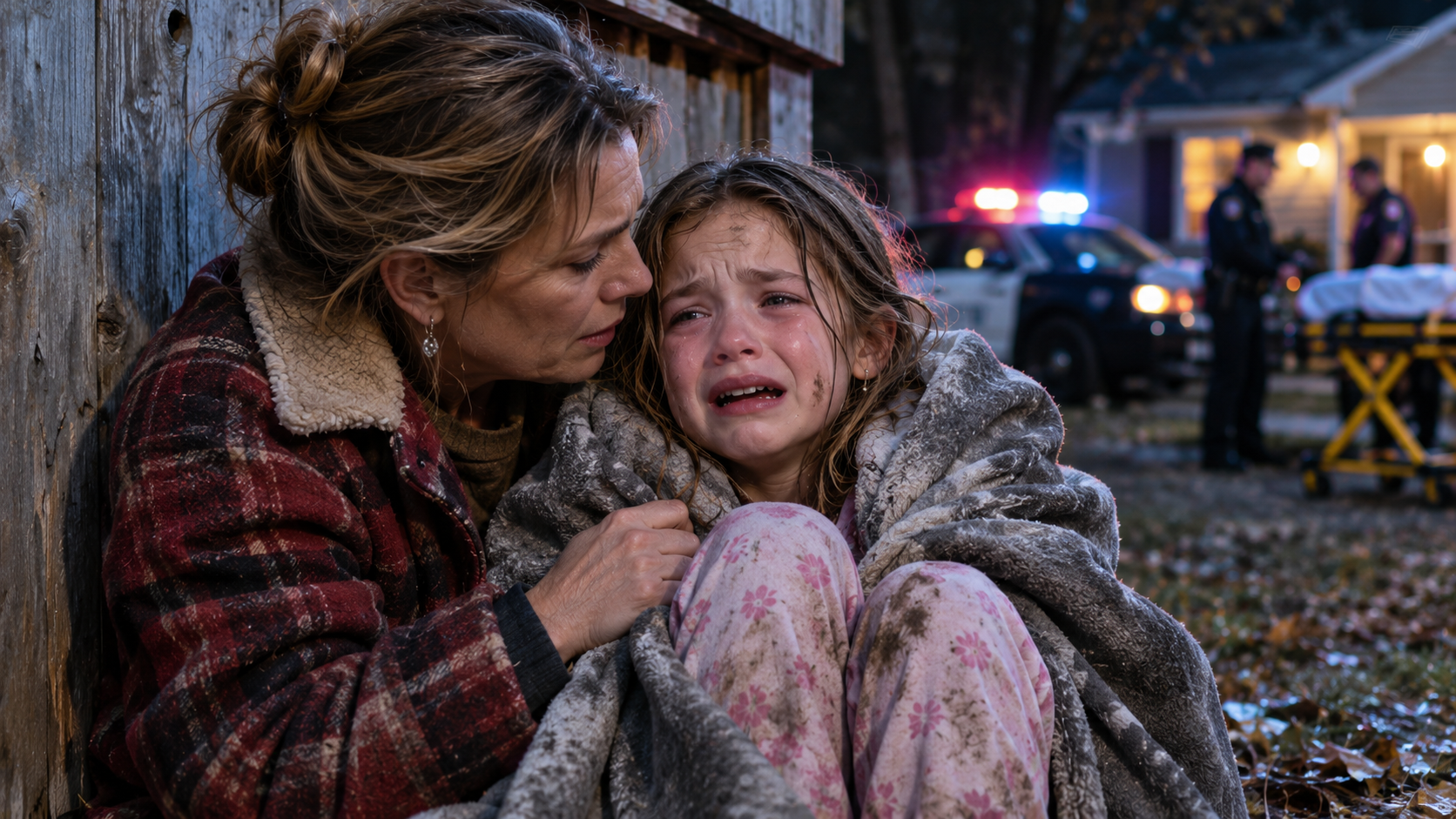
At dawn, a neighbor found my little girl hiding behind a shed, shivering and barely able to stand. I was 4,000 miles away on deployment when the call came. When I finally returned, I didn’t start by confronting my husband. I went straight to the woman who had answered that call—and asked her to repeat those words to my face.
My 9-year-old daughter called 911 while her uncle kicked in her bedroom door. She whispered our address four times, begging for help. The dispatcher replied, “Go back to bed, kid,” and hung up. The voice belonged to my own sister-in-law. At dawn, a neighbor found my little girl hiding behind a shed, shivering and barely able to stand. I was 4,000 miles away on deployment when the call came. When I finally returned, I didn’t start by confronting my husband.
I went straight to the woman who had answered that call and asked her to repeat those words to my face.
My name is Joanna Whitaker, a Staff Sergeant in the U.S. Army. When deployment orders to the Middle East arrived, my world shattered: my husband, Russell, had just been paralyzed from the waist down in a commercial job-site fall, leaving our eight-year-old daughter, Poppy, vulnerable. In our most desperate hour, Russell’s older sister, Marlene, clutched my arms with tears in her eyes: “Go serve your country, Joanna. Blood takes care of blood. Wendell and I will protect this family as our own.”
God forgive me, but I believed her. Until the fateful night of October ninth.
Wendell, Marlene’s husband, used his spare key to enter our home under the pretext of printing an invoice. When Poppy padded down the hallway to retrieve a library book, she froze.
Her uncle was forcibly prying open the locked family drawer, inserting a flash drive into the desktop. Glowing on the monitor was a private ledger under Russell’s name, marked with a figure highlighted in red: $38,600.00.
Caught red-handed, Wendell whirled around with predatory rage in his bloodshot eyes. Terrified, the little girl bolted down the corridor, slammed her bedroom door, and jammed the latch.
SLAM! A violent boot struck the timber, rattling the entire frame.
Two rooms away, Russell’s frantic shouts echoed in sheer agony. His wheelchair had been deliberately pushed twenty feet down the hallway hours earlier, leaving a disabled father helplessly trapped in his bed.
Under the dark shelter of her bed frame, Poppy’s trembling fingers dialed the only lifeline left: 9-1-1.
“Emergency dispatch, what is your location?”
“Please help me…” Poppy sobbed into the receiver. “My uncle is breaking down my door!
He’s taking files from dad’s computer… I’m at 214 Maple Ridge Road!”
Disturbingly, the typing on the other end ceased. A chilling, deliberate silence hung in the frequency.
CRACK! The latch sheared off under another brutal kick, timber splintering across the carpet.
“214 Maple Ridge! Please hurry!” she screamed in terror.
No sirens tore through the night. Instead, the dispatcher’s voice returned, flat, dismissive, and venomously calm:
“Go back to bed, kid.”
Click. The line severed. The door yielded completely, framing Wendell’s menacing silhouette. With no protectors left, Poppy pulled the red emergency window latch and threw herself out into the freezing autumn mist…
Four thousand miles away in Kuwait, when an emergency transmission informed me that my child was hospitalized and Russell was found stranded on the floor, my blood turned to ice.
But the darkest revelation was yet to come: The 911 dispatcher who had hung up on my terrified child… was Marlene herself.
What was that hidden $38,600 secret? And how far will a mother in uniform go when blood relatives become the ultimate threat?
The fourteen-hour transatlantic flight aboard a C-17 felt endless. I sat motionless in my military uniform, staring into the darkness of the cargo bay. But nothing could drown out my daughter’s words echoing inside my head.
I’d spent eighteen years in the Army. I knew how to handle the most dangerous situations. But I’d never imagined that one day, the greatest threat would come from inside my own daughter’s bedroom.
When I arrived at Cape Fear Valley Medical Center, I didn’t stop by my unit or change out of my dust-covered uniform.
“Which room is Poppy Whitaker in?”
I asked the nurse.
She glanced at my rank insignia before answering softly.
“Room 312, Sergeant. Please be gentle with her. She barely sleeps. She keeps staring at the door, waiting for her mother to come home.”
I opened the door.
Poppy looked impossibly small beneath the white hospital pillows. Her little leg was secured in a medical brace, and an IV line was attached to her hand. The moment she heard my voice, she turned sharply.
“Mom?”
That single word nearly brought me to my knees.
I opened my arms to hug her, but Poppy suddenly shrank back. I stopped immediately and knelt beside her bed.
“It’s okay, Peanut. Mommy’s home. You’re safe now.”
She stared at me for several seconds before bursting into tears and wrapping her little arms around my neck.
“He broke my bedroom door, Mommy! I called the police.
I called so many times… but the lady on the phone told me to go to bed!”
I gently squeezed her hand.
“You did nothing wrong, sweetheart. Mommy believes you.”
Forty minutes later, after Poppy had fallen asleep, I found Russell in the consultation room. He sat in his wheelchair, his face exhausted.
“Why was Wendell in our house at midnight?” I asked.
Russell lowered his head.
“He said he was helping me with the insurance claims. I signed a power of attorney for the medical accounts…”
“What about our savings?”
Russell began to cry.
“He said if I demanded to see the statements, he’d contact Child Protective Services. He threatened that a disabled father like me couldn’t take care of Poppy while you were overseas.”
Before I could respond, the door swung open.
Wendell stood there, holding an enormous teddy bear.
“Joanna! You’re finally home!
I just wanted to bring the little girl a gift.”
“Get out.”
His smile stiffened.
“You think you can give me orders? I’ve been taking care of this family while you’ve been busy playing soldier!”
Just as two hospital security officers appeared, a gentle voice sounded behind me.
It was Ruthanne, our kindhearted neighbor.
She handed me a small plastic bag. Inside was a black flash drive, its casing cracked at one corner and streaked with wet grass.
“I found it beneath the bushes right below Poppy’s bedroom window,” she whispered. “I believe this is what Wendell was looking for.”
Wendell’s eyes went to the bag in my hand, and for one second the mask slipped completely. I saw arithmetic in his face, the kind a man does when he realizes how much he stands to lose.
“That’s mine,” he said. “That’s company property.
I dropped it.”
“Out of an eight-year-old’s window,” I said. “At midnight.”
The security officers took him by the elbows. He went quietly, which told me more than a fight would have. Men who are sure they’ll win don’t go quietly.
I didn’t open the drive in that room. Eighteen years in the Army had taught me the difference between evidence and curiosity. I sealed the bag, signed across the flap, and asked Ruthanne to write down exactly where she’d found it and when. Then I called the Cumberland County Sheriff’s Office and asked for a detective, not a patrol deputy.
Detective Alana Pierce arrived within the hour. She was a compact woman in her forties with a legal pad and a habit of letting silence do her work. She listened to Russell. She listened to Ruthanne.
Then she sat beside Poppy’s bed, in the chair I’d vacated, and asked my daughter a few gentle questions while Poppy held my hand with both of hers.
“You told the lady your address four times,” Pierce said. “Do you remember what she said before the last time?”
“She stopped typing,” Poppy whispered. “I could hear it stop.”
Pierce wrote that down. She didn’t look at me, but her pen pressed harder.
“Sergeant Whitaker, I’m going to be honest. If what your daughter says is accurate, the call was recorded. Every 911 call is. I’ll request the audio and the dispatch log tonight, before anyone has a reason to tidy them.”
“And my sister-in-law?”
“Until I’ve heard that recording, she’s a witness. After I’ve heard it, we’ll see.” She finally looked at me. “I know what you want to do.
I’m asking you to let me do my job first.”
I nodded. It was one of the hardest nods of my life.
The drive opened on Pierce’s forensic laptop that night, in a conference room that smelled of burnt coffee. Russell had insisted on coming. We sat side by side, my hand on his shoulder, and watched the folders unfold.
The ledger was the first file. It matched the screen my daughter had seen: Russell’s name, a column of dates, and one red-highlighted figure, $38,600.00.
It wasn’t just a number. It was a trail.
Russell’s fall had triggered a workers’ compensation advance. His employer’s insurer had paid out in installments, and our church had run a fundraiser for his rehabilitation. The money from both had been routed, after Russell signed a power of attorney in a haze of pain medication, into an account Wendell controlled.
Wendell ran a small trucking company, and the trucking company was drowning. For four months he had been feeding our family’s money into it, one transfer at a time, labeling each one as a medical expense.
The red figure was the shortfall. It was what Wendell would have to replace before the settlement’s final audit, scheduled for the middle of the month.
“He was going to be caught,” Pierce said quietly. “Nobody could look at that number without asking where it went.”
“So he came for the original,” I said. “The one on the family computer.”
“And the one in the drawer. Paper statements Russell kept.” She scrolled. “He wanted to wipe the trail and plant a version where Russell had made the withdrawals himself. A disabled man mismanaging his own funds.
Then a call to Child Protective Services about unfit supervision, and suddenly the in-laws are the responsible adults.”
Russell’s hands had gone white on the armrests. “He said that to me, almost word for word. He said no one would believe a man in a wheelchair over a man with a business.”
“Somebody did,” I said, and I thought of Poppy’s small fingers on the red window latch.
The last folder on the drive was labeled M. It held a scanned notebook, ruled pages in handwriting I knew from every birthday card I’d ever received. Marlene’s.
Dates. Times. Shifts at the county communications center, where she’d worked as a dispatcher for eleven years. Beside each of Wendell’s visits to our house she had written a note.
10/9, W. at R’s, 10:40 p.m. Cover if anything pings. Wait for my text.
Pierce stopped breathing for a moment, then exhaled slowly.
“She knew,” she said. “She knew he’d be there. She was on shift that night, waiting for something to ping.”
I stood up. I didn’t remember deciding to.
“Sergeant.”
“I’m not going to touch her.”
“I believe you. But I need you to understand what that notebook means. She sat at a console and heard a child scream for help from her brother’s house, and she knew exactly why.” Pierce’s voice was even, and underneath it was something fierce. “I’ll have the audio by morning. Don’t go to her tonight.”
I didn’t. I went back to the hospital and slept in a chair beside my daughter’s bed, with my boots on and my hand through the rail, holding hers.
The recording came at 7:40 a.m.
Pierce played it for us in the same conference room, with a victim advocate, a sheriff’s lieutenant, and a county prosecutor named Mr. Alvarado, who looked as if he hadn’t slept either.
It began with the dispatcher’s flat, professional greeting. “Emergency dispatch, what is your location?”
Then my daughter’s voice, tiny and shaking. My uncle is breaking down my door.
I had imagined that moment so many times on the flight, in the cargo bay, in the dark. Nothing I had imagined was as bad as the real sound of it. You could hear her breath hitching. You could hear wood splitting behind her.
The dispatcher said nothing for eleven seconds.
I counted them.
Then: 214 Maple Ridge! Please hurry!
And Marlene’s voice, steady as a metronome: “Go back to bed, kid.”
The click. Then the long tone of a dead line.
Mr. Alvarado took off his glasses and rubbed his eyes. “We can work with that,” he said, and I realized he meant it as the worst kind of compliment.
The audit logs were worse still.
The computer-aided dispatch system showed that the call had been received, the location auto-populated from Poppy’s phone, and the entry closed by dispatcher M. Garrity, with the code for a prank call, within ninety seconds. No unit had been assigned. A second, delayed call, from Ruthanne, who had heard shouting and called at 5:50 a.m., was the only reason a deputy ever reached our street.
By then my daughter had been outside in forty-degree mist for hours, barefoot, hiding behind a shed with a broken ankle, and Russell had been on the floor of our bedroom, unable to reach a phone.
I asked Pierce one question. “Can I talk to her? With you there?”
She studied me for a long moment.
“On the record,” she said. “Wearing a wire. You say nothing that isn’t true and nothing that’s a threat. If she talks, she talks.
If she doesn’t, you walk away.”
“That’s all I need.”
Marlene opened her front door in a pink bathrobe with a cup of tea in her hand. She’d already had one night to think. Her eyes were red, her hair was neatly pinned, and her expression arranged itself into relief when she saw me.
“Joanna. Thank God. I’ve been sick about Poppy. I was going to come to the hospital.”
“Were you?”