The Storm in October
By autumn, a comfortable rhythm had settled over my dual life. Morning prayers at the church, afternoon deliveries with the bakery van, and Friday dinners with Wade, who had started bringing along a woman named Elena—a pediatric nurse he had met while dropping off pastries at the hospital. Seeing Wade happy, watching the guarded look fade from his eyes as Elena laughed at his dry accounting jokes, felt like another quiet blessing Margaret had set in motion.
Then, in the third week of October, an early nor’easter swept down the coast, knocking out power lines across the entire county.
I woke at four in the morning to the sound of wind howling through the oaks outside my bedroom window and the sudden, heavy silence of the refrigerator clicking off.
By dawn, freezing rain was lashing the streets, and fallen branches blocked half the intersections in town.
My first thought was the bakery. Three commercial freezers were packed with butter, cream, and prepped dough, and our industrial ovens relied on electronic igniters.
I pulled on my heavy slicker and drove slowly through the dark streets, dodging downed limbs until I reached the storefront. Denise was already there, standing inside the dim shop with a flashlight tucked under her chin, looking grim.
“Power’s been out since three,” she said as I stepped inside. “The utility company says it could be forty-eight hours before they clear the main lines on Route 9. If the freezers warm up, we lose four thousand dollars in inventory—not to mention all the food prepped for tomorrow’s community lunch.”
I stood in the half-light, listening to the rain drum against the front glass.
Across the street, the streetlights were dead, and the traffic signal swung wildly in the wind.
“What about the church?” I asked suddenly. “We have an emergency generator behind the fellowship hall—the one the trustees bought after the ice storm five years ago. And the church kitchen has two old gas ranges with pilot lights that don’t need electricity.”
Denise blinked in the flashlight beam. “Are those ranges actually big enough to bake?”
“They’re forty years old and cast iron,” I said. “They’ll outlive us both.”
Within two hours, we had formed a human chain in the pouring rain. Wade arrived in his pickup truck, followed by Leo and two teenage boys from the youth group.
We hauled crates of butter, milk, eggs, and pans of unbaked rolls from the bakery’s walk-in cooler into the church kitchen, hooking the commercial reach-in fridge directly to the fellowship hall generator.
By noon, the church basement was warm, bright, and smelling overwhelmingly of yeast and cinnamon. Because half the town was without heat or hot water, word spread quickly. Neighbors trudged through the slush carrying thermoses, flashlights, and wet coats. Arthur Pendelton arrived in Wade’s truck and immediately took charge of boiling pots of soup on the back burners while Denise and her bakers turned out tray after tray of hot bread from the ancient gas ovens.
Nobody paid a dime.
We set a large soup tureen on the counter for donations, and by evening, when the county crews finally restored power to the grid, the tureen was overflowing with crumpled bills and loose change—more than enough to cover every ounce of flour and butter we had used.
Exhausted and smelling of woodsmoke and cinnamon, I sat on the edge of the church stage after the last family had gone home. Denise slumped into a folding chair beside me, kicking off her flour-dusted clogs.
“Well, Pastor,” she murmured, staring up at the acoustic ceiling tiles. “I take back what I said about you not belonging in a kitchen.”
“I didn’t touch a single dial,” I reminded her.
“No,” she smiled faintly. “You just moved the whole bakery across town in a hurricane.”
The Letter in the Locket
November brought crisp, clear skies and the first hard frost.
With Thanksgiving approaching, the bakery entered its busiest stretch of the year—hundreds of pumpkin pies, dinner rolls, and braided loaves stacked from floor to ceiling.
One quiet Sunday evening, after finishing my sermon notes for the following week, I sat at my study desk and pulled out the tin box I had found beneath Margaret’s floorboards. I had worked through nearly every entry in the blue notebook, yet I had never opened the tarnished silver locket resting beside it.
The clasp was stiff with age. I pressed my thumbnail into the groove until it clicked open.
Inside, behind a tiny oval of scratched plastic, was a faded photograph I hadn’t seen in nearly half a century: me at seventeen, wearing an ill-fitting rented tuxedo, grinning foolishly beside Margaret in her pale blue prom dress.
Behind the photograph, folded into a square no larger than a postage stamp, was a slip of thin onionskin paper.
I eased it out with the tip of a letter opener and unfolded it carefully under my desk lamp. The ink had faded to a soft sepia, and the handwriting was rounder, younger—the script of a teenage girl rather than a seasoned businesswoman.
May 19, 1978, it read. Tommy promised tonight that he’ll marry me when we’re older. He burned his cuff trying to light a candle at the diner and got punch all down his front, and I don’t think I’ve ever laughed so hard in my life. Even if we end up miles apart, I know he’s going to make the world a kinder place wherever he goes.
I sat motionless at my desk, the tiny square of paper trembling slightly between my fingers.
For forty-five years, while I was building a life with Susan, raising a congregation, and believing my youth was simply a pleasant memory tucked away in a scrapbook, Margaret had carried that night with her.
A soft knock at the front door pulled me from my thoughts. I wiped my eyes, walked down the hallway, and opened the door to find Wade standing on the porch holding two steaming paper cups from the diner down the street.
“Saw your study light on,” Wade said, stepping inside out of the chill. “Thought you might want decaf.”
We sat in the living room, the clock ticking softly on the mantel. After a long silence, Wade looked down at his cup.
“Elena asked me today what Mom was like when she was young,” he said quietly. “I realized I only ever knew her as ‘Mom’—always organized, always taking care of everybody else.
I didn’t really know the girl you knew.”
I reached into my shirt pocket, took out the silver locket, and placed it in Wade’s palm.
“She was fearless, Wade,” I said. “And she never forgot a single person she loved.”
Wade opened the locket, stared at the tiny prom photograph, and let out a low, surprised laugh. “Look at your hair. You look like you stuck your finger in a light socket.”
“Humidity,” I said defensively. “It was a very damp May.”
A Seat at the Table
By the time December arrived, Margaret’s Table had outgrown the church basement. Twice a week, nearly ninety people filled the fellowship hall—widowers, retired teachers, single parents working double shifts, and college students living off instant noodles.
To keep up with the demand, Denise suggested hiring a second assistant baker at the shop, and to my surprise, she recommended the young woman I had met back in January—the mother in the frayed wool coat who had been counting coins for a plain roll.
Her name was Hannah, and she arrived at five every morning with her toddler bundled in a stroller tucked safely in the back office, braiding dough with a speed and precision that impressed even Denise.
“She’s a natural,” Denise told me one morning as we watched Hannah glaze three dozen cinnamon rolls in under two minutes. “And she never burns the toast.”
“I’m never living that down, am I?”
“Not as long as my name is on the schedule.”
On the week before Christmas, we hosted our largest dinner of the year. Arthur Pendelton had spent three weeks building four long pine trestle tables so everyone could sit together in two continuous rows rather than scattered at small card tables. The high school choir sang carols near the piano, and Wade and Elena worked side by side carving turkeys in the kitchen.
Near the end of the evening, as plates were being cleared and warm apple cider was poured into paper cups, an elderly woman sitting near the end of Arthur’s new pine table caught my sleeve.
I didn’t recognize her; she wore a neat navy cardigan and had silver hair pinned back with a tortoiseshell comb.
“Excuse me,” she said softly. “Are you Pastor Whitaker?”
“I am. Welcome. I’m glad you came tonight.”
“My name is Evelyn,” she said, clasping her hands on the table. “I live three towns over, in Oakridge. My sister used to live here—Sarah Jenkins.”
The name echoed immediately from the pages of the blue notebook: March 3, 2011: Covered deposit on apartment for Sarah Jenkins after her husband left.
“Sarah passed away two years ago,” Evelyn continued, her voice steady though her eyes shone. “Before she died, she told me about a woman in this town who saved her life when she had nothing—a woman who paid her rent anonymously and gave her a fresh start.
She never found out who it was until she saw Margaret’s obituary in the county paper and recognized the woman who used to slip extra bread into her grocery bag.”
Evelyn reached into her handbag and placed a crisp envelope on the table between us.
“I heard on the local radio about the meals you’re serving here,” she said. “My husband and I wanted to make sure Sarah’s name stayed part of this.”
I looked down at the envelope, then back up at Evelyn’s warm, determined face. Across the room, Arthur was laughing at something Leo had said, Hannah was bouncing her sleepy toddler on her hip while chatting with Mrs. Gable, and Wade was wiping down the counter with Elena beside him.
Margaret had been right in her letter. Love wasn’t something you finished giving.
It moved outward in circles long after the stone had dropped beneath the surface.
The Anniversary
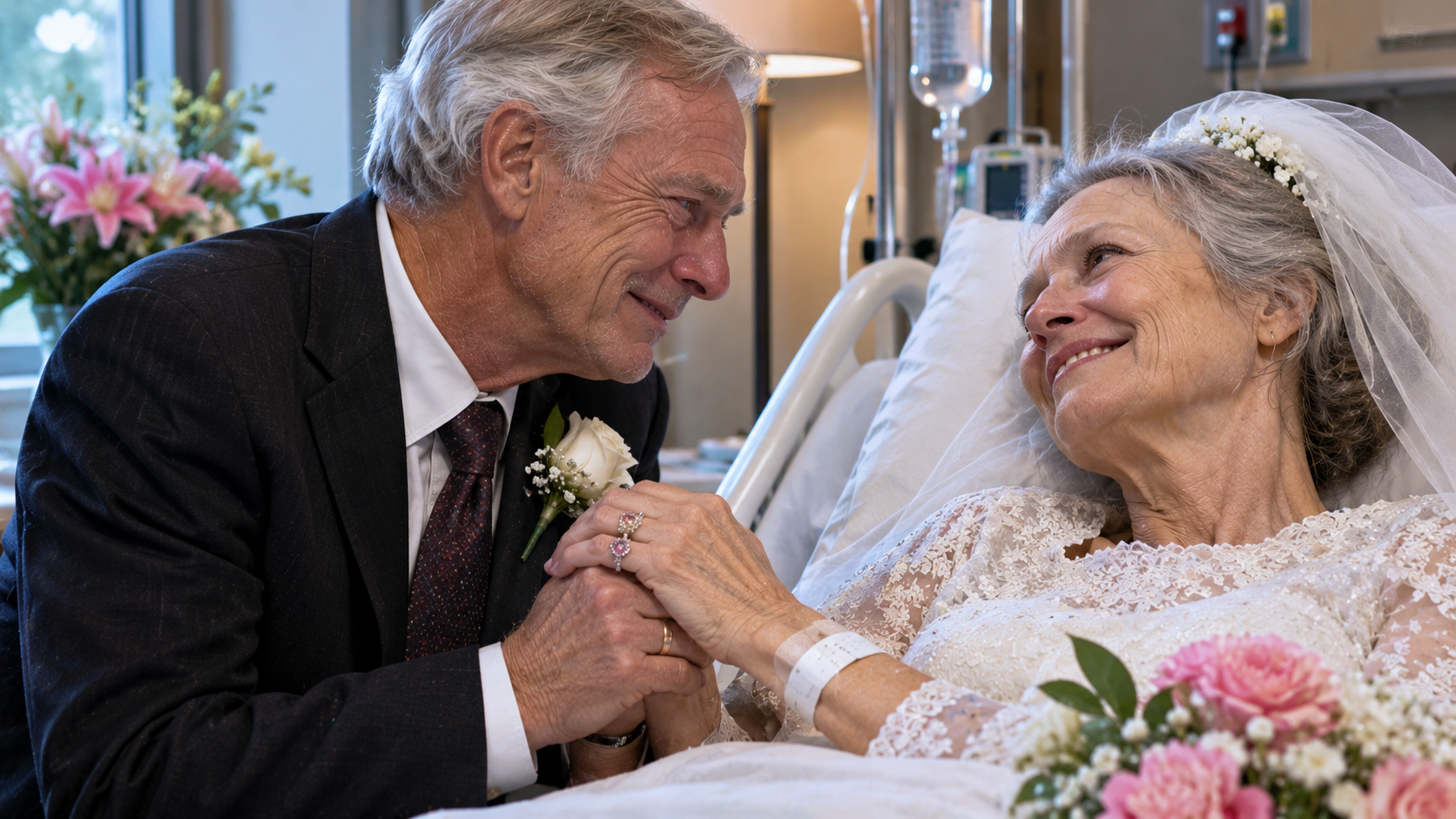
One year to the day after we stood in that quiet hospital room while Pastor George read our vows, I walked into the bakery just as the sun was rising over the rooftops across the street.
The shop was quiet before the morning rush, bathed in the golden light of the display lamps. On the wall behind the counter, the framed photograph of seventeen-year-old Margaret and me hung right where she had placed it years ago, flanked now by a small brass plaque Wade had mounted beneath it: Margaret Ellis-Whitaker, Founder. “Some people are worth waiting for.”
I poured myself a mug of black coffee and picked up a warm slice of Tommy’s Terrible Toast from the sample tray. The cinnamon sugar crackled faintly as I took a bite.
The bell above the front door chimed, and Wade walked in, shaking cold air from his jacket.
He carried a small white florist’s box in one hand and a thick manila folder in the other.
“Beat me here again,” Wade said, setting the box on the counter. “Happy anniversary, Tom.”
I opened the box. Inside rested a small bouquet of winter white roses and sprigs of cedar—the exact flowers Margaret had held in her hospital bed twelve months earlier.
“Thank you, Wade,” I said softly, setting the flowers beside her photograph. “What’s in the folder?”
Wade grinned, tapping the cardboard edge against the counter. “The county library board approved our proposal. Next spring, we’re launching a second Book & Biscuit van for the rural routes on the north side of the county. Two local banks agreed to match every dollar the bakery and church raise.”
I stared at the folder, feeling that familiar swell of astonishment that Margaret still managed to trigger even after a full year had passed.
“Your mother would tell us we’re both working too hard,” I said.
“Mom would tell you to take off that apron before you get flour on your good suit,” Wade replied, nodding toward my trousers. “You have a ten o’clock service in forty minutes.”
I glanced down—sure enough, a fine dusting of white flour coated my black wool slacks. I laughed, untied the apron, and hung it neatly on its peg beside the kitchen door.
Keep Going
Sixty-four is an age when most men begin narrowing their horizons—clearing out closets, stepping back from committees, and settling into quieter routines. Had Margaret not returned during those final weeks of her life, I suspect I would have done the same, living peacefully inside the memories of the life I had already lived.
Instead, every morning feels like the opening page of a chapter I never knew was coming.
On Sundays, I still stand behind the pulpit at my small neighborhood church, though I have taken Margaret’s advice to heart and trimmed my sermons by a full ten minutes. Afterward, half the congregation walks two blocks east to the bakery, where Denise keeps the coffee urns full and Hannah’s cinnamon rolls disappear within minutes of leaving the oven.
The blue notebook sits safely on my desk at home now, its original list completely checked off. Yet whenever I open it, I find myself adding new names on the blank pages at the back—a retired mechanic who needs rides to dialysis, a family new to town looking for work, a high school senior saving for trade school tools.
Every Saturday morning, without fail, I sit at the corner table by the front window with a cup of coffee and a plate of Tommy’s Terrible Toast.
Across from me sits the framed photograph of a seventeen-year-old girl with bright, mischievous eyes who loved me once, built a life full of quiet grace, and circled back at the very end to make sure I wouldn’t walk the rest of the road alone.
Outside, the morning sun catches the gold lettering on the bakery window, and the front bell chimes as the first customers step inside, drawn by the warmth of the ovens and the scent of cinnamon drifting out into the street.
I lift my coffee mug toward the photograph behind the counter, smile, and take another bite.
THE END..!



One Comment on “A Man Married His First Love After 45 Years Apart to Fulfill Her Final Wish – After She Passed Away, Her Son Handed Him an Envelope and Said, ‘You Don’t Know the Whole Truth About Mom. She Left This for You”