The check landed on the polished desk with a crisp, final sound—like the last word in an argument no one was allowed to have. My father-in-law, Arthur Sterling, didn’t bother to soften his expression or his tone.
“You don’t belong in my son’s world,” he said, each syllable measured and icy. “This is enough for someone like you to live comfortably for the rest of your life. Sign the papers, take it, and go.”
I stared at the number—so many zeros they looked unreal, like a prop meant to intimidate. Without thinking, my hand drifted to my stomach, where the smallest hint of a bump hid under my coat. It wasn’t something anyone else would notice yet. But I noticed. I felt it.
I didn’t plead. I didn’t raise my voice. I didn’t give him the scene he seemed to expect.
- No argument.
- No tears.
- No bargaining.
I picked up the pen, signed what they put in front of me, accepted the money, and stepped out of the Sterling orbit as quietly as a drop of rain sliding into the sea—gone without a splash.
Five Years Later: The Door Opens Again
Time has a way of turning endings into prologues.
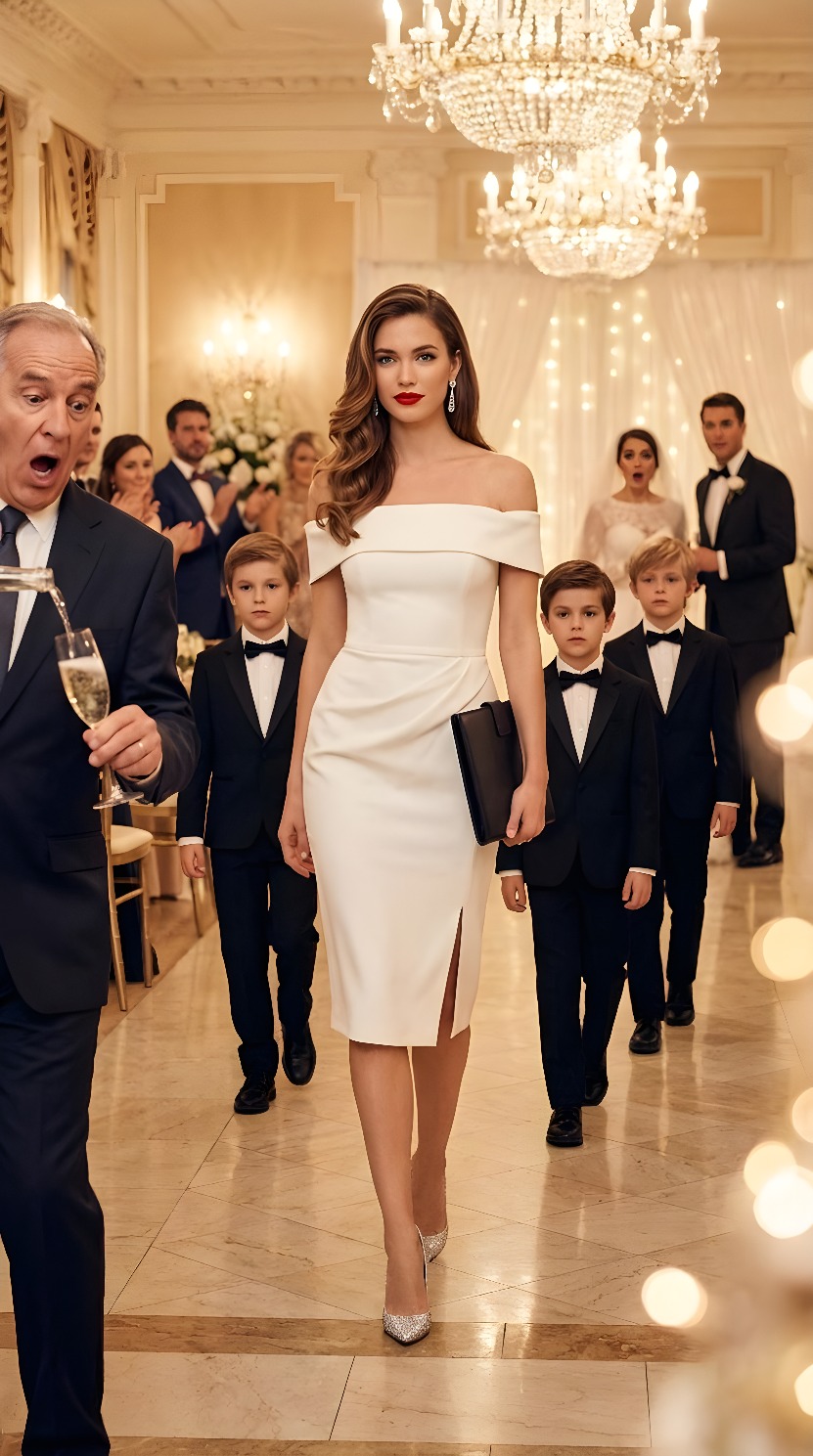
Five years later, Manhattan was dressed in its finest for what the tabloids would have loved to call the “Wedding of the Decade.” The Plaza Hotel glowed with old-world elegance—lilies perfumed the air, crystal chandeliers scattered light like diamonds, and every surface seemed designed to whisper, wealth lives here.
I walked into the grand ballroom in four-inch stilettos, my posture steady, my pace unhurried. Each step across the marble sounded like a choice I’d made—and stood by.
Behind me came four children, moving in a neat line with the serious focus only kids can manage when they sense something important. Quadruplets. Identical. Bright-eyed. And if anyone looked closely, they would have noticed a resemblance so striking it could steal the breath from a room.
The woman who left quietly didn’t come back to beg. She came back to be seen.
Not an Invitation—A Statement
I wasn’t holding an invitation. I didn’t need one.
In my hand was a document that meant far more in that world than a ribboned envelope ever could: an IPO filing for a tech company now valued at a trillion dollars. The paper itself wasn’t flashy, yet it carried the weight of countless late nights, hard decisions, and the kind of determination that grows when someone tries to erase you.
Arthur Sterling finally looked up—and the moment our eyes met, his confidence cracked. His champagne flute slipped from his fingers and shattered against the floor. The sound was sharp, unmistakable, and strangely fitting, like reality breaking through the polished performance of the evening.
Near the front, my ex-husband, Julian Sterling, stood as if the room had turned to stone around him. His expression froze, caught between disbelief and recognition.
Beside him, his bride’s smile tightened, then thinned into something brittle—pretty from a distance, but ready to splinter at the slightest pressure.
- They had expected silence from me.
- They had expected distance.
- They had expected I’d stay gone.
The Calm That Speaks Louder Than Noise
I didn’t march in for a public fight. I didn’t come to disrupt the celebration with shouting or accusations. I simply stood there, holding my children’s hands, letting the truth of our presence fill the space they’d tried to keep closed.
And I smiled.
Not the kind of smile that asks permission. Not the kind that apologizes for taking up room. It was calm—almost gentle—but unmovable. The kind that says, I survived what you intended to break me with.
Sometimes the strongest return is the quiet one—the one that makes everyone else lose their words.
The ballroom fell into a hush, as if the air itself had paused to listen. No announcement was needed. No introduction required. In a world built on image, presence was power—and mine had just rewritten the room.
Conclusion
Years ago, I left with a signature and a check, treated like a problem to be paid away. But life doesn’t end where other people try to cut it short. In five years, I built something bigger than their dismissal, stronger than their control, and fuller than their narrow definition of belonging. I didn’t return to take anything from them—I returned because I no longer needed their permission to exist in the same world.