General Vance didn’t say anything for several seconds. He simply stared at Arthur. My father had spent his entire adult life learning how to dominate rooms.
Boardrooms. Fundraisers. Country clubs. Private dinners where men decided the future of companies before dessert arrived.
Arthur Mercer knew how to intimidate employees, charm investors, flatter politicians, and make competitors feel small without ever raising his voice.
But standing beneath the security lights of the White House East Gate, he suddenly looked like a man who had realized he was in a room where his money meant absolutely nothing.
General Vance turned toward the Secret Service agent.
“What exactly happened?”
The agent glanced at me.
“Sir, Mr. Mercer made physical contact with the colonel twice after being instructed to remain within the visitor lane.”
Colonel.
The word landed harder than a gunshot.
Trevor’s mouth opened.
Evelyn blinked.
Arthur slowly turned toward me.
“What did he call you?”
I said nothing.
General Vance answered for me.
“Colonel.”
Arthur stared at the silver eagle on my shoulder as though seeing it for the first time.
For twenty-six years, he had apparently imagined me frozen at twenty-two.
Still the stubborn daughter who had walked away from his mansion carrying one suitcase and an ROTC contract.
Still the foolish girl he believed would eventually come crawling home.
Still someone beneath him.
He had never bothered to discover what happened afterward.
General Vance stepped closer.
“Colonel Mercer, are you injured?”
“No, sir.”
Arthur’s head snapped toward me.
“Colonel Mercer?”
His voice was barely audible.
I finally looked at him.
“Yes.”
Trevor laughed nervously.
“Okay, wait. Colonel?”
He looked between General Vance and me.
“As in an actual colonel?”
I almost smiled.
“What other kind is there?”
Trevor’s face reddened.
Evelyn recovered first.
She always had.
“Well,” she said quickly, smoothing the front of her dress, “obviously there’s been some misunderstanding.”
General Vance looked at her.
“What misunderstanding?”
Evelyn hesitated.
She glanced at Arthur.
Then at me.
“We’re family.”
The word almost made me laugh.
Family.
Interesting how quickly people rediscovered that word when it became useful.
Arthur cleared his throat.
“General, perhaps introductions are overdue.”
He straightened his jacket.
“I’m Arthur Mercer. Founder and CEO of Mercer Defense Technologies.”
“I know who you are.”
Arthur brightened.
Of course he did.
Arthur probably heard admiration where none existed.
“We’re currently bidding on several major defense programs,” he continued. “In fact, I was hoping we might have an opportunity today to discuss—”
“We won’t.”
Arthur stopped.
General Vance’s voice remained perfectly controlled.
“This is not a procurement meeting.”
“Of course.”
“And Colonel Mercer is not security.”
Arthur looked at me again.
I could see him recalculating.
Colonel.
White House.
Four-star general.
Something wasn’t fitting inside the story he had told himself about me.
General Vance glanced at his watch.
“Colonel, they’re waiting for you inside.”
Arthur frowned.
“Waiting for her?”
General Vance finally looked directly at him.
“Yes.”
“For what?”
There was a short silence.
Then General Vance said:
“The ceremony.”
Arthur’s face emptied.
“What ceremony?”
I could have answered.
I didn’t.
After twenty-six years, I had learned that silence could sometimes do what anger never could.
General Vance gestured toward the doors.
“We should go.”
I nodded.
“Yes, sir.”
I stepped forward.
Arthur grabbed my arm again.
It was instinctive.
Possessive.
Exactly the way he used to stop me when I was seventeen and tried to leave one of his lectures.
The Secret Service moved instantly.
Two agents closed the distance before Arthur had time to understand his mistake.
“Sir. Remove your hand.”
Arthur released me.
“Jesus, I’m her father.”
One agent replied calmly.
“That does not authorize you to restrain her.”
My father stared at him.
Then at me.
For the first time that afternoon, he seemed frightened.
Not angry.
Not offended.
Frightened.
“Kate.”
I stopped.
Twenty-six years.
Not Katherine.
Not Colonel.
Not “uniform.”
Kate.
The name he used when I was little.
I turned.
“What?”
His eyes searched mine.
“What ceremony?”
Before I could answer, General Vance did.
“The ceremony honoring her.”
Silence.
Even the donors behind us stopped whispering.
Arthur’s lips parted.
General Vance continued.
“Colonel Katherine Mercer is receiving the Distinguished Service Medal today.”
Arthur looked at me.
Then at the White House doors.
Then back at me.
“No.”
The word escaped him involuntarily.
General Vance’s expression changed.
Not anger.
Something colder.
“You believe there’s been an error?”
Arthur realized immediately how that sounded.
“No. No, of course not. I simply meant…”
He couldn’t finish.
General Vance nodded toward the entrance.
“Colonel.”
I followed him inside.
And for the first time in twenty-six years, I left my father standing behind me.
The White House corridor was cool and quiet compared with the noise outside.
My shoes clicked softly against the polished floor.
General Vance walked beside me.
For several seconds, neither of us spoke.
Then he said:
“You all right?”
“Yes, sir.”
“That wasn’t the question.”
I looked at him.
General Daniel Vance had known me for nineteen years.
He had been Lieutenant Colonel Vance when we first met overseas.
He had seen me exhausted.
Bleeding.
Terrified.
Furious.
He had once watched me argue with a brigadier general for eleven straight minutes because I believed an evacuation route would expose a convoy to unnecessary danger.
I won that argument.
Barely.
Vance had never forgotten it.
Neither had the brigadier general.
“I’m fine,” I said.
Vance sighed.
“Katherine.”
That was how I knew he wasn’t speaking as my superior anymore.
I looked ahead.
“I didn’t expect them to be here.”
“I gathered that.”
“I haven’t seen him in twenty-six years.”
Vance stopped walking.
So did I.
“Twenty-six?”
“Yes.”
“And he thought you were security?”
“Yes.”
Vance stared at me.
Then something almost resembling amusement appeared at the corner of his mouth.
“I suppose technically we all provide security.”
I laughed.
I couldn’t help it.
The sound surprised me.
After everything outside, laughter felt almost inappropriate.
But maybe that was exactly why I needed it.
Vance’s expression softened.
“There she is.”
I shook my head.
“Don’t.”
“I’m serious.”
He lowered his voice.
“You’ve walked into rooms with people actively trying to kill you with less tension in your shoulders than you had standing beside that man.”
I looked away.
“That’s different.”
“Yes.”
He paused.
“Family usually is.”
We started walking again.
Then Vance said something that stopped me.
“He knows nothing, does he?”
I looked at him.
“About what?”
“About you.”
I didn’t answer.
That was answer enough.
Vance exhaled slowly.
“Nothing?”
“Apparently not.”
“He doesn’t know about Kandahar?”
“No.”
“Baghdad?”
“No.”
“The evacuation?”
“No.”
“The task force?”
“No.”
He looked genuinely astonished.
“What does he think you’ve been doing for twenty-six years?”
I remembered Arthur’s words.
Playing soldier in the mud.
“Apparently checking badges.”
Vance muttered something under his breath.
I smiled despite myself.
Then his expression became serious again.
“You know he’s going to find out today.”
“Yes.”
“Everything.”
I stared toward the doors ahead.
“I know.”
The reception hall was already crowded.
Military officers.
Cabinet officials.
Defense representatives.
Diplomats.
Families.
Journalists.
The ceremony was part of a larger national security recognition event honoring military personnel and civilian leaders.
My medal was only one portion of the program.
That was why Mercer Defense had received donor invitations through a foundation connected to the event.
Arthur hadn’t come for me.
He hadn’t even known I would be there.
That coincidence would have been funny if it hadn’t hurt so much.
A young Army captain approached.
“Colonel Mercer?”
“Yes?”
“Ma’am, they’re ready for you in the holding room.”
“Thank you.”
I followed her.
Halfway across the hall, I glanced back.
Arthur had entered.
Evelyn and Trevor were beside him.
None of them were talking.
Arthur was staring directly at me.
This time, when our eyes met, he looked away first.
Twenty-six years earlier, my father had given me a choice.
I remembered every word.
We were standing inside his study.
I had been twenty-two.
My ROTC paperwork was sitting on his desk.
Arthur stood behind it with both hands planted on the mahogany surface.
“You’re throwing your future away.”
“I’m choosing my future.”
“No.”
His voice had cracked through the room.
“I chose your future.”
That sentence told me everything.
Not helped.
Not prepared.
Not supported.
Chose.
“You’re going to Wharton,” he said. “Then you’ll spend two years rotating through Mercer subsidiaries. By thirty, you’ll be executive vice president.”
“I don’t want that.”
“You don’t know what you want.”
“I want to serve.”
He laughed.
Actually laughed.
“Serve whom?”
“My country.”
“You can serve your country by building companies that employ ten thousand people.”
“That’s what you want.”
“That’s what intelligent people want.”
I remember staring at him.
Then I asked:
“What happens if I go?”
He walked around the desk.
“You walk out that door in uniform, you are no longer my daughter.”
I thought he was bluffing.
He wasn’t.
Two weeks later, my accounts were frozen.
My car was repossessed because it was registered through one of his companies.
My credit card stopped working.
My bedroom at home was emptied.
My belongings arrived in cardboard boxes at my college apartment.
Inside one box was a legal letter informing me that Arthur Mercer had revised his estate plan.
I had been removed.
At the bottom, in my father’s handwriting, were six words:
You made your choice.
Live with it.
So I did.
For twenty-six years.
And now, standing inside the White House in dress blues, waiting to receive one of the highest honors of my career, I realized something.
I had lived with my choice.
Arthur was about to live with his.
The ceremony began at three.
The audience stood.
Then sat.
Names were announced.
Awards presented.
Speeches delivered.
I remained backstage.
I could hear everything through the curtains.
Then the announcer’s voice changed.
“And now, ladies and gentlemen, we recognize Colonel Katherine Anne Mercer, United States Army.”
My heart beat once.
Hard.
The captain beside me smiled.
“That’s you, ma’am.”
“I was hoping they meant another Katherine Mercer.”
She grinned.
“Good luck.”
I walked onto the stage.
Applause filled the room.
Bright lights struck my face.
For the first few seconds, I couldn’t see anyone.
Then my eyes adjusted.
General Vance stood near the podium.
Senior officials occupied the front row.
And seven rows back sat Arthur.
Evelyn beside him.
Trevor beside her.
Arthur wasn’t applauding.
He was simply staring.
The announcer began reading.
“Colonel Mercer entered military service twenty-six years ago…”
I watched Arthur’s face.
“…and has served in command and strategic assignments across multiple theaters of operation.”
His expression changed.
“…including deployments supporting operations in Iraq and Afghanistan…”
Evelyn turned toward him.
“…where her leadership under hostile conditions contributed to the evacuation of wounded American and allied personnel.”
Arthur’s jaw tightened.
The citation continued.
Mission after mission.
Assignment after assignment.
Command.
Strategy.
Casualties avoided.
Lives protected.
Coalition operations coordinated.
Then came the incident I rarely discussed.
“During an attack on Forward Operating Base Archer, then-Major Mercer assumed command after the operations center suffered a direct strike…”
The room became completely silent.
“…coordinating the defense and evacuation of forty-three personnel while refusing medical evacuation for her own injuries until every critically wounded service member had been removed.”
Arthur stared at me.
His face had lost all color.
He had never known.
Not one part of it.
I had spent three weeks in a hospital after Archer.
My left side still carried scars.
My father had been photographed at a charity golf tournament during the same week.
I knew because I had seen the magazine in the hospital waiting room.
The citation continued.
“Her subsequent work in strategic defense planning has directly influenced force-protection doctrine and modernization initiatives across multiple commands.”
Then General Vance stepped forward.
He held the medal.
“Colonel Mercer.”
I faced him.
He pinned it carefully.
Then he saluted.
I returned the salute.
The room erupted in applause.
And that was when I saw Arthur stand.
For one absurd second, I thought he had finally decided to applaud.
Instead, he started walking toward the aisle.
Leaving.
But Trevor grabbed his sleeve.
“Dad.”
Arthur stopped.
Trevor whispered something.
Arthur sat down.
And I realized something strange.
Trevor was crying.
After the ceremony, the reception resumed.
I wanted five minutes alone.
I got forty seconds.
“Katherine.”
I recognized the voice immediately.
I turned.
Arthur stood behind me.
Alone.
For once, Evelyn wasn’t beside him.
Neither was Trevor.
My father looked older than he had ninety minutes earlier.
“What do you want?”
He looked around.
People were watching.
Not obviously.
But watching.
Arthur Mercer hated being watched when he wasn’t controlling the narrative.
“I want to speak privately.”
“No.”
His eyebrows lifted.
He wasn’t accustomed to that word.
“Katherine.”
“You had twenty-six years to speak privately.”
His jaw tightened.
“This isn’t the place.”
“You’re right.”
I started walking away.
He stepped in front of me.
“I didn’t know.”
I stopped.
“Exactly.”
Something flickered across his face.
“Why didn’t you tell me?”
That almost made me laugh.
“You disowned me.”
“I was angry.”
“For twenty-six years?”
“I thought you would come back.”
“I thought you might call.”
Silence.
Arthur looked down.
Then he said something remarkable.
“I was waiting for you to apologize.”
I stared at him.
“For joining the Army?”
“For choosing strangers over your family.”
There it was.
The same wound.
The same distorted story.
“You think that’s what happened?”
“You walked away.”
“No, Arthur.”
My voice remained quiet.
“You gave me an ultimatum.”
“You embarrassed me.”
“I was twenty-two.”
“I had spent your entire life preparing you.”
“For a life I didn’t want.”
“You were supposed to inherit everything.”
“I wanted a father.”
That silenced him.
For perhaps the first time in his life, Arthur Mercer had no immediate answer.
I continued.
“I didn’t care about the company.”
His eyes lifted.
“I didn’t care about the estate.”
“Katherine—”
“I cared that my father could erase me because I chose something he didn’t understand.”
“I didn’t erase you.”
“You told people you no longer had a daughter.”
His face tightened.
“Who told you that?”
“Does it matter?”
“Yes.”
“No. It doesn’t.”
He looked away.
Across the reception hall, General Vance was speaking with two officials.
Arthur followed my gaze.
His businessman instincts returned.
“Katherine…”
I knew that tone.
I almost smiled.
“What?”
He hesitated.
“I understand you’re involved in modernization planning.”
There it was.
I felt something inside me go completely still.
Not anger.
Clarity.
“You waited less than five minutes.”
Arthur frowned.
“What?”
“Five minutes after discovering your daughter survived twenty-six years without you before asking whether she could help your company.”
“That’s not what I’m doing.”
“Then don’t.”
“I’m trying to understand your work.”
“No, you’re calculating.”
His face hardened.
“I am still your father.”
“And I am still the daughter you told to disappear.”
“That was decades ago.”
“Then why did you call me a failure ninety minutes ago?”
Arthur’s mouth closed.
Behind him, someone spoke.
“That’s a very good question.”
General Vance.
Arthur turned.
“General.”
Vance stopped beside me.
“Mr. Mercer.”
Arthur straightened.
Whatever humiliation he felt disappeared behind his corporate smile.
“General, I’m glad you joined us. I actually wanted to clarify something about earlier.”
“No clarification necessary.”
“I’m afraid there is.”
Arthur lowered his voice.
“What occurred outside was a private family disagreement.”
General Vance glanced at me.
“Colonel?”
“I’m fine, sir.”
Vance nodded.
Then he looked back at Arthur.
“Good.”
Arthur smiled faintly.
“Then perhaps we can put this unfortunate misunderstanding behind us.”
Vance didn’t answer.
Arthur continued.
“As I mentioned earlier, Mercer Defense is bidding on the Sentinel modernization package. Given Colonel Mercer’s role, perhaps there may be opportunities for dialogue.”
I stared at him.
Even I couldn’t believe it.
General Vance could.
Apparently he had met men like Arthur before.
“Mr. Mercer, procurement decisions are handled through formal processes.”
“Of course.”
“And Colonel Mercer will not discuss restricted program matters with you.”
Arthur’s smile stiffened.
“I wasn’t suggesting—”
“I know exactly what you were suggesting.”
Several people nearby went quiet.
Arthur’s cheeks reddened.
Then another voice entered the conversation.
“Colonel Mercer?”
I turned.
A woman in a dark suit approached.
“Ma’am.”
She extended her hand.
“Deputy Secretary Elaine Porter.”
I shook it.
“Deputy Secretary.”
“Congratulations.”
“Thank you.”
She glanced toward Arthur.
“Mr. Mercer.”
Arthur immediately brightened.
“Deputy Secretary Porter. Wonderful to see you.”
Her expression remained neutral.
“I understand your company is participating in the Sentinel competition.”
“Yes.”
“Then your contracting team should be communicating exclusively through the designated acquisition channels.”
Arthur’s smile vanished.
“Absolutely.”
“Good.”
She looked at me again.
“Colonel, we need you in the Roosevelt Room in ten minutes.”
Arthur blinked.
“For Sentinel?”
Nobody answered him.
Porter walked away.
Arthur looked at me.
“What exactly do you do?”
For the first time, the question sounded genuine.
I considered refusing to answer.
Instead, I gave him the simplest version.
“I help decide what soldiers need before companies decide what they want to sell them.”
Arthur stared.
Something clicked.
Not everything.
But enough.
His eyes widened.
“You’re on the requirements board.”
I didn’t answer.
“Katherine.”
His voice dropped.
“You’re on the Sentinel requirements board?”
“I cannot discuss procurement details with you.”
That sentence destroyed him more effectively than shouting ever could.
Because suddenly Arthur understood the scale of his mistake.
He had arrived hoping to impress senior military leadership.
Instead, he had physically shoved, insulted, and belittled a senior officer involved in the defense ecosystem his company depended upon.
Worse, that officer was his daughter.
And there were witnesses.
Arthur stepped closer.
“Katherine, listen to me.”
“No.”
“You need to understand something.”
“I understand perfectly.”
“Anything I said outside was personal.”
“You called me a mall cop.”
Trevor had appeared behind him.
He looked miserable.
“Dad, stop.”
Arthur turned.
“Stay out of this.”
“No.”
The word surprised all of us.
Trevor stepped forward.
I had barely spoken to my stepbrother since he was a child.
He had been nine when Arthur married Evelyn.
Thirteen when I left.
He was nearly forty now.
But suddenly I could see the boy inside him.
“Stop trying to turn everything into a deal,” Trevor said.
Arthur stared at him.
“Excuse me?”
“You heard me.”
Evelyn rushed over.
“Trevor, sweetheart, this isn’t your concern.”
“It is.”
“No, it isn’t.”
Trevor looked at his mother.
“You called her a guard dog.”
Evelyn’s face changed.
“That was before we understood—”
“Understood what?”
Trevor pointed toward me.
“That she mattered?”
Evelyn went silent.
Trevor laughed bitterly.
“So if she actually had been security, treating her like garbage would’ve been okay?”
Nobody answered.
I looked at Trevor differently.
He met my eyes.
“I’m sorry.”
Arthur scoffed.
“Trevor.”
“No, Dad.”
Trevor looked at me again.
“I’m sorry for what I said outside.”
“You told me to move.”
“I shoved you.”
“Yes.”
He swallowed.
“I’m sorry.”
I studied him.
Then nodded.
“Thank you.”
Arthur stared at us.
He seemed almost offended that an apology could be that simple.
Trevor turned toward him.
“You should try it.”
Arthur’s face became stone.
“I will not be lectured by my son.”
Trevor laughed.
“Then maybe listen to your daughter.”
The Roosevelt Room meeting lasted almost an hour.
It had nothing to do with Arthur.
Nothing to do with Mercer Defense.
And I made absolutely certain it stayed that way.
When I returned to the reception, I expected my family to be gone.
Evelyn was.
Trevor wasn’t.
He stood near a window holding two glasses of sparkling water.
When he saw me, he lifted one.
“Peace offering?”
I took it.
“Thank you.”
For a moment, we stood silently.
Then Trevor said:
“I was thirteen.”
“I remember.”
“When you left.”
“Yes.”
“I thought you hated us.”
That surprised me.
“Why?”
“Dad said you did.”
Of course he had.
Trevor looked down at his glass.
“He said you chose the Army because you couldn’t handle the responsibility of inheriting the company.”
I almost laughed.
“That sounds like Arthur.”
“He said you were selfish.”
“That also sounds like Arthur.”
“He said you never contacted us again.”
I looked at him.
“That part isn’t true.”
Trevor frowned.
“I wrote.”
“To who?”
“Dad.”
“How many times?”
“Every birthday for the first four years.”
Trevor stared.
“Christmas too.”
His face slowly changed.
“No.”
“Yes.”
“I never saw anything.”
“I sent letters from basic officer training. Then Germany. Then Kuwait.”
Trevor shook his head.
“No.”
“I sent you a birthday card when you turned sixteen.”
His eyes widened.
“You did?”
“Yes.”
“What did it say?”
I smiled faintly.
“I told you not to let Arthur choose your college major.”
Trevor laughed.
Then covered his mouth.
“God.”
“What?”
“He told me you forgot my birthday.”
Something cold moved through me.
I had suspected Arthur threw away my letters.
Hearing confirmation was different.
Trevor stared toward the crowd.
“He lied to us.”
“Yes.”
“All these years.”
“I don’t know what he told you.”
Trevor’s eyes filled.
“He told me you wanted nothing to do with us.”
“I was told the same thing.”
“By Dad?”
“Yes.”
We stood there quietly.
Then Trevor whispered:
“I spent twenty-six years thinking you abandoned me.”
I looked at him.
“I spent twenty-six years thinking you forgot me.”
He laughed once.
It sounded broken.
“Apparently we’re both idiots.”
“No.”
I looked across the room.
Arthur stood alone near the doors.
“We were both children of the same man.”
Trevor followed my gaze.
Then he whispered:
“He’s terrified.”
“Of what?”
“You.”
I shook my head.
“No.”
Trevor looked at me.
“He’s terrified that you don’t need him.”
That sentence stayed with me.
Because Trevor was right.
Arthur had built his life around leverage.
Money.
Access.
Employment.
Inheritance.
Approval.
Everything was transactional.
Everything had strings.
But there was nothing he could threaten to take from me anymore.
He had already taken it twenty-six years ago.
And I had built something else.
Arthur approached us ten minutes later.
Trevor stiffened.
“I’ll stay.”
I shook my head.
“No.”
“You sure?”
“Yes.”
Trevor looked at Arthur.
Then at me.
Finally, he walked away.
Arthur stopped several feet from me.
His posture was different now.
No swagger.
No performance.
No corporate smile.
“I owe you an apology.”
I waited.
He swallowed.
“What I said outside was unacceptable.”
“Yes.”
“I shouldn’t have touched you.”
“No.”
“I shouldn’t have insulted your uniform.”
“No.”
His jaw tightened.
Clearly this was difficult.
“I was wrong.”
I looked at him.
Those were probably the hardest three words Arthur Mercer had ever spoken.
But they weren’t enough.
Not yet.
“You were wrong about what?”
His brow furrowed.
“Katherine.”
“No.”
I stepped closer.
“Don’t apologize because you discovered I outrank the person you thought I was.”
He stared at me.
“Apologize to the woman you thought was checking badges.”
His face changed.
“Because she deserved respect too.”
Silence.
“You didn’t become wrong when you discovered my rank,” I continued.
“You were wrong when you decided my rank determined whether I deserved dignity.”
Arthur looked down.
For once, he didn’t argue.
Then he said:
“You sound like your mother.”
My breath caught.
He hadn’t spoken about her in decades.
My mother died when I was nineteen.
Cancer.
Fast.
Brutal.
Arthur remarried two years later.
“What does that mean?”
“She used to say the same thing.”
“About what?”
“Me.”
He looked toward the window.
“She said I only respected people when I needed something from them.”
I didn’t know what to say.
Arthur laughed quietly.
“She told me someday it would cost me someone I couldn’t buy back.”
The room seemed to disappear around us.
“And did you listen?”
“No.”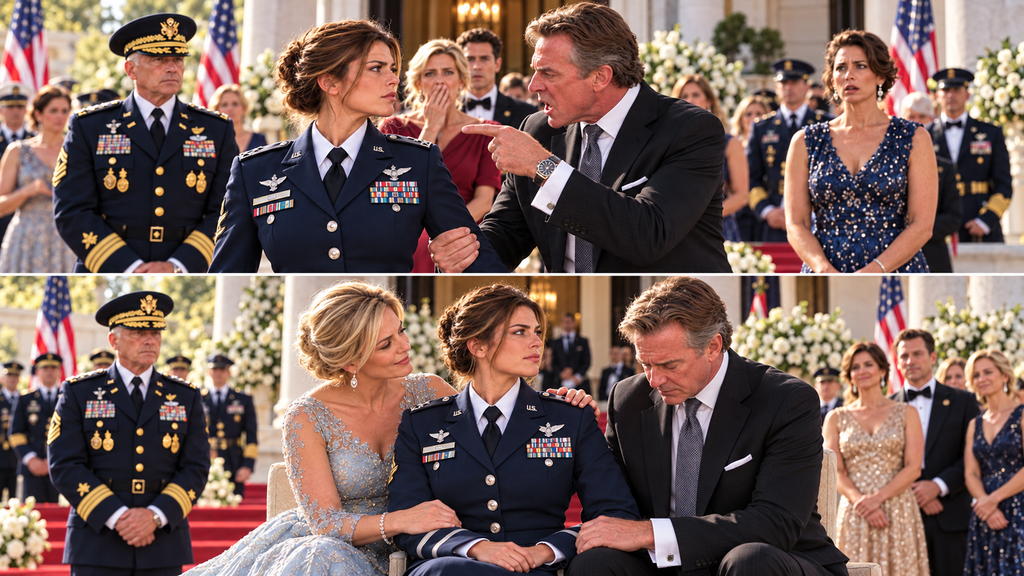
He looked at me.
“I thought she was being dramatic.”
I swallowed.
Arthur’s eyes were wet.
I had never seen my father cry.
Not at my mother’s funeral.
Not once.
“She was right.”
He reached inside his jacket.
For one strange second, I tensed.
Then he removed his wallet.
Inside was an old photograph.
He handed it to me.
I knew it immediately.
I was eighteen.
Mom stood beside me.
Arthur behind us.
We were standing outside my high school graduation.
I stared at the photograph.
“You kept this?”
“Twenty-nine years.”
“Why?”
He gave me a broken smile.
“Because apparently I’m better at keeping photographs than daughters.”
I looked at him.
There it was.
Not redemption.
Not forgiveness.
But truth.
Finally.
Arthur inhaled.
“I read every letter.”
My chest tightened.
“What?”
“The letters you sent.”
The room went cold.
“You told Trevor—”
“I know.”
“You told him I forgot him.”
“I know.”
“Why?”
Arthur closed his eyes.
“Because I was angry.”
“That isn’t an answer.”
“I wanted you to come home.”
“So you punished him?”
“I thought if you believed everyone had moved on…”
He stopped.
I stared at him.
“You thought I would break.”
“Yes.”
The honesty hurt more than another lie would have.
“And when I didn’t?”
Arthur looked at me.
“I kept waiting.”
“For what?”
“For you to fail.”
I almost whispered the next question.
“Why?”
“Because if you succeeded…”
His voice cracked.
“…then I had been wrong.”
There it was.
Twenty-six years reduced to one sentence.
Arthur Mercer had sacrificed his daughter because admitting he was wrong felt more unbearable than losing her.
I handed the photograph back.
“You missed my entire life.”
“I know.”
“You missed every promotion.”
“I know.”
“My wedding.”
He froze.
“You were married?”
“For eleven years.”
“What happened?”
“Cancer.”
Arthur closed his eyes.
“I’m sorry.”
“His name was Michael.”
Arthur nodded slowly.
“I’m sorry.”
“You missed his funeral.”
“I didn’t know.”
“You didn’t ask.”
He flinched.
I continued.
“You missed the birth of your granddaughter.”
Arthur’s eyes opened.
“What?”
“My daughter.”
His face collapsed.
“You have a daughter?”
“Yes.”
“How old?”
“Seventeen.”
Arthur actually staggered backward half a step.
“A granddaughter.”
“Yes.”
“What’s her name?”
“Grace.”
He repeated it.
“Grace.”
Quietly.
Like a prayer.
Then he looked at me.
“Does she know about me?”
“Yes.”
“What did you tell her?”
“The truth.”
His face tightened.
“All of it?”
“All of it.”
“Does she hate me?”
“No.”
He looked surprised.
“She doesn’t know you well enough to hate you.”
That hurt him.
I could see it.
But I wasn’t trying to hurt him.
I was finished doing things for that reason.
Arthur looked down at his hands.
“Could I meet her?”
“No.”
His eyes lifted.
“Not now.”
“Katherine.”
“You don’t get twenty-six years back in one afternoon.”
“I understand.”
“No. I don’t think you do.”
I stepped closer.
“You don’t get to discover that I became someone you respect and suddenly reclaim the title of father.”
His eyes filled again.
“I know.”
“You don’t get to meet Grace because you’re curious.”
“I know.”
“You don’t get access to my career.”
“I know.”
“You don’t get introductions.”
“I know.”
“You don’t get information about contracts.”
“I know.”
“And if you ever use my name to advance Mercer Defense, there will never be another conversation between us.”
Arthur nodded.
“I understand.”
I watched him.
Then I said:
“If you want a relationship with me, there are no deals.”
He looked up.
“No leverage.”
He nodded.
“No money.”
Another nod.
“No inheritance.”
His eyebrows lifted.
“Katherine—”
“I don’t want it.”
“You don’t even know—”
“I know enough.”
“It’s worth billions.”
“So?”
Arthur stared at me.
I smiled faintly.
“I told you twenty-six years ago. I don’t want your company.”
His face twisted with an emotion I couldn’t identify.
Regret, perhaps.
Or pride.
Maybe both.
“What do you want?”
The answer came easily.
“A father who can sit across from me at breakfast without needing anything.”
Arthur’s eyes closed.
When they opened again, tears finally spilled down his face.
“I don’t know how to do that.”
For the first time in my life, I believed him.
“Then learn.”
I left the White House just after seven.
The sky over Washington had turned orange.
My feet hurt.
My shoulders hurt.
My face hurt from smiling.
But I felt strangely light.
General Vance was waiting near the steps.
“You survived.”
“Barely.”
He smiled.
“How’d it go?”
“I think my father apologized.”
Vance raised an eyebrow.
“Should we alert the press?”
I laughed.
“National emergency.”
He chuckled.
Then his expression softened.
“You did well today.”
“With the ceremony?”
“With everything.”
I looked toward Pennsylvania Avenue.
“Thank you.”
Vance started walking away.
Then stopped.
“Oh.”
“What?”
“Someone’s waiting for you.”
He pointed.
A young woman stood near the security barrier.
Seventeen.
Brown hair.
My eyes.
Michael’s smile.
Grace.
I stared.
“What are you doing here?”
She grinned.
“General Vance texted me.”
I slowly turned toward him.
He was already walking away.
“Traitor!”
He lifted one hand without looking back.
Grace ran toward me.
I hugged her.
Hard.
She laughed.
“Mom, breathing is becoming optional.”
I released her.
“You weren’t supposed to arrive until tomorrow.”
“I changed my train.”
“Why?”
“Because my mother got a medal at the White House.”
I smiled.
Then her expression changed.
“So…”
I knew that look.
“What?”
“I met someone.”
My stomach dropped.
“Grace.”
She pointed toward a bench.
Arthur was sitting there.
Alone.
No Evelyn.
No Trevor.
No assistants.
No driver.
Just an old man in an expensive suit holding a folded program.
I looked at Grace.
“He didn’t approach me,” she said quickly.
“What happened?”
“I recognized him from pictures.”
“And?”
“I walked over.”
“Grace.”
“I know.”
“What did he say?”
She shrugged.
“He said hello.”
“That’s it?”
“He asked my name.”
“You told him?”
“He already knew.”
I looked toward Arthur.
He wasn’t watching us.
He was staring at the ground.
Grace slipped her hand into mine.
“He cried.”
I closed my eyes.
“Of course he did.”
“Mom?”
“Yes?”
“Are you okay?”
I looked at my daughter.
Then at my father.
Two generations.
One I had protected.
One that had failed to protect me.
And suddenly I understood something.
Forgiveness wasn’t pretending nothing happened.
It wasn’t restoring trust automatically.
It wasn’t erasing consequences.
Sometimes forgiveness was simply deciding that the person who hurt you would no longer control what you carried.
“I think so.”
Grace squeezed my hand.
“Do you want to leave?”
I looked at Arthur.
Then I made my decision.
“No.”
Grace waited.
I took a breath.
“Let’s go say hello.”
Arthur stood when we approached.
His eyes went immediately to Grace.
Then to me.
“Katherine.”
“Arthur.”
Grace nudged me.
I sighed.
“Dad.”
Something happened to his face.
One word.
That was all.
Dad.
He looked down quickly.
Grace smiled awkwardly.
“So this is weird.”
I laughed.
Arthur did too.
A real laugh.
Small.
Rusty.
Human.
“Yes,” he said. “It is.”
Grace looked between us.
“Do billionaires eat hamburgers?”
Arthur blinked.
“What?”
“There’s a burger place around the corner.”
I covered my face.
“Grace.”
“What? I’m hungry.”
Arthur looked at me.
He didn’t assume.
Didn’t command.
Didn’t reach for his phone.
He simply asked:
“Would that be all right?”
I thought about twenty-six years.
About the ultimatum.
The unopened doors.
The letters.
Michael.
Grace.
The medal resting against my chest.
Then I nodded.
“One dinner.”
Arthur smiled.
“One dinner.”
“And you’re paying.”
Grace looked horrified.
“Mom.”
Arthur laughed.
“I think I can manage.”
The burger place had sticky tables.
Paper menus.
Plastic ketchup bottles.
Arthur Mercer looked like someone had dropped a Fortune 500 CEO into a high school cafeteria.
Grace loved every second of it.
“So,” she asked, stealing one of his fries, “are you actually a billionaire?”
Arthur glanced at me.
“Apparently subtlety isn’t hereditary.”
“Nope,” Grace said.
He smiled.
“Yes.”
“Cool.”
That was it.
Arthur seemed confused.
“You don’t have another question?”
“Should I?”
“Most people do.”
Grace shrugged.
“My mom says money is only impressive if you know what to do when it can’t solve the problem.”
Arthur looked at me.
I sipped my soda.
“Don’t blame me. She reads.”
Grace kicked me beneath the table.
Arthur smiled.
Then his smile faded.
“She sounds like your mother.”
I knew he meant mine.
Grace leaned forward.
“My grandmother?”
“Yes.”
“What was she like?”
Arthur looked at me.
Permission.
For once, he asked without words.
I nodded.
And my father told my daughter about my mother.
Not about money.
Not about Mercer Defense.
Not about society dinners.
He told Grace about the woman who sang terribly while cooking.
Who loved thunderstorms.
Who once drove six hours because I forgot a stuffed rabbit at a hotel.
Who told Arthur he was too proud.
Who apparently had been right more often than either of us realized.
We stayed until the restaurant began stacking chairs.
Arthur never mentioned business.
Not once.
Three months later, I received a letter.
Not an email.
A letter.
Arthur’s handwriting.
I almost didn’t open it.
Inside were two pages.
He didn’t ask for anything.
He told me he had started seeing a counselor.
That surprised me more than the apology.
He told me he had apologized to Trevor.
Properly.
He told me he had found the box containing every letter I had sent.
He had kept them.
All of them.
Then he wrote:
I spent twenty-six years believing pride was strength.
You spent twenty-six years proving strength can exist without pride.
I cannot recover what I destroyed.
I can only stop destroying what remains.
If you allow me, I would like to know my daughter.
Not Colonel Mercer.
Not the person who can introduce me to generals.
Kate.
I folded the letter.
Then I called him.
He answered on the first ring.
“Hello?”
“Dad.”
Silence.
Then:
“Hi, Kate.”
“Breakfast Saturday?”
His voice cracked.
“Yes.”
“No assistants.”
“Yes.”
“No business.”
“Yes.”
“No expensive place.”
A pause.
“How inexpensive?”
I smiled.
“Waffle House.”
Another pause.
“Katherine, there are limits to reconciliation.”
I laughed so hard I nearly dropped the phone.
And somewhere between the laughter and the tears that followed, twenty-six years finally began to loosen their grip.
Arthur never got the shortcut he had wanted.
Mercer Defense competed for contracts like every other company.
I never discussed classified or procurement-sensitive information with him.
I never made introductions on his behalf.
I never allowed our repaired relationship to become a corporate asset.
And strangely, he stopped asking.
Trevor changed too.
He eventually admitted that he had spent his entire adult life trying to become the son Arthur wanted instead of figuring out what kind of man he wanted to be.
A year later, he left Mercer Defense.
Arthur was furious.
For approximately twelve hours.
Then something extraordinary happened.
He called me.
“What do I do?”
“About Trevor?”
“Yes.”
“Nothing.”
“What does that mean?”
“It means you tell him you love him.”
“And then?”
“That’s it.”
There was a long silence.
“That seems insufficient.”
“Try it.”
He did.
Trevor later called me laughing.
“What did you do to him?”
“Nothing.”
“He told me he loved me.”
“Terrifying.”
“I almost called an ambulance.”
We laughed.
That was how our strange family rebuilt itself.
Not through one dramatic apology.
Not through money.
Not through a medal.
Through small things.
Phone calls.
Breakfasts.
Birthdays.
Awkward dinners.
Grace teaching Arthur how to use emojis.
Arthur accidentally sending me fourteen thumbs-up icons.
Trevor showing up for Thanksgiving carrying a pie nobody wanted to eat.
Evelyn took longer.
Much longer.
She never became warm.
Perhaps she never would.
But six months after the White House incident, she called.
“I owe you an apology.”
“Yes.”
She paused.
“You could make this easier.”
“I could.”
Another pause.
“I was cruel.”
“Yes.”
“I judged you based on what Arthur told me.”
“You also called me a guard dog.”
“I know.”
Silence.
“I’m sorry.”
I accepted the apology.
I did not pretend we were close.
Those are different things.
Two years after that afternoon at the White House, I retired from active duty.
Twenty-eight years.
My final ceremony was smaller.
No White House.
No cameras.
No cabinet officials.
Just soldiers.
Friends.
Family.
Grace stood in the front row.
Trevor beside her.
General Vance attended, though by then he was preparing for retirement himself.
And sitting at the end of the row was Arthur.
He was eighty-one.
He walked with a cane.
His hair had gone almost completely white.
But he was there.
When the ceremony ended, he waited until everyone else had finished congratulating me.
Then he approached.
He looked at my uniform.
The same uniform he once mocked.
His eyes settled on the ribbons.
Then the silver eagle.
Then my face.
“I owe this uniform an apology too.”
I smiled.
“I don’t think it holds grudges.”
“I do.”
“I noticed.”
He laughed.
Then his expression became serious.
“May I ask you something?”
“Yes.”
“Do you regret it?”
“What?”
“Choosing this.”
I looked around.
At Vance.
At soldiers I had served beside.
At Grace.
At the flag.
Then back at my father.
“No.”
He nodded.
“I’m glad.”
I stared at him.
Twenty-eight years earlier, those words would have meant everything.
Now they meant something different.
Not permission.
Not approval.
Recognition.
Arthur swallowed.
“I’m proud of you.”
My eyes burned.
I could have told him I didn’t need to hear it.
That would have been true.
But truth can have more than one side.
I didn’t need his approval.
But I had once desperately wanted his love.
So I let the words reach the young woman inside me who had walked away carrying one suitcase.
“Thank you, Dad.”
He hugged me.
Not tightly.
Not possessively.
He waited until I stepped forward first.
Then he held me.
Grace took a photograph.
It sits on my desk now.
Arthur in his dark suit.
Me in uniform.
Both of us older.
Both of us smiling.
Neither of us pretending the missing twenty-six years never happened.
People sometimes ask what happened to the inheritance.
That part makes me laugh.
Arthur changed his will again.
He divided most of his personal estate between Trevor, Grace, several charities, and a veterans’ foundation.
He asked whether I wanted anything.
I told him yes.
One thing.
The old graduation photograph.
The one he had carried in his wallet for twenty-nine years.
When he finally gave it to me, I framed it beside the photograph from my retirement ceremony.
Two photographs.
Nearly three decades apart.
In the first, Arthur stood behind me.
In the second, he stood beside me.
That difference mattered more than billions ever could.
Arthur died four years after my retirement.
Quietly.
At home.
I was there.
So was Trevor.
So was Grace.
Near the end, when his breathing had become shallow, he opened his eyes and looked at me.
“Kate?”
“I’m here.”
His fingers moved weakly against the blanket.
I took his hand.
“I wasted so much time.”
My throat tightened.
“Yes.”
He smiled faintly.
Still my father.
Still stubborn enough to appreciate an honest answer.
“I’m sorry.”
“I know.”
“Did you forgive me?”
I thought carefully.
Then I told him the truth.
“A long time ago.”
His eyes filled.
“But forgiveness wasn’t the same as pretending it didn’t happen.”
“I know.”
“And it wasn’t permission to hurt me again.”
“I know.”
I squeezed his hand.
“But yes.”
He closed his eyes.
“Thank you.”
Those were among the last words he spoke.
After the funeral, Trevor and I went through Arthur’s study.
Inside the bottom drawer of his desk was a wooden box.
Every letter.
Every birthday card.
Every photograph.
All the things I had mailed during those first years.
Trevor sat on the floor reading them.
Eventually, he started crying.
I sat beside him.
“Look.”
He handed me the birthday card I had sent him when he turned sixteen.
The handwriting belonged to a twenty-five-year-old version of me.
Trevor,
Happy birthday.
Sixteen feels enormous until you become thirty.
Then you’ll realize nobody actually knows what they’re doing.
Don’t let Dad choose your life for you.
Pick something that makes you proud when nobody is watching.
Love,
Kate.
Trevor wiped his eyes.
“You were right.”
“About thirty?”
“About nobody knowing what they’re doing.”
I laughed.
Then he looked at me.
“You know what’s crazy?”
“What?”
“If Dad hadn’t gone to that White House event…”
I knew.
“We might never have found each other.”
Trevor nodded.
I thought about that afternoon.
The shove.
The insult.
The order.
Pretend you don’t know us.
Arthur had wanted me invisible.
Instead, his cruelty had forced him to finally see me.
But the greatest revelation that afternoon had never been my rank.
It wasn’t the medal.
It wasn’t General Vance.
It wasn’t the White House.
It wasn’t even the fact that the daughter Arthur had dismissed as a failure had built a life worthy of respect.
The real revelation was simpler.
I had spent years believing success would prove my father wrong.
It didn’t.
Because my life had never been evidence in a case against him.
My career wasn’t revenge.
My uniform wasn’t revenge.
My medals weren’t revenge.
Grace wasn’t revenge.
Happiness wasn’t revenge.
They were simply mine.
That was the lesson Arthur eventually learned too late.
And the lesson I learned just in time.
The people who reject you do not get to decide what your rejection means.
They do not get to write the rest of your story.
They do not get to freeze you forever at the moment they walked away.
Twenty-six years earlier, my father had stood in his study and told me:
“You made your choice. Live with it.”
For years, I heard those words as a curse.
Eventually, they became something else.
Permission.
I had made my choice.
I had lived with it.
I had served.
I had loved.
I had lost.
I had become a mother.
A commander.
A widow.
A mentor.
A friend.
And eventually, strangely, unexpectedly…
a daughter again.
Not because a four-star general exposed my identity.
Not because a room full of important people applauded.
Not because Arthur discovered that the “mall cop” standing in front of him was actually a decorated colonel.
Those things only shattered the story he had invented about me.
What changed us came afterward.
When the uniforms came off.
When nobody important was watching.
When there were no contracts to win.
No reputations to protect.
No inheritance to threaten.
Just an old father sitting across from his daughter in a cheap diner, trying to figure out how to become the man he should have been twenty-six years earlier.
And a daughter deciding, one breakfast at a time, how much of the door she was willing to reopen.
The first morning we met at that Waffle House, Arthur arrived twenty minutes early.
Of course he did.
He had reserved a corner booth.
Apparently he had tried to reserve the entire restaurant first.
The waitress refused.
I liked her immediately.
When I walked inside, Arthur stood.
“You came.”
“You sound surprised.”
“I wasn’t sure you would.”
I sat down.
“You ordered?”
“No.”
“Why?”
He looked almost embarrassed.
“I don’t know what you eat.”
That sentence nearly broke me.
My own father didn’t know how I took my coffee.
Didn’t know I hated mushrooms.
Didn’t know I always ordered hash browns extra crispy.
Didn’t know I had developed an irrational love of blueberry waffles during pregnancy because they were the only thing I could keep down.
Twenty-six years existed inside that tiny admission.
I picked up the menu.
“Then ask.”
Arthur looked at me.
“What?”
“If you don’t know something about me, ask.”
He nodded.
“All right.”
So he did.
“What do you drink?”
“Coffee.”
“How?”
“Black.”
He smiled faintly.
“Your mother drank it black.”
“I know.”
“What do you eat?”
“Almost anything.”
“Mushrooms?”
“Absolutely not.”
He laughed.
“I hate mushrooms too.”
“Congratulations. Genetics confirmed.”
The waitress arrived.
Arthur ordered pancakes.
I ordered blueberry waffles and hash browns.
Then he asked another question.
“What music do you like?”
I stared at him.
“What?”
“You said ask.”
I smiled.
So we talked.
Not about the past.
Not at first.
He learned that I loved old rock music.
That I hated golf.
That I had broken my ankle at thirty-seven.
That Michael proposed to me in a hospital cafeteria because we had both been too exhausted to go anywhere romantic.
That Grace wanted to study engineering.
That I had a dog named Sherman who feared vacuum cleaners.
And I learned things about Arthur too.
He hated being alone in thunderstorms.
He secretly watched cooking competitions.
He had developed diabetes.
He missed my mother every day.
He had kept her perfume in a drawer for thirty years because opening the bottle made him remember Sunday mornings.
He regretted selling our childhood house.
He feared Trevor hated him.
He feared I would disappear again.
At one point, he asked:
“Will you?”
“Will I what?”
“Disappear?”
I looked at him across the sticky table.
“No.”
His shoulders relaxed.
“But Dad?”
“Yes?”
“If you ever make me choose between loving you and respecting myself again, I’ll choose myself.”
He nodded.
“You should.”
That was the moment I knew something had genuinely changed.
Not enough to erase anything.
But enough to begin.
Years later, after Arthur died, I returned to that same Waffle House.
Same corner booth.
Different waitress.
I ordered blueberry waffles.
Black coffee.
Extra-crispy hash browns.
I placed the old graduation photograph on the table across from me.
For a while, I simply sat there.
Then I smiled.
“You were impossible, Dad.”
The empty seat offered no defense.
“You were arrogant.”
Nothing.
“Controlling.”
Still nothing.
“And spectacularly bad at apologizing.”
I laughed.
A woman at the next table looked at me strangely.
I didn’t care.
Then I touched the photograph.
“But you learned.”
My eyes filled.
“And so did I.”
Outside, morning sunlight stretched across the parking lot.
I finished my coffee.
Paid the check.
And walked toward the door.
Before leaving, I looked back at the empty booth one final time.
Twenty-six years ago, Arthur Mercer told me that if I chose the Army, I would lose my family.
He was wrong.
I lost him for a while.
Then I found myself.
And eventually, when he was finally ready to stop demanding that I become someone else…
I found my father too.
I stepped outside.
Grace was waiting beside the car.
She smiled.
“You okay, Mom?”
I looked back through the restaurant window.
Then at my daughter.
The medal Arthur first learned about that day at the White House was locked safely away at home.
The uniform had been retired.
The rank was behind me.
And none of that felt like something I needed to prove anymore.
I smiled.
“Yeah.”
Grace opened the passenger door.
“Ready?”
I nodded.
“Ready.”
As we drove away, I thought once more about that afternoon at the White House.
Arthur’s hand gripping my arm.
His disgusted expression.
His words:
Pretend you don’t know us.
If I could return to that moment, I wouldn’t yell.
I wouldn’t reveal my rank.
I wouldn’t tell him about the medal waiting inside.
I wouldn’t warn him that General Vance was walking toward me instead of him.
I would simply look at the frightened twenty-two-year-old woman I had once been and tell her:
Keep walking.
One day, you will understand.
You do not need to become powerful enough to make the people who rejected you regret losing you.
You only need to build a life in which their rejection no longer defines you.
And sometimes, if you are very lucky, they will grow enough to understand that too.
Arthur eventually did.
Twenty-six years late.
But he did.
And that was enough.
Not to rewrite our past.
But to give us an ending neither of us expected.
Because the most important thing General Vance revealed that afternoon wasn’t my identity.
It was something my father should have understood from the beginning.
I had never needed Arthur Mercer’s billions to become somebody.
I already was somebody.
I just needed him to finally see me.
 THE END! THANK YOU FOR READING!

