Commander Hayes held the salute for one long second. Then two. Long enough for every person beneath that white tent to understand that it was not a joke.
Long enough for my mother’s hand to fall away from the pearls at her throat. Long enough for my father to stop smiling.
Long enough for Ryan to stare at me as though the woman sitting in the black dress had suddenly become a stranger.
I stood.
Not quickly.
Not dramatically.
I simply rose from the folding chair, straightened my shoulders, and returned the salute.
The movement was automatic.
Muscle memory.
Something my body remembered even when I desperately wanted my heart to forget.
Commander Hayes lowered his hand.
“So you made it,” he said quietly.
“I said I would.”
His expression softened.
“You also said you’d let protocol seat you where you belonged.”
I glanced at my mother.
“That became complicated.”
Hayes followed my eyes.
For the first time since he approached me, he seemed to notice the expressions surrounding us.
My mother looked pale.
Dad looked irritated rather than confused, as if someone had broken an unspoken rule by treating me with respect in public.
Aunt Patricia’s mouth hung slightly open.
Madison had lowered her phone.
And Ryan—
Ryan looked frightened.
Not because he knew the truth.
Because he finally understood that he didn’t.
Commander Hayes turned toward the security guard.
“Why is Commander Carter sitting back here?”
The guard swallowed.
“Sir, I—”
My mother stood abruptly.
“There must be some misunderstanding.”
Hayes looked at her.
Mom gave him the smile she reserved for pastors, doctors, and anyone else she believed might be useful.
“I’m Emily’s mother.”
“I gathered that, ma’am.”
“She isn’t—”
Mom stopped.
Hayes waited.
My father rose beside her.
“What exactly is going on?”
The commander looked from him to me.
Then back again.
“That depends,” he said. “How much has your daughter told you?”
Dad actually laughed.
It was short and uncomfortable.
“About what?”
Hayes stared at him.
“Her career.”
Silence.
Dad’s face changed.
Not much.
But enough.
“My daughter doesn’t have a military career.”
The sentence struck harder than I expected.
After everything they had said that morning, that was the one that hurt.
Maybe because he said it with such certainty.
Not suspicion.
Not confusion.
Certainty.
My father had decided what my life was without ever asking me.
Hayes looked at me.
I gave the smallest shake of my head.
He understood immediately.
“You never told them?”
“I tried once.”
Ryan spoke from behind him.
“Told us what?”
I turned.
My little brother was staring at me.
For the first time all morning, there was no arrogance in his face.
Only confusion.
“Emily?”
Commander Hayes stepped aside.
The senior chief carrying the dark folder approached.
“Sir.”
Hayes accepted it.
Then he looked at me again.
“You want me to do this privately?”
That was my last chance.
I could have walked away.
Part of me wanted to.
I had spent more than a decade protecting my family from the details of my life.
From the classified parts.
From the ugly parts.
From the nights that ended with helicopters and blood.
From the mornings when names disappeared from contact lists because the people attached to them were never coming home.
They had mistaken my silence for failure.
Maybe I had allowed them to.
But I had not come to Coronado to humiliate them.
I had come because Ryan was my brother.
Because whatever he thought of me, I had wanted to see him receive his Trident.
I looked at Hayes.
“Ryan deserves his ceremony.”
Hayes nodded.
“He does.”
Then he glanced toward the stage.
“And you deserve your seat.”
He gestured toward the empty chair beside the podium.
My mother whispered, “Emily, what is happening?”
I picked up my purse.
“Apparently,” I said, “I’m sitting in the wrong place.”
Nobody laughed.
I followed Commander Hayes toward the front.
Each step felt louder than the last.
The crowd was silent enough that I could hear my heels striking the pavement.
Click.
Click.
Click.
I passed Ryan.
His eyes followed me.
“Emily.”
I stopped.
He looked at the commander.
Then at the reserved chair.
Then back at me.
“What rank did he call you?”
I held his gaze.
“Commander.”
His face went blank.
“You’re Navy?”
“Yes.”
“For how long?”
“Fourteen years.”
Ryan actually recoiled.
Fourteen years.
He did the arithmetic immediately.
Everyone did.
The years I had supposedly been drifting.
The years Dad told people I was “finding myself.”
The years Mom said I was too unstable to hold down a real career.
Fourteen years.
Ryan whispered, “That’s impossible.”
I almost smiled.
“You used to say the same thing when I beat you at chess.”
“This isn’t chess.”
“No.”
His voice dropped.
“You never told me.”
That hurt too.
Because technically, it was true.
But only technically.
“I tried.”
“When?”
“Your eighteenth birthday.”
He stared at me.
I could see him searching backward.
Then he remembered.
The restaurant.
The envelope.
The interruption.
Dad telling me nobody wanted another one of my dramatic announcements.
Mom asking me to wait until after Ryan opened his presents.
Ryan laughing with his friends while I slipped the envelope back into my purse.
I had been leaving for training forty-eight hours later.
He had never asked what was inside.
Ryan’s eyes lowered.
“Oh.”
“Yes,” I said.
Then I walked away.
Commander Hayes guided me to the reserved chair.
A small card rested on the seat.
CDR EMILY CARTER.
My mother could see it from where she stood.
So could my father.
I sat.
The ceremony resumed.
At least, officially it did.
Commander Hayes returned to the podium and welcomed the families.
He spoke about sacrifice.
Discipline.
Brotherhood.
Responsibility.
He spoke about the Trident not as a trophy but as a promise.
I watched Ryan as he listened.
His posture remained perfect.
But his eyes kept moving toward me.
Every few seconds.
As though checking whether I was still there.
Then came the individual recognitions.
One by one, names were called.
Families applauded.
Men who had survived some of the most demanding training in the military stepped forward with faces that tried and failed to hide what the moment meant to them.
Then Hayes reached Ryan.
“Petty Officer Ryan Carter.”
My mother immediately stood.
Dad stood with her.
Aunt Patricia began clapping before anyone else.
Ryan stepped forward.
For one moment, he looked exactly like the little boy who used to stand at the edge of the community pool in orange water wings, terrified to jump.
He had been five.
I had been eleven.
“Catch me?” he had asked.
“Always.”
He jumped.
I caught him.
Standing there now, he looked toward me.
And I clapped.
Not loudly.
Not theatrically.
But sincerely.
Because pride and pain can live in the same heart.
That is one of the crueler things adulthood teaches you.
You can love someone who has wounded you.
You can be proud of someone you are angry with.
You can celebrate their achievement without pretending they treated you well.
Ryan received his Trident.
The applause rose.
Mom cried.
Dad shouted, “That’s my boy!”
And I smiled.
For him.
Just for him.
I thought that was the end.
I was wrong.
Commander Hayes returned to the microphone.
“Before we conclude, we have one additional recognition.”
My stomach tightened.
I looked at him.
Hayes did not look back.
Oh, no.
The senior chief opened the dark folder.
My name was still printed across the front.
Ryan turned.
My father frowned.
Hayes continued.
“Ceremonies like this focus appropriately on those receiving the Trident. But no operator reaches this point alone. There are instructors, teammates, families, physicians, intelligence personnel, air crews, logistics specialists, and countless others whose names are rarely spoken from a podium.”
My pulse quickened.
I hated podiums.
I hated recognition.
Hayes knew that.
Which meant whatever he was doing, he had decided it mattered more than my discomfort.
He looked toward me.
“Commander Carter, please stand.”
Every face turned.
I stood.
Hayes continued.
“Commander Emily Carter has requested throughout her career that her service remain private whenever possible.”
Dad whispered something I could not hear.
Hayes spoke carefully.
He did not reveal operations.
He did not reveal locations.
He did not tell stories that belonged to people who were not present to consent to their telling.
He simply told the truth.
“Commander Carter currently serves in a senior operational support capacity working alongside Naval Special Warfare and joint-service personnel.”
Ryan’s lips parted.
Hayes continued.
“She has deployed repeatedly in support of missions that will not be discussed today.”
A murmur passed through the crowd.
“And more than one person standing on this base owes something to her judgment under pressure.”
I closed my eyes for half a second.
There it was.
The part I had asked him not to say.
Not details.
Just enough.
Hayes looked directly at me.
“Three years ago, during an overseas operation, Commander Carter was injured while assisting personnel during an emergency extraction.”
My mother sat down.
Hard.
Her chair scraped against the pavement.
I remembered that night.
Not heroically.
People imagine courage as something clean.
It isn’t.
That night smelled like fuel, dust, burned metal, and blood.
There had been screaming.
There had been a young man calling for his mother.
There had been someone pressing both hands against my side while telling me not to close my eyes.
There had been a moment when I genuinely believed I would never see the sunrise.
There had been nothing beautiful about it.
Hayes continued.
“She returned to duty after recovery.”
Ryan stared at the thin scar visible near my wrist.
He had mocked that scar once.
Thanksgiving.
Two years earlier.
He asked if I had gotten it “doing one of those weird wilderness retreats.”
Everyone laughed.
I had laughed too.
Sometimes laughter is cheaper than explanation.
Hayes closed the folder.
“That is all I’m authorized to say about Commander Carter’s record.”
Then he paused.
“But I can say this.”
His voice changed.
Less official.
More personal.
“Character is often clearest when nobody is applauding.”
The words settled over the tent.
“Commander Carter has spent most of her career without applause.”
My eyes burned.
I hated him a little for that sentence.
Because I had prepared myself for embarrassment.
For anger.
For confrontation.
I had not prepared myself for kindness.
Hayes stepped away from the microphone.
The first person to clap was an elderly man near the aisle.
Then a woman beside him.
Then one of the senior chiefs.
Then another.
Within seconds, the entire tent was standing.
I remained frozen.
Applause surrounded me.
Not the wild applause of a stadium.
Something heavier.
Measured.
Respectful.
I looked toward my family.
Mom was crying.
Dad was not clapping.
Aunt Patricia was.
Madison was staring at the ground.
Ryan—
Ryan slowly brought his hands together.
Once.
Twice.
Then harder.
His eyes never left mine.
And for the first time in my life, I saw shame on my brother’s face.
Not embarrassment.
Shame.
There is a difference.
Embarrassment worries about how you look.
Shame understands what you did.
When the ceremony ended, families flooded toward the graduates.
Parents hugged sons.
Children climbed into arms.
Cameras appeared everywhere.
My instinct was to leave.
I had done what I came to do.
I had watched Ryan receive his Trident.
That was enough.
I slipped my purse over my shoulder and started toward the side exit.
“Emily.”
Mom.
I kept walking.
“Emily, wait.”
I stopped.
Not because she ordered me to.
Because I was tired of running from conversations I had already survived in my head a thousand times.
I turned.
My entire family stood behind her.
Mom.
Dad.
Ryan.
Aunt Patricia.
Madison.
Even two cousins who had spent breakfast pretending not to see me.
Mom reached me first.
Her mascara had smudged beneath her eyes.
“Fourteen years?”
“Yes.”
“You’ve been in the Navy for fourteen years?”
“Yes.”
“Why didn’t you tell us?”
I stared at her.
It was such a remarkable question that for a moment I could not answer.
Then I laughed.
One small sound.
Mom flinched.
“Emily?”
“I did tell you.”
“No, you didn’t.”
“I tried.”
“When?”
“Do you really want the list?”
She went quiet.
Dad approached.
His face had turned red.
“This is ridiculous.”
Ryan looked at him.
“Dad.”
“No, Ryan. Think about this. Fourteen years? And nobody knew? That doesn’t make sense.”
I looked at him.
“You knew I joined the Navy.”
His expression changed.
Just a flicker.
Mom turned toward him.
“What?”
Ryan stared.
“Dad?”
My father’s jaw tightened.
And suddenly I understood something I had not known until that exact second.
He remembered.
Of course he remembered.
I had been twenty-two.
Standing in our kitchen.
A duffel bag at my feet.
My hair cut shorter than Mom liked.
Orders folded inside my coat.
Dad had walked in from the garage and stared at the bag.
“What’s that?”
“I enlisted.”
He had looked at me for perhaps five seconds.
Then he said:
“Don’t tell your mother until after your brother’s graduation. She has enough to deal with.”
I had assumed he eventually forgot.
He had not forgotten.
He had hidden it.
Mom looked between us.
“Robert?”
Dad shoved his hands into his pockets.
“She said she enlisted. Kids say things.”
“I was twenty-two.”
“You dropped out of college.”
“To enlist.”
“You were always changing your mind.”
“I never changed this one.”
His voice sharpened.
“Then why disappear?”
That question finally cracked something inside me.
Not my composure.
Something older.
Something I had been carrying since I was twenty-two.
“I didn’t disappear.”
Dad scoffed.
“You missed Christmas.”
“I was deployed.”
“You missed Patricia’s wedding.”
“I was deployed.”
“You missed Grandma’s funeral.”
I swallowed.
“I was in a military hospital.”
Mom made a sound.
Tiny.
Broken.
“What?”
I looked at her.
“I was in a hospital.”
“When your grandmother died?”
“Yes.”
“Why didn’t you tell me?”
“I called.”
Mom shook her head.
“No.”
“November seventeenth. 2:13 in the morning where I was. I left you a voicemail.”
Her face drained of color.
Dad looked away.
And that was when I knew.
I knew before either of them said another word.
I stared at my father.
“What did you do?”
Nobody moved.
“Dad.”
His mouth tightened.
“It wasn’t the right time.”
Mom turned toward him.
“What wasn’t?”
He said nothing.
My heart started beating harder.
“What did you do with my message?”
Dad exhaled through his nose.
“You were upset. Your mother was already devastated. I didn’t see any point in adding more chaos.”
I stared at him.
“You deleted it.”
Mom whispered, “Robert.”
He lifted his hands.
“She was incoherent.”
“I was medicated.”
“I didn’t know that.”
“Because you didn’t listen to the whole message.”
He stopped.
That was the answer.
My mother took two steps away from him.
“You deleted a message from our daughter?”
Dad’s voice hardened.
“Don’t turn this into something it isn’t.”
“What is it, then?”
“She was always bringing drama into everything.”
The words hung there.
Ryan looked sick.
I felt strangely calm.
Sometimes the truth you spend years fearing turns out to be smaller than the damage created by avoiding it.
I nodded.
“All right.”
Dad frowned.
“All right what?”
“Now I understand.”
“Understand what?”
“Why nobody came.”
Mom covered her mouth.
I looked at her.
“I thought you knew.”
Her eyes filled.
“I didn’t.”
“I spent nine days in that hospital.”
Mom began crying harder.
“I didn’t know.”
“I know that now.”
Ryan whispered, “Were you alone?”
I looked at him.
“No.”
He seemed relieved for half a second.
Then I finished.
“My team was there.”
His relief vanished.
“They took turns sitting with me.”
I remembered Senior Chief Bennett asleep in a plastic chair with his arms crossed.
Maya smuggling terrible coffee past the nurses.
Hayes, years before he became the man standing fifty feet away from us now, bringing me a paperback novel because I complained there was nothing to read.
People I barely knew had sat beside my hospital bed.
My own family had been told I simply chose not to attend Grandma’s funeral.
Mom turned toward Dad.
“You told us she didn’t care enough to come.”
Dad’s face went rigid.
“I said I didn’t know where she was.”
“No,” Ryan said.
Everyone looked at him.
He was pale.
“You said she chose not to come.”
Dad stared at him.
Ryan’s voice grew stronger.
“I remember. Mom cried in the kitchen, and you said, ‘This is who Emily is. Stop expecting more.’”
I remembered that sentence too.
Mom had repeated it to me months later.
This is who you are.
Stop expecting us to understand.
I had believed they all decided that together.
Maybe they had.
Maybe Dad had simply given them the first push.
Aunt Patricia quietly stepped backward.
She suddenly seemed desperate to become invisible.
I looked at her.
“Don’t leave yet.”
She froze.
“Emily, I—”
“You called me selfish at Grandma’s memorial dinner.”
Her face reddened.
“I didn’t know.”
“You never asked.”
“I was grieving.”
“So was I.”
She looked down.
Madison started crying.
That surprised me.
“Emily,” she whispered, “I’m sorry about what I said this morning.”
I studied her.
“Which part?”
She winced.
“The supportive family thing.”
“You said what everyone else was thinking.”
“No.”
“Yes.”
I looked around at them.
“Do you know what the strangest part is?”
Nobody answered.
“I wasn’t angry when I came here this morning.”
Ryan stared at me.
“I was nervous.”
He blinked.
“You?”
“Yes.”
“Why?”
“Because I wanted you to be happy I came.”
His face collapsed.
Not dramatically.
His mouth simply opened, and whatever answer he had disappeared.
“I thought maybe today could be different,” I continued. “I thought I’d sit with Mom and Dad. I thought we’d take a picture. I thought maybe you’d introduce me to some of your friends.”
Ryan looked at the ground.
“I thought maybe afterward you’d ask me where I’ve been all these years.”
I smiled sadly.
“But before the ceremony even started, Mom told security I wasn’t important.”
Mom sobbed.
“Emily—”
“Dad told me not to come to the reception because people might ask what I do.”
My father looked away.
“And Ryan told me not to embarrass him.”
Ryan shut his eyes.
I let the silence remain.
Nobody rescued him from it.
Finally, he whispered, “I’m sorry.”
I nodded.
“I believe you’re sorry right now.”
His eyes opened.
“That doesn’t mean you forgive me.”
“No.”
The word seemed to hurt him.
It was supposed to.
Not as punishment.
As truth.
Forgiveness given too cheaply becomes permission.
Ryan stepped closer.
“I thought you didn’t care about us.”
“Why?”
“Because you never came home.”
“I came home.”
“Not often.”
“Every time I came home, Dad asked when I was going to get a real job. Mom introduced me as her daughter who was ‘between things.’ You made jokes about me being unemployed.”
His eyes filled.
“I didn’t know.”
“You didn’t ask.”
That became the sentence none of them could escape.
You didn’t ask.
They had opinions.
They had jokes.
They had explanations.
They had stories about me that they told one another until those stories became family history.
But they had never asked.
Commander Hayes approached slowly.
“Emily?”
I turned.
“Sir.”
He held out the dark folder.
“This belongs to you.”
I took it.
My father stared at the seal embossed on the front.
“What is that?”
“Paperwork.”
“For what?”
I looked at Hayes.
He gave me the choice.
So I opened the folder.
Inside was a letter.
Not an award.
Not exactly.
It was notification that I had been selected for a new assignment.
A position I had spent years pretending I did not want because wanting something makes rejection more painful.
Ryan read my face.
“What?”
I looked at Hayes.
“When did this become official?”
“Yesterday.”
“You could have called.”
“I did.”
I checked my phone.
Six missed calls.
I had been driving through the night.
Hayes smiled.
“You didn’t answer.”
“Apparently I was busy trying not to embarrass my brother.”
Ryan groaned.
To my surprise, Hayes laughed.
Even I smiled.
The tension broke for half a second.
Then Hayes nodded toward the paper.
“Read the last paragraph.”
I did.
My throat tightened.
The assignment meant promotion.
Captain.
I read it again.
Mom stared at me.
“What does it say?”
I closed the folder.
“It means I’m being promoted.”
“To what?” Ryan asked.
“Captain.”
He exhaled.
“Captain Emily Carter.”
“Eventually.”
He shook his head as though reality had become too large to fit inside his skull.
Then Hayes said something that made him freeze.
“She’ll be one of the people reviewing portions of your community’s readiness program next year.”
Ryan stared at me.
I stared at Hayes.
“You enjoyed saying that.”
“More than I should have.”
Ryan made a sound somewhere between a laugh and a cough.
“Wait.”
Hayes raised an eyebrow.
Ryan pointed at me.
“My sister might be reviewing us?”
“Professionally, yes.”
“Oh, God.”
I folded my arms.
“Don’t embarrass me, Ryan.”
One of the senior chiefs behind Hayes choked on his coffee.
Ryan stared at me.
Then, unbelievably, he laughed.
A real laugh.
Not cruel.
Not defensive.
Just stunned.
And for a few seconds, I saw my little brother again.
Then Dad ruined it.
“Enough.”
Everyone turned.
He stepped forward.
“This has gotten completely out of control.”
Mom stared at him.
“Robert.”
“No. I’m not going to stand here while everyone pretends Emily is some kind of saint.”
“I never said I was.”
“You hid this from your own family.”
“I protected my privacy.”
“You lied.”
“About what?”
“You let us believe you were doing nothing.”
That finally made me angry.
Not loud.
Angry.
I stepped toward him.
“No, Dad.”
He stopped.
“You chose to believe I was doing nothing because that version of me made you feel better about Ryan.”
His face darkened.
“Don’t bring your brother into this.”
“Why not? You did.”
Ryan went still.
I continued.
“Every achievement in our family needed a failure beside it. Ryan got straight A’s, so you talked about the semester I struggled. Ryan made varsity, so you reminded everyone I quit volleyball. Ryan graduated college, so you told the entire restaurant I dropped out.”
“You did drop out.”
“To join the Navy.”
“You could have finished.”
“I did.”
He blinked.
I almost laughed.
“I finished my degree eight years ago.”
Mom whispered, “You have a degree?”
“Two.”
Nobody spoke.
Dad’s face reddened further.
I continued.
“I completed my bachelor’s while serving. Then a master’s.”
Ryan rubbed both hands over his face.
“Of course you did.”
I looked at him.
“What?”
He gave a broken laugh.
“Nothing. It’s just every thirty seconds I find out something else about my sister.”
His voice cracked on the word sister.
Dad shook his head.
“This is absurd.”
“No,” I said. “What’s absurd is that strangers know more about me than my own family because strangers bothered to ask questions.”
Dad pointed toward Hayes.
“These people filled your head with this.”
Hayes’ expression changed.
I stepped between them before he could respond.
“No.”
My voice was quiet.
“These people never once told me to hate you.”
Dad stopped.
“They never told me you were beneath me. They never laughed at you. They never told me to stop calling home.”
My eyes burned.
“I did that myself.”
Mom whispered, “Why?”
I looked at her.
“Because every call hurt.”
That silenced her.
I had not planned to say it.
Maybe that was why it sounded so raw.
“Every call home became a list of everything Ryan was doing right and everything I was doing wrong. Every holiday became another joke. Every question about my life was really an accusation.”
Mom shook her head.
“I didn’t realize.”
“I know.”
“I would have changed.”
“Maybe.”
She flinched.
I hated hurting her.
But I was done lying to protect people from the consequences of how they treated me.
Mom stepped closer.
“Can I ask you something now?”
“Yes.”
“Were you happy?”
The question almost broke me.
Not where had I been.
Not how much did I make.
Not why hadn’t I told her.
Were you happy?
I looked toward the ocean beyond the buildings.
“Sometimes.”
She waited.
“I was proud,” I said. “I was scared a lot. I was tired. I made friends. I lost friends. I learned things about myself I wish I hadn’t needed to learn.”
My voice softened.
“And sometimes I was very happy.”
Mom nodded through tears.
“Okay.”
It was the first question she had asked me in years that did not contain a judgment.
Ryan walked toward us.
He stopped several feet away.
“Emily.”
“Yes?”
“I need to tell you something.”
His face had changed again.
This time, there was fear in it.
Real fear.
“I knew you were Navy.”
The world seemed to tilt.
Mom stared at him.
“What?”
Ryan swallowed.
“I didn’t know any of this. I swear. I didn’t know her rank. I didn’t know what she did. But I knew she served.”
I stared at him.
“How?”
His eyes lowered.
“Dad told me.”
My father’s face changed instantly.
“Ryan.”
“No.”
Ryan turned toward him.
“No, Dad. You don’t get to do that.”
“Watch your tone.”
“I’m thirty-one years old.”
“Then act like it.”
“I am.”
Ryan looked back at me.
“He told me when I said I wanted to try for the teams.”
My stomach dropped.
“When?”
“Three years ago.”
The same year I was injured.
Ryan continued.
“I asked him if anyone in the family had served. He said you had joined the Navy years ago but probably washed out or ended up behind a desk somewhere.”
Dad interrupted.
“That was my understanding.”
“You never asked me,” I said.
He ignored me.
Ryan’s eyes filled.
“I believed him.”
I nodded slowly.
“That part is on you.”
“I know.”
He looked toward the ground.
“And I think…”
He stopped.
“What?”
“I think part of me liked believing it.”
That was the first truly brave thing my brother said that day.
Not because it made him look good.
Because it made him look terrible.
And he said it anyway.
“Why?” I asked.
He swallowed.
“Because I wanted this to be mine.”
He touched the Trident on his chest.
“I wanted to be the one who did something hard. The one everybody respected.”
His voice trembled.
“If you had already done something bigger than anything I could explain, then…”
“Then what?”
“Then maybe I wasn’t special.”
I looked at him for a long time.
Finally, I said, “Ryan, your accomplishment doesn’t become smaller because someone else accomplished something too.”
He looked up.
“You don’t need me to fail for you to succeed.”
Behind him, Dad looked away.
Ryan nodded.
“I know that now.”
“Do you?”
“I’m trying to.”
I believed him.
Trying mattered.
Not as much as changing.
But it mattered.
Mom suddenly sat down in the nearest chair.
“I feel like I don’t know my own daughter.”
I sat beside her.
For several seconds, neither of us spoke.
Then she whispered, “What food do you hate?”
I blinked.
“What?”
“What food do you hate?”
“Mom—”
“I don’t know.”
She wiped her face.
“I know Ryan hates mushrooms. I know Patricia hates cilantro. I know your father won’t eat onions unless they’re practically burned.”
Dad muttered, “Susan.”
She ignored him.
“But I don’t know what you hate.”
Despite everything, I smiled.
“Bananas.”
Her eyebrows rose.
“You ate banana pudding every Thanksgiving.”
“Because you made it.”
“You hate bananas?”
“With the passion of a thousand suns.”
She laughed.
A wet, broken laugh.
Then I laughed too.
“I don’t know your favorite color,” she said.
“Green.”
“I thought it was blue.”
“It was blue when I was twelve.”
“What music do you listen to?”
“Mostly terrible eighties rock.”
She smiled.
“You got that from your father.”
“Unfortunately.”
Dad looked at me.
For one brief second, something softened in his expression.
Then pride closed over it again.
Mom reached toward my hand.
She stopped before touching me.
“May I?”
That almost undid me.
Permission.
Such a tiny thing.
I placed my hand in hers.
Her fingers closed around mine.
“You have calluses.”
“Yes.”
“I never noticed.”
“I know.”
We sat like that while the reception began around us.
Then Ryan cleared his throat.
“There’s something I want to do.”
I looked at him.
“What?”
“Come with me.”
“Where?”
“The reception.”
I almost laughed.
“Dad specifically told me not to.”
Ryan looked at our father.
“Dad isn’t the one being honored.”
Then he faced me.
“I am.”
He extended his hand.
“And I’m inviting my sister.”
I stared at it.
He did not rush me.
Eventually, I took it.
The reception was held in a large room overlooking the water.
Families clustered around high tables.
There was food, coffee, photographs, laughter.
The moment I entered beside Ryan, conversations shifted.
Not because everyone knew my story.
Most didn’t.
But enough people had witnessed the ceremony.
Ryan introduced me to his teammates.
Not as Commander Carter.
Not as some mysterious officer.
As his sister.
“This is Emily.”
A broad-shouldered man named Mason shook my hand.
“We’ve heard absolutely nothing about you.”
Ryan winced.
I smiled.
“That sounds about right.”
Mason laughed.
Another teammate approached.
“Ma’am.”
I shook my head.
“Not today.”
He grinned.
“Yes, ma’am.”
Ryan groaned.
For the first time that morning, I relaxed.
Then a young woman approached me.
She wore a simple cream dress and carried a small purse.
“Commander Carter?”
“Yes?”
“My name is Leah.”
She glanced toward Ryan.
And Ryan immediately looked terrified.
Interesting.
“I’m Ryan’s girlfriend.”
I turned slowly toward my brother.
“Girlfriend?”
Ryan rubbed the back of his neck.
“We were going to tell everyone today.”
Leah smiled.
“We’ve been together eleven months.”
I looked at him.
“Eleven months?”
“Don’t.”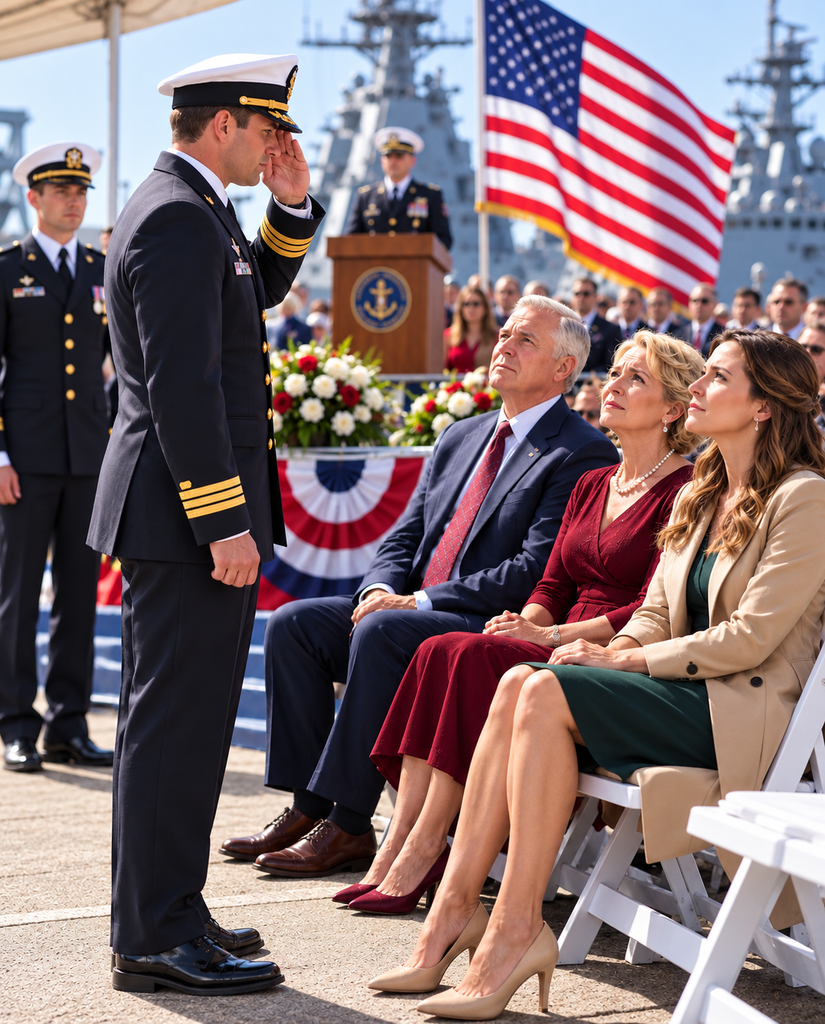
“You hid something from your family for eleven months?”
He stared at me.
I raised an eyebrow.
Then he laughed.
“Fine. I deserved that.”
Leah touched my arm gently.
“Can I tell you something?”
“Sure.”
“Ryan talks about you.”
He froze.
“Leah.”
She ignored him.
“What does he say?”
Her expression softened.
“That he misses you.”
Ryan looked toward the window.
I studied him.
Leah continued.
“He has a picture of you two on his phone.”
Ryan’s ears turned red.
“What picture?”
She smiled.
“You’re both kids. He’s missing his front teeth.”
I knew exactly which one.
Virginia Beach.
Ryan was seven.
I was thirteen.
We were covered in sand, holding a plastic shovel between us like a trophy.
I looked at him.
“You kept that?”
He shrugged.
“Yeah.”
“Why?”
His eyes met mine.
“Because before everybody decided who we were supposed to be, you were my favorite person.”
That one hurt differently.
I looked away.
The ocean blurred through the glass.
Ryan continued.
“You taught me to swim.”
I nodded.
“You taught me to drive.”
“You almost killed us.”
“You taught me to throw a football.”
“Badly.”
“You stayed up all night with me when I had pneumonia.”
“You were eight.”
“You beat up Tommy Richardson because he pushed me off my bike.”
“I did not beat him up.”
“You broke his nose.”
“He ran into my fist.”
Leah laughed.
Ryan smiled.
Then the smile disappeared.
“I don’t know when I started treating you like the enemy.”
I did.
But I did not say it.
Because some realizations need to belong to the person making them.
He looked at me.
“I want my sister back.”
I took a slow breath.
“You don’t get her back today.”
He nodded.
“I know.”
“But maybe you can get to know her again.”
His eyes filled.
“I’d like that.”
“Start with bananas.”
He frowned.
“What?”
“I hate them.”
He laughed.
And just like that, the first brick came out of the wall.
Not the whole wall.
One brick.
That was enough for one day.
Dad did not join us.
I noticed him standing alone near the doorway.
Mom eventually went to him.
They spoke quietly.
Then not quietly.
I did not hear every word.
I heard enough.
“You let me believe she abandoned us.”
“I was trying to protect this family.”
“From our daughter?”
“She made choices.”
“So did you.”
People began glancing toward them.
Dad lowered his voice again.
Mom did not.
“For years, Robert.”
“I did what I thought was best.”
“No. You did what made the story easier.”
That sentence landed across the room.
Dad looked toward me.
Our eyes met.
I expected anger.
Instead, for the first time, I saw something that looked almost like fear.
Not fear of me.
Fear that the version of himself he had protected for years was beginning to collapse.
He walked out.
Mom did not follow.
Twenty minutes later, I found her on the balcony.
The ocean wind pulled strands of hair from her carefully sprayed hairstyle.
She looked older.
Not physically.
Just suddenly human.
“I’m sorry,” she said.
I leaned against the railing.
“For what part?”
“All of it.”
“That’s a lot.”
“I know.”
She stared at the water.
“I laughed this morning.”
“Yes.”
“When Patricia said you weren’t supportive.”
“Yes.”
“I let the guard move you.”
“Yes.”
“I told people you couldn’t keep a career.”
“Yes.”
Each answer made her shoulders sink lower.
Finally she whispered, “I don’t have an excuse.”
“No.”
She nodded.
“I kept waiting for you to tell me I was still a good mother.”
I looked at her.
She gave a sad smile.
“You’re not going to, are you?”
“Not today.”
She nodded.
“Fair.”
We stood quietly.
Then she said, “Can I earn another chance?”
I thought about it.
“Yes.”
She cried again.
“But Mom?”
“Yes?”
“Another chance is not the same as pretending none of it happened.”
“I understand.”
“You don’t get to ask me for details I can’t share.”
“Okay.”
“You don’t get to use my career as something to brag about now.”
That startled her.
“I wouldn’t—”
“You might.”
She considered it.
Then nodded.
“Okay.”
“And if someone insults me at Thanksgiving, I’m not going to sit there politely anymore.”
A small smile appeared.
“I think I’d like to see that.”
“I wouldn’t.”
She laughed.
Then she asked, “Will you come this year?”
I looked out at the Pacific.
“I’ll think about it.”
She accepted that.
That mattered.
When we returned inside, Ryan was cutting cake.
He handed me a slice.
Chocolate.
“Peace offering.”
“I accept.”
Then Madison approached.
She held her phone.
“I deleted the video.”
I frowned.
“What video?”
“From this morning.”
Of course.
She had been recording.
“I started recording when Aunt Susan asked security to move you.”
Mom closed her eyes.
Madison looked ashamed.
“I thought it was funny.”
“Why?”
“I don’t know.”
“Yes, you do.”
She looked at me.
“Because everyone always jokes about you.”
There it was.
Family culture in one sentence.
Cruelty rarely arrives fully grown.
Someone plants it.
Someone waters it.
Other people learn to sit beneath its shade.
Madison swallowed.
“I deleted it.”
“Good.”
“And I’m sorry.”
“Thank you.”
She hesitated.
“Do you forgive me?”
“No.”
Her face fell.
“But I appreciate the apology.”
She nodded slowly.
It was important for her to learn that apology was not a vending machine.
You did not insert “sorry” and receive forgiveness on demand.
Sometimes sorry simply began the repair.
Hours later, the reception thinned.
Families left carrying flowers and photographs.
The afternoon sun had softened.
I walked toward the parking lot alone.
My rental car sat beneath a row of palms.
I was reaching for the door handle when I heard footsteps behind me.
Dad.
I closed my eyes.
Then turned.
He stopped ten feet away.
His tie was loose.
For the first time I could remember, Robert Carter looked uncertain about what to say.
“I’m leaving,” I told him.
“I know.”
He stared at the pavement.
“I wanted to talk.”
“Then talk.”
He looked up.
“I was proud of Ryan.”
“I know.”
“I wanted him to have something that was his.”
“So did I.”
He frowned.
“You always had a way of making everything about you.”
I nearly got into the car.
Then he said, “Wait.”
I stopped.
His shoulders dropped.
“That came out wrong.”
“No. It came out exactly the way you think.”
He rubbed his forehead.
“I don’t know how to do this.”
“Do what?”
“Admit I was wrong.”
That was probably the most truthful thing my father had ever said to me.
I leaned against the car.
“Start there.”
He took a breath.
“I was wrong.”
I waited.
He seemed almost offended that those three words had not fixed everything.
Then he continued.
“When you left college, I was angry.”
“I know.”
“I had told everyone you were going to graduate.”
“So?”
“I felt embarrassed.”
There it was.
Not concern for me.
Embarrassment.
“I thought you were throwing away your future.”
“You could have asked why.”
“I should have.”
“Yes.”
“When you enlisted, I thought you were doing it to prove something.”
“I was.”
He looked surprised.
“I was proving something to myself.”
He nodded slowly.
“Then Ryan started doing well, and…”
He stopped.
“And?”
“I knew how to understand him.”
That sentence surprised me.
Dad looked toward the ocean.
“He liked football. I liked football. He wanted college. I understood college. He wanted the military, but he talked about it constantly. He let me be part of it.”
“And I didn’t.”
“No.”
“Because every time I tried, you criticized me.”
He nodded.
“I know that now.”
I studied him.
“You deleted my voicemail.”
His face tightened.
“Yes.”
“That wasn’t a misunderstanding.”
“No.”
“That was a choice.”
“Yes.”
“Mom spent years thinking I skipped Grandma’s funeral because I didn’t care.”
“I know.”
“You let her.”
His eyes became wet.
“I know.”
I had never seen my father cry.
Not at his father’s funeral.
Not when Grandma died.
Not when our childhood dog had to be put down.
But his eyes were wet now.
“I was angry with you,” he said.
“So you punished me.”
“Yes.”
“And you let everyone else punish me too.”
He closed his eyes.
“Yes.”
There was no excuse after that.
And strangely, that made the conversation easier.
“I can’t fix that,” he said.
“No.”
“I wish I could.”
“So do I.”
“Can you forgive me?”
I looked at him.
“No.”
He nodded once.
Pain moved across his face.
Then I added, “Not yet.”
He looked up.
“I don’t know what happens later.”
Hope appeared.
I lifted a hand.
“Don’t turn that into a promise.”
He nodded quickly.
“I won’t.”
“If you want a relationship with me, it has to be a new one.”
“What does that mean?”
“It means you don’t get to be the authority on who I am anymore.”
He swallowed.
“Okay.”
“It means if you don’t know something, you ask.”
“Okay.”
“It means no more comparisons with Ryan.”
“Okay.”
“And you tell Mom the entire truth about Grandma.”
“I already did.”
That surprised me.
“When?”
“After she followed me outside.”
“What happened?”
A humorless smile crossed his face.
“She threw her wedding ring at me.”
I blinked.
“What?”
“She picked it back up.”
I laughed before I could stop myself.
Dad laughed too.
For perhaps three seconds, we stood in a parking lot laughing together.
Then the laughter disappeared.
He looked at me.
“Captain?”
“Not officially yet.”
His eyes filled again.
“Captain Emily Carter.”
I waited for pride to irritate me.
Instead, it hurt.
Because I had wanted to hear those words from him when I was twenty-two.
I had wanted him to look at me like that when I first left home.
Better late than never is a comforting phrase.
It is not always true.
Sometimes late is simply late.
Still—
late is not nothing.
Dad stepped forward.
Then stopped.
“Can I hug you?”
That was the second time that day a parent had asked permission.
Maybe people really could learn.
I nodded.
He hugged me.
It was awkward.
Brief.
Nothing magically healed.
But when he stepped away, both of us were crying.
“Drive safely,” he said.
“I will.”
I opened the car door.
Then Ryan came sprinting across the parking lot.
“Wait!”
I sighed.
“What now?”
He bent over, hands on his knees.
“You were actually going to leave without saying goodbye?”
“I said goodbye inside.”
“No, you said, ‘Congratulations, don’t do anything stupid.’”
“That is goodbye.”
“It is absolutely not.”
He straightened.
Leah followed several yards behind him, laughing.
Ryan held something in his hand.
A small velvet box.
My stomach tightened.
“What’s that?”
He opened it.
Inside was a Trident.
I stared at him.
“No.”
“It’s not mine.”
“I know it’s not yours.”
His was pinned to his uniform.
“This is a replica.”
“Ryan.”
“Just listen.”
I crossed my arms.
He held it carefully.
“When I decided I wanted this, I thought earning it would finally prove I mattered.”
His voice grew quieter.
“Today I realized something.”
I waited.
“It proves I earned the right to serve with people who expect more from me.”
He looked down at the replica.
“And I think I need to expect more from myself too.”
He closed the box and held it out.
“I bought this months ago for Dad.”
Dad went very still.
Ryan looked at him.
“I was going to give it to him tonight.”
Dad nodded slowly.
“I understand.”
Ryan turned back to me.
“I want you to have it.”
I shook my head.
“No.”
His face fell.
“That symbol belongs to you and your teammates. Not me.”
“But—”
“I don’t need your Trident.”
I touched the center of his chest lightly beside the real one.
“You earned this.”
His eyes filled.
“And I’m proud of you.”
His mouth trembled.
“Even after this morning?”
“Even after this morning.”
He looked down.
“That somehow makes it worse.”
“It should.”
He laughed through his tears.
Then I reached into my purse.
There was something inside I had carried for fourteen years.
Something I had nearly thrown away several times.
An old envelope.
Creased.
Soft around the edges.
Ryan frowned.
“What is that?”
“The thing I tried to give you on your eighteenth birthday.”
His face changed.
I handed it to him.
He opened it.
Inside was a photograph.
Me.
Twenty-two years old.
Standing in uniform.
Terrified.
Trying to look brave.
On the back, in faded blue ink, I had written:
For Ryan.
Whatever I become, I’ll always be your big sister.
Make your life something you’re proud of.
And if you ever get scared, jump anyway.
I’ll catch you.
Ryan read it twice.
Then a third time.
His shoulders began shaking.
“Emily.”
I looked away.
He stepped forward.
I let him hug me.
This one was not awkward.
He wrapped both arms around me exactly the way he had when he was eight years old and afraid of thunderstorms.
I held him.
“You kept this?”
“Yes.”
“All these years?”
“Yes.”
“Why?”
I closed my eyes.
“Because I kept hoping someday you’d be ready to read it.”
He cried against my shoulder.
“I’m sorry.”
“I know.”
“I was awful.”
“Yes.”
He laughed.
“Could you disagree with me once?”
“Not when you’re finally making sense.”
He pulled back.
Then he looked at the photograph again.
“Can I keep it?”
“It was always yours.”
He pressed it against his chest.
Leah wiped tears from her cheeks.
Mom had appeared near the building and was crying again.
Dad stood quietly beside my car.
And for the first time in years, my family looked at me without a story already prepared.
They simply looked.
Maybe that was enough.
I drove away from Coronado at 5:42 that evening.
The ocean disappeared behind me.
My black dress was wrinkled.
My feet hurt.
My phone had sixty-three unread messages because apparently someone from the ceremony had posted about the commander saluting the mysterious woman in black.
I turned the phone facedown.
I did not care.
For most of my life, I had believed being understood would require some grand revelation.
A microphone.
A folder.
A commander telling everyone what I had accomplished.
But somewhere on the highway, I realized none of that had actually been the important part.
The important part was smaller.
My mother asking what food I hated.
My father saying, “I was wrong.”
My brother admitting that part of him had needed me to fail.
Me telling them forgiveness would not arrive on command.
Them listening anyway.
Three weeks later, a package arrived at my apartment.
No return address.
Inside was a plastic container.
Banana pudding.
I stared at it for a full ten seconds.
Then my phone rang.
Mom.
I answered.
“Seriously?”
She was already laughing.
“I panicked.”
“You mailed banana pudding across the country.”
“It has dry ice.”
“That isn’t the issue.”
“I realized after I shipped it.”
“You remembered the one food I hate and immediately sent me some?”
“I’m still learning.”
I laughed so hard I had to sit down.
Then she said, “There’s something underneath it.”
I moved the container.
At the bottom of the box was a green scarf.
My favorite color.
I stopped laughing.
There was a note.
One sentence.
I’m listening now.
I sat at my kitchen table for a long time with that scarf in my hands.
Then I called her back.
We talked for two hours.
Not about my career.
Not about Ryan.
Not about Dad.
About books.
Music.
Coffee.
The neighbor whose dog kept digging beneath her fence.
Ordinary things.
Things mothers and daughters talk about when they are no longer performing their assigned roles.
Dad started therapy.
I learned that from Mom, not from him.
He did not use therapy as proof that I owed him forgiveness.
That mattered.
Every Sunday evening, he sent one text.
Nothing dramatic.
Hope you had a good week.
Sometimes I answered.
Sometimes I didn’t.
He never complained.
Two months later, I called him.
We talked for eleven minutes.
Mostly about baseball.
It was awkward.
It was also the longest conversation we had had in years without either of us hurting the other.
Ryan called constantly.
Too constantly.
At one point I told him that repairing a sibling relationship did not require sending me a photograph every time he ate lunch.
He responded by sending me a photograph of his dinner.
Some things never change.
But other things did.
When Thanksgiving came, I went home.
I almost turned around twice on the drive from the airport.
Then I walked through the front door.
Mom hugged me.
Dad asked before hugging me.
Aunt Patricia brought flowers and did not make a single joke at my expense.
Madison showed me that she had deleted every recording from the ceremony.
And Ryan—
Ryan had placed a small card beside my plate.
CAPTAIN CARTER.
I stared at him.
He grinned.
“Too much?”
“Way too much.”
“I can remove it.”
I picked it up.
“No.”
His smile softened.
“Leave it.”
Dinner was not perfect.
Families do not become healthy because one secret is exposed.
Old habits surfaced.
Dad interrupted me twice.
Mom accidentally started comparing Ryan’s career to mine, caught herself, and apologized.
Patricia asked a question about an operation I could not discuss, then accepted “I can’t discuss it” without acting offended.
Small things.
But healthy relationships are mostly small things repeated.
After dinner, Ryan and I walked outside.
The Virginia air was cold.
He shoved his hands into his coat pockets.
“I’ve been thinking about that ceremony.”
“That sounds dangerous.”
He smiled.
“You know what bothered me most?”
“What?”
“When Hayes saluted you, my first thought wasn’t that I was proud.”
I waited.
“My first thought was that I felt threatened.”
He looked ashamed.
“Because suddenly you were important.”
I stopped walking.
“Ryan.”
“I know.”
“No.”
He looked at me.
“I was important before he saluted me.”
His face changed.
I continued.
“That’s the lesson.”
He nodded slowly.
“I know.”
“I was important sitting alone in the back row.”
“Yes.”
“I was important when Mom called me disappointing.”
“Yes.”
“I was important when you thought I had no career.”
“Yes.”
“The salute didn’t make me valuable.”
Ryan swallowed.
“It just made us notice.”
“Exactly.”
We stood beneath the porch light.
Then he smiled faintly.
“You always were annoyingly good at speeches.”
“I barely talk.”
“That’s what makes it worse. You save everything up for one devastating paragraph.”
I laughed.
He bumped his shoulder against mine.
“Love you, Em.”
I looked at him.
“Love you too.”
That Christmas, he gave me a framed copy of the photograph from his eighteenth birthday.
The old one.
Me in uniform.
On the back, beneath my faded message, he had added something in his handwriting.
You caught me.
Now let me show up for you too.
I keep it on my desk.
Not because everything is fixed.
It isn’t.
There are still days when Mom says something careless.
Days when Dad and I run out of things to say.
Days when Ryan tries too hard because guilt can make people impatient for forgiveness.
And there are days when I need distance.
They are learning that distance is not punishment.
Sometimes it is simply how I protect the peace I fought hard to build.
As for the promotion—
Six months after the ceremony, I stood in uniform while the new insignia was pinned into place.
There was no huge crowd.
I did not want one.
Commander Hayes was there.
A few people from my team were there.
And in the second row sat four people who had flown across the country without asking for special seats.
Mom.
Dad.
Ryan.
Leah.
Mom wore green.
Dad stayed quiet.
Ryan looked more nervous than I did.
Afterward, Hayes shook my hand.
“Congratulations, Captain.”
“Thank you, sir.”
Then he glanced over my shoulder.
“Your family seems different.”
I looked toward them.
Mom was arguing with Ryan about whether he had remembered the restaurant reservation.
Dad was taking a terrible photograph with his thumb partly covering the camera.
Leah was laughing.
“They’re trying.”
Hayes nodded.
“So are you.”
“Yes.”
“That’s usually how it works.”
Ryan called across the room.
“Emily!”
I turned.
He held up Dad’s phone.
“Picture.”
I walked over.
Mom immediately tried to fix my hair.
“Mom.”
“Sorry.”
Dad moved beside me.
Then hesitated.
“Here okay?”
He meant beside me.
I nodded.
“Yeah.”
Ryan stood on my other side.
The photographer raised the camera.
Then Ryan whispered, “Hey, Em?”
“What?”
“Don’t embarrass me.”
I slowly turned my head.
His face remained serious for exactly half a second.
Then he broke.
I laughed.
Mom laughed.
Dad laughed.
Leah laughed so hard she had to step out of the picture.
The camera clicked right in the middle of it.
It became my favorite photograph.
Not because my uniform looked perfect.
It didn’t.
Not because we looked like a perfect family.
We didn’t.
It is my favorite because nobody was pretending.
Years earlier, I thought strength meant enduring pain without letting anyone see it.
Then I thought strength meant walking away.
Sometimes it does.
But I eventually learned there is another kind of strength.
The strength to stay when people are genuinely changing.
The strength to leave when they are not.
The strength to forgive slowly.
The strength to say no without hatred.
The strength to accept an apology without erasing the wound that made the apology necessary.
And most importantly—
the strength to know who you are before anyone else recognizes it.
My family spent years believing I was the disappointing daughter.
The aimless sister.
The woman who never stayed anywhere long enough to become anything.
Then one morning beneath a white tent in Coronado, a commander walked across the pavement and saluted me.
Everyone thought that was the moment my life changed.
It wasn’t.
My life had changed years before.
Quietly.
Without witnesses.
Without applause.
It changed every morning I got up when I wanted to quit.
Every night I chose discipline over bitterness.
Every time I entered a room where nobody knew my family name and built a reputation from nothing.
Every time I lost someone and still reported for duty the next morning.
Every time I came home and allowed my family to underestimate me because I no longer needed their approval to know my worth.
The salute did not give me dignity.
It only revealed to them the dignity they had refused to see.
And the strangest thing?
By the time they finally saw it—
I no longer needed them to.
A year after Ryan’s Trident ceremony, another envelope arrived at my apartment.
This one had his handwriting on it.
Inside was a photograph.
Ryan stood beside Leah on a beach.
He was holding a tiny pair of baby shoes.
I stared at the picture until my vision blurred.
Then my phone rang.
Ryan.
I answered.
“You’re pregnant?”
He shouted, “Leah is pregnant, you lunatic!”
I laughed.
“You know what I meant.”
“You scared me.”
“How far along?”
“Fourteen weeks.”
“Mom knows?”
“She screamed for six minutes.”
“Dad?”
“He cried.”
I smiled.
“And why am I finding out through the mail?”
Ryan became quiet.
“Because there’s something else in the envelope.”
I looked again.
Behind the photograph was a smaller card.
I pulled it out.
On the front were three words.
WILL YOU PROMISE?
I frowned.
“Promise what?”
“Turn it over.”
I did.
The message on the back made me sit down.
If anything ever happens to us, will you be the person who teaches our child to jump?
Underneath it, Ryan had written:
Godmother?
I covered my mouth.
“Ryan.”
“I know you’re busy.”
“Ryan.”
“And you travel.”
“Ryan.”
“And obviously we don’t expect—”
“Yes.”
Silence.
“What?”
“Yes.”
“You mean it?”
“Yes, idiot.”
He laughed.
Then cried.
Then I cried.
And somewhere in the middle of both of us trying to speak at once, I remembered that little boy at the swimming pool.
Orange water wings.
Skinny knees.
Terrified eyes.
Catch me?
Always.
Some promises survive things we do not.
Some love gets buried beneath pride, resentment, silence, and years of misunderstanding.
Sometimes it stays buried forever.
And sometimes—
if people are brave enough to dig—
they find it again.
Not untouched.
Not innocent.
Not exactly what it was before.
But alive.
That was what happened to us.
My family did not become perfect.
My father could not undo the voicemail he deleted.
My mother could not take back the years she laughed along.
Ryan could not erase the morning he told me not to embarrass him.
And I could not become the twenty-two-year-old girl who still believed one explanation would make everybody understand.
We became something else.
A family that finally asked.
A family learning to listen.
A family learning that love without respect eventually becomes another form of loneliness.
And me?
I stopped sitting in the back row of my own life.
Not because a commander moved my chair.
Not because a promotion put new insignia on my uniform.
Not because my parents finally understood what I had accomplished.
I stopped because I finally understood something I wish someone had told me when I was twenty-two:
You do not have to spend your life proving your worth to people committed to misunderstanding you.
You can tell the truth once.
You can leave the door unlocked if you choose.
But they have to walk through it themselves.
Ryan did.
Mom did.
Eventually, even Dad did.
And on the day my goddaughter was born, Ryan sent me a photograph from the hospital.
A tiny pink face.
Dark hair.
One fist pressed against her cheek.
Underneath it, he wrote:
Meet Emily Grace Carter.
I called him immediately.
“You named her Emily?”
“Middle name.”
“You said Emily Grace Carter.”
“I’m sleep deprived.”
“Clearly.”
He laughed.
Then his voice softened.
“We wanted her to have part of your name.”
I could not speak.
Ryan continued.
“And when she’s old enough, I’m going to tell her about her aunt.”
“Oh, please don’t.”
“I’m absolutely doing it.”
“Ryan.”
“I’m going to tell her that her aunt is terrifying.”
“Ryan.”
“And bossy.”
“Keep talking.”
“And apparently hates bananas, which is still insane.”
“I’m hanging up.”
“But mostly…”
I waited.
“I’m going to tell her that when everybody else decided who her aunt was without bothering to ask, she never let their ignorance decide who she became.”
My eyes filled.
“And I’ll tell her,” he continued, “that being strong doesn’t mean making other people look weak.”
I closed my eyes.
He had learned.
Finally.
He had learned.
“And when she gets scared,” Ryan said, “I’ll tell her what you told me.”
“What?”
“Jump anyway.”
I smiled through my tears.
“And?”
He laughed softly.
“Someone who loves you will be there to catch you.”
After we hung up, I walked to my office window.
The evening sky was turning gold.
On my desk sat the photograph from my promotion.
Five people caught in the middle of imperfect laughter.
Beside it was Ryan’s childhood photograph.
Beside that, the card asking me to become his daughter’s godmother.
Three different versions of the same family.
Broken.
Repairing.
Growing.
I thought about the woman in the black dress sitting alone beneath the Coronado sun.
Hands folded.
Back straight.
Listening while her own family laughed.
If I could speak to her now, I would not tell her that everyone would eventually apologize.
Some people never do.
I would not tell her everything would become easy.
It didn’t.
I would tell her something better.
Stay seated as long as you choose.
Stand when you are ready.
But never confuse where someone puts your chair with where you belong.
Because sometimes the world does not suddenly discover your value.
Sometimes nothing about your value changes at all.
The only thing that changes—
is that the truth finally walks into the room.
And that morning, beneath a white tent in Coronado, the truth walked toward me in uniform.
It stopped.
It saluted.
And for the first time in years, my family had no choice but to become quiet enough to see me.
Not the disappointing sister.
Not the difficult daughter.
Not Ryan’s shadow.
Just Emily.
And after everything—
that was more than enough.
💬THE END! THANK YOU FOR READING! ❤️🙏
