When it was Patricia’s turn, she did not begin by accusing Lauren of theft or forgery. We had planned the presentation like an audit, establishing each fact before moving to the next conclusion so that eventually the documents would leave only one possible explanation.
Patricia called Dr. Reyes first. He explained the full day of standardized cognitive testing he had conducted and testified that he found no evidence of dementia or meaningful cognitive decline, adding that my scores were exceptional for someone my age.
She then asked him about the physician’s eleven-minute examination. Dr. Reyes explained that such a brief conversation, especially when the patient’s history had been supplied by an interested third party in the room, could not reasonably compare with a comprehensive competency evaluation.
Then Patricia called me.
For three years, I had made myself small because I didn’t want Jared worrying about me. Now I sat before the court as the man I had spent forty years becoming, answering Patricia’s questions carefully and walking the judge through the financial records one transaction at a time.
I explained how $8,000 entered the trust account each month before $7,800 immediately disappeared. I also explained why leaving exactly $200 behind mattered: it kept the account active and created the appearance of ordinary financial activity while almost all the money was being diverted elsewhere.
Next came the signature. I told the court about my 1987 ladder accident, the wrist injury it caused, and the tiny break between the O and the s that had appeared in every genuine signature I had written for nearly four decades.
Patricia displayed the forged power of attorney beside authenticated checks from my records. Even without specialized training, the difference was visible, and the forensic document examiner confirmed that the absence of my consistent pen lift strongly established that the signature was not mine.
Then the notary testified. Under oath, he admitted that Lauren had brought him the document already signed and falsely claimed that her elderly father-in-law was waiting outside because he was too frail to enter.
Finally, Patricia followed the money.
Every monthly transfer led to Meridian Care Solutions, a company controlled by Lauren’s brother, Gregory Honce. The records showed that Meridian had no employees, no genuine office, no other clients, and no evidence that it had ever provided the senior care Lauren claimed my money had been paying for.
During the silence that followed, I looked at Jared. He sat rigidly in the gallery, staring at his wife as the story he had believed for three years collapsed under the weight of documents, bank records, expert testimony, and Lauren’s own paper trail.
The judge dismissed the guardianship petition and formally found me fully competent. She also voided the power of attorney as a forgery and ordered the court record referred to prosecutors for investigation into financial exploitation, fraud, and forgery.
For three years, Lauren had built her entire plan around proving that I could no longer understand what was happening around me.
In the end, my ability to understand every detail was exactly what exposed her.
Part 5: Just Come on Tuesday
Lauren was arrested three weeks after the hearing, and her brother Gregory was arrested as well. The criminal case lasted most of the following year, but the evidence Patricia and I had assembled made the financial trail difficult to dispute, and Lauren eventually accepted a plea rather than challenge the entire case at trial.
Most of the missing money was recovered from Meridian’s accounts and returned to the trust. A licensed fiduciary took over its management, and although I finally had professional protection around the money Jared had set aside for me, I began reviewing every statement myself because I had learned that trust and verification could exist together.
The money, however, was never the deepest wound.
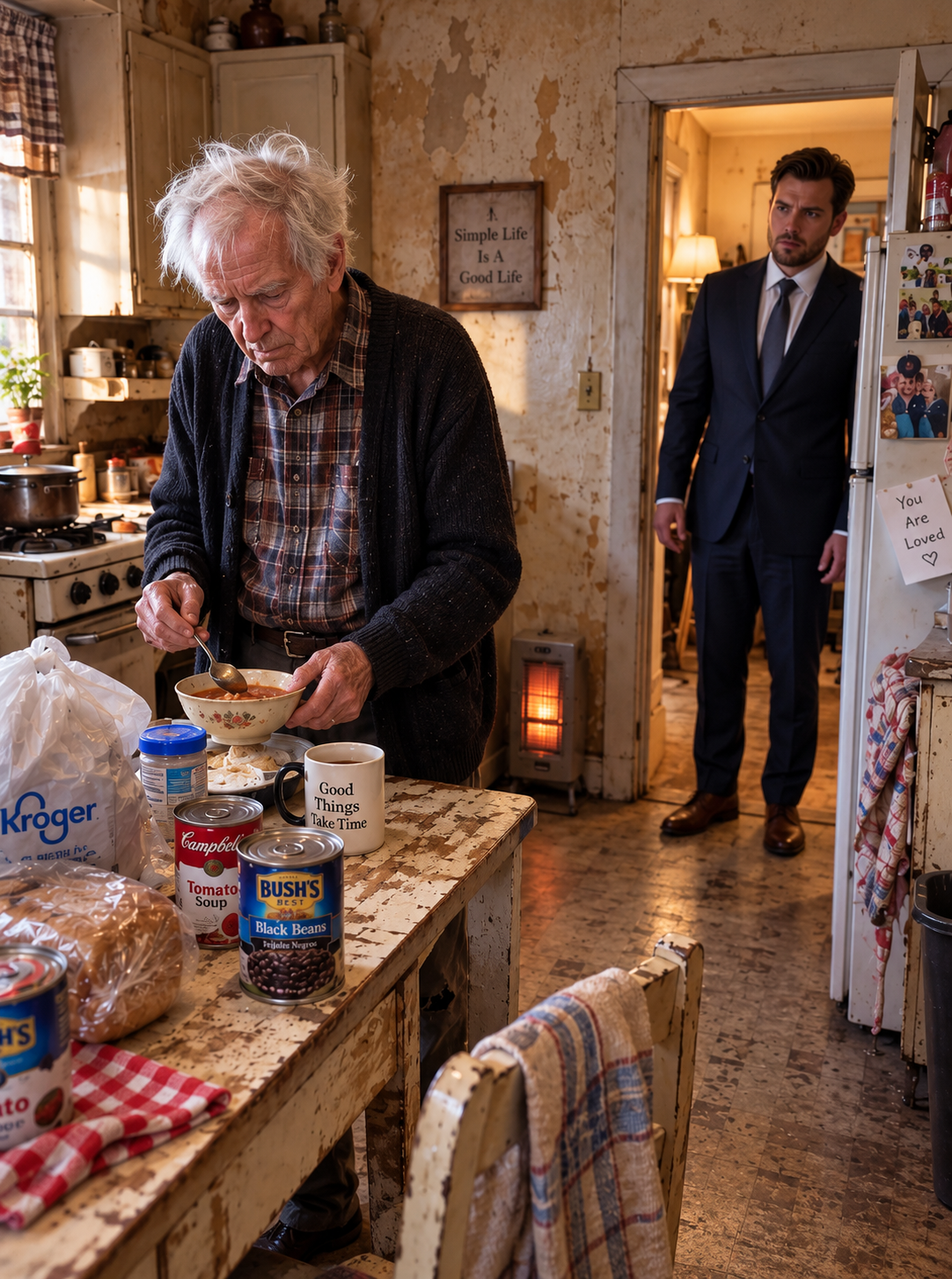
On the night of the guardianship hearing, Jared came to my apartment alone. He stood inside the same room where everything had begun, looking at the unreliable radiator, the space heater, and the canned soup with a completely different understanding of what those things represented.
Then my forty-year-old son sat at my kitchen table, covered his face with his hands, and began to cry. He told me he couldn’t stop thinking about the fact that I had been walking to a food pantry twice a week while he believed Lauren had moved me into a comfortable residence downtown.
“Dad, you were here for three years, and I never came. I sent cards. I let Lauren handle everything. I never once just came to see you.”
Part of me wanted to make him feel every Tuesday and Thursday I had walked those six blocks in the cold. I could have placed every lonely dinner and every broken promise on his shoulders, and Jared would have accepted the guilt because he already believed he deserved it.
But after everything that had happened, I no longer wanted another victory. Lauren was facing criminal consequences, my trust had been restored, and the court had returned full control of my life to me, yet none of those victories could rebuild what had been missing between my son and me.
I put my hand on the back of Jared’s neck the way I had when he was a frightened child. Then I told him that Lauren had deceived lawyers, a doctor, a notary, and even me for a time, so failing to uncover her entire scheme was not the mistake I needed him to spend the rest of his life punishing himself for.
“You failed to visit your father. That’s smaller, more forgivable, and more fixable.”
He looked at me through tears.
“How do I fix it?”
“Come next Tuesday. Then come the Tuesday after that. That’s all I ever wanted.”
Jared immediately insisted that I move into his home that night, but I refused. I had just fought to prove that I was competent to control my own life, and I wasn’t going to finish that fight by allowing someone else, even a loving son, to decide where I should live.
Eventually, I found a small warm apartment near Jared’s home, close enough that visiting was easy but far enough away that the place remained unquestionably mine. The radiator worked, the cupboards stayed full, and I kept a few cans of soup on the shelf as a reminder of how quietly a person can become isolated when everyone assumes someone else is taking care of him.
Jared began coming every Tuesday, often bringing my grandchildren with him. We talked about his company, the children, ordinary family problems, and eventually Diane, whose memory I could finally discuss without anyone turning my grief into evidence that something was wrong with me.
After forty years as an auditor, I still believe numbers often tell the truth more clearly than people do. The bank records exposed Lauren, the signatures proved the forgery, and the financial trail helped restore everything she had tried to take from me.
But numbers could only identify the thief. They could not repair a father and son.
Only showing up could do that.
More than a year later, Jared still had not missed a Tuesday. During one visit, he stood inside my warm apartment, looked at the working radiator, the full cupboard, and the photograph of Diane hanging on the wall before turning toward me.
“It’s warm in here, Dad.”
I smiled and invited him inside.
“Yes, son. It is. Come sit down. The soup’s on, but you don’t have to have any.”
