I refused to make the same mistake twice, which was why I didn’t immediately call Jared and accuse his wife. Without documented proof, Lauren could easily portray my accusations as paranoia from the same confused elderly man she had already taught everyone to expect.
Instead, I decided to approach the situation the way I had approached financial fraud throughout my career. I would build the case quietly, document every claim, and wait until the evidence could speak more convincingly than either Lauren or I ever could.
Over the next two weeks, the auditor I had once been returned completely. For the first time since Diane died, I had a difficult problem in front of me, and although the circumstances were devastating, there was something strangely familiar about following numbers that refused to balance.
I retained Patricia Okafor, an attorney specializing in elder financial abuse, and placed the bank records, disputed power of attorney, transfer history, and information about Meridian Care Solutions on her desk. After studying the documents and listening to my explanation of the unusual gap in my genuine signature, she looked up at me with visible curiosity.
“Mr. Blake, in fifteen years, I’ve rarely had a client arrive with the case already organized. Who are you?”
“I’m a retired corporate auditor.”
I paused before giving her the part that mattered most.
“And apparently, I’m the confused old man in question.”
Part 3: Building a Case Against My Own Family
Patricia immediately understood the weakness at the center of Lauren’s plan. Everything depended on convincing people that I was mentally incapable of managing my own affairs, which meant that if we could formally establish my competence, much of the evidence Lauren had created would begin working against her instead.
Our first step was a comprehensive evaluation by Dr. Reyes, a respected geriatric neurologist whose conclusions would carry weight in court. He spent an entire day testing my memory, reasoning, judgment, and cognitive function before determining that my results were not merely normal for a seventy-two-year-old man, but exceptional for my age.
“There is no evidence here of cognitive decline.”
I asked him to put that conclusion in writing, and he provided four copies of his report. With the central accusation against me professionally challenged, Patricia and I turned our attention to the financial evidence.
I organized three years of bank records into a detailed timeline, matching every $8,000 deposit from Jared’s trust with the $7,800 withdrawal that followed it. Every trail led to Meridian Care Solutions, the company controlled by Lauren’s brother, Gregory Honce, and further investigation revealed that the business had no employees, no real office, no other clients, and no senior-care operation of any kind.
The power of attorney was our next target. Patricia’s investigator located the notary who had stamped it, and when confronted with the document, he admitted that Lauren had brought it to him already signed and claimed that I was waiting outside because I was too frail to enter the building.
I had never been there.
The notary had violated the basic requirements of his commission by authenticating a signature he had never witnessed, and that mistake made him extremely willing to cooperate with our investigation. His testimony established that Lauren had personally delivered the document and supplied the false explanation that allowed it to be notarized.
Then we focused on the signature itself, and that was where forty years of personal history became evidence. Diane had saved boxes of our canceled checks, and when I retrieved them from storage, we found hundreds of genuine examples of my signature dating back decades.
Every signature after my 1987 wrist injury contained the same tiny break between the O and the s in Oscar. A forensic document examiner compared those examples with the power of attorney and concluded that the disputed signature lacked the distinctive feature present in every authenticated sample.
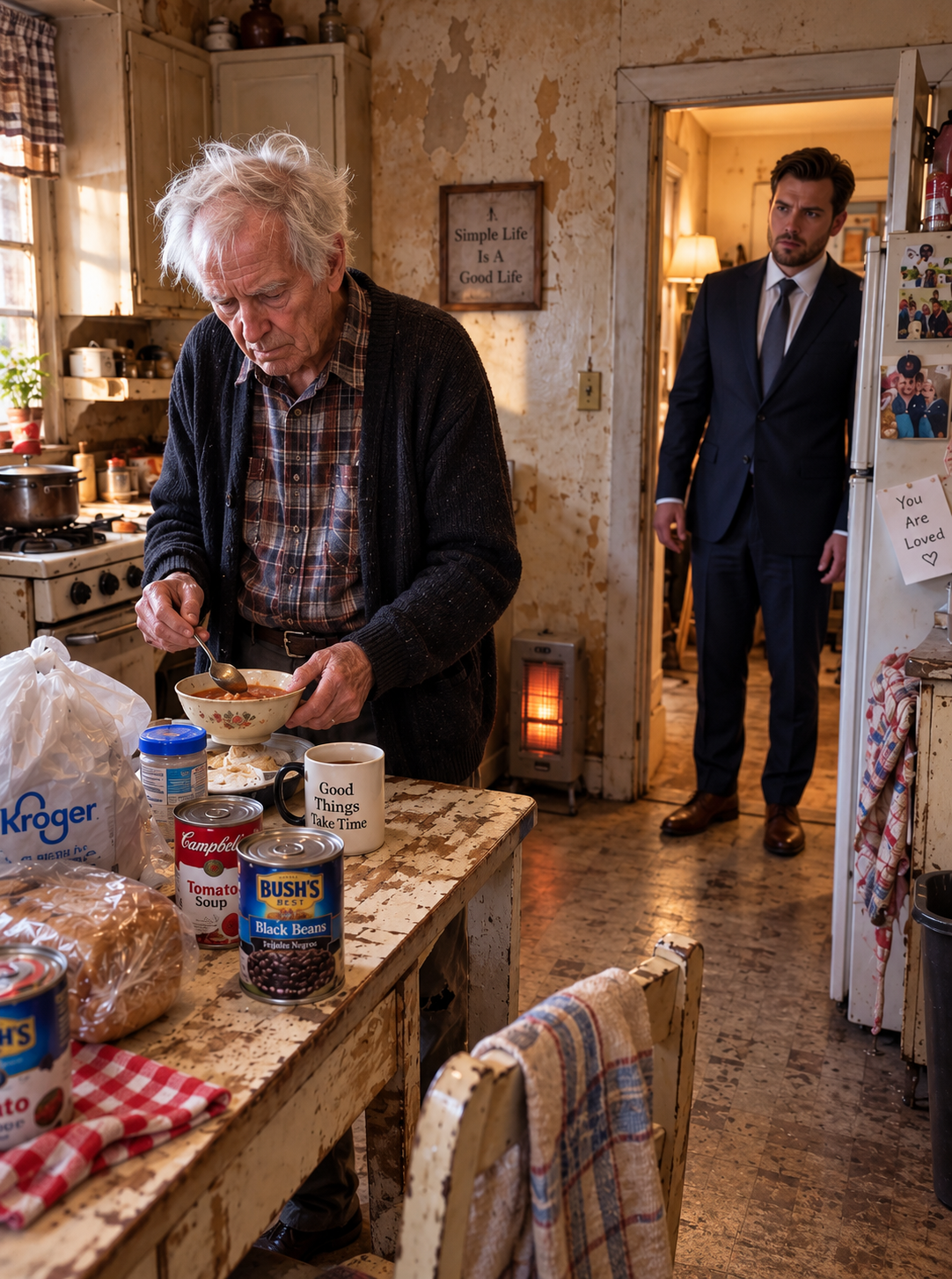
Within two weeks, my kitchen table disappeared beneath bank statements, old checks, corporate records, legal documents, and carefully organized exhibits. The radiator clicked beside me while I reconstructed the scheme one transaction at a time, and by the end, Patricia and I no longer had a theory about what Lauren had done.
We had a case.
Every important claim had documentation behind it, which meant the truth no longer depended on anyone choosing to believe a lonely seventy-two-year-old widower. If Lauren called me confused, we had Dr. Reyes; if she defended the power of attorney, we had the notary and forensic examiner; and if she claimed the missing money paid for my care, we had Meridian’s records.
Lauren knew none of this.
She still believed I was the frightened, declining old man who had asked about his dead wife on Father’s Day, so three weeks after that visit, she finally made the move Patricia had predicted. I received formal notice that Lauren had petitioned probate court for emergency guardianship over both my person and my estate.
Her filing described progressive cognitive decline and an inability to manage my finances. As supporting evidence, she included a physician’s letter, a record of supposedly troubling incidents, and the same forged power of attorney she claimed proved that I had voluntarily surrendered control years earlier.
Lauren had finally put her entire story into a legal document.
That was exactly what we needed.
Only then did I call Jared. I didn’t accuse Lauren or explain the evidence because I wanted my son to see it presented where neither of us could manipulate what it meant.
“Jared, there’s a court hearing about my competence in nine days. Your wife filed it. I want you to be there.”
He hesitated before explaining that Lauren had described the hearing as a simple formality intended to protect me.
“Come and watch. That’s all I’m asking. If you hear everything and still believe I need a guardian, I’ll accept your decision.”
Then I made one final request.
“Don’t tell Lauren I called.”
Nine days later, my son came to court.

Part 4: When the Numbers Testified
Lauren’s attorney presented her case first, confidently describing a devoted daughter-in-law who had spent years caring for an elderly man whose mental condition was steadily deteriorating. He explained that Lauren had reluctantly requested guardianship only because I could no longer manage my finances, medical decisions, or daily life without assistance.
Among his evidence was a letter from a physician who had examined me once for only eleven minutes at an appointment Lauren had arranged and attended. There was also an incident log documenting examples of my supposed confusion, including the Father’s Day moment when I had asked Jared whether my wife Diane would be joining us for dinner.
I looked toward my son as that incident was read aloud. Jared had personally witnessed it, and his face tightened as he realized that a moment he had interpreted as evidence of his father’s decline was now being used in court to justify taking away my independence.
Then Lauren’s attorney introduced the power of attorney. He described it as proof that three years earlier, during a more lucid period, I had voluntarily recognized my own limitations and given Lauren authority to manage my finances.
