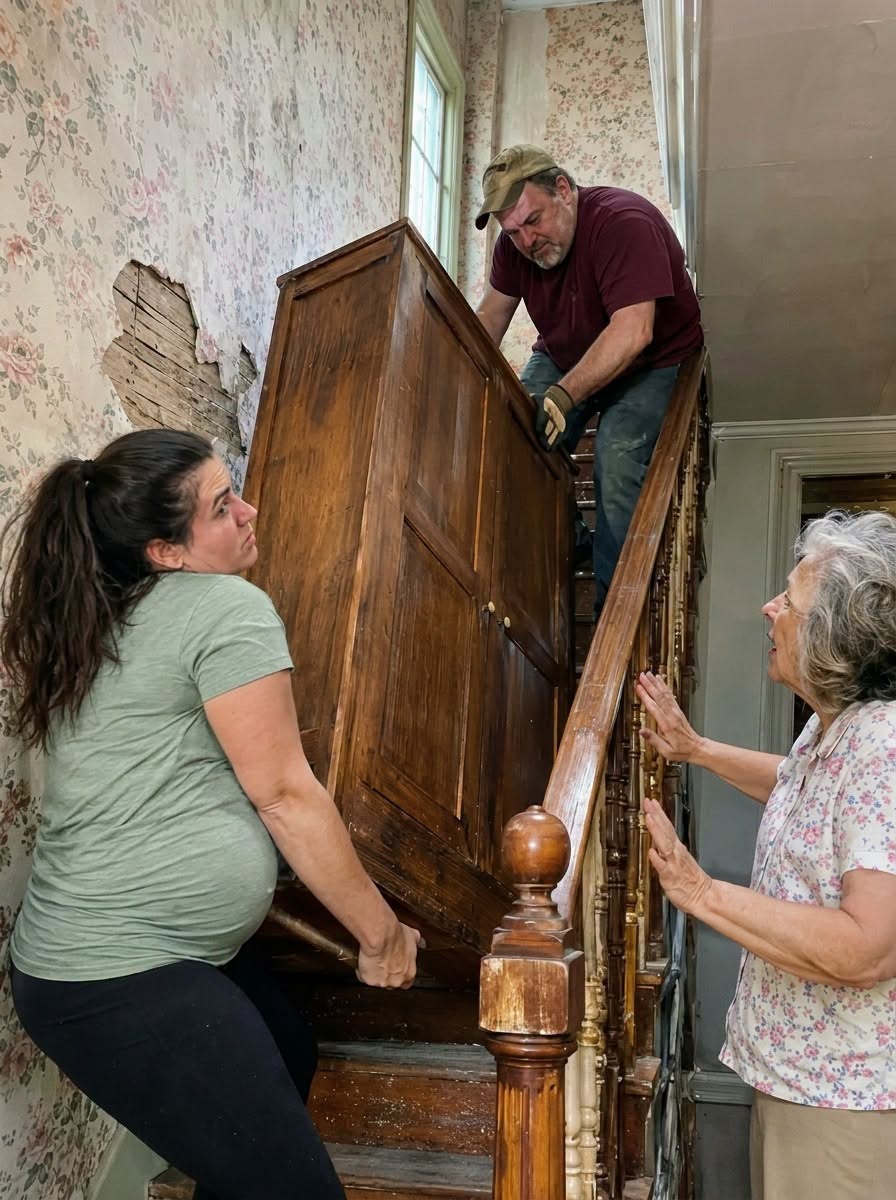
Then she looked past both of us.
At the top of the stairs.
At the open kitchen door.
At the bare wall above the counter, where the daylight from the stair window fell on nothing at all.
Her mouth opened.
“What are you doing?” Darlene said.
Very quietly.
Nobody said anything.
The cabinet was getting heavy. My arms were shaking.
Nate didn’t move.
He just stood there. On the seventh step. Holding the cabinet. Looking down at his mother.
“Nathan,” Darlene said. “What are you doing?”
“Mom,” Nate said. “Can you move out of the way? Kelsey’s pregnant. This is heavy.”
Darlene didn’t move.
“You can’t take that,” she said.
“We can,” Nate said.
“That’s part of the house.”
“It’s not, Mom. It’s ours. We bought it. We put it in. I called a lawyer. Doug Kauffman. In Lewistown. Herb Swartz’s nephew.
He said anything we bought and installed ourselves that comes out clean is ours. The cabinets. The counters. The sink. The range.”
Darlene’s face went white.
“You called a lawyer,” she said. “On your own mother.”
“I called a lawyer,” Nate said. “To find out what’s fair. Because you gave us till Easter. And we’ve got a baby coming in August. And we put thirty-eight thousand dollars into your upstairs.”
“I told you,” Darlene said. “You’ve had six years of free rent.”
“I know.”
“That’s worth something.”
“I know it is, Mom. Doug said the same thing. He said six years of rent cancels out most of it.”
Nate shifted the cabinet against his chest.
“So we’re not asking for the money,” he said. “We’re not suing you. We’re not asking you for anything.”
He looked down at her.
“We’re just taking the kitchen,” he said.
Darlene stared at him.
“What about Tanner?” she said.
“Tanner can have the upstairs,” Nate said. “Exactly the way you gave it to us.”
“What does that mean?”
“It means the old sink’s going back in,” Nate said. “The fifties one. From the hayloft. I cleaned it up. I put a new faucet on it. And the old two-burner stove. I got it working again. I’m putting them back in this afternoon. Right where they were.”
He looked at her.
“He’ll get exactly what we got, Mom,” he said. “Six years ago. When you said it’d be ours someday.”
Darlene didn’t say anything.
“Every screw we put in,” Nate said, “I’m taking out. Every hole, I’m filling. I’m not touching the walls. I’m not touching your plumbing. I’m not touching the bathroom tile or the floors. Those stay.
Those are part of the house.”
He swallowed.
“But the cabinets are coming with us,” he said. “And the sink. And the counters. And the range. And Ada’s window seat.”
“Where are you going?” Darlene said.
Her voice was very small.
“Mifflintown,” Nate said. “Cherry Street. Mr. Stine’s rental. We signed the lease Tuesday.”
“Tuesday,” Darlene said. “You signed a lease Tuesday. And you didn’t tell me.”
Nate didn’t answer.
“You were going to just leave,” Darlene said. “You were going to just pack up my grandchildren and leave. On Good Friday. While I was at church. Without saying a word.”
“Mom,” Nate said. “You gave us till Easter. That’s Sunday. We’re leaving Friday. We’re doing what you asked.”
The cabinet was too heavy.
My arms were shaking so hard I could feel it in my shoulders. My lower back was screaming.
The baby kicked. Hard. Right under my ribs.
“Nate,” I said. “I need to set it down.”
Nate looked up at me.
Then at his mother.
“Mom,” he said. “Please move.”
Darlene didn’t move.
She stood at the bottom of the stairs with her hand on the banister. In her lavender blouse. With her pocketbook over her arm.
She was staring at me.
At my stomach.
“Nate,” I said again. “I can’t hold it.”
That’s when the back door opened again.
Myron came around the corner from Darlene’s kitchen.
In his barn coat. His work boots. A smear of grease on his cheek. Sawdust on his sleeves.
He stopped next to Darlene.
He looked up the stairs.
At Nate. At me. At the cabinet.
At my arms, shaking.
He didn’t say anything.
He walked past his wife.
He came up the stairs.
Two at a time.
For a sixty-eight-year-old man with bad knees, he moved fast.
He came up past Nate. On the inside of the staircase, where there was barely room. He squeezed past his son.
He stopped on the step just below me.
And he took the top of the cabinet out of my hands.
“I’ve got it,” Myron said.
Three words.
“Go sit down,” he said to me. “On the landing. Put your feet up.”
Five more.
I let go.
My arms were shaking so hard I couldn’t feel my fingers.
I sat down on the top step. On the landing. In the yellow light from the stair window.
Myron and Nate carried the cabinet down the rest of the stairs.
Past Darlene.
Out through her kitchen. Out the back door. Around the side of the house to the porch where the U-Haul ramp was.
Darlene stood at the bottom of the stairs.
She watched them go.
She didn’t say anything.
Then she looked up at me.
Sitting on the top step.
We looked at each other for a long time.
Then she turned around.
And she walked into her kitchen.
And I heard her pocketbook hit the table.
And I heard her start to cry.
Myron came back up the stairs.
He walked past me on the landing. Into our kitchen. Into the bare room with the pale rectangles on the wall where the cabinets used to hang.
He stood in the middle of it.
He looked around.
At the window seat. At the farm sink. At the butcher block counters. At the barn-board shelves.
The barn boards. From his hayloft.
“Nathan,” he said.
Nate came in behind him.
“Yeah, Dad.”
“What’s next?”
Nate looked at him.
“Dad,” he said. “You don’t have to—”
“What’s next,” Myron said again.
Not a question.
Nate swallowed.
“The other uppers,” he said. “Five more. Then the lowers.”
Myron nodded.
He took off his barn coat. He folded it and laid it on the window seat.
He rolled up his sleeves.
“Show me how you’re numbering the doors,” he said.
They worked all afternoon.
The two of them. Father and son. In the bare kitchen at the top of the stairs.
They didn’t talk much.
Neither of them talks much.
But I sat on the window seat with my feet up, the way Myron told me to, and I watched them.
Myron held each cabinet while Nate took out the screws. Nate passed each screw to Myron. Myron put it in the Folgers can. He counted out loud. Very quietly. Under his breath.
“Forty-one. Forty-two. Forty-three.”
When they got to the lowers, Myron got down on his knees on the oak floor.
I heard both his knees crack.
He held the flashlight while Nate disconnected the farm sink. He handed Nate the wrench before Nate asked for it.
Around three o’clock, Myron stopped.
He was holding a cabinet door. L4-R. The one from under the sink. The one where we kept the trash can and the dish soap.
He was looking at the inside of it.
On the inside of that door, in pencil, there were little marks.
Lines. With dates next to them. And names.
ELI — 3 yrs. ELI — 4 yrs. ELI — 5 yrs. ADA — 1 yr. ADA — 2 yrs. ADA — 3 yrs.
We’d measured the kids against the inside of that cabinet door every birthday. Because it was the only place we could do it where nobody would see the pencil marks.
The top mark said ELI — 8 yrs. Dated last October.
Myron looked at that door for a long time.
He ran his thumb along the marks.
“I didn’t know you did this,” he said.
“Every birthday,” Nate said.
Myron was quiet.
“Your mother did that,” he said finally. “On the pantry door downstairs. For you and Carrie.”
“I know.”
“She painted over it. When she redid the kitchen in 2003. I told her not to.”
He set the door down very carefully on the moving blanket.
Face up.
So the pencil marks wouldn’t rub.
By five o’clock, the kitchen was empty.
Every cabinet. Every door. Every hinge. Every shelf. The butcher block counters. The farm sink. The range. The range hood. The pendant lights. The window seat. The cushion I’d sewn from my grandmother’s quilt.
All of it. Wrapped in moving blankets. Loaded into the U-Haul behind the barn.
Nate filled every screw hole with drywall patch. He sanded it smooth.
He touched it up with leftover paint from the basement.
Then he and Myron carried the old fifties sink up the stairs. The one from the hayloft. They set it back on its old metal legs, right where it had been six years earlier, under the window.
Nate hooked up the new forty-two-dollar faucet.
He turned the water back on.
It worked.
Then they carried the old two-burner stove up. They set it where it had been. Nate hooked up the gas line. He lit the burners.
Both of them worked.
The kitchen looked exactly the way it had looked the day we moved in.
Bare plaster walls. Pale rectangles where the cabinets had been, painted over now, almost invisible. The old sink. The old stove. The oak floors Nate laid, because those were part of the house now and couldn’t come out.
Empty.
Myron stood in the doorway.
He looked at it for a long time.
He didn’t say anything.
Darlene didn’t come upstairs all afternoon.
She stayed in her kitchen. I could hear her down there sometimes. The radio. Water running. A chair scraping.
Once, around four o’clock, I heard her playing the piano. In the front room. “Were You There.” Very slowly. Over and over.
When we were done, Nate went downstairs.
I followed him.
Darlene was sitting at her kitchen table. In her lavender blouse. With a cup of coffee in front of her she hadn’t touched.
Her eyes were red.
She didn’t look up.
Nate stood in the doorway.
“Mom,” he said. “We’re done. Everything’s out. The old sink’s back in. And the stove. Every hole’s patched. You can go look.”
Darlene didn’t say anything.
“The kids are at Kelsey’s mom’s,” Nate said.
“We’ll come back tomorrow for the rest. The beds and the dressers and the clothes. We’ll be out by Saturday night. Before Easter. Like you said.”
Darlene looked up.
She looked at her son for a long time.
“You took the window seat,” she said.
It wasn’t what I expected her to say.
I don’t think it was what Nate expected either.
“Ada’s window seat,” Darlene said. “You took it.”
“She learned to walk from it, Mom.”
“I know she did,” Darlene said.
Her voice broke.
“I was there,” she said. “I was standing in your kitchen. She let go of the cushion and walked four steps to the sink. And then she fell down and laughed. I was there.”
Nate didn’t say anything.
Darlene put her face in her hands.
“I didn’t think you’d go,” she said. Into her hands.
“I thought you’d stay. I thought you’d find a way to make it work. I thought you’d fight me on it. I thought you’d yell. Or cry. Or something.”
She looked up.
“You never yell,” she said. “You never yell, Nathan. You’ve never yelled at me once in your whole life. Not even when you were a teenager. You just go quiet. And you fix things.”
She wiped her eyes.
“And I thought you’d fix this too,” she said. “I thought you’d find a way to fit five people up there. Build a wall. Add a room. Something. I didn’t think you’d just leave.”
“You didn’t leave us any room, Mom,” Nate said quietly. “You gave the upstairs to Tanner. At Sunday dinner. In front of my kids. You didn’t ask. You didn’t talk to me first.
You just said five won’t fit and Tanner can take it at Easter.”
He looked at her.
“There wasn’t anything to fix,” he said.
That’s when Myron spoke.
He’d been standing in the back doorway. Behind us. In his barn coat. Holding the Folgers can of screws.
“Darlene,” he said.
She looked at him.
“You told them it would be theirs,” Myron said.
Darlene stared at him.
“Myron—”
“You stood in that kitchen,” Myron said, “six years ago. The first week. I was there. You said, ‘It’ll be yours someday anyway.’”
He set the Folgers can down on the counter.
“I didn’t say anything then,” he said. “I should have. I should have said, ‘Let’s write it down.’ I didn’t.”
He looked at his wife.
“And at Sunday dinner,” he said, “I didn’t say anything either. I went out to the barn.
Because I didn’t know what to say.”
He took a breath.
It was the longest I’d ever heard him talk.
“I’m saying it now,” Myron said. “You were wrong, Darlene.”
Darlene stared at him.
In forty years of marriage, I don’t think Myron Weaver had ever said those words to her.
“You owe Bonnie,” Myron said. “I know that. I know what she did for us. I was there. I signed the papers. But you don’t pay Bonnie back by taking it out of our son.”
He picked the Folgers can back up.
“You could have asked Nate,” he said. “You could have said, ‘Bonnie needs help with Tanner. What can we do?’ And he’d have figured something out. He always figures something out.”
He looked at his son.
“He’d have put Tanner in the spring house,” Myron said. “Fixed it up. Insulated it. Put in a woodstove. He’d have done it in a month.”
Nate looked at his father.
“I would have,” he said quietly.
“I know you would have,” Myron said.