Darlene didn’t say anything for a long time.
The kitchen clock ticked. The refrigerator hummed.
Outside, the sun was going down over the back pasture. Golden. The light coming through the window over Darlene’s sink.
“I didn’t think,” Darlene said finally.
Very quietly.
“Lisa called me in January. She was crying. She said Tanner was doing so good. A year sober. A real job. And he was still sleeping on her couch in that trailer, with those people from his old life coming by every weekend. She said if he didn’t get out of there, he’d go back.”
She looked at her hands.
“And Bonnie got on the phone,” she said. “Bonnie. Eighty-three. With her oxygen. And she said, ‘Dar, I’ve never asked you for anything.’”
She wiped her eyes.
“And I thought about the eleven thousand dollars,” she said. “In 1984.
When we didn’t have anything. When Myron’s father wouldn’t help us. When the bank said no. And Bonnie just wrote the check. She didn’t even make us sign anything.”
She looked up at Nate.
“She didn’t make us sign anything,” Darlene said again. “And I paid her back. Every penny. But I never felt like I paid her back. Not really.”
“So you gave Tanner our upstairs,” Nate said.
“I gave Tanner your upstairs,” Darlene said. “And I told myself you’d be fine. You’ve got your job. You’ve got Kelsey. You’ve got everything Tanner doesn’t.”
She looked at me.
At my stomach.
“And then she said she was pregnant,” Darlene said. “At dinner. And I panicked. And I said the first thing that came into my head. Five won’t fit. Tanner can take it at Easter.”
She put her hand over her mouth.
“I didn’t mean it to come out like that,” she said. “I didn’t mean it to sound like that.”
“But you meant it,” Nate said.
Darlene closed her eyes.
“I meant it,” she said.
Nobody said anything for a long time.
Then I spoke.
I don’t know where it came from.
“Darlene,” I said. “Does Tanner know?”
She looked at me.
“Know what?”
“That we put thirty-eight thousand dollars into it,” I said. “That we had to find a rental. That we’re moving out on Good Friday with a baby coming. Does he know any of that?”
Darlene didn’t answer right away.
“I told Lisa you were planning to move anyway,” she said. “Because of the baby. I said you wanted your own place.”
Tanner came on Saturday.
We were loading the last of it. The beds. The dressers. The kids’ toys. Boxes of clothes.
Nate was carrying Eli’s mattress down the narrow stairs, and I was in the upstairs hallway with a box of books.
A beat-up blue Chevy pulled into the driveway. A 2008 Cobalt with a cracked windshield and a Mifflin County Huskies sticker on the bumper.
Tanner got out.
He’s tall. Skinny. Shaggy brown hair. He was wearing a gray hoodie and work boots. He had his Empire Kosher ID badge clipped to his belt.
He stood in the driveway looking at the U-Haul.
Then he came to the side porch door.
He knocked.
I came downstairs.
“Hi, Tanner,” I said.
“Hi, Kelsey.” He looked nervous. “Aunt Dar said I could come look at the upstairs today. To see where I’m going to put my stuff.”
He looked past me at the U-Haul. At Nate, carrying the mattress down the side porch steps.
“Are you guys… are you moving today?”
“We are.”
“Because of the baby? Aunt Dar said you wanted your own place.”
I looked at him.
Twenty-four. Skinny. A year sober. Nervous. Standing on the porch of a farmhouse where he’d been promised a fresh start.
He didn’t know.
I could have lied.
I thought about it.
I thought about saying, Yes, Tanner, we wanted our own place. Good luck with the upstairs.
I didn’t.
“Come upstairs,” I said. “I’ll show you.”
I walked him up the narrow stairs.
Into the kitchen.
The bare walls. The pale rectangles where the cabinets used to be, painted over. The old fifties sink on its metal legs. The two-burner stove. The oak floors.
Tanner stood in the doorway.
He looked around.
“Huh,” he said. “It’s smaller than I thought.”
“It was different,” I said. “Yesterday.”
He looked at me.
I took out my phone.
I showed him a picture. From last Christmas. The kitchen. With the white Amish cabinets and the butcher block counters and the big farm sink and Ada’s window seat and the barn-board shelves full of mason jars. With a little Christmas tree on the counter. Eli and Ada in their pajamas. Nate in an apron, flipping pancakes on the five-burner range.
Tanner stared at the picture.
He looked up at the bare room.
He looked back at the picture.
“What happened?” he said.
So I told him.
All of it.
The six years. The thirty-eight thousand dollars. The Amish cabinets from Belleville. The butcher block from Mifflinburg. The bathroom Nate gutted down to the studs. Herb Swartz on three Saturdays in a row.
Sunday dinner. Five won’t fit up there. Tanner can take it at Easter.
The lawyer. The rental on Cherry Street.
The Folgers can of screws.
Good Friday.
Tanner didn’t say anything for a long time.
He walked over to the old fifties sink. He put his hand on the edge of it.
He looked out the window. At the bank barn. At Myron’s workshop. At the back pasture.
“She told my mom you wanted to move,” he said finally. Quietly. “She said you were glad. That it worked out for everybody.”
He turned around.
“I wouldn’t have taken it,” he said. “If I knew. I swear to God, Kelsey. I wouldn’t have. I’d have stayed on my mom’s couch.”
“I know,” I said.
He looked at the pale rectangles on the wall.
“Thirty-eight thousand dollars,” he said.
“Thirty-eight thousand, one hundred and twelve dollars and forty-one cents.”
He almost laughed.
“You kept track.”
“I kept every receipt.”
Tanner shook his head slowly.
“I make fourteen-fifty an hour,” he said. “At the chicken plant. Second shift. Pulling guts out of chickens. I couldn’t pay you back in ten years.”
“Nobody’s asking you to pay anything back.”
He looked at me for a long time.
“Why are you telling me?” he said.
I thought about it.
“Because you deserve to know,” I said. “You’re starting over. You shouldn’t start over in a place you don’t know the truth about.”
Tanner went downstairs.
I heard him go into Darlene’s kitchen.
I heard his voice. And hers. I couldn’t make out the words.
It went on for a long time.
Then the back door slammed.
And I watched out the window as Tanner walked across the yard. Past the U-Haul. Past Nate, who was loading the last dresser.
To the barn.
To Myron’s workshop.
He was in there for an hour.
When he came out, Myron was with him.
They walked across the yard together. Past the house. To the spring house.
The little stone building by the creek, about fifty yards from the barn. Built in 1890. One room. Stone walls two feet thick. A slate roof Nate replaced in 2022. An old woodstove in the corner that hadn’t been lit in twenty years.
Myron opened the door.
He and Tanner went inside.
Tanner moved into the spring house in June.
Myron and Nate fixed it up. Over six Saturdays. Nate drove out from Mifflintown every weekend.
They insulated the walls. They put in a little bathroom with a shower stall in what used to be the milk room. They ran electric from the barn. They got the old woodstove working again. They built a loft for a bed.
Tanner helped. Every Saturday. Before his shift.
He’s not very good with tools.
But he learned.
Darlene paid for all of it.
Every board. Every sheet of insulation. Every foot of wire. Out of her own savings. She wouldn’t let Myron or Nate or Tanner pay a dime.
It cost about nine thousand dollars.
She wrote the checks herself.
The upstairs sat empty all summer.
The old fifties sink. The two-burner stove. The bare walls.
Nobody moved in.
We moved into the little brick house on Cherry Street on the Saturday before Easter.
That first week, Nate took out Mr. Stine’s cheap oak cabinets. He wrapped every one in a moving blanket and stacked them in Mr. Stine’s garage, exactly the way Mr. Stine asked.
Then he started putting ours in.
It took him three weeks.
The kitchen on Cherry Street is smaller than the one upstairs at the farm. Some of the cabinets didn’t fit.
Nate had to leave two of the uppers in the basement. The butcher block counters were too long. He cut them down with a circular saw and a lot of cursing.
The farm sink fit perfectly.
The range fit perfectly.
And Ada’s window seat fit under the kitchen window.
Like it was built for it.
When it was done, Ada stood in the kitchen doorway in her pajamas.
With Mr. Buttons under her arm.
She looked around.
At the white cabinets. At the butcher block. At the big white sink. At the window seat with the cushion made from her great-grandmother’s quilt.
“It moved,” she said.
“It moved,” Nate said.
“Even the sink.”
“Even the sink.”
She ran across the kitchen and climbed onto the window seat.
She sat there for a long time with her face against the glass.
Looking out at the little fenced backyard and the swing set and the alley.
“It’s different out the window,” she said.
“It is.”
“There’s no barn.”
“No. No barn.”
She thought about it.
“That’s okay,” she said. “The window seat’s the same.”
Nate put up the cabinet door from under the sink last.
L4-R.
The one with the pencil marks.
He hung it under the new sink. Exactly where it was before.
Then he got down on his knees on the floor. With a pencil from his shirt pocket.
And he measured Ada against the inside of it.
ADA — 5½ yrs. CHERRY ST.
Our daughter was born on August 17th.
Three days early. At Lewistown Hospital. Seven pounds, six ounces. Dark hair. Nate’s chin.
We named her Ruth. After my grandmother. The one whose quilt is on the window seat.
Darlene came to the hospital.
She came alone. She didn’t call first. She just showed up at the nurses’ station on the second day and asked for me.
She stood in the doorway of my room for a long time.
In her lavender blouse.
Holding a casserole dish wrapped in a dish towel.
“Can I come in?” she said.
I looked at her.
We hadn’t talked much since Good Friday. A few phone calls. Some texts about the kids. She’d come to Ada’s kindergarten graduation in June and sat in the back row. She’d waved. I’d waved back.
That was about it.
“Come in,” I said.
She came in.
She set the casserole on the windowsill. Chicken and dumplings. I could smell it through the foil.
She looked at Ruth in the bassinet next to my bed.
“Can I?” she said.
“Yes.”
She picked her up.
Very carefully.
The way you pick up something that’s made of glass.
She held Ruth for a long time. She didn’t say anything. She just looked at her.
“She has Nathan’s chin,” Darlene said finally.
“She does.”
“And Myron’s ears.”
“Poor thing.”
Darlene laughed. A small, wet laugh.
Then she looked at me.
“Kelsey,” she said. “I owe you an apology.”
I didn’t say anything.
“I told you five wouldn’t fit,” Darlene said. “In front of your children. At my table. I gave away something that wasn’t mine to give. I told myself it was mine because it was my house. But you’d made it yours. You and Nathan. You’d put your whole life into it. And I didn’t even see it.”
She looked down at Ruth.
“I went up there last week,” she said. “Upstairs. First time since Easter.
I stood in that kitchen with the old sink and the old stove. And I looked at those walls.”
She swallowed.
“You could still see where the cabinets were,” she said. “Even with the paint. If the light hit it right. Little rectangles.”
She looked up at me.
“I’m sorry,” she said. “I’m so sorry, Kelsey. For all of it.”
I looked at her.
Sixty-four years old. Standing in my hospital room in her lavender blouse. Holding my daughter.
“Thank you,” I said.
I didn’t say it was okay.
It wasn’t okay.
But it was something.
It’s December now.
We still live on Cherry Street. Nate likes it. He’s twenty minutes closer to the feed mill. Eli has a best friend two doors down. Ada walks to school.
Mr. Stine comes over sometimes.
He sits on the window seat and drinks coffee and tells Nate he should have studied harder in algebra.
Tanner still lives in the spring house.
He’s eighteen months sober now. He got promoted at the chicken plant. Line lead. Seventeen dollars an hour. He goes to meetings in Lewistown on Tuesday nights. He’s taking an online class through Penn State Mont Alto. Business.
Every Saturday morning, he and Myron work on old tractors in the barn.
Myron says Tanner’s getting pretty good with a wrench.
That’s a lot of words for Myron.
Bonnie died in October. Peacefully. At home in Lewistown. With Lisa and Tanner and Darlene by her bed.
Darlene told me at the funeral lunch that right before she died, Bonnie looked at her and said, “Dar. You paid me back the first year. You know that, right?
Everything after was you being stubborn.”
Darlene laughed so hard telling it that she had to go sit in her car.
The upstairs is still empty.
Darlene asked us in September if we wanted to move back.
She stood in our kitchen on Cherry Street, by the farm sink, and asked.
She said she’d put it in writing this time. A deed. To Nate. For the upstairs and an acre around the house. She’d already called Doug Kauffman in Lewistown. She’d already paid him.
“It’ll be yours,” she said. “For real this time. On paper.”
Nate looked at me.
I looked at him.
We said no.
Not yet.
Maybe someday. When the kids are older. When it feels like home again.
But not yet.
Darlene nodded.
She didn’t argue.
“Okay,” she said. “Then it’ll be there. Whenever you’re ready.”
She looked around our little kitchen on Cherry Street.
At the white cabinets. At the butcher block. At Ada’s window seat.
“It looks good here,” she said quietly. “It looks like it belongs.”
Sunday dinner is at our house now.
Once a month. The first Sunday.
Darlene and Myron come in from Richfield after church. Darlene brings the pie. Myron brings Tanner.
We eat at our kitchen table. It’s too small for everybody. We squeeze. Eli sits on a stool. Ada sits on the window seat. Ruth sits on somebody’s lap. Usually Myron’s. He’s the only one she’ll stop crying for.
Last Sunday, after the pie, Myron stood up from the table.
He folded his napkin and put it next to his plate.
He didn’t go out to the barn.
There isn’t a barn on Cherry Street.
He went over to the sink. And he started washing the dishes.
Darlene stared at him.
“Myron,” she said. “What are you doing?”
“Dishes,” Myron said.
“You’ve never washed a dish in forty-two years.”
“Then it’s about time,” Myron said.
Nate got up and dried.
Tanner put them away.
Darlene sat at the table with Ruth in her lap and watched the three of them at my farm sink. Under my window. In my kitchen.
She looked over at me.
I was sitting on the window seat next to Ada.
“Kelsey,” Darlene said. “Can I ask you something?”
“Sure.”
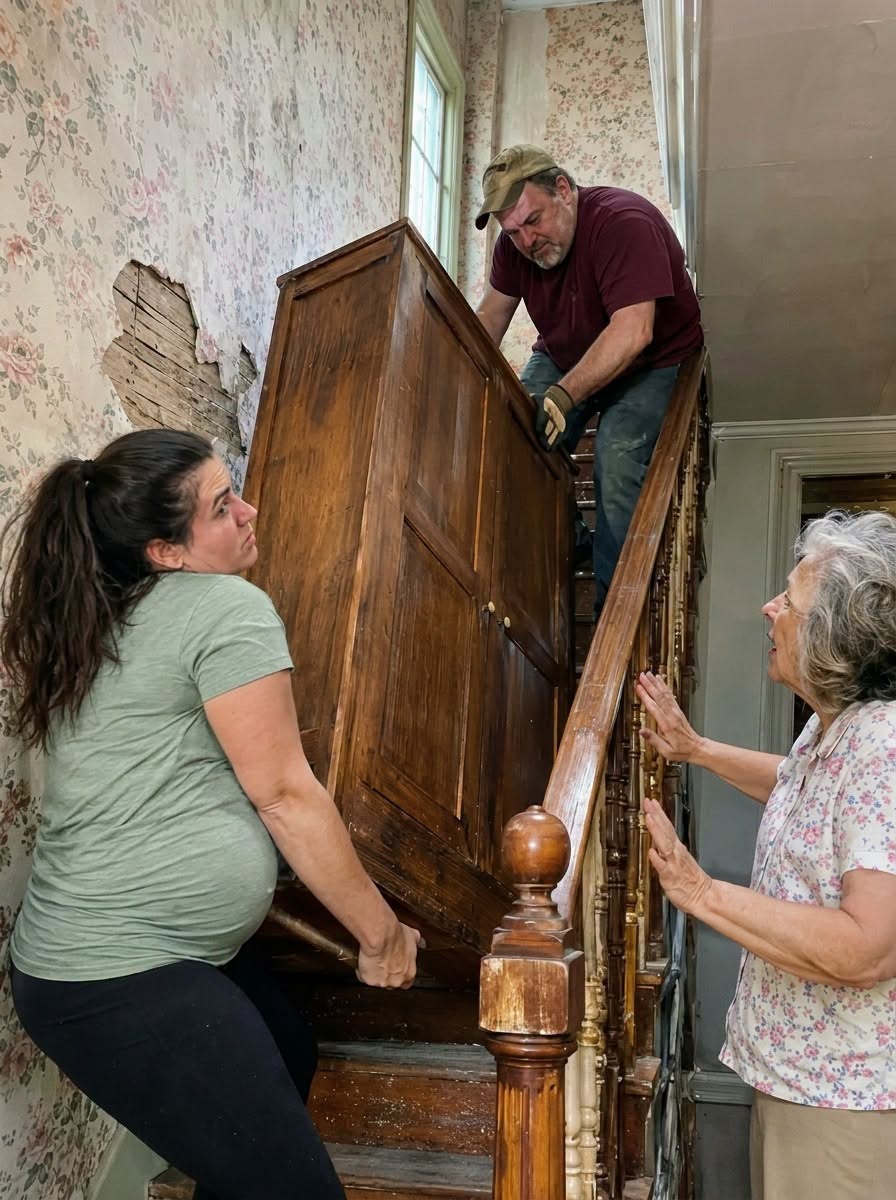
“That Good Friday. When I came around the corner. And you two were on the stairs with that cabinet.”
“I remember.”
“What were you going to do?” Darlene said. “If Myron hadn’t come in. If I hadn’t moved out of the way.”
I thought about it.
I thought about standing on that seventh step with forty pounds of white maple cabinet in my arms.
Twenty weeks pregnant. Shaking. With the daylight from the stair window falling on a bare wall above me.
“Hold on,” I said.
Darlene looked at me for a long time.
Then she looked down at Ruth, asleep in her lap.
She nodded slowly.
“Yes,” she said. “I suppose you would have.”
At the sink, Myron handed Nate another plate.
Ada leaned her head on my shoulder.
Outside the window, it had started to snow. Big soft flakes falling on the little fenced backyard and the swing set and the alley.
There was no barn.
But the window seat was the same.
THE END..!




One Comment on “My Mother In Law Kicked Us Out After We Spent 38000 So We Took The Kitchen With Us”