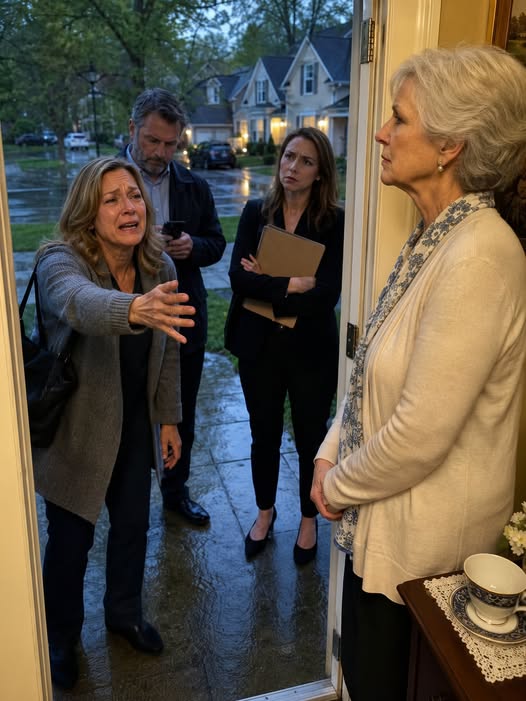
Her voice remained even. That made Serena angrier than shouting would have.
Wesley sank onto the edge of the sofa without asking. His knees looked weak. His wet shoes left dark marks on the rug. Arthur would have hated that rug being marked. Then again, Arthur would have hated what his son had become far more.
Serena remained standing. You’re punishing us because of one awkward dinner, she said.
I picked up the townhouse brochure from the side table. I had left it there on purpose. The pages still showed the brick walkway, the staged lamps, the smiling kind of emptiness real estate photographers sell as home. I opened to the page with the kitchen. The one Serena had called perfect. The one Wesley had said was for me too. I placed it on top of the folder.
I paid part of the down payment on a house where I was not welcome for dinner, I said.
Serena’s gaze dropped to the glossy page. For a moment, her face looked almost naked. Not sorry. Exposed.
Wesley covered his eyes with one hand. I didn’t think you’d actually stop everything, he said.
That sentence told the whole truth. Not that he loved me. Not that he forgot. Not that he was trapped. He simply believed I would absorb the wound and keep paying.
My fingers tightened once around the armrest. Then relaxed. At seventy-seven, the body teaches you what the heart refuses. Tightness hurts. Release hurts less.
I know, I said.
Serena’s phone rang. She looked down and silenced it. It rang again immediately. Then Wesley’s buzzed. Then hers again.
Their life, built on automatic yes, had begun asking manual questions.
Serena glanced toward the front door. Wesley, she said. We need to go.
But he did not stand.
He looked at me like a boy waiting outside the principal’s office, hoping his mother would come and make the consequences softer. I had done that too many times.
Lydia gathered the loose pages back into order. Her hands were calm, professional, careful. She clipped the folder shut and passed me a receipt copy.
The revocations are complete, she said. The trust protections are active. The business authorization has been flagged for review.
Wesley’s head snapped up. Flagged.
Lydia looked at him. Mrs. Hale did not recognize the business expenses. That required notation.
Serena turned slowly toward Wesley.
The room sharpened. There are moments when a marriage does not break loudly. No thrown glass. No screaming. Just one spouse realizing the other has been lying in a direction they never bothered to check.
What review, Serena asked.
Wesley stood. Not now.
Yes, she said. Now.
I rose from Arthur’s chair.
Not quickly. My knees complained. My hand found the armrest first, then the air, then balance.
All three of them watched me.
I walked to the mantel and touched Arthur’s frame. The silver was cool.
You should leave, I said.
Wesley took one step toward me. Mom, please.
I looked at my son. His face blurred slightly at the edges, but I did not let the tears fall.
You may call me when you are ready to speak without needing something.
He stopped.
Serena pulled her coat closed, though the room was warm.
Lydia lifted the folder.
No, I said softly.
She paused. I held out my hand. She gave it to me.
The folder was heavy. Heavier than paper should be.
Wesley looked at it as if it were alive.
I walked to the front door and opened it. Cold damp air slipped into the hall.
The porch light caught the rain in thin silver threads.
Serena stepped out first, fast now, her heels sharp against the boards.
Wesley lingered.
Did you ever love me without the money, he asked.
The question struck harder than I expected. I held the folder against my chest.
Yes, I said. That was the problem.
His face folded. For one second, I saw the little boy with the torn kite. Then I saw the man who had written, you weren’t invited.
He stepped onto the porch.
I closed the door.
This time, he was on the other side of it.
The house settled around me. No applause. No victory music. No clean happiness. Just the clock, the rain, and my own breathing.
Lydia stood beside the sitting room archway, quiet as a witness in a church.
Are you all right, she asked.
I looked at the good teacup on the table.
The tea had gone cold.
I will be.
Through the window, I saw Serena and Wesley standing beside their car. She was speaking fast. He kept looking back at the house.
Then Serena opened the passenger door and stopped.
Because another car had turned into my driveway. A small blue sedan. My granddaughter climbed out holding a backpack against her chest. Behind her, her teacher stepped into the rain with one hand raised, uncertain.
I moved to the window.
My granddaughter looked past her parents, straight at my door. Her small face was pale. Then she lifted her phone.
A message arrived on my screen.
Grandma, Mom said you ruined everything. Can I come inside?
I opened the door before the second buzz.
This time, I did not ask anyone’s permission.
The rain had turned from a mist into a steady, cold sheet that drummed against the porch roof.
My granddaughter, Clara, didn’t run. She walked up the front steps with the stiff, deliberate posture of a child trying very hard not to cry in front of adults. Her yellow raincoat was buttoned crookedly, one plastic toggle missed near her collar. She held her canvas backpack against her chest like a shield.
Behind her, her parents stood frozen beside their silver SUV. Serena had one hand on the passenger door handle, her mouth slightly open. Wesley had taken two steps toward the walkway, then stopped as if he had hit an invisible wall.
The woman from the blue sedan—Ms. Vance, Clara’s kindergarten teacher—hurried up the steps behind Clara, holding a clear plastic umbrella over both of them. She looked exhausted, her cardigan damp at the hem, her eyes darting nervously between me and the couple in the driveway.
“Mrs. Hale,” Ms. Vance said, her voice pitched low and tight.
“I am so sorry to intrude like this.”
“Come inside,” I said, stepping back to widen the doorway. “Both of you. You’re getting soaked.”
Clara slipped past me first. The moment she crossed the threshold, the rigid tension in her small shoulders gave way. She let out a long, shuddering breath and pressed her face directly into the wool of my cardigan, right at my hip.
I set the heavy banking folder down on the hall console and placed both hands on her damp hood. “I’ve got you, sweetheart. You’re warm now.”
Ms. Vance stepped inside and closed her umbrella, shaking it carefully on the exterior mat before crossing the threshold. She looked back toward the driveway. Serena was striding up the path now, her heels clicking sharply against the wet concrete, Wesley trailing a pace behind her.
“What is going on?” Serena demanded before she even reached the bottom step.
Her voice had lost its smooth, curated edge; it was high and thin. “Ms. Vance, why is Clara in your car? School doesn’t let out for another hour.”
Ms. Vance turned to face them, keeping her body angled slightly between the doorway and the steps. “Mrs. Hale—Serena—I tried calling you four times. And Mr. Hale twice. The school office tried as well.”
“My phone was on silent,” Serena snapped, gesturing toward the house. “We were in a meeting. Why did you leave campus with my daughter?”
“Because the school’s electronic payment portal flagged your tuition account as severely delinquent at noon, and the automatic backup card declined,” Ms. Vance said evenly. “The administrative director tried to reach you to resolve it before afternoon dismissal, as per policy for the extended-day program.
When neither of you answered, and no authorized secondary payer could be reached, the director had to place Clara in the front office.”
Wesley stopped at the bottom of the steps, the color draining from his face all over again. “They pulled her out of class?”
“She was sitting in the lobby with her backpack for forty-five minutes,” Ms. Vance said, her professional restraint slipping just enough to let a flash of anger show through. “She was terrified. She thought she had done something wrong. When you didn’t answer, she asked the secretary if she could call her grandmother. Mrs. Hale is listed as her primary emergency contact and authorized pickup.”
Serena’s eyes darted to me. “You told her to bring Clara here.”
“I told Ms. Vance that if she could not reach Clara’s parents, I was home and my door was open,” I replied calmly.
“I wasn’t going to leave a five-year-old sitting in an administrative hallway watching the clock while her parents’ phones went straight to voicemail,” Ms. Vance said, looking squarely at Serena. “I had a free period, I am on the approved transport list, and Mrs. Hale verified her identity over the phone. Here is the incident log for your signature, Serena.”
She held out a clipboard with a damp sheet of paper clipped to it.
Serena stared at the clipboard as if it were a venomous snake. She didn’t take it. Instead, she looked past Ms. Vance at Clara, who was still standing pressed against my side, her fingers twisted tightly into the fabric of my sweater.
“Clara,” Serena said, forcing her voice into a bright, brittle register. “Come on, sweetie. Thank Ms. Vance, and let’s go get in the car. We’re going home.”
Clara didn’t look up.
She buried her face deeper into my hip and shook her head.
“Clara,” Serena repeated, sharper now. “Don’t be dramatic. Get your bag.”
“She doesn’t want to go with you right now,” I said.
Serena’s head snapped toward me. “Excuse me? She is my daughter. You don’t get to decide when she goes home, Eleanor. You’ve already caused enough damage today.”
“I didn’t cause this,” I said, keeping my voice low so Clara wouldn’t feel the vibration of anger in my chest. “You left your child on an automatic payment system funded by an account you never bothered to check, and then you turned off your phone while you stood in my living room arguing about your country club dues.”
Wesley flinched as if I had struck him.
He looked at Clara, then at Ms. Vance, who was staring intently at her own shoes, clearly wishing she could evaporate into the rain.
“Serena,” Wesley muttered, reaching out to touch his wife’s elbow. “Let’s just sign the form. Let’s not do this in front of her teacher.”
Serena jerked her arm away from him. She snatched the pen from Ms. Vance’s clipboard, scribbled an illegible slash across the bottom of the page, and thrust the board back at the teacher.
“Thank you for your time, Ms. Vance,” Serena said through clenched teeth. “I will be speaking with the headmaster tomorrow about how this was handled.”
“Of course,” Ms. Vance said quietly. She looked at me, gave a small, sympathetic nod, and hurried back down the steps toward her blue sedan. Within seconds, her taillights disappeared down the street.
The silence that followed was heavy with the sound of rain hitting the gutters.
Serena stepped up onto the porch, stopping just outside the threshold. She looked at Clara, her expression hardening into something cold and transactional. “Clara, get in the car. Now.”
Clara finally lifted her head. Her cheeks were red, her eyes swollen, though she hadn’t shed a tear. She looked at her mother, then at her father, and finally up at me.
“Mommy said you broke our house,” Clara whispered, loud enough to carry across the porch. “She said on the phone in the car that you took away our money because you’re mad at us.”
Wesley closed his eyes. A muscle jumped in his jaw.
Serena’s face flushed a deep, blotchy crimson. “I was speaking to your father, Clara. Adults talk about things you don’t understand. Come here.”
I looked down at my granddaughter.
“Clara, do you want to stay here with Grandma for a little while and have some warm soup while your mom and dad sort things out?”
“Yes, please,” she said immediately.
“No,” Serena said. “She is coming with us. We have things to handle.”
“What things?” I asked, meeting Serena’s glare without blinking. “You have a mortgage draft pending review, a declined auto lease, and a preschool tuition bill that is currently unpaid. You are going to spend the next four hours on the phone with banks, creditors, and lawyers. Do you really want a five-year-old sitting at the kitchen table listening to you panic?”
Serena opened her mouth to argue, then stopped. For the first time, the reality of the afternoon seemed to catch up with her. Her phone buzzed again inside her coat pocket—another automated alert, another small crack in the facade.
Wesley looked at me, his voice barely above a whisper.
“Just for tonight? Until we get the accounts sorted?”
“Until tomorrow morning,” I said. “I will drive her to school myself at eight o’clock. By then, you can arrange whatever payment method you intend to use with the front office.”
Serena stared at me, her chest rising and falling rapidly. She looked as though she wanted to reach past me, grab Clara by the arm, and drag her down the steps just to prove she still had control over something.
“Serena,” Wesley said softly. “Please. Look at her.”
Serena looked down at Clara’s pale, exhausted face. Something flickered behind her eyes—not warmth, not quite guilt, but the sudden realization that forcing a screaming match on a front porch in full view of the neighbors was a battle she couldn’t afford to lose.
“Fine,” Serena said flatly. “Eight o’clock. Don’t make her late.
She has music at nine.”
She turned on her heel and walked briskly back to the SUV without saying goodbye to her daughter.
Wesley lingered on the step for a second longer. He knelt down, wincing slightly as his knees popped, so he was eye-level with Clara.
“Hey, bug,” he said softly, reaching out to smooth a damp strand of hair behind her ear. “You be good for Grandma, okay? Mommy and Daddy just have some grown-up work to do tonight. Nothing is your fault. Nobody is mad at you.”
Clara looked at her father with a solemnity that broke my heart. “Are you mad at Grandma?”
Wesley swallowed hard. He glanced up at me, his eyes shining with unshed tears. “No, sweetheart. I’m not mad at Grandma.”
He kissed the top of her head, stood up, and walked down to the car.
A moment later, the SUV backed out of the driveway, its headlights sweeping across my living room window before disappearing into the gray afternoon.
I closed the front door and turned the deadbolt.
From the archway of the sitting room, Lydia cleared her throat softly. I had almost forgotten she was still there.
“I’ll take my leave now, Mrs. Hale,” Lydia said, picking up her leather briefcase. “All the documentation is stamped and dated. If you need anything else before Monday, you have my direct line.”
“Thank you, Lydia,” I said. “Drive carefully in this rain.”
When the door closed behind her, the house finally fell completely quiet.
Clara stood in the center of the foyer, still clutching her backpack. “Grandma?”
“Yes, sweetheart?”
“Why did Mommy say you ruined everything?”
I knelt down and unfastened the crooked toggles on her yellow raincoat, sliding it off her shoulders and hanging it on the brass hook by the door.
Then I took her small, cold hands in mine.
“Because sometimes, Clara, when adults forget how to take care of their own things, they get scared,” I said gently. “And when people get scared, they look for someone else to blame. I didn’t break anything. I just stopped carrying something that wasn’t mine to carry.”
She thought about that for a moment, her brow furrowing just like Arthur’s used to when he was working through a difficult crossword clue.
“Okay,” she said simply. “Can we have tomato soup? With the little crackers?”
“We certainly can,” I said, standing up and taking her hand. “And after that, you can help me water the ferns.”
As we walked toward the kitchen, my phone buzzed on the hall table. I glanced at the screen as we passed. It was a text from Wesley.
Thank you for taking her. We need to talk about the business account tomorrow. Please.
I didn’t pick up the phone. I let the screen go dark and kept walking toward the warm light of the kitchen.
The business account was the one thing I hadn’t touched yet, and Wesley knew it.
At six o’clock the next morning, while Clara was still asleep in the guest bedroom upstairs under Arthur’s old patchwork quilt, I sat at my kitchen table with a fresh pot of coffee and the thick manila folder Lydia had left behind.
The house was quiet except for the ticking of the grandfather clock in the hall and the low hum of the refrigerator. Outside, the rain had stopped, leaving the backyard slick and silver under a pale November dawn.
I opened the folder to the third tab—the one marked Hale & Son Logistics, LLC.
When Arthur died six years ago, he left behind two things: a comfortable retirement portfolio that had grown steadily over forty years of careful, unglamorous work, and a small regional freight brokerage he had built from a single desk and a landline in 1988.
Arthur had loved that business. He knew every dispatcher by first name, knew which routes flooded in April, and never bought a truck on credit if he could wait six months and pay cash. When he passed, Wesley had begged me not to sell it.
“Let me run it, Mom,” he had said at the kitchen table three weeks after the funeral, still wearing his dark suit. “I can modernize it. Expand the regional contracts. Keep Dad’s name on the door.”
I had agreed. More than that, I had signed on as the majority capital partner, leaving three hundred thousand dollars in a dedicated operating reserve account so Wesley wouldn’t have to take out predatory small-business loans during his first two years.
The agreement was simple: I held sixty percent equity as silent partner, Wesley held forty percent as managing director, and the operating reserve was strictly for payroll, insurance, and freight claims.
For the first three years, the quarterly statements looked healthy. Wesley stopped by every Sunday for pot roast, talked enthusiastically about new software systems, and never asked for a dime.
Then he met Serena.
Serena came from a family that measured worth in square footage, private school admissions, and the brand of sparkling water served at charity luncheons. Within six months of their wedding, the Sunday dinners became monthly lunches. Within a year, they became rushed holiday appearances where Serena checked her watch every twenty minutes and complained subtly about the dust in my sitting room.
And quietly, incrementally, the numbers in the folder had begun to shift.
I put on my reading glasses and pulled out the line-item audit Lydia had printed for me the day before—the one that had caused the bank’s compliance department to flag the business authorization.
I ran my finger down the column of recent transfers from the Hale & Son operating reserve.
October 4: Wire transfer to Vance & Sterling Custom Interiors — $18,500.October 19: Corporate Amex payment — $14,200 (Itemized: Four Seasons Resort Maui, Louis Vuitton Honolulu, Hertz Prestige Collection).November 2: Wire transfer to Silver Creek Country Club (Initiation Installment 3 of 4) — $25,000.November 11: ACH transfer to personal checking ending in 4419 — $22,000.
I stared at the numbers until the black ink blurred slightly against the white paper.
It wasn’t just the personal accounts I had closed yesterday. Wesley had been treating his father’s operating reserve—the money meant to guarantee payroll for twelve full-time dispatchers and drivers—as a private slush fund to finance Serena’s lifestyle.
If a major client defaulted on an invoice this month, or if a truck went down and needed an emergency payout, the company wouldn’t have enough cash on hand to cover Friday’s payroll.
My stomach turned cold. Arthur had never missed a Friday payroll in thirty-four years. Not during the 1991 recession, not in 2008, not even the week he had his first heart attack. He had told me once, sitting on the edge of our bed in his undershirt, “Eleanor, a man’s word is only as good as the check his workers cash on Friday afternoon. Everything else is just talk.”
A soft creak on the stairs pulled me out of my thoughts.
Clara appeared in the kitchen doorway, wearing one of my oversized flannel shirts as a nightgown, the sleeves rolled up four times around her wrists. Her hair stuck out in a wild halo on one side.
“Morning, Grandma,” she yawned, rubbing one eye with her fist. “Is it school time?”
I folded the audit sheet neatly and slipped it back inside the folder, sliding the whole thing under the morning newspaper.
“Not yet, sweetie,” I said, forcing warmth back into my voice. “You still have an hour. Climb up and I’ll make you scrambled eggs with cheese.”
She scrambled onto the wooden chair across from me, swinging her legs under the table. As I cracked eggs into a bowl at the counter, she watched me quietly.
“Grandma?”
“Yes, Clara?”
“Did Mommy and Daddy have to sell our house?”
I paused with the whisk in my hand. “What makes you ask that?”
“Because last night before I went to sleep, Mommy was crying in the bathroom and yelling at Daddy on the phone. She said if she has to give back the Range Rover, everyone at the club is going to know we’re broke.”
I closed my eyes briefly, took a slow breath, and resumed whisking the eggs.
“No one is selling your house today, Clara,” I said evenly.
“And having a different car doesn’t make anyone broken. People are worth the same whether they drive a shiny car or an old bicycle.”
“Like your Buick?” she asked seriously.
“Just like my Buick,” I smiled. “It gets us to the library and the ice cream shop, and it never complains.”
She nodded, satisfied with that logic, and went back to swinging her legs.
By seven-forty-five, Clara was dressed in her uniform, her hair braided neatly down her back, and her backpack packed with an extra apple and a thermos of warm milk. We walked out to the garage together, and I buckled her into the booster seat in the back of my ten-year-old Buick sedan.
When we pulled up to the drop-off lane at Oakridge Academy at eight o’clock sharp, I expected to see Wesley’s SUV parked near the entrance.
Instead, the curb was lined only with minivans and sedans idling in the morning chill.
I parked in a visitor space, walked Clara up to the front doors, and waited while she waved to Ms. Vance in the lobby. Before I turned back toward my car, the school’s administrative director—a crisp, polite woman in a navy blazer—stepped out onto the walkway.
“Mrs. Hale?” she said softly, glancing around to make sure no other parents were within earshot. “Thank you for bringing Clara in on time. I just wanted to let you know that the custodial education trust wire cleared at seven-thirty this morning. Her tuition for the remainder of the academic year is completely settled.”
“Good,” I said. “And the extended-day program?”
“Covered as well,” she smiled faintly. “Mr. Hale called twenty minutes ago to confirm. He sounded… relieved.”
I thanked her and walked back to my car.
As I reached for the door handle, a shadow fell across the hood.
Wesley was standing three spaces down, leaning against the fender of a silver sedan I didn’t recognize. It wasn’t his luxury SUV. It was a dented, base-model rental car.
He looked terrible. He was wearing the same slacks from yesterday, wrinkled at the knees, and a dark jacket over a wrinkled button-down shirt. His eyes were bloodshot, and a gray stubble shadowed his jaw.
“Mom,” he said quietly, pushing himself off the fender. “Thanks for bringing her.”
I didn’t get into my car. I stood beside the open door, resting one hand on the roof. “Where is your truck?”
“Surrendered it to the dealership at seven this morning,” he said, looking down at his shoes. “The lease was through the personal line you closed.
I couldn’t cover the balloon payment without transferring money from the company.”
“You shouldn’t have been leasing an eighty-thousand-dollar vehicle in the first place,” I said.
“I know,” he whispered. He looked up, and for the first time in years, there was no defensiveness in his posture. Just raw, hollowed-out exhaustion. “Serena took Clara’s car—the Mercedes—and went to stay at her sister’s house in Greenwich last night. She packed two suitcases while I was on the phone with the bank.”
I didn’t say anything. I simply waited.
Wesley rubbed a hand over his face. “She found out about the business account flag. She went through my briefcase after we got home from your house. She saw the credit card statements, the country club wires… everything.
She told me I embarrassed her in front of the whole community and that she couldn’t stay in a house where the utilities might get shut off.”
“And what did you tell her?” I asked.
He let out a short, bitter laugh that didn’t reach his eyes. “I told her she was the one who insisted on the Greenwich zip code, the custom kitchen, and the club initiation. And she told me it was my job as a man to figure out how to pay for it without involving my mother.”
The morning breeze blew dry leaves across the asphalt between us. Somewhere down the street, a church bell chimed eight-fifteen.
“I’m not here to ask for the personal accounts back, Mom,” Wesley said, his voice trembling slightly. “You were right yesterday. About all of it. I let things get out of control.
I lied to you, I used money that wasn’t mine, and I let Serena push you out because it was easier than telling her no.”
He stepped closer, stopping a few feet away.
“The compliance department froze the Hale & Son operating reserve at midnight,” he said. “Because you’re the majority partner and you flagged the unauthorized transfers, they won’t release a dime without your signature. Payroll for twelve people goes out tomorrow at noon. If that account stays frozen, Marty, Carlos, Denise—all of Dad’s people—their checks are going to bounce.”
I looked closely at my son. I looked for the manipulation I had seen yesterday—the boy waiting for his mother to soften the blow.
It wasn’t there.
What was standing in front of me was a man standing in the wreckage of his own choices, terrified not for his image, but for the people who depended on him.
“How much is missing from the operating reserve?” I asked.
Wesley swallowed hard. “Seventy-nine thousand, seven hundred dollars.”
“And how much is left in the account?”
“Forty-two thousand. Payroll tomorrow is thirty-eight thousand.”
I nodded slowly. “You left yourself a four-thousand-dollar margin on a three-hundred-thousand-dollar reserve.”
“Yes,” he said, his voice dropping to a whisper. “I was going to pay it back when the fourth-quarter freight contracts settled in January. I kept telling myself it was just a bridge.”
“Every gambler calls it a bridge until the river rises,” I said.
Wesley flinched, then nodded once. “I know.
Look—if you unfreeze the account just enough to clear tomorrow’s payroll, I will sign over my forty percent equity to you on Monday morning. You can bring in an outside manager, sell the company, whatever you want. Just don’t let Dad’s employees lose their paychecks because of me.”
I studied his face in the pale morning light. For six years, I had watched him drift further away, insulated by money he hadn’t earned and praised by a wife who only loved what he could buy. Now, stripped of the car, the house, and the wife, he was finally standing on solid ground—even if that ground was cold.
“I am not going to let Marty or Denise miss a paycheck,” I said.
Wesley exhaled so sharply his shoulders dropped two inches. “Thank you. Thank you, Mom.”
“Don’t thank me yet,” I said, opening my car door.
“Get in your rental car and follow me to the bank. We are going to unfreeze the payroll allocation under dual-signature control. And then you and I are going to sit down with Lydia and go through every single invoice, lease, and contract your company has signed in the last twenty-four months.”
He nodded quickly. “Okay. Yes. Anything.”
“And Wesley?” I paused before getting into the driver’s seat.
“Yeah?”
“Clara stays with me this weekend. You have too much work to do, and she needs a quiet house where nobody is shouting into a phone.”
He looked toward the front doors of the school, his throat working as he swallowed. “She asked about you this morning when I called the front office. She told the secretary to tell you she finished her apple.”
“I’ll make sure she gets another one tonight,” I said.
I got into the Buick, started the engine, and pulled out of the parking lot.
In my rearview mirror, the dented silver rental car pulled out behind me, keeping a respectful distance all the way down the avenue.
The conference room at the regional bank smelled of lemon polish and cold coffee.
For two hours, Lydia laid out spreadsheets across the mahogany table while Wesley sat across from me, his sleeves rolled up, walking me line by line through the true financial state of Hale & Son Logistics.
Stripped of the personal luxuries Wesley had siphoned off, the core business was surprisingly resilient. The regional freight contracts Arthur had built were still profitable. Dispatchers were efficient, customer retention was above ninety percent, and overhead at the warehouse was lean.
The hemorrhage wasn’t the company. The hemorrhage was Wesley’s personal life.
“If we liquidate the corporate credit cards, cancel the Greenwich office lease you took out last spring—which nobody uses—and claw back the refundable deposit on the country club initiation,” Lydia said, tapping her pen against the summary sheet, “we recover forty-one thousand dollars by next Friday.”
Wesley nodded, scribbling notes on a yellow legal pad. “I can cover the remaining thirty-eight thousand over the next eight months by cutting my own salary in half and taking zero distributions.”
I looked across the table at him. “And what about the townhouse?”
Wesley stopped writing. He stared at the legal pad for a long moment. “I called the realtor this morning before I came to the school. We’re listing it on Monday. Even after fees, we should break even on the mortgage. Whatever comes back from the down payment… belongs to you.”
“Keep the down payment,” I said.
Both Wesley and Lydia looked up in surprise.
“Use it to settle your personal debts, pay off the rental car, and get yourself a modest two-bedroom apartment near Clara’s school,” I said calmly.
“I don’t want my granddaughter sleeping on an air mattress while you rebuild.”
Wesley’s eyes filled with tears again, though this time he didn’t try to hide them or use them to soften me. He simply wiped his face with the back of his wrist and nodded. “Okay, Mom. Thank you.”
At eleven-thirty, I signed the dual-authorization release for the Friday payroll. Lydia processed the wire immediately, printing the confirmation receipt and sliding it across the table.
Wesley looked at the paper as if it were a pardon. “Denise is going to get her direct deposit at midnight. She’s putting her youngest through nursing school.”
“I know,” I said. “Your father paid for her first semester out of his own pocket ten years ago.”
Wesley looked down at the table, quiet for a beat. “I forgot how much he knew about everyone there.”
“He paid attention,” I replied.
“That’s all leadership is, Wesley. Paying attention to the people who carry the weight.”
We walked out of the bank together into the crisp midday air. The sun had finally broken through the clouds, turning the wet pavement bright and clean.
Wesley’s phone rang just as we reached the sidewalk. He glanced at the screen, his expression tightening.
“It’s Serena,” he said.
“Answer it,” I told him. “I’ll wait by the car.”
I walked twenty paces away and stood beside my Buick, pretending to check my purse while the wind rustled the last yellow leaves in the oak trees overhead. Even from a distance, I could hear the sharp, metallic cadence of Serena’s voice bleeding through the speaker.
Wesley didn’t pace. He didn’t raise his voice.
He stood completely still on the concrete, one hand in his pocket, listening until she ran out of breath.
When he finally spoke, his voice carried clearly across the quiet street.
“No, Serena. I’m not asking her for a loan. The townhouse goes on the market Monday. If you want to stay in Greenwich with your sister, that’s your choice. I’m staying here, I’m fixing my company, and I’m taking care of Clara.”
A burst of shrill sound came from the phone.
“Then call a lawyer,” Wesley said flatly. “I’ll send you the address of my new apartment as soon as I sign the lease.”
He ended the call, slid the phone into his pocket, and stood staring at the ground for several seconds before walking over to where I stood.
His face was pale, set in hard, unfamiliar lines.
He looked less like the boy I had raised and much more like the man Arthur had been at forty-five.
“She wants a divorce,” he said simply.
“I’m sorry, Wesley,” I said, and I meant it—not because I liked Serena, nor because I wished her back in my house, but because watching a marriage collapse is never a victory. It is just an ending that leaves debris everywhere.
“Don’t be,” he said quietly. “I think we were divorced a long time ago. We just hadn’t run out of money yet.”
He glanced at his watch. “I need to get down to the warehouse before the afternoon shift comes in. I want to talk to Marty and the drivers myself so nobody hears rumors about the bank freeze.”
“Good,” I said. “What time will you come by for dinner?”
Wesley blinked. “Dinner?”
“You have to eat, and Clara is going to want to show you the birdhouse we’re painting this afternoon,” I said, opening my door.
“Six o’clock. Don’t be late, and wipe your shoes on the mat before you come into the sitting room.”
A small, genuine smile broke through the exhaustion on his face—the first real one I had seen in years.
“Six o’clock,” he promised. “I’ll bring dessert.”
“Don’t buy anything expensive,” I warned. “A half-gallon of vanilla ice cream from the corner market is plenty.”





One Comment on “At 77, My Son Uninvited Me From Dinner So I Canceled 174 Payments Before Sunrise”