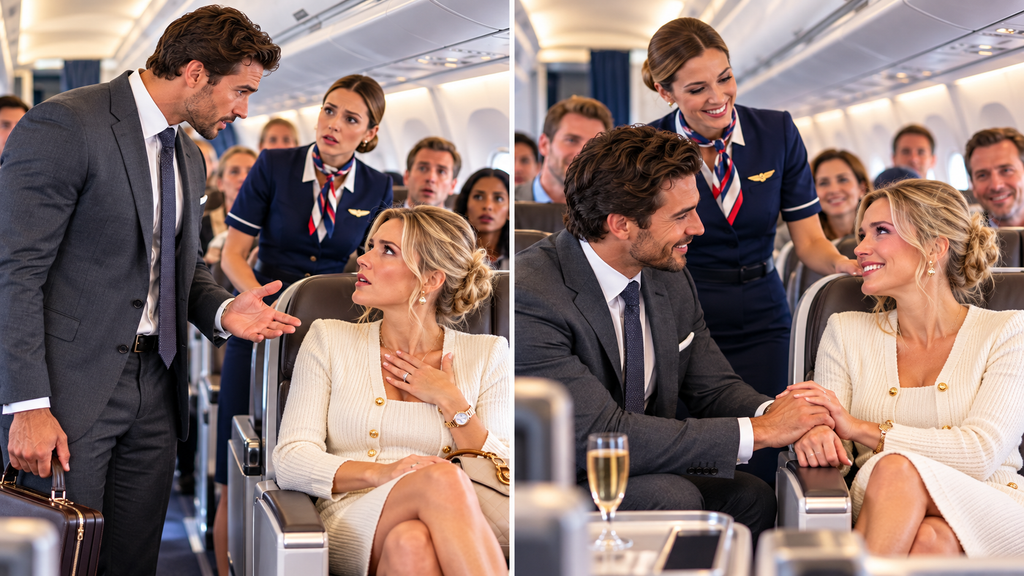
An embarrassing mistake could be buried.
An inconvenient truth could be purchased.
And anyone who challenged her could usually be silenced by mentioning her husband’s name.
But sitting in the first-class cabin of Flight 2174, with dozens of strangers watching her and her husband’s voice trembling through her phone, Darla discovered something terrifying.
There were some problems money could not solve.
Especially when the man she had just humiliated was the one holding the truth.
“Darla, listen to me carefully.”
Her husband’s voice was sharp.
Almost desperate.
“Where are you right now?”
She swallowed.
“On the plane, Robert.”
“Have you boarded?”
“Yes.”
“Has Evan Cole boarded?”
Darla closed her eyes.
Across the aisle, Evan was placing his leather suitcase into the overhead compartment.
He moved without hurry.
Without triumph.
As though he hadn’t just shattered the foundation of her entire life.
“Darla?”
Robert’s voice grew louder.
“Answer me. Is Evan Cole on that airplane?”
“Yes,” she whispered.
There was a long silence.
Then Robert said something she would remember for the rest of her life.
“Tell me you haven’t said anything to him.”
Darla felt her stomach tighten.
“Robert—”
“Tell me.”
She looked toward the passengers.
Several were still holding their phones.
Jessica stood beside the galley, visibly shaken.
Marissa was quietly speaking into the aircraft intercom.
And Evan had finally settled into seat 2A.
The seat Darla had refused to surrender.
“Robert,” she whispered, “I didn’t know who he was.”
Another silence.
Then her husband asked, very slowly:
“What did you do?”
Darla’s lips trembled.
“I thought he was trying to take my seat.”
“What did you do?”
“I asked the crew to remove him.”
Robert made a strange sound.
Not quite a gasp.
Not quite a groan.
“Darla.”
His voice had become frighteningly quiet.
“Please tell me you didn’t mention my company.”
She couldn’t answer.
“Darla?”
“I may have said something.”
“What?”
She pressed her fingers against her forehead.
“I told them your company practically keeps the airline in business.”
Robert cursed under his breath.
Then he asked the question that finally made her understand the magnitude of what had happened.
“Did you say anything about his race?”
Darla stared straight ahead.
Her silence answered for her.
“Oh, God.”
Robert’s voice cracked.
“Oh, God, Darla. What have you done?”
And then the call ended.
Not because Robert had hung up.
Because Evan Cole had stood up.
He was looking directly at her.
“Mrs. Whitmore,” he said, “I believe we should finish this conversation before departure.”
Darla lowered her phone.
For the first time in her life, she didn’t know whether to threaten someone, apologize, or run.
And she had no idea that the worst part of her morning hadn’t even begun.
Because Evan Cole had boarded Flight 2174 carrying more than a first-class ticket.
Inside his briefcase was a confidential report.
A report concerning Whitmore Logistics.
A report that had taken six months to prepare.
And one name appeared repeatedly throughout its pages.
Robert Whitmore.
But there was another name.
One that Darla had not heard in seventeen years.
A name that would turn this humiliating encounter into something far more devastating than a viral video.
A name Evan had recognized the moment he heard her voice.
Naomi Brooks.
And when Evan finally told Darla who Naomi Brooks had been, the wealthy woman would discover that the man she had insulted was connected to the greatest secret her husband had ever kept.
The captain’s voice came over the intercom.
“Ladies and gentlemen, we apologize for the delay. We are resolving a seating matter and expect to continue boarding shortly.”
Darla sat frozen in 4C.
She had moved there only after Marissa made it clear that remaining in 2A was not an option.
The short walk down the aisle had felt endless.
She could hear whispers.
She could feel people staring.
And for once, nobody stepped aside because of her expensive clothes or famous surname.
A man in 3B shook his head as she passed.
A young woman near the window looked directly at her and said, “That was disgusting.”
Darla almost responded.
Almost told the woman to mind her own business.
But something about Evan’s calm expression stopped her.
He wasn’t smiling.
He wasn’t celebrating.
He wasn’t enjoying her embarrassment.
That frightened her more than anger would have.
Because anger could be dismissed.
Anger could be called unreasonable.
But the quiet certainty in Evan’s face suggested that he was thinking about consequences.
Real consequences.
The kind Darla had spent her life making other people suffer.
A few minutes later, Marissa approached Evan.
“Mr. Cole, the captain would like to speak with you before we depart.”
Evan looked up.
“Of course.”
He unfastened his seat belt and stood.
Darla immediately leaned into the aisle.
“Am I being removed from the flight?”
Marissa hesitated.
“Mrs. Whitmore, we’re still reviewing the incident.”
“Reviewing what? I moved.”
“Yes, ma’am.”
“Then there’s no problem.”
A voice came from across the aisle.
“There was a problem before you moved.”
The speaker was an older woman with silver hair and a navy cardigan.
She sat in 3A.
Darla glared at her.
“Excuse me?”
The woman removed her reading glasses.
“You accused that gentleman of having a fake ticket. You demanded security remove him. And you told him to go to the back of the plane because people like him didn’t belong here.”
Darla’s face flushed.
“You don’t understand the situation.”
“I understand it perfectly.”
The woman folded her glasses.
“I taught American history for thirty-eight years. I’ve heard every version of that excuse.”
Someone behind her murmured agreement.
Darla looked away.
The older woman wasn’t finished.
“And the saddest part is that you only became embarrassed when you discovered he had more money than you.”
The words struck harder than Darla expected.
Because they were true.
If Evan had been an ordinary passenger, she would have continued arguing.
If he had been a teacher, a nurse, a mechanic, or a college student, she would have expected him to apologize for inconveniencing her.
The realization made her uncomfortable.
So she did what she had always done when confronted with something she didn’t want to examine.
She became defensive.
“I didn’t know who he was.”
The older woman nodded slowly.
“That’s exactly the problem.”
Near the front galley, Captain Daniel Reeves stood with Marissa and Jessica.
He was a broad-shouldered man in his late fifties, with tired eyes and the composed manner of someone who had handled emergencies at thirty thousand feet.
“Mr. Cole,” he said, offering his hand, “I’m Captain Reeves. I’m sorry for what happened.”
Evan shook it.
“Thank you.”
“I’ve reviewed the seat assignments. There’s no question that 2A belongs to you.”
“I know.”
“We also have several passenger statements.”
Evan glanced toward Jessica.
The young flight attendant looked nervous.
“Jessica,” he said gently, “are you all right?”
She blinked.
“Me?”
“Yes.”
“I’m fine, sir.”
He studied her for a moment.
“You were trying to help.”
Her eyes filled unexpectedly.
“I should have spoken up sooner.”
Marissa turned toward her.
“Jessica—”
“No,” Jessica said quietly. “He’s right to ask.”
She took a shaky breath.
“When Mrs. Whitmore accused him of being aggressive, I knew that wasn’t what happened. I heard everything. But she started talking about her husband’s company and demanding supervisors, and I got scared.”
Evan said nothing.
Jessica continued.
“My mother works two jobs. I’m helping pay for my younger brother’s college. I can’t afford to lose this job.”
Her voice broke.
“So I stayed quiet.”
Evan’s expression softened.
“How long have you been flying?”
“Eight months.”
“And before that?”
“I worked at a hotel.”
“Do you like this job?”
She nodded.
“I love it.”
“Then remember something.”
He lowered his voice.
“Your responsibility is to the truth and the safety of your passengers. Not to the loudest person in the cabin.”
Jessica wiped her eyes.
“Yes, sir.”
“And being afraid doesn’t make you a bad person. What matters is what you choose after you recognize the fear.”
Captain Reeves nodded.
“She’s not going to lose her job for telling the truth.”
Jessica exhaled.
Marissa looked relieved.
Then the captain turned back to Evan.
“Mr. Cole, we can have Mrs. Whitmore removed.”
Evan considered the offer.
He glanced toward the cabin.
Darla was staring at her phone.
Her shoulders were hunched.
Her confidence had disappeared.
“No,” he said finally.
Captain Reeves raised an eyebrow.
“Are you sure?”
“Has she threatened anyone physically?”
“No.”
“Is she refusing crew instructions now?”
“No.”
“Then I don’t want her removed simply because she embarrassed herself.”
Marissa looked surprised.
“That’s very generous.”
Evan shook his head.
“It isn’t generosity.”
He paused.
“It’s consistency.”
The captain waited.
Evan continued.
“If she had treated an ordinary passenger this way, I would want the airline to follow its procedures fairly. I don’t want special punishment because I’m wealthy, any more than I wanted special permission to sit in the seat I paid for.”
Captain Reeves regarded him for a long moment.
“Understood.”
“But I do want the incident documented accurately,” Evan added. “And I want your staff to know that I won’t support anyone retaliating against Jessica for telling the truth.”
“Agreed.”
Evan started to turn away.
Then Marissa spoke.
“Mr. Cole?”
“Yes?”
“Can I ask you something?”
“Of course.”
“How did you stay so calm?”
Evan looked toward the windows.
Outside, baggage handlers were loading suitcases into the aircraft.
The morning sunlight reflected off the terminal glass.
For several seconds, he seemed to be looking at something much farther away.
Then he answered.
“Because this wasn’t the first time someone told me I didn’t belong.”
His voice was steady.
“But it may be the last time I let it pass without asking why.”
Darla was scrolling through messages when Evan returned to his seat.
Robert had sent six texts.
CALL ME IMMEDIATELY.
DO NOT SPEAK TO THE PRESS.
DO NOT POST ANYTHING.
DELETE NOTHING.
WHAT EXACTLY DID YOU SAY?
And finally:
DID HE MENTION NAOMI?
Darla stared at the last message.
Naomi.
Her heart gave a strange, painful jump.
She hadn’t seen that name in years.
Not since the summer Robert had come home furious about an employee at one of his distribution centers.
Not since a young woman had appeared at their front gate holding a folder.
Not since Darla had ordered the security guard to turn her away.
Naomi Brooks.
Darla remembered her.
A young Black woman.
Early thirties.
Pregnant.
Wearing a pale blue blouse.
She had stood outside the Whitmore estate in the rain.
Darla could still hear her voice.
“Mrs. Whitmore, please. I don’t want money. I just need your husband to tell the truth.”
Darla had looked at her through the intercom camera.
“Whatever problem you have with my husband, take it to his office.”
“I’ve tried.”
“Then call his lawyer.”
“His lawyers are the problem.”
Darla had laughed.
“Of course they are.”
The young woman had pressed a hand against her stomach.
“Please. People are going to get hurt.”
Darla remembered becoming irritated.
“Young lady, I don’t know what you’re trying to accomplish, but you will not come to my home and threaten my family.”
“I’m not threatening you.”
“Leave.”
“Mrs. Whitmore—”
“Security.”
The gate had remained closed.
And Darla had gone back inside to finish preparing for a charity luncheon.
She had forgotten about the woman by dinner.
Or at least she had told herself she had.
Now, seventeen years later, Robert was asking whether Evan Cole had mentioned her.
Why?
What could a former employee possibly have to do with the man who owned Whitmore Logistics?
Darla looked toward seat 2A.
Evan was reading a document on his tablet.
His face gave nothing away.
She typed a reply to Robert.
Why are you asking about Naomi Brooks?
The response came almost immediately.
DO NOT DISCUSS HER WITH EVAN.
Darla’s mouth went dry.
A second message appeared.
I MEAN IT.
Then a third.
IF HE KNOWS ABOUT HER, EVERYTHING CHANGES.
Darla stared at those words until the screen dimmed.
Everything changes.
She had no idea how right Robert was.
The plane finally pushed back from the gate.
The cabin lights softened.
Seat belts clicked.
The engines began their low, powerful hum.
Darla kept glancing toward Evan.
She wanted to speak.
She wanted to ask him about Naomi.
But pride and fear fought inside her.
At last, as the plane reached cruising altitude and the seat belt sign went off, she unbuckled and approached him.
“Mr. Cole?”
Evan looked up.
“Mrs. Whitmore.”
“May I speak with you?”
He closed his tablet.
“You’re speaking.”
She glanced at the passengers nearby.
“Privately.”
Evan considered her request.
Then he gestured toward the empty seat across the aisle.
“You can sit there for a moment, provided the crew agrees.”
Darla sat.
Her hands were trembling.
“I want to apologize.”
Evan waited.
“I didn’t realize who you were.”
He said nothing.
She swallowed.
“And if I had known—”
“Mrs. Whitmore.”
His voice was quiet.
“Please stop there.”
She looked confused.
He leaned forward slightly.
“You’re apologizing because you discovered my position. I need you to understand that my position is irrelevant.”
Darla stared at him.
“If I were a schoolteacher traveling to my daughter’s graduation, would your words have been acceptable?”
“No.”
“If I were a janitor who saved for two years to buy a first-class ticket, would I have deserved that treatment?”
“No.”
“If I were an unemployed father flying to a job interview, would I have belonged in that seat any less?”
Darla lowered her eyes.
“No.”
“Then don’t apologize for failing to recognize a CEO.”
He paused.
“Apologize for failing to recognize a human being.”
The words hung between them.
Darla’s throat tightened.
For once, she couldn’t find an argument.
“I’m sorry,” she whispered.
Evan watched her.
“Why?”
She looked up.
“Because I judged you.”
“Based on what?”
Darla’s eyes filled.
She knew the answer.
She hated the answer.
But she finally said it.
“Because you’re Black.”
Evan nodded once.
“Thank you for telling the truth.”
Darla covered her mouth.
She had never heard herself say those words before.
Not so plainly.
Not without excuses.
And hearing them spoken aloud made something inside her recoil.
“I don’t know why I behaved that way,” she whispered.
Evan’s expression grew serious.
“I think you do.”
She looked away.
He didn’t press her.
Instead, he reached for his tablet.
“I received a message from your husband.”
Darla’s head snapped back.
“What?”
“Robert wants to meet me when we land.”
“Why?”
“That depends on what he wants to discuss.”
Darla hesitated.
Then she asked the question that had been burning inside her.
“Do you know someone named Naomi Brooks?”
Evan went completely still.
The change was subtle.
But Darla saw it.
His fingers stopped moving.
His eyes hardened.
And for the first time that morning, the calm man in seat 2A looked genuinely wounded.
“Where did you hear that name?”
Darla’s voice trembled.
“My husband mentioned her.”
Evan slowly set down his tablet.
“Mrs. Whitmore.”
He looked directly into her eyes.
“Before I answer, I need you to tell me something.”
“What?”
“Seventeen years ago, a woman came to your house.”
Darla stopped breathing.
“She was pregnant,” Evan continued. “She was frightened. And she asked to speak with your husband.”
Darla gripped the armrest.
“How do you know that?”
Evan’s jaw tightened.
“Did you let her in?”
Darla stared at him.
The cabin seemed to disappear.
The sound of the engines faded.
All she could see was that rainy afternoon.
The woman at the gate.
The pale blue blouse.
The hand resting protectively over an unborn child.
“No,” Darla whispered.
Evan closed his eyes.
For several seconds, he didn’t speak.
Then he asked:
“Did she tell you why she was there?”
Darla shook her head.
“She said people were going to get hurt.”
Evan opened his eyes.
“And what did you say?”
Darla’s voice was barely audible.
“I told her to leave.”
Evan looked down.
When he spoke again, his voice had changed.
It was no longer merely controlled.
It was filled with a grief so old that it had become part of him.
“That woman was my sister.”
Darla felt the blood drain from her face.
“What?”
“Naomi Brooks was my older sister.”
She stared at him.
“No.”
“She worked for Whitmore Logistics for six years.”
Darla’s lips parted.
Evan continued.
“She was one of the best safety analysts the company ever employed. She discovered something dangerous. Something that could have saved lives.”
He paused.
“She tried to warn your husband.”
Darla shook her head.
“I don’t understand.”
Evan looked toward the window.
“She came to your house because every other door had been closed.”
Then he turned back to her.
“And you closed the last one.”
Seventeen years earlier, Naomi Brooks had been thirty-two years old.
She was brilliant.
Stubborn.
Funny.
And, according to Evan, the kind of woman who remembered everyone’s birthday but routinely forgot where she had put her car keys.
She loved lemon cake.
She sang terribly.
She kept spare umbrellas in her office because she couldn’t stand seeing warehouse workers walking to their cars in the rain.
And she believed that doing the right thing mattered even when nobody was watching.
At the time, Whitmore Logistics was expanding rapidly.
Robert Whitmore had built a reputation as an aggressive businessman who could move freight faster and cheaper than his competitors.
Investors loved him.
Business magazines praised him.
And his wife hosted glamorous charity events celebrating his success.
But behind the impressive financial statements, Naomi had discovered a disturbing pattern.
Maintenance reports were being altered.
Safety inspections were being marked complete when they hadn’t been performed.
Drivers were being pressured to exceed legal working-hour limits.
And a refrigerated transport facility outside St. Louis had repeatedly reported electrical failures that management refused to repair.
Naomi documented everything.
She sent reports.
She requested meetings.
She warned executives.
Nothing changed.
Then she discovered that someone had been changing her reports before they reached the board.
The warnings disappeared.
The numbers improved.
The problems remained.
And Naomi realized that the falsification wasn’t an accident.
It was deliberate.
She told Evan about it one Sunday afternoon.
He was twenty-four then.
Working two jobs.
Trying to launch the small technology company that would eventually become Cole Holdings.
They were sitting at her kitchen table.
Naomi was seven months pregnant.
A bowl of strawberries sat between them.
“Evan,” she said, “if something happens, promise me you’ll keep copies of these.”
She slid a folder across the table.
He laughed nervously.
“Why are you talking like that?”
“Because people with money don’t always like being told they’re wrong.”
“Then quit.”
Naomi shook her head.
“And leave the drivers there?”
“Naomi.”
“Somebody has to speak for them.”
He remembered becoming frustrated.
“You have a baby coming.”
She smiled.
“I know.”
“Then think about yourself.”
Naomi reached across the table and squeezed his hand.
“I am thinking about myself.”
He looked confused.
She placed her other hand over her stomach.
“What kind of mother would I be if I taught my child that staying comfortable matters more than keeping people safe?”
Evan never forgot those words.
Three weeks later, Naomi was fired.
The official reason was misconduct.
Robert’s company accused her of stealing confidential information.
Her professional reputation collapsed.
Former colleagues stopped returning calls.
Potential employers suddenly withdrew interviews.
And Naomi, heavily pregnant and terrified, began receiving anonymous warnings.
Then she went to the Whitmore estate.
She believed Darla might listen.
She believed another woman might understand.
She believed that a mother might care about the danger to workers and their families.
But Darla never opened the gate.
Two days later, Naomi was involved in a serious car accident while driving home from a meeting with an attorney.
Her vehicle was struck at an intersection by a delivery truck whose driver had reportedly fallen asleep.
The truck belonged to a subcontractor working under a Whitmore Logistics contract.
Naomi survived long enough to give birth prematurely.
Her daughter lived.
Naomi did not.
When Evan told Darla that part, his voice broke for the first time.
“She never got to hold her baby.”
Darla pressed both hands over her mouth.
Evan stared down at his fingers.
“My sister spent her last months trying to keep other people alive.”
He swallowed.
“And the company she was trying to protect destroyed her reputation before she died.”
Darla began crying.
“I’m so sorry.”
Evan shook his head.
“Don’t make this about your tears.”
The words weren’t cruel.
They were exhausted.
Darla lowered her hands.
He continued.
“I spent seventeen years wondering what might have happened if one person had listened.”
Darla couldn’t look at him.
“Maybe nothing would have changed,” Evan said. “Maybe the accident still would have happened. I don’t know.”
He leaned back.
“But Naomi deserved to be heard.”
Darla whispered, “I didn’t know.”
Evan nodded.
“I believe you didn’t know everything.”
He paused.
“But you knew she was frightened.”
Darla closed her eyes.
“You knew she was pregnant.”
A tear rolled down her cheek.
“And you knew she was asking for help.”
The silence between them became unbearable.
Finally, Darla whispered:
“What happened to her daughter?”
Evan looked at her.
And something changed in his expression.
A small, almost invisible warmth appeared beneath the grief.
“Her name is Grace.”
Darla swallowed.
“Is she all right?”
Evan nodded.
“She’s seventeen.”
He glanced at the photograph on his phone.
“She’s extraordinary.”
Grace Brooks had grown up knowing that her mother was brave.
Evan had made certain of that.
He had adopted his niece when she was an infant, after the family agreed that he could provide her with a stable home.
He was young.
Overwhelmed.
And barely earning enough to cover rent.
His technology company existed in a rented office above a laundromat.
Some nights, he worked until three in the morning while Grace slept in a portable crib beside his desk.
He learned to change diapers between conference calls.
He memorized the lyrics to children’s songs.
He burned pancakes.
He ruined laundry.
He once arrived at an investor meeting with a bright pink sticker on his forehead because Grace had placed it there and he hadn’t noticed.
The investors laughed.
Evan didn’t care.
Because Grace was the last living piece of his sister.
And he intended to give her the childhood Naomi had dreamed of.
Years passed.
The company grew.
Evan built logistics software that reduced delivery delays, improved driver scheduling, and identified dangerous maintenance patterns.
He hired people other companies had overlooked.
He invested in training.
He refused contracts that required unsafe working conditions.
And when Cole Holdings became successful, he began acquiring struggling transportation businesses and rebuilding them.
He never forgot why.
Every annual report included a statement:
No delivery is worth a human life.
His employees assumed it was a corporate philosophy.
Only a few knew it was a promise.
A promise he had made beside his sister’s hospital bed.
Darla listened without interrupting.
For the first time in decades, she had no desire to hear herself speak.
When Evan finished telling her about Grace, she wiped her cheeks.
“Does she know about Robert?”
“She knows what the records establish.”
“Does she hate us?”
Evan looked at her carefully.
“Grace has never met you.”
“That’s not what I asked.”
He paused.
“She hates what happened to her mother.”
Darla nodded slowly.
“Of course.”
Evan studied her.
“Mrs. Whitmore, why did your husband ask you not to mention Naomi?”
Darla froze.
She hadn’t told him about Robert’s messages.
“How did you know?”
“Because he called me before boarding.”
Her eyes widened.
“What did he say?”
“He wanted to know whether I had reviewed the historical safety files.”
Darla’s pulse quickened.
“And had you?”
“Yes.”
She looked at him.
“Why did you buy the company?”
Evan took a long breath.
“Not for revenge.”
Darla seemed surprised.
He continued.
“Whitmore Logistics employs nearly eleven thousand people. Most of them are hardworking men and women who had nothing to do with what happened seventeen years ago.”
He looked down at his tablet.
“The company was carrying serious debt. If it collapsed, thousands of families could lose their income.”
Darla whispered, “Robert never told me that.”
“I’m beginning to understand there are many things Robert didn’t tell you.”
Evan continued.
“Cole Holdings acquired the company because its infrastructure was valuable, its workers deserved stability, and its safety systems needed rebuilding.”
He paused.
“But during due diligence, my team discovered discrepancies in old records.”
Darla felt sick.
“What kind of discrepancies?”
“Payments to consulting firms that no longer exist. Legal settlements recorded under misleading categories. Maintenance documents with conflicting dates.”
He looked directly at her.
“And correspondence concerning Naomi.”
Darla stared.
“Correspondence?”
“Letters.”
Her heart began pounding.
“What letters?”
“Letters your husband received after Naomi’s death.”
Darla’s voice trembled.
“What did they say?”
Evan hesitated.
Then he answered.
“They warned him that the falsified safety reports could expose the company to serious legal consequences.”
Darla gripped her seat.
“And Robert?”
“He authorized a confidential settlement with the subcontractor involved in the accident.”
“That doesn’t mean—”
“No,” Evan interrupted gently. “It doesn’t prove he caused the accident. It doesn’t prove the driver was instructed to work beyond legal limits. And it doesn’t prove a crime by itself.”
He paused.
“But it raises questions that should have been answered seventeen years ago.”
Darla stared at him.
“And now?”
“Now independent investigators are reviewing the records.”
Darla looked down.
Robert had built their entire life around the image of a successful, honorable businessman.
Their home.
Their parties.
Their charitable foundation.
Their carefully polished reputation.
She had defended him at every opportunity.
Even when people whispered about his temper.
Even when former employees accused him of being ruthless.
Even when she noticed that his stories sometimes changed.
She had always chosen the explanation that allowed her to remain comfortable.
Now she wondered how much comfort had cost other people.
“Mr. Cole,” she whispered, “what happens to Robert?”
Evan’s expression remained serious.
“That depends on what the evidence shows.”
She looked up.
“Will you destroy him?”
Evan shook his head.
“I’m not interested in destroying your husband.”
He paused.
“I’m interested in finding out what happened.”
Then he added:
“And making sure it never happens again.”
Halfway through the flight, Darla’s phone connected to the aircraft’s Wi-Fi.
Messages flooded the screen.
At first, she didn’t understand.
Then she saw the video.
It had already been posted by a passenger.
The caption read:
WEALTHY WOMAN TELLS BLACK PASSENGER HE DOESN’T BELONG IN FIRST CLASS. DISCOVERS HE OWNS HER HUSBAND’S COMPANY.
The clip showed everything.
Her expensive handbag.
Her sneering expression.
Her refusal to move.
Her accusation that Evan’s boarding pass was fake.
Her demand for security.
And the exact moment she learned who he was.
Millions of views were accumulating.
Comments appeared faster than she could read.
Some were furious.
Some were mocking.
Others shared personal stories of discrimination.
Darla saw a comment from a woman who wrote:
My father was a surgeon. A stranger once asked him to carry her luggage because she assumed he worked at the hotel. He was wearing a tuxedo.
Another person wrote:
The saddest part is that she only respected him after finding out he was rich.
Then a third:
Imagine how many people she treated this way who weren’t CEOs.
Darla stopped scrolling.
That last comment stayed with her.
Because she could imagine.
And the memories began arriving.
A hotel employee she had accused of stealing a bracelet that was later found in her own suitcase.
A restaurant hostess she had threatened to have fired because her reservation wasn’t immediately available.
A young Black valet she had refused to hand her car keys to, insisting that someone “more experienced” assist her.
A housekeeper she had once told to use the service entrance even though the woman had been invited to a family celebration.
Each memory came with the same uncomfortable realization.
She had spent years treating people as though their dignity depended on their usefulness to her.
And until that morning, she had rarely been challenged.
Her phone rang again.
This time, it was her daughter.
CLAIRE WHITMORE.
Darla stared at the screen.
Claire was thirty-one.
An elementary school principal in Chicago.
Independent.
Thoughtful.
And often critical of her parents’ obsession with appearances.
They had argued for years about Darla’s treatment of employees.
Darla almost declined the call.
Then she answered.
“Claire?”
“Mom.”
Her daughter’s voice sounded strained.
“Tell me that video isn’t real.”
Darla closed her eyes.
“Claire, it’s complicated.”
“No.”
A pause.
“Please don’t do that.”
“Do what?”
“Turn something cruel into something complicated because you don’t want to admit you were wrong.”
Darla felt tears rising again.
“I made a mistake.”
Claire was silent for a moment.
Then she said:
“Mom, a mistake is forgetting someone’s birthday. A mistake is spilling coffee on a shirt.”
Her voice cracked.
“What you did was look at a Black man and decide he didn’t deserve the same seat as you.”
Darla pressed her hand against her mouth.
“I know.”
“Do you?”
“Yes.”
“Because I’ve been trying to tell you for years.”
Darla looked toward Evan.
He was speaking quietly with Jessica, who had brought him a glass of water.
Claire continued.
“When I was sixteen, you told me not to invite Maya’s family to our Christmas party because you thought they would feel uncomfortable around our friends.”
Darla remembered.
Maya.
Claire’s best friend.
A brilliant girl whose father worked as a city bus driver.
“I said that because—”
“Because they were Black and didn’t have money.”
Darla closed her eyes.
Claire’s voice became softer.
“Maya heard you, Mom.”
Darla went still.
“What?”
“She was standing outside the kitchen.”
Darla felt as though something had dropped through her chest.
“She heard everything?”
“Yes.”
“Why didn’t you tell me?”
“I did.”
Darla frowned.
“No, you didn’t.”
Claire gave a sad laugh.
“I told you she was hurt. You said she was being sensitive.”
Darla couldn’t speak.
“She stopped coming over after that.”
A tear fell onto Darla’s lap.
Claire continued.
“Do you know what happened to Maya?”
“No.”
“She’s a pediatric surgeon now.”
Darla stared at the seat in front of her.
“She has two children. She’s married. She’s wonderful. And she still remembers what you said.”
Darla began crying quietly.
“Claire—”
“I love you, Mom.”
Her daughter’s voice trembled.
“But loving you doesn’t mean pretending you haven’t hurt people.”
Darla wiped her face.
“I don’t know how to fix this.”
“Then start by not asking the people you hurt to make you feel better.”
The words were painful.
But Darla knew they were fair.
Claire took a breath.
“And Mom?”
“Yes?”
“Don’t make Mr. Cole responsible for saving your reputation.”
The call ended.
Darla stared at her phone.
She had lost control of the story.
But perhaps, for the first time, she was beginning to understand that it had never been hers to control.
Three rows ahead, Evan’s phone vibrated.
A message from Grace.
UNCLE EVAN, PLEASE CALL ME WHEN YOU CAN.
He smiled faintly.
Then he saw the next message.
I SAW THE VIDEO.
His smile disappeared.
A third message arrived.
IS THAT THE WOMAN WHO TURNED MOM AWAY?
Evan closed his eyes.
He had spent years protecting Grace from unnecessary pain.
He had told her the truth about Naomi gradually, carefully, as she grew old enough to understand.
But he had never wanted her grief turned into public entertainment.
He typed:
Yes. But there’s more to understand. I’ll explain when I land.
Grace replied immediately.
Are you okay?
Evan stared at those words.
Not Are you angry?
Not Are you going to punish her?
Not Can we sue?
Just:
Are you okay?
He thought about Naomi.
About the way she always worried about everyone else.
And he realized how much of his sister lived inside her daughter.
He typed:
I’m okay, sweetheart. I promise.
Then another message appeared.
Mom would have been proud of you for staying calm.
Evan looked out the window.
Clouds stretched beneath the aircraft like an endless white ocean.
His throat tightened.
“Maybe,” he whispered.
But deep inside, he wondered whether Naomi would have wanted him to do something very different.
When Flight 2174 landed in Chicago, the atmosphere in first class had changed completely.
Darla no longer looked like the woman who had boarded.
Her makeup had smudged.
Her hair was loose around her face.
And the expensive handbag she had clutched so protectively now sat forgotten beneath the seat.
As passengers prepared to disembark, she approached Evan one last time.
“Mr. Cole.”
He looked up.
“Yes?”
“I know you don’t owe me anything.”
He waited.
“But I’d like to ask you one question.”
“Go ahead.”
She swallowed.
“If Naomi had lived… do you think she would have forgiven me?”
Evan looked at her for a long time.
Then he answered carefully.
“My sister believed people could change.”
Darla’s eyes filled.
“But she also believed change required action.”
Darla nodded.
“I understand.”
Evan picked up his suitcase.
“Forgiveness isn’t something you can demand from the people you’ve hurt.”
He paused.
“And it isn’t something you can buy.”
Darla looked down.
“Then what do I do?”
Evan’s voice softened.
“You start telling the truth.”
He stepped into the aisle.
“And you keep telling it, even when it costs you something.”
Robert Whitmore was waiting near a private conference room inside the airport’s executive services building.
He looked ten years older than he had in the photographs hanging throughout their home.
His expensive suit was wrinkled.
His tie was crooked.
And when he saw Darla, he didn’t embrace her.
He grabbed her arm.
“What did you tell him?”
Darla pulled away.
“Let go of me.”
Robert stared.
“What?”
“I said let go.”
He released her.
For a moment, neither spoke.
Then Robert looked toward Evan, who had entered behind her.
“Mr. Cole.”
He forced a smile.
“Thank you for agreeing to meet.”
Evan didn’t return the smile.
“Robert.”
Two attorneys stood near the conference table.
One represented Cole Holdings.
The other represented Whitmore Logistics.
A woman with short gray hair sat beside Evan’s attorney.
Her name was Helena Price.
She was the independent investigator overseeing the historical safety review.
Robert glanced at her and stiffened.
“Why is she here?”
Helena closed the folder in front of her.
“Because we have questions.”
Robert’s smile vanished.
“I was told this meeting concerned my wife’s behavior.”
“It does,” Evan replied.
He placed his suitcase beside a chair.
“But your wife’s behavior has revealed another issue.”
Robert looked at Darla.
“What did you say?”
Darla folded her arms.
“I told him about Naomi.”
Robert went pale.
For several seconds, he simply stared at her.
Then he whispered:
“You had one job.”
Darla flinched.
“What?”
“One job, Darla. Keep your mouth shut.”
The room became silent.
Evan watched him carefully.
Darla stared at her husband.
Something inside her shifted.
For twenty-six years, Robert had spoken to her like that whenever he was frightened or angry.
She had accepted it.
Explained it away.
Called it stress.
But now, after everything that had happened on the plane, the words sounded different.
Smaller.
Crueler.
More revealing.
“No,” she said.
Robert blinked.
“What?”
“No.”
Her voice grew stronger.
“You don’t get to talk to me like that.”
Robert gave a humorless laugh.
“Are you serious?”
“Completely.”
He leaned toward her.
“Do you have any idea what you’ve done?”
Darla looked him directly in the eyes.
“I know exactly what I did.”
She swallowed.
“I humiliated a man because of his race. I accused him of something he hadn’t done. I tried to use your name to frighten people into obeying me.”
Robert looked impatient.
“And?”
“And it was wrong.”
He stared.
Darla continued.
“But I also know you’ve been lying to me.”
Robert’s expression changed.
“What are you talking about?”
“Naomi Brooks.”
The name seemed to strike him physically.
Darla stepped closer.
“Why did you tell me she was trying to extort you?”
Robert looked toward the attorneys.
“This isn’t the place.”
“Why did you tell me she stole company documents?”
“Darla.”
“Why did you tell me she was dangerous?”
Robert’s jaw tightened.
“Enough.”
“No.”
Her voice cracked.
“She was pregnant, Robert.”
He looked away.
“She came to our house begging for help.”
Robert said nothing.
“And I sent her away because I believed you.”
The silence stretched.
Then Helena Price opened her folder.
“Mr. Whitmore,” she said, “we’d like to discuss a series of emails dated August 14, seventeen years ago.”
Robert turned toward her.
“I’ve already answered questions about those records.”
“Not these questions.”
She slid a document across the table.
Robert glanced down.
His face changed.
Darla noticed immediately.
“What is that?”
Robert reached for the paper.
Helena placed her hand on it.
“Before you read further, I want to clarify that this is an internal review. Any potential criminal matters will be referred to the appropriate authorities.”
Robert’s attorney leaned forward.
“My client will cooperate through counsel.”
Helena nodded.
“Good.”
Then she looked at Robert.
“Did you instruct the compliance department to remove Naomi Brooks’s name from the safety escalation register?”
Robert didn’t answer.
Darla stared at him.
“Robert?”
He cleared his throat.
“I don’t recall.”
Helena turned another page.
“Did you authorize a payment to a consulting firm called Northbridge Advisory?”
“I would need to review the records.”
“That firm was controlled by a former senior manager at Whitmore Logistics.”
Robert’s face tightened.
Helena continued.
“The payment was made eleven days after Naomi Brooks died.”
Darla felt sick.
“How much?”
Helena glanced at the document.
“Four hundred and eighty thousand dollars.”
Darla gripped the back of a chair.
“Robert.”
He turned toward her.
“Stay out of this.”
But she didn’t.
“Why did you pay someone almost half a million dollars after that woman died?”
Robert looked toward his lawyer.
His lawyer said quietly, “Robert, don’t answer without reviewing the documentation.”
Darla stared at them both.
For the first time, she understood that the wealth surrounding her had been built inside a world of secrets she had never been allowed to examine.
Evan stood near the window.
He hadn’t spoken.
He wasn’t enjoying the confrontation.
His face was solemn.
Because for him, this wasn’t about humiliating Robert.
It was about Naomi.
And a seventeen-year-old girl who deserved answers about her mother.
The meeting lasted nearly two hours.
Robert refused to answer several questions without his attorney.
Helena documented the responses.
Evan listened.
Darla sat at the end of the table, feeling as though her marriage were being dismantled one document at a time.
Then Helena produced a photograph.
It showed Naomi Brooks standing beside three warehouse employees.
They were smiling.
Behind them was a sign reading:
SAFETY FIRST — EVERY SHIFT, EVERY DELIVERY.
Darla stared at the photograph.
Naomi looked so alive.
So ordinary.
So hopeful.
Her hand rested on her pregnant stomach.
Darla began crying again.
Robert looked irritated.
“Can we please move on?”
Evan turned toward him.
“No.”
Robert stared.
Evan’s voice was quiet.
“We’ve spent seventeen years moving on.”
He pointed toward the photograph.
“She doesn’t get to move on.”
The room went silent.
Robert looked away.
Evan continued.
“Her daughter grew up without a mother.”
His voice tightened.
“My parents buried their child.”
He paused.
“And I spent years wondering whether I should have done more.”
Darla looked at him.
Evan swallowed.
“I told Naomi to quit.”
He gave a bitter smile.
“I thought I was protecting her.”
His eyes filled.
“She told me that protecting people meant refusing to look away.”
For a moment, nobody spoke.
Then Evan looked directly at Robert.
“I don’t know yet whether your decisions contributed to her death.”
Robert shifted in his chair.
“But I do know that you helped destroy her reputation.”
He tapped the documents.
“And I intend to correct the record.”
Robert finally spoke.
“What do you want?”
Evan stared at him.
“What?”
“Money?”
Robert spread his hands.
“Is that what this is about? Because if it is, let’s stop pretending.”
Darla looked horrified.
“Robert!”
He ignored her.
“Everybody has a price, Cole.”
Evan’s expression changed.
Not into anger.
Into disappointment.
He slowly closed the folder.
“That’s the difference between us.”
Robert frowned.
“What?”
Evan stood.
“You think everything has a price because you’ve spent your life buying silence.”
He picked up Naomi’s photograph.
“But some things aren’t for sale.”
Then he turned toward Helena.
“Continue the investigation.”
Robert rose abruptly.
“You can’t just walk out.”
Evan looked back.
“I can.”
Robert’s voice sharpened.
“You think buying my company makes you better than me?”
Evan paused.
“No.”
He glanced toward Darla.
“Buying your company made me responsible for its future.”
Then he looked directly at Robert.
“What you did with its past is something you still have to answer for.”
The first major revelation came forty-eight hours later.
Helena’s investigators located a former Whitmore Logistics compliance officer named Thomas Bell.
He was sixty-four.
Retired.
Living quietly in Wisconsin.
For seventeen years, he had carried a secret.
When Helena contacted him, he initially refused to speak.
Then she mentioned Naomi Brooks.
Thomas went silent.
Finally, he said:
“I’ve been waiting for someone to ask me about her.”
He agreed to an interview.
And what he revealed changed the investigation.
Naomi had not merely reported unsafe conditions.
She had discovered that certain company managers were falsifying driver-hour records to make delivery schedules appear compliant.
Thomas had helped prepare the original reports.
He admitted that Robert’s office pressured him to revise them.
When Naomi refused to sign the revised documents, she was terminated.
Thomas had been ordered to remove her name from the internal escalation system.
He obeyed.
Then, after Naomi died, he received a payment through Northbridge Advisory.
He told himself it was severance.
He told himself he had earned it.
But he knew why the money had been sent.
“To keep me quiet,” he admitted.
Helena asked whether Robert had directly ordered him to conceal evidence.
Thomas hesitated.
Then he produced an old external hard drive.
“I kept copies.”
The drive contained emails, draft reports, and meeting notes.
Some were incomplete.
Some required authentication.
But one email stood out.
It had been sent from Robert’s executive account to the compliance team.
Remove the Brooks escalation from the active register. This issue is closed. No further discussion without my authorization.
Darla saw the email three days later.
She read it once.
Then again.
Then a third time.
And finally she looked at Robert across their kitchen island.
“Tell me this isn’t real.”
Robert stood beside the refrigerator.
He looked exhausted.
“Darla, you don’t understand how business works.”
She shook her head.
“Don’t.”
He sighed.
“Companies make difficult decisions.”
“A woman died.”
“Her death was an accident.”
“Maybe.”
Darla’s voice trembled.
“But you knew her reports were being altered.”
Robert looked away.
“You can’t prove that.”
Darla stared at him.
“That’s what you’re worried about?”
He frowned.
“What?”
“Whether it can be proved?”
Robert’s face hardened.
“Don’t start acting morally superior. You enjoyed the money.”
The words struck her.
Because they were true.
She had enjoyed the house.
The cars.
The vacations.
The jewelry.
The feeling of being important.
She had never asked enough questions about what made it all possible.
But she looked at him and said:
“Yes. I enjoyed it.”
Robert seemed surprised.
Darla continued.
“And I used it to make other people feel small.”
Her eyes filled.
“I was wrong.”
Robert laughed bitterly.
“So now you’re a saint?”
“No.”
She shook her head.
“I’m a woman who finally sees what she’s become.”
He stared at her.
“And what does that mean for us?”
Darla looked around the kitchen.
The marble countertops.
The expensive appliances.
The crystal chandelier.
The room had been featured in a luxury magazine.
She had once been so proud of it.
Now it felt like a museum of everything she had mistaken for happiness.
“I don’t know,” she whispered.
Then she picked up her handbag.
And walked out.
For the first time in twenty-six years, Darla spent the night in a hotel she had booked herself.
Not a presidential suite.
Not a luxury penthouse.
Just an ordinary room overlooking a parking lot.
She sat on the edge of the bed and stared at the television.
The video from Flight 2174 was still everywhere.
News commentators discussed discrimination.
Business analysts discussed the acquisition.
Social media users debated whether she deserved forgiveness.
Some people called for her to be banned from flying.
Others demanded that Robert be fired.
Several claimed Evan had deliberately staged the incident.
That last accusation made Darla angry.
Because she knew the truth.
Evan hadn’t staged anything.
She had created the entire scene herself.
Every cruel word.
Every accusation.
Every demand.
He had simply stood there and asked for the seat he had purchased.
She turned off the television.
Then she opened her phone.
For several minutes, she stared at Claire’s number.
Finally, she called.
Her daughter answered on the fourth ring.
“Mom?”
Darla began crying.
“I’m sorry.”
Claire was silent.
Darla continued.
“I’m not calling to ask you to defend me.”
She wiped her face.
“I’m not calling to explain the video.”
Her voice broke.
“I’m calling because you were right.”
Claire exhaled slowly.
“About what?”
“About Maya.”
A pause.
“About the way I treated people.”
Darla swallowed.
“About the way I made you feel when you tried to tell me.”
Claire didn’t speak.
Darla continued.
“I spent so much of my life worrying about what people thought of our family that I stopped worrying about what kind of family we actually were.”
Her daughter began crying quietly.
“Mom…”
“I don’t expect you to forgive me tonight.”
Darla looked toward the dark window.
“But I want to become someone you don’t have to be ashamed of.”
Claire was silent for a long time.
Then she said:
“Mom, I don’t need you to become perfect.”
Darla closed her eyes.
“I need you to become honest.”
The following morning, Darla made a decision.
She called Helena Price.
“I want to give a statement.”
Helena sounded cautious.
“Regarding the airplane incident?”
“No.”
Darla looked at the photograph of Naomi that Evan had allowed her to keep.
“Regarding seventeen years ago.”
There was a pause.
“What do you remember?”
Darla took a breath.
“A woman came to my house.”
She closed her eyes.
“Her name was Naomi Brooks.”
Helena listened.
Darla continued.
“She told me people were going to get hurt. She asked to speak with Robert. And I refused.”
Her voice shook.
“But there’s something else.”
Helena’s tone changed.
“What?”
Darla stared at the hotel wall.
“After she left, Robert came home.”
She swallowed.
“I told him about the woman.”
“And what did he say?”
Darla closed her eyes.
“He became furious.”
“At you?”
“No.”
She took another breath.
“He asked whether Naomi had left anything.”
Helena was silent.
Darla continued.
“I told him she hadn’t.”
“And?”
“He made me check the security camera recordings.”
Helena’s voice sharpened.
“Why?”
“Because he wanted to know whether she had been carrying documents.”
Darla paused.
“She was.”
Helena waited.
“She had a folder.”
“What happened to it?”
Darla looked down.
“I don’t know.”
Then she remembered something.
A small detail.
Something she had forgotten for seventeen years.
Her eyes widened.
“Wait.”
Helena said, “Mrs. Whitmore?”
Darla stood abruptly.
“She left an envelope.”
Silence.
“What envelope?”
Darla’s heart began pounding.
“After security turned her away, the guard brought an envelope to the house.”
Helena’s voice became very quiet.
“Do you remember what was written on it?”
Darla closed her eyes.
She could see it.
A cream-colored envelope.
Her name written in careful blue ink.
For Mrs. Darla Whitmore. Please read before it’s too late.
Darla began trembling.
“I never opened it.”
“Where is it?”
Darla whispered:
“I gave it to Robert.”
Helena immediately contacted Evan.
He was at Cole Holdings headquarters, reviewing the company’s restructuring plan.
When he heard about the envelope, he stood so quickly that his chair rolled backward.
“She left a letter?”
Helena nodded.
“According to Mrs. Whitmore.”
Evan gripped the phone.
“Where is it?”
“We don’t know.”
He closed his eyes.
For seventeen years, he had wondered whether Naomi had left any final explanation.
Now he learned that she had written directly to the woman who turned her away.
“Find it,” he said.
His voice cracked.
“Please.”
The search took four days.
Robert denied remembering the envelope.
Darla insisted it existed.
Investigators reviewed old household records.
They interviewed former staff.
They examined archived storage inventories.
Then a former housekeeper named Elena Ramirez came forward.
Elena had worked for the Whitmores for eleven years.
She remembered Naomi.
And she remembered the envelope.
“Mr. Whitmore told me to put it in the study,” Elena said.
Helena leaned forward.
“Did you?”
“Yes.”
“What happened afterward?”
Elena hesitated.
“Mrs. Whitmore asked me to clean the study the next morning.”
“And?”
“The envelope was still on the desk.”
Helena’s pulse quickened.
“Was it open?”
Elena nodded.
“Yes.”
“Did you see what was inside?”
“A letter. And some papers.”
“Did you read them?”
“No.”
Elena paused.
“But I remember something else.”
Helena waited.
“Mr. Whitmore was on the phone that morning.”
“What did he say?”
Elena looked down.
“He said, ‘Make sure she doesn’t get another chance to talk.’”
The room became silent.
Helena didn’t immediately respond.
Because the sentence was disturbing.
But it was also ambiguous.
It could refer to legal action.
Employment.
Public statements.
Or something worse.
She carefully documented Elena’s recollection without drawing a conclusion.
Then she asked whether any records from the study had been stored.
Elena nodded.
“Mr. Whitmore kept everything.”
She gave a small, sad smile.
“He was afraid of throwing away the wrong paper.”
The envelope was eventually found in a locked archive cabinet at an off-site storage facility.
It had been placed inside a box labeled:
LEGAL — 2009 — CONFIDENTIAL.
When Helena called Evan, he was driving home.
He pulled into a parking lot before answering.
“We found it,” she said.
Evan closed his eyes.
For a moment, he couldn’t speak.
“Is it intact?”
“Yes.”
“Has it been authenticated?”
“We’re beginning that process. The handwriting appears consistent with Naomi’s known correspondence.”
Evan gripped the steering wheel.
“Can I see it?”
“Yes. But Evan…”
He waited.
“Prepare yourself.”
The letter was four pages long.
Naomi had written it two days before her accident.
Her handwriting was neat.
Careful.
But several words had been crossed out and rewritten.
As though she had struggled to find the right way to speak to a woman who had refused to listen.
Evan sat in Helena’s office with the letter in front of him.
Grace sat beside him.
She had insisted on coming.
At seventeen, she looked remarkably like her mother.
The same dark eyes.
The same determined chin.
The same habit of pressing her lips together when she was trying not to cry.
Evan looked at her.
“Are you sure?”
Grace nodded.
“I want to know.”
He opened the letter.
And began reading.
Dear Mrs. Whitmore,
I know you probably believe I came to your home to cause trouble.
I didn’t.
I came because I am afraid.
Not only for myself, but for the people who work in the warehouses and drive the trucks.
Your husband’s company is changing records that should never be changed.
I have tried to report it through the proper channels.
I have been ignored.
I have been threatened with legal action.
And now I have been fired.
Evan stopped.
His hands were shaking.
Grace placed her hand over his.
“Keep going,” she whispered.
He swallowed.
I don’t know whether your husband understands the full danger of what is happening.
I hope he doesn’t.
Because if he does, then he is choosing profit over human lives.
I am going to be a mother soon.
I want my daughter to grow up believing that adults protect people who cannot protect themselves.
I want her to know that courage isn’t always loud.
Sometimes courage is simply refusing to lie.
Evan’s voice broke.
Grace was crying silently.
He continued.
Mrs. Whitmore, I am asking you to help me get these documents to someone who will listen.
I am not asking for money.
I am not asking for revenge.
I am asking for the truth.
If you choose not to help me, I understand that you may have reasons I cannot see.
But please don’t tell yourself that this has nothing to do with you.
When we know someone may be hurt and choose to look away, that choice becomes part of the story.
Evan stopped again.
He pressed his fist against his mouth.
Grace leaned into him.
“Uncle Evan?”
He shook his head.
“Give me a second.”
After a long moment, he read the final paragraph.
If anything happens to me, please make sure someone knows I tried.
And if my daughter ever reads these words, I want her to know that I loved her before I saw her face.
I loved her enough to be afraid.
And I loved her enough to keep going anyway.
Naomi Brooks.
The room fell silent.
Grace covered her face.
Evan put his arms around her.
And for several minutes, the two of them cried together.
Not because the letter solved everything.
It didn’t.
Not because it proved every suspicion.
It didn’t.
But because Naomi’s voice had finally returned.
After seventeen years of silence, her daughter had heard her mother’s words.
And Evan had found something he hadn’t realized he was still searching for.
Proof that his sister had never stopped fighting.
Darla read the letter two days later.
She was alone in a conference room.
Helena sat across from her.
Darla’s hands shook so badly that she could barely hold the pages.
When she reached the sentence about looking away, she began sobbing.
Helena waited.
Finally, Darla whispered:
“She was right.”
Helena said nothing.
Darla looked up.
“She knew.”
“What did she know?”
“That I would tell myself it wasn’t my responsibility.”
Her voice broke.
“That’s exactly what I did.”
She looked down at the letter.
“I told myself Robert handled business matters.”
A tear fell onto the table.
“I told myself she was probably trying to get money.”
She shook her head.
“I told myself anything that allowed me to go back inside and finish preparing for that stupid luncheon.”
Helena watched her quietly.
Darla pressed the letter against her chest.
“I could have opened the gate.”
She sobbed.
“I could have listened.”
Helena spoke gently.
“Mrs. Whitmore, you cannot know what would have happened afterward.”
Darla nodded.
“I know.”
She wiped her eyes.
“But I know what happened because I didn’t.”
The investigation continued for seven weeks.
As more records were authenticated, the picture became clearer.
Whitmore Logistics had suffered from serious compliance failures during the years Robert controlled the company.
Several executives had participated in altering reports.
Some employees had objected.
Others had remained silent.
Robert had authorized the removal of Naomi’s safety escalation from the active register.
He had also approved legal strategies that portrayed her as dishonest after her termination.
Those findings were supported by documents and witness testimony.
But investigators could not establish that Robert had deliberately caused Naomi’s fatal accident.
The driver involved had been employed by a subcontractor.
His work records contained inconsistencies.
And the available evidence could not conclusively determine whether fatigue caused the collision or whether any specific Whitmore executive had known of the driver’s schedule.
Evan refused to exaggerate the findings.
When one adviser suggested that the public would believe a stronger accusation, Evan rejected it.
“We don’t manufacture certainty because the truth is painful.”
He looked at the report.
“Naomi spent her life fighting falsified records.”
His voice hardened.
“We will not honor her by falsifying the story.”
That decision surprised some people.
It disappointed others.
But Grace understood.
When Evan explained it to her, she nodded.
“Mom wouldn’t want us to lie.”
Evan smiled sadly.
“No.”
Grace looked at her mother’s photograph.
“She’d want us to keep looking.”
Robert Whitmore resigned from all remaining advisory positions connected to the company.
Cole Holdings announced a comprehensive safety restructuring.
Independent oversight was established.
A confidential reporting system was introduced.
Historical employee complaints were reviewed.
And workers who had suffered retaliation for raising safety concerns were invited to submit their cases for independent assessment.
Several former managers faced civil proceedings.
Regulators began reviewing potential violations.
Robert’s lawyers denied criminal wrongdoing and said he would respond through the proper legal process.
The matter did not end with a dramatic arrest.
It ended with something more complicated.
Documents.
Hearings.
Testimony.
Financial consequences.
Public accountability.
And the slow, difficult work of correcting systems that had failed people for years.
Evan knew that real justice rarely looked like a movie.
There was no single moment when every wrong was repaired.
No speech that brought Naomi back.
No amount of money that returned Grace’s childhood with her mother.
But there could be accountability.
There could be change.
And there could be a future in which the warnings Naomi had made were finally taken seriously.
Darla filed for separation three months after Flight 2174.
The decision shocked her social circle.
Friends called.
Relatives questioned her.
Several people accused her of abandoning Robert when he needed her most.
But Darla had stopped confusing loyalty with silence.
She didn’t claim to be innocent.
She didn’t pretend Robert had forced her to behave cruelly on the airplane.
She accepted responsibility for her own actions.
And for the first time, she began examining the habits and assumptions that had shaped her life.
She started seeing a therapist.
She attended community discussions about discrimination.
She listened more than she spoke.
She reached out privately to people she remembered mistreating.
Some accepted her apologies.
Some ignored them.
A few told her never to contact them again.
Darla respected those decisions.
Because she was beginning to understand that an apology did not create an obligation to forgive.
One afternoon, she wrote a letter to Maya, Claire’s childhood friend.
She didn’t ask Maya to defend her.
She didn’t explain away the Christmas party incident.
She simply acknowledged what she had said, how it had hurt Maya, and how wrong she had been.
Two weeks later, Maya replied.
The letter was short.
Mrs. Whitmore,
I appreciate that you finally acknowledged what happened.
But I want you to understand something.
Your words did not stop me from becoming successful.
They did, however, teach me very young that some people would judge me before they knew me.
I hope you are sincere about changing.
I wish you well.
Maya.
Darla read it three times.
Then she placed it in a drawer beside Naomi’s letter.
Not as proof that she had been forgiven.
But as a reminder of the work she still needed to do.
Six months after the flight, Evan received an unexpected invitation.
It came from Darla.
She had established a small community scholarship program using money from her personal assets.
The program supported students from families affected by workplace injuries and unsafe employment conditions.
She had named it the Brooks Opportunity Fund.
But before announcing it publicly, she wanted to ask Evan and Grace for permission to use Naomi’s name.
Evan read the letter carefully.
Then he called Grace.
“What do you think?”
Grace was quiet for a moment.
“Did she ask for publicity?”
“No.”
“Did she ask you to forgive her?”
“No.”
“Did she say it would make up for what happened?”
“No.”
Grace considered that.
“Then maybe she’s learning.”
Evan smiled faintly.
“Maybe.”
Grace paused.
“But I don’t want Mom’s name used to make Mrs. Whitmore look good.”
“Neither do I.”
They discussed it for nearly an hour.
Eventually, Grace made a suggestion.
“Tell her she can fund scholarships.”
Evan nodded.
“But?”
“But the students should be selected independently. And she shouldn’t control the stories people tell about Mom.”
Evan smiled.
“That’s a good idea.”
Grace shrugged.
“Mom was a safety analyst. She probably liked rules.”
Evan laughed.
For the first time in days, the laughter came easily.
Darla agreed to every condition.
The scholarship program would be independently administered.
Recipients would be chosen based on need and merit.
Naomi’s family would approve the use of her name.
And Darla would not use the fund as a personal publicity campaign.
When a reporter later asked why she had created it, Darla answered simply:
“Because I spent too much of my life using money to protect myself from uncomfortable truths. I want to use some of it to help people whose voices are too easily ignored.”
The reporter asked whether she expected Evan Cole to forgive her.
Darla shook her head.
“No.”
“Why not?”
“Because forgiveness belongs to the person who was hurt.”
She paused.
“My responsibility is to change how I treat people, whether they forgive me or not.”
One year after Flight 2174, Cole Holdings held a ceremony at the newly renovated St. Louis distribution facility.
The building had been transformed.
Outdated electrical systems had been replaced.
Driver scheduling was independently monitored.
Workers had access to anonymous safety reporting.
And a large training center had been built beside the main warehouse.
Above its entrance hung a bronze plaque.
THE NAOMI BROOKS CENTER FOR SAFETY AND INTEGRITY
In honor of a woman who believed every worker deserved to return home.
Evan stood before a crowd of employees, families, and community leaders.
Grace sat in the front row.
Darla stood near the back.
She had not requested a special seat.
She had not asked to be introduced.
She was simply there to listen.
Evan approached the microphone.
For several seconds, he looked at the plaque.
Then he began.
“My sister Naomi used to say that courage was often misunderstood.”
The room grew quiet.
“People imagine courage as something dramatic.”
He smiled faintly.
“A heroic speech. A grand gesture. A moment when everyone stands and applauds.”
He paused.
“But Naomi believed courage was usually smaller.”
He looked toward the warehouse employees.
“It was the worker who reported a dangerous machine even when the supervisor told him to stay quiet.”
He glanced toward the drivers.
“It was the driver who refused to continue when exhaustion made the road unsafe.”
Then he looked toward Grace.
“And it was a mother who wanted her daughter to grow up in a world where doing the right thing mattered more than being powerful.”
Grace wiped her eyes.
Evan continued.
“Seventeen years ago, Naomi tried to raise concerns about unsafe practices.”
His voice grew heavier.
“She was not heard.”
He paused.
“And the consequences of that failure reached far beyond one workplace.”
The room was silent.
“Today, we cannot change the past.”
He looked at the plaque.
“But we can decide what the past teaches us.”
He took a breath.
“We can build systems that protect the people who speak up.”
“We can listen when someone tells us something is wrong.”
“And we can refuse to measure a person’s worth by their job title, bank account, skin color, or social position.”
At the back of the room, Darla lowered her head.
Evan’s voice softened.
“Because dignity is not a luxury.”
He paused.
“It is not an upgrade.”
A faint murmur moved through the audience.
“And it is not a seat reserved for the wealthy.”
Grace smiled through her tears.
Evan looked out across the crowd.
“Dignity belongs to everyone.”
The applause began slowly.
Then grew.
Workers stood.
Families stood.
Grace stood.
And near the back, Darla Whitmore rose with the rest of them.
But she did not clap to be noticed.
She clapped because, at last, she understood.
After the ceremony, Grace walked toward Darla.
The older woman was standing near a window, holding a small program.
When she saw Grace approaching, her expression changed.
“Grace.”
The teenager nodded.
“Mrs. Whitmore.”
For a moment, neither spoke.
Darla’s eyes filled.
“You look so much like your mother.”
Grace looked at her carefully.
“People tell me that.”
Darla swallowed.
“I wish I’d known her.”
Grace was quiet.
Then she said:
“You had a chance.”
Darla flinched.
The words were simple.
Not shouted.
Not cruel.
But they carried seventeen years of truth.
“Yes,” Darla whispered.
“I did.”
Grace looked toward the plaque.
“My uncle told me you helped fund scholarships.”
Darla nodded.
“Yes.”
“That’s good.”
“Thank you.”
Grace looked back at her.
“But it doesn’t change what happened.”
Darla’s eyes filled.
“I know.”
“And it doesn’t make you part of my mother’s story in the way you might want.”
Darla nodded again.
“I understand.”
Grace studied her.
Then she asked:
“Are you really trying to change?”
Darla took a long breath.
“Yes.”
“Even when nobody is watching?”
Darla began crying.
“Especially then.”
Grace looked at her for a long moment.
Then she said something Darla hadn’t expected.
“Good.”
Darla blinked.
Grace continued.
“Because my mom believed people could change.”
She glanced toward Evan.
“But she also believed they had to prove it.”
Darla nodded.
“I’ll remember that.”
Grace turned to leave.
Then stopped.
“Mrs. Whitmore?”
“Yes?”
Grace smiled sadly.
“My mother didn’t need you to be rich.”
Darla’s throat tightened.
“She just needed you to open the gate.”
Then Grace walked away.
And Darla stood by the window, crying quietly.
Because no sentence had ever shown her the truth of her life so clearly.
That evening, Evan and Grace returned home.
The house was quiet.
The sun was setting.
Grace kicked off her shoes and went straight to the kitchen.
“Uncle Evan?”
“Yeah?”
“Can we make pancakes?”
He laughed.
“For dinner?”
“Why not?”
He loosened his tie.
“Your mother would approve.”
Grace smiled.
“She liked pancakes?”
“She loved pancakes.”
“Did she make them better than you?”
Evan gave her a mock-offended look.
“Everyone makes pancakes better than me.”
Grace laughed.
And for a moment, the kitchen felt full of something that had been missing for years.
Not the absence of grief.
Grief never disappeared completely.
But peace.
A quiet kind of peace.
The kind that comes when a truth has finally been spoken aloud.
While Grace mixed the batter, Evan opened a drawer and removed a small wooden box.
Inside were photographs, letters, and a faded hospital bracelet.
He took out a picture of Naomi holding a tiny pair of baby shoes.
Grace leaned over his shoulder.
“Was that before I was born?”
He nodded.
“About a month before.”
Grace studied the photograph.
“She looks happy.”
“She was.”
Evan smiled sadly.
“She was scared, too.”
Grace looked up.
“Can you be both?”
Evan nodded.
“Most of the important things in life make you both.”
Grace thought about that.
Then she asked:
“Do you think she knows what happened?”
Evan looked at the photograph.
“I don’t know, sweetheart.”
He paused.
“But I like to think she’d be proud of you.”
Grace smiled.
“And you?”
Evan looked at her.
“More than I can explain.”
She hugged him.
He held her tightly.
And for a long moment, neither said anything.
Two years after the incident, Darla boarded another flight.
This time, she was traveling alone.
No designer entourage.
No demands for special treatment.
No expectation that the world would rearrange itself around her.
She had booked an economy seat.
Not as a performance.
Not to prove humility.
Simply because it was the flight that suited her schedule.
As she approached her row, she noticed a young mother struggling to lift a suitcase into the overhead compartment.
The woman was holding a toddler.
Her face was exhausted.
People were waiting behind her.
Darla stopped.
“Would you like some help?”
The woman looked relieved.
“Oh, yes, please.”
Darla lifted the suitcase carefully.
It was heavier than she expected.
She struggled for a moment.
Then a man behind her stepped forward.
“Here, let me help.”
He was Black.
Tall.
Wearing a simple blue work shirt.
Together, they lifted the bag into the compartment.
The young mother smiled.
“Thank you both.”
Darla smiled back.
“You’re welcome.”
The man nodded politely.
“No problem.”
Then he moved toward his seat.
Darla watched him for a moment.
She realized she knew nothing about him.
Not his name.
Not his profession.
Not his income.
Not whether he owned a company or worked for one.
And for the first time in her life, none of those things seemed important.
He had helped someone.
That was enough.
As Darla settled into her seat, the young mother turned toward her.
“That was kind of you.”
Darla looked down at her hands.
A small smile appeared.
“Someone once taught me that kindness shouldn’t depend on who a person is.”
The woman smiled.
“Sounds like a wise person.”
Darla looked toward the window.
“Yes.”
Her eyes filled.
“Very wise.”
Three years after Flight 2174, Evan Cole received a handwritten letter.
It arrived at his office on an ordinary Tuesday morning.
The envelope was plain.
His name was written in careful handwriting.
He recognized it immediately.
Darla Whitmore.
He considered leaving it unopened.
Then he sat down and read.
Dear Mr. Cole,
I have thought about writing this letter many times.
Each time, I stopped because I didn’t want my words to become another burden you had to carry.
I know an apology cannot undo what I said on Flight 2174.
It cannot erase the years I spent treating people as though wealth and status determined their worth.
And it cannot change what happened to your sister.
But I want you to know that I have tried to live differently since that day.
I have listened to people I once dismissed.
I have admitted mistakes I once would have hidden.
I have learned that shame is useless unless it leads to responsibility.
Most importantly, I have learned that being respected is not the same as being feared.
For most of my life, I confused the two.
I don’t expect forgiveness.
I don’t expect friendship.
I simply want to thank you for refusing to become cruel when I gave you every reason to be.
You could have humiliated me further.
Instead, you told me the truth.
And although it was painful, that truth saved me from spending the rest of my life as the person I was that morning.
I hope Grace is well.
I hope Naomi’s memory continues to inspire people.
And I hope the next time someone is told they don’t belong, there will be someone brave enough to speak up before the situation becomes another viral video.
Sincerely,
Darla Whitmore.
Evan read the letter twice.
Then he placed it beside a photograph of Naomi.
For a long time, he sat quietly.
Finally, he picked up a pen.
He wrote only a few lines.
Mrs. Whitmore,
Thank you for your letter.
I’m glad you have chosen to change.
The most meaningful apology is the life you live afterward.
I wish you well.
Evan Cole.
He placed the reply in an envelope.
Then he returned to work.
Because the story had never been about making Darla suffer forever.
It had been about ensuring that the truth mattered.
Years later, people still shared the video from Flight 2174.
Some watched it for the dramatic moment when Darla discovered who Evan was.
Some laughed at the way her confidence vanished.
Some enjoyed seeing a wealthy woman confronted with the consequences of her arrogance.
But the people who knew the entire story understood that the real turning point wasn’t when Evan revealed he owned Whitmore Logistics.
It wasn’t when Robert resigned.
It wasn’t when the investigation exposed the altered records.
And it wasn’t when Darla lost the social standing she had spent decades protecting.
The real turning point came when Darla finally understood something she should have known all along.
A person’s dignity does not increase when you discover they are wealthy.
It does not disappear when they are poor.
It does not depend on their profession.
Their clothes.
Their address.
Their skin color.
Or the number printed on their boarding pass.
Evan Cole deserved respect before Darla knew his name.
Naomi Brooks deserved to be heard before anyone understood the importance of her evidence.
Jessica deserved to feel safe telling the truth, even when a powerful passenger demanded silence.
And Grace deserved to grow up knowing that her mother’s life had mattered.
In the end, Evan didn’t need to destroy Darla Whitmore.
He didn’t need to shout.
He didn’t need to threaten.
He didn’t even need to use his wealth to prove he belonged.
Because the truth was much simpler.
He had always belonged.
And so had everyone else.
One autumn evening, Evan stood beside Naomi’s memorial plaque after the employees had gone home.
The training center was quiet.
Outside, the last trucks were returning from their routes.
Grace had recently started college.
She was studying engineering.
She wanted to design safer transportation systems.
Evan had laughed when she told him.
“Are you sure you don’t want to do something completely different from the family business?”
Grace had smiled.
“Uncle Evan, I’m not joining the family business.”
She paused.
“I’m continuing Mom’s work.”
Now, standing alone beneath the bronze plaque, Evan remembered that conversation.
He reached into his pocket and removed an old photograph.
Naomi.
Smiling.
Pregnant.
Full of hope.
He placed the photograph gently against the plaque.
“Hey, big sister,” he whispered.
His voice echoed softly through the empty building.
“We did it.”
He smiled through tears.
“Not everything.”
He shook his head.
“Not nearly everything.”
Then he looked toward the warehouse floor.
“But people are listening now.”
A long silence followed.
Evan touched the edge of the plaque.
“Grace is doing well.”
His voice cracked.
“She’s becoming so much like you.”
He laughed quietly.
“Stubborn. Brilliant. Always telling me when I’m wrong.”
He wiped his eyes.
“And she still makes better pancakes than I do.”
For a moment, he could almost hear Naomi laughing.
That warm, familiar laugh he had carried in his memory for seventeen years.
He closed his eyes.
“I miss you.”
The words came out barely above a whisper.
“I miss you every day.”
Then he took a breath.
“But I think you’d like what we’ve built.”
He looked once more at the inscription.
EVERY WORKER DESERVES TO RETURN HOME.
And beneath it, a smaller sentence had been added at Grace’s request.
COURAGE IS REFUSING TO LOOK AWAY.
Evan smiled.
Then he turned off the lights and walked toward the exit.
The next morning, a young employee arrived at the training center for her first day.
Her name was Aaliyah Johnson.
She was twenty-three.
Nervous.
Fresh out of college.
And thrilled to have been hired as a safety analyst.
She stopped in front of Naomi’s plaque.
Read the inscription.
Then took out her phone and photographed it.
An older supervisor approached.
“First day?”
Aaliyah nodded.
“Yes, sir.”
He smiled.
“Welcome aboard.”
She looked toward the plaque.
“Who was Naomi Brooks?”
The supervisor’s expression softened.
“Someone you should know about.”
Aaliyah smiled.
“Was she important?”
The supervisor looked at the photograph.
Then he answered:
“More important than most people realized.”
He gestured toward the training room.
“Come on. I’ll tell you her story.”
And as they walked through the doors, the building filled with the sound of a new workday beginning.
People learning.
People asking questions.
People preparing to protect one another.
The kind of future Naomi had dreamed about.
The kind of future Evan had spent his life trying to build.
And the kind of future that became possible when one person finally refused to look away.
