Aunt Patricia arrived at Whitmore Estate at seven seventeen the following morning.
No diamond bracelets.
No designer handbag.
No expensive coat.
She wore a simple gray sweater, black trousers, and shoes that looked as though she’d put them on without thinking.
Her face was pale.
Her eyes were swollen.
And for the first time in my life, Patricia Whitmore looked like someone who had run out of places to hide.
I stood inside the entrance hall.
Rebecca was beside me.
A security officer waited near the front doors.
I had agreed to hear what Patricia wanted to say, but only with my attorney present.
Patricia stared at me.
Then slowly looked around the enormous hallway.
“I never thought I’d see you standing here as the owner.”
I folded my arms.
“Neither did Vanessa.”
Patricia lowered her head.
“I deserve that.”
I said nothing.
She swallowed.
“Stella, I need to tell you something.”
I looked directly into her eyes.
“Then tell the truth.”
Her lips trembled.
“I should have done that seven years ago.”
My chest tightened.
“About my parents?”
She nodded.
I felt my heartbeat quicken.
Rebecca spoke calmly.
“Mrs. Whitmore, if you’re here to discuss potentially criminal conduct, you should understand that Stella cannot promise confidentiality. You may wish to consult your own attorney.”
Patricia looked at her.
“I know.”
Then she turned back to me.
“But I’ve spent seven years living with what happened. I can’t do it anymore.”
I swallowed.
“Then start with the gas station.”
Patricia closed her eyes.
“Your father called me that afternoon.”
My hands tightened.
“Why?”
“He’d found documents bearing your name. He wanted to know why I’d been involved in administering transfers after your parents had never authorized them.”
I stared at her.
“And?”
“I told him I was willing to meet.”
“Why?”
Her voice broke.
“Because I was frightened.”
“Of Dad?”
“No.”
“Then who?”
Patricia looked down.
“Richard.”
I felt anger rise.
“Everyone keeps blaming Richard.”
She nodded.
“I know. And I won’t pretend I was innocent.”
I stared.
“Then what did you do?”
She took a shaking breath.
“I signed documents I should never have signed.”
My stomach tightened.
“Which documents?”
“Transfer instructions. Administrative approvals. Papers I was told were routine.”
I looked at her.
“Did you know they involved my name?”
“Eventually.”
The word struck like a slap.
“Eventually?”
Patricia began crying.
“Yes.”
I stepped forward.
“And when you found out?”
She covered her mouth.
“I kept signing.”
For several seconds, I couldn’t speak.
Then I whispered:
“Why?”
“Because Gerald told me the family company would collapse if the records were challenged.”
I stared at her.
“So you chose the company over my future?”
She lowered her head.
“Yes.”
My eyes burned.
“Over my father’s reputation?”
“Yes.”
“Over my mother’s peace?”
Patricia began sobbing.
“Yes.”
I stood motionless.
For seven years, I’d wanted someone to admit it.
To stop pretending their cruelty had been necessary.
To stop calling their greed a family obligation.
And now Patricia was doing exactly that.
But her confession didn’t make the pain disappear.
I looked at her.
“What happened that night?”
She wiped her face.
“I met Daniel and Eleanor at the gas station.”
“I know.”
“I told them the waiver had not been signed by Daniel.”
My chest tightened.
“Did you admit signing his name?”
She nodded.
“Yes.”
I swallowed.
“And the accounts?”
“I told them Richard had directed many of the arrangements, but that Gerald and I had allowed them to continue even after we began questioning the records.”
I stared.
“What did Dad say?”
Patricia’s eyes filled.
“He was furious.”
I closed my eyes.
“He asked how I could sit across from you at family dinners while knowing your name had been used in documents you didn’t understand.”
My tears began falling.
Patricia continued.
“He said you were nineteen and already struggling enough.”
I covered my mouth.
“He told me I had one chance to help make things right.”
My throat tightened.
“What did he ask you to do?”
“Give him the original documents.”
I stared.
“Did you?”
“Some.”
“And the rest?”
Patricia lowered her head.
“I was afraid Gerald would find out.”
I looked at Rebecca.
She was taking notes.
Then I faced Patricia again.
“What happened after the gas station?”
Patricia’s breathing changed.
“I left first.”
“Did you follow my parents?”
She shook her head.
“Not myself.”
I froze.
“What does that mean?”
Patricia began trembling.
“I called Gerald.”
My stomach dropped.
“You called him?”
“Yes.”
“What did you tell him?”
“That Daniel was going to an attorney with the records.”
I stared.
“And?”
“Gerald told me to come home.”
My pulse raced.
“Did you?”
She hesitated.
“No.”
I felt cold.
“Where did you go?”
Patricia looked toward the floor.
“Richard called me.”
I swallowed.
“What did he want?”
“He said he needed to know where Daniel was going.”
My heartbeat thundered.
“Did you tell him?”
Patricia began crying harder.
“Yes.”
For several seconds, I couldn’t move.
I looked at the woman who had mocked my clothes and laughed at my grief.
The woman who had stood beside my parents’ graves.
The woman who had known they were carrying evidence.
And I whispered:
“You told him where they were.”
She nodded.
“Yes.”
I closed my eyes.
“Then what happened?”
Patricia took a shaking breath.
“Richard said he would send someone to speak with Daniel.”
My entire body went cold.
“Who?”
“I don’t know who he contacted.”
I stared.
“But you knew he was sending someone?”
“Yes.”
My voice rose.
“And you didn’t warn my parents?”
Patricia began sobbing.
“No.”
I turned away.
For a moment, I couldn’t look at her.
My mother had written that she didn’t trust Patricia.
My father had suspected someone was following them.
And Patricia had apparently given Richard information about their location.
I swallowed the anger burning inside me.
Then turned back.
“Gerald said your car was at the accident scene.”
Patricia went completely still.
She didn’t answer.
I took a step closer.
“Was it?”
She nodded slowly.
“Yes.”
My heartbeat thundered.
“Who was driving?”
Patricia stared at me.
Then whispered:
“Richard’s employee.”
I froze.
“What employee?”
She shook her head.
“I only knew him as Martin.”
I felt my hands trembling.
“Why was he driving your car?”
“Richard said his own vehicle was being watched by people connected to the company dispute. He asked me to let Martin use mine.”
I stared.
“And you agreed?”
Patricia nodded through tears.
“I did.”
I looked toward Rebecca.
Her expression had become grave.
I faced Patricia again.
“Was Martin following my parents?”
“I believe he was. Richard later told me Martin had gone to find them.”
My stomach tightened.
“Did Martin cause the accident?”
Patricia shook her head.
“I don’t know.”
“Then why were you at the scene?”
She covered her mouth.
“I wasn’t.”
I froze.
“But Gerald said Richard showed him a photograph of you standing beside the car.”
Patricia looked up sharply.
“Richard showed him what?”
I stared.
“A photograph.”
Her expression changed.
Then she whispered:
“Stella, I wasn’t at the crash site.”
For several seconds, nobody spoke.
I looked at Rebecca.
She asked calmly:
“Mrs. Whitmore, are you saying the photograph Gerald described is inaccurate?”
Patricia nodded.
“Either it’s been misidentified or someone manipulated it. I was at home when I learned about the crash.”
I stared.
“Can you prove that?”
She swallowed.
“Possibly. There may be phone records and security footage from our property.”
Rebecca made a note.
I looked at Patricia.
She might be telling the truth.
Or she might still be hiding something.
But after years of secrets, I wasn’t going to build another accusation on a photograph I hadn’t seen.
“Where is Martin now?” I asked.
Patricia’s face crumpled.
“I don’t know.”
“Did Richard tell you what happened?”
“He said Martin returned the car the next day.”
My heart tightened.
“Was it damaged?”
Patricia hesitated.
“Yes.”
I stopped breathing.
“What kind of damage?”
“The front bumper was scratched. One headlight was cracked.”
I stared.
My parents’ car had left the road.
There had been reports of another vehicle nearby.
And now Patricia was telling me the car Richard borrowed had returned damaged.
“Did you report it?”
Patricia began crying again.
“No.”
My voice broke.
“Why?”
“Because Richard told me the damage happened in a parking lot. I wanted to believe him.”
I looked at her.
“You wanted to believe whatever allowed you to stay comfortable.”
Patricia lowered her head.
“Yes.”
The honesty was almost unbearable.
I stepped backward.
I couldn’t look at her anymore.
Rebecca quietly asked Patricia whether she would provide her statement and any supporting records to investigators.
She nodded.
“I will.”
I turned toward the staircase.
Then Patricia spoke.
“Stella.”
I stopped.
“What?”
Her voice broke.
“Your mother said something to me that night.”
My chest tightened.
I slowly turned.
“What?”
Patricia wiped her tears.
“After Daniel confronted me, Eleanor looked at me and said, ‘One day Stella will know the truth. And when she does, I hope you have the courage to look her in the eyes.’”
I covered my mouth.
My mother.
Even in the middle of everything, she’d been thinking about me.
Patricia continued.
“I’ve spent seven years remembering those words.”
I stared.
“Then why did you keep mocking me?”
Patricia began crying harder.
“Because every time I saw you, I remembered what I’d done. And instead of admitting it, I tried to convince myself you were someone who didn’t deserve what had been taken.”
My chest tightened.
“You made me feel worthless so you wouldn’t have to feel guilty.”
She nodded.
“Yes.”
I looked at her for a long moment.
Then said quietly:
“Thank you for finally admitting that.”
Her eyes filled with hope.
“Stella, does that mean—”
“No.”
She froze.
“It means I heard you. It doesn’t mean you’re forgiven.”
Patricia lowered her head.
I took a breath.
“And it doesn’t mean you’ll escape the consequences.”
She nodded.
“I understand.”
I looked toward Rebecca.
“Make sure her account is properly documented and referred to the investigators.”
Rebecca agreed.
Then I turned away.
For seven years, I’d imagined confronting the people who destroyed my peace.
I thought I would feel powerful.
Victorious.
Satisfied.
Instead, I felt tired.
Not because I regretted seeking the truth.
But because I finally understood how much cruelty could grow from ordinary cowardice.
One person signed a document.
Another stayed silent.
Another hid a record.
Another repeated a lie.
And by the time anyone tried to correct it, generations had been hurt.
But the story wasn’t finished.
Because Patricia’s statement had given investigators something specific.
A name.
Martin.
A damaged vehicle.
And records that might help reconstruct my parents’ final night.
Over the following months, Rebecca and the investigative team worked through the evidence.
The blue ledger was examined.
The red notebook was authenticated through handwriting and document analysis.
Financial institutions produced records through formal legal processes.
The disputed signatures were compared with verified examples.
And the old accident file was reviewed alongside the newly discovered recording and witness information.
Some of the allegations proved more complicated than we’d expected.
Not every suspicious payment was fraudulent.
Not every missing record meant someone had destroyed it.
Not every person whose name appeared on an authorization had knowingly approved the transaction.
But certain findings were impossible to ignore.
The signatures on several documents bearing my name were determined not to be genuine.
Records showed that funds associated with family-benefit arrangements had been redirected through entities controlled by Gerald and Richard.
Patricia had submitted financial instructions without verifying authorization.
And Judith Mercer’s administrative credentials had continued to be used after her death.
Rebecca explained that the original family agreements created serious questions about whether Daniel, Margaret, Caroline, and I had been denied interests or benefits intended for us.
It took time.
Independent experts.
Court orders.
And more patience than I believed I possessed.
But the evidence began to speak for itself.
Then came the breakthrough involving my parents’ accident.
Investigators located historical records for the vehicle registered to Patricia.
They also identified a former employee who had worked for Richard.
Martin Keller.
He was alive.
Living in another state.
And after investigators contacted him, he agreed to provide a statement.
I wasn’t present for his interview.
I learned about it later through Rebecca.
She called me one rainy afternoon.
“Stella, we have an important development.”
My heart tightened.
“Martin?”
“Yes.”
I sat down.
“What did he say?”
Rebecca took a slow breath.
“He confirmed Richard asked him to locate your parents’ vehicle that night.”
My hands began shaking.
“Did he follow them?”
“Yes.”
I closed my eyes.
For seven years, I’d wondered whether the car my mother mentioned had really been following them.
Now there was a witness who said it had.
“Did he cause the accident?”
Rebecca hesitated.
“According to his statement, he tried to get close enough to signal your father to stop. He says his vehicle approached theirs on the highway, but he denies making contact.”
I swallowed.
“Do investigators believe him?”
“They’re comparing his account with the available physical evidence and other records.”
My heart pounded.
“What about the damage to Patricia’s car?”
“He claims he struck a roadside barrier while trying to stop after seeing your parents’ car leave the road.”
I covered my mouth.
My parents.
Their final moments.
The rain.
The road.
The headlights behind them.
I couldn’t speak.
Rebecca continued gently.
“Stella, there’s more.”
I swallowed.
“What?”
“Martin says he stopped near the crash site and called Richard before contacting emergency services.”
My chest tightened.
“Why?”
“He claims Richard told him to leave.”
I stared.
“Did he?”
“Yes.”
My hands began trembling.
“Did he call for help?”
“Not according to his statement.”
I closed my eyes.
For a moment, the room seemed to disappear.
My parents were dying.
And someone had apparently been more concerned about protecting an employer than making sure help arrived.
I pressed a hand against my mouth.
“Rebecca…”
“I’m here.”
I struggled to breathe normally.
“Could they have survived?”
There was a long silence.
Then Rebecca answered carefully.
“We don’t have evidence establishing that an earlier call would have changed the outcome.”
I nodded through tears.
I hated that answer.
But I respected it.
Because I had learned how dangerous it was to replace uncertainty with whatever explanation hurt most.
“What happens now?” I whispered.
“Investigators are reviewing whether criminal charges are warranted. The financial case is moving forward separately.”
I wiped my eyes.
“And Richard?”
“He’s been questioned. His attorneys dispute several allegations.”
I looked toward the photograph of my parents.
For years, I’d believed there was nothing left to discover about the night they died.
Now I knew someone had followed them.
Someone had left the scene.
Someone had withheld information.
Those facts couldn’t bring my parents back.
But they mattered.
And they deserved to be examined.
Several months later, prosecutors announced charges arising from portions of the financial misconduct investigation.
Richard Vale faced allegations related to fraudulent transfers, falsified records, and obstruction.
Gerald faced charges connected to unauthorized use of trust assets and financial documents.
Patricia entered into a cooperation agreement and acknowledged her role in submitting certain improper instructions.
The precise responsibility for the accident remained the subject of a separate investigation.
I refused to make public accusations beyond what the evidence supported.
For the first time in my life, I understood that truth didn’t need exaggeration to be powerful.
Gerald called me after the charges were announced.
I almost didn’t answer.
Then I remembered my mother’s words.
Don’t become cruel simply because cruel people taught you how.
I picked up.
“Hello?”
There was a long silence.
Then:
“Stella.”
His voice sounded older.
Exhausted.
“Uncle Gerald.”
He swallowed.
“I never thought things would end like this.”
I looked out across Whitmore Lake.
“Neither did I.”
He was silent.
Then he whispered:
“I’ve lost the company.”
I said nothing.
“Most of my assets are tied up in litigation. The board removed me. People I’ve known for thirty years won’t return my calls.”
I listened.
For years, Gerald had treated money like proof of human worth.
Now, without his wealth and status, he sounded frightened.
“Stella, I don’t know who I am anymore.”
I closed my eyes.
Then quietly said:
“Now you understand how dangerous it is to build your identity around things you can lose.”
He began crying.
“I know.”
A long silence.
Then he whispered:
“I’m sorry.”
I stared at the water.
“For what?”
He hesitated.
“For everything.”
I shook my head.
“That’s too easy.”
He went silent.
“You laughed at me when I couldn’t pay my bills.”
“I know.”
“You humiliated my father for struggling financially.”
His voice broke.
“I know.”
“You hid information about a trust created for my benefit.”
He began sobbing.
“Yes.”
“And when my parents died, you let me believe I had nobody.”
Silence.
I swallowed.
“Do you know what I remember most?”
He didn’t answer.
“Not the expensive things Vanessa owned. Not your big house. Not the family vacations I couldn’t afford.”
My voice shook.
“I remember asking you for help with funeral expenses.”
Gerald began crying harder.
“And I remember you looking at me like I was an inconvenience.”
He whispered:
“Stella…”
“You had access to resources that were supposed to protect me, and you told me to sell my belongings.”
For several seconds, I couldn’t speak.
Then I said:
“I didn’t need you to make me rich.”
My voice broke.
“I needed you to act like family.”
Gerald sobbed.
“I’m sorry.”
I closed my eyes.
I believed he regretted what had happened.
Perhaps he regretted the cruelty too.
But regret didn’t erase the past.
And forgiveness wasn’t something he could demand simply because his circumstances had changed.
“I hope you take responsibility for what you’ve done,” I said.
He was silent.
“And I hope you become someone who understands that people matter more than money.”
His voice broke.
“Do you think you could ever forgive me?”
I looked at the photograph of my parents beside the window.
Then answered:
“I don’t know.”
A long silence.
“But I won’t spend the rest of my life hating you.”
He began crying again.
“Thank you.”
I took a breath.
“Goodbye, Uncle Gerald.”
And I ended the call.
For the first time, I felt no need to prove anything to him.
No need to make him suffer.
No need to hear him admit I was better.
His opinion had finally stopped defining me.
And that freedom was worth more than any amount of money.
A year after the auction, Whitmore Estate looked different.
The mansion had been restored.
The gardens were blooming.
The old stone bridge had been repaired.
And the guesthouse where my mother once hid birthday presents had been transformed into a family history center.
Not a monument to Gerald’s wealth.
Not a celebration of Richard’s business success.
But a place where the real Whitmore family history could be preserved.
The good.
The painful.
And the parts that had been hidden for too long.
Margaret helped organize the archives.
Caroline oversaw a project documenting the original family-benefit arrangements.
Adrian assisted with reviewing historical financial records, under independent professional supervision.
And Vanessa…
Vanessa surprised me.
She sold several of her luxury possessions.
Left her parents’ business circle.
And began working for a nonprofit that helped young adults learn basic financial skills.
The first time she told me, I didn’t know what to say.
She looked embarrassed.
“I know it doesn’t change what I did to you.”
I nodded.
“It doesn’t.”
She swallowed.
“But I want to do something useful with what I’ve learned.”
I studied her.
For years, Vanessa had believed being wealthy made her important.
Now she was discovering that being useful mattered more.
“Then keep going,” I told her.
She smiled faintly.
“I will.”
We weren’t suddenly best friends.
We didn’t pretend the past had never happened.
But we began speaking honestly.
And sometimes, that was enough for a beginning.
The civil proceedings concerning the family-benefit arrangements eventually resulted in a settlement after extensive financial review.
Assets connected to the disputed transfers were recovered or compensated in part.
The original beneficiaries’ interests were recognized through a combination of verified documents, negotiated agreements, and court-approved arrangements.
Not every loss could be reversed.
Not every dollar could be recovered.
But Margaret and Caroline finally received formal recognition of rights that had been denied or obscured for decades.
And I learned something that surprised me.
The money didn’t feel like victory.
The documents didn’t feel like victory.
Even the settlement didn’t.
The moment that felt like victory came on a quiet Sunday morning.
Margaret was sitting beside Caroline beneath the oak tree near Whitmore Lake.
They were laughing.
Really laughing.
Caroline had brought an album of childhood photographs.
Margaret was listening to stories about the birthdays she’d missed.
The school plays.
The first job.
The wedding.
The ordinary moments she’d spent forty-nine years wishing she could have witnessed.
And suddenly, I realized the truth had given them something no financial settlement could provide.
Time together.
Not the years they’d lost.
Those were gone.
But the years still ahead.
I watched them from the terrace.
Then turned toward the old library.
My father’s favorite room.
I’d kept his chair exactly where it had always stood.
Beside the tall window overlooking the lake.
On the small table next to it sat three things.
His photograph.
My mother’s letter.
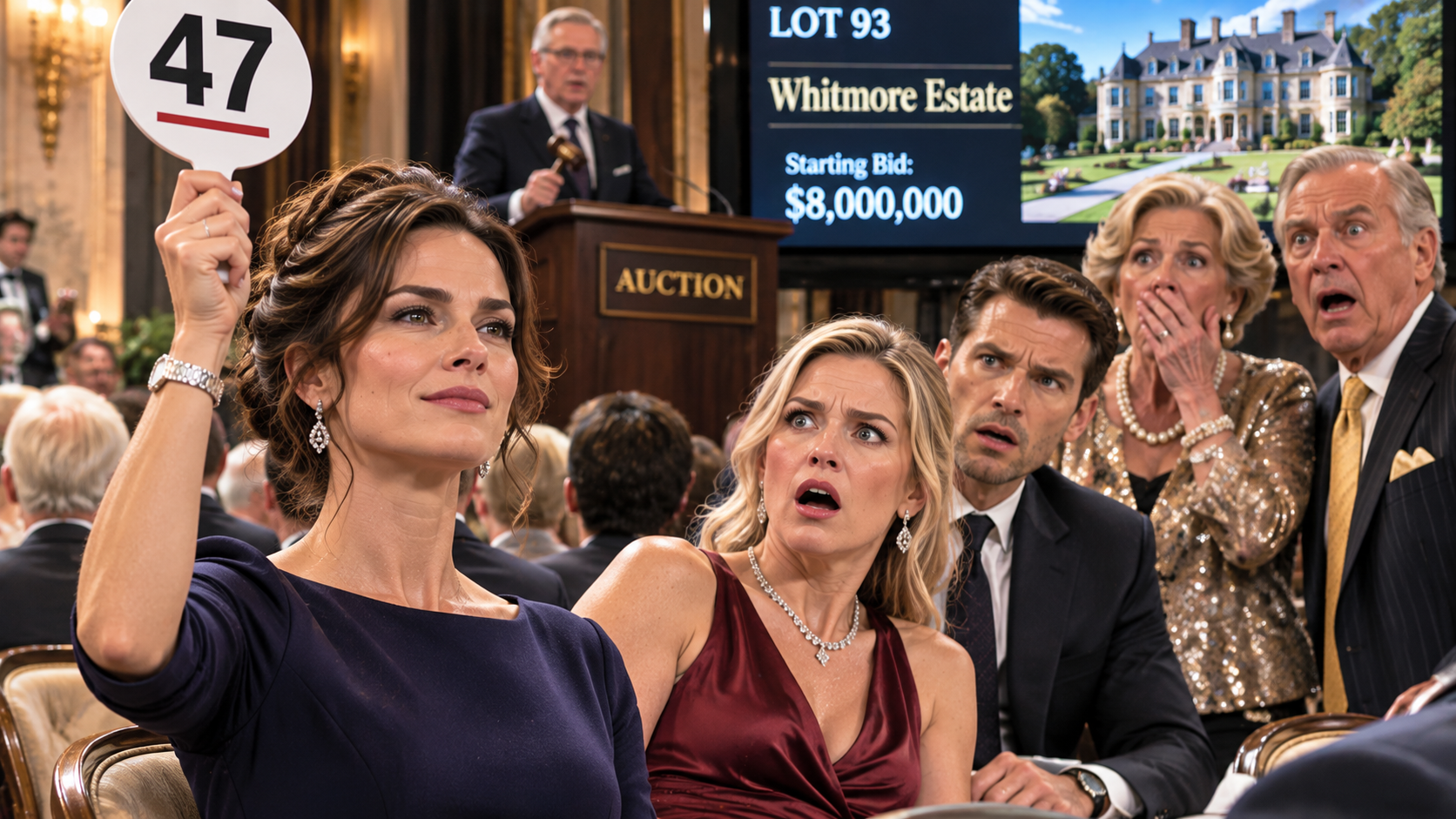
And paddle number 47.
The paddle that changed everything.
I picked it up.
It was ordinary.
A white rectangular card.
A black number.
A simple wooden handle.
Nothing about it looked remarkable.
But I remembered the moment I raised it.
Vanessa laughing.
Gerald shouting.
Patricia staring.
The auctioneer calling out the price.
And the entire room turning toward the poor cousin nobody expected to bid.
I smiled faintly.
At the time, I thought I was buying a house.
I thought I was proving that my relatives had underestimated me.
I thought the greatest moment would be seeing Vanessa’s expression when the gavel fell.
I was wrong.
The auction was only the beginning.
The real victory was uncovering the truth without allowing bitterness to consume me.
It was learning that my father had fought for people who couldn’t defend themselves.
It was discovering that my mother had loved me enough to leave a path toward independence.
It was seeing Margaret finally acknowledged as a daughter.
Caroline reunited with her mother.
And Vanessa beginning to understand that kindness was worth more than status.
I placed paddle 47 beside my parents’ photograph.
Then whispered:
“We did it.”
A soft voice answered behind me.
“Yes, you did.”
I turned.
Margaret stood in the doorway.
Her eyes were filled with tears.
“Your father would have been so proud.”
My throat tightened.
“I hope so.”
She smiled.
“I know so.”
We walked together toward the terrace.
The afternoon sun shimmered across the lake.
Children were playing on the lawn.
Caroline was laughing beneath the oak tree.
Vanessa was helping set the table.
And for the first time in generations, Whitmore Estate felt like something it had never truly been.
A home.
That evening, we held a small family dinner.
No photographers.
No expensive jewelry displayed for attention.
No speeches about wealth.
Just people who wanted to be there.
At the head of the table stood an empty chair.
My father’s chair.
Beside it, another place was set in memory of my mother.
I looked around the room.
Then raised my glass.
“I want to say something.”
Everyone became quiet.
I took a breath.
“A year ago, I walked into an auction house wearing a department-store dress.”
Vanessa looked down, smiling sadly.
“Some people laughed.”
A few guests chuckled softly.
“Some people believed I didn’t belong there because I didn’t look wealthy enough.”
I paused.
“And for a long time, I thought the best way to answer them was to become richer than they were.”
I looked toward the empty chairs.
“But my parents taught me something more important.”
My voice softened.
“Your worth isn’t something another person gets to decide.”
Margaret wiped her eyes.
I continued.
“Money can give you comfort. It can give you opportunities. It can help you protect the people you love.”
I looked around the table.
“But it cannot make you honorable.”
A long silence.
“It cannot make you kind.”
I swallowed.
“And it cannot turn a house into a home.”
Caroline reached for Margaret’s hand.
Vanessa lowered her head.
I smiled through tears.
“That part is up to us.”
For a moment, nobody moved.
Then Margaret stood.
She raised her glass.
“To Daniel and Eleanor.”
My heart tightened.
Caroline rose beside her.
“To the people who never stopped fighting for the truth.”
Vanessa stood too.
Her eyes filled with tears.
“And to Stella.”
I looked at her.
She swallowed.
“The cousin I spent years laughing at because I was too foolish to recognize her strength.”
The room went silent.
Vanessa looked directly into my eyes.
“I’m sorry for every time I made you feel unwelcome.”
My throat tightened.
She continued.
“You deserved kindness when you had nothing to prove. You deserved respect before anyone knew you were wealthy.”
Tears slipped down my cheeks.
Vanessa raised her glass.
“And I hope the rest of my life shows that I’ve learned what you tried to teach us.”
For a moment, I couldn’t speak.
Then I nodded.
“Thank you.”
We raised our glasses together.
And as the sunlight faded beyond the windows, I felt something I hadn’t experienced in seven years.
Peace.
Not because every question had been answered.
Not because every person had changed.
Not because all the damage had disappeared.
But because I was finally free to build a future that didn’t revolve around what my relatives thought of me.
Later that night, after the guests had gone, I returned to the library.
The house was quiet.
Moonlight fell across the floor.
I sat in my father’s chair and opened my mother’s letter one last time.
I read the sentence I’d memorized.
“If they close their doors to you, build your own.”
I smiled.
Then I took out a blank sheet of paper.
And began writing.
Not a financial report.
Not a legal statement.
Not another complaint about Gerald.
A letter.
To the nineteen-year-old girl I’d once been.
The girl standing outside the funeral home.
The girl counting coins at her kitchen table.
The girl who cried quietly after family dinners because she couldn’t understand why the people who were supposed to love her enjoyed making her feel small.
I wrote:
“Dear Stella,
I know you’re frightened.
I know you feel alone.
I know you’re tired of pretending their words don’t hurt.
But I need you to understand something.
You are not the failure they say you are.
You do not need expensive clothes to deserve respect.
You do not need a mansion to belong.
And you do not need the approval of people who only recognize worth when it comes with a price tag.
One day, you will walk into a room where everyone expects you to lose.
They will laugh.
They will whisper.
They will underestimate you.
And you will discover that the most powerful thing you can do is remain calm while they reveal who they really are.
You will raise a paddle.
You will buy a house.
You will uncover secrets.
You will learn that people you trusted made terrible mistakes.
And you will face moments when revenge feels easier than mercy.
But you will remember Mom.
You will remember Dad.
And you will choose to become someone they would recognize.
Not because you’re wealthy.
But because you’re still kind.
Because you’re still brave.
Because you still believe the truth matters.
And when the day comes that you finally stand inside Whitmore Estate, I want you to look around and remember something.
You didn’t become worthy when the auctioneer said sold.
You were worthy when you walked through the door.”
I placed the pen down.
Then folded the letter.
For a long moment, I sat in silence.
Finally, I stood and walked toward the window.
The moon reflected across Whitmore Lake.
Somewhere beyond the trees stood the old stone bridge where my father had taught me to fish.
I smiled through tears.
“Goodnight, Dad.”
Then I looked toward the sky.
“Goodnight, Mom.”
And for the first time, saying those words didn’t feel like another goodbye.
It felt like bringing them home.
The following morning, I made one final decision.
I called Rebecca.
“There’s something I want to do with the estate.”
She listened.
Then smiled.
“I think your parents would have loved that.”
Six months later, the guesthouse opened its doors to young adults who had lost parents or family support and needed help rebuilding their lives.
We offered financial education.
Career mentoring.
Practical assistance.
And access to professional guidance.
No one had to wear expensive clothes to enter.
No one had to prove they came from the right family.
No one had to explain why they were struggling before being treated with dignity.
On opening day, I stood beside the entrance.
A young woman approached.
She looked nervous.
Her coat was worn.
Her shoes were old.
She held a small folder tightly against her chest.
“Excuse me,” she whispered.
I smiled.
“Yes?”
“Are you sure I’m allowed to come inside?”
My heart tightened.
For a moment, I saw myself at nineteen.
The fear.
The uncertainty.
The feeling of being somewhere you didn’t belong.
I stepped aside and opened the door wider.
“Of course.”
She looked down.
“But I don’t have much money.”
I felt tears rising.
Then I smiled.
“That doesn’t matter here.”
Her eyes filled.
“Really?”
I nodded.
“Really.”
She stepped inside.
And as I watched her disappear into the warm hallway, I understood something that made every difficult day worthwhile.
My relatives had spent their lives trying to decide who deserved to enter Whitmore Estate.
I had spent twelve and a half million dollars making sure people like me would never again have to ask.
That evening, I returned to the auction room where everything began.
The auction house had invited me to speak at a charity event supporting families in financial hardship.
I wore the same navy-blue department-store dress.
It had been carefully cleaned and pressed.
And in my handbag, I carried paddle number 47.
When I stepped onto the stage, the audience applauded.
I smiled.
Then held up the paddle.
“One year ago,” I began, “some relatives laughed because they thought a woman without money had no business being in this room.”
The audience grew quiet.
“They believed they knew everything about me because they knew where I lived, how I dressed, and what kind of car I didn’t drive.”
I paused.
“Thirty minutes later, I bought the property they wanted.”
A ripple of laughter moved through the room.
I smiled faintly.
“But that’s not why I’m here tonight.”
I lowered the paddle.
“I’m here because I learned something after that auction.”
The room fell silent.
“The greatest victory isn’t making the people who humiliated you feel small.”
I looked across the audience.
“It’s making sure you never become the kind of person who needs someone else to feel small.”
For several seconds, nobody moved.
Then applause filled the room.
I looked down at paddle 47.
The simple wooden handle.
The black number.
The object everyone remembered from the day I shocked my family.
And I smiled.
Because the people who laughed at me had been right about one thing.
I wasn’t like them.
I never had been.
They believed money made a person important.
I believed what a person did with their life mattered more.
They wanted Whitmore Estate because it made them look powerful.
I wanted it because it held the memories of people I loved.
They tried to erase the truth to protect their fortune.
I uncovered it so the next generation wouldn’t inherit their lies.
And the girl they mocked for being poor became the woman who opened the doors they had spent their entire lives trying to keep closed.
But here’s the part they never understood.
I didn’t win the day I raised paddle number 47.
I didn’t win when Gerald lost control of the company.
I didn’t win when the hidden documents were discovered.
I won the day I stopped asking people who never respected me to tell me what I was worth.
Because a person’s value isn’t determined by the house they own, the money in their bank account, or the approval of relatives who only love them when they succeed.
And sometimes, the strongest revenge is refusing to become cruel after life has given you every reason to be.
My name is Stella Bennett.
I was the poor cousin everyone laughed at.
I bought the twelve-million-dollar estate they thought I could never afford.
But the greatest thing I inherited was never the house.
It was my parents’ courage, my mother’s kindness, and the freedom to decide what kind of woman I wanted to become.
And that was something nobody could ever take from me.
PART 12 — FINAL PART: THE LAST CONFESSION AND THE DAY THE WHITMORE EMPIRE FELL

One Comment on “PART 12 — FINAL PART: THE LAST CONFESSION AND THE DAY THE WHITMORE EMPIRE FELL”