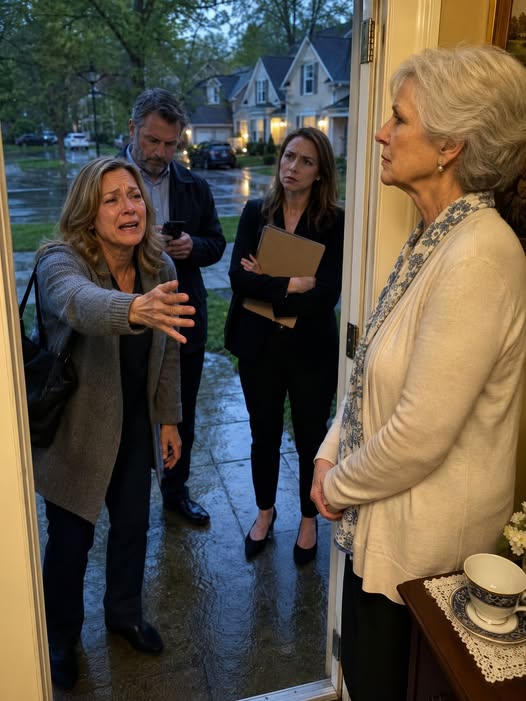
By Friday evening, the house felt different. Not loud, not crowded—just settled, like a ship that had finally dropped anchor after riding out a storm.
Clara spent the afternoon at my kitchen table wearing one of Arthur’s old button-down shirts backward as a smock, painting a cedar birdhouse bright turquoise with yellow polka dots. Every ten minutes she stopped to inspect her work with deadpan seriousness, her tongue tucked slightly into the corner of her mouth.
“Do you think the birds will know it’s a fancy house?” she asked, dipping her brush into the yellow paint.
“I think any bird would be lucky to live there,” I said, peeling potatoes at the sink. “Especially with a porch like that.”
At five-forty-five, headlights swept across the driveway. A moment later, there was a polite knock at the front door.
I wiped my hands on a dish towel and walked into the hall.
When I opened the door, Wesley was standing on the porch holding a brown paper grocery bag in one arm and a small potted chrysanthemum in the other. He had stopped at his house to shower and change; he was wearing clean jeans, a dark flannel shirt, and scuffed work boots that he had already wiped thoroughly on the coir mat.
“I know you said nothing expensive,” he said, holding out the yellow mums. “They were six dollars at the market. Thought they might look nice by the steps.”
“They will,” I said, taking the pot and stepping back. “Come in. Dinner’s almost ready.”
“Daddy!” Clara shouted from the kitchen, abandoning her paintbrush immediately. She barreled down the hall and launched herself at his legs.
Wesley set the grocery bag on the console table and caught her easily, lifting her into his arms with a grunt. “Whoa!
Careful, bug, you’ve got paint on your elbows.”
“I made a house for the robins!” she announced proudly, wrapping both arms around his neck. “Grandma said I can put it in the maple tree tomorrow.”
“Then we’ll get the ladder out first thing in the morning,” Wesley said, burying his face briefly in her hair before setting her back down. He looked at me over her head, his eyes bright. “Smells like pot roast.”
“It is,” I said. “Go wash your hands, both of you. We eat in ten minutes.”
Dinner was the quietest, simplest meal we had shared in three years. There were no phones on the table. No rushed glances at watches. No subtle remarks about neighborhoods, schools, or renovations.
Clara chattered happily about her music class and the stray cat she had seen behind the library.
Wesley listened to every word, asking questions, cutting her meat into small bites, and eating two full servings of roast and potatoes like a man who hadn’t had a real meal in weeks.
After dinner, while Clara sat on the living room rug sorting through a tin of Arthur’s old dominoes, Wesley insisted on clearing the table and washing the dishes.
I leaned against the counter with a cup of chamomile tea, watching my son scrub a roasting pan with methodical care.
“Serena’s lawyer sent over a preliminary separation agreement this afternoon,” Wesley said, keeping his eyes on the sink.
“Already?”
“Her brother-in-law works at a firm in Stamford. They moved fast.” He rinsed the pan and set it in the drying rack.
“She wants sole primary custody during the week so Clara can stay in the Greenwich school district, plus four thousand a month in temporary support.”
I set my teacup down carefully. “And what did your lawyer say?”
“I don’t have one yet—I’m meeting someone Monday morning,” Wesley said, drying his hands on a towel. “But I already told her sister when she called to drop off a box of my clothes: Serena doesn’t even get up in the morning to take Clara to school. Our nanny did it until the card declined Wednesday. And Clara’s school is twenty minutes from here, not in Greenwich.”
“Write everything down,” I said calmly. “Every text message, every call log from the school on Wednesday afternoon, every receipt showing who actually picked her up and paid her tuition.”
Wesley nodded slowly.
“Ms. Vance already offered to provide a written statement for the school record if I need it. She said she didn’t appreciate being threatened with a complaint to the headmaster.”
“Good,” I said. “Keep your temper, stay polite, and let the facts speak for themselves. Judges aren’t impressed by country club memberships, Wesley. They care about who shows up when a child is sitting alone in an office.”
He leaned back against the counter beside me, folding his arms across his chest. For a long moment, neither of us spoke.
“I keep thinking about what you said at the door yesterday,” he murmured, looking down at the worn linoleum floor.
“Which part?”
“When I asked if you ever loved me without the money. And you said that was the problem.” He let out a quiet breath.
“I didn’t understand what you meant until last night, sitting alone in that huge empty house with the heat turned down to sixty.”
I looked up at him. “And what do you think I meant?”
“You kept paying because you didn’t want to lose me,” he said softly. “You thought if you said no, I’d stop coming around. And I let you think that, because it was convenient.”
The truth of it sat between us—plain, unvarnished, and strangely painless now that it had finally been spoken aloud.
“When your father died,” I said quietly, “I was terrified of becoming a burden. Every woman my age hears the stories—about widows who complain too much, or cling too tightly, or expect their children to entertain them. So I decided I would be useful instead. If I paid for the house, the cars, the tuition, I wouldn’t be in the way.
I would be essential.”
I picked up my teacup, wrapping both hands around the warm porcelain.
“It took me six years to realize that buying a seat at someone’s table isn’t the same as being invited.”
Wesley’s throat tightened. He reached out, hesitated for half a second, and then placed his hand gently over mine on the counter. His palm was warm and rough from the dishwater.
“You don’t ever have to buy a seat at my table again, Mom,” he said, his voice steady. “Even if the table is a secondhand card table in a two-bedroom apartment.”
“A card table is fine,” I smiled faintly. “As long as the chairs don’t wobble.”
From the sitting room, Clara called out, “Grandma! Daddy! Look! I made a train all the way to the fireplace!”
Wesley smiled and pushed off the counter. “Come on.
If we don’t inspect the railroad before bedtime, the conductor’s going to fine us.”
Part 6
Three weeks later, the first snow of December fell softly over the town, blanketing the front lawn and dusting the turquoise birdhouse Wesley had nailed to the maple tree.
The townhouse in Greenwich had sold in eleven days to a young couple relocating from New York. After paying off the mortgage and closing costs, Wesley walked away clean—no equity windfall, no profit, just the quiet relief of being out from under a payment he had never been able to afford.
He had rented a modest brick duplex ten minutes from Oakridge Academy, with a fenced backyard, an older kitchen with oak cabinets, and a second bedroom that Clara had immediately claimed as her “art studio.”
On Saturday morning, I drove over with two boxes of spare linens, a cast-iron skillet, and a freshly baked apple pie.
When I pulled into the driveway, Wesley was outside shoveling the front walk in a heavy flannel jacket while Clara rolled a lopsided snowman near the porch steps.
“Grandma!” Clara yelled, dropping her mittens in the snow to wave.
I stepped out of the Buick, breathing in the sharp, clean smell of woodsmoke and cold air. Wesley leaned his shovel against the railing and walked over to take the heavy box of linens from my trunk.
“You didn’t have to bring all this,” he said, squinting against the winter glare. “I actually bought towels yesterday. On clearance.”
“Good,” I said, handing him the warm pie tin. “Now you have extras for when she tracks mud through the hall.”
Inside, the duplex was small, bright, and smelled faintly of fresh paint and cinnamon.
There were still unpacked cardboard boxes stacked neatly against the living room wall, and the sofa was an older tweed piece Wesley had found at an estate sale, covered with the patchwork quilt I had sent over the week before.
On the mantel above the small brick fireplace stood a framed photograph—the same one from my sitting room, duplicated at the local print shop. Arthur in his fishing hat, grinning beside the lake.
I stopped in the doorway, my breath catching slightly.
Wesley set the box down and followed my gaze. “Clara insisted,” he said quietly. “She told me Grandpa Star needed to see the new house so he wouldn’t get lost when he visits.”
I walked over and touched the corner of the wooden frame. “He would like this place, Wesley. You can actually hear yourself think in here.”
“Speaking of thinking,” Wesley said, walking into the kitchen to set the pie on the counter.
“I got the final numbers from the accountant yesterday. With the Greenwich office closed and the credit lines paid down, Hale & Son finished November twelve percent ahead of projections. Marty asked if we could give the warehouse crew a small holiday bonus this year.”
“Can the cash flow handle it?” I asked.
“Easily,” Wesley said, pouring two mugs of coffee from a drip pot on the counter. “We have over a hundred and eighty thousand back in the operating reserve, and January contracts are already locked in. If you’re still willing to stay on as majority partner… I’d like to keep building it the way Dad did. Slowly.”
I took the mug he offered and wrapped my fingers around it. “On one condition.”
“Name it.”
“Every Friday afternoon at four, you close your laptop, leave your phone on your desk, and go pick up your daughter from school yourself.”
Wesley smiled, raising his mug in a quiet salute. “Deal. In fact, Serena agreed to the custody schedule yesterday. She’s taking a marketing job in Boston starting in January. She’ll have Clara every other weekend, and she’s dropping the spousal support demand in exchange for keeping the Mercedes.”
I raised an eyebrow. “She’s paying the lease on that car herself?”
“Her sister co-signed,” Wesley said dryly. “Not my problem anymore.”
There was no bitterness in his voice. Just the calm detachment of a man who had finally stopped trying to carry water in a leaking bucket.
A knock at the front door interrupted us.
Clara ran into the hall before either of us could move, pulling the door open with both hands. “Ms. Vance! Look at my snowman!”
I blinked in surprise as Clara’s kindergarten teacher stepped onto the porch, holding a Tupperware container of cookies and wearing a bright red scarf.
“Good morning, Clara,” Ms. Vance laughed, looking up as Wesley appeared in the hallway behind his daughter. Her cheeks turned slightly pink in the cold air. “Hi, Wesley. Sorry to drop by unannounced—I was dropping off some extra art supplies for the winter break packet and realized I was right down the street.”
“Not at all,” Wesley said, his voice warming noticeably as he stepped forward to hold the door open. “Come in out of the cold. My mom just brought a fresh apple pie, and we’ve got plenty of coffee.”
Ms. Vance looked past him at me, offering a warm, slightly shy smile. “Good morning, Mrs. Hale. It’s wonderful to see you.”
“Good morning, Ms. Vance,” I said, taking a slow sip of my coffee and hiding a smile behind the rim of my mug. “Come on in.
Clara was just about to show us her new bedroom.”
As Wesley took Ms. Vance’s coat and hung it carefully on the rack beside Clara’s little yellow raincoat, I looked out the front window at the fresh snow covering the yard.
For seventy-seven years, I had believed that love meant holding everything together with your bare hands, no matter how heavy it got. I had been wrong.
Love was knowing when to put the weight down—and trusting that the people worth keeping would learn how to stand on their own.
Part 7
January arrived with a deep freeze that turned the river edges to gray glass and coated the maple branches outside my window in crystalline frost.
For the first time in six years, my calendar was entirely my own.
Without the constant low-grade anxiety of managing someone else’s emergencies, my mornings stretched out wide and unhurried.
On Tuesdays, I volunteered at the town library’s literacy desk, helping adults practice reading forms and job applications. On Thursdays, I had lunch with Lydia—not as client and banker, but as two women who shared an appreciation for quiet restaurants and dry humor.
“You look ten years younger, Eleanor,” Lydia remarked one Thursday afternoon over bowls of French onion soup. “And your blood pressure must be down twenty points.”
“At least,” I said, breaking off a piece of crusty bread. “It turns out when you stop funding a small country’s luxury economy, you sleep remarkably well.”
Lydia smiled, stirring her tea. “Speaking of economies—I reviewed the fourth-quarter audit for Hale & Son this morning. Wesley transferred another fifteen thousand into the operating reserve on Tuesday. He’s ahead of his repayment schedule by nearly two months.”
“He’s working hard,” I said simply.
“And he’s learning.”
He was also living differently. Every Friday evening, without fail, Wesley and Clara came to my house for dinner. Sometimes he brought takeout from the Thai place down the street; other times we cooked together in my kitchen while Clara sat at the counter doing her kindergarten phonics worksheets.
And twice in January, when Wesley had to stay late at the warehouse to oversee an emergency snow-storm reroute for three freight trucks, he didn’t panic, didn’t hide the problem, and didn’t ask me to bail him out. He called me at four-thirty, asked calmly if I could pick Clara up from school and keep her overnight, and showed up at seven the next morning with fresh bagels and a full report on how he had resolved the dispatch delay.
He had stopped treating me like a safety net and started treating me like a partner.
Then, on a Tuesday afternoon in mid-February, the past knocked on my door one last time.
I was sitting in Arthur’s chair reading a novel when a sleek black sedan pulled up to the curb outside. Even through the sheer curtains, I recognized the sharp, deliberate way the passenger door swung open.
Serena stepped onto the walkway.
She was dressed impeccably, as always—a tailored camel wool coat, leather boots, oversized sunglasses pushed up onto her head. Yet as she walked up my front steps, I noticed the subtle differences. The gloss was thinner. Her shoulders were pulled tight against the cold, and there was a faint, strained pinch around her mouth.
When I opened the front door, she didn’t sweep past me the way she used to. She stopped on the top step, keeping a careful two feet of distance between us.
“Hello, Eleanor,” she said, her voice controlled and polite.
“Do you have ten minutes?”
“Come inside,” I said, stepping back. “It’s too cold to stand on the porch.”
She entered the sitting room slowly, glancing around at the worn rug, the quilt over the sofa, and Arthur’s silver-framed photograph on the mantel. This time, there was no condescension in her eyes—only a quiet, guarded wariness.
She didn’t sit down. She stood near the edge of the coffee table, her gloved hands clasped tightly in front of her.
“I’m in town for the afternoon,” she began, choosing her words with care. “I’m picking Clara up from school at three for my weekend. Before I went over there, I wanted to stop by and… thank you. For keeping her education trust active.”
I folded my hands in my lap. “I didn’t do it for you, Serena. I did it for Clara.”
“I know,” she said, and for a fraction of a second, her polished composure cracked.
She looked down at the worn carpet. “The job in Boston didn’t work out. The firm downsized their marketing division last week. Last in, first out.”
I waited silently.
“I’m staying with my sister in Greenwich again while I look for something new,” she continued, her voice dropping slightly. “My brother-in-law has been… very clear about how long I can stay without contributing to expenses. And the lease on my car is due next week.”
There it was. Not a demand this time. Not an accusation. Just an unspoken opening, laid carefully on the table between us like an unsealed envelope.
“Wesley told me the divorce is nearly final,” I said evenly.
“Next month,” Serena nodded. She lifted her chin, looking directly at me now. “Look, Eleanor, I know we didn’t end things well. I said things in November that I shouldn’t have said.
I was scared, and I felt cornered. But Clara needs stability from both of her parents. If I lose my car and have to move out of state to find work, I won’t be able to see her every other weekend.”
“Greenwich is twenty-five minutes from Wesley’s duplex,” I pointed out calmly. “And there is a commuter train that stops four blocks from Oakridge Academy.”
Serena’s jaw tightened slightly. “I’m asking if you would consider a short-term loan. Just enough to cover six months of my car lease and a security deposit on a small apartment near the station. I’ll sign a promissory note. I’ll pay interest.”
I looked at her standing in my sitting room—a woman who had spent years believing that charm, pressure, and the strategic use of a child’s name could unlock any door she stood in front of.
I didn’t feel angry. I didn’t even feel triumphant. Just entirely clear.
“No, Serena,” I said gently.
The color drained slightly from her cheeks. “Eleanor, please. Think about Clara—”
“I am thinking about Clara,” I interrupted, my voice steady and warm. “I have spent the last three months watching my granddaughter learn that love isn’t measured by what people buy her, and that hard times don’t break a family when everyone pulls their own weight. If I step in now and rescue you from the consequences of your own choices, I am teaching her that rules only apply to people who don’t know how to ask for money.”
Serena stared at me, her chest rising in a sharp breath. “You helped Wesley.”
“Wesley surrendered his truck, sold his house, cut his salary in half, and showed up at six in the morning to work before he ever asked me to sign a single piece of paper,” I said.
“And even then, he didn’t ask for a dime for himself. He asked me to protect the paychecks of twelve people who work for him.”
Silence settled over the room, broken only by the steady ticking of the mantel clock.
Serena stood very still. For a moment, I thought she might argue, or throw a sharp parting remark the way she had in November. Instead, she let out a long, quiet breath, her shoulders dropping an inch.
“He really changed, didn’t he?” she murmured, almost to herself.
“He remembered who he was,” I replied. “You can too, Serena. You’re smart, you’re capable, and you have a daughter who is watching how you handle this.”
She looked at me for a long moment, then nodded once—stiffly, without warmth, yet without hostility.
“Thank you for your honesty, Eleanor,” she said quietly. “I should get going.
I don’t want to be late for pickup.”
I walked her to the front door and held it open as she stepped out into the crisp February sunlight. She didn’t look back as she walked down the steps to the black sedan, and when she drove away, I closed the door and felt no weight at all.
Part 8
Spring arrived slowly that year, softening the ground bit by bit until yellow crocuses pushed up through the mulch beside my front porch and the maple tree outside Wesley’s duplex burst into pale green leaves.
By May, the turquoise birdhouse Clara had painted was occupied by a pair of energetic house wrens that chattered furiously every time anyone walked across the yard.
On the last Sunday of the month, Wesley hosted a small Memorial Day cookout in his fenced backyard.
It was nothing like the catered, curated gatherings Serena used to stage in Greenwich.
There were folding lawn chairs arranged in a rough circle on the grass, a battered charcoal grill smoking near the garage, and a red-and-white checkered tablecloth weighted down at the corners with smooth river stones Clara had collected.
I sat in the shade of the maple tree with a glass of iced tea, watching Wesley flip burgers at the grill while talking animatedly with Marty, his senior dispatcher, who had brought his wife and two teenage sons.
Near the picnic table, Clara was kneeling on a blanket, showing Ms. Vance—now simply “Hannah” on weekends—how to weave dandelion crowns.
Hannah laughed at something Clara said, reaching over to tuck a stray braid behind the little girl’s ear with an easy, unhurried tenderness that made my chest ache in the best possible way.
Wesley glanced over from the grill, caught Hannah laughing, and smiled—a quiet, unguarded expression of contentment that I hadn’t seen on his face since he was twenty years old.
He walked over to the picnic table with a platter of grilled burgers, set it down, and then strolled over to where I was sitting in the shade. He pulled up a folding chair beside mine and sat down, wiping his forehead with the back of his wrist.
“You getting enough shade, Mom?” he asked.
“More than enough,” I said, looking out across the lively yard. “Though I think your burgers are going to disappear before Marty’s boys even get to the potato salad.”
Wesley chuckled, leaning back in his chair. He looked healthy. The dark circles under his eyes were gone, replaced by a light tan from working loading docks alongside his crew during the spring rush. His hands were calloused, his posture relaxed.
“Hannah’s parents are coming into town next weekend,” he said casually, watching the picnic table. “She asked if Clara and I wanted to meet them for lunch on Sunday.
Thought I’d check if you wanted to join us, or if you’d rather have the afternoon to yourself.”
I looked at my son—truly looked at him. He wasn’t asking for permission. He wasn’t hedging. He was simply opening a door and leaving it up to me whether I wanted to walk through it.
“You four go ahead and enjoy your lunch,” I said warmly. “I have a garden club meeting on Sunday afternoon anyway. Tell her parents I’m looking forward to meeting them at Clara’s graduation next month.”
Wesley smiled, reaching over to squeeze my hand briefly. “Clara’s been practicing her graduation song every night in the tub. You’re going to need tissues.”
“I already bought two boxes,” I assured him.
Across the yard, Serena’s silver compact car—a modest, three-year-old Honda she had bought used after turning in the Mercedes—pulled up along the curb outside the fence.
Wesley stood up smoothly. “Excuse me, Mom. Serena’s here to drop off Clara’s overnight bag for tomorrow.”
I watched as Wesley walked out through the side gate to meet his ex-wife on the sidewalk. Serena had taken a job managing communications for a small regional hospital twenty minutes away. She lived in a tidy one-bedroom apartment near the train station, wore simpler clothes, and—while she would never be warm—had grown noticeably quieter, steadier, and more present during her weekends with Clara.
They spoke briefly on the sidewalk, passing a small pink duffel bag between them. There was no tension in their posture. No raised voices. Just two adults coordinating the life of the child they shared.
Before Serena got back into her car, she glanced over the low wooden fence, caught my eye under the maple tree, and offered a brief, polite nod.
I raised my glass of iced tea in return.
Part 9
Clara’s kindergarten graduation took place on a bright, warm Friday morning in June in the gymnasium of Oakridge Academy.
I sat in the third row of folding chairs between Wesley and Marty’s wife, holding a small bouquet of yellow daisies wrapped in brown paper. On stage, twenty-two five- and six-year-olds stood on wooden risers wearing miniature navy caps with gold tassels that kept slipping over their eyes.
When the music started, Clara sang at the top of her lungs, beaming out at the audience until she spotted us in the third row. She gave a huge, two-handed wave that nearly knocked her cap off, making half the parents around us laugh softly.
Wesley leaned over to me, his eyes shining, and whispered, “She gets that from Dad.”
“Every bit of it,” I whispered back.
After the ceremony, the families spilled out onto the sun-drenched lawn behind the school for lemonade and sheet cake.
Clara ran straight to me first, throwing her arms around my waist before I could even hand her the daisies. “Did you hear me sing, Grandma? I remembered all the words!”
“You were the best singer on the entire stage, sweetheart,” I said, kneeling down to adjust her crooked gold tassel and hand her the flowers.
“Look what I made in art class for you,” she said, reaching into the pocket of her dress and pulling out a slightly crumpled piece of construction paper folded in half.
I opened it carefully. Inside was a crayon drawing of a yellow house with a big maple tree, a blue bird sitting on a crooked porch, and four stick figures holding hands on the grass—one tall man, one woman with brown hair, one small girl with braids, and one older woman with silver curls.
Above the house, written in careful, blocky capital letters, were the words: OUR FAMILY.
My throat tightened so suddenly I couldn’t speak for a moment. I folded the drawing gently and tucked it inside my purse, right beside Arthur’s old pocket watch.
“I’m going to frame this and put it right next to Grandpa Star on the mantel,” I told her, kissing her cheek.
“Okay!” she beamed, and darted off toward the lemonade table where Hannah and Wesley were standing with Serena.
I stood quietly in the shade of the oak trees for a moment, watching them talk together—Wesley holding a plate of cake, Serena laughing lightly at something Clara had smeared on her chin, Hannah handing over a stack of napkins.
They weren’t a picture-perfect brochure. There were cracks, histories, and compromises woven into every corner of that small circle. Yet it was real. Nobody was pretending. Nobody was carrying a hidden ledger.
When Wesley turned and waved me over to join them, I walked across the sunlit grass with empty hands and a light heart.
Part 10
Six months later, on a crisp November evening—almost a year to the day after Lydia had sat in my sitting room with a heavy manila folder—the front doorbell rang at six o’clock sharp.
I had spent the afternoon roasting a chicken, baking cornbread, and setting the dining room table with the good porcelain plates that had stayed wrapped in tissue paper inside the hutch for six years.
When I opened the front door, the cold autumn air rushed in, carrying the scent of woodsmoke and fallen leaves.
Wesley stood on the porch holding a warm apple pie from the bakery on Main Street. Beside him stood Hannah, holding a bottle of sparkling cider, and in front of them stood Clara, wearing a bright red sweater and carrying her school backpack slung over one shoulder.
“Happy Thanksgiving, Grandma!”
Clara announced, stepping inside and wrapping her arms around my legs.
“Happy Thanksgiving, sweetheart,” I laughed, smoothing her braids. “Come on in, all of you. You’re letting the heat out.”
Wesley stepped across the threshold, wiped his boots carefully on the mat, and leaned down to kiss my cheek. “Smells incredible in here, Mom. Need any help carving?”
“Everything is ready,” I said, taking the pie from his hands. “Go pour the cider. We’re eating in five minutes.”
As they walked into the dining room, their voices filling the hallway with easy laughter and overlapping chatter, I paused for a second by the sitting room archway.
The room looked much the same as it had a year ago. The worn rug. The quilt over the arm of the sofa. The framed photograph of Arthur on the mantel, beside a brightly colored crayon drawing of a yellow house.
Yet the silence that used to sit heavy in the corners of the house was gone.
I walked into the dining room, took my seat at the head of the table, and watched my son pass the bread basket to the woman beside him while my granddaughter told a rambling, animated story about a squirrel she had seen on the way over.
I hadn’t had to buy a single seat at this table. And for the first time in a very long time, every chair was full.
THE END..!